Can programming be 
liberated from the 
von Neumann style? 
Backus J. Can programming be liberated from the von Neumann style?: 
a functional style and its algebra of programs. 
Commun ACM 1978;21:613–41. 
Oriol López Massaguer 
Barcelona CompSci Club meetup 
8/10/2014
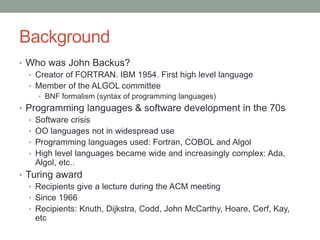
Background 
• Who was John Backus? 
• Creator of FORTRAN. IBM 1954. First high level language compiler 
• Member of the ALGOL committee 
• BNF formalism (syntax of programming languages) 
• Programming languages & software development in the 70s 
• OO languages not in widespread use 
• Programming languages used: Fortran, COBOL and Algol 
• High level languages became wide and increasingly complex: Ada, 
Algol, etc.. 
• Software crisis: increasing difficulty of software projects 
• Turing award 
• Recipients give a lecture during the ACM meeting 
• Since 1966 
• Recipients: Knuth, Dijkstra, Codd, John McCarthy, Hoare, Cerf, Kay, 
etc.
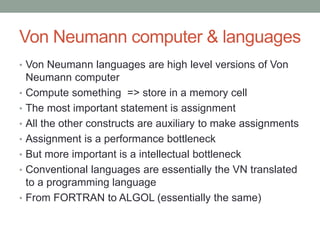
Von Neumann computer & languages 
What are Von Neumann Languages? 
• Conventional languages are Von Neumann languages 
because they are high level versions of Von Neumann 
computer 
• The most important statement is assignment. To compute 
something is to store the result in a memory cell 
• All the other constructs are auxiliary to make assignments 
• Assignment is both: 
• performance bottleneck 
• intellectual bottleneck 
• Despite the evolution from FORTRAN to ALGOL 
(essentially the same) and even to today (2014) 
programming languages they are essentially the same
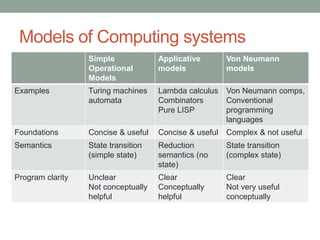
Models of Computing systems 
Simple 
Operational 
Models 
Applicative models Von Neumann 
models 
Examples Turing machines 
automata 
Lambda calculus 
Combinators 
Pure LISP, 
FP systems. 
Von Neumann 
comps, 
Conventional 
programming 
languages 
Semantics State transition 
(simple state) 
Reduction semantics 
(no state) 
State transition 
(complex state) 
Program clarity Unclear 
Not conceptually 
helpful 
Clear 
Conceptually 
helpful 
Clear 
Not very useful 
conceptually
Solution proposed 
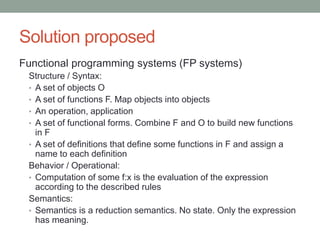
Functional programming systems (FP systems) 
Structure / Syntax: 
• A set of objects O 
• A set of functions F. Map objects into objects 
• An operation, application 
• A set of functional forms. Combine F and O to build new functions 
in F 
• A set of definitions that define some functions in F and assign a 
name to each definition 
Behavior / Operational: 
• Computation of some f:x is the evaluation of the expression 
according to the described rules 
Semantics: 
• Semantics is a reduction semantics. No state. The expression has 
the whole meaning of the computation.
Solution proposed 
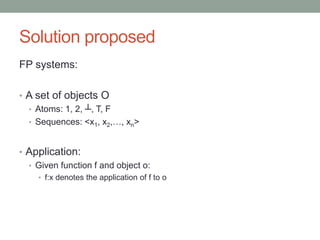
FP systems: 
• A set of objects O 
• Atoms: 1, 2, ┴, T, F 
• Sequences: <x1, x2,…, xn> 
• Application: 
• Given function f and object o: 
• f:x denotes the application of f to o
Solution proposed 
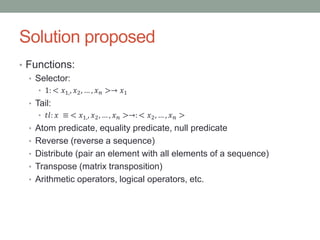
• Functions: 
• Selector: 
• 1: < 푥1,, 푥2, … , 푥푛 >→ 푥1 
• Tail: 
• 푡푙: 푥 ≡ < 푥1,, 푥2, … , 푥푛 >→: < 푥2, … , 푥푛 > 
• Atom predicate, equality predicate, null predicate 
• Reverse (reverse a sequence) 
• Distribute (pair an element with all elements of a sequence) 
• Transpose (matrix transposition) 
• Arithmetic operators, logical operators, etc.
Solution proposed 
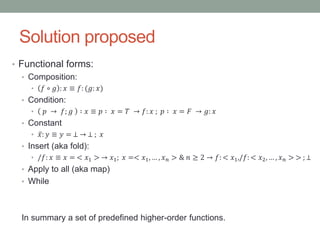
• Functional forms: 
• Composition: 
• 푓 ∘ 푔 : 푥 ≡ 푓: (푔: 푥) 
• Condition: 
• 푝 → 푓; 푔 ∶ 푥 ≡ 푝 ∶ 푥 = 푇 → 푓: 푥 ; 푝 ∶ 푥 = 퐹 → 푔: 푥 
• Constant 
• 푥 : 푦 ≡ 푦 = ⊥ → ⊥ ; 푥 
• Insert (aka fold): 
• /푓: 푥 ≡ 푥 = < 푥1 > → 푥1; 푥 =< 푥1, … , 푥푛 > & 푛 ≥ 2 → 푓: < 푥1,/푓: < 푥2, … , 푥푛 > > ; ⊥ 
• Apply to all (aka map) 
• While 
In summary a set of predefined higher-order functions.
Solution proposed 
• Definitions: 
• 퐷푒푓 푓 ≡ 푟(푓) 
• l is a unused functional symbol 
• r is a functional form which may depend on f (in case of recursion) 
• Example (function to obtain the last element of a list) 
• 퐷푒푓 푙푎푠푡 ≡ 푛푢푙푙 ∘ 푡푙 → 1 ; 푙푎푠푡 ∘ 푡푙 
• Haskell syntax: 
• last [x] = x 
• last (_:xs) = last xs 
• Example (inner product) 
• 퐷푒푓 퐼푃 ≡ (/+) ∘ ∝× ∘ 푡푟푎푛푠 
• Haskell syntax: 
• ip l1 l2 = foldl (+) 0 (map2 (*) l1 l2)
Limitations of FP systems 
Limitations of FP systems: 
• can not compute an FP program 
• since functions expressions are not objects 
• can not define new functional forms 
• no state concept. no I/O 
Extensions 
• Formal systems for functional programming (FFP) 
• FP systems + possibility of creating new functional forms 
• Applicative State Transition (AST) Systems 
• Proposes an hybrid language that 
• An applicative subsystem (such as FFP) 
• A state D (the set of definitions of the applicative subsystem) 
• A set of transition rules to define the I/O transformations and the D state transitions
Goals of the solution 
Improve reasoning about the software developed 
• Programs as a certain kind of algebraic expressions 
• Verify correctness by following equational reasoning on 
the programs 
• This algebra is mathematically simpler than the classical 
approach to verify program correctness in von Neumann 
languages (Dijkstra, Hoare, etc.) 
Improve the research on new architectures to execute 
applicative languages more efficiently 
• Some attempts of graph reduction machines in the early 
80s, but failed
Today, has programming been liberated 
from von Neumann style? 
Global failure of the program 
• FP is not mainstream 
• We didn’t have new architectures for applicative languages 
But: 
• Some FP constructs / ideas are becoming mainstream 
• Closures / Higher order functions / Pattern matching / for comprehensions 
• Some people claim that concurrency may be easier by using FP 
techniques (due to stateless nature) 
• Multicore architectures require new programming tools. Some people 
claim that FP will ease development 
• But some questions remain open in the FP paradigm 
• Lazy evaluation / strict evaluation: Haskell vs ML 
• Modelling imperative computations: I/O, state, etc. 
• Pure functional language + Monads: Haskell approach 
• Hybrid / impure approach: Scala, ML, F#, OCAML
References 
• Backus J. Can programming be liberated from the von Neumann style?: a 
functional style and its algebra of programs. Commun ACM 1978;21:613–41. 
• Hudak P. Conception, evolution, and application of functional programming 
languages. ACM Comput Surv 1989;21:359–411. 
• Wadler P. The essence of functional programming. Proc. 19th ACM 
SIGPLAN-SIGACT Symp. Princ. Program. Lang., 1992, p. 1–14. 
• Wadler P. Comprehending monads. Math Struct Comput Sci 1992;2:461. 
• Hughes J. Why functional programming matters. Comput J 1989:1–23. 
• Bird R, Moor O de. The algebra of programming. 1997.

Can programming be liberated from the von neumann style?

  • 1.
    Can programming be liberated from the von Neumann style? Backus J. Can programming be liberated from the von Neumann style?: a functional style and its algebra of programs. Commun ACM 1978;21:613–41. Oriol López Massaguer Barcelona CompSci Club meetup 8/10/2014
  • 2.
    Background • Whowas John Backus? • Creator of FORTRAN. IBM 1954. First high level language compiler • Member of the ALGOL committee • BNF formalism (syntax of programming languages) • Programming languages & software development in the 70s • OO languages not in widespread use • Programming languages used: Fortran, COBOL and Algol • High level languages became wide and increasingly complex: Ada, Algol, etc.. • Software crisis: increasing difficulty of software projects • Turing award • Recipients give a lecture during the ACM meeting • Since 1966 • Recipients: Knuth, Dijkstra, Codd, John McCarthy, Hoare, Cerf, Kay, etc.
  • 3.
    Von Neumann computer& languages What are Von Neumann Languages? • Conventional languages are Von Neumann languages because they are high level versions of Von Neumann computer • The most important statement is assignment. To compute something is to store the result in a memory cell • All the other constructs are auxiliary to make assignments • Assignment is both: • performance bottleneck • intellectual bottleneck • Despite the evolution from FORTRAN to ALGOL (essentially the same) and even to today (2014) programming languages they are essentially the same
  • 4.
    Models of Computingsystems Simple Operational Models Applicative models Von Neumann models Examples Turing machines automata Lambda calculus Combinators Pure LISP, FP systems. Von Neumann comps, Conventional programming languages Semantics State transition (simple state) Reduction semantics (no state) State transition (complex state) Program clarity Unclear Not conceptually helpful Clear Conceptually helpful Clear Not very useful conceptually
  • 5.
    Solution proposed Functionalprogramming systems (FP systems) Structure / Syntax: • A set of objects O • A set of functions F. Map objects into objects • An operation, application • A set of functional forms. Combine F and O to build new functions in F • A set of definitions that define some functions in F and assign a name to each definition Behavior / Operational: • Computation of some f:x is the evaluation of the expression according to the described rules Semantics: • Semantics is a reduction semantics. No state. The expression has the whole meaning of the computation.
  • 6.
    Solution proposed FPsystems: • A set of objects O • Atoms: 1, 2, ┴, T, F • Sequences: <x1, x2,…, xn> • Application: • Given function f and object o: • f:x denotes the application of f to o
  • 7.
    Solution proposed •Functions: • Selector: • 1: < 푥1,, 푥2, … , 푥푛 >→ 푥1 • Tail: • 푡푙: 푥 ≡ < 푥1,, 푥2, … , 푥푛 >→: < 푥2, … , 푥푛 > • Atom predicate, equality predicate, null predicate • Reverse (reverse a sequence) • Distribute (pair an element with all elements of a sequence) • Transpose (matrix transposition) • Arithmetic operators, logical operators, etc.
  • 8.
    Solution proposed •Functional forms: • Composition: • 푓 ∘ 푔 : 푥 ≡ 푓: (푔: 푥) • Condition: • 푝 → 푓; 푔 ∶ 푥 ≡ 푝 ∶ 푥 = 푇 → 푓: 푥 ; 푝 ∶ 푥 = 퐹 → 푔: 푥 • Constant • 푥 : 푦 ≡ 푦 = ⊥ → ⊥ ; 푥 • Insert (aka fold): • /푓: 푥 ≡ 푥 = < 푥1 > → 푥1; 푥 =< 푥1, … , 푥푛 > & 푛 ≥ 2 → 푓: < 푥1,/푓: < 푥2, … , 푥푛 > > ; ⊥ • Apply to all (aka map) • While In summary a set of predefined higher-order functions.
  • 9.
    Solution proposed •Definitions: • 퐷푒푓 푓 ≡ 푟(푓) • l is a unused functional symbol • r is a functional form which may depend on f (in case of recursion) • Example (function to obtain the last element of a list) • 퐷푒푓 푙푎푠푡 ≡ 푛푢푙푙 ∘ 푡푙 → 1 ; 푙푎푠푡 ∘ 푡푙 • Haskell syntax: • last [x] = x • last (_:xs) = last xs • Example (inner product) • 퐷푒푓 퐼푃 ≡ (/+) ∘ ∝× ∘ 푡푟푎푛푠 • Haskell syntax: • ip l1 l2 = foldl (+) 0 (map2 (*) l1 l2)
  • 10.
    Limitations of FPsystems Limitations of FP systems: • can not compute an FP program • since functions expressions are not objects • can not define new functional forms • no state concept. no I/O Extensions • Formal systems for functional programming (FFP) • FP systems + possibility of creating new functional forms • Applicative State Transition (AST) Systems • Proposes an hybrid language that • An applicative subsystem (such as FFP) • A state D (the set of definitions of the applicative subsystem) • A set of transition rules to define the I/O transformations and the D state transitions
  • 11.
    Goals of thesolution Improve reasoning about the software developed • Programs as a certain kind of algebraic expressions • Verify correctness by following equational reasoning on the programs • This algebra is mathematically simpler than the classical approach to verify program correctness in von Neumann languages (Dijkstra, Hoare, etc.) Improve the research on new architectures to execute applicative languages more efficiently • Some attempts of graph reduction machines in the early 80s, but failed
  • 12.
    Today, has programmingbeen liberated from von Neumann style? Global failure of the program • FP is not mainstream • We didn’t have new architectures for applicative languages But: • Some FP constructs / ideas are becoming mainstream • Closures / Higher order functions / Pattern matching / for comprehensions • Some people claim that concurrency may be easier by using FP techniques (due to stateless nature) • Multicore architectures require new programming tools. Some people claim that FP will ease development • But some questions remain open in the FP paradigm • Lazy evaluation / strict evaluation: Haskell vs ML • Modelling imperative computations: I/O, state, etc. • Pure functional language + Monads: Haskell approach • Hybrid / impure approach: Scala, ML, F#, OCAML
  • 13.
    References • BackusJ. Can programming be liberated from the von Neumann style?: a functional style and its algebra of programs. Commun ACM 1978;21:613–41. • Hudak P. Conception, evolution, and application of functional programming languages. ACM Comput Surv 1989;21:359–411. • Wadler P. The essence of functional programming. Proc. 19th ACM SIGPLAN-SIGACT Symp. Princ. Program. Lang., 1992, p. 1–14. • Wadler P. Comprehending monads. Math Struct Comput Sci 1992;2:461. • Hughes J. Why functional programming matters. Comput J 1989:1–23. • Bird R, Moor O de. The algebra of programming. 1997.