CAN IT BE ‘TOO COLD TO SNOW’?
                                                   Hugo King
                                           Snow Research International
                                           2650 Snow Road, The Arctic
                                           snow.research.int@snow.com


1. Introduction                                            When an air mass reaches the point where it can
An oft posed question is, “Sod me it’s bloody              contain no more vapour condensation occurs and
freezing, so why isn’t it snowing?!” the repost of         clouds form, inside clouds droplets collide, and
which is often heard to be, “Because it’s just too         when large enough fall as precipitation. At 32ºF
cold, old chum”. Well can it be too cold to snow?          more water vapour can be present in the air, so
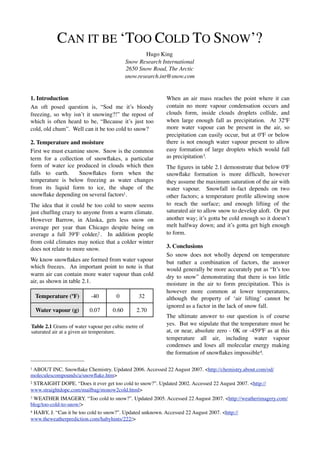
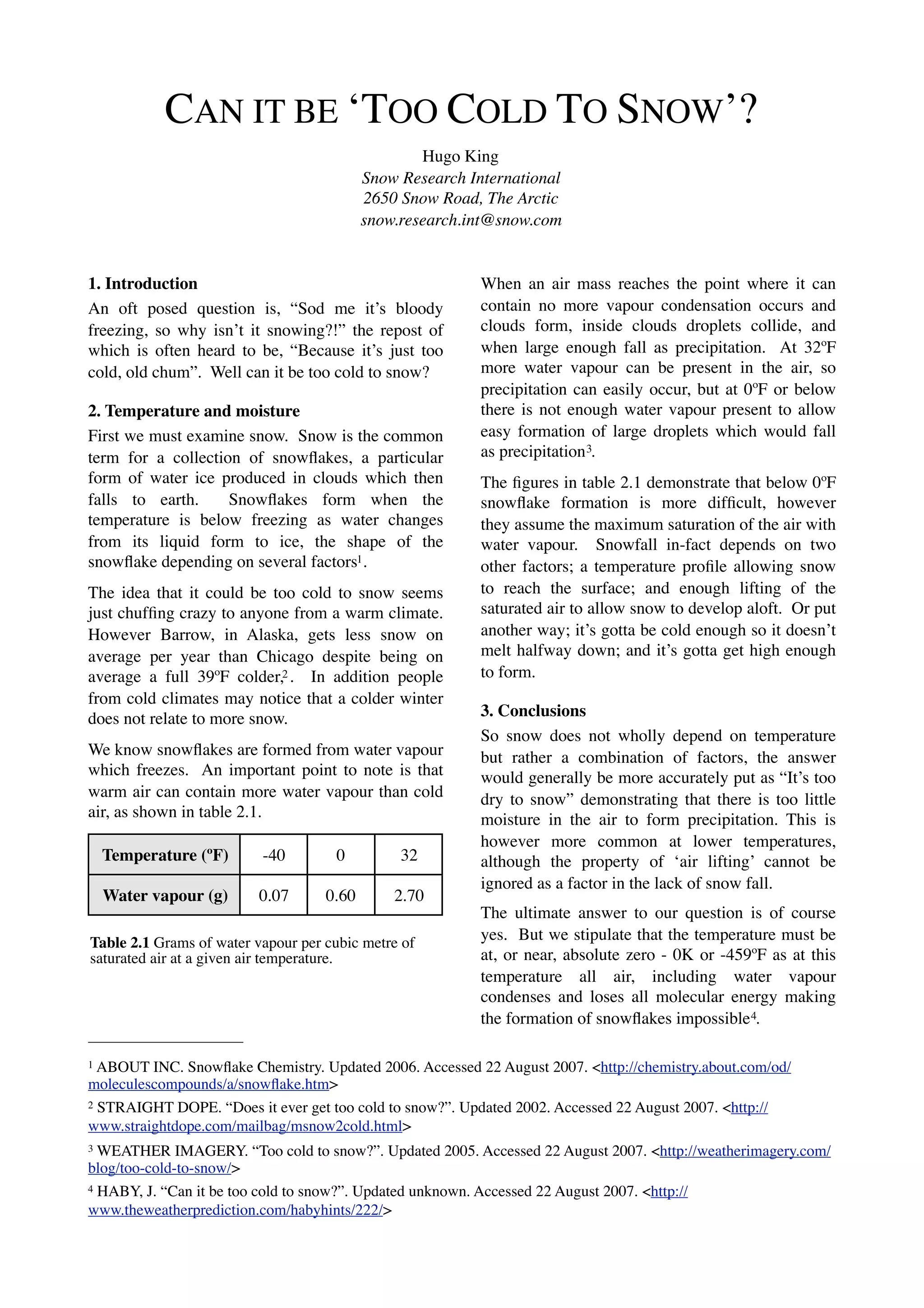
                                                           precipitation can easily occur, but at 0ºF or below
2. Temperature and moisture                                there is not enough water vapour present to allow
First we must examine snow. Snow is the common             easy formation of large droplets which would fall
term for a collection of snowflakes, a particular           as precipitation 3.
form of water ice produced in clouds which then            The figures in table 2.1 demonstrate that below 0ºF
falls to earth.     Snowflakes form when the                snowflake formation is more difficult, however
temperature is below freezing as water changes             they assume the maximum saturation of the air with
from its liquid form to ice, the shape of the              water vapour. Snowfall in-fact depends on two
snowflake depending on several factors1 .                   other factors; a temperature profile allowing snow
The idea that it could be too cold to snow seems           to reach the surface; and enough lifting of the
just chuffing crazy to anyone from a warm climate.          saturated air to allow snow to develop aloft. Or put
However Barrow, in Alaska, gets less snow on               another way; it’s gotta be cold enough so it doesn’t
average per year than Chicago despite being on             melt halfway down; and it’s gotta get high enough
average a full 39ºF colder,2 . In addition people          to form.
from cold climates may notice that a colder winter
does not relate to more snow.                              3. Conclusions
                                                           So snow does not wholly depend on temperature
We know snowflakes are formed from water vapour             but rather a combination of factors, the answer
which freezes. An important point to note is that          would generally be more accurately put as “It’s too
warm air can contain more water vapour than cold           dry to snow” demonstrating that there is too little
air, as shown in table 2.1.                                moisture in the air to form precipitation. This is
                                                           however more common at lower temperatures,
    Temperature (ºF)      -40        0          32         although the property of ‘air lifting’ cannot be
                                                           ignored as a factor in the lack of snow fall.
    Water vapour (g)      0.07      0.60       2.70
                                                           The ultimate answer to our question is of course
Table 2.1 Grams of water vapour per cubic metre of         yes. But we stipulate that the temperature must be
saturated air at a given air temperature.                  at, or near, absolute zero - 0K or -459ºF as at this
                                                           temperature all air, including water vapour
                                                           condenses and loses all molecular energy making
                                                           the formation of snowflakes impossible 4.

1 ABOUT  INC. Snowflake Chemistry. Updated 2006. Accessed 22 August 2007. <http://chemistry.about.com/od/
moleculescompounds/a/snowflake.htm>
2 STRAIGHT DOPE. “Does it ever get too cold to snow?”. Updated 2002. Accessed 22 August 2007. <http://

www.straightdope.com/mailbag/msnow2cold.html>
3 WEATHER IMAGERY. “Too cold to snow?”. Updated 2005. Accessed 22 August 2007. <http://weatherimagery.com/
blog/too-cold-to-snow/>
4 HABY, J. “Can it be too cold to snow?”. Updated unknown. Accessed 22 August 2007. <http://

www.theweatherprediction.com/habyhints/222/>

Can it be 'too cold to snow'?

  • 1.
    CAN IT BE‘TOO COLD TO SNOW’? Hugo King Snow Research International 2650 Snow Road, The Arctic snow.research.int@snow.com 1. Introduction When an air mass reaches the point where it can An oft posed question is, “Sod me it’s bloody contain no more vapour condensation occurs and freezing, so why isn’t it snowing?!” the repost of clouds form, inside clouds droplets collide, and which is often heard to be, “Because it’s just too when large enough fall as precipitation. At 32ºF cold, old chum”. Well can it be too cold to snow? more water vapour can be present in the air, so precipitation can easily occur, but at 0ºF or below 2. Temperature and moisture there is not enough water vapour present to allow First we must examine snow. Snow is the common easy formation of large droplets which would fall term for a collection of snowflakes, a particular as precipitation 3. form of water ice produced in clouds which then The figures in table 2.1 demonstrate that below 0ºF falls to earth. Snowflakes form when the snowflake formation is more difficult, however temperature is below freezing as water changes they assume the maximum saturation of the air with from its liquid form to ice, the shape of the water vapour. Snowfall in-fact depends on two snowflake depending on several factors1 . other factors; a temperature profile allowing snow The idea that it could be too cold to snow seems to reach the surface; and enough lifting of the just chuffing crazy to anyone from a warm climate. saturated air to allow snow to develop aloft. Or put However Barrow, in Alaska, gets less snow on another way; it’s gotta be cold enough so it doesn’t average per year than Chicago despite being on melt halfway down; and it’s gotta get high enough average a full 39ºF colder,2 . In addition people to form. from cold climates may notice that a colder winter does not relate to more snow. 3. Conclusions So snow does not wholly depend on temperature We know snowflakes are formed from water vapour but rather a combination of factors, the answer which freezes. An important point to note is that would generally be more accurately put as “It’s too warm air can contain more water vapour than cold dry to snow” demonstrating that there is too little air, as shown in table 2.1. moisture in the air to form precipitation. This is however more common at lower temperatures, Temperature (ºF) -40 0 32 although the property of ‘air lifting’ cannot be ignored as a factor in the lack of snow fall. Water vapour (g) 0.07 0.60 2.70 The ultimate answer to our question is of course Table 2.1 Grams of water vapour per cubic metre of yes. But we stipulate that the temperature must be saturated air at a given air temperature. at, or near, absolute zero - 0K or -459ºF as at this temperature all air, including water vapour condenses and loses all molecular energy making the formation of snowflakes impossible 4. 1 ABOUT INC. Snowflake Chemistry. Updated 2006. Accessed 22 August 2007. <http://chemistry.about.com/od/ moleculescompounds/a/snowflake.htm> 2 STRAIGHT DOPE. “Does it ever get too cold to snow?”. Updated 2002. Accessed 22 August 2007. <http:// www.straightdope.com/mailbag/msnow2cold.html> 3 WEATHER IMAGERY. “Too cold to snow?”. Updated 2005. Accessed 22 August 2007. <http://weatherimagery.com/ blog/too-cold-to-snow/> 4 HABY, J. “Can it be too cold to snow?”. Updated unknown. Accessed 22 August 2007. <http:// www.theweatherprediction.com/habyhints/222/>