Necessary conditions for condensation
The following three conditions must be fulfilled for occurrence of
condensation in the atmosphere: -
(A)Presence of sufficient water vapour in air
(B)Presence of condensation nuclei in atmosphere
(C)Cooling of air
A. Presence of sufficient water vapour
An adequate amount of water vapour is necessary to bring about
saturation of air with water vapour. Air can be easily brought
to saturation when sufficient moisture is present or decrease
in temperature. The dew point shall be reached through this
abundance of water vapour to begin condensation.
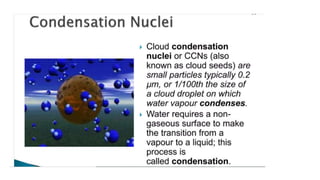
Sodium chloride (salt particles) injected in the atmosphere by sea
ocean water spray.
Some combustion products viz. sulphur dioxides, nitrous oxide etc,
released from industries and dust particles in the atmosphere act as
'condensation nuclei'.
Water vapour can only deposit and condense on these particles as
these are hygroscopic in nature.
These particles have water affinity.
These particles are also microscopic in size (0.1 to 1 µm) called
either “hygroscopic nuclei” or “condensation nuclei”.
In the absence of these nuclei condensation cannot take place even
if air is super saturated and its temperature is below freezing level.
(C) Cooling of air
Air must be cooled to dew point temperature i.e.
saturation.
Cooling of air up to and below dew point is necessary for
saturation of atmospheric air with water vapour.
Cooling takes place in atmosphere due to adiabatic cooling
of air masses.
The different forms of condensation are:
(1) Dew (2) Frost (3) Fog (4) Mist and (5) Cloud
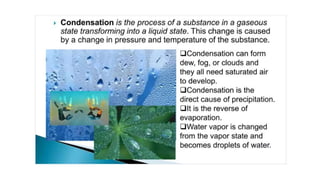
What is Dew?
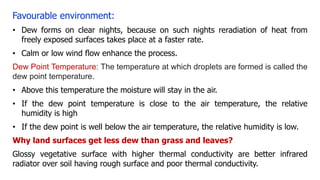
Dew is the deposit of waterdrops formed at night by the condensation of water
vapor from the air onto the surfaces of objects freely exposed to the sky.
Dew is water in the form of droplets that appears on thin, exposed objects in
the morning or evening due to condensation.
Formation mechanism: On clear nights, adequate cooling of the surface typically
takes place when it loses more energy by infrared radiation than the radiation it
receives from the sun.
Then atmospheric moisture condenses at a rate greater than that at which it
can evaporate, resulting in the formation of water droplets. Water vapor will
condense into droplets depending on the temperature.
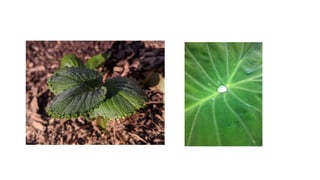
Most objects, including grass blades, leaves, and petals, are much better
reradiators than air and, as a result, are usually colder at night than is the air.
Favourable environment:
• Dew forms on clear nights, because on such nights reradiation of heat from
freely exposed surfaces takes place at a faster rate.
• Calm or low wind flow enhance the process.
Dew Point Temperature: The temperature at which droplets are formed is called the
dew point temperature.
• Above this temperature the moisture will stay in the air.
• If the dew point temperature is close to the air temperature, the relative
humidity is high
• If the dew point is well below the air temperature, the relative humidity is low.
Why land surfaces get less dew than grass and leaves?
Glossy vegetative surface with higher thermal conductivity are better infrared
radiator over soil having rough surface and poor thermal conductivity.
Beneficial effects of Dew in relation to Agriculture
• In the arid and semiarid regions or in the dry season, because of its higher
frequency dew acts as a notable water resource. This, accelerates the increase
of biomass in plants.
• During desiccation and rehydration dew enhance the photosynthetic activity. It
regulates the transpiration pressure and thus helping the wilting plant to restore
the appropriate turger pressure of cell.
• Dew provide a moist environment in repairing the DNA of embryo, thus
maintain viability of seed under harsh desert conditions;
• Improving water content of surface soil and there by mitigating soil water stress
partially.
• Regulating growing environment of forest plants.
• Harmful effects of Dew:
• Creation of moist environment due to dew increases pest and disease attack.
• Dew inhibits the plant stomata movement
• When the quantity and sustaining time of dew is high it discourage the route of
pollen diffusing.
• Acid dew could lead to a degradation of vegetation for the decreasing of CO2
assimilation efficiency.
• Black spot disease of fruit could be induced by dew.
• Some times it deteriorated the quality of vegetables, Fruits.
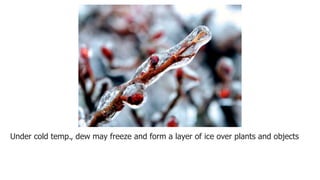
Under cold temp., dew may freeze and form a layer of ice over plants and objects
What is Frost
Due to reradiation temperature on surface of objects may reach below the freezing
point. Under that situation, water vapour directly condensed to tiny ice crystal.
These ice crystals are called frost.
Frost is a thin layer of ice on the solid surface, which forms from water vapour in
an above- freezing atmosphere coming in contact with a solid surface whose
temperature is below freezing, and resulting in a phase change from water vapor
(a gas) to ice (a solid).
In temperate climates, it most commonly appears on surfaces near the ground as
fragile white crystals with variety of forms.
The propagation of crystal formation occurs by the process of nucleation.
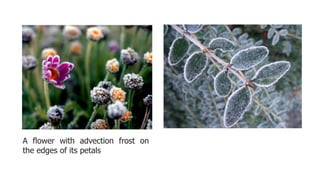
A flower with advection frost on
the edges of its petals
Effects on Plants
• Many plants can be damaged or killed by freezing temperatures or frost.
• This varies with the type of plant, the tissue exposed, and how low
temperatures get; a "light frost" of −2 to 0 °C damages fewer types of plants
than a "hard frost" below −2 °C.
• Plants likely to be damaged even by a light frost are: Beans, Grapes,
Squashes, Melons, Tomatoes, Eggplants, and Peppers.
• Plants that may tolerate (or even benefit from) frosts include:
• Root vegetables (Beets, Carrots, Onions)
• Leafy greens (Lettuces, Spinach, Cucumber)
• Cruciferous Vegetables (Cabbages, Cauliflower, Broccoli, Radishes)
• These frost tolerate crops may be damaged once temperatures drop below
−4°C
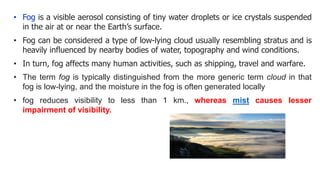
• Fog is a visible aerosol consisting of tiny water droplets or ice crystals suspended
in the air at or near the Earth’s surface.
• Fog can be considered a type of low-lying cloud usually resembling stratus and is
heavily influenced by nearby bodies of water, topography and wind conditions.
• In turn, fog affects many human activities, such as shipping, travel and warfare.
• The term fog is typically distinguished from the more generic term cloud in that
fog is low-lying, and the moisture in the fog is often generated locally
• fog reduces visibility to less than 1 km., whereas mist causes lesser
impairment of visibility.
Formation of Fog
Fog forms when the difference between air temp. and dew point is less than 2.5.
Addition of water vapor by wind convergence into areas of upward wind motion.
Intense precipitation.
Evaporation from the surface of oceans/ water bodies/ wet land due to daytime
heating.
Cool or dry air moving over warmer water. Lifting air over mountains
When, at 100% RH, the minute water droplets begin to coalesce into larger
droplets, fog produces precipitation in the form of drizzle or very light snow, This
can occur when the fog layer is lifted and cooled sufficiently, or when it is forcibly
compressed from above by descending air.
The thickness of a fog layer is largely determined by the height of the inversion
boundary, which in oceanic locales is also the top of the marine layer, above which
the air mass is warmer and drier.
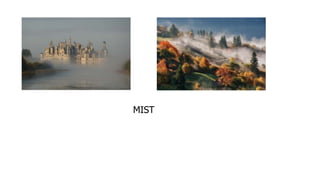
Mist is a phenomenon caused by the formation of tiny droplets of water due to
condensation and suspended in the cold air.
Physically, it is an example of a dispersion.
It is most commonly seen where water vapor in warm, moist air meets sudden
cooling, such as in exhaled air in the winter.
It occurs, when humid air cools rapidly, notably when the air comes into contact
with surfaces that are much cooler than the air (e.g. mountains).
Mist is commonly confused with fog. Fog is denser, more opaque, and generally
lasts a longer time, while mist is thinner and more transparent.
The phenomenon is called fog if the visibility is 1 km or less.
MIST
Clouds: Clouds are visible aggregates of very minute
droplets of water or ice crystals or a mixture of both of
moist air.”
Size of clouds and fogs droplets is 20 to 60 micron.
It formed and remains suspended in the air at higher
altitudes particularly in troposphere due to adiabatic
cooling of moist warm air due to buoyancy force.
They may be also formed due to orographic ascent
caused by mountain barriers and also due to fronts.
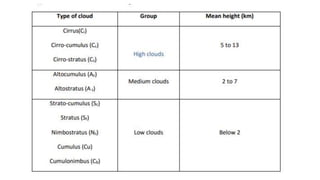
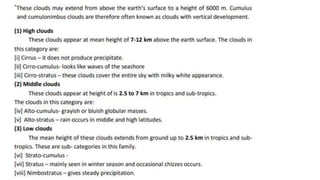
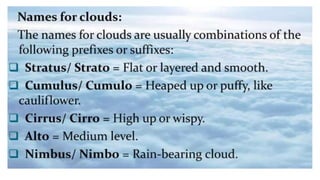
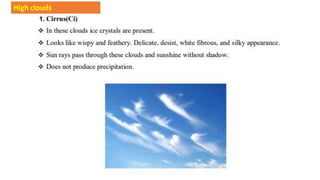
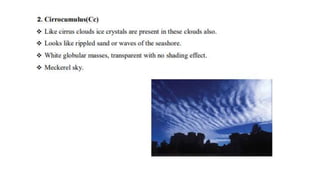
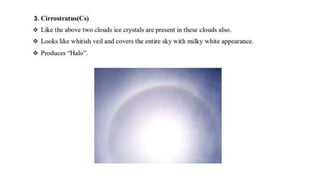
High clouds
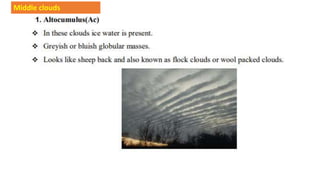
Middle clouds
Low clouds
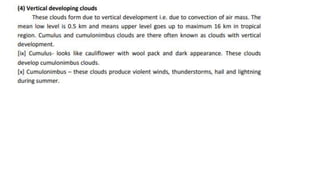
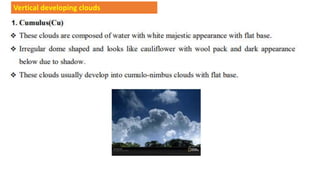
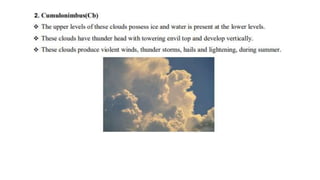
Vertical developing clouds
2. Condesation, condensation nuclei, clouds

2. Condesation, condensation nuclei, clouds

  • 2.
    Necessary conditions forcondensation The following three conditions must be fulfilled for occurrence of condensation in the atmosphere: - (A)Presence of sufficient water vapour in air (B)Presence of condensation nuclei in atmosphere (C)Cooling of air A. Presence of sufficient water vapour An adequate amount of water vapour is necessary to bring about saturation of air with water vapour. Air can be easily brought to saturation when sufficient moisture is present or decrease in temperature. The dew point shall be reached through this abundance of water vapour to begin condensation.
  • 4.
    Sodium chloride (saltparticles) injected in the atmosphere by sea ocean water spray. Some combustion products viz. sulphur dioxides, nitrous oxide etc, released from industries and dust particles in the atmosphere act as 'condensation nuclei'. Water vapour can only deposit and condense on these particles as these are hygroscopic in nature. These particles have water affinity. These particles are also microscopic in size (0.1 to 1 µm) called either “hygroscopic nuclei” or “condensation nuclei”. In the absence of these nuclei condensation cannot take place even if air is super saturated and its temperature is below freezing level.
  • 6.
    (C) Cooling ofair Air must be cooled to dew point temperature i.e. saturation. Cooling of air up to and below dew point is necessary for saturation of atmospheric air with water vapour. Cooling takes place in atmosphere due to adiabatic cooling of air masses.
  • 7.
    The different formsof condensation are: (1) Dew (2) Frost (3) Fog (4) Mist and (5) Cloud
  • 8.
    What is Dew? Dewis the deposit of waterdrops formed at night by the condensation of water vapor from the air onto the surfaces of objects freely exposed to the sky. Dew is water in the form of droplets that appears on thin, exposed objects in the morning or evening due to condensation. Formation mechanism: On clear nights, adequate cooling of the surface typically takes place when it loses more energy by infrared radiation than the radiation it receives from the sun. Then atmospheric moisture condenses at a rate greater than that at which it can evaporate, resulting in the formation of water droplets. Water vapor will condense into droplets depending on the temperature. Most objects, including grass blades, leaves, and petals, are much better reradiators than air and, as a result, are usually colder at night than is the air.
  • 10.
    Favourable environment: • Dewforms on clear nights, because on such nights reradiation of heat from freely exposed surfaces takes place at a faster rate. • Calm or low wind flow enhance the process. Dew Point Temperature: The temperature at which droplets are formed is called the dew point temperature. • Above this temperature the moisture will stay in the air. • If the dew point temperature is close to the air temperature, the relative humidity is high • If the dew point is well below the air temperature, the relative humidity is low. Why land surfaces get less dew than grass and leaves? Glossy vegetative surface with higher thermal conductivity are better infrared radiator over soil having rough surface and poor thermal conductivity.
  • 11.
    Beneficial effects ofDew in relation to Agriculture • In the arid and semiarid regions or in the dry season, because of its higher frequency dew acts as a notable water resource. This, accelerates the increase of biomass in plants. • During desiccation and rehydration dew enhance the photosynthetic activity. It regulates the transpiration pressure and thus helping the wilting plant to restore the appropriate turger pressure of cell. • Dew provide a moist environment in repairing the DNA of embryo, thus maintain viability of seed under harsh desert conditions; • Improving water content of surface soil and there by mitigating soil water stress partially. • Regulating growing environment of forest plants.
  • 12.
    • Harmful effectsof Dew: • Creation of moist environment due to dew increases pest and disease attack. • Dew inhibits the plant stomata movement • When the quantity and sustaining time of dew is high it discourage the route of pollen diffusing. • Acid dew could lead to a degradation of vegetation for the decreasing of CO2 assimilation efficiency. • Black spot disease of fruit could be induced by dew. • Some times it deteriorated the quality of vegetables, Fruits.
  • 13.
    Under cold temp.,dew may freeze and form a layer of ice over plants and objects
  • 14.
    What is Frost Dueto reradiation temperature on surface of objects may reach below the freezing point. Under that situation, water vapour directly condensed to tiny ice crystal. These ice crystals are called frost. Frost is a thin layer of ice on the solid surface, which forms from water vapour in an above- freezing atmosphere coming in contact with a solid surface whose temperature is below freezing, and resulting in a phase change from water vapor (a gas) to ice (a solid). In temperate climates, it most commonly appears on surfaces near the ground as fragile white crystals with variety of forms. The propagation of crystal formation occurs by the process of nucleation.
  • 15.
    A flower withadvection frost on the edges of its petals
  • 16.
    Effects on Plants •Many plants can be damaged or killed by freezing temperatures or frost. • This varies with the type of plant, the tissue exposed, and how low temperatures get; a "light frost" of −2 to 0 °C damages fewer types of plants than a "hard frost" below −2 °C. • Plants likely to be damaged even by a light frost are: Beans, Grapes, Squashes, Melons, Tomatoes, Eggplants, and Peppers. • Plants that may tolerate (or even benefit from) frosts include: • Root vegetables (Beets, Carrots, Onions) • Leafy greens (Lettuces, Spinach, Cucumber) • Cruciferous Vegetables (Cabbages, Cauliflower, Broccoli, Radishes) • These frost tolerate crops may be damaged once temperatures drop below −4°C
  • 17.
    • Fog isa visible aerosol consisting of tiny water droplets or ice crystals suspended in the air at or near the Earth’s surface. • Fog can be considered a type of low-lying cloud usually resembling stratus and is heavily influenced by nearby bodies of water, topography and wind conditions. • In turn, fog affects many human activities, such as shipping, travel and warfare. • The term fog is typically distinguished from the more generic term cloud in that fog is low-lying, and the moisture in the fog is often generated locally • fog reduces visibility to less than 1 km., whereas mist causes lesser impairment of visibility.
  • 18.
    Formation of Fog Fogforms when the difference between air temp. and dew point is less than 2.5. Addition of water vapor by wind convergence into areas of upward wind motion. Intense precipitation. Evaporation from the surface of oceans/ water bodies/ wet land due to daytime heating. Cool or dry air moving over warmer water. Lifting air over mountains When, at 100% RH, the minute water droplets begin to coalesce into larger droplets, fog produces precipitation in the form of drizzle or very light snow, This can occur when the fog layer is lifted and cooled sufficiently, or when it is forcibly compressed from above by descending air. The thickness of a fog layer is largely determined by the height of the inversion boundary, which in oceanic locales is also the top of the marine layer, above which the air mass is warmer and drier.
  • 19.
    Mist is aphenomenon caused by the formation of tiny droplets of water due to condensation and suspended in the cold air. Physically, it is an example of a dispersion. It is most commonly seen where water vapor in warm, moist air meets sudden cooling, such as in exhaled air in the winter. It occurs, when humid air cools rapidly, notably when the air comes into contact with surfaces that are much cooler than the air (e.g. mountains). Mist is commonly confused with fog. Fog is denser, more opaque, and generally lasts a longer time, while mist is thinner and more transparent. The phenomenon is called fog if the visibility is 1 km or less.
  • 20.
  • 21.
    Clouds: Clouds arevisible aggregates of very minute droplets of water or ice crystals or a mixture of both of moist air.” Size of clouds and fogs droplets is 20 to 60 micron. It formed and remains suspended in the air at higher altitudes particularly in troposphere due to adiabatic cooling of moist warm air due to buoyancy force. They may be also formed due to orographic ascent caused by mountain barriers and also due to fronts.
  • 29.
  • 32.
  • 34.
  • 37.