Camera shots,
angles and
techniques
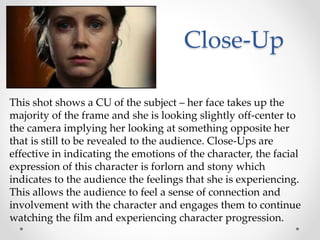
Close-Up
This shot shows a CU of the subject – her face takes up the
majority of the frame and she is looking slightly off-center to
the camera implying her looking at something opposite her
that is still to be revealed to the audience. Close-Ups are
effective in indicating the emotions of the character, the facial
expression of this character is forlorn and stony which
indicates to the audience the feelings that she is experiencing.
This allows the audience to feel a sense of connection and
involvement with the character and engages them to continue
watching the film and experiencing character progression.
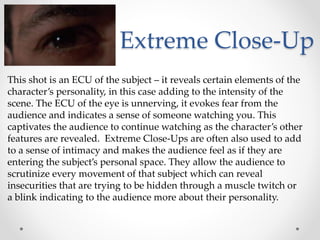
Extreme Close-Up
This shot is an ECU of the subject – it reveals certain elements of the
character’s personality, in this case adding to the intensity of the
scene. The ECU of the eye is unnerving, it evokes fear from the
audience and indicates a sense of someone watching you. This
captivates the audience to continue watching as the character’s other
features are revealed. Extreme Close-Ups are often also used to add
to a sense of intimacy and makes the audience feel as if they are
entering the subject’s personal space. They allow the audience to
scrutinize every movement of that subject which can reveal
insecurities that are trying to be hidden through a muscle twitch or
a blink indicating to the audience more about their personality.
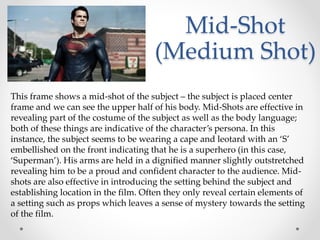
Mid-Shot
(Medium Shot)
This frame shows a mid-shot of the subject – the subject is placed center
frame and we can see the upper half of his body. Mid-Shots are effective in
revealing part of the costume of the subject as well as the body language;
both of these things are indicative of the character’s persona. In this
instance, the subject seems to be wearing a cape and leotard with an ‘S’
embellished on the front indicating that he is a superhero (in this case,
‘Superman’). His arms are held in a dignified manner slightly outstretched
revealing him to be a proud and confident character to the audience. Mid-
shots are also effective in introducing the setting behind the subject and
establishing location in the film. Often they only reveal certain elements of
a setting such as props which leaves a sense of mystery towards the setting
of the film.
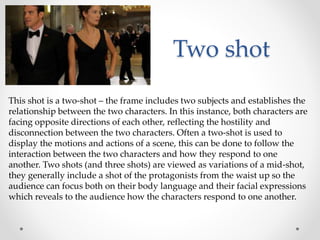
Two shot
This shot is a two-shot – the frame includes two subjects and establishes the
relationship between the two characters. In this instance, both characters are
facing opposite directions of each other, reflecting the hostility and
disconnection between the two characters. Often a two-shot is used to
display the motions and actions of a scene, this can be done to follow the
interaction between the two characters and how they respond to one
another. Two shots (and three shots) are viewed as variations of a mid-shot,
they generally include a shot of the protagonists from the waist up so the
audience can focus both on their body language and their facial expressions
which reveals to the audience how the characters respond to one another.
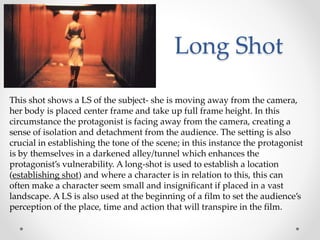
Long Shot
This shot shows a LS of the subject- she is moving away from the camera,
her body is placed center frame and take up full frame height. In this
circumstance the protagonist is facing away from the camera, creating a
sense of isolation and detachment from the audience. The setting is also
crucial in establishing the tone of the scene; in this instance the protagonist
is by themselves in a darkened alley/tunnel which enhances the
protagonist’s vulnerability. A long-shot is used to establish a location
(establishing shot) and where a character is in relation to this, this can
often make a character seem small and insignificant if placed in a vast
landscape. A LS is also used at the beginning of a film to set the audience’s
perception of the place, time and action that will transpire in the film.
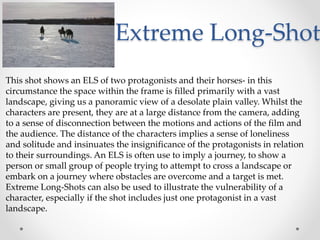
Extreme Long-Shot
This shot shows an ELS of two protagonists and their horses- in this
circumstance the space within the frame is filled primarily with a vast
landscape, giving us a panoramic view of a desolate plain valley. Whilst the
characters are present, they are at a large distance from the camera, adding
to a sense of disconnection between the motions and actions of the film and
the audience. The distance of the characters implies a sense of loneliness
and solitude and insinuates the insignificance of the protagonists in relation
to their surroundings. An ELS is often use to imply a journey, to show a
person or small group of people trying to attempt to cross a landscape or
embark on a journey where obstacles are overcome and a target is met.
Extreme Long-Shots can also be used to illustrate the vulnerability of a
character, especially if the shot includes just one protagonist in a vast
landscape.
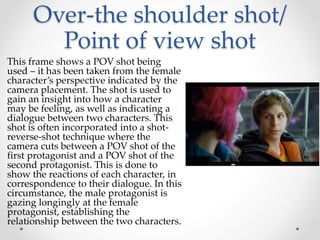
Over-the shoulder shot/
Point of view shot
This frame shows a POV shot being
used – it has been taken from the female
character’s perspective indicated by the
camera placement. The shot is used to
gain an insight into how a character
may be feeling, as well as indicating a
dialogue between two characters. This
shot is often incorporated into a shot-
reverse-shot technique where the
camera cuts between a POV shot of the
first protagonist and a POV shot of the
second protagonist. This is done to
show the reactions of each character, in
correspondence to their dialogue. In this
circumstance, the male protagonist is
gazing longingly at the female
protagonist, establishing the
relationship between the two characters.

Camera angles, shots and techniques

  • 1.
  • 2.
    Close-Up This shot showsa CU of the subject – her face takes up the majority of the frame and she is looking slightly off-center to the camera implying her looking at something opposite her that is still to be revealed to the audience. Close-Ups are effective in indicating the emotions of the character, the facial expression of this character is forlorn and stony which indicates to the audience the feelings that she is experiencing. This allows the audience to feel a sense of connection and involvement with the character and engages them to continue watching the film and experiencing character progression.
  • 3.
    Extreme Close-Up This shotis an ECU of the subject – it reveals certain elements of the character’s personality, in this case adding to the intensity of the scene. The ECU of the eye is unnerving, it evokes fear from the audience and indicates a sense of someone watching you. This captivates the audience to continue watching as the character’s other features are revealed. Extreme Close-Ups are often also used to add to a sense of intimacy and makes the audience feel as if they are entering the subject’s personal space. They allow the audience to scrutinize every movement of that subject which can reveal insecurities that are trying to be hidden through a muscle twitch or a blink indicating to the audience more about their personality.
  • 4.
    Mid-Shot (Medium Shot) This frameshows a mid-shot of the subject – the subject is placed center frame and we can see the upper half of his body. Mid-Shots are effective in revealing part of the costume of the subject as well as the body language; both of these things are indicative of the character’s persona. In this instance, the subject seems to be wearing a cape and leotard with an ‘S’ embellished on the front indicating that he is a superhero (in this case, ‘Superman’). His arms are held in a dignified manner slightly outstretched revealing him to be a proud and confident character to the audience. Mid- shots are also effective in introducing the setting behind the subject and establishing location in the film. Often they only reveal certain elements of a setting such as props which leaves a sense of mystery towards the setting of the film.
  • 5.
    Two shot This shotis a two-shot – the frame includes two subjects and establishes the relationship between the two characters. In this instance, both characters are facing opposite directions of each other, reflecting the hostility and disconnection between the two characters. Often a two-shot is used to display the motions and actions of a scene, this can be done to follow the interaction between the two characters and how they respond to one another. Two shots (and three shots) are viewed as variations of a mid-shot, they generally include a shot of the protagonists from the waist up so the audience can focus both on their body language and their facial expressions which reveals to the audience how the characters respond to one another.
  • 6.
    Long Shot This shotshows a LS of the subject- she is moving away from the camera, her body is placed center frame and take up full frame height. In this circumstance the protagonist is facing away from the camera, creating a sense of isolation and detachment from the audience. The setting is also crucial in establishing the tone of the scene; in this instance the protagonist is by themselves in a darkened alley/tunnel which enhances the protagonist’s vulnerability. A long-shot is used to establish a location (establishing shot) and where a character is in relation to this, this can often make a character seem small and insignificant if placed in a vast landscape. A LS is also used at the beginning of a film to set the audience’s perception of the place, time and action that will transpire in the film.
  • 7.
    Extreme Long-Shot This shotshows an ELS of two protagonists and their horses- in this circumstance the space within the frame is filled primarily with a vast landscape, giving us a panoramic view of a desolate plain valley. Whilst the characters are present, they are at a large distance from the camera, adding to a sense of disconnection between the motions and actions of the film and the audience. The distance of the characters implies a sense of loneliness and solitude and insinuates the insignificance of the protagonists in relation to their surroundings. An ELS is often use to imply a journey, to show a person or small group of people trying to attempt to cross a landscape or embark on a journey where obstacles are overcome and a target is met. Extreme Long-Shots can also be used to illustrate the vulnerability of a character, especially if the shot includes just one protagonist in a vast landscape.
  • 8.
    Over-the shoulder shot/ Pointof view shot This frame shows a POV shot being used – it has been taken from the female character’s perspective indicated by the camera placement. The shot is used to gain an insight into how a character may be feeling, as well as indicating a dialogue between two characters. This shot is often incorporated into a shot- reverse-shot technique where the camera cuts between a POV shot of the first protagonist and a POV shot of the second protagonist. This is done to show the reactions of each character, in correspondence to their dialogue. In this circumstance, the male protagonist is gazing longingly at the female protagonist, establishing the relationship between the two characters.