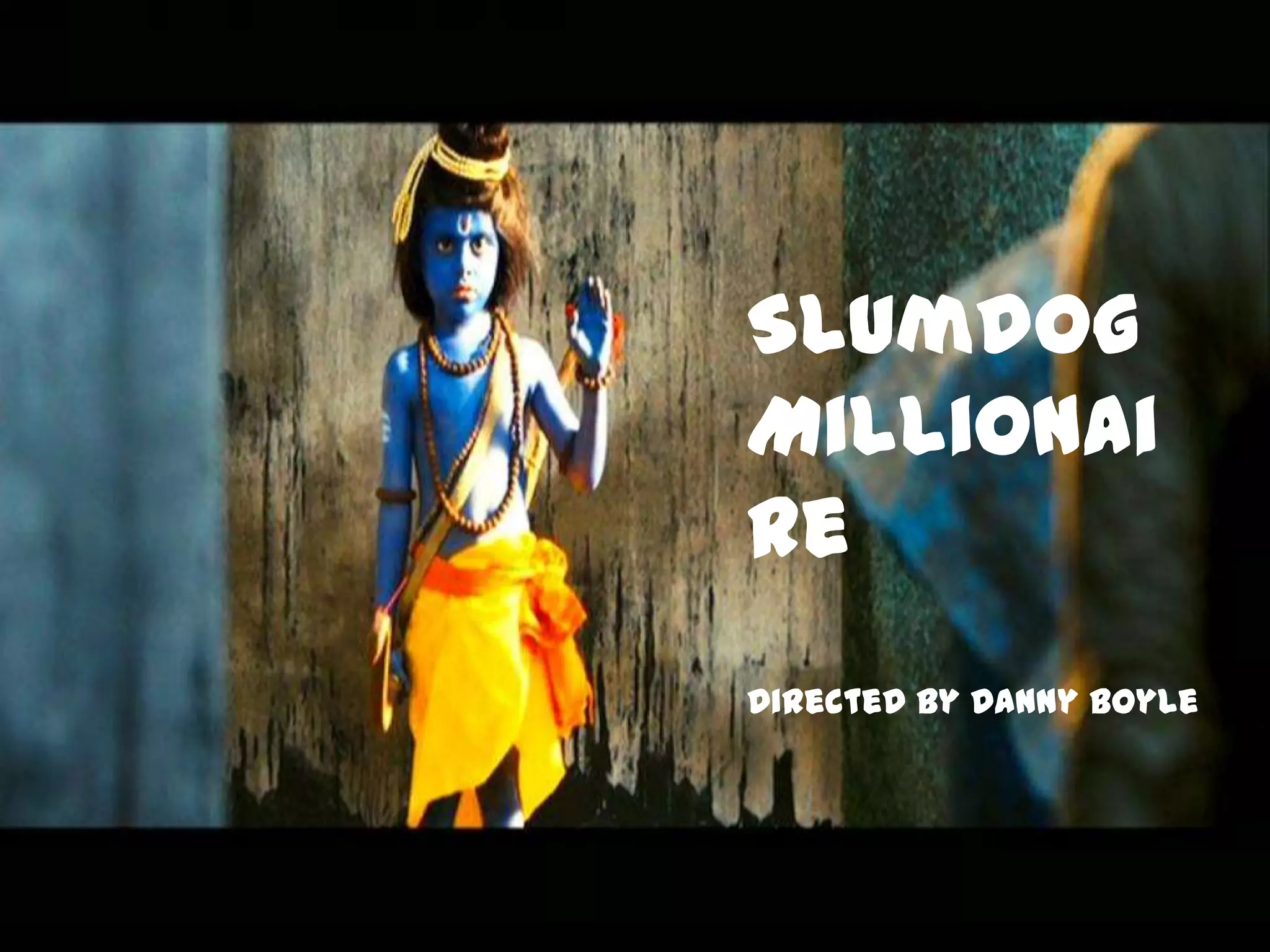
Slumdog
Millionai
re
Directed by Danny Boyle
Learning Outcomes
By the time you have completed this unit, you
  should be able to
 analyse film image and sequences in detail;
 understand the way film language creates
  setting and character, and manipulates our
  responses;
 describe how verbal and visual features are
  combined for different purposes;
 respond to and interpret meaning, ideas and
  effects;
 write about aspects of the text.
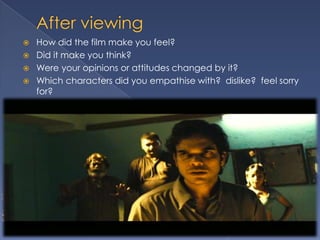
   How did the film make you feel?
   Did it make you think?
   Were your opinions or attitudes changed by it?
   Which characters did you empathise with? dislike? feel sorry
    for?
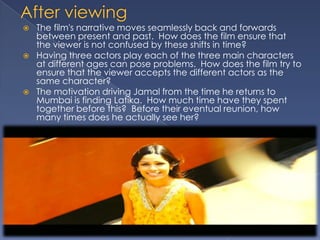
   The film's narrative moves seamlessly back and forwards
    between present and past. How does the film ensure that
    the viewer is not confused by these shifts in time?
   Having three actors play each of the three main characters
    at different ages can pose problems. How does the film try to
    ensure that the viewer accepts the different actors as the
    same character?
   The motivation driving Jamal from the time he returns to
    Mumbai is finding Latika. How much time have they spent
    together before this? Before their eventual reunion, how
    many times does he actually see her?
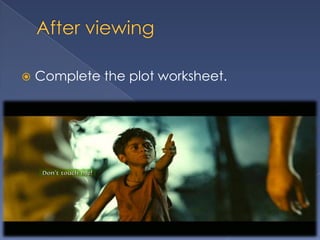
   Complete the plot worksheet.
Approaching Genre
'Genre' is a word – borrowed from French – which means a grouping of
  similar works. All movies in a particular genre will include certain
  basic ingredients, the way a chocolate cake or a casserole does.

          epic                      black comedy
          history                   buddy movie
          horror                    comedy
          love story                coming of age
          mockumentary              crime
          musical                   detective
          road movie                disaster
          romantic comedy           documentary
          science fiction           drama
          social drama              dysfunctional family
          sports                    action
          superhero                 Adventure

1. Working on your own, in pairs or in groups, decide which genres this
    films best fits.
2. For each genre, identify the features of the film that make you decide
    it fits there.
Narrative structure means the organisation of the plot, including the
   order in which events are related.
1. Is there one plot or more than one?
The most common ways in which stories are told are in chronological
   order, i.e. the order in which the events happen; using
   flashbacks, i.e. earlier events are included later in the story with a
   frame of later time, and the whole story a flashback (book-ending)
   with flash forwards, in which future events are included earlier than
   they actually happen.
1. Which of these descriptions best fits the structure of this film?
    Explain in detail.
Narrative structure does not mean just the order in which the story is
   told; the term refers to the whole structural framework that underlies
   the order and manner in which a story is presented.
Director Danny Boyle has called the film 'a tale of two chairs'.
1.          Explain in detail how the 'two chairs' are used to anchor the
            storyline, and how the TV quiz show provides a framework for
            the narrative.
2.          Show how each success in the quiz show is balanced by a
            great loss in Jamal's real life.

An important aspect of storytelling is point of view: who tells the story, or
   from whose perspective the events are shown.
1.        From whose point of view is the story told in this film? Quote
          specific examples.
Time is always an important consideration in a screenplay; a feature film
   may cover days, weeks, even years of real time, so ways of showing
   time passing are needed.

1. How much time is covered in this film? Can you work out a timeline?
Some of the ways the passing of time may be indicated include:
 fades or dissolves
 changing light
 showing a clock or a calendar
 references in dialogue
 dates or times on screen
 seasonal differences – winter to summer
 cuts to the same scene at a clearly later time, e.g. from full plates to
    empty, or the same people with different clothes or in different
    places.
 a montage of brief symbolic or typical images.


2. What techniques are used in this film to show time passing?
Most commercial films – “classic Hollywood” type - are similar in structure
     to a three-act play:
The first act introduces the main characters and situation, and includes a
     scene that sets up a complication around which the plot will revolve -
     the catalyst or inciting incident, that disrupts the equilibrium of the
     original situation.
The second act develops this complication.
The third act brings the situation to a climax and resolution.
i.e. – get the hero up a tree, throw things at him, and then get him down
     from the tree.
Each act is structured to end on a moment of heightened tension or
     interest – a „plot point' that will change the direction of the story.
1.     Does this film follow this pattern? Can you identify three acts? The
       plot points that end acts 1 and 2?

There will often be a central incident (coming about half way through the
   film), a mid-point scene, which packs a dramatic punch and kicks the
   action to a higher level.
1.   Can you identify the mid-point scene? How does it affect subsequent
     action?
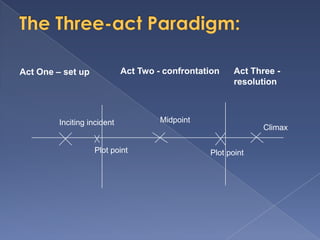
Act One – set up             Act Two - confrontation    Act Three -
                                                        resolution


         Inciting incident            Midpoint
                                                               Climax

                   Plot point                    Plot point
Although it might not seem to at first glance, the film follows the
   traditional 3-act structure. The scenes in the present and the
   flashbacks fit together neatly within the framework.
1. Act 1 ends with the escape from Maman and the separation
    from Latika; the rest of the film is Jamal's quest to find her
    again. At the police station, the Inspector is beginning to
    believe Jamal; in the studio he has won 250,000 rupees.
2. Act 2 ends with the fourth loss of Latika [58]: "We're
    done", says the Inspector; Jamal says Latika has
    disappeared; he is in despair, not knowing what will happen
    to him. Hollywood screenwriting wisdom says that Act 2
    should end with the protagonist at his lowest ebb, which is
    what Jamal is here. Act 3 begins with "You're back on the
    show."
3.   Act 3 is pretty much all in the present, with much cross-
    cutting between the three main characters.
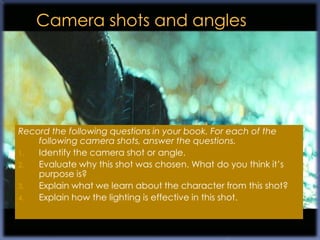
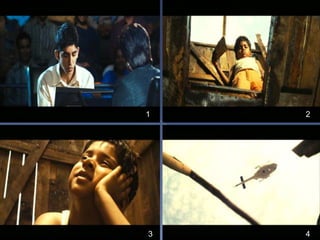
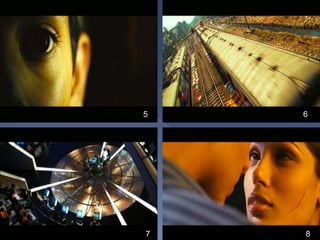
Record the following questions in your book. For each of the
    following camera shots, answer the questions.
1.  Identify the camera shot or angle.
2.  Evaluate why this shot was chosen. What do you think it‟s
    purpose is?
3.  Explain what we learn about the character from this shot?
4.  Explain how the lighting is effective in this shot.
1   2


3   4
5   6


7   8
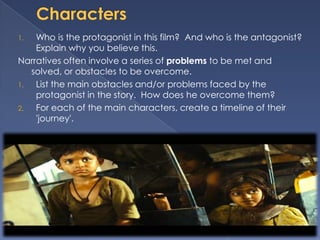
1.  Who is the protagonist in this film? And who is the antagonist?
    Explain why you believe this.
Narratives often involve a series of problems to be met and
   solved, or obstacles to be overcome.
1.  List the main obstacles and/or problems faced by the
    protagonist in the story. How does he overcome them?
2.  For each of the main characters, create a timeline of their
    'journey'.
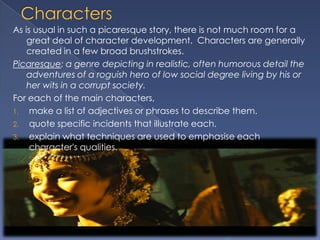
As is usual in such a picaresque story, there is not much room for a
    great deal of character development. Characters are generally
    created in a few broad brushstrokes.
Picaresque: a genre depicting in realistic, often humorous detail the
    adventures of a roguish hero of low social degree living by his or
    her wits in a corrupt society.
For each of the main characters,
1. make a list of adjectives or phrases to describe them.
2. quote specific incidents that illustrate each.
3. explain what techniques are used to emphasise each
     character's qualities.
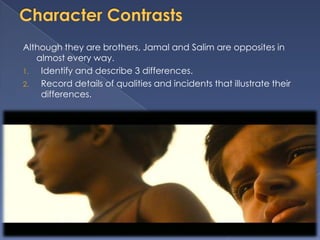
Although they are brothers, Jamal and Salim are opposites in
   almost every way.
1.  Identify and describe 3 differences.
2.  Record details of qualities and incidents that illustrate their
    differences.
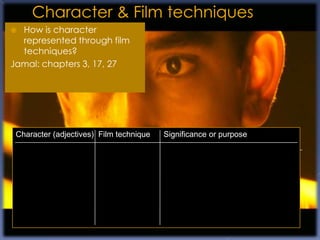
 How is character
  represented through film
  techniques?
Jamal: chapters 3, 17, 27


 Character (adjectives) Film technique   Significance or purpose
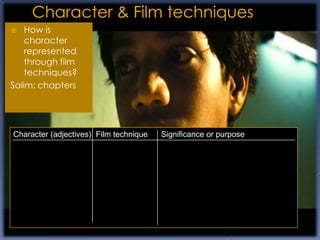
   How is
    character
    represented
    through film
    techniques?
Salim: chapters


Character (adjectives) Film technique   Significance or purpose
  How is character
   represented
   through film
   techniques?
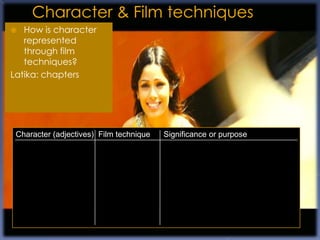
Latika: chapters


 Character (adjectives) Film technique   Significance or purpose
Choose ONE of the following questions and
   write at least 400 words.
 Analyse how the experiences and/or
   behaviour of a character or individual had
   an impact in your studied text.
   Analyse and discuss in detail the importance of
    EITHER relationships OR conflicts in your studied
    text.
   Analyse how TWO or THREE production
    techniques helped develop your opinion of
    a main character / individual.
Most of the film – apart from the above – was filmed on
    location in India, in and around Mumbai, and at Agra.
As is not surprising in a picaresque film like this, there are
    many different and often contrasted settings.
1. How many different settings can you identify?
2. Select the three you consider the most important and
     note as many specific details as you can.
3. Why is the Hotel Tulip Star location unusual in this film?
4. Setting is as much about society as about geography.
     How are the various social groups signified?
5. Cite examples where the gap between rich and poor is
     made clear.
6. How important to the film is the setting in India?
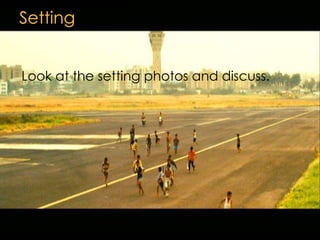
Look at the setting photos and discuss.
1.   What is significant about the Indian poet Surdas?
2.   What do the three lions on the national emblem of India
     stand for?
3.   What can you find out about Amitabh Bachchan?
4.   What can you find out about the Juhu slum?
5.   What can you find out about the Taj Mahal, one of the most
     beautiful buildings in the world?
6.   Whose face is on the 1000 rupee note? Why is he famous?
7.   Whose face is on the American $100 bill? Why is he famous?
8.   When did Jack Hobbs play cricket? How many first class
     centuries did he score
9.   Aramis is the third musketeer. Who were
     d'Artagnan, Cardinal Richelieu, Planchet?
In groups, read through your notes then discuss the following
      questions:
1.     Identify an important message in the film.
2.     Identify and describe 3 examples of the theme being shown
       n the film. Think about the characters which show this
       theme.
3.     Explain it‟s relevance to today‟s world.
4.     Describe the director‟s intention in relation to this message.
5.     Identify and describe the social issues that are represented
       in the film.
6.     Evaluate the message and explain what lessons we can
       learn about human behaviour.
Choose one theme and complete the following chart:
Theme Characters and how linked      example significance
        1.


        2.

        3.
Theme   Film technique   example   significance

        1.


        2.


        3.
Choose ONE of the following questions and write at least
   450 words.
  Analyse an idea in your studied text that caused
   strong reaction or interest in you as a reader/
   audience.

   Identify what you consider to be the director‟s main
    purpose AND analyse, in depth, one or two main
    visual / oral techniques used to achieve this purpose.

   Analyse how at least TWO of the following were used
    to present a main theme:
       Colour Lighting Music Special effects Sound
    effects Camera work costume
A motif is an image, a word or phrase that is repeated several
   times in a film. Motifs are often used to keep the film
   unified, to link one scene with another. Another way that
   film-makers will create unity is by repeating or echoing
   the same camera angles and shots (visual) and
   sometimes the same ideas or words and phrases (verbal).
1. Can you identify any motifs in this film? any visual or
    verbal links?
2. Complete the following chart:
Motif & where it appears   Character associated
  Significance
1.    the emblematic shot of Latika at the railway station: [6, 53, 54] +
      linked with yellow: [6, 20, 60]
2.    money, bank notes: [1, 2, 12, 24, 31, 33, 36, 40, 52, 56, 63, 64]
3.    "destiny": [45, 56, 64]; "It is written" [1, 56, 64]
4.    Jamal being hit: [3, 10, 13, 34, 37, 45]
5.    hands and feet: Salim lets go Latika's hand [28]; Arvind's begging
      hand [40]; Latika's painted hands [45]; Jamal's, Latika's hands in the
      kitchen [52]; the inspector's feet, Jamal's feet [7]; + [20, 32, 41]
6.    mobile phones: [5, 49, 60 onwards]
7.    mirrors and reflections
8.    echoes of scenes: Latika is left by the train and bundled away by
      Maman [28]; she is abducted at the train station by Salim and others
      [54]; Jamal is arrested [57]; Salim's hand with the keys [60] echoes
      Arvind's begging hand [40]
9.    steam and similar effects – associated with Latika: [28, 32, 35, 40, 41]
10.   cages: [51, 52, 54, 57]
11.   the musketeers
12.   trains – frequently; climaxes in the dance in the TV station.
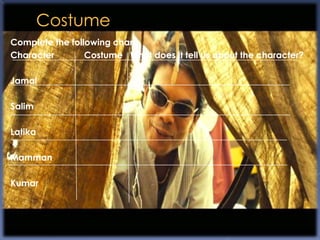
Complete the following chart:
Character        Costume What does it tell us about the character?

Jamal

Salim

Latika

Mamman

Kumar
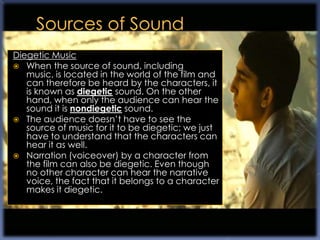
Diegetic Music
 When the source of sound, including
   music, is located in the world of the film and
   can therefore be heard by the characters, it
   is known as diegetic sound. On the other
   hand, when only the audience can hear the
   sound it is nondiegetic sound.
 The audience doesn‟t have to see the
   source of music for it to be diegetic; we just
   have to understand that the characters can
   hear it as well.
 Narration (voiceover) by a character from
   the film can also be diegetic. Even though
   no other character can hear the narrative
   voice, the fact that it belongs to a character
   makes it diegetic.
Describe the diegetic sound in chapter 9:
Include
 - a description of what is happening,
 - an explanation of why the sound is significant e.g. does the
   sound represent a certain character? Why? Does the sound
   represent a theme? Why? What does the sound tell us about
   the character or theme?
 Identify the characters involved.
  The most common non-diegetic sound is a film‟s soundtrack.
   For example, in a horror film the characters do not hear the
   creepy music that sets the mood to the film. Also the music
   played during the film‟s opening and closing credits would
   not usually be heard by the characters.
 Non musical sounds can also be non-diegetic.
Task 2
1. Watch chapter 6 and list as many diegetic and nondiegetic
    sounds as you can.
2. For each one, explain what you think its purpose is in the
    film.
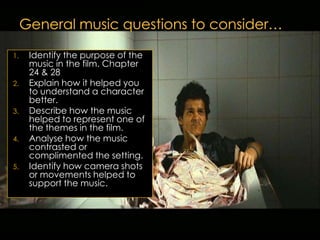
1.   Identify the purpose of the
     music in the film. Chapter
     24 & 28
2.   Explain how it helped you
     to understand a character
     better.
3.   Describe how the music
     helped to represent one of
     the themes in the film.
4.   Analyse how the music
     contrasted or
     complimented the setting.
5.   Identify how camera shots
     or movements helped to
     support the music.
   Analyse how particular techniques are used to encourage the viewer to
    form a positive or negative view of a character in a visual text you have
    studied.

   Analyse how visual techniques and sound or verbal techniques are
    combined to manipulate viewer response in a visual text you have studied.

   Analyse how mood or atmosphere in a setting is created for a particular
    purpose in a visual text you have studied.

   Analyse how time is manipulated for a particular purpose in a visual text
    you have studied.

   Analyse how visual techniques are used to develop deeper ideas in a
    visual text you have studied.

   Analyse how particular techniques are used to challenge society’s ideas or
    beliefs in a visual text you have studied.

Slumdog Millionaire

  • 1.
  • 2.
    Learning Outcomes By thetime you have completed this unit, you should be able to  analyse film image and sequences in detail;  understand the way film language creates setting and character, and manipulates our responses;  describe how verbal and visual features are combined for different purposes;  respond to and interpret meaning, ideas and effects;  write about aspects of the text.
  • 3.
    How did the film make you feel?  Did it make you think?  Were your opinions or attitudes changed by it?  Which characters did you empathise with? dislike? feel sorry for?
  • 4.
    The film's narrative moves seamlessly back and forwards between present and past. How does the film ensure that the viewer is not confused by these shifts in time?  Having three actors play each of the three main characters at different ages can pose problems. How does the film try to ensure that the viewer accepts the different actors as the same character?  The motivation driving Jamal from the time he returns to Mumbai is finding Latika. How much time have they spent together before this? Before their eventual reunion, how many times does he actually see her?
  • 5.
    Complete the plot worksheet.
  • 6.
    Approaching Genre 'Genre' isa word – borrowed from French – which means a grouping of similar works. All movies in a particular genre will include certain basic ingredients, the way a chocolate cake or a casserole does. epic black comedy history buddy movie horror comedy love story coming of age mockumentary crime musical detective road movie disaster romantic comedy documentary science fiction drama social drama dysfunctional family sports action superhero Adventure 1. Working on your own, in pairs or in groups, decide which genres this films best fits. 2. For each genre, identify the features of the film that make you decide it fits there.
  • 7.
    Narrative structure meansthe organisation of the plot, including the order in which events are related. 1. Is there one plot or more than one? The most common ways in which stories are told are in chronological order, i.e. the order in which the events happen; using flashbacks, i.e. earlier events are included later in the story with a frame of later time, and the whole story a flashback (book-ending) with flash forwards, in which future events are included earlier than they actually happen. 1. Which of these descriptions best fits the structure of this film? Explain in detail.
  • 8.
    Narrative structure doesnot mean just the order in which the story is told; the term refers to the whole structural framework that underlies the order and manner in which a story is presented. Director Danny Boyle has called the film 'a tale of two chairs'. 1. Explain in detail how the 'two chairs' are used to anchor the storyline, and how the TV quiz show provides a framework for the narrative. 2. Show how each success in the quiz show is balanced by a great loss in Jamal's real life. An important aspect of storytelling is point of view: who tells the story, or from whose perspective the events are shown. 1. From whose point of view is the story told in this film? Quote specific examples.
  • 9.
    Time is alwaysan important consideration in a screenplay; a feature film may cover days, weeks, even years of real time, so ways of showing time passing are needed. 1. How much time is covered in this film? Can you work out a timeline? Some of the ways the passing of time may be indicated include:  fades or dissolves  changing light  showing a clock or a calendar  references in dialogue  dates or times on screen  seasonal differences – winter to summer  cuts to the same scene at a clearly later time, e.g. from full plates to empty, or the same people with different clothes or in different places.  a montage of brief symbolic or typical images. 2. What techniques are used in this film to show time passing?
  • 10.
    Most commercial films– “classic Hollywood” type - are similar in structure to a three-act play: The first act introduces the main characters and situation, and includes a scene that sets up a complication around which the plot will revolve - the catalyst or inciting incident, that disrupts the equilibrium of the original situation. The second act develops this complication. The third act brings the situation to a climax and resolution. i.e. – get the hero up a tree, throw things at him, and then get him down from the tree. Each act is structured to end on a moment of heightened tension or interest – a „plot point' that will change the direction of the story. 1. Does this film follow this pattern? Can you identify three acts? The plot points that end acts 1 and 2? There will often be a central incident (coming about half way through the film), a mid-point scene, which packs a dramatic punch and kicks the action to a higher level. 1. Can you identify the mid-point scene? How does it affect subsequent action?
  • 11.
    Act One –set up Act Two - confrontation Act Three - resolution Inciting incident Midpoint Climax Plot point Plot point
  • 12.
    Although it mightnot seem to at first glance, the film follows the traditional 3-act structure. The scenes in the present and the flashbacks fit together neatly within the framework. 1. Act 1 ends with the escape from Maman and the separation from Latika; the rest of the film is Jamal's quest to find her again. At the police station, the Inspector is beginning to believe Jamal; in the studio he has won 250,000 rupees. 2. Act 2 ends with the fourth loss of Latika [58]: "We're done", says the Inspector; Jamal says Latika has disappeared; he is in despair, not knowing what will happen to him. Hollywood screenwriting wisdom says that Act 2 should end with the protagonist at his lowest ebb, which is what Jamal is here. Act 3 begins with "You're back on the show." 3. Act 3 is pretty much all in the present, with much cross- cutting between the three main characters.
  • 13.
    Record the followingquestions in your book. For each of the following camera shots, answer the questions. 1. Identify the camera shot or angle. 2. Evaluate why this shot was chosen. What do you think it‟s purpose is? 3. Explain what we learn about the character from this shot? 4. Explain how the lighting is effective in this shot.
  • 14.
    1 2 3 4
  • 15.
    5 6 7 8
  • 16.
    1. Whois the protagonist in this film? And who is the antagonist? Explain why you believe this. Narratives often involve a series of problems to be met and solved, or obstacles to be overcome. 1. List the main obstacles and/or problems faced by the protagonist in the story. How does he overcome them? 2. For each of the main characters, create a timeline of their 'journey'.
  • 17.
    As is usualin such a picaresque story, there is not much room for a great deal of character development. Characters are generally created in a few broad brushstrokes. Picaresque: a genre depicting in realistic, often humorous detail the adventures of a roguish hero of low social degree living by his or her wits in a corrupt society. For each of the main characters, 1. make a list of adjectives or phrases to describe them. 2. quote specific incidents that illustrate each. 3. explain what techniques are used to emphasise each character's qualities.
  • 18.
    Although they arebrothers, Jamal and Salim are opposites in almost every way. 1. Identify and describe 3 differences. 2. Record details of qualities and incidents that illustrate their differences.
  • 19.
     How ischaracter represented through film techniques? Jamal: chapters 3, 17, 27 Character (adjectives) Film technique Significance or purpose
  • 20.
    How is character represented through film techniques? Salim: chapters Character (adjectives) Film technique Significance or purpose
  • 21.
     Howis character represented through film techniques? Latika: chapters Character (adjectives) Film technique Significance or purpose
  • 22.
    Choose ONE ofthe following questions and write at least 400 words.  Analyse how the experiences and/or behaviour of a character or individual had an impact in your studied text.  Analyse and discuss in detail the importance of EITHER relationships OR conflicts in your studied text.  Analyse how TWO or THREE production techniques helped develop your opinion of a main character / individual.
  • 23.
    Most of thefilm – apart from the above – was filmed on location in India, in and around Mumbai, and at Agra. As is not surprising in a picaresque film like this, there are many different and often contrasted settings. 1. How many different settings can you identify? 2. Select the three you consider the most important and note as many specific details as you can. 3. Why is the Hotel Tulip Star location unusual in this film? 4. Setting is as much about society as about geography. How are the various social groups signified? 5. Cite examples where the gap between rich and poor is made clear. 6. How important to the film is the setting in India?
  • 24.
    Look at thesetting photos and discuss.
  • 25.
    1. What is significant about the Indian poet Surdas? 2. What do the three lions on the national emblem of India stand for? 3. What can you find out about Amitabh Bachchan? 4. What can you find out about the Juhu slum? 5. What can you find out about the Taj Mahal, one of the most beautiful buildings in the world? 6. Whose face is on the 1000 rupee note? Why is he famous? 7. Whose face is on the American $100 bill? Why is he famous? 8. When did Jack Hobbs play cricket? How many first class centuries did he score 9. Aramis is the third musketeer. Who were d'Artagnan, Cardinal Richelieu, Planchet?
  • 26.
    In groups, readthrough your notes then discuss the following questions: 1. Identify an important message in the film. 2. Identify and describe 3 examples of the theme being shown n the film. Think about the characters which show this theme. 3. Explain it‟s relevance to today‟s world. 4. Describe the director‟s intention in relation to this message. 5. Identify and describe the social issues that are represented in the film. 6. Evaluate the message and explain what lessons we can learn about human behaviour.
  • 27.
    Choose one themeand complete the following chart: Theme Characters and how linked example significance 1. 2. 3.
  • 28.
    Theme Film technique example significance 1. 2. 3.
  • 29.
    Choose ONE ofthe following questions and write at least 450 words.  Analyse an idea in your studied text that caused strong reaction or interest in you as a reader/ audience.  Identify what you consider to be the director‟s main purpose AND analyse, in depth, one or two main visual / oral techniques used to achieve this purpose.  Analyse how at least TWO of the following were used to present a main theme:  Colour Lighting Music Special effects Sound effects Camera work costume
  • 30.
    A motif isan image, a word or phrase that is repeated several times in a film. Motifs are often used to keep the film unified, to link one scene with another. Another way that film-makers will create unity is by repeating or echoing the same camera angles and shots (visual) and sometimes the same ideas or words and phrases (verbal). 1. Can you identify any motifs in this film? any visual or verbal links? 2. Complete the following chart: Motif & where it appears Character associated Significance
  • 31.
    1. the emblematic shot of Latika at the railway station: [6, 53, 54] + linked with yellow: [6, 20, 60] 2. money, bank notes: [1, 2, 12, 24, 31, 33, 36, 40, 52, 56, 63, 64] 3. "destiny": [45, 56, 64]; "It is written" [1, 56, 64] 4. Jamal being hit: [3, 10, 13, 34, 37, 45] 5. hands and feet: Salim lets go Latika's hand [28]; Arvind's begging hand [40]; Latika's painted hands [45]; Jamal's, Latika's hands in the kitchen [52]; the inspector's feet, Jamal's feet [7]; + [20, 32, 41] 6. mobile phones: [5, 49, 60 onwards] 7. mirrors and reflections 8. echoes of scenes: Latika is left by the train and bundled away by Maman [28]; she is abducted at the train station by Salim and others [54]; Jamal is arrested [57]; Salim's hand with the keys [60] echoes Arvind's begging hand [40] 9. steam and similar effects – associated with Latika: [28, 32, 35, 40, 41] 10. cages: [51, 52, 54, 57] 11. the musketeers 12. trains – frequently; climaxes in the dance in the TV station.
  • 32.
    Complete the followingchart: Character Costume What does it tell us about the character? Jamal Salim Latika Mamman Kumar
  • 33.
    Diegetic Music  Whenthe source of sound, including music, is located in the world of the film and can therefore be heard by the characters, it is known as diegetic sound. On the other hand, when only the audience can hear the sound it is nondiegetic sound.  The audience doesn‟t have to see the source of music for it to be diegetic; we just have to understand that the characters can hear it as well.  Narration (voiceover) by a character from the film can also be diegetic. Even though no other character can hear the narrative voice, the fact that it belongs to a character makes it diegetic.
  • 34.
    Describe the diegeticsound in chapter 9: Include  - a description of what is happening,  - an explanation of why the sound is significant e.g. does the sound represent a certain character? Why? Does the sound represent a theme? Why? What does the sound tell us about the character or theme?  Identify the characters involved.
  • 35.
     Themost common non-diegetic sound is a film‟s soundtrack. For example, in a horror film the characters do not hear the creepy music that sets the mood to the film. Also the music played during the film‟s opening and closing credits would not usually be heard by the characters.  Non musical sounds can also be non-diegetic. Task 2 1. Watch chapter 6 and list as many diegetic and nondiegetic sounds as you can. 2. For each one, explain what you think its purpose is in the film.
  • 36.
    1. Identify the purpose of the music in the film. Chapter 24 & 28 2. Explain how it helped you to understand a character better. 3. Describe how the music helped to represent one of the themes in the film. 4. Analyse how the music contrasted or complimented the setting. 5. Identify how camera shots or movements helped to support the music.
  • 37.
    Analyse how particular techniques are used to encourage the viewer to form a positive or negative view of a character in a visual text you have studied.  Analyse how visual techniques and sound or verbal techniques are combined to manipulate viewer response in a visual text you have studied.  Analyse how mood or atmosphere in a setting is created for a particular purpose in a visual text you have studied.  Analyse how time is manipulated for a particular purpose in a visual text you have studied.  Analyse how visual techniques are used to develop deeper ideas in a visual text you have studied.  Analyse how particular techniques are used to challenge society’s ideas or beliefs in a visual text you have studied.