INVESTMENT PROJECT APPRAISAL
Money-weighted rate of return , Time-weighted rate of
return and Linked internal rate of return
GROUP:
SUMALEELA
POOJA
AKSHAT JAIN
NEWMONEY
 This includes all extra money paid out into
the fund that was not generated by the
fund itself.
 Withdrawing from the fund corresponds to
negative new money.
 Income generated by the fund:
This includes interest payments,
dividends and rental payments earned by
the fund’s assets.
MONEY-
WEIGHTED
RATEOF
RETURN
 Money-weighted rate of return is a
measure of the performance of an
investment.
 Incorporates the size and timing of cash
flows, so it is an effective measure for
returns on a portfolio.
 Finds the interest rate or rate of return that
would have to have been paid for the
investor to obtain the actual ending value,
given the beginning value and the deposits
and withdrawals that occurred during the
period.
• MWRR takes into account investor behavior via the impact of fund inflows
and outflows on performance but doesn’t separate the intervals where cash
flows occurred.
• It is mainly used to compute individual portfolio returns as timing and
amount of contributions and withdrawals can be different for each individual
investor’s portfolio.
EXAMPLE:
An investment fund is valued at £60m on 1 January 2016 and at £70m on 1
January 2017. Immediately after the valuation on 1 January 2017, £100m is
paid into the fund. On 1 July 2018, the value of the fund is £300m.
Calculate the effective money-weighted rate of return over the whole period.
ADVANTAGESAND
DISADVANTAGESOF
MWRR
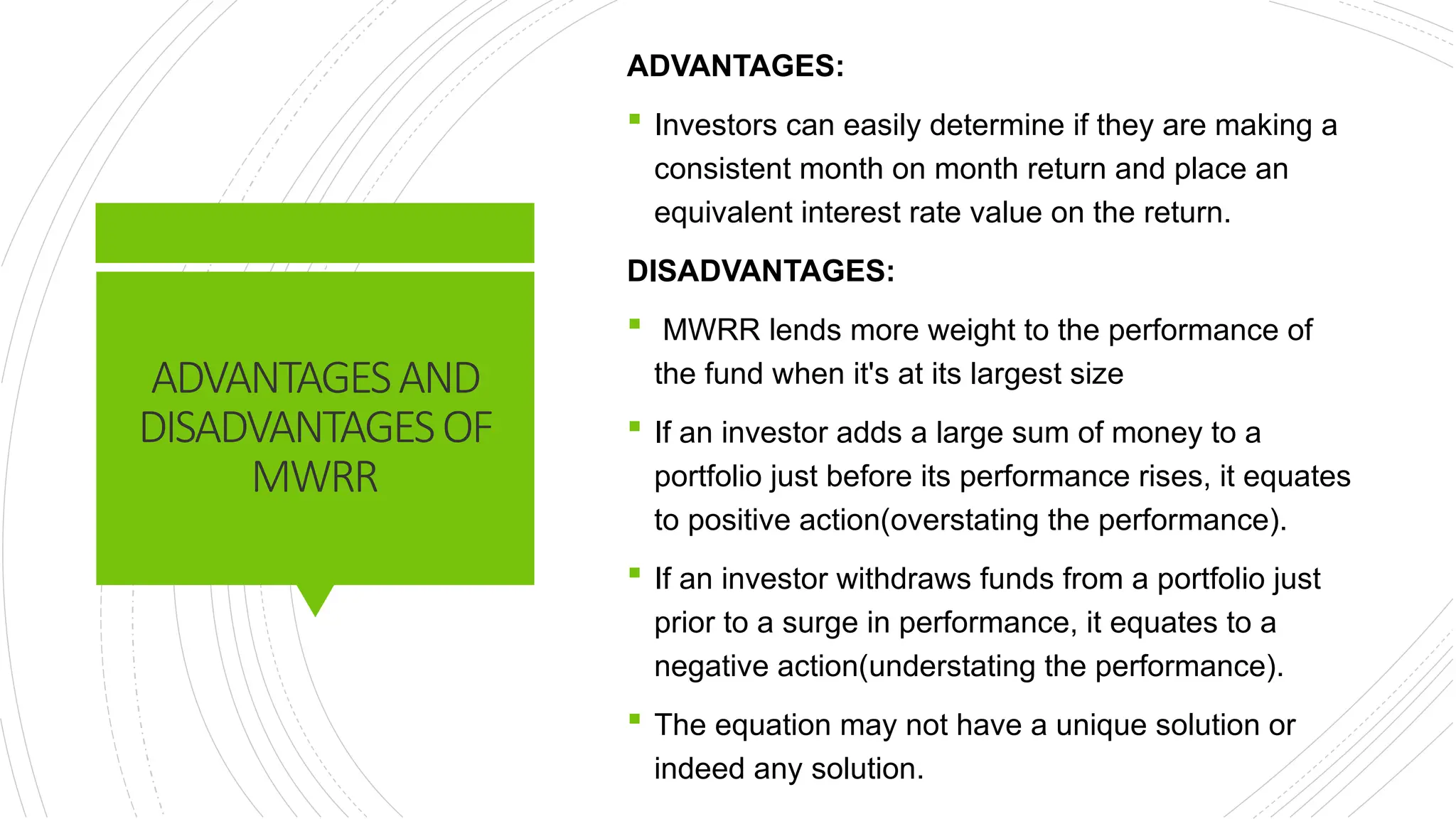
ADVANTAGES:
 Investors can easily determine if they are making a
consistent month on month return and place an
equivalent interest rate value on the return.
DISADVANTAGES:
 MWRR lends more weight to the performance of
the fund when it's at its largest size
 If an investor adds a large sum of money to a
portfolio just before its performance rises, it equates
to positive action(overstating the performance).
 If an investor withdraws funds from a portfolio just
prior to a surge in performance, it equates to a
negative action(understating the performance).
 The equation may not have a unique solution or
indeed any solution.
TIME-
WEIGHTED
RATEOF
RETURN
 Method of calculating investment return. To
apply the time-weighted return method,
combine the returns over sub-periods, by
compounding them together, resulting in the
overall period return.
 Time-weighted rate of return also called the
geometric mean return, is a measure of the
compound rate of growth in a portfolio.
 The time-weighted return (TWRR) helps
eliminate the distorting effects on growth rates
created by inflows and outflows of money
ADVANTAGESAND
DISADVANTAGESOF
TWRR
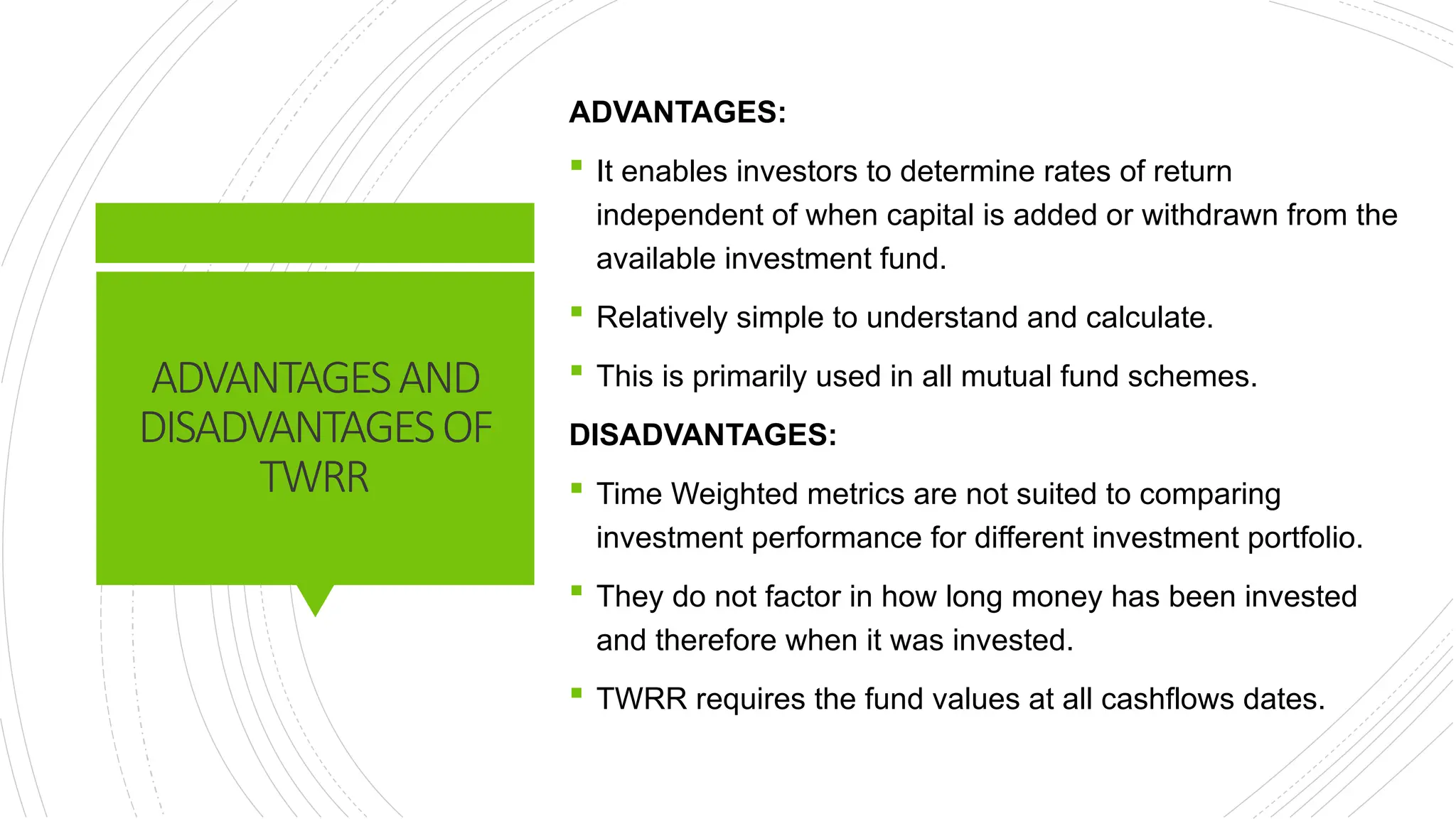
ADVANTAGES:
 It enables investors to determine rates of return
independent of when capital is added or withdrawn from the
available investment fund.
 Relatively simple to understand and calculate.
 This is primarily used in all mutual fund schemes.
DISADVANTAGES:
 Time Weighted metrics are not suited to comparing
investment performance for different investment portfolio.
 They do not factor in how long money has been invested
and therefore when it was invested.
 TWRR requires the fund values at all cashflows dates.
EXAMPLE:
An investment fund is valued at £60m on 1 January 2016 and at £70m on 1
January 2017. Immediately after the valuation on 1 January 2017, £100m is paid
into the fund. On 1 July 2018, the value of the fund is £300m.
Calculate the effective time-weighted rate of return per annum over the whole
period.
LINKED
INTERNAL RATE
OFRETURN
 Linked rates of return provide a way of
combining rates of return for successive
subperiods to obtain an approximate rate
of return over a longer period.
 A common situation is for an investment
manager to have estimates of the quarterly
returns of a fund available from computer
printouts, which can then be combined to
calculate linked rates of return for longer
periods.
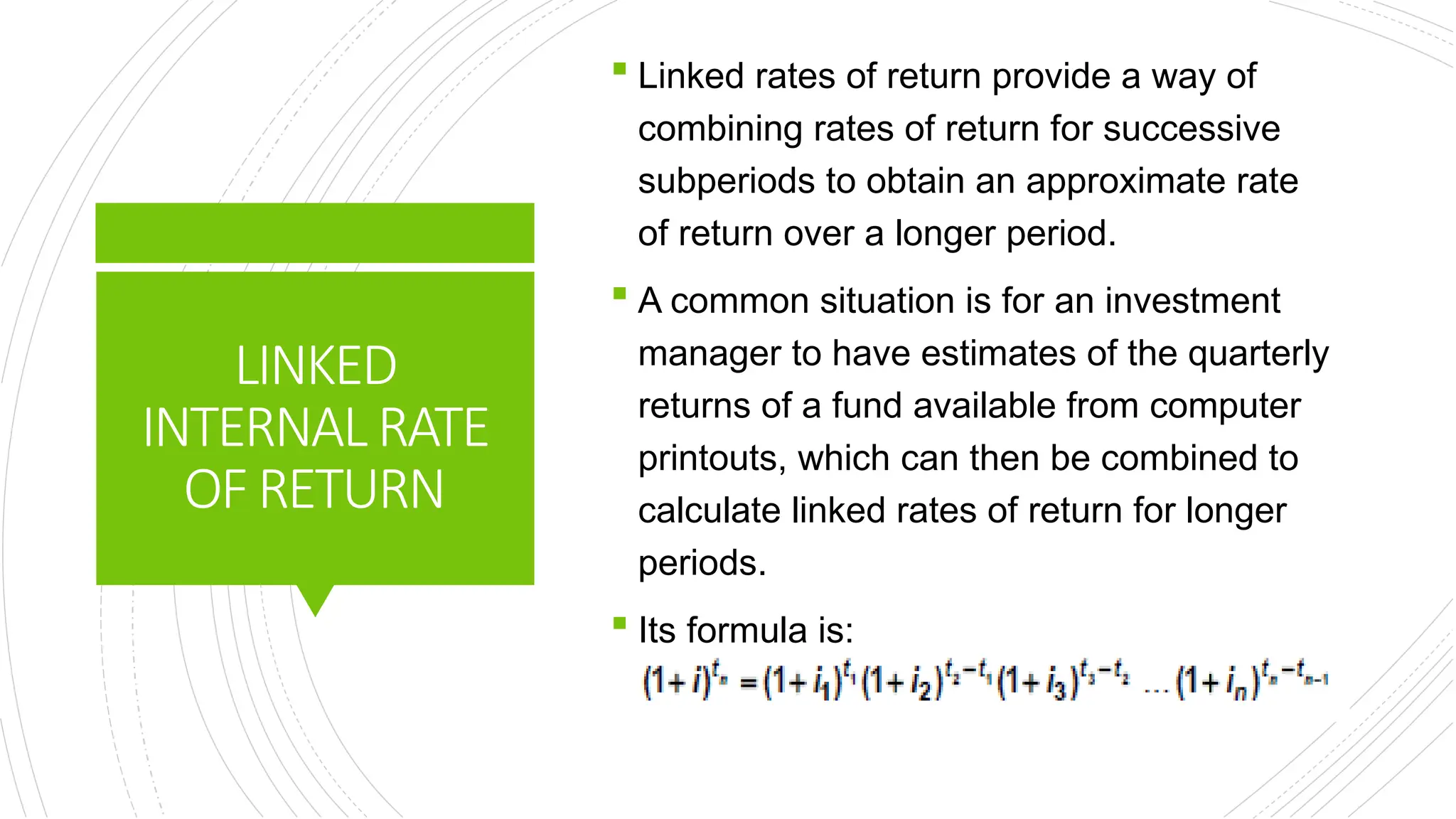
 Its formula is:
EXAMPLE:
The effective half-yearly rates of return obtained by an investment fund in four
consecutive half-years were 3.4%,2.95%, -3.2% and 3.24%.Calculate the
linked rate of return for the two years.
QUESTIONS
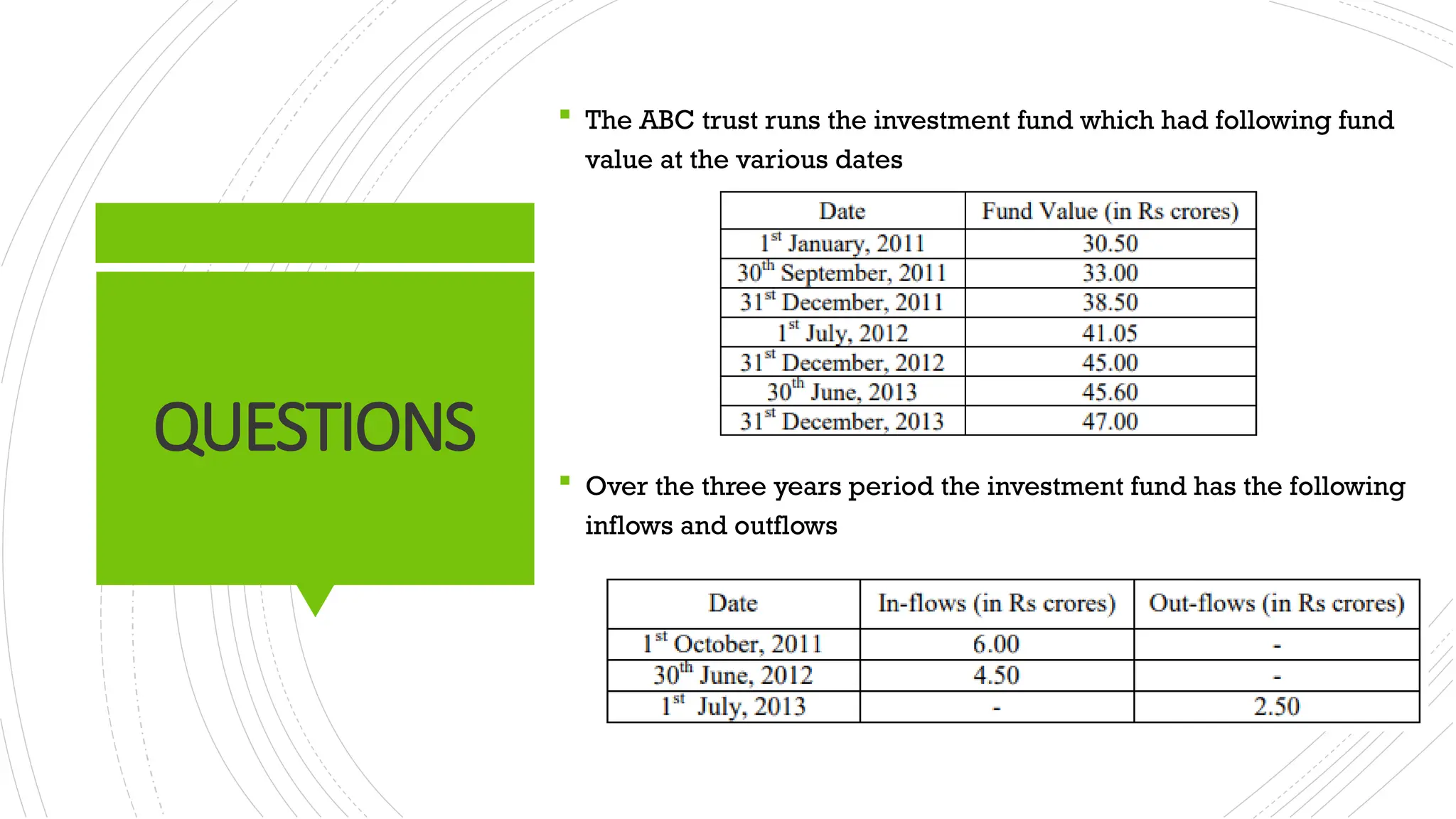
 The ABC trust runs the investment fund which had following fund
value at the various dates
 Over the three years period the investment fund has the following
inflows and outflows
SOLUTION
THANK YOU!!

calculate the rate of return for investm

  • 1.
    INVESTMENT PROJECT APPRAISAL Money-weightedrate of return , Time-weighted rate of return and Linked internal rate of return GROUP: SUMALEELA POOJA AKSHAT JAIN
  • 2.
    NEWMONEY  This includesall extra money paid out into the fund that was not generated by the fund itself.  Withdrawing from the fund corresponds to negative new money.  Income generated by the fund: This includes interest payments, dividends and rental payments earned by the fund’s assets.
  • 3.
    MONEY- WEIGHTED RATEOF RETURN  Money-weighted rateof return is a measure of the performance of an investment.  Incorporates the size and timing of cash flows, so it is an effective measure for returns on a portfolio.  Finds the interest rate or rate of return that would have to have been paid for the investor to obtain the actual ending value, given the beginning value and the deposits and withdrawals that occurred during the period.
  • 4.
    • MWRR takesinto account investor behavior via the impact of fund inflows and outflows on performance but doesn’t separate the intervals where cash flows occurred. • It is mainly used to compute individual portfolio returns as timing and amount of contributions and withdrawals can be different for each individual investor’s portfolio. EXAMPLE: An investment fund is valued at £60m on 1 January 2016 and at £70m on 1 January 2017. Immediately after the valuation on 1 January 2017, £100m is paid into the fund. On 1 July 2018, the value of the fund is £300m. Calculate the effective money-weighted rate of return over the whole period.
  • 5.
    ADVANTAGESAND DISADVANTAGESOF MWRR ADVANTAGES:  Investors caneasily determine if they are making a consistent month on month return and place an equivalent interest rate value on the return. DISADVANTAGES:  MWRR lends more weight to the performance of the fund when it's at its largest size  If an investor adds a large sum of money to a portfolio just before its performance rises, it equates to positive action(overstating the performance).  If an investor withdraws funds from a portfolio just prior to a surge in performance, it equates to a negative action(understating the performance).  The equation may not have a unique solution or indeed any solution.
  • 6.
    TIME- WEIGHTED RATEOF RETURN  Method ofcalculating investment return. To apply the time-weighted return method, combine the returns over sub-periods, by compounding them together, resulting in the overall period return.  Time-weighted rate of return also called the geometric mean return, is a measure of the compound rate of growth in a portfolio.  The time-weighted return (TWRR) helps eliminate the distorting effects on growth rates created by inflows and outflows of money
  • 7.
    ADVANTAGESAND DISADVANTAGESOF TWRR ADVANTAGES:  It enablesinvestors to determine rates of return independent of when capital is added or withdrawn from the available investment fund.  Relatively simple to understand and calculate.  This is primarily used in all mutual fund schemes. DISADVANTAGES:  Time Weighted metrics are not suited to comparing investment performance for different investment portfolio.  They do not factor in how long money has been invested and therefore when it was invested.  TWRR requires the fund values at all cashflows dates.
  • 8.
    EXAMPLE: An investment fundis valued at £60m on 1 January 2016 and at £70m on 1 January 2017. Immediately after the valuation on 1 January 2017, £100m is paid into the fund. On 1 July 2018, the value of the fund is £300m. Calculate the effective time-weighted rate of return per annum over the whole period.
  • 9.
    LINKED INTERNAL RATE OFRETURN  Linkedrates of return provide a way of combining rates of return for successive subperiods to obtain an approximate rate of return over a longer period.  A common situation is for an investment manager to have estimates of the quarterly returns of a fund available from computer printouts, which can then be combined to calculate linked rates of return for longer periods.  Its formula is:
  • 10.
    EXAMPLE: The effective half-yearlyrates of return obtained by an investment fund in four consecutive half-years were 3.4%,2.95%, -3.2% and 3.24%.Calculate the linked rate of return for the two years.
  • 11.
    QUESTIONS  The ABCtrust runs the investment fund which had following fund value at the various dates  Over the three years period the investment fund has the following inflows and outflows
  • 12.
  • 14.