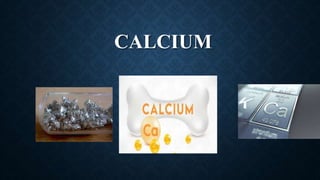
CALCIUM
CONTENTS :
• INTRODUCTION OF CALCIUM
• BIOCHEMICAL FUNCTION
• ROLE O CALCIUM IN HUMAN BODY
• DIETARY REQUIRMENTS
• SOURCE
• CLINICAL IMPORTANCE
• REFERENCES
CALCIUM:
• Calcium is most abundant among the minerals
in the body.
• The total content of calcium in an adult man is
about 1 to 1.5 kg.
• As much as 99 % of it is present in the bones and
teeth.
• A small fraction about 1% o calcium, found
outside the skeletal tissue, performs a wide
variety of function
BIOCHEMICAL FUNCTION:
• Development of bones and teeth
• Muscle contraction
• Blood coagulation
• Nerve transmission
• Membrane integrity and
permeability
• Activation of enzymes
• Calmodulin mediated action of
Calcium
• Calcium as intracellular
messenger
• Release of hormones
• Action on heart
DEVELOPMENT OF BONES AND TEETH:
• Calcium along with phosphate, is
required for the formation and
physical strength of skeletal tissue.
• Adequate calcium intake is essential
for proper bone development and
maintenance
• It helps prevent conditions such as
osteoporosis and osteopenia.
DENTAL HEALTH:
• It is essential for the formation and
maintenance of healthy teeth.
• It helps in the mineralization of tooth
enamel, which protects the teeth from
decay and erosion.
MUSCLE FUNCTION:
• Calcium is vital for muscle contraction. When a muscle is
stimulated, calcium is released from intracellular stores, initiating
the process of muscle contraction. Proper calcium levels are
necessary for normal muscle function
• Calcium also activates ATPase, to increases the interaction
between actin and myosin.
BLOOD COAGULATION:
• It is essential for the clotting of blood. During the coagulation process, calcium ions are
involved in several steps, including the activation of clotting factors. Adequate calcium
levels are necessary to prevent excessive bleeding and promote proper clot formation.
• NERVE TRANSMISSION:
• Calcium is necessary for the transmission of nerve impulse.
MEMBRANE INTEGRITY & PERMEABILITY:
• Ca+2 influences the membrane structure and
transport of water and several ions across it.
• It is important for the activation of enzymes
such as lipase, ATPase and succinate
dehydrogenase.
• It also act on myocardium and prolongs
systole.
HORMONE SECRETION:
• Calcium is involved in regulating the
secretion of various hormones,
including those from the parathyroid
glands, which control calcium
homeostasis.
• It also plays a role in the release of
hormones from endocrine glands, such
as insulin from the pancreas.
BLOOD PRESSURE REGULATION:
• Calcium is involved in the regulation of
blood pressure.
• It plays a role in smooth muscle
contraction within blood vessel walls,
affecting their diameter and controlling
blood flow.
METABOLIC PROCESSES:
• It is involved in numerous metabolic reactions within the
body.
• It participates in enzyme activation, energy production, and
the metabolism of macronutrients such as carbohydrates
DIETARY REQUIREMENTS:
• Adult men and women require ___ 800 mg/day.
• Children (1 – 18 ) need ___ 0.8 – 1.2 g/day
• Infants (<1 year) ___300—500 mg/day
SOURCES
• Best sources __________milk and milk products
• Good sources _________Beans, leafy vegetables, fish, cabbage, egg
yolk.
CLINICAL IMPORTANCE:
• It is important to note that while calcium is vital for
overall health, maintaining appropriate levels is crucial.
Both calcium deficiencies (hypocalcemia) and excess
calcium (hypercalcemia) can lead to health
complications.
• Consulting with a healthcare professional can help
determine the appropriate calcium intake and manage
any related conditions.
REFERENCES:
• https://www.medicalnewstoday.com/articles/321865
• https://www.google.com/search?q=uvas+logo&rlz=1C1ONGR_enPK1040
PK1040&oq=uvas&aqs=chrome.0.69i59j69i57j69i64j69i60l2.3113j0j15&
sourceid=chrome&ie=UTF-8#imgrc=6VI8KjufPzbQ0M
• https://www.ncbi.nlm.nih.gov/books/NBK56060/
• https://www.sciencedirect.com/topics/chemistry/blood-clotting-factor
• https://opentextbc.ca/biology/chapter/4-1-energy-and-metabolism/
• https://www.ncbi.nlm.nih.gov/books/NBK109827/
calcium.pptx

calcium.pptx

  • 1.
  • 2.
    CONTENTS : • INTRODUCTIONOF CALCIUM • BIOCHEMICAL FUNCTION • ROLE O CALCIUM IN HUMAN BODY • DIETARY REQUIRMENTS • SOURCE • CLINICAL IMPORTANCE • REFERENCES
  • 3.
    CALCIUM: • Calcium ismost abundant among the minerals in the body. • The total content of calcium in an adult man is about 1 to 1.5 kg. • As much as 99 % of it is present in the bones and teeth. • A small fraction about 1% o calcium, found outside the skeletal tissue, performs a wide variety of function
  • 4.
    BIOCHEMICAL FUNCTION: • Developmentof bones and teeth • Muscle contraction • Blood coagulation • Nerve transmission • Membrane integrity and permeability • Activation of enzymes • Calmodulin mediated action of Calcium • Calcium as intracellular messenger • Release of hormones • Action on heart
  • 5.
    DEVELOPMENT OF BONESAND TEETH: • Calcium along with phosphate, is required for the formation and physical strength of skeletal tissue. • Adequate calcium intake is essential for proper bone development and maintenance • It helps prevent conditions such as osteoporosis and osteopenia.
  • 6.
    DENTAL HEALTH: • Itis essential for the formation and maintenance of healthy teeth. • It helps in the mineralization of tooth enamel, which protects the teeth from decay and erosion.
  • 7.
    MUSCLE FUNCTION: • Calciumis vital for muscle contraction. When a muscle is stimulated, calcium is released from intracellular stores, initiating the process of muscle contraction. Proper calcium levels are necessary for normal muscle function • Calcium also activates ATPase, to increases the interaction between actin and myosin.
  • 8.
    BLOOD COAGULATION: • Itis essential for the clotting of blood. During the coagulation process, calcium ions are involved in several steps, including the activation of clotting factors. Adequate calcium levels are necessary to prevent excessive bleeding and promote proper clot formation. • NERVE TRANSMISSION: • Calcium is necessary for the transmission of nerve impulse.
  • 9.
    MEMBRANE INTEGRITY &PERMEABILITY: • Ca+2 influences the membrane structure and transport of water and several ions across it. • It is important for the activation of enzymes such as lipase, ATPase and succinate dehydrogenase. • It also act on myocardium and prolongs systole.
  • 10.
    HORMONE SECRETION: • Calciumis involved in regulating the secretion of various hormones, including those from the parathyroid glands, which control calcium homeostasis. • It also plays a role in the release of hormones from endocrine glands, such as insulin from the pancreas.
  • 11.
    BLOOD PRESSURE REGULATION: •Calcium is involved in the regulation of blood pressure. • It plays a role in smooth muscle contraction within blood vessel walls, affecting their diameter and controlling blood flow.
  • 12.
    METABOLIC PROCESSES: • Itis involved in numerous metabolic reactions within the body. • It participates in enzyme activation, energy production, and the metabolism of macronutrients such as carbohydrates
  • 13.
    DIETARY REQUIREMENTS: • Adultmen and women require ___ 800 mg/day. • Children (1 – 18 ) need ___ 0.8 – 1.2 g/day • Infants (<1 year) ___300—500 mg/day
  • 14.
    SOURCES • Best sources__________milk and milk products • Good sources _________Beans, leafy vegetables, fish, cabbage, egg yolk.
  • 15.
    CLINICAL IMPORTANCE: • Itis important to note that while calcium is vital for overall health, maintaining appropriate levels is crucial. Both calcium deficiencies (hypocalcemia) and excess calcium (hypercalcemia) can lead to health complications. • Consulting with a healthcare professional can help determine the appropriate calcium intake and manage any related conditions.
  • 16.
    REFERENCES: • https://www.medicalnewstoday.com/articles/321865 • https://www.google.com/search?q=uvas+logo&rlz=1C1ONGR_enPK1040 PK1040&oq=uvas&aqs=chrome.0.69i59j69i57j69i64j69i60l2.3113j0j15& sourceid=chrome&ie=UTF-8#imgrc=6VI8KjufPzbQ0M •https://www.ncbi.nlm.nih.gov/books/NBK56060/ • https://www.sciencedirect.com/topics/chemistry/blood-clotting-factor • https://opentextbc.ca/biology/chapter/4-1-energy-and-metabolism/ • https://www.ncbi.nlm.nih.gov/books/NBK109827/