Estimation of calcium and
phosphorus
DUDEJA
Three hormones, PTH, vitamin D, and calcitonin,
are known to regulate serum Ca2+ by altering
their secretion rate in response to changes in
ionized Ca2+
Distribution
About 99% of Ca2+ in the body is part of bone. The
remaining 1% is mostly in the blood and other
ECF. Little is in the cytosol of most cells.
Ca2+ in blood is distributed among several forms.
About 45% circulates as free Ca2+ ions (referred
to as ionized Ca2+), 40% is bound to protein,
mostly albumin, and 15% is bound to anions,
such as HCO3 −, citrate, HCO3 −, and lactate
Symptoms of hypocalcemia
Neuromuscular irritability and cardiac irregularities are the
primary groups of symptoms that occur with hypocalcemia.
Neuromuscular symptoms include
paresthesia,
muscle cramps,
tetany,
and seizures.
Cardiac symptoms may include arrhythmia
or heart block. Symptoms usually occur with severe
hypocalcemia, in which total Ca2+ levels are below 1.88
mmol/L (7.5 mg/dL).
Symptoms of hypercalcemia
Moderate or severe Ca2+ elevations include NEUROLOGIC, GI,
AND RENAL SYMPTOMS.
Neurologic symptoms may include mild drowsiness or
weakness, depression, lethargy, and coma.
GI symptoms may include constipation, nausea, vomiting,
anorexia, and peptic ulcer disease.
Hypercalcemia may cause renal symptoms of nephrolithiasis
and nephrocalcinosis.
Hypercalciuria can result in nephrogenic diabetes insipidus,
which causes polyuria that results in hypovolemia, which
further aggravates the hypercalcemia.
Hypercalcemia can also cause symptoms of digitalis toxicity.
Methods
The two commonly used methods for total Ca2+ analysis use
either ortho-cresolphthalein complexone (CPC) or arsenazo III
dye to form a complex with Ca2+. Prior to the dye-binding
reaction, Ca2+ is released from its protein carrier and
complexes by acidification of the sample. The CPC method
uses 8-hydroxyquinoline to prevent Mg2+ interference.
AAS remains the reference method for total Ca2.
Current commercial analyzers that measure ionized/ free Ca2+
use ISEs for this measurement. These systems may use
membranes impregnated with special molecules that
selectively, but reversibly, bind Ca2+ ions. As Ca2+ binds to
these membranes, an electric potential develops across the
membrane that is proportional to the ionized Ca2+
concentration.
PHOSPHATE
An adult has about 600 g or approximately 20
mol of phosphorus in inorganic and organic
phosphates, of which about 85% is in the
skeleton, and the rest is principally in soft
tissue.
Plasma contains both inorganic and organic
phosphate, but only inorganic phosphate is
measured. Inorganic phosphate exists as both
monovalent (H2PO4 −) and divalent (HPO4 2−)
phosphate anions.
Approximately 10% of the phosphate in serum is
protein-bound; 35% is complexed with
sodium, calcium, and magnesium; and the
remainder, or 55%, is free.
In the soft tissue, most phosphate is cellular.
Although both inorganic and organic
phosphate is present in cells, most is organic
and is incorporated into nucleic acids,
phospholipids, phosphoproteins, and high-
energy compounds involved in metabolism
like ATP.
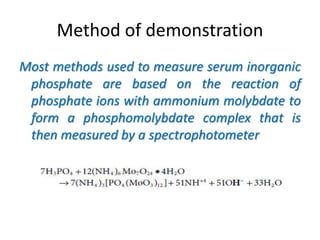
Method of demonstration
Most methods used to measure serum inorganic
phosphate are based on the reaction of
phosphate ions with ammonium molybdate to
form a phosphomolybdate complex that is
then measured by a spectrophotometer
The colorless phosphomolybdate complex may
be measured directly by ultraviolet absorption
(340 nm) or reduced to molybdenum blue and
measured at 600 to 700 nm.
An acidic pH is necessary for the formation of
complexes, but it must be controlled because
both complex formation and reduction of
molybdate are dependent on pH. A less acidic
pH can result in spontaneous reduction of
molybdate.
Phosphate concentrations can also be
determined by several other procedures,
including the vanadate-molybdate and
enzymatic methods.
Vanadate and molybdate form a yellow complex
with phosphate at acid pH, but the method
tends to overestimate inorganic phosphate
because of hydrolysis of organic esters.
Interferences
 Depending on the method used, positive or
negative interference has been noted with
hemolyzed,
 icteric,
 & lipemic specimens.
 Mannitol, fluoride, and monoclonal
immunoglobulins have also been reported to
interfere.
 Glassware should be properly cleaned and
rinsed because phosphate is a common
component of many detergents
Calcium and phosphorus

Calcium and phosphorus

  • 1.
    Estimation of calciumand phosphorus DUDEJA
  • 2.
    Three hormones, PTH,vitamin D, and calcitonin, are known to regulate serum Ca2+ by altering their secretion rate in response to changes in ionized Ca2+
  • 3.
    Distribution About 99% ofCa2+ in the body is part of bone. The remaining 1% is mostly in the blood and other ECF. Little is in the cytosol of most cells. Ca2+ in blood is distributed among several forms. About 45% circulates as free Ca2+ ions (referred to as ionized Ca2+), 40% is bound to protein, mostly albumin, and 15% is bound to anions, such as HCO3 −, citrate, HCO3 −, and lactate
  • 5.
    Symptoms of hypocalcemia Neuromuscularirritability and cardiac irregularities are the primary groups of symptoms that occur with hypocalcemia. Neuromuscular symptoms include paresthesia, muscle cramps, tetany, and seizures. Cardiac symptoms may include arrhythmia or heart block. Symptoms usually occur with severe hypocalcemia, in which total Ca2+ levels are below 1.88 mmol/L (7.5 mg/dL).
  • 7.
    Symptoms of hypercalcemia Moderateor severe Ca2+ elevations include NEUROLOGIC, GI, AND RENAL SYMPTOMS. Neurologic symptoms may include mild drowsiness or weakness, depression, lethargy, and coma. GI symptoms may include constipation, nausea, vomiting, anorexia, and peptic ulcer disease. Hypercalcemia may cause renal symptoms of nephrolithiasis and nephrocalcinosis. Hypercalciuria can result in nephrogenic diabetes insipidus, which causes polyuria that results in hypovolemia, which further aggravates the hypercalcemia. Hypercalcemia can also cause symptoms of digitalis toxicity.
  • 8.
    Methods The two commonlyused methods for total Ca2+ analysis use either ortho-cresolphthalein complexone (CPC) or arsenazo III dye to form a complex with Ca2+. Prior to the dye-binding reaction, Ca2+ is released from its protein carrier and complexes by acidification of the sample. The CPC method uses 8-hydroxyquinoline to prevent Mg2+ interference. AAS remains the reference method for total Ca2. Current commercial analyzers that measure ionized/ free Ca2+ use ISEs for this measurement. These systems may use membranes impregnated with special molecules that selectively, but reversibly, bind Ca2+ ions. As Ca2+ binds to these membranes, an electric potential develops across the membrane that is proportional to the ionized Ca2+ concentration.
  • 11.
    PHOSPHATE An adult hasabout 600 g or approximately 20 mol of phosphorus in inorganic and organic phosphates, of which about 85% is in the skeleton, and the rest is principally in soft tissue.
  • 12.
    Plasma contains bothinorganic and organic phosphate, but only inorganic phosphate is measured. Inorganic phosphate exists as both monovalent (H2PO4 −) and divalent (HPO4 2−) phosphate anions. Approximately 10% of the phosphate in serum is protein-bound; 35% is complexed with sodium, calcium, and magnesium; and the remainder, or 55%, is free.
  • 13.
    In the softtissue, most phosphate is cellular. Although both inorganic and organic phosphate is present in cells, most is organic and is incorporated into nucleic acids, phospholipids, phosphoproteins, and high- energy compounds involved in metabolism like ATP.
  • 14.
    Method of demonstration Mostmethods used to measure serum inorganic phosphate are based on the reaction of phosphate ions with ammonium molybdate to form a phosphomolybdate complex that is then measured by a spectrophotometer
  • 15.
    The colorless phosphomolybdatecomplex may be measured directly by ultraviolet absorption (340 nm) or reduced to molybdenum blue and measured at 600 to 700 nm. An acidic pH is necessary for the formation of complexes, but it must be controlled because both complex formation and reduction of molybdate are dependent on pH. A less acidic pH can result in spontaneous reduction of molybdate.
  • 16.
    Phosphate concentrations canalso be determined by several other procedures, including the vanadate-molybdate and enzymatic methods. Vanadate and molybdate form a yellow complex with phosphate at acid pH, but the method tends to overestimate inorganic phosphate because of hydrolysis of organic esters.
  • 17.
    Interferences  Depending onthe method used, positive or negative interference has been noted with hemolyzed,  icteric,  & lipemic specimens.  Mannitol, fluoride, and monoclonal immunoglobulins have also been reported to interfere.  Glassware should be properly cleaned and rinsed because phosphate is a common component of many detergents