REGION
Reporter:
Larry G. Pael Jr.
Surigao State College of Technology
Main Campus, Surigao City
IV
Region IV- A is composed of five
provinces
•Cavite
•Laguna
•Batangas
•Rizal
•Quezon
CALABARZON
Calabarzon (/ká-lɑ-bɑr-zon/), formally
known as Southern Filipino Mainland and
designated as Region IV-A, is an administrative
region in the Philippines. The region comprises
five provinces: Cavite, Laguna, Batangas, Rizal,
and Quezon, and one highly urbanized
city, Lucena. The name of the region is an
acronym of its five component provinces. Its
regional center is Calamba City in Laguna.
Calabarzon is the most populous region in the
Philippines, having 14,414,774 inhabitants in
2015, and is also the country's second most
densely populated after NCR.
The history of the area known as Calabarzon
dates back to early historic times. Local historians
believe that three of the tenth century place-names
mentioned in the Philippines' earliest known written
document, the Laguna Copperplate Inscription,
pertain to regions or polities (Tagalog: "bayan") along
the shores of Laguna Lake; and some Filipino-
Chinese scholars believe the tenth century trading
polity known as Ma-i may actually have been the
predecessor of the present day town of Bay, Laguna.
Since the Philippines' colonial period, the region has
served as home to some of the most important
Philippine historical figures, including the
Philippines' national hero, Jose Rizal, who was born
in Calamba.
HISTORY
On June 5, 1901, a convention was called on whether or not the province
of Manila should annex the province of Morong, which was found to be unable to be self-
sufficient as a province. Eventually, on June 11, Act No. 137of the First Philippine
Commission abolished Morong and created a new province, named after the Philippines'
national hero, Jose Rizal, who, coincidentally, was a native of Laguna. The new province
comprised 29 municipalities, 17 from Manila and 12 from Morong. In 1902, Macario Sakay, a
veteran Katipunan member, established the Tagalog Republic in the mountains of Rizal.
Ultimately, Sakay's Tagalog Republic ended in 1906 when he and his men were betrayed
under the guise of holding a national assembly aimed at the self-determination of the Filipino
people.
On September 7, 1946, the Third Philippine Republic enacted Republic Act No. 14,
which renamed the province of Tayabas to Quezon, in honor of Manuel Quezon. Quezon was
the second President of the Philippinesand a native of Baler (now part of Aurora). In 1951, the
northern part of Quezon became the sub-province Aurora, named after Quezon's wife.
On September 24, 1972, President Ferdinand Marcos enacted Presidential Decree
No. 1, which organized the provinces into 11 regions as part of Marcos' Integrated
Reorganization Plan.The IRP created Region IV, known as the Southern Tagalog region, and
was the largest region in the Philippines. At this time, Region IV consisted of Batangas, Cavite,
Laguna, Marinduque, Oriental Mindoro, Occidental Mindoro, Quezon, Rizal, Romblon,
and Palawan. In 1979, Aurora formally became a province independent of Quezon and was
also included in Region IV.[citation needed]
On May 17, 2002, President Gloria Macapagal-Arroyo signed Executive Order No.
103, which made reorganized to the Southern Tagalog region. Due to its size, Region IV was
split into two separate regions, Region IV-A (Calabarzon) and Region IV-B (Mimaropa).
Aurora was transferred to Region III, Central Luzon.The next year, Arroyo signed Executive
Order No. 246, which declared Calamba as the regional center of the region.
GEOGRAPHY
CALABARZON is the 12th largest region in the Philippines, with an area of
16,873.31 km2. The region itself is relatively flat, but also consists of coastal areas and
highlands.[14] CALABARZON is bordered by Manila Bay in the west, Metro
Manila, Bulacan, and Aurora in the north, Lamon Bay and Bicol in the east, and the Isla
Verde Passage in the south. Each province in the region is composed of different
environments, ranging from low coastal areas to rugged mountainous ones.
Cavite is characterized by rolling hinterlands punctured by hills, with a
shoreline bordering Manila Bay and a rugged portion bordering Batangas near Mount
Pico de Loro. The Tagaytay is located in Cavite, bordering Alfonso, Silang, Calamba,
and Santa Rosa. Mount Sungay is the highest peak in the province and can be found in
Tagaytay. There are nine islands in Cavite, most notable of which is the island
of Corregidor. Historically a site of great strategic importance, Corregidor is found at the
mouth of Manila Bay and is under the jurisdiction of Cavite City.
Laguna has rugged terrain, with narrow plains near the shores of Laguna de
Bay and mountainous ranges further inland. Laguna de Bay is the largest lake in the
Philippines, and is named after the town of Bay. Laguna is also home to Mount
Makiling, a dormant volcano near Los Banos reputed for its mystical properties. There
are also a lot of hot springs near the Makiling area, especially in San Pablo. Another
famous landmark in Laguna are the Pagsanjan Falls, in Cavinti. The water from the
Pagsanjan Falls comes from the Bumbungan River. Mount Banahaw borders Laguna
and Quezon, and is similarly considered to be a holy mountain like Makiling.
The Batangas area is mostly elevated, with small low flat lands and
scattered mountain areas. Batangas is also home to the Taal Volcano,
a complex volcano and one of the 16 Decade Volcanoes. The Taal Volcano
is situated within Taal Lake, making Taal a third-order island, and
possibly one of the largest in the world. Other islands in Batangas
are Verde Island, near the Isla Verde Passage, and Fortune
Island in Nasugbu. Batangas borders Cavite via Mount Pico de Loro,
known for the views that could be found in its summit. Mount
Makulot and Mount Batulao can also be found in Batangas.
Rizal is situated north of Laguna de Bay, and consists of a mixture
of valleys and mountain ranges, with flat low-lying areas in the western
portion of the province near Manila. The eastern portion of Rizal has hills
and ridges which form part of the Sierra Madre range. Talim Island, the
largest island in Laguna de Bay, is under the jurisdiction of the province of
Rizal.
Quezon is mountainous, with few plains and swamps, and the tail-
end of the Sierra Madre running through it. Quezon is a narrow province,
with the Tayabas Isthmus comprising the southern part of the province
and connecting it to the Bicol Peninsula. The southern part also consists of
the Bondoc Peninsula, sandwiched between the Tayabas Bay and Ragay
Gulf. The largest islands in Quezon are the Alabat and Polillo islands,
which are both located in Lamon Bay, connecting to Calauag Bay of the
town of Calauag. Laguna shares a border with Quezon via Mount
Banahaw.
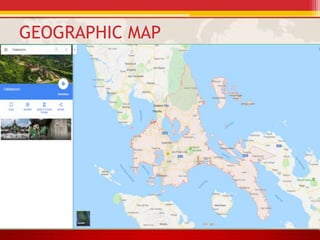
GEOGRAPHIC MAP
POPULATION AND LAND AREA
Calabarzon has a population of 14.4 million people, the largest of all
the regions in the Philippines.[1] The population growth rate between 2000 and
2010 of 3.07% decreased from the growth rate between 1990 and 2000 of
3.91%, a trend which coincided with the rest of the nation. Life expectancy for
men in Calabarzon is 68.9 years and 75.2 years for women. There are an
estimated 356,000 Overseas Filipino Workers originally from Calabarzon.
A vast majority of people living in Calabarzon are Tagalogs. It is
estimated that around 5.8 million Tagalogs live in Region IV-A. Taal, in
particular, is considered the "Heartland of Tagalog Culture" and is currently
the present "center" of Tagalog culture and people. Calabarzon is also home to
a sizable number of people with Chinese and Spanish ancestry on account of
Chinese immigration and Spanish colonialization, respectively. Because of this
large majority of Tagalog natives, the majority of people living in Calabarzon
also speak the Tagalog language. Filipino, being a version of Tagalog, is also
predominant in the region. English is also commonly spoken throughout
Calabarzon and is the language of business and education. In
Cavite, Chavacano, a Creole language is also commonly spoken.
The large majority of the population of Calabarzon is a part of
the Roman Catholic church which accounts for 80% of the national population.
Other Christian denominations present in the region are the Iglesia Ni Cristo,
the Philippine Independent Church and Seventh-day Adventist Church. There
are also Muslims living in Calabarzon although they are in the minority.
Province or
HUC
Capital Population (2015) Area Density Cities Muni. Brgy.
km2 sq mi /km2 /sq mi
Batangas Batangas City 18.7% 2,694,335 3,119.75 1,204.54 860 2,200 3 31 1,078
Cavite
•Imus
(de jure)
•Trece Martires
(de facto)
25.5% 3,678,301 1,574.17 607.79 2,300 6,000 7 16 829
Laguna Santa Cruz 21.1% 3,035,081 1,917.85 740.49 1,600 4,100 6 24 681
Quezon Lucena † 12.9% 1,856,582 8,989.39 3,470.82 210 540 1 39 1,209
Rizal Antipolo 20.0% 2,884,227 1,191.94 460.21 2,400 6,200 1 13 188
Lucena † — 1.8% 266,248 80.21 30.97 3,300 8,500 1 — 33
Total 14,414,774 16,873.31 6,319.77 850 2,200 19 123 4,011
† Lucena is a highly-urbanized city; figures are excluded from Quezon province.
ECONOMY
Calabarzon is the second largest contributor to the national GDP,
accounting for 17% of the gross domestic product. The region boasts a 2.1% inflation
rate, lower than the national average of 3%. The region has a 9.2% unemployment
rate which is higher than the national average of 7%. Calabarzon, much like the rest
of the country, is caught in the middle of being an industrial and an agricultural
economy.
Due to the region's proximity to Metro Manila, a large amount of
urbanization has taken place over the years. Cavite and Laguna in particular are
sites of manufacturing and high-tech industries, with companies
like Intel and Panasonic setting up plants in the region. Santa Rosa, Laguna, is home
to a host of semi-conductor and automotive companies such as Amkor and Toyota,
while General Trias is home to Cavite's largest economic development zone, the PEC
Industrial Park.
The region still has a large agricultural base. As of 2002, the region had
282,700 farms, covering 588,500 hectares (1,454,000 acres), or 36.3% of the
region's total land area.[25] Cavite alone has almost 70,500 hectares (174,000 acres)
of agricultural land. Laguna is home to the International Rice Research Institute,
which can be found within the University of the Philippines Los Baños, whose main
goal is find sustainable ways to help rice farmers. Batangas, meanwhile, is home to a
large pineapple and coconut industry, which is used to make Barong Tagalogs and
native liqueurs such as lambanog and tuba in Tayabas City. Quezon is the country's
leader in coconut products such as coconut oil and copra. Rizal is known for its
piggeries. Region IV-A's agricultural base, however, is slowly decreasing. Due to
their proximity to large bodies of water, Laguna and Batangas also have sizable
fishing industries. Taal Lake is a large source of fresh water fishes for the country.
Tagaytay
Tagaytay is a popular
holiday town south of
Manila on the Philippine
island Luzon. Known for its
mild climate, it sits on a
ridge above Taal Volcano
Island, an active volcano
surrounded by Taal Lake.
Overlooking the area,
People’s Park in the Sky
occupies the grounds of a
never-finished presidential
mansion. Picnic Grove is a
recreation area with trails
and a zip line.
Corregidor Island
Corregidor Island, locally called
Isla ng Corregidor, is an island located at
the entrance of Manila Bay in
southwestern part of Luzon Island in the
Philippines. Due to this location,
Corregidor has historically been fortified
with coastal artillery to defend the
entrance of Manila Bay and Manila from
attacks by enemy warships. Located 48
kilometres inland, Manila has been the
largest city and the most important
seaport in the Philippines for centuries,
from the colonial rule of Spain, Japan and
the United States, to the establishment of
the Philippines in 1946. Corregidor is the
largest of the islands that formed the
harbor defenses of Manila Bay, together
with El Fraile Island, Caballo Island and
Carabao Island, which were all fortified
during the American colonial period. The
island was also the site of a small military
airfield, as part of the defense.
Pagsanjan Falls
Pagsanjan, officially the Municipality of
Pagsanjan, is a 3rd class municipality in the province
of Laguna, Philippines. According to the 2015 census,
it has a population of 42,164 people. Situated about
92 kilometres southeast of Manila, Pagsanjan is the
tourist capital of Laguna and the home of the
Bangkero Festival. The bangkeros are tour guides,
who steer the tourists' boats. They are the boatmen
who shoot the 14 rapids between rocks and boulders
all the way to the Pagsanjan Falls, for which the town
is well known but are actually located in the
neighboring municipality of Cavinti. The Bangkero
Festival is celebrated in the month of March. The
incumbent mayor of Pagsanjan, Laguna is Girlie J.
Ejercito, known as former actress Maita Sanchez. She
is also the wife of Emilio Ramon "Jorge Estregan, Jr."
Ejercito, who served as mayor from 2001–2010 and
previous governor of Laguna. For 170 years,
Pagsanjan was the capital of the province of Laguna.
During this long period, the town prospered as the
commercial, cultural and learning center of the
province, and was called the "Athens of Laguna"
Fantasy World
Fantasy World is an
abandoned theme park
located in Lemery,
Batangas. It was built back
in 2001. There were a lot of
speculations about this
abandoned theme park.
Some say that it was
supposed to be the
Disneyland in the
Philippines, some say that
the Japanese businessman
who used to own this
couldn’t secure all the funds
needed to finish everything
that’s why it was half built.
Laguna de Baý
Laguna de Baý is the largest lake
in the Philippines located east of Metro
Manila between the provinces of Laguna to
the south and Rizal to the north. The
freshwater lake has a surface area of 911–
949 km², with an average depth of about
2.8 metres and an elevation of about 1
metre above sea level. The lake is shaped
like a stylized 'W', with two peninsulas
jutting out from the northern shore.
Between these peninsulas, the middle lobe
fills the large volcanic Laguna Caldera. In
the middle of the lake is the large island of
Talim, which falls under the jurisdiction of
the towns of Binangonan and Cardona in
Rizal province. The lake is one of the
primary sources of freshwater fish in the
country. Its water drains to Manila Bay via
the Pasig River.
Region IV- B is composed of five provinces
• Occidental Mindoro
• Oriental Mindoro
• Marinduque
• Romblon
• Palawan
MIMAROPA
The Southwestern Tagalog Region, officially designated
as MIMAROPA Region, is an administrative region in the Philippines. It
was also formerly designated as Region IV-B until 2016. It is one of two
regions in the country having no land border with another region (the other
being Eastern Visayas). The name is an acronym combination of its
constituent provinces: Mindoro (divided into Occidental
Mindoro and Oriental Mindoro), Marinduque, Romblon and Palawan.
The region was part of the now-defunct Southern Tagalog region until
17 May 2002. On 23 May 2005, Palawan and the highly urbanized
city of Puerto Princesa were moved to the region of Western
Visayas by Executive Order No. 429. However, on 19 August 2005, then-
President Arroyo issued Administrative Order No. 129 to put in
abeyance Executive Order No. 429 pending a review. On 17 July
2016, Republic Act No. 10879 formally established the Southwestern Tagalog
Region to be known as the MIMAROPA Region discontinuing the "Region IV-
B" designation, however no boundary changes were involved.
Calapan is Mimaropa's regional center. However, most regional
government offices such as the Department of Public Works and
Highways[7] and the Department of Budget and Management are in Quezon
City, Metro Manila.
HISTORY
MIMAROPA Region, together with CALABARZON, were officially created with
the partitioning of Region IV (Southern Tagalog) into the two regions on 17 May 2002
with the issuance of Executive Order No. 103 by then-President Gloria Macapagal-
Arroyo; for the purpose of promoting efficiency in the government, accelerating social
and economic development and improving public services in the provinces covered.
Region IV-B was designated as MIMAROPA, which stands for the island provinces
belonging to the Southern Tagalog region—
Mindoro (Oriental and Occidental), Marinduque, Romblon and Palawan. Region IV-A
was designated as CALABARZON.
On 23 May 2005, Executive Order 429 was issued, moving the province
of Palawan to the region of Western Visayas, designating Region IV-B as MIMARO.
However, Palawan residents criticized the move, citing a lack of consultation, with most
residents in Puerto Princesa and nearly all municipalities preferring to stay with Region
IV-B. Consequently, Administrative Order No. 129 was issued on 19 August 2005 to
address this backlash. This order directed the abeyance of Executive Order 429 pending
the approval of an implementation plan for the orderly transfer of Palawan from
Mimaropa to Region VI.
The 2010 Philippine Census of Population reported the region's name as
"MIMAROPA" and included Palawan as part of the region. As of 2014, it is not clear
whether the transfer of Palawan to Western Visayas is still considered pending by the
Philippine government. As of 2014, the National Statistical Coordinating Board of the
Philippines continued to list Palawan province as part of the Mimaropa region.
On 17 July 2016, Republic Act No. 10879 formally established
the Southwestern Tagalog Region to be known as the MIMAROPA Region. This
involved no boundary changes but was in effect merely a renaming and discontinuation
of the "Region IV-B" designation.
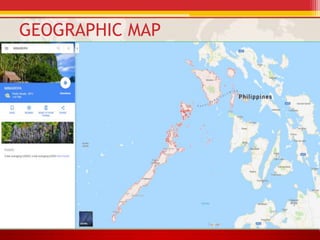
GEOGRAPHIC MAP
POPULATION AND LAND AREA
Province or
HUC
Capital Population (2015) Area Density Cities Muni. Brgy.
km2 sq mi /km2 /sq mi
Marinduque Boac 7.9% 234,521 952.58 367.79 250 650 0 6 218
Occidental
Mindoro
Mamburao 16.4% 487,414 5,865.70 2,264.76 83 210 0 11 162
Oriental Mindoro Calapan 28.5% 844,059 4,238.40 1,636.46 200 520 1 14 426
Palawan
Puerto
Princesa
28.7% 849,469 14,649.70 5,656.28 58 150 0 23 367
Romblon Romblon 9.9% 292,781 1,533.50 592.09 190 490 0 17 219
Puerto
Princesa
† — 8.6% 255,116 2,381.02 919.32 110 280 — — 66
Total 2,963,360 29,620.90 11,436.69 100 260 2 71 1,458
† Puerto Princesa is a highly-urbanized city pursuant to Presidential Proclamation No. 1264;figures are excluded from Palawan.
El Nido
El Nido is a Philippine
municipality on Palawan
island. It’s known for white-
sand beaches, coral reefs and
as the gateway to the Bacuit
archipelago, a group of
islands with steep karst cliffs.
Miniloc Island is famed for
the clear waters of its Small
and Big lagoons. Nearby
Shimizu Island has fish-filled
waters. The area has many
dive sites, including
Dilumacad Island’s long
tunnel leading to an
underwater cavern.
Coron Island
Coron, officially the
Municipality of Coron is a 1st class
municipality in the province of Palawan,
Philippines. According to the 2015
census, it has a population of 51,803
people. It comprises the eastern half of
Busuanga Island, all of Coron Island and
about 50 other minor islets stretching as
far as Tara Island in the north-east and
Canipo Island in the south. All these
islands are part of the Calamian
Archipelago in Northern Palawan that
separates the South China Sea from the
Sulu Sea. The main population center of
the municipality is composed of
Poblacion barangays 1 to 6, where the
Municipal Building, the Municipal
Legislative Building, and the Judicial Hall
of the Municipal Circuit Trial Court are
located. Its fiesta is held annually on
August 28 in honor of Saint Augustine. It
is the commercial capital of the Calamian
Islands. The municipality is home to the
Coron Island Natural Biotic Area, which
is listed in the natural category of the
UNESCO World Heritage Tentative List.
Underground River
Mountainous
national park known
for its 5-mile
underground river &
caves with boat tours.
Busuanga Island
Busuanga, is the largest island in
the Calamian Group of islands in the
province of Palawan in the Philippines.
Busuanga Island is the second largest
island in the province after Palawan island
itself. The island is located halfway
between the islands of Mindoro and
Palawan with the South China Sea located
to the west and the Sulu Sea to the
southeast. South of the island are the two
other major islands of the Calamian
Group: Culion Island and Coron Island.
The western third of the island is under the
municipality of Busuanga and the eastern
two-thirds belong to the municipality of
Coron. Busuanga Island is mainly known
as a recreational diving location due to the
twelve World War II Japanese wrecks that
were sunk by American navy bombings in
Coron Bay, a natural anchorage near the
town center of Coron, on September 24,
1944.
Calauit Safari Park
Calauit Island is an island of the
Calamian Archipelago, just off the north-
western coast of Busuanga Island. It is part
of the municipality of Busuanga in the
province of Palawan, Philippines. The entire
island was declared as a wildlife sanctuary
and game preserve in 1977, now is a tourist
attraction known as Calauit Safari Park. The
wild animals were imported from Africa in
the 1970s to save them from extinction. The
imported animals include 20 giraffes,
dozens of zebra and antelopes. Philippine
President Ferdinand Marcos ordered the
locals to move to Halsey Island and ordered
to clear the bamboo forests to make the
place similar to the savannahs of Kenya.
Today, the African animals continue to roam
around the island and the number of
animals is increasing.
Region IV

Region IV

  • 1.
    REGION Reporter: Larry G. PaelJr. Surigao State College of Technology Main Campus, Surigao City IV
  • 3.
    Region IV- Ais composed of five provinces •Cavite •Laguna •Batangas •Rizal •Quezon
  • 4.
    CALABARZON Calabarzon (/ká-lɑ-bɑr-zon/), formally knownas Southern Filipino Mainland and designated as Region IV-A, is an administrative region in the Philippines. The region comprises five provinces: Cavite, Laguna, Batangas, Rizal, and Quezon, and one highly urbanized city, Lucena. The name of the region is an acronym of its five component provinces. Its regional center is Calamba City in Laguna. Calabarzon is the most populous region in the Philippines, having 14,414,774 inhabitants in 2015, and is also the country's second most densely populated after NCR.
  • 5.
    The history ofthe area known as Calabarzon dates back to early historic times. Local historians believe that three of the tenth century place-names mentioned in the Philippines' earliest known written document, the Laguna Copperplate Inscription, pertain to regions or polities (Tagalog: "bayan") along the shores of Laguna Lake; and some Filipino- Chinese scholars believe the tenth century trading polity known as Ma-i may actually have been the predecessor of the present day town of Bay, Laguna. Since the Philippines' colonial period, the region has served as home to some of the most important Philippine historical figures, including the Philippines' national hero, Jose Rizal, who was born in Calamba.
  • 6.
    HISTORY On June 5,1901, a convention was called on whether or not the province of Manila should annex the province of Morong, which was found to be unable to be self- sufficient as a province. Eventually, on June 11, Act No. 137of the First Philippine Commission abolished Morong and created a new province, named after the Philippines' national hero, Jose Rizal, who, coincidentally, was a native of Laguna. The new province comprised 29 municipalities, 17 from Manila and 12 from Morong. In 1902, Macario Sakay, a veteran Katipunan member, established the Tagalog Republic in the mountains of Rizal. Ultimately, Sakay's Tagalog Republic ended in 1906 when he and his men were betrayed under the guise of holding a national assembly aimed at the self-determination of the Filipino people. On September 7, 1946, the Third Philippine Republic enacted Republic Act No. 14, which renamed the province of Tayabas to Quezon, in honor of Manuel Quezon. Quezon was the second President of the Philippinesand a native of Baler (now part of Aurora). In 1951, the northern part of Quezon became the sub-province Aurora, named after Quezon's wife. On September 24, 1972, President Ferdinand Marcos enacted Presidential Decree No. 1, which organized the provinces into 11 regions as part of Marcos' Integrated Reorganization Plan.The IRP created Region IV, known as the Southern Tagalog region, and was the largest region in the Philippines. At this time, Region IV consisted of Batangas, Cavite, Laguna, Marinduque, Oriental Mindoro, Occidental Mindoro, Quezon, Rizal, Romblon, and Palawan. In 1979, Aurora formally became a province independent of Quezon and was also included in Region IV.[citation needed] On May 17, 2002, President Gloria Macapagal-Arroyo signed Executive Order No. 103, which made reorganized to the Southern Tagalog region. Due to its size, Region IV was split into two separate regions, Region IV-A (Calabarzon) and Region IV-B (Mimaropa). Aurora was transferred to Region III, Central Luzon.The next year, Arroyo signed Executive Order No. 246, which declared Calamba as the regional center of the region.
  • 7.
    GEOGRAPHY CALABARZON is the12th largest region in the Philippines, with an area of 16,873.31 km2. The region itself is relatively flat, but also consists of coastal areas and highlands.[14] CALABARZON is bordered by Manila Bay in the west, Metro Manila, Bulacan, and Aurora in the north, Lamon Bay and Bicol in the east, and the Isla Verde Passage in the south. Each province in the region is composed of different environments, ranging from low coastal areas to rugged mountainous ones. Cavite is characterized by rolling hinterlands punctured by hills, with a shoreline bordering Manila Bay and a rugged portion bordering Batangas near Mount Pico de Loro. The Tagaytay is located in Cavite, bordering Alfonso, Silang, Calamba, and Santa Rosa. Mount Sungay is the highest peak in the province and can be found in Tagaytay. There are nine islands in Cavite, most notable of which is the island of Corregidor. Historically a site of great strategic importance, Corregidor is found at the mouth of Manila Bay and is under the jurisdiction of Cavite City. Laguna has rugged terrain, with narrow plains near the shores of Laguna de Bay and mountainous ranges further inland. Laguna de Bay is the largest lake in the Philippines, and is named after the town of Bay. Laguna is also home to Mount Makiling, a dormant volcano near Los Banos reputed for its mystical properties. There are also a lot of hot springs near the Makiling area, especially in San Pablo. Another famous landmark in Laguna are the Pagsanjan Falls, in Cavinti. The water from the Pagsanjan Falls comes from the Bumbungan River. Mount Banahaw borders Laguna and Quezon, and is similarly considered to be a holy mountain like Makiling.
  • 8.
    The Batangas areais mostly elevated, with small low flat lands and scattered mountain areas. Batangas is also home to the Taal Volcano, a complex volcano and one of the 16 Decade Volcanoes. The Taal Volcano is situated within Taal Lake, making Taal a third-order island, and possibly one of the largest in the world. Other islands in Batangas are Verde Island, near the Isla Verde Passage, and Fortune Island in Nasugbu. Batangas borders Cavite via Mount Pico de Loro, known for the views that could be found in its summit. Mount Makulot and Mount Batulao can also be found in Batangas. Rizal is situated north of Laguna de Bay, and consists of a mixture of valleys and mountain ranges, with flat low-lying areas in the western portion of the province near Manila. The eastern portion of Rizal has hills and ridges which form part of the Sierra Madre range. Talim Island, the largest island in Laguna de Bay, is under the jurisdiction of the province of Rizal. Quezon is mountainous, with few plains and swamps, and the tail- end of the Sierra Madre running through it. Quezon is a narrow province, with the Tayabas Isthmus comprising the southern part of the province and connecting it to the Bicol Peninsula. The southern part also consists of the Bondoc Peninsula, sandwiched between the Tayabas Bay and Ragay Gulf. The largest islands in Quezon are the Alabat and Polillo islands, which are both located in Lamon Bay, connecting to Calauag Bay of the town of Calauag. Laguna shares a border with Quezon via Mount Banahaw.
  • 9.
  • 10.
    POPULATION AND LANDAREA Calabarzon has a population of 14.4 million people, the largest of all the regions in the Philippines.[1] The population growth rate between 2000 and 2010 of 3.07% decreased from the growth rate between 1990 and 2000 of 3.91%, a trend which coincided with the rest of the nation. Life expectancy for men in Calabarzon is 68.9 years and 75.2 years for women. There are an estimated 356,000 Overseas Filipino Workers originally from Calabarzon. A vast majority of people living in Calabarzon are Tagalogs. It is estimated that around 5.8 million Tagalogs live in Region IV-A. Taal, in particular, is considered the "Heartland of Tagalog Culture" and is currently the present "center" of Tagalog culture and people. Calabarzon is also home to a sizable number of people with Chinese and Spanish ancestry on account of Chinese immigration and Spanish colonialization, respectively. Because of this large majority of Tagalog natives, the majority of people living in Calabarzon also speak the Tagalog language. Filipino, being a version of Tagalog, is also predominant in the region. English is also commonly spoken throughout Calabarzon and is the language of business and education. In Cavite, Chavacano, a Creole language is also commonly spoken. The large majority of the population of Calabarzon is a part of the Roman Catholic church which accounts for 80% of the national population. Other Christian denominations present in the region are the Iglesia Ni Cristo, the Philippine Independent Church and Seventh-day Adventist Church. There are also Muslims living in Calabarzon although they are in the minority.
  • 11.
    Province or HUC Capital Population(2015) Area Density Cities Muni. Brgy. km2 sq mi /km2 /sq mi Batangas Batangas City 18.7% 2,694,335 3,119.75 1,204.54 860 2,200 3 31 1,078 Cavite •Imus (de jure) •Trece Martires (de facto) 25.5% 3,678,301 1,574.17 607.79 2,300 6,000 7 16 829 Laguna Santa Cruz 21.1% 3,035,081 1,917.85 740.49 1,600 4,100 6 24 681 Quezon Lucena † 12.9% 1,856,582 8,989.39 3,470.82 210 540 1 39 1,209 Rizal Antipolo 20.0% 2,884,227 1,191.94 460.21 2,400 6,200 1 13 188 Lucena † — 1.8% 266,248 80.21 30.97 3,300 8,500 1 — 33 Total 14,414,774 16,873.31 6,319.77 850 2,200 19 123 4,011 † Lucena is a highly-urbanized city; figures are excluded from Quezon province.
  • 12.
    ECONOMY Calabarzon is thesecond largest contributor to the national GDP, accounting for 17% of the gross domestic product. The region boasts a 2.1% inflation rate, lower than the national average of 3%. The region has a 9.2% unemployment rate which is higher than the national average of 7%. Calabarzon, much like the rest of the country, is caught in the middle of being an industrial and an agricultural economy. Due to the region's proximity to Metro Manila, a large amount of urbanization has taken place over the years. Cavite and Laguna in particular are sites of manufacturing and high-tech industries, with companies like Intel and Panasonic setting up plants in the region. Santa Rosa, Laguna, is home to a host of semi-conductor and automotive companies such as Amkor and Toyota, while General Trias is home to Cavite's largest economic development zone, the PEC Industrial Park. The region still has a large agricultural base. As of 2002, the region had 282,700 farms, covering 588,500 hectares (1,454,000 acres), or 36.3% of the region's total land area.[25] Cavite alone has almost 70,500 hectares (174,000 acres) of agricultural land. Laguna is home to the International Rice Research Institute, which can be found within the University of the Philippines Los Baños, whose main goal is find sustainable ways to help rice farmers. Batangas, meanwhile, is home to a large pineapple and coconut industry, which is used to make Barong Tagalogs and native liqueurs such as lambanog and tuba in Tayabas City. Quezon is the country's leader in coconut products such as coconut oil and copra. Rizal is known for its piggeries. Region IV-A's agricultural base, however, is slowly decreasing. Due to their proximity to large bodies of water, Laguna and Batangas also have sizable fishing industries. Taal Lake is a large source of fresh water fishes for the country.
  • 14.
    Tagaytay Tagaytay is apopular holiday town south of Manila on the Philippine island Luzon. Known for its mild climate, it sits on a ridge above Taal Volcano Island, an active volcano surrounded by Taal Lake. Overlooking the area, People’s Park in the Sky occupies the grounds of a never-finished presidential mansion. Picnic Grove is a recreation area with trails and a zip line.
  • 15.
    Corregidor Island Corregidor Island,locally called Isla ng Corregidor, is an island located at the entrance of Manila Bay in southwestern part of Luzon Island in the Philippines. Due to this location, Corregidor has historically been fortified with coastal artillery to defend the entrance of Manila Bay and Manila from attacks by enemy warships. Located 48 kilometres inland, Manila has been the largest city and the most important seaport in the Philippines for centuries, from the colonial rule of Spain, Japan and the United States, to the establishment of the Philippines in 1946. Corregidor is the largest of the islands that formed the harbor defenses of Manila Bay, together with El Fraile Island, Caballo Island and Carabao Island, which were all fortified during the American colonial period. The island was also the site of a small military airfield, as part of the defense.
  • 16.
    Pagsanjan Falls Pagsanjan, officiallythe Municipality of Pagsanjan, is a 3rd class municipality in the province of Laguna, Philippines. According to the 2015 census, it has a population of 42,164 people. Situated about 92 kilometres southeast of Manila, Pagsanjan is the tourist capital of Laguna and the home of the Bangkero Festival. The bangkeros are tour guides, who steer the tourists' boats. They are the boatmen who shoot the 14 rapids between rocks and boulders all the way to the Pagsanjan Falls, for which the town is well known but are actually located in the neighboring municipality of Cavinti. The Bangkero Festival is celebrated in the month of March. The incumbent mayor of Pagsanjan, Laguna is Girlie J. Ejercito, known as former actress Maita Sanchez. She is also the wife of Emilio Ramon "Jorge Estregan, Jr." Ejercito, who served as mayor from 2001–2010 and previous governor of Laguna. For 170 years, Pagsanjan was the capital of the province of Laguna. During this long period, the town prospered as the commercial, cultural and learning center of the province, and was called the "Athens of Laguna"
  • 17.
    Fantasy World Fantasy Worldis an abandoned theme park located in Lemery, Batangas. It was built back in 2001. There were a lot of speculations about this abandoned theme park. Some say that it was supposed to be the Disneyland in the Philippines, some say that the Japanese businessman who used to own this couldn’t secure all the funds needed to finish everything that’s why it was half built.
  • 18.
    Laguna de Baý Lagunade Baý is the largest lake in the Philippines located east of Metro Manila between the provinces of Laguna to the south and Rizal to the north. The freshwater lake has a surface area of 911– 949 km², with an average depth of about 2.8 metres and an elevation of about 1 metre above sea level. The lake is shaped like a stylized 'W', with two peninsulas jutting out from the northern shore. Between these peninsulas, the middle lobe fills the large volcanic Laguna Caldera. In the middle of the lake is the large island of Talim, which falls under the jurisdiction of the towns of Binangonan and Cardona in Rizal province. The lake is one of the primary sources of freshwater fish in the country. Its water drains to Manila Bay via the Pasig River.
  • 20.
    Region IV- Bis composed of five provinces • Occidental Mindoro • Oriental Mindoro • Marinduque • Romblon • Palawan
  • 21.
    MIMAROPA The Southwestern TagalogRegion, officially designated as MIMAROPA Region, is an administrative region in the Philippines. It was also formerly designated as Region IV-B until 2016. It is one of two regions in the country having no land border with another region (the other being Eastern Visayas). The name is an acronym combination of its constituent provinces: Mindoro (divided into Occidental Mindoro and Oriental Mindoro), Marinduque, Romblon and Palawan. The region was part of the now-defunct Southern Tagalog region until 17 May 2002. On 23 May 2005, Palawan and the highly urbanized city of Puerto Princesa were moved to the region of Western Visayas by Executive Order No. 429. However, on 19 August 2005, then- President Arroyo issued Administrative Order No. 129 to put in abeyance Executive Order No. 429 pending a review. On 17 July 2016, Republic Act No. 10879 formally established the Southwestern Tagalog Region to be known as the MIMAROPA Region discontinuing the "Region IV- B" designation, however no boundary changes were involved. Calapan is Mimaropa's regional center. However, most regional government offices such as the Department of Public Works and Highways[7] and the Department of Budget and Management are in Quezon City, Metro Manila.
  • 22.
    HISTORY MIMAROPA Region, togetherwith CALABARZON, were officially created with the partitioning of Region IV (Southern Tagalog) into the two regions on 17 May 2002 with the issuance of Executive Order No. 103 by then-President Gloria Macapagal- Arroyo; for the purpose of promoting efficiency in the government, accelerating social and economic development and improving public services in the provinces covered. Region IV-B was designated as MIMAROPA, which stands for the island provinces belonging to the Southern Tagalog region— Mindoro (Oriental and Occidental), Marinduque, Romblon and Palawan. Region IV-A was designated as CALABARZON. On 23 May 2005, Executive Order 429 was issued, moving the province of Palawan to the region of Western Visayas, designating Region IV-B as MIMARO. However, Palawan residents criticized the move, citing a lack of consultation, with most residents in Puerto Princesa and nearly all municipalities preferring to stay with Region IV-B. Consequently, Administrative Order No. 129 was issued on 19 August 2005 to address this backlash. This order directed the abeyance of Executive Order 429 pending the approval of an implementation plan for the orderly transfer of Palawan from Mimaropa to Region VI. The 2010 Philippine Census of Population reported the region's name as "MIMAROPA" and included Palawan as part of the region. As of 2014, it is not clear whether the transfer of Palawan to Western Visayas is still considered pending by the Philippine government. As of 2014, the National Statistical Coordinating Board of the Philippines continued to list Palawan province as part of the Mimaropa region. On 17 July 2016, Republic Act No. 10879 formally established the Southwestern Tagalog Region to be known as the MIMAROPA Region. This involved no boundary changes but was in effect merely a renaming and discontinuation of the "Region IV-B" designation.
  • 23.
  • 24.
    POPULATION AND LANDAREA Province or HUC Capital Population (2015) Area Density Cities Muni. Brgy. km2 sq mi /km2 /sq mi Marinduque Boac 7.9% 234,521 952.58 367.79 250 650 0 6 218 Occidental Mindoro Mamburao 16.4% 487,414 5,865.70 2,264.76 83 210 0 11 162 Oriental Mindoro Calapan 28.5% 844,059 4,238.40 1,636.46 200 520 1 14 426 Palawan Puerto Princesa 28.7% 849,469 14,649.70 5,656.28 58 150 0 23 367 Romblon Romblon 9.9% 292,781 1,533.50 592.09 190 490 0 17 219 Puerto Princesa † — 8.6% 255,116 2,381.02 919.32 110 280 — — 66 Total 2,963,360 29,620.90 11,436.69 100 260 2 71 1,458 † Puerto Princesa is a highly-urbanized city pursuant to Presidential Proclamation No. 1264;figures are excluded from Palawan.
  • 26.
    El Nido El Nidois a Philippine municipality on Palawan island. It’s known for white- sand beaches, coral reefs and as the gateway to the Bacuit archipelago, a group of islands with steep karst cliffs. Miniloc Island is famed for the clear waters of its Small and Big lagoons. Nearby Shimizu Island has fish-filled waters. The area has many dive sites, including Dilumacad Island’s long tunnel leading to an underwater cavern.
  • 27.
    Coron Island Coron, officiallythe Municipality of Coron is a 1st class municipality in the province of Palawan, Philippines. According to the 2015 census, it has a population of 51,803 people. It comprises the eastern half of Busuanga Island, all of Coron Island and about 50 other minor islets stretching as far as Tara Island in the north-east and Canipo Island in the south. All these islands are part of the Calamian Archipelago in Northern Palawan that separates the South China Sea from the Sulu Sea. The main population center of the municipality is composed of Poblacion barangays 1 to 6, where the Municipal Building, the Municipal Legislative Building, and the Judicial Hall of the Municipal Circuit Trial Court are located. Its fiesta is held annually on August 28 in honor of Saint Augustine. It is the commercial capital of the Calamian Islands. The municipality is home to the Coron Island Natural Biotic Area, which is listed in the natural category of the UNESCO World Heritage Tentative List.
  • 28.
    Underground River Mountainous national parkknown for its 5-mile underground river & caves with boat tours.
  • 29.
    Busuanga Island Busuanga, isthe largest island in the Calamian Group of islands in the province of Palawan in the Philippines. Busuanga Island is the second largest island in the province after Palawan island itself. The island is located halfway between the islands of Mindoro and Palawan with the South China Sea located to the west and the Sulu Sea to the southeast. South of the island are the two other major islands of the Calamian Group: Culion Island and Coron Island. The western third of the island is under the municipality of Busuanga and the eastern two-thirds belong to the municipality of Coron. Busuanga Island is mainly known as a recreational diving location due to the twelve World War II Japanese wrecks that were sunk by American navy bombings in Coron Bay, a natural anchorage near the town center of Coron, on September 24, 1944.
  • 30.
    Calauit Safari Park CalauitIsland is an island of the Calamian Archipelago, just off the north- western coast of Busuanga Island. It is part of the municipality of Busuanga in the province of Palawan, Philippines. The entire island was declared as a wildlife sanctuary and game preserve in 1977, now is a tourist attraction known as Calauit Safari Park. The wild animals were imported from Africa in the 1970s to save them from extinction. The imported animals include 20 giraffes, dozens of zebra and antelopes. Philippine President Ferdinand Marcos ordered the locals to move to Halsey Island and ordered to clear the bamboo forests to make the place similar to the savannahs of Kenya. Today, the African animals continue to roam around the island and the number of animals is increasing.