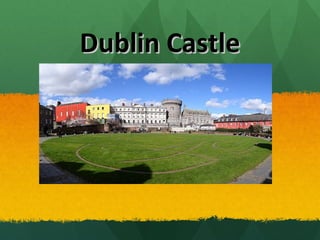
Dublin CastleDublin Castle
VikingsVikings
In 930, the Vikings builtIn 930, the Vikings built
fortifications on the river Liffey. Thefortifications on the river Liffey. The
site was called Dubh Linn in Gaelicsite was called Dubh Linn in Gaelic
(pronounced Dub Lin), which means(pronounced Dub Lin), which means
Black Water. Their settlementBlack Water. Their settlement
quickly became the main Vikingquickly became the main Viking
military base and trading centre ofmilitary base and trading centre of
slaves and silver, in Ireland. Theslaves and silver, in Ireland. The
Scandanavian rulers had control ofScandanavian rulers had control of
the Irish Sea and attacked deep intothe Irish Sea and attacked deep into
the centre of Ireland, wherethe centre of Ireland, where
monasteries, with their preciousmonasteries, with their precious
treasures, were easy targets.treasures, were easy targets.
Eventually their power was brokenEventually their power was broken
when were heavily defeated by anwhen were heavily defeated by an
Irish army under the command ofIrish army under the command of
King Brian Boru, at the Battle ofKing Brian Boru, at the Battle of
Clontarft, 1014.Clontarft, 1014.
Sculpture ofSculpture of
King BrianKing Brian
Boru,Boru,
ChapelChapel
Royal,Royal,
DublinDublin
CastleCastle
NormansNormans
When the NormansWhen the Normans
invaded Dublin in 1169,invaded Dublin in 1169,
they picked Dublin Castlethey picked Dublin Castle
as their stronghold.as their stronghold. NNeithereither
the Irish nor the Vikingsthe Irish nor the Vikings
could withstand thecould withstand the
Norman invasion of 1169.Norman invasion of 1169.
The Vikings were ejectedThe Vikings were ejected
and the Normans becameand the Normans became
the next occupiers ofthe next occupiers of
Dublin. They strengthenedDublin. They strengthened
and expanded the existingand expanded the existing
town walls.town walls.
The first 'castle' in the proper sense of the word - stone walls and ditches -The first 'castle' in the proper sense of the word - stone walls and ditches -
was completed by the English in 1230. The Great Courtyard of todaywas completed by the English in 1230. The Great Courtyard of today
corresponds closely with these fortifications, with the Record Tower as thecorresponds closely with these fortifications, with the Record Tower as the
last intact medieval tower of Dublin.last intact medieval tower of Dublin.
The Record Tower is the last intact tower of DublinThe Record Tower is the last intact tower of Dublin
Castle. Its walls are very thick as it was often used as aCastle. Its walls are very thick as it was often used as a
high security prison. However, it was not secure enoughhigh security prison. However, it was not secure enough
to contain the Irish Chieftain, Red Hugh O'Donnell, whoto contain the Irish Chieftain, Red Hugh O'Donnell, who
made two successful escapes from the tower. The towermade two successful escapes from the tower. The tower
now houses the Garda (Police) Museum.now houses the Garda (Police) Museum.
Many of the Castle's functions changed over the centuries. It wasMany of the Castle's functions changed over the centuries. It was
always the centre of the English colonial administration. Dublin Castlealways the centre of the English colonial administration. Dublin Castle
was the dungeon for state prisoners and the seat of Parliament. Thewas the dungeon for state prisoners and the seat of Parliament. The
Courts of Law also met at Dublin Castle. The Castle housed the theCourts of Law also met at Dublin Castle. The Castle housed the the
Royal Treasury and the Royal Mint, army and police barracks,Royal Treasury and the Royal Mint, army and police barracks,
armaments factories and weapons stores.armaments factories and weapons stores.
Star andStar and
Badge ofBadge of
the Orderthe Order
of St.of St.
PatrickPatrick
In 1783, King George IIIIn 1783, King George III
established the Order of St.established the Order of St.
Patrick The granting ofPatrick The granting of
knighthoods was seen as a wayknighthoods was seen as a way
of rewarding and ensuringof rewarding and ensuring
loyalty.loyalty.
The ceremony of KnighthoodThe ceremony of Knighthood
took place in St. Patrick's hall.took place in St. Patrick's hall.
The Irish Crown Jewels was theThe Irish Crown Jewels was the
name given to the valuable,name given to the valuable,
jewelled objects which thejewelled objects which the
monarch wore during themonarch wore during the
ceremony. In 1903, it wasceremony. In 1903, it was
decided that the jewels shoulddecided that the jewels should
be stored at Dublin Castle wherebe stored at Dublin Castle where
a new strong room had beena new strong room had been
installedinstalled..
The Mystery of the Missing Crown JewelsThe Mystery of the Missing Crown Jewels
.. The jewels were discovered missing four days before a visitThe jewels were discovered missing four days before a visit
by King EdwardVII in 1907.The King was furious - he hadby King EdwardVII in 1907.The King was furious - he had
intended to bestow a Knighthood. Instead, the ceremony wasintended to bestow a Knighthood. Instead, the ceremony was
cancelled.The whereabouts of the Irish Crown Jewels stillcancelled.The whereabouts of the Irish Crown Jewels still
remains a mysteryremains a mystery..
The Throne Room
State Drawing RoomState Drawing Room
Built in the 1830s as the principal reception room of the LordBuilt in the 1830s as the principal reception room of the Lord
Lieutenant and his household, today this room is reserved in useLieutenant and his household, today this room is reserved in use
for the reception of foreign dignitaries.for the reception of foreign dignitaries.
St Patrick’s HallSt Patrick’s Hall
This is the grandest room of the State Apartments, and contains one ofThis is the grandest room of the State Apartments, and contains one of
the most important decorative interiors in Ireland. Formerly thethe most important decorative interiors in Ireland. Formerly the
ballroom of the Lord Lieutenant's administration, today the room is usedballroom of the Lord Lieutenant's administration, today the room is used
for presidential inaugurations.for presidential inaugurations.
Easter 1916Easter 1916
RisingRising
As a symbol of EnglishAs a symbol of English
reign, Dublin Castle was areign, Dublin Castle was a
key target during thekey target during the
Easter Rising of 1916,Easter Rising of 1916,
which marked the firstwhich marked the first
step towards the end ofstep towards the end of
British rule in Ireland. OneBritish rule in Ireland. One
of the first fatalities of theof the first fatalities of the
Rising was a policemanRising was a policeman
named O'Brien, whonamed O'Brien, who
attempted to shut theattempted to shut the
Castle's Cork Hill Gate onCastle's Cork Hill Gate on
an advancing rebel party.an advancing rebel party.
Cork Hill Gate
Captain Séan Connolly who fired the shot wasCaptain Séan Connolly who fired the shot was
killed by army snipers located on the roof ofkilled by army snipers located on the roof of
Bedford Tower when he attempted to raise theBedford Tower when he attempted to raise the
rebel flag on adjacent City Hall.rebel flag on adjacent City Hall.
Bedford Tower
Handing the Castle over to the IrishHanding the Castle over to the Irish
For over seven centuries, Dublin Castle was a symbol of British rule in Ireland. On January 16th 1922,For over seven centuries, Dublin Castle was a symbol of British rule in Ireland. On January 16th 1922,
Michael Collins received the handover of the Castle on behalf of the new Irish Free StateMichael Collins received the handover of the Castle on behalf of the new Irish Free State Government.Government.
Lord Lieutenant FitzAlan is reported to have said, "You are seven minutes late Mr. Collins" toLord Lieutenant FitzAlan is reported to have said, "You are seven minutes late Mr. Collins" to
which he received the reply "We've been waiting over seven hundred years, you can have thewhich he received the reply "We've been waiting over seven hundred years, you can have the
extra seven minutes!".extra seven minutes!".
From the film: Michael Collins
The castle is a tourist attraction and,The castle is a tourist attraction and,
following major refurbishment, is also used as afollowing major refurbishment, is also used as a
conference centre. During Ireland's presidenciesconference centre. During Ireland's presidencies
of the European Union it has been the venue ofof the European Union it has been the venue of
many meetings of the European Council.many meetings of the European Council.
The Crypt of the castle is now used as an artsThe Crypt of the castle is now used as an arts
centre and concerts are held in the grounds of thecentre and concerts are held in the grounds of the
castle. The Chester Beatty Library is also in thecastle. The Chester Beatty Library is also in the
castle.castle.
 Chester Beatty MuseumChester Beatty Museum
Sand Sculptures in Dublin
Castle grounds

Caisleán Bhaile Átha Cliath

  • 1.
  • 2.
    VikingsVikings In 930, theVikings builtIn 930, the Vikings built fortifications on the river Liffey. Thefortifications on the river Liffey. The site was called Dubh Linn in Gaelicsite was called Dubh Linn in Gaelic (pronounced Dub Lin), which means(pronounced Dub Lin), which means Black Water. Their settlementBlack Water. Their settlement quickly became the main Vikingquickly became the main Viking military base and trading centre ofmilitary base and trading centre of slaves and silver, in Ireland. Theslaves and silver, in Ireland. The Scandanavian rulers had control ofScandanavian rulers had control of the Irish Sea and attacked deep intothe Irish Sea and attacked deep into the centre of Ireland, wherethe centre of Ireland, where monasteries, with their preciousmonasteries, with their precious treasures, were easy targets.treasures, were easy targets. Eventually their power was brokenEventually their power was broken when were heavily defeated by anwhen were heavily defeated by an Irish army under the command ofIrish army under the command of King Brian Boru, at the Battle ofKing Brian Boru, at the Battle of Clontarft, 1014.Clontarft, 1014.
  • 3.
    Sculpture ofSculpture of KingBrianKing Brian Boru,Boru, ChapelChapel Royal,Royal, DublinDublin CastleCastle
  • 4.
    NormansNormans When the NormansWhenthe Normans invaded Dublin in 1169,invaded Dublin in 1169, they picked Dublin Castlethey picked Dublin Castle as their stronghold.as their stronghold. NNeithereither the Irish nor the Vikingsthe Irish nor the Vikings could withstand thecould withstand the Norman invasion of 1169.Norman invasion of 1169. The Vikings were ejectedThe Vikings were ejected and the Normans becameand the Normans became the next occupiers ofthe next occupiers of Dublin. They strengthenedDublin. They strengthened and expanded the existingand expanded the existing town walls.town walls.
  • 5.
    The first 'castle'in the proper sense of the word - stone walls and ditches -The first 'castle' in the proper sense of the word - stone walls and ditches - was completed by the English in 1230. The Great Courtyard of todaywas completed by the English in 1230. The Great Courtyard of today corresponds closely with these fortifications, with the Record Tower as thecorresponds closely with these fortifications, with the Record Tower as the last intact medieval tower of Dublin.last intact medieval tower of Dublin.
  • 6.
    The Record Toweris the last intact tower of DublinThe Record Tower is the last intact tower of Dublin Castle. Its walls are very thick as it was often used as aCastle. Its walls are very thick as it was often used as a high security prison. However, it was not secure enoughhigh security prison. However, it was not secure enough to contain the Irish Chieftain, Red Hugh O'Donnell, whoto contain the Irish Chieftain, Red Hugh O'Donnell, who made two successful escapes from the tower. The towermade two successful escapes from the tower. The tower now houses the Garda (Police) Museum.now houses the Garda (Police) Museum.
  • 7.
    Many of theCastle's functions changed over the centuries. It wasMany of the Castle's functions changed over the centuries. It was always the centre of the English colonial administration. Dublin Castlealways the centre of the English colonial administration. Dublin Castle was the dungeon for state prisoners and the seat of Parliament. Thewas the dungeon for state prisoners and the seat of Parliament. The Courts of Law also met at Dublin Castle. The Castle housed the theCourts of Law also met at Dublin Castle. The Castle housed the the Royal Treasury and the Royal Mint, army and police barracks,Royal Treasury and the Royal Mint, army and police barracks, armaments factories and weapons stores.armaments factories and weapons stores.
  • 8.
    Star andStar and BadgeofBadge of the Orderthe Order of St.of St. PatrickPatrick In 1783, King George IIIIn 1783, King George III established the Order of St.established the Order of St. Patrick The granting ofPatrick The granting of knighthoods was seen as a wayknighthoods was seen as a way of rewarding and ensuringof rewarding and ensuring loyalty.loyalty. The ceremony of KnighthoodThe ceremony of Knighthood took place in St. Patrick's hall.took place in St. Patrick's hall. The Irish Crown Jewels was theThe Irish Crown Jewels was the name given to the valuable,name given to the valuable, jewelled objects which thejewelled objects which the monarch wore during themonarch wore during the ceremony. In 1903, it wasceremony. In 1903, it was decided that the jewels shoulddecided that the jewels should be stored at Dublin Castle wherebe stored at Dublin Castle where a new strong room had beena new strong room had been installedinstalled..
  • 9.
    The Mystery ofthe Missing Crown JewelsThe Mystery of the Missing Crown Jewels .. The jewels were discovered missing four days before a visitThe jewels were discovered missing four days before a visit by King EdwardVII in 1907.The King was furious - he hadby King EdwardVII in 1907.The King was furious - he had intended to bestow a Knighthood. Instead, the ceremony wasintended to bestow a Knighthood. Instead, the ceremony was cancelled.The whereabouts of the Irish Crown Jewels stillcancelled.The whereabouts of the Irish Crown Jewels still remains a mysteryremains a mystery.. The Throne Room
  • 10.
    State Drawing RoomStateDrawing Room Built in the 1830s as the principal reception room of the LordBuilt in the 1830s as the principal reception room of the Lord Lieutenant and his household, today this room is reserved in useLieutenant and his household, today this room is reserved in use for the reception of foreign dignitaries.for the reception of foreign dignitaries.
  • 11.
    St Patrick’s HallStPatrick’s Hall This is the grandest room of the State Apartments, and contains one ofThis is the grandest room of the State Apartments, and contains one of the most important decorative interiors in Ireland. Formerly thethe most important decorative interiors in Ireland. Formerly the ballroom of the Lord Lieutenant's administration, today the room is usedballroom of the Lord Lieutenant's administration, today the room is used for presidential inaugurations.for presidential inaugurations.
  • 12.
    Easter 1916Easter 1916 RisingRising Asa symbol of EnglishAs a symbol of English reign, Dublin Castle was areign, Dublin Castle was a key target during thekey target during the Easter Rising of 1916,Easter Rising of 1916, which marked the firstwhich marked the first step towards the end ofstep towards the end of British rule in Ireland. OneBritish rule in Ireland. One of the first fatalities of theof the first fatalities of the Rising was a policemanRising was a policeman named O'Brien, whonamed O'Brien, who attempted to shut theattempted to shut the Castle's Cork Hill Gate onCastle's Cork Hill Gate on an advancing rebel party.an advancing rebel party. Cork Hill Gate
  • 13.
    Captain Séan Connollywho fired the shot wasCaptain Séan Connolly who fired the shot was killed by army snipers located on the roof ofkilled by army snipers located on the roof of Bedford Tower when he attempted to raise theBedford Tower when he attempted to raise the rebel flag on adjacent City Hall.rebel flag on adjacent City Hall. Bedford Tower
  • 14.
    Handing the Castleover to the IrishHanding the Castle over to the Irish For over seven centuries, Dublin Castle was a symbol of British rule in Ireland. On January 16th 1922,For over seven centuries, Dublin Castle was a symbol of British rule in Ireland. On January 16th 1922, Michael Collins received the handover of the Castle on behalf of the new Irish Free StateMichael Collins received the handover of the Castle on behalf of the new Irish Free State Government.Government. Lord Lieutenant FitzAlan is reported to have said, "You are seven minutes late Mr. Collins" toLord Lieutenant FitzAlan is reported to have said, "You are seven minutes late Mr. Collins" to which he received the reply "We've been waiting over seven hundred years, you can have thewhich he received the reply "We've been waiting over seven hundred years, you can have the extra seven minutes!".extra seven minutes!". From the film: Michael Collins
  • 15.
    The castle isa tourist attraction and,The castle is a tourist attraction and, following major refurbishment, is also used as afollowing major refurbishment, is also used as a conference centre. During Ireland's presidenciesconference centre. During Ireland's presidencies of the European Union it has been the venue ofof the European Union it has been the venue of many meetings of the European Council.many meetings of the European Council.
  • 16.
    The Crypt ofthe castle is now used as an artsThe Crypt of the castle is now used as an arts centre and concerts are held in the grounds of thecentre and concerts are held in the grounds of the castle. The Chester Beatty Library is also in thecastle. The Chester Beatty Library is also in the castle.castle.  Chester Beatty MuseumChester Beatty Museum Sand Sculptures in Dublin Castle grounds