©sp


Dublin

   Sightseeing
©sp

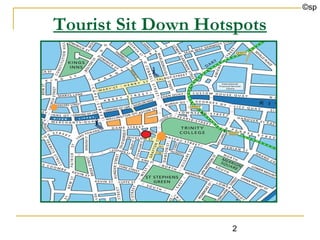
Tourist Sit Down Hotspots


                    2
©sp

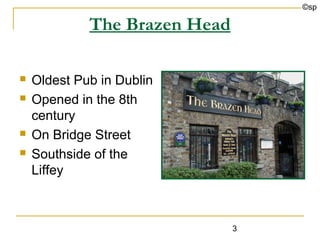
             The Brazen Head

   Oldest Pub in Dublin
   Opened in the 8th
    century
   On Bridge Street
   Southside of the
    Liffey


                               3
©sp

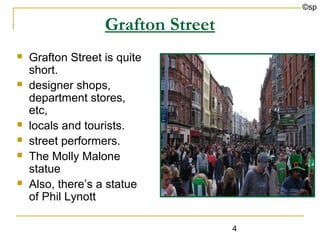
                   Grafton Street
   Grafton Street is quite
    short.
   designer shops,
    department stores,
    etc,
   locals and tourists.
   street performers.
   The Molly Malone
    statue
   Also, there’s a statue
    of Phil Lynott

                                    4
©sp

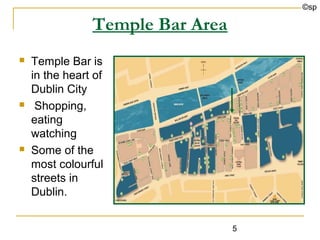
                Temple Bar Area
   Temple Bar is
    in the heart of
    Dublin City
    Shopping,
    eating
    watching
   Some of the
    most colourful
    streets in
    Dublin.


                                  5
©sp

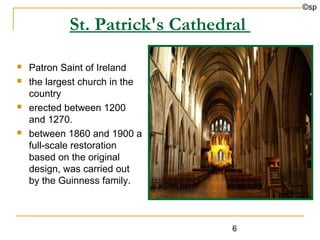
            St. Patrick's Cathedral

   Patron Saint of Ireland
   the largest church in the
    country
   erected between 1200
    and 1270.
   between 1860 and 1900 a
    full-scale restoration
    based on the original
    design, was carried out
    by the Guinness family.


                                 6
©sp

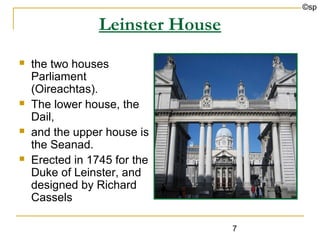
                 Leinster House
   the two houses
    Parliament
    (Oireachtas).
   The lower house, the
    Dail,
   and the upper house is
    the Seanad.
   Erected in 1745 for the
    Duke of Leinster, and
    designed by Richard
    Cassels

                                  7
©sp

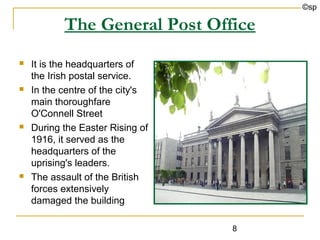
           The General Post Office
   It is the headquarters of
    the Irish postal service.
   In the centre of the city's
    main thoroughfare
    O'Connell Street
   During the Easter Rising of
    1916, it served as the
    headquarters of the
    uprising's leaders.
   The assault of the British
    forces extensively
    damaged the building

                                  8
©sp

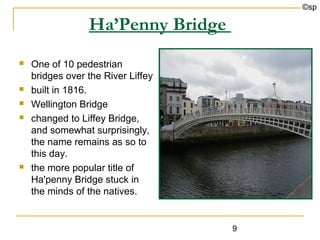
                 Ha’Penny Bridge
   One of 10 pedestrian
    bridges over the River Liffey
   built in 1816.
   Wellington Bridge
   changed to Liffey Bridge,
    and somewhat surprisingly,
    the name remains as so to
    this day.
   the more popular title of
    Ha'penny Bridge stuck in
    the minds of the natives.


                                    9
©sp

                Museums in Dublin
   National Museum of                  Irish Museum of Modern
    Ireland –                            Art (IMMA)
                                        Whether you are 8 years old
   The National Museum of               or 80, there is a wide range
    Ireland has long been a              of services, programmes
    resource for people of all           and events
    ages, providing a wide              including guided tours,
    range of opportunities for           public lectures, weekend
    life long learning and for the       events, and demonstrations,
    discovery and enjoyment of           education resource rooms
    Ireland’s rich heritage.             and an information and
                                         resource service.


                                                     10
©sp

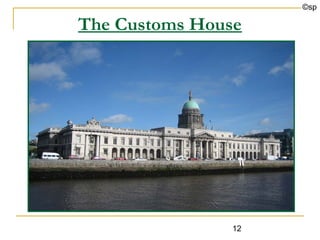
             The Customs House
   one of Dublin's finest Georgian buildings.
   Designed by James Gandon
   The Custom House was seized by the Dublin
    Brigade of the IRA on 25th May 1921.
   They saw the Custom House as a manifestation of
    British power in Ireland, and set the building ablaze.
    The fire burnt for 5 days, destroying the interiors &
    many paper records housed there.
   It was decided in 1926 to rebuild the Custom House
    on the existing shell.

                                             11
©sp

The Customs House


                12
©sp

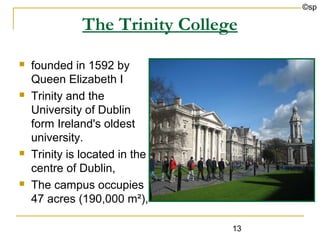
              The Trinity College
   founded in 1592 by
    Queen Elizabeth I
   Trinity and the
    University of Dublin
    form Ireland's oldest
    university.
   Trinity is located in the
    centre of Dublin,
   The campus occupies
    47 acres (190,000 m²),

                                13
©sp

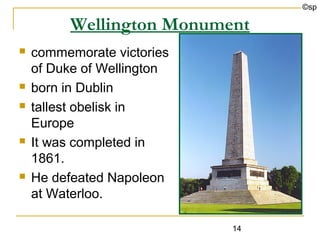
         Wellington Monument
   commemorate victories
    of Duke of Wellington
   born in Dublin
   tallest obelisk in
    Europe
   It was completed in
    1861.
   He defeated Napoleon
    at Waterloo.

                            14
©sp

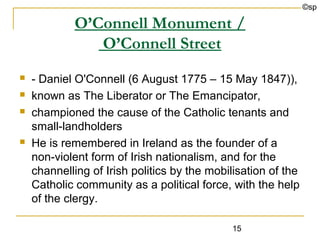
            O’Connell Monument /
               O’Connell Street
   - Daniel O'Connell (6 August 1775 – 15 May 1847)),
   known as The Liberator or The Emancipator,
   championed the cause of the Catholic tenants and
    small-landholders
   He is remembered in Ireland as the founder of a
    non-violent form of Irish nationalism, and for the
    channelling of Irish politics by the mobilisation of the
    Catholic community as a political force, with the help
    of the clergy.

                                             15
©sp

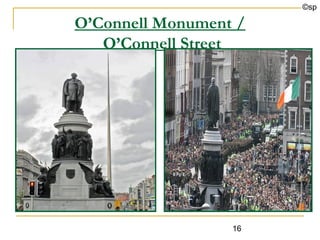
O’Connell Monument /
   O’Connell Street


                  16
©sp

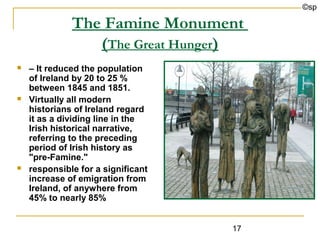
              The Famine Monument
                 (The Great Hunger)
   – It reduced the population
    of Ireland by 20 to 25 %
    between 1845 and 1851.
   Virtually all modern
    historians of Ireland regard
    it as a dividing line in the
    Irish historical narrative,
    referring to the preceding
    period of Irish history as
    "pre-Famine."
   responsible for a significant
    increase of emigration from
    Ireland, of anywhere from
    45% to nearly 85%


                                    17
©sp

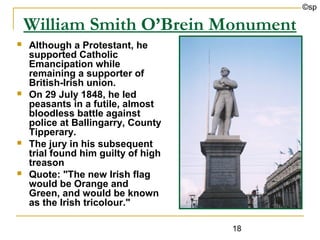
    William Smith O’Brein Monument
   Although a Protestant, he
    supported Catholic
    Emancipation while
    remaining a supporter of
    British-Irish union.
   On 29 July 1848, he led
    peasants in a futile, almost
    bloodless battle against
    police at Ballingarry, County
    Tipperary.
   The jury in his subsequent
    trial found him guilty of high
    treason
   Quote: "The new Irish flag
    would be Orange and
    Green, and would be known
    as the Irish tricolour."

                                     18
©sp

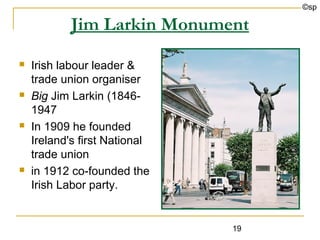
            Jim Larkin Monument
   Irish labour leader &
    trade union organiser
   Big Jim Larkin (1846-
    1947
   In 1909 he founded
    Ireland's first National
    trade union
   in 1912 co-founded the
    Irish Labor party.


                               19
©sp

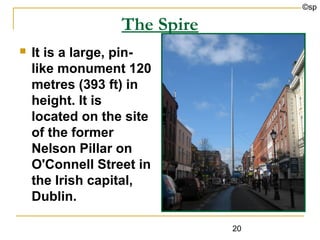
                  The Spire
   It is a large, pin-
    like monument 120
    metres (393 ft) in
    height. It is
    located on the site
    of the former
    Nelson Pillar on
    O'Connell Street in
    the Irish capital,
    Dublin.

                              20
©sp

                        Trams
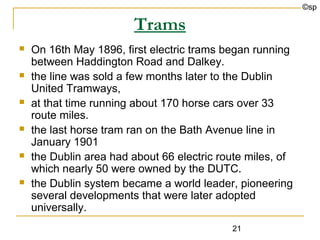
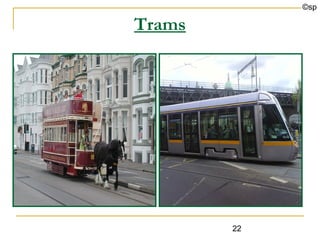
   On 16th May 1896, first electric trams began running
    between Haddington Road and Dalkey.
   the line was sold a few months later to the Dublin
    United Tramways,
   at that time running about 170 horse cars over 33
    route miles.
   the last horse tram ran on the Bath Avenue line in
    January 1901
   the Dublin area had about 66 electric route miles, of
    which nearly 50 were owned by the DUTC.
   the Dublin system became a world leader, pioneering
    several developments that were later adopted
    universally.
                                            21
©sp

Trams


        22
©sp

                The River Liffey
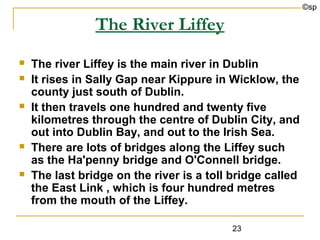
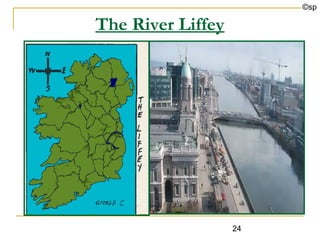
   The river Liffey is the main river in Dublin
   It rises in Sally Gap near Kippure in Wicklow, the
    county just south of Dublin.
   It then travels one hundred and twenty five
    kilometres through the centre of Dublin City, and
    out into Dublin Bay, and out to the Irish Sea.
   There are lots of bridges along the Liffey such
    as the Ha'penny bridge and O'Connell bridge.
   The last bridge on the river is a toll bridge called
    the East Link , which is four hundred metres
    from the mouth of the Liffey.

                                          23
©sp

The River Liffey


                   24
©sp


The End
     25

Dublin sightseeing

  • 1.
    ©sp Dublin Sightseeing
  • 2.
  • 3.
    ©sp The Brazen Head  Oldest Pub in Dublin  Opened in the 8th century  On Bridge Street  Southside of the Liffey 3
  • 4.
    ©sp Grafton Street  Grafton Street is quite short.  designer shops, department stores, etc,  locals and tourists.  street performers.  The Molly Malone statue  Also, there’s a statue of Phil Lynott 4
  • 5.
    ©sp Temple Bar Area  Temple Bar is in the heart of Dublin City  Shopping, eating watching  Some of the most colourful streets in Dublin. 5
  • 6.
    ©sp St. Patrick's Cathedral  Patron Saint of Ireland  the largest church in the country  erected between 1200 and 1270.  between 1860 and 1900 a full-scale restoration based on the original design, was carried out by the Guinness family. 6
  • 7.
    ©sp Leinster House  the two houses Parliament (Oireachtas).  The lower house, the Dail,  and the upper house is the Seanad.  Erected in 1745 for the Duke of Leinster, and designed by Richard Cassels 7
  • 8.
    ©sp The General Post Office  It is the headquarters of the Irish postal service.  In the centre of the city's main thoroughfare O'Connell Street  During the Easter Rising of 1916, it served as the headquarters of the uprising's leaders.  The assault of the British forces extensively damaged the building 8
  • 9.
    ©sp Ha’Penny Bridge  One of 10 pedestrian bridges over the River Liffey  built in 1816.  Wellington Bridge  changed to Liffey Bridge, and somewhat surprisingly, the name remains as so to this day.  the more popular title of Ha'penny Bridge stuck in the minds of the natives. 9
  • 10.
    ©sp Museums in Dublin  National Museum of  Irish Museum of Modern Ireland – Art (IMMA)  Whether you are 8 years old  The National Museum of or 80, there is a wide range Ireland has long been a of services, programmes resource for people of all and events ages, providing a wide  including guided tours, range of opportunities for public lectures, weekend life long learning and for the events, and demonstrations, discovery and enjoyment of education resource rooms Ireland’s rich heritage. and an information and resource service. 10
  • 11.
    ©sp The Customs House  one of Dublin's finest Georgian buildings.  Designed by James Gandon  The Custom House was seized by the Dublin Brigade of the IRA on 25th May 1921.  They saw the Custom House as a manifestation of British power in Ireland, and set the building ablaze. The fire burnt for 5 days, destroying the interiors & many paper records housed there.  It was decided in 1926 to rebuild the Custom House on the existing shell. 11
  • 12.
  • 13.
    ©sp The Trinity College  founded in 1592 by Queen Elizabeth I  Trinity and the University of Dublin form Ireland's oldest university.  Trinity is located in the centre of Dublin,  The campus occupies 47 acres (190,000 m²), 13
  • 14.
    ©sp Wellington Monument  commemorate victories of Duke of Wellington  born in Dublin  tallest obelisk in Europe  It was completed in 1861.  He defeated Napoleon at Waterloo. 14
  • 15.
    ©sp O’Connell Monument / O’Connell Street  - Daniel O'Connell (6 August 1775 – 15 May 1847)),  known as The Liberator or The Emancipator,  championed the cause of the Catholic tenants and small-landholders  He is remembered in Ireland as the founder of a non-violent form of Irish nationalism, and for the channelling of Irish politics by the mobilisation of the Catholic community as a political force, with the help of the clergy. 15
  • 16.
    ©sp O’Connell Monument / O’Connell Street 16
  • 17.
    ©sp The Famine Monument (The Great Hunger)  – It reduced the population of Ireland by 20 to 25 % between 1845 and 1851.  Virtually all modern historians of Ireland regard it as a dividing line in the Irish historical narrative, referring to the preceding period of Irish history as "pre-Famine."  responsible for a significant increase of emigration from Ireland, of anywhere from 45% to nearly 85% 17
  • 18.
    ©sp William Smith O’Brein Monument  Although a Protestant, he supported Catholic Emancipation while remaining a supporter of British-Irish union.  On 29 July 1848, he led peasants in a futile, almost bloodless battle against police at Ballingarry, County Tipperary.  The jury in his subsequent trial found him guilty of high treason  Quote: "The new Irish flag would be Orange and Green, and would be known as the Irish tricolour." 18
  • 19.
    ©sp Jim Larkin Monument  Irish labour leader & trade union organiser  Big Jim Larkin (1846- 1947  In 1909 he founded Ireland's first National trade union  in 1912 co-founded the Irish Labor party. 19
  • 20.
    ©sp The Spire  It is a large, pin- like monument 120 metres (393 ft) in height. It is located on the site of the former Nelson Pillar on O'Connell Street in the Irish capital, Dublin. 20
  • 21.
    ©sp Trams  On 16th May 1896, first electric trams began running between Haddington Road and Dalkey.  the line was sold a few months later to the Dublin United Tramways,  at that time running about 170 horse cars over 33 route miles.  the last horse tram ran on the Bath Avenue line in January 1901  the Dublin area had about 66 electric route miles, of which nearly 50 were owned by the DUTC.  the Dublin system became a world leader, pioneering several developments that were later adopted universally. 21
  • 22.
  • 23.
    ©sp The River Liffey  The river Liffey is the main river in Dublin  It rises in Sally Gap near Kippure in Wicklow, the county just south of Dublin.  It then travels one hundred and twenty five kilometres through the centre of Dublin City, and out into Dublin Bay, and out to the Irish Sea.  There are lots of bridges along the Liffey such as the Ha'penny bridge and O'Connell bridge.  The last bridge on the river is a toll bridge called the East Link , which is four hundred metres from the mouth of the Liffey. 23
  • 24.
  • 25.