Annual Conference and Exposition
       September 21, 2002
               CASH VERSUS ACCRUAL
                BASIS ACCOUNTING
                 Community Associations
                       Institute
OUTLINE
•   Introduction
•   Defining Cash Basis and Accrual Basis Accounting
•   The Matching Principle
•   Illustrative Example/Differences in Results
•   AICPA CIRA Guide
•   Audited Financial Statements
•   Comparison of Balance Sheet Using Each Basis
•   Industry Requirements
•   Management’s Financial Statements
•   Questions and Answers
INTRODUCTION

“How can our bottom
 line show a loss when
 our checking account
 has thousands of
 dollars in it?”
DEFINING………
CASH BASIS
    • Simplified basis of accounting
    • Reflects actual cash transactions “Cash that
      comes in” and “Cash that goes out”
    • Revenue is recognized when cash is collected;
      expense is recognized when cash is paid
    • Individuals generally operate their personal
      finances using the cash basis of accounting
DEFINING….….

ACCRUAL BASIS
    • Reflects transactions as they occur
    • Revenues are recognized when earned; expenses
      are recognized when incurred – even if revenue
      has not yet been collected, or the expense has not
      yet been paid
    • No regard to when the related cash transaction
      took place
    • Organizations often use this method of accounting
MATCHING PRINCIPLE

• Recognizes revenues when realized
  (earned), and expenses when incurred,
  regardless of when the cash is collected
  or paid
• This method, “matches”, or offsets
  revenues with the expenses during the
  period in which they both occur; i.e.
  special assessment
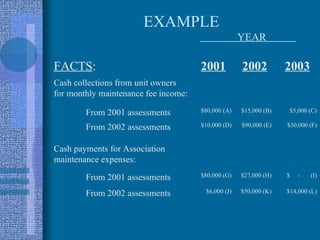
EXAMPLE
                                                    YEAR

FACTS:                                2001          2002          2003
Cash collections from unit owners
for monthly maintenance fee income:

        From 2001 assessments         $80,000 (A)   $15,000 (B)    $5,000 (C)

        From 2002 assessments         $10,000 (D)   $90,000 (E)   $30,000 (F)


Cash payments for Association
maintenance expenses:

        From 2001 assessments         $80,000 (G)   $27,000 (H)   $   -   (I)

        From 2002 assessments          $6,000 (J)   $50,000 (K)   $14,000 (L)
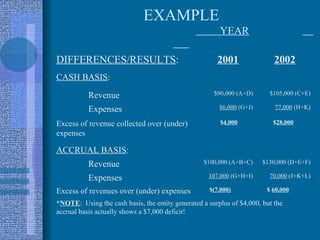
EXAMPLE
                                                        YEAR

DIFFERENCES/RESULTS:                                   2001                2002
CASH BASIS:

           Revenue                                    $90,000 (A+D)      $105,000 (C+E)

           Expenses                                     86,000 (G+J)       77,000 (H+K)

Excess of revenue collected over (under)                $4,000            $28,000
expenses

ACCRUAL BASIS:
           Revenue                                $100,000 (A+B+C)     $130,000 (D+E+F)

           Expenses                                 107,000 (G+H+I)      70,000 (J+K+L)

Excess of revenues over (under) expenses            $(7,000)            $ 60,000

*NOTE: Using the cash basis, the entity generated a surplus of $4,000, but the
accrual basis actually shows a $7,000 deficit!
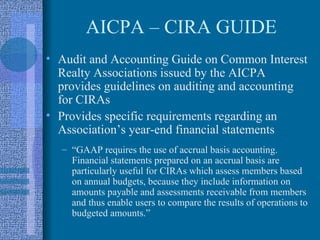
AICPA – CIRA GUIDE
• Audit and Accounting Guide on Common Interest
  Realty Associations issued by the AICPA
  provides guidelines on auditing and accounting
  for CIRAs
• Provides specific requirements regarding an
  Association’s year-end financial statements
  – “GAAP requires the use of accrual basis accounting.
    Financial statements prepared on an accrual basis are
    particularly useful for CIRAs which assess members based
    on annual budgets, because they include information on
    amounts payable and assessments receivable from members
    and thus enable users to compare the results of operations to
    budgeted amounts.”
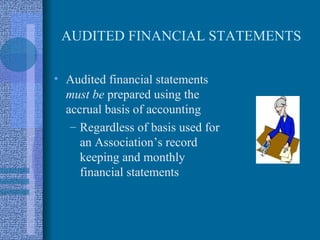
AUDITED FINANCIAL STATEMENTS

• Audited financial statements
  must be prepared using the
  accrual basis of accounting
   – Regardless of basis used for
     an Association’s record
     keeping and monthly
     financial statements
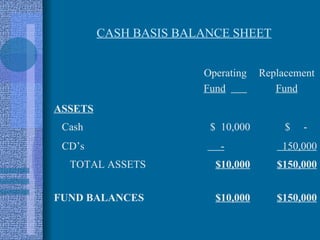
CASH BASIS BALANCE SHEET


                       Operating   Replacement
                       Fund           Fund
ASSETS
 Cash                   $ 10,000        $   -
 CD’s                     -            150,000
  TOTAL ASSETS           $10,000      $150,000


FUND BALANCES            $10,000      $150,000
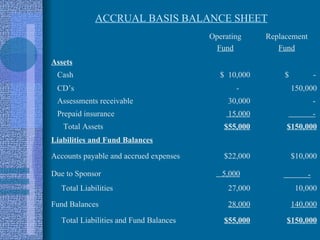
ACCRUAL BASIS BALANCE SHEET
                                        Operating     Replacement
                                          Fund           Fund
Assets
 Cash                                      $ 10,000        $            -
 CD’s                                          -               150,000
 Assessments receivable                      30,000                     -
 Prepaid insurance                           15,000                     -
   Total Assets                             $55,000        $150,000
Liabilities and Fund Balances

Accounts payable and accrued expenses       $22,000            $10,000

Due to Sponsor                             5,000                    -
  Total Liabilities                          27,000             10,000

Fund Balances                                28,000            140,000

  Total Liabilities and Fund Balances       $55,000        $150,000
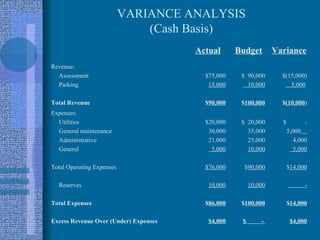
VARIANCE ANALYSIS
                               (Cash Basis)
                                       Actual      Budget        Variance
Revenue:
  Assessment                             $75,000    $ 90,000       $(15,000)
  Parking                                 15,000      10,000          5,000

Total Revenue                            $90,000    $100,000       $(10,000)
Expenses:
  Utilities                              $20,000    $ 20,000       $         -
  General maintenance                     30,000      35,000           5,000
  Administrative                          21,000      25,000             4,000
  General                                  5,000      10,000             5,000

Total Operating Expenses                 $76,000     $90,000           $14,000

  Reserves                                10,000        10,000               -

Total Expenses                           $86,000    $100,000           $14,000

Excess Revenue Over (Under) Expenses      $4,000    $       -           $4,000
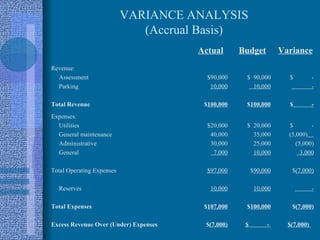
VARIANCE ANALYSIS
                              (Accrual Basis)
                                       Actual      Budget         Variance
Revenue:
  Assessment                             $90,000    $ 90,000        $          -
  Parking                                 10,000      10,000                   -

Total Revenue                           $100,000    $100,000        $          -
Expenses:
  Utilities                              $20,000    $ 20,000        $        -
  General maintenance                     40,000      35,000        (5,000)
  Administrative                          30,000      25,000           (5,000)
  General                                  7,000      10,000             3,000

Total Operating Expenses                 $97,000        $90,000      $(7,000)

  Reserves                                10,000         10,000                -

Total Expenses                          $107,000    $100,000         $(7,000)

Excess Revenue Over (Under) Expenses    $(7,000)    $        -      $(7,000)
REPORTING
• Financial Reporting
• Management Reporting
• Membership Reporting
DECISION MAKING
•   Monthly Planning
•   Annual Planning
•   Discretionary Spending
•   Long Term Planning
•   Collection Problems
BUDGETING

•   Annualized Actuals
•   Misguided Assumptions
•   Long Term Funding
•   Special Assessments
CONCLUSION
QUESTIONS & ANSWERS

Cai annual conference 2002final

  • 1.
    Annual Conference andExposition September 21, 2002 CASH VERSUS ACCRUAL BASIS ACCOUNTING Community Associations Institute
  • 2.
    OUTLINE • Introduction • Defining Cash Basis and Accrual Basis Accounting • The Matching Principle • Illustrative Example/Differences in Results • AICPA CIRA Guide • Audited Financial Statements • Comparison of Balance Sheet Using Each Basis • Industry Requirements • Management’s Financial Statements • Questions and Answers
  • 3.
    INTRODUCTION “How can ourbottom line show a loss when our checking account has thousands of dollars in it?”
  • 4.
    DEFINING……… CASH BASIS • Simplified basis of accounting • Reflects actual cash transactions “Cash that comes in” and “Cash that goes out” • Revenue is recognized when cash is collected; expense is recognized when cash is paid • Individuals generally operate their personal finances using the cash basis of accounting
  • 5.
    DEFINING….…. ACCRUAL BASIS • Reflects transactions as they occur • Revenues are recognized when earned; expenses are recognized when incurred – even if revenue has not yet been collected, or the expense has not yet been paid • No regard to when the related cash transaction took place • Organizations often use this method of accounting
  • 6.
    MATCHING PRINCIPLE • Recognizesrevenues when realized (earned), and expenses when incurred, regardless of when the cash is collected or paid • This method, “matches”, or offsets revenues with the expenses during the period in which they both occur; i.e. special assessment
  • 7.
    EXAMPLE YEAR FACTS: 2001 2002 2003 Cash collections from unit owners for monthly maintenance fee income: From 2001 assessments $80,000 (A) $15,000 (B) $5,000 (C) From 2002 assessments $10,000 (D) $90,000 (E) $30,000 (F) Cash payments for Association maintenance expenses: From 2001 assessments $80,000 (G) $27,000 (H) $ - (I) From 2002 assessments $6,000 (J) $50,000 (K) $14,000 (L)
  • 8.
    EXAMPLE YEAR DIFFERENCES/RESULTS: 2001 2002 CASH BASIS: Revenue $90,000 (A+D) $105,000 (C+E) Expenses 86,000 (G+J) 77,000 (H+K) Excess of revenue collected over (under) $4,000 $28,000 expenses ACCRUAL BASIS: Revenue $100,000 (A+B+C) $130,000 (D+E+F) Expenses 107,000 (G+H+I) 70,000 (J+K+L) Excess of revenues over (under) expenses $(7,000) $ 60,000 *NOTE: Using the cash basis, the entity generated a surplus of $4,000, but the accrual basis actually shows a $7,000 deficit!
  • 9.
    AICPA – CIRAGUIDE • Audit and Accounting Guide on Common Interest Realty Associations issued by the AICPA provides guidelines on auditing and accounting for CIRAs • Provides specific requirements regarding an Association’s year-end financial statements – “GAAP requires the use of accrual basis accounting. Financial statements prepared on an accrual basis are particularly useful for CIRAs which assess members based on annual budgets, because they include information on amounts payable and assessments receivable from members and thus enable users to compare the results of operations to budgeted amounts.”
  • 10.
    AUDITED FINANCIAL STATEMENTS •Audited financial statements must be prepared using the accrual basis of accounting – Regardless of basis used for an Association’s record keeping and monthly financial statements
  • 11.
    CASH BASIS BALANCESHEET Operating Replacement Fund Fund ASSETS Cash $ 10,000 $ - CD’s - 150,000 TOTAL ASSETS $10,000 $150,000 FUND BALANCES $10,000 $150,000
  • 12.
    ACCRUAL BASIS BALANCESHEET Operating Replacement Fund Fund Assets Cash $ 10,000 $ - CD’s - 150,000 Assessments receivable 30,000 - Prepaid insurance 15,000 - Total Assets $55,000 $150,000 Liabilities and Fund Balances Accounts payable and accrued expenses $22,000 $10,000 Due to Sponsor 5,000 - Total Liabilities 27,000 10,000 Fund Balances 28,000 140,000 Total Liabilities and Fund Balances $55,000 $150,000
  • 13.
    VARIANCE ANALYSIS (Cash Basis) Actual Budget Variance Revenue: Assessment $75,000 $ 90,000 $(15,000) Parking 15,000 10,000 5,000 Total Revenue $90,000 $100,000 $(10,000) Expenses: Utilities $20,000 $ 20,000 $ - General maintenance 30,000 35,000 5,000 Administrative 21,000 25,000 4,000 General 5,000 10,000 5,000 Total Operating Expenses $76,000 $90,000 $14,000 Reserves 10,000 10,000 - Total Expenses $86,000 $100,000 $14,000 Excess Revenue Over (Under) Expenses $4,000 $ - $4,000
  • 14.
    VARIANCE ANALYSIS (Accrual Basis) Actual Budget Variance Revenue: Assessment $90,000 $ 90,000 $ - Parking 10,000 10,000 - Total Revenue $100,000 $100,000 $ - Expenses: Utilities $20,000 $ 20,000 $ - General maintenance 40,000 35,000 (5,000) Administrative 30,000 25,000 (5,000) General 7,000 10,000 3,000 Total Operating Expenses $97,000 $90,000 $(7,000) Reserves 10,000 10,000 - Total Expenses $107,000 $100,000 $(7,000) Excess Revenue Over (Under) Expenses $(7,000) $ - $(7,000)
  • 15.
    REPORTING • Financial Reporting •Management Reporting • Membership Reporting
  • 16.
    DECISION MAKING • Monthly Planning • Annual Planning • Discretionary Spending • Long Term Planning • Collection Problems
  • 17.
    BUDGETING • Annualized Actuals • Misguided Assumptions • Long Term Funding • Special Assessments
  • 18.