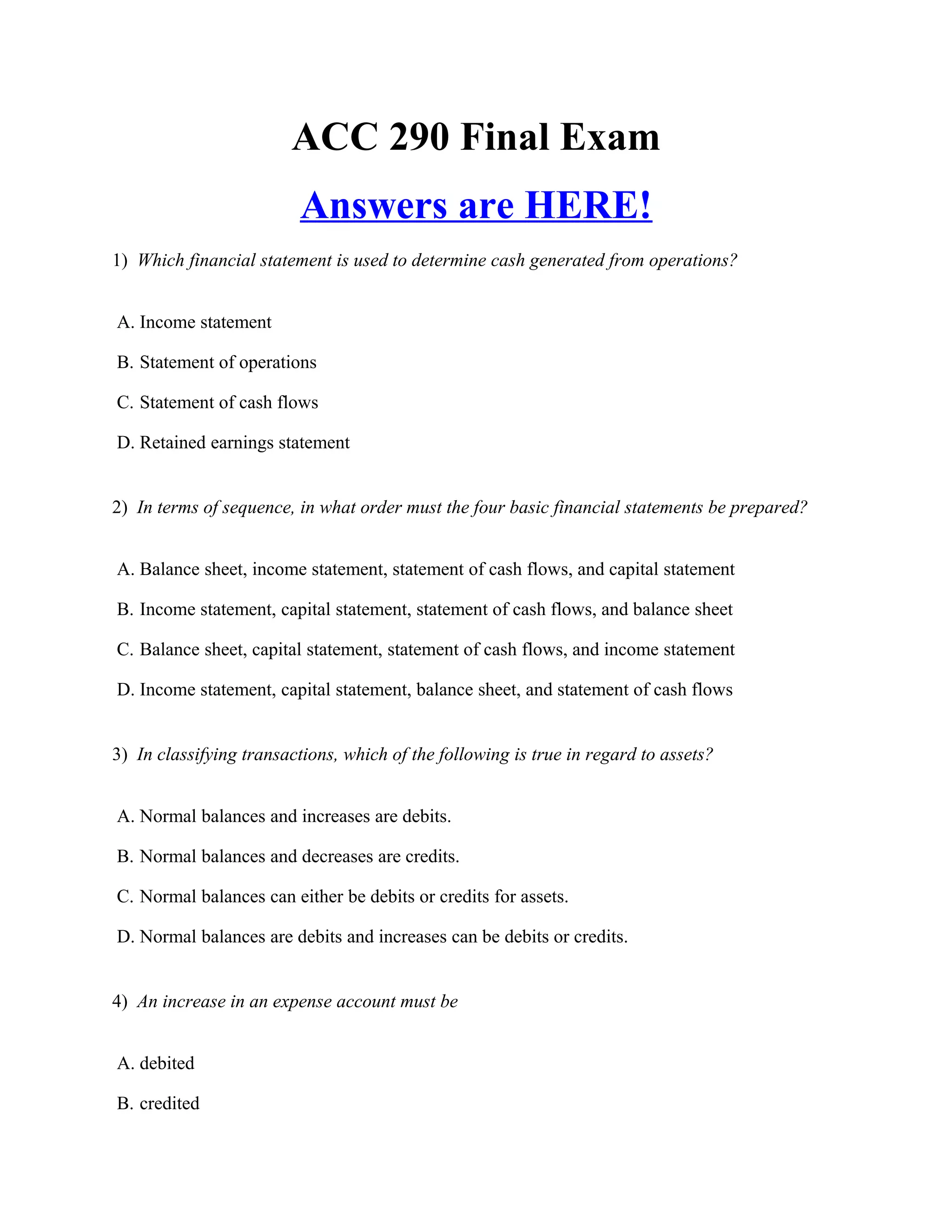
ACC 290 Final Exam
                         Answers are HERE!
1) Which financial statement is used to determine cash generated from operations?


A. Income statement

B. Statement of operations

C. Statement of cash flows

D. Retained earnings statement


2) In terms of sequence, in what order must the four basic financial statements be prepared?


A. Balance sheet, income statement, statement of cash flows, and capital statement

B. Income statement, capital statement, statement of cash flows, and balance sheet

C. Balance sheet, capital statement, statement of cash flows, and income statement

D. Income statement, capital statement, balance sheet, and statement of cash flows


3) In classifying transactions, which of the following is true in regard to assets?


A. Normal balances and increases are debits.

B. Normal balances and decreases are credits.

C. Normal balances can either be debits or credits for assets.

D. Normal balances are debits and increases can be debits or credits.


4) An increase in an expense account must be


A. debited

B. credited
C. either debited or credited, depending on the circumstances

D. capitalized


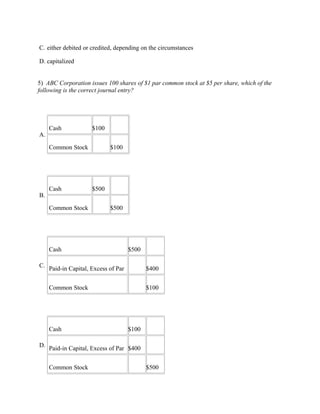
5) ABC Corporation issues 100 shares of $1 par common stock at $5 per share, which of the
following is the correct journal entry?


     Cash           $100
A.

     Common Stock           $100


     Cash           $500
B.

     Common Stock           $500


     Cash                           $500

C. Paid-in Capital, Excess of Par          $400


     Common Stock                          $100


     Cash                           $100

D. Paid-in Capital, Excess of Par $400


     Common Stock                          $500
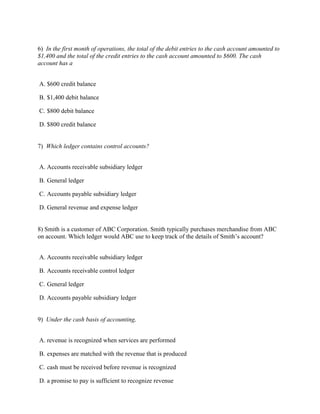
6) In the first month of operations, the total of the debit entries to the cash account amounted to
$1,400 and the total of the credit entries to the cash account amounted to $600. The cash
account has a


A. $600 credit balance

B. $1,400 debit balance

C. $800 debit balance

D. $800 credit balance


7) Which ledger contains control accounts?


A. Accounts receivable subsidiary ledger

B. General ledger

C. Accounts payable subsidiary ledger

D. General revenue and expense ledger


8) Smith is a customer of ABC Corporation. Smith typically purchases merchandise from ABC
on account. Which ledger would ABC use to keep track of the details of Smith’s account?


A. Accounts receivable subsidiary ledger

B. Accounts receivable control ledger

C. General ledger

D. Accounts payable subsidiary ledger


9) Under the cash basis of accounting,


A. revenue is recognized when services are performed

B. expenses are matched with the revenue that is produced

C. cash must be received before revenue is recognized

D. a promise to pay is sufficient to recognize revenue
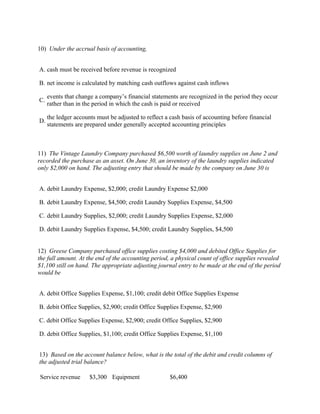
10) Under the accrual basis of accounting,


A. cash must be received before revenue is recognized

B. net income is calculated by matching cash outflows against cash inflows

     events that change a company’s financial statements are recognized in the period they occur
C.
     rather than in the period in which the cash is paid or received

     the ledger accounts must be adjusted to reflect a cash basis of accounting before financial
D.
     statements are prepared under generally accepted accounting principles


11) The Vintage Laundry Company purchased $6,500 worth of laundry supplies on June 2 and
recorded the purchase as an asset. On June 30, an inventory of the laundry supplies indicated
only $2,000 on hand. The adjusting entry that should be made by the company on June 30 is


A. debit Laundry Expense, $2,000; credit Laundry Expense $2,000

B. debit Laundry Expense, $4,500; credit Laundry Supplies Expense, $4,500

C. debit Laundry Supplies, $2,000; credit Laundry Supplies Expense, $2,000

D. debit Laundry Supplies Expense, $4,500; credit Laundry Supplies, $4,500


12) Greese Company purchased office supplies costing $4,000 and debited Office Supplies for
the full amount. At the end of the accounting period, a physical count of office supplies revealed
$1,100 still on hand. The appropriate adjusting journal entry to be made at the end of the period
would be


A. debit Office Supplies Expense, $1,100; credit debit Office Supplies Expense

B. debit Office Supplies, $2,900; credit Office Supplies Expense, $2,900

C. debit Office Supplies Expense, $2,900; credit Office Supplies, $2,900

D. debit Office Supplies, $1,100; credit Office Supplies Expense, $1,100


13) Based on the account balance below, what is the total of the debit and credit columns of
the adjusted trial balance?

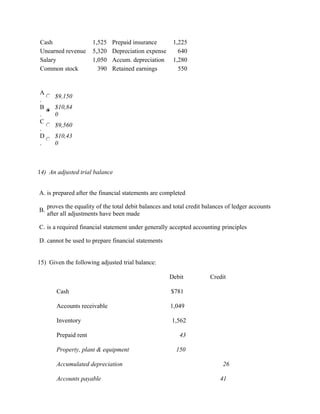
Service revenue       $3,300 Equipment                $6,400
Cash                   1,525   Prepaid insurance        1,225
Unearned revenue       5,320   Depreciation expense       640
Salary                 1,050   Accum. depreciation      1,280
Common stock             390   Retained earnings          550


A
        $9,150
.
B       $10,84
.       0
C
        $9,560
.
D       $10,43
.       0


14) An adjusted trial balance


A. is prepared after the financial statements are completed

     proves the equality of the total debit balances and total credit balances of ledger accounts
B.
     after all adjustments have been made

C. is a required financial statement under generally accepted accounting principles

D. cannot be used to prepare financial statements


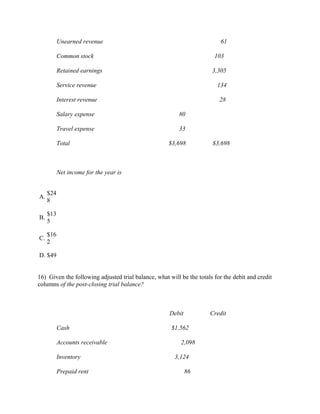
15) Given the following adjusted trial balance:

                                                       Debit            Credit

        Cash                                            $781

        Accounts receivable                            1,049

        Inventory                                       1,562

        Prepaid rent                                       43

        Property, plant & equipment                       150

        Accumulated depreciation                                             26

        Accounts payable                                                    41
Unearned revenue                                                61

           Common stock                                                 103

           Retained earnings                                           3,305

           Service revenue                                               134

           Interest revenue                                               28

           Salary expense                                80

           Travel expense                                33

           Total                                     $3,698            $3,698


           Net income for the year is


     $24
A.
     8

     $13
B.
     5

     $16
C.
     2

D. $49


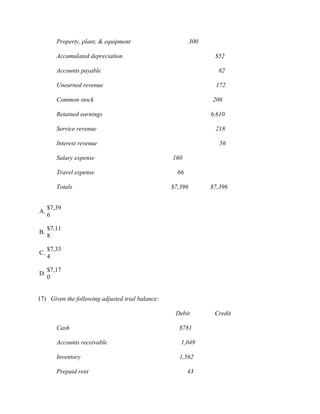
16) Given the following adjusted trial balance, what will be the totals for the debit and credit
columns of the post-closing trial balance?


                                                      Debit           Credit

           Cash                                       $1,562

           Accounts receivable                            2,098

           Inventory                                    3,124

           Prepaid rent                                       86
Property, plant, & equipment                       300

        Accumulated depreciation                                  $52

        Accounts payable                                           82

        Unearned revenue                                           172

        Common stock                                             206

        Retained earnings                                        6,610

        Service revenue                                           218

        Interest revenue                                            56

        Salary expense                            160

        Travel expense                              66

        Totals                                    $7,396         $7,396


     $7,39
A.
     6

     $7,11
B.
     8

     $7,33
C.
     4

     $7,17
D.
     0


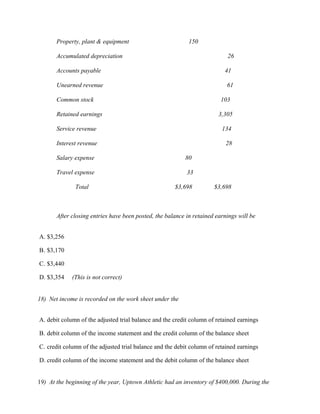
17) Given the following adjusted trial balance:

                                                   Debit          Credit

        Cash                                        $781

        Accounts receivable                          1,049

        Inventory                                   1,562

        Prepaid rent                                     43
Property, plant & equipment                          150

       Accumulated depreciation                                            26

       Accounts payable                                                   41

       Unearned revenue                                                    61

       Common stock                                                      103

       Retained earnings                                                3,305

       Service revenue                                                   134

       Interest revenue                                                    28

       Salary expense                                     80

       Travel expense                                      33

              Total                                   $3,698          $3,698


       After closing entries have been posted, the balance in retained earnings will be


A. $3,256

B. $3,170

C. $3,440

D. $3,354    (This is not correct)


18) Net income is recorded on the work sheet under the


A. debit column of the adjusted trial balance and the credit column of retained earnings

B. debit column of the income statement and the credit column of the balance sheet

C. credit column of the adjusted trial balance and the debit column of retained earnings

D. credit column of the income statement and the debit column of the balance sheet


19) At the beginning of the year, Uptown Athletic had an inventory of $400,000. During the
year, the company purchased goods costing $1,500,000. If Uptown Athletic reported ending
inventory of $600,000 and sales of $2,000,000, their cost of goods sold and gross profit rate
would be


A. $900,000 and 65%

B. $1,300,000 and 35%

C. $900,000 and 35%

D. $1,300,000 and 65%


20) During the year, Sarah’s Pet Shop’s merchandise inventory decreased by $30,000. If the
company’s cost of goods sold for the year was $450,000, purchases would have been


A. $480,000

B. $420,000

C. $390,000

D. Insufficient data to determine


21) At the beginning of the year, Wildcat Athletic had an inventory of $200,000. During the
year, the company purchased goods costing $700,000. If Wildcat Athletic reported ending
inventory of $300,000 and sales of $1,000,000, their cost of goods sold and gross profit rate
would be


A. $400,000 and 60%

B. $600,000 and 40%

C. $400,000 and 40%

D. $600,000 and 60%


22) The entry to record of sale of $900 with terms of 2/10, n/30 will include a


A. debit to Sales Discount for $18354       (This is not correct)

B. debit to Sales Revenue for $882
C. credit to Accounts Receivable for $900 (Probably correct)

D. credit to Sales Revenue for $900354      (This is not correct)


23) Dobler Company uses a periodic inventory system. Details for the inventory account for the

month of January 2012 are as follows:


                                    Units            Per unit price         Total
        Balance, 1/1/2012          200                    $5.00        $1,000
        Purchase, 1/15/2012        100                       5.30          530
        Purchase, 1/28/2012        100                       5.50          550


        An end of the month (1/31/2012), inventory showed that 140 units were on hand. If the
        company uses LIFO, what is the value of the ending inventory?


A. $737

B. $700

C. $762

     $1,38
D.
     0


24) The difference between ending inventory using LIFO and ending inventory using FIFO is
referred to as


A. FIFO reserve

B. inventory reserve

C. LIFO reserve

D. periodic reserve


25) A consistent application of an inventory costing method enhances
A. conservatism

B. accuracy

C. comparability

D. efficiency


26) The accountant at Patton Company has determined that income before income taxes
amounted to $11,000 using the FIFO costing assumption. If the income tax rate is 30% and the
amount of income taxes paid would be $300 greater if the LIFO assumption were used, what
would be the amount of income before taxes under the LIFO assumption?


     $11,30
A.
     0

     $12,00
B.
     0

     $10,00
C.
     0

     $10,70
D.
     0


27) A very small company would have the most difficulty in implementing which of the following
internal control activities?


A. Separation of duties

B. Limited access to assets

C. Periodic independent verification

D. Sound personnel procedures


28) A system of internal control


A. is infallible

B. can be rendered ineffective by employee collusion
C. invariably will have costs exceeding benefits


D. is premised on the concept of absolute assurance


29) The custodian of a company asset should


A. have access to the accounting record for that asset

B. be someone outside the company

C. not have access to the accounting record for that asset

D. be an accountant


30) The Sarbanes Oxley Act (2002) applies to


A. U.S. companies but not international companies

B. international companies but not U.S. companies

C. U.S. and Canadian companies but not other international companies

D. U.S. and international companies

Acc 290 final exam

  • 1.
    ACC 290 FinalExam Answers are HERE! 1) Which financial statement is used to determine cash generated from operations? A. Income statement B. Statement of operations C. Statement of cash flows D. Retained earnings statement 2) In terms of sequence, in what order must the four basic financial statements be prepared? A. Balance sheet, income statement, statement of cash flows, and capital statement B. Income statement, capital statement, statement of cash flows, and balance sheet C. Balance sheet, capital statement, statement of cash flows, and income statement D. Income statement, capital statement, balance sheet, and statement of cash flows 3) In classifying transactions, which of the following is true in regard to assets? A. Normal balances and increases are debits. B. Normal balances and decreases are credits. C. Normal balances can either be debits or credits for assets. D. Normal balances are debits and increases can be debits or credits. 4) An increase in an expense account must be A. debited B. credited
  • 2.
    C. either debitedor credited, depending on the circumstances D. capitalized 5) ABC Corporation issues 100 shares of $1 par common stock at $5 per share, which of the following is the correct journal entry? Cash $100 A. Common Stock $100 Cash $500 B. Common Stock $500 Cash $500 C. Paid-in Capital, Excess of Par $400 Common Stock $100 Cash $100 D. Paid-in Capital, Excess of Par $400 Common Stock $500
  • 3.
    6) In thefirst month of operations, the total of the debit entries to the cash account amounted to $1,400 and the total of the credit entries to the cash account amounted to $600. The cash account has a A. $600 credit balance B. $1,400 debit balance C. $800 debit balance D. $800 credit balance 7) Which ledger contains control accounts? A. Accounts receivable subsidiary ledger B. General ledger C. Accounts payable subsidiary ledger D. General revenue and expense ledger 8) Smith is a customer of ABC Corporation. Smith typically purchases merchandise from ABC on account. Which ledger would ABC use to keep track of the details of Smith’s account? A. Accounts receivable subsidiary ledger B. Accounts receivable control ledger C. General ledger D. Accounts payable subsidiary ledger 9) Under the cash basis of accounting, A. revenue is recognized when services are performed B. expenses are matched with the revenue that is produced C. cash must be received before revenue is recognized D. a promise to pay is sufficient to recognize revenue
  • 4.
    10) Under theaccrual basis of accounting, A. cash must be received before revenue is recognized B. net income is calculated by matching cash outflows against cash inflows events that change a company’s financial statements are recognized in the period they occur C. rather than in the period in which the cash is paid or received the ledger accounts must be adjusted to reflect a cash basis of accounting before financial D. statements are prepared under generally accepted accounting principles 11) The Vintage Laundry Company purchased $6,500 worth of laundry supplies on June 2 and recorded the purchase as an asset. On June 30, an inventory of the laundry supplies indicated only $2,000 on hand. The adjusting entry that should be made by the company on June 30 is A. debit Laundry Expense, $2,000; credit Laundry Expense $2,000 B. debit Laundry Expense, $4,500; credit Laundry Supplies Expense, $4,500 C. debit Laundry Supplies, $2,000; credit Laundry Supplies Expense, $2,000 D. debit Laundry Supplies Expense, $4,500; credit Laundry Supplies, $4,500 12) Greese Company purchased office supplies costing $4,000 and debited Office Supplies for the full amount. At the end of the accounting period, a physical count of office supplies revealed $1,100 still on hand. The appropriate adjusting journal entry to be made at the end of the period would be A. debit Office Supplies Expense, $1,100; credit debit Office Supplies Expense B. debit Office Supplies, $2,900; credit Office Supplies Expense, $2,900 C. debit Office Supplies Expense, $2,900; credit Office Supplies, $2,900 D. debit Office Supplies, $1,100; credit Office Supplies Expense, $1,100 13) Based on the account balance below, what is the total of the debit and credit columns of the adjusted trial balance? Service revenue $3,300 Equipment $6,400
  • 5.
    Cash 1,525 Prepaid insurance 1,225 Unearned revenue 5,320 Depreciation expense 640 Salary 1,050 Accum. depreciation 1,280 Common stock 390 Retained earnings 550 A $9,150 . B $10,84 . 0 C $9,560 . D $10,43 . 0 14) An adjusted trial balance A. is prepared after the financial statements are completed proves the equality of the total debit balances and total credit balances of ledger accounts B. after all adjustments have been made C. is a required financial statement under generally accepted accounting principles D. cannot be used to prepare financial statements 15) Given the following adjusted trial balance: Debit Credit Cash $781 Accounts receivable 1,049 Inventory 1,562 Prepaid rent 43 Property, plant & equipment 150 Accumulated depreciation 26 Accounts payable 41
  • 6.
    Unearned revenue 61 Common stock 103 Retained earnings 3,305 Service revenue 134 Interest revenue 28 Salary expense 80 Travel expense 33 Total $3,698 $3,698 Net income for the year is $24 A. 8 $13 B. 5 $16 C. 2 D. $49 16) Given the following adjusted trial balance, what will be the totals for the debit and credit columns of the post-closing trial balance? Debit Credit Cash $1,562 Accounts receivable 2,098 Inventory 3,124 Prepaid rent 86
  • 7.
    Property, plant, &equipment 300 Accumulated depreciation $52 Accounts payable 82 Unearned revenue 172 Common stock 206 Retained earnings 6,610 Service revenue 218 Interest revenue 56 Salary expense 160 Travel expense 66 Totals $7,396 $7,396 $7,39 A. 6 $7,11 B. 8 $7,33 C. 4 $7,17 D. 0 17) Given the following adjusted trial balance: Debit Credit Cash $781 Accounts receivable 1,049 Inventory 1,562 Prepaid rent 43
  • 8.
    Property, plant &equipment 150 Accumulated depreciation 26 Accounts payable 41 Unearned revenue 61 Common stock 103 Retained earnings 3,305 Service revenue 134 Interest revenue 28 Salary expense 80 Travel expense 33 Total $3,698 $3,698 After closing entries have been posted, the balance in retained earnings will be A. $3,256 B. $3,170 C. $3,440 D. $3,354 (This is not correct) 18) Net income is recorded on the work sheet under the A. debit column of the adjusted trial balance and the credit column of retained earnings B. debit column of the income statement and the credit column of the balance sheet C. credit column of the adjusted trial balance and the debit column of retained earnings D. credit column of the income statement and the debit column of the balance sheet 19) At the beginning of the year, Uptown Athletic had an inventory of $400,000. During the
  • 9.
    year, the companypurchased goods costing $1,500,000. If Uptown Athletic reported ending inventory of $600,000 and sales of $2,000,000, their cost of goods sold and gross profit rate would be A. $900,000 and 65% B. $1,300,000 and 35% C. $900,000 and 35% D. $1,300,000 and 65% 20) During the year, Sarah’s Pet Shop’s merchandise inventory decreased by $30,000. If the company’s cost of goods sold for the year was $450,000, purchases would have been A. $480,000 B. $420,000 C. $390,000 D. Insufficient data to determine 21) At the beginning of the year, Wildcat Athletic had an inventory of $200,000. During the year, the company purchased goods costing $700,000. If Wildcat Athletic reported ending inventory of $300,000 and sales of $1,000,000, their cost of goods sold and gross profit rate would be A. $400,000 and 60% B. $600,000 and 40% C. $400,000 and 40% D. $600,000 and 60% 22) The entry to record of sale of $900 with terms of 2/10, n/30 will include a A. debit to Sales Discount for $18354 (This is not correct) B. debit to Sales Revenue for $882
  • 10.
    C. credit toAccounts Receivable for $900 (Probably correct) D. credit to Sales Revenue for $900354 (This is not correct) 23) Dobler Company uses a periodic inventory system. Details for the inventory account for the month of January 2012 are as follows: Units Per unit price Total Balance, 1/1/2012 200 $5.00 $1,000 Purchase, 1/15/2012 100 5.30 530 Purchase, 1/28/2012 100 5.50 550 An end of the month (1/31/2012), inventory showed that 140 units were on hand. If the company uses LIFO, what is the value of the ending inventory? A. $737 B. $700 C. $762 $1,38 D. 0 24) The difference between ending inventory using LIFO and ending inventory using FIFO is referred to as A. FIFO reserve B. inventory reserve C. LIFO reserve D. periodic reserve 25) A consistent application of an inventory costing method enhances
  • 11.
    A. conservatism B. accuracy C.comparability D. efficiency 26) The accountant at Patton Company has determined that income before income taxes amounted to $11,000 using the FIFO costing assumption. If the income tax rate is 30% and the amount of income taxes paid would be $300 greater if the LIFO assumption were used, what would be the amount of income before taxes under the LIFO assumption? $11,30 A. 0 $12,00 B. 0 $10,00 C. 0 $10,70 D. 0 27) A very small company would have the most difficulty in implementing which of the following internal control activities? A. Separation of duties B. Limited access to assets C. Periodic independent verification D. Sound personnel procedures 28) A system of internal control A. is infallible B. can be rendered ineffective by employee collusion
  • 12.
    C. invariably willhave costs exceeding benefits D. is premised on the concept of absolute assurance 29) The custodian of a company asset should A. have access to the accounting record for that asset B. be someone outside the company C. not have access to the accounting record for that asset D. be an accountant 30) The Sarbanes Oxley Act (2002) applies to A. U.S. companies but not international companies B. international companies but not U.S. companies C. U.S. and Canadian companies but not other international companies D. U.S. and international companies