Caesar Ciphers
An Introduction to
Cryptography
What is a Caesar Cipher?
 Caesar used to encrypt his messages using a very
simple algorithm, which could be easily decrypted if you
know the key.
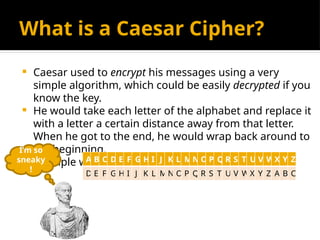
 He would take each letter of the alphabet and replace it
with a letter a certain distance away from that letter.
When he got to the end, he would wrap back around to
the beginning.
 Example with a shift of 3:
A B C D E F G H I J K L MN O P Q R S T U V WX Y Z
D E F G H I J K L MN O P Q R S T U V WX Y Z A B C
I’m so
sneaky
!
But I Don’t Want to Make a Table!
 That’s fine! If you know what the shift is, you
can use something called modulo, which is
commonly shortened to mod.
 Let’s say we wanted to find 8 mod 5. We
would divide 8 by 5 and find the remainder.
So in this case, 8 mod 5 = 3.
 In this case, 5 is called the modulus.
 Can you solve these?
19 mod 5 2 mod 5 25 mod 5
4 2 0
How Is That Helpful?
 When using a Caesar cipher, you assign each letter to
an index starting from 0.
 You would then compute the following.
(plain letter index + key) mod (total number of letters)
 This will give you the index of the encrypted letter!
 As you can see, the modulus is the total number of
letters in the alphabet. For English, this modulus is 26.
A B C D E F G H I J K L M N O P Q R S T U V W X Y Z
0 1 2 3 4 5 6 7 8 9 10 1
1
1
2
1
3
1
4
1
5
1
6
1
7
1
8
1
9
2
0
2
1
2
2
2
3
2
4
2
5
A Simple Example
 Let’s say we have a 5 letter alphabet with only the letters A-E
 First, we assign each letter an index, starting from 0.
 We then have to choose a key. For this example, we’ll use 2.
 Let’s try encoding the word BEAD using the formula for the
previous slide.
 The index of the letter B is 1. The key is 2. The modulus is 5,
since the alphabet is 5 letters.
 Let’s use the algorithm: (1+2) = 3. 3 mod 5 = 3. The index of D is
3, so B would become the letter D.
 Using algorithm on each letter, can you encode the full word?
DBCA
A B C D E
0 1 2 3 4
Why Does Modding Work?
 The mod accounts for wrapping back around once
you reach the end of the alphabet.
 When converting the letter E using the key 2, you
first add 4 + 2, which gives you 6. As you can see, the
index 6 is beyond the scope of this alphabet. When
you do 6 mod 5, you get the remainder of 1, which is
how much you need to go back and count from the
beginning of the alphabet.
A B C D E
0 1 2 3 4
What About Decoding?
 To decode, you do the following:
(cipher letter index – key + total number of letters) mod (total number of letters)
 Does anyone know why we can’t just do:
(cipher letter index – key) mod (total number of letters)?
 By adding the total number of letters, you don’t have to
end up taking the mod of a negative number.
 See if you can decode DBCA to get back to the word BEAD.
How Would You Program This?
 It’s unbelievably simple!
 The mod function is one of the most basic
components of a lot of programming
languages. You’ll learn the mod function
for python early on. That means all we have
to deal with is indexing the letters.
 Believe it or not, this also is no problem.
The solution lies in ASCII.
Wait, What’s ASCII?
 Computers have to represent
everything as numbers,
including things as basic as
text.
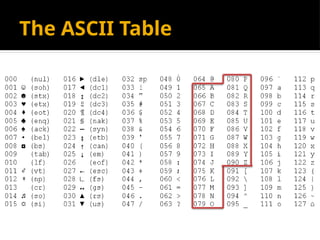
 ASCII is the standard character
encoding scheme, where each
symbol is assigned a number.
 These symbols range from
upper and lower case letters
to numbers to things like
punctuation and arrows.
There are many tables online
that allow you to look up the
number associated with each
symbol.
Numbers
associated
with letters?
This sounds
strangely
familiar…
The ASCII Table
Using ASCII for Caesar’s
Cipher
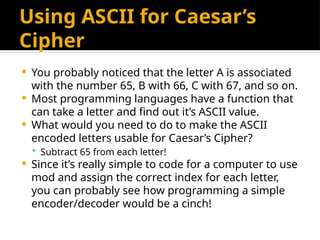
 You probably noticed that the letter A is associated
with the number 65, B with 66, C with 67, and so on.
 Most programming languages have a function that
can take a letter and find out it’s ASCII value.
 What would you need to do to make the ASCII
encoded letters usable for Caesar’s Cipher?
 Subtract 65 from each letter!
 Since it’s really simple to code for a computer to use
mod and assign the correct index for each letter,
you can probably see how programming a simple
encoder/decoder would be a cinch!
The Problem with Caesar’s Cipher
 It’s too easy to break! Let’s go back to our five letter alphabet.
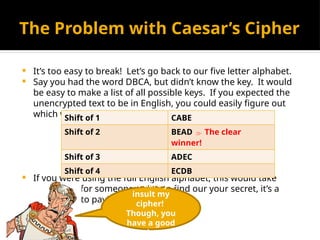
 Say you had the word DBCA, but didn’t know the key. It would
be easy to make a list of all possible keys. If you expected the
unencrypted text to be in English, you could easily figure out
which word was right:
 If you were using the full English alphabet, this would take
longer, but for someone trying to find our your secret, it’s a
small price to pay!
Shift of 1 CABE
Shift of 2 BEAD  The clear
winner!
Shift of 3 ADEC
Shift of 4 ECDB
How dare you
insult my
cipher!
Though, you
have a good
point…
Photo Encryption- Colors
 We can apply what we’ve learned about
encryption to pictures too!
 As you may have noticed when using Photoshop,
colors are determined by concentrations of red,
green, and blue. The amount of each color is
represented by a digit between 0 and 255.
 For instance, red would be represented as
(255,0,0)
Red Green Blue
How It Works
 This means that, just like words, we can
convert all of our colors into numbers!
This is helpful for encryption.
 For instance, let’s say that one pixel of
your image has a color value of
(253,244,3). It looks like this:
How It Works
 We want to send this color to someone
else safely- do you have any idea how
we can do this?
 We can use a secret code, just like
before!
 Like the alphabet, we can shift our
color values.
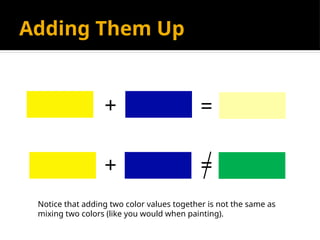
 In this case, we are going to add
another color’s value to our original
value.
Adding Them Up
+
+
=
=
Notice that adding two color values together is not the same as
mixing two colors (like you would when painting).
Adding Them Up- Mods
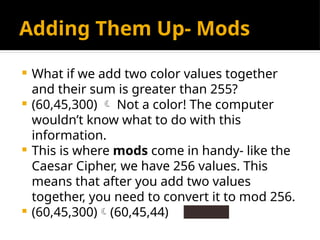
 What if we add two color values together
and their sum is greater than 255?
 (60,45,300)  Not a color! The computer
wouldn’t know what to do with this
information.
 This is where mods come in handy- like the
Caesar Cipher, we have 256 values. This
means that after you add two values
together, you need to convert it to mod 256.
 (60,45,300)(60,45,44)
Decoding
 To decode this color, all the recipient
needs to do is subtract the color we
added- in this case, we subtract the
blue from the light yellow.
=
-
Applications
 We just encoded and decoded one pixel. We can apply
this to an entire picture by adding one image to
another.
 Think of it this way- You have a photo that you are
sending and a photo that is your “key.” As long as the
other person has the key, they can subtract it from your
encoded photo to get back the original!
 This isn’t particularly useful in computer science,
however, because there is no way to stop someone
from seeing your photo key and decoding it
themselves. They could intercept this key (just like they
could intercept the photo) if you try to send it to anyone
or make it public!
An example
pixel addition
Cryptography
 Cryptography is the study and practice of
hiding information. Caesar’s cipher and
photo encryption are just two ways to encrypt
and decrypt information. They are both too
weak for real-world applications.
 There are many methods of cryptography
that are much more foolproof than these two
methods!
 Later today, we will learn about one of these
methods, RSA (public key) encryption.

Caesar Ciphers Powerpoint.pptxCaesar Ciphers Powerpoint.pptx

  • 1.
  • 2.
    What is aCaesar Cipher?  Caesar used to encrypt his messages using a very simple algorithm, which could be easily decrypted if you know the key.  He would take each letter of the alphabet and replace it with a letter a certain distance away from that letter. When he got to the end, he would wrap back around to the beginning.  Example with a shift of 3: A B C D E F G H I J K L MN O P Q R S T U V WX Y Z D E F G H I J K L MN O P Q R S T U V WX Y Z A B C I’m so sneaky !
  • 3.
    But I Don’tWant to Make a Table!  That’s fine! If you know what the shift is, you can use something called modulo, which is commonly shortened to mod.  Let’s say we wanted to find 8 mod 5. We would divide 8 by 5 and find the remainder. So in this case, 8 mod 5 = 3.  In this case, 5 is called the modulus.  Can you solve these? 19 mod 5 2 mod 5 25 mod 5 4 2 0
  • 4.
    How Is ThatHelpful?  When using a Caesar cipher, you assign each letter to an index starting from 0.  You would then compute the following. (plain letter index + key) mod (total number of letters)  This will give you the index of the encrypted letter!  As you can see, the modulus is the total number of letters in the alphabet. For English, this modulus is 26. A B C D E F G H I J K L M N O P Q R S T U V W X Y Z 0 1 2 3 4 5 6 7 8 9 10 1 1 1 2 1 3 1 4 1 5 1 6 1 7 1 8 1 9 2 0 2 1 2 2 2 3 2 4 2 5
  • 5.
    A Simple Example Let’s say we have a 5 letter alphabet with only the letters A-E  First, we assign each letter an index, starting from 0.  We then have to choose a key. For this example, we’ll use 2.  Let’s try encoding the word BEAD using the formula for the previous slide.  The index of the letter B is 1. The key is 2. The modulus is 5, since the alphabet is 5 letters.  Let’s use the algorithm: (1+2) = 3. 3 mod 5 = 3. The index of D is 3, so B would become the letter D.  Using algorithm on each letter, can you encode the full word? DBCA A B C D E 0 1 2 3 4
  • 6.
    Why Does ModdingWork?  The mod accounts for wrapping back around once you reach the end of the alphabet.  When converting the letter E using the key 2, you first add 4 + 2, which gives you 6. As you can see, the index 6 is beyond the scope of this alphabet. When you do 6 mod 5, you get the remainder of 1, which is how much you need to go back and count from the beginning of the alphabet. A B C D E 0 1 2 3 4
  • 7.
    What About Decoding? To decode, you do the following: (cipher letter index – key + total number of letters) mod (total number of letters)  Does anyone know why we can’t just do: (cipher letter index – key) mod (total number of letters)?  By adding the total number of letters, you don’t have to end up taking the mod of a negative number.  See if you can decode DBCA to get back to the word BEAD.
  • 8.
    How Would YouProgram This?  It’s unbelievably simple!  The mod function is one of the most basic components of a lot of programming languages. You’ll learn the mod function for python early on. That means all we have to deal with is indexing the letters.  Believe it or not, this also is no problem. The solution lies in ASCII.
  • 9.
    Wait, What’s ASCII? Computers have to represent everything as numbers, including things as basic as text.  ASCII is the standard character encoding scheme, where each symbol is assigned a number.  These symbols range from upper and lower case letters to numbers to things like punctuation and arrows. There are many tables online that allow you to look up the number associated with each symbol. Numbers associated with letters? This sounds strangely familiar…
  • 10.
  • 11.
    Using ASCII forCaesar’s Cipher  You probably noticed that the letter A is associated with the number 65, B with 66, C with 67, and so on.  Most programming languages have a function that can take a letter and find out it’s ASCII value.  What would you need to do to make the ASCII encoded letters usable for Caesar’s Cipher?  Subtract 65 from each letter!  Since it’s really simple to code for a computer to use mod and assign the correct index for each letter, you can probably see how programming a simple encoder/decoder would be a cinch!
  • 12.
    The Problem withCaesar’s Cipher  It’s too easy to break! Let’s go back to our five letter alphabet.  Say you had the word DBCA, but didn’t know the key. It would be easy to make a list of all possible keys. If you expected the unencrypted text to be in English, you could easily figure out which word was right:  If you were using the full English alphabet, this would take longer, but for someone trying to find our your secret, it’s a small price to pay! Shift of 1 CABE Shift of 2 BEAD  The clear winner! Shift of 3 ADEC Shift of 4 ECDB How dare you insult my cipher! Though, you have a good point…
  • 13.
    Photo Encryption- Colors We can apply what we’ve learned about encryption to pictures too!  As you may have noticed when using Photoshop, colors are determined by concentrations of red, green, and blue. The amount of each color is represented by a digit between 0 and 255.  For instance, red would be represented as (255,0,0) Red Green Blue
  • 14.
    How It Works This means that, just like words, we can convert all of our colors into numbers! This is helpful for encryption.  For instance, let’s say that one pixel of your image has a color value of (253,244,3). It looks like this:
  • 15.
    How It Works We want to send this color to someone else safely- do you have any idea how we can do this?  We can use a secret code, just like before!  Like the alphabet, we can shift our color values.  In this case, we are going to add another color’s value to our original value.
  • 16.
    Adding Them Up + + = = Noticethat adding two color values together is not the same as mixing two colors (like you would when painting).
  • 17.
    Adding Them Up-Mods  What if we add two color values together and their sum is greater than 255?  (60,45,300)  Not a color! The computer wouldn’t know what to do with this information.  This is where mods come in handy- like the Caesar Cipher, we have 256 values. This means that after you add two values together, you need to convert it to mod 256.  (60,45,300)(60,45,44)
  • 18.
    Decoding  To decodethis color, all the recipient needs to do is subtract the color we added- in this case, we subtract the blue from the light yellow. = -
  • 19.
    Applications  We justencoded and decoded one pixel. We can apply this to an entire picture by adding one image to another.  Think of it this way- You have a photo that you are sending and a photo that is your “key.” As long as the other person has the key, they can subtract it from your encoded photo to get back the original!  This isn’t particularly useful in computer science, however, because there is no way to stop someone from seeing your photo key and decoding it themselves. They could intercept this key (just like they could intercept the photo) if you try to send it to anyone or make it public!
  • 20.
  • 21.
    Cryptography  Cryptography isthe study and practice of hiding information. Caesar’s cipher and photo encryption are just two ways to encrypt and decrypt information. They are both too weak for real-world applications.  There are many methods of cryptography that are much more foolproof than these two methods!  Later today, we will learn about one of these methods, RSA (public key) encryption.