Reframing Employer-
Employee Relationships
Personal Thoughts on Reid Hoffman’s The Alliance
Reframe what, you say?
Activating the Non-Engaged Employee
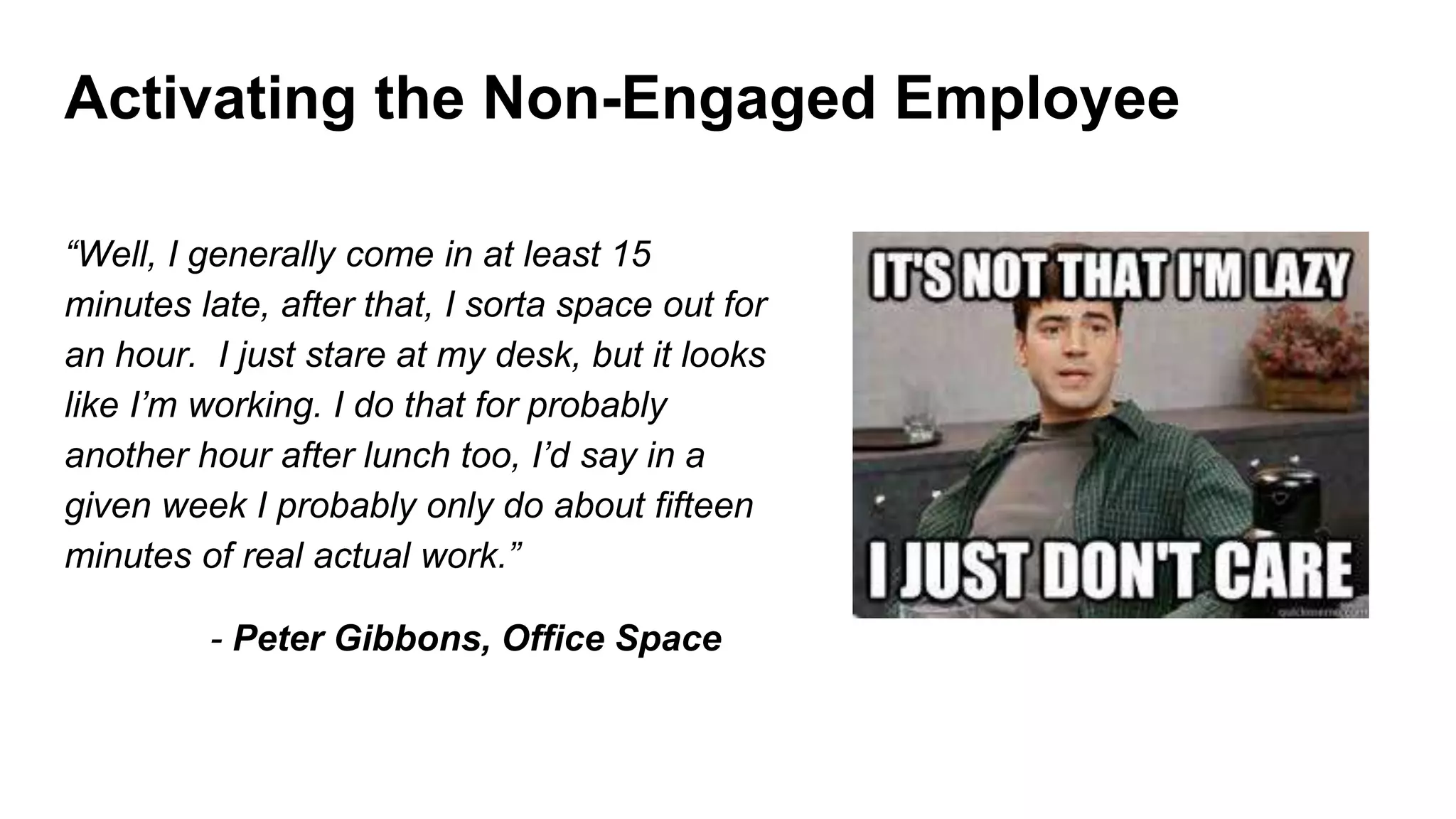
“Well, I generally come in at least 15
minutes late, after that, I sorta space out for
an hour. I just stare at my desk, but it looks
like I’m working. I do that for probably
another hour after lunch too, I’d say in a
given week I probably only do about fifteen
minutes of real actual work.”
- Peter Gibbons, Office Space
What I’m Going to Cover Today:
● We need to reframe employer / employee relationships
● I will introduce to you a new perspective on employment
● Based on some of the key points in my talk, I hope that can encourage
NEO’s managers and employees to create mission-focused and
personally rewarding work.
Why Is This Important
● For most of my recent work history, I’ve felt disconnected & under-utilized, out
of sync with how my goals and values fit with my employer’s until I came to
NEO.
● I have always been fascinated by how companies can motivate & retain
employees.
● Importance of company culture; influences positivity & loyalty
● Neo practices many of these concepts but can always improve.
Introduction to the Concept of “The Alliance”
● The Alliance is a book on a new framework for
companies to develop their talent, by Reid
Hoffman, co-founder and Chairman of LinkedIn.
● Hoffman argues that employee/employer
relationships are based on lies. Employees have
a different set of motivations & goals than the
company. Neither side is acknowledging that
difference. Creates a disconnect.
● What if we had a working contract between
managers and employees that aims to define and
align the employee’s personal/professional goals
with company mission & goals.
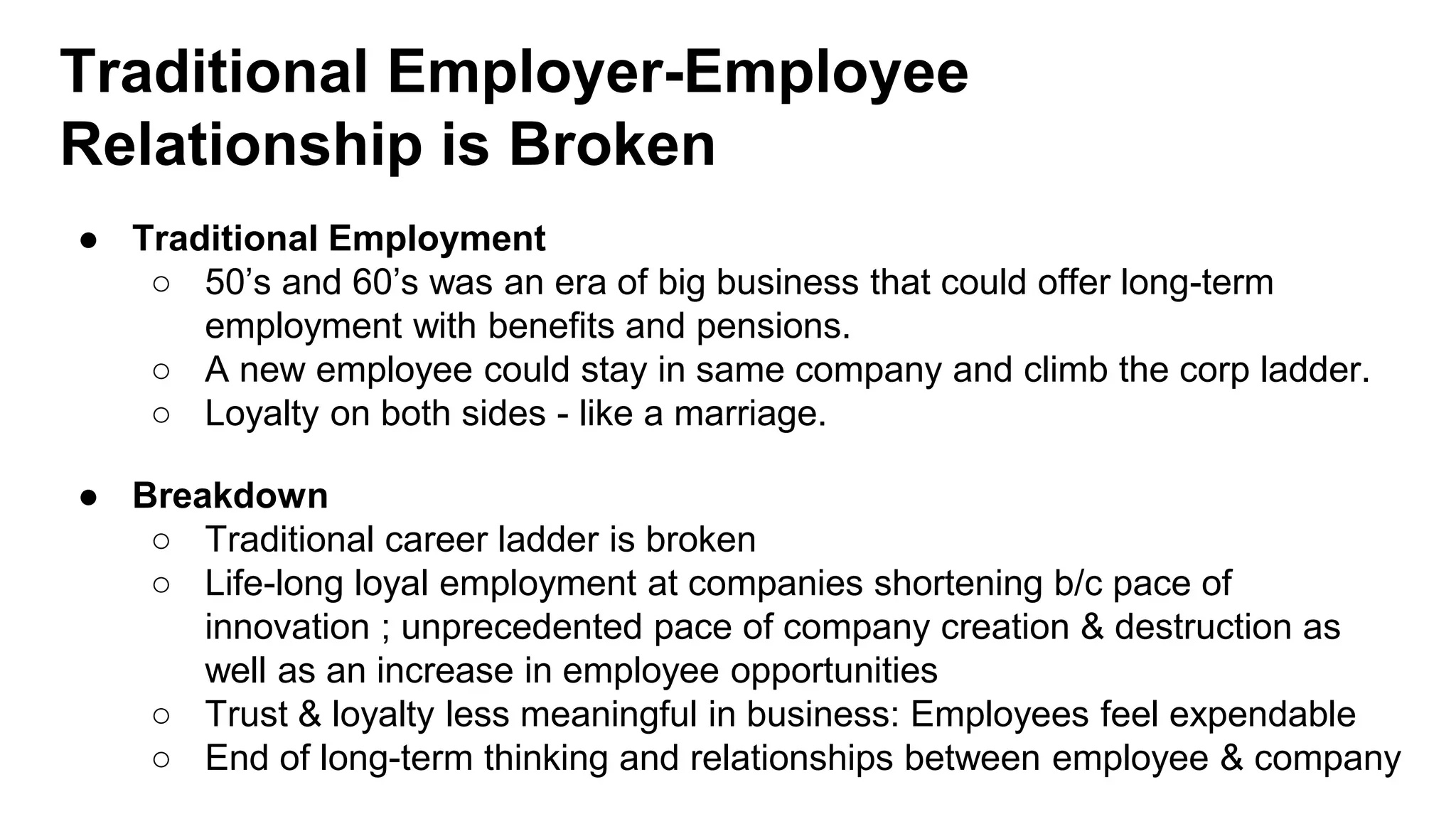
Traditional Employer-Employee
Relationship is Broken
● Traditional Employment
○ 50’s and 60’s was an era of big business that could offer long-term
employment with benefits and pensions.
○ A new employee could stay in same company and climb the corp ladder.
○ Loyalty on both sides - like a marriage.
● Breakdown
○ Traditional career ladder is broken
○ Life-long loyal employment at companies shortening b/c pace of
innovation ; unprecedented pace of company creation & destruction as
well as an increase in employee opportunities
○ Trust & loyalty less meaningful in business: Employees feel expendable
○ End of long-term thinking and relationships between employee & company
How Do We Fix It?
Solution 1: Building Alignment
● The emerging model of employer-employee dynamics is built on establishing mutually
beneficial relationship
● Starts with thinking of each other as allies in a win-win environment, recognizing the
value of your employees. Working-with vs working-for.
● Aligning company and employee’s Missions, goals, values and aspirations
○ Honest conversations between employer and employee
○ Define expectations and benefits of relationship
○ Enable employees and employers find overlaps and commonality
○ Create a Statement of Alliance that lays out a mission for the employee to lead to
Constructing the Alliance Contract
Terms of the Contract
● A pact that defines scope of work
● Timeframe
● Goals
● Sweet spot where company
mission and goals overlap with
employee
● What the company will do for
employee’s career
● What the employee can do for the
company
Goals of the the Contract
● Build Trust
● Strengthen employee / employer
relations
● Commitment
● Loyalty
● Productivity/engagement
● Encourage long term thinking
● Transactional work is transformed
Solution 2: Create ‘Tours of Duty’ as
New Work Paradigm
● What is a “Tour of Duty”? Tour of Duty for military soldiers is a structured
period of time spent performing operational duties for a specific mission. It is
part of a rotation of similar tours over several months.
Within the context of work, a tour of duty is short-term, project-oriented work designed to support
employee and employer goals in a mutually beneficial way.
As a manager you want to construct an environment where your employee can help to transform the
company for the future and your employee wants the company help them transform their careers for
the future
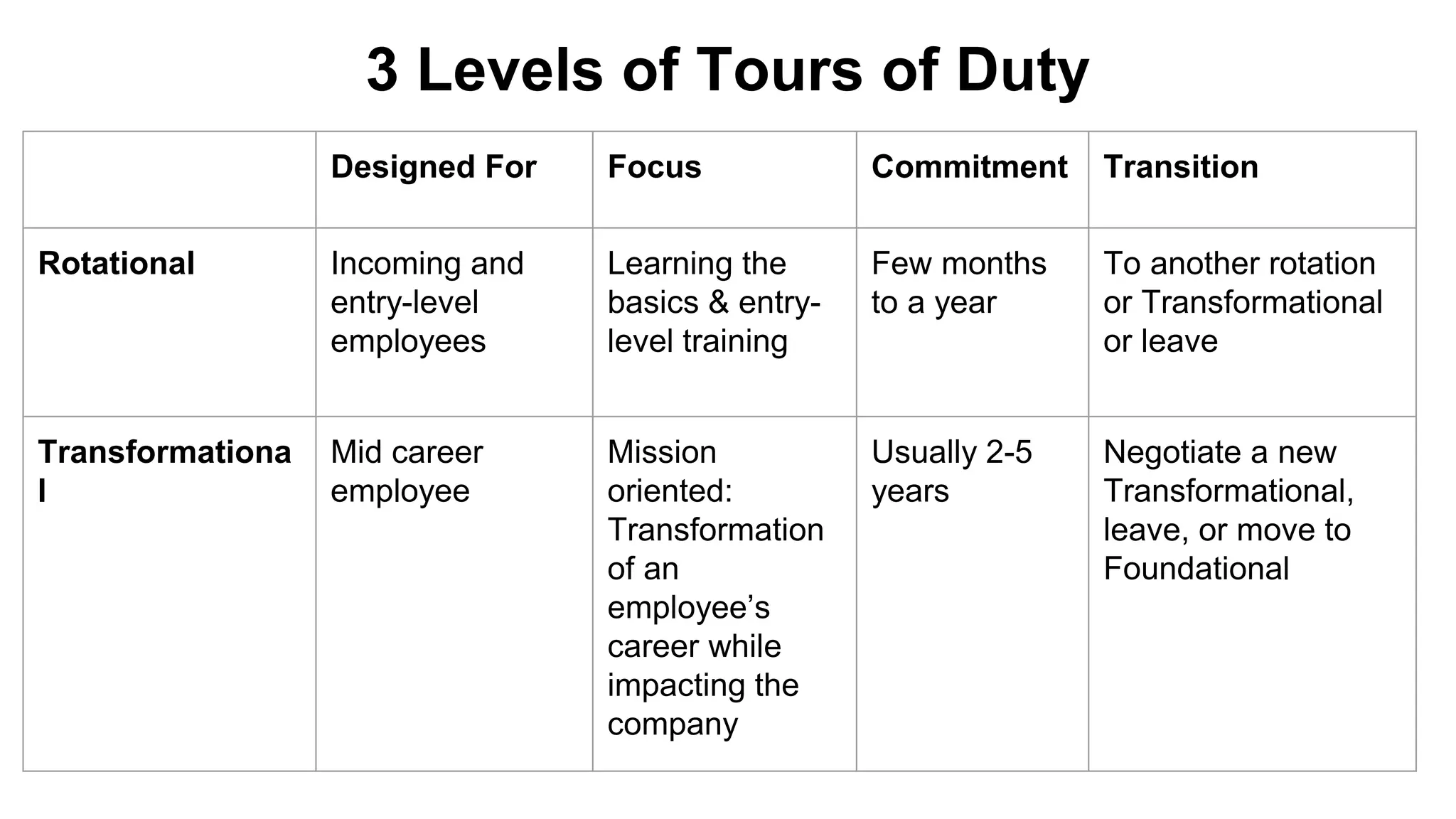
3 Levels of Tours of Duty
Designed For Focus Commitment Transition
Rotational Incoming and
entry-level
employees
Learning the
basics & entry-
level training
Few months
to a year
To another rotation
or Transformational
or leave
Transformationa
l
Mid career
employee
Mission
oriented:
Transformation
of an
employee’s
career while
impacting the
company
Usually 2-5
years
Negotiate a new
Transformational,
leave, or move to
Foundational
3 Levels of Tours of Duty (cont.)
Designed For Focus Commitment Transition
Foundational Senior For long-term
employees
who serve as
stewards of
the company
mission ;
Preparing
employee to
lead
Ongoing Long-term
Solution 3: Network Intelligence, Alumni Networks
● Embrace Network Intelligence
○ Encourage employees to cultivate relationships outside of the company via
conferences/linkedin/meetups/lectures
○ Helps employee grow their professional network & in turn helps companies stay relevant.
“Lifetime employment might be over but a lifetime relationship
remains the ideal” -Reid Hoffman
● Alumni Networks
○ fosters sources of expertise for new employees
○ creating alumni networks is great for both employee and employers
○ Keeping alumni connected, creates a boomerang effect; they can return for a new
tour
Why Consider Applying These Practices Here?
● Re-energize passions
● Create a vibrant collaborative and innovative culture
● Get unstuck - both employee and employer
● Create a sense of purpose at work
● Ensure higher retention of employees if they are engaged
● Create more loyal employers and employees
● Strengthen the long-term alliance between companies and its talent
Thank You!

Neo Talks Alliance

  • 1.
    Reframing Employer- Employee Relationships PersonalThoughts on Reid Hoffman’s The Alliance
  • 2.
  • 3.
    Activating the Non-EngagedEmployee “Well, I generally come in at least 15 minutes late, after that, I sorta space out for an hour. I just stare at my desk, but it looks like I’m working. I do that for probably another hour after lunch too, I’d say in a given week I probably only do about fifteen minutes of real actual work.” - Peter Gibbons, Office Space
  • 4.
    What I’m Goingto Cover Today: ● We need to reframe employer / employee relationships ● I will introduce to you a new perspective on employment ● Based on some of the key points in my talk, I hope that can encourage NEO’s managers and employees to create mission-focused and personally rewarding work.
  • 5.
    Why Is ThisImportant ● For most of my recent work history, I’ve felt disconnected & under-utilized, out of sync with how my goals and values fit with my employer’s until I came to NEO. ● I have always been fascinated by how companies can motivate & retain employees. ● Importance of company culture; influences positivity & loyalty ● Neo practices many of these concepts but can always improve.
  • 6.
    Introduction to theConcept of “The Alliance” ● The Alliance is a book on a new framework for companies to develop their talent, by Reid Hoffman, co-founder and Chairman of LinkedIn. ● Hoffman argues that employee/employer relationships are based on lies. Employees have a different set of motivations & goals than the company. Neither side is acknowledging that difference. Creates a disconnect. ● What if we had a working contract between managers and employees that aims to define and align the employee’s personal/professional goals with company mission & goals.
  • 7.
    Traditional Employer-Employee Relationship isBroken ● Traditional Employment ○ 50’s and 60’s was an era of big business that could offer long-term employment with benefits and pensions. ○ A new employee could stay in same company and climb the corp ladder. ○ Loyalty on both sides - like a marriage. ● Breakdown ○ Traditional career ladder is broken ○ Life-long loyal employment at companies shortening b/c pace of innovation ; unprecedented pace of company creation & destruction as well as an increase in employee opportunities ○ Trust & loyalty less meaningful in business: Employees feel expendable ○ End of long-term thinking and relationships between employee & company
  • 8.
    How Do WeFix It?
  • 9.
    Solution 1: BuildingAlignment ● The emerging model of employer-employee dynamics is built on establishing mutually beneficial relationship ● Starts with thinking of each other as allies in a win-win environment, recognizing the value of your employees. Working-with vs working-for. ● Aligning company and employee’s Missions, goals, values and aspirations ○ Honest conversations between employer and employee ○ Define expectations and benefits of relationship ○ Enable employees and employers find overlaps and commonality ○ Create a Statement of Alliance that lays out a mission for the employee to lead to
  • 10.
    Constructing the AllianceContract Terms of the Contract ● A pact that defines scope of work ● Timeframe ● Goals ● Sweet spot where company mission and goals overlap with employee ● What the company will do for employee’s career ● What the employee can do for the company Goals of the the Contract ● Build Trust ● Strengthen employee / employer relations ● Commitment ● Loyalty ● Productivity/engagement ● Encourage long term thinking ● Transactional work is transformed
  • 11.
    Solution 2: Create‘Tours of Duty’ as New Work Paradigm ● What is a “Tour of Duty”? Tour of Duty for military soldiers is a structured period of time spent performing operational duties for a specific mission. It is part of a rotation of similar tours over several months. Within the context of work, a tour of duty is short-term, project-oriented work designed to support employee and employer goals in a mutually beneficial way. As a manager you want to construct an environment where your employee can help to transform the company for the future and your employee wants the company help them transform their careers for the future
  • 12.
    3 Levels ofTours of Duty Designed For Focus Commitment Transition Rotational Incoming and entry-level employees Learning the basics & entry- level training Few months to a year To another rotation or Transformational or leave Transformationa l Mid career employee Mission oriented: Transformation of an employee’s career while impacting the company Usually 2-5 years Negotiate a new Transformational, leave, or move to Foundational
  • 13.
    3 Levels ofTours of Duty (cont.) Designed For Focus Commitment Transition Foundational Senior For long-term employees who serve as stewards of the company mission ; Preparing employee to lead Ongoing Long-term
  • 14.
    Solution 3: NetworkIntelligence, Alumni Networks ● Embrace Network Intelligence ○ Encourage employees to cultivate relationships outside of the company via conferences/linkedin/meetups/lectures ○ Helps employee grow their professional network & in turn helps companies stay relevant. “Lifetime employment might be over but a lifetime relationship remains the ideal” -Reid Hoffman ● Alumni Networks ○ fosters sources of expertise for new employees ○ creating alumni networks is great for both employee and employers ○ Keeping alumni connected, creates a boomerang effect; they can return for a new tour
  • 15.
    Why Consider ApplyingThese Practices Here? ● Re-energize passions ● Create a vibrant collaborative and innovative culture ● Get unstuck - both employee and employer ● Create a sense of purpose at work ● Ensure higher retention of employees if they are engaged ● Create more loyal employers and employees ● Strengthen the long-term alliance between companies and its talent
  • 16.

Editor's Notes

  • #8  BROKEN: 1 continuous change/onset of globalization of communication 2. competitive pressures to stay relevant 4. Steak holders want spending cuts. Cost are cut/layoffs to meet bottom lines 6. Employees feel expendable and replaceable and managers can’t keep good talent 7. Employees pick up vibe that they are Employee At Will-fired for any reason at any time 8. Employees will look for the next better opportunity that comes along without communication with manager. 9. No alliance between the manager and employee
  • #9 ven diagram shows
  • #11 what problem does it solve? the breakdown of traditional employment
  • #12  Benefits: Keeps employee Engagement employee transforms career and
  • #13  benefits of tours are: loyalty engaged employee fosters innovation encourage long-term thinking and entrepreneurial behavior employee has transformed their career by enhancing skills and portfolio employer gains loyal employees who want to help transform the company gives employee and employer flexibility to adapt and change Can use a restaurant chain as example
  • #14  benefits of tours are: loyalty engaged employee fosters innovation encourage long-term thinking and entrepreneurial behavior employee has transformed their career by enhancing skills and portfolio employer gains loyal employees who want to help transform the company gives employee and employer flexibility to adapt and change Can use a restaurant chain as example
  • #15  College Alumni networks as a framework for buliding an allicnace Network Benifits: Alumni Benifits: keeps former employees up to date on company and keeps them engaged Former employees can reffre customers and future employees Former employees can return for a new Tour of Duty Current employees can tap into assets of former emplpyees for current tours for insights and help For the alumni: refferal bonuses, discounts on survices
  • #16 Why is this relevant to NEO, the tech and startup industry and beyond?