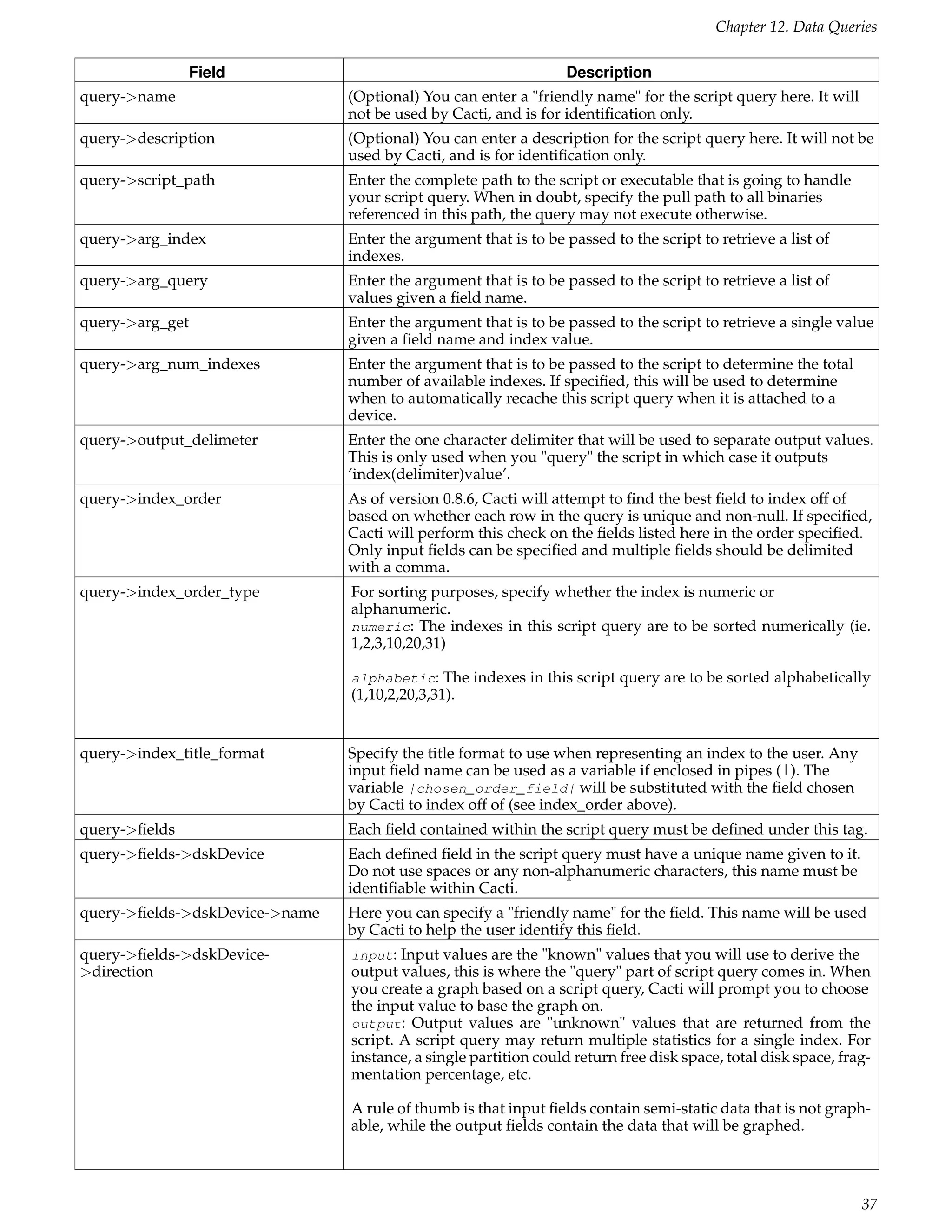
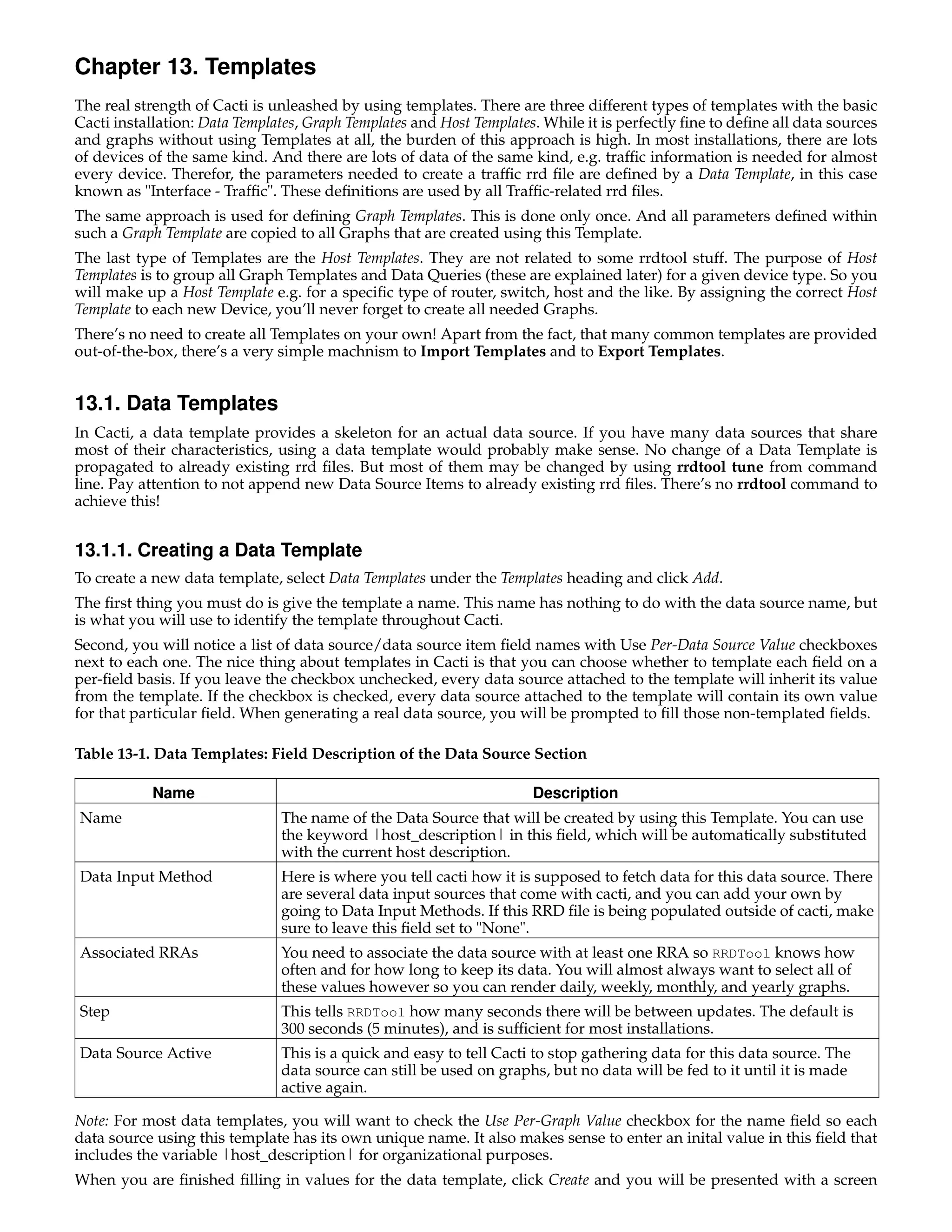
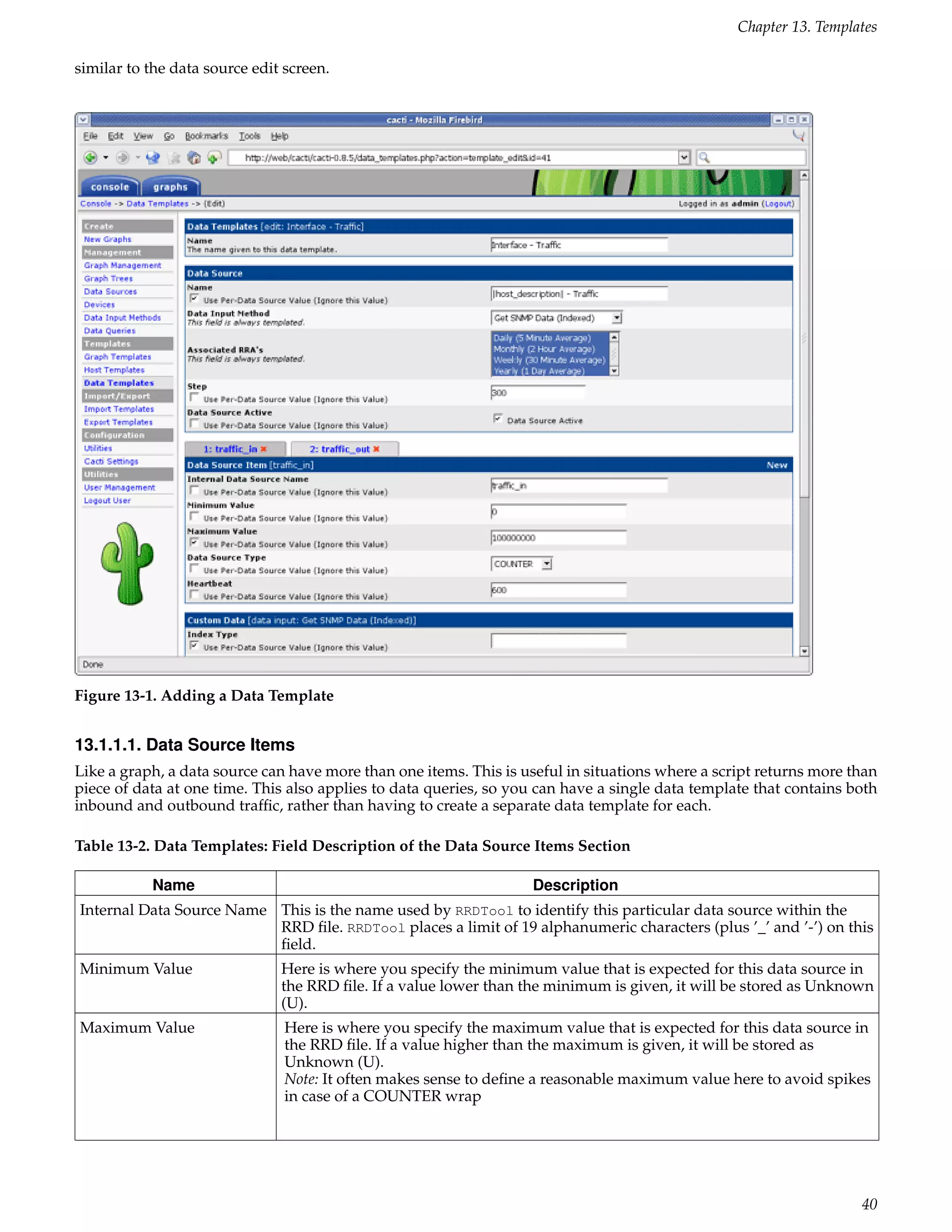
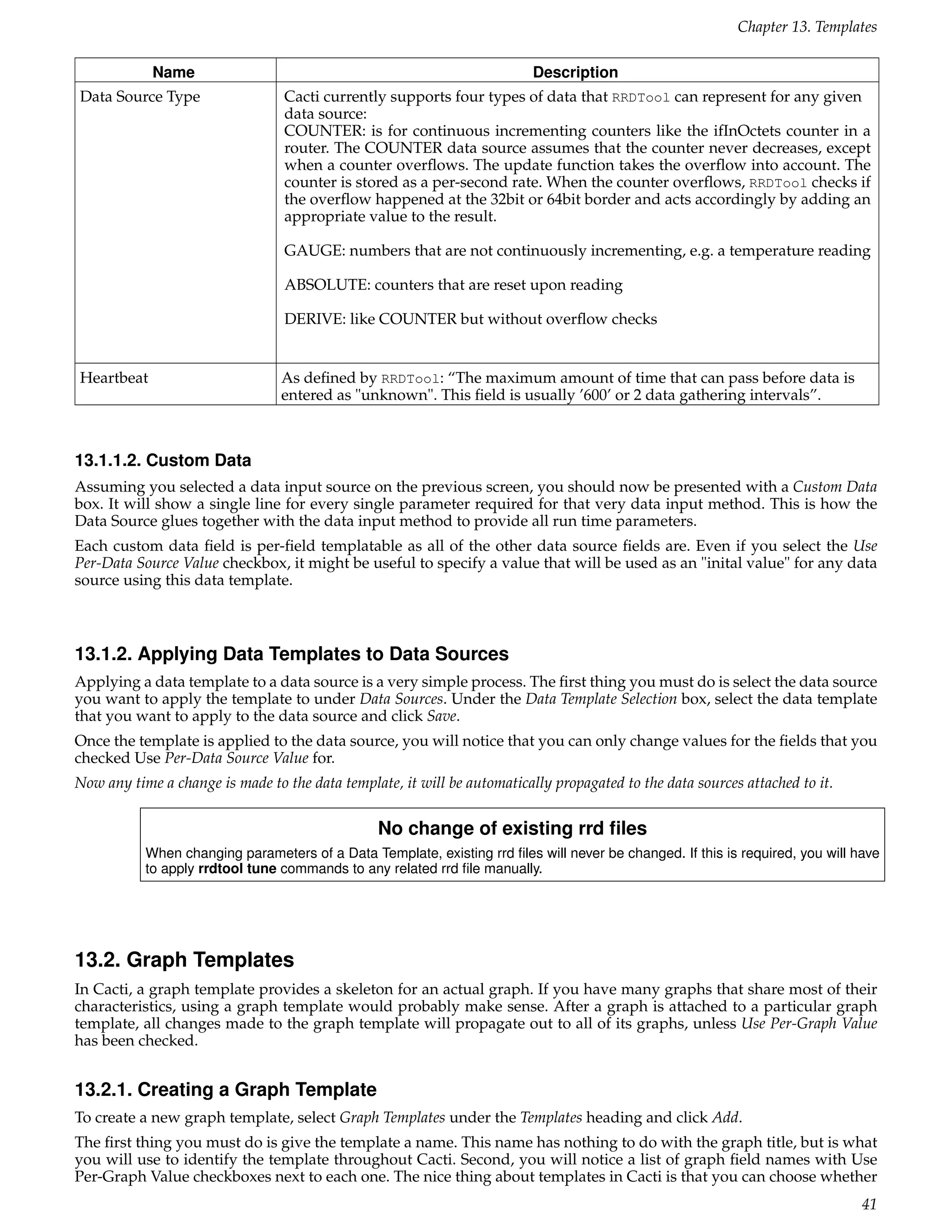
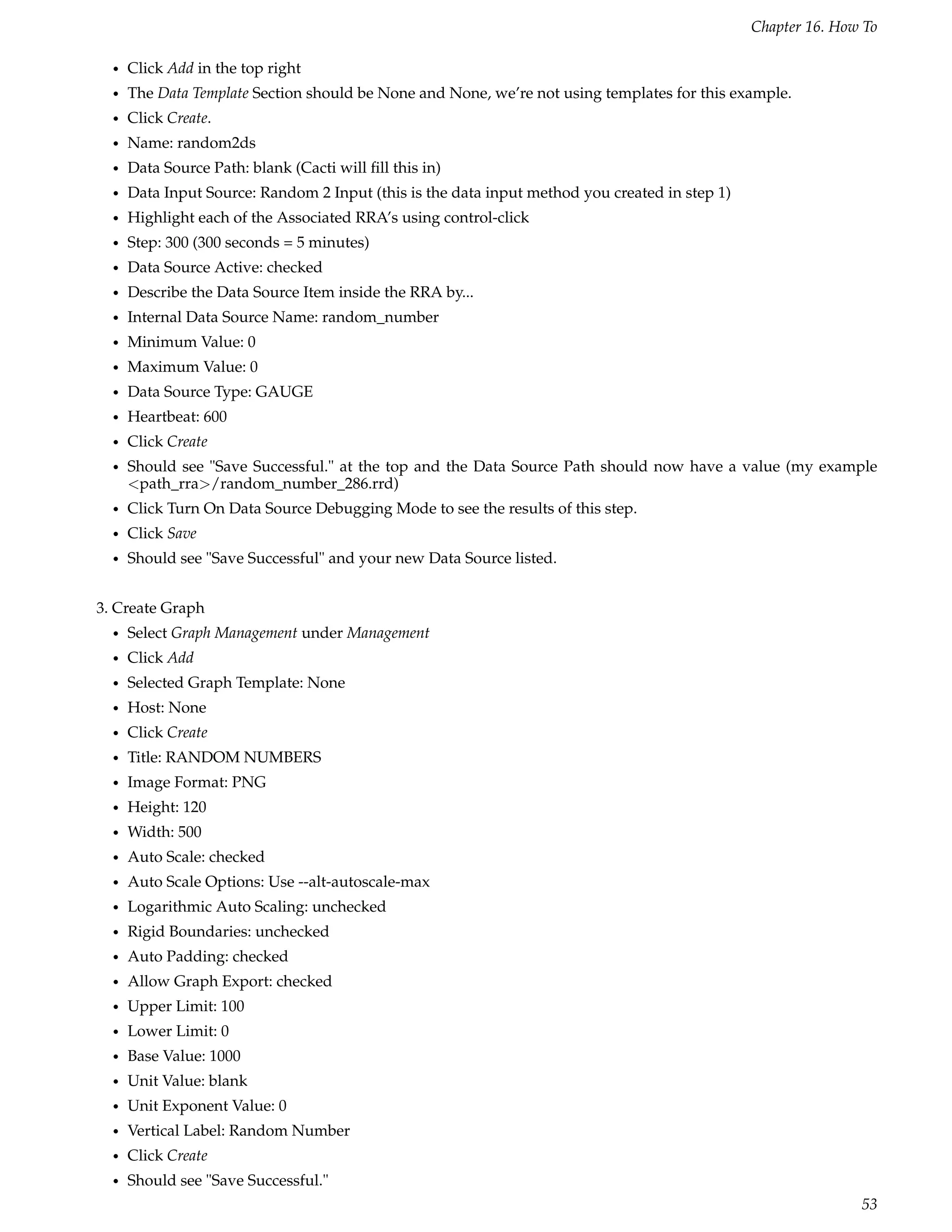
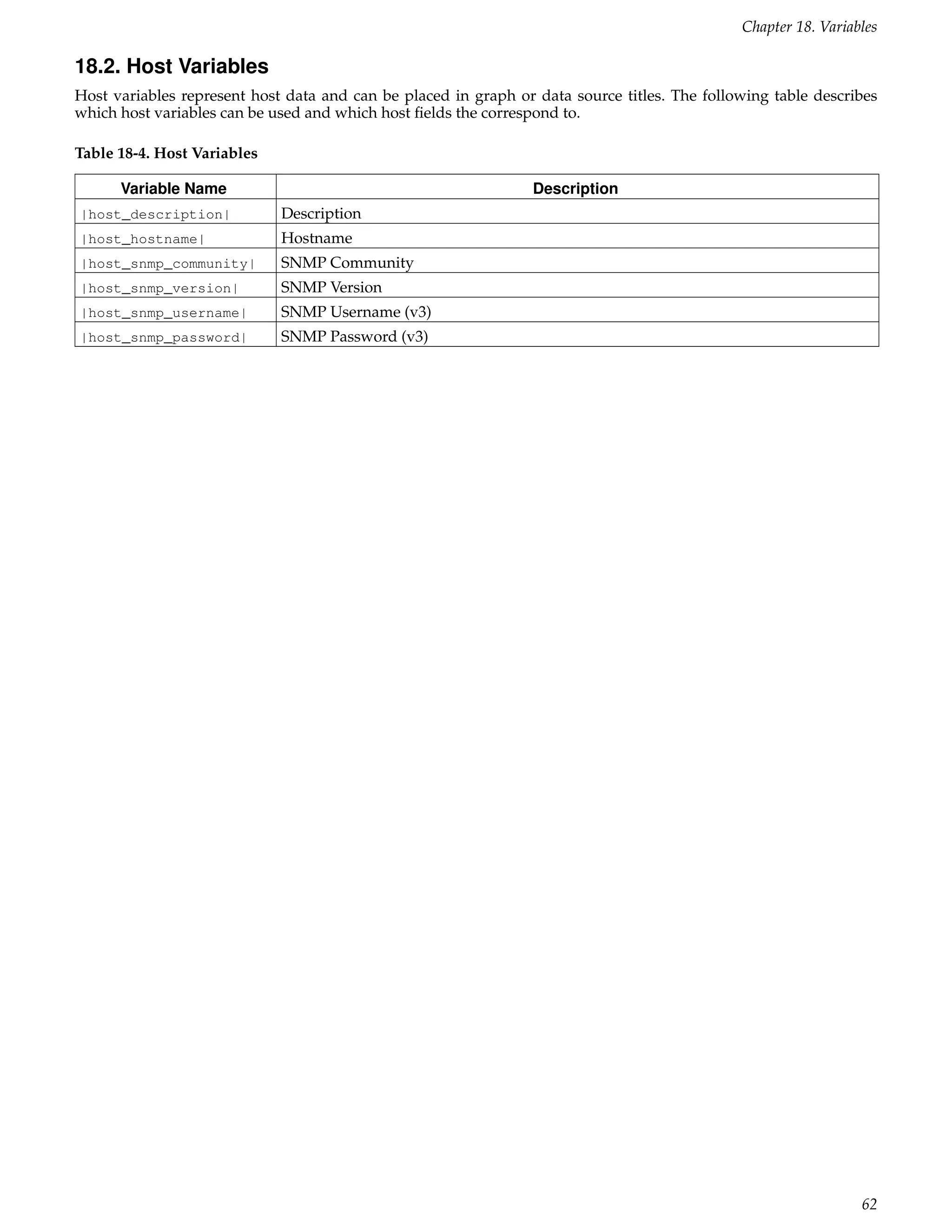
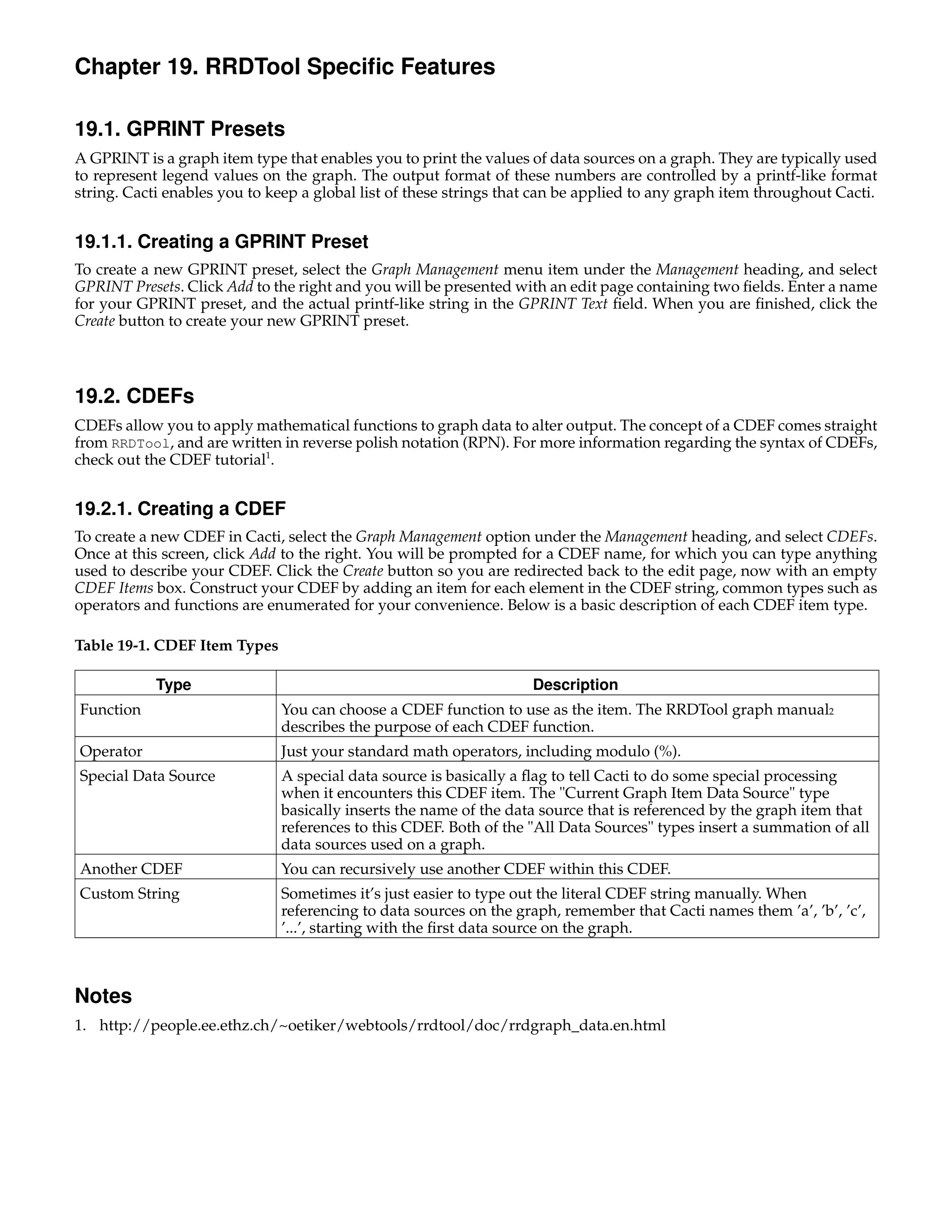
The Cacti Manual


    Ian Berry
   Tony Roman
   Larry Adams
   J.P. Pasnak
  Jimmy Conner
 Reinhard Scheck
The Cacti Manual
by Ian Berry, Tony Roman, Larry Adams, J.P. Pasnak, Jimmy Conner, and Reinhard Scheck

Published 2007
Copyright © 2007 The Cacti Group

This project is licensed under the terms of the GPL.
This program is free software; you can redistribute it and/or modify it under the terms of the GNU General Public License as published by the
Free Software Foundation; either version 2 of the License, or (at your option) any later version.
This program is distributed in the hope that it will be useful, but WITHOUT ANY WARRANTY; without even the implied warranty of
MERCHANTABILITY or FITNESS FOR A PARTICULAR PURPOSE. See the GNU General Public License for more details.
All product names are property of their respective owners. Such names are used for identification purposes only and are not indicative of
endorsement by or of any company, organization, product, or platform.
Table of Contents
I. Installation...................................................................................................................................................................................1
      1. Requirements .....................................................................................................................................................................1
      2. Installing Under Unix .......................................................................................................................................................2
             2.1. Required Packages for RPM-based Operating Systems..................................................................................2
             2.2. Ports for FreeBSD..................................................................................................................................................2
             2.3. Configure PHP ......................................................................................................................................................2
             2.4. Configure the Webserver (Apache) ....................................................................................................................2
             2.5. Configure MySQL.................................................................................................................................................3
             2.6. Install and Configure Cacti..................................................................................................................................3
             2.7. (Optional) Install and Configure Spine.............................................................................................................4
             2.8. Apply Patches........................................................................................................................................................4
      3. Installing Under Windows...............................................................................................................................................5
      4. Upgrading Cacti ..............................................................................................................................................................10
II. Basics .........................................................................................................................................................................................11
      5. Principles of Operation...................................................................................................................................................11
             5.1. Data Retrieval ......................................................................................................................................................11
             5.2. Data Storage.........................................................................................................................................................11
             5.3. Data Presentation................................................................................................................................................11
      6. Graph Overview ..............................................................................................................................................................12
      7. How to Graph Your Network........................................................................................................................................13
             7.1. Creating a Device................................................................................................................................................13
             7.2. Creating the Graphs ...........................................................................................................................................17
      8. Viewing Graphs ...............................................................................................................................................................19
             8.1. Graph Trees..........................................................................................................................................................19
      9. User Management ...........................................................................................................................................................21
             9.1. Editing an existing User.....................................................................................................................................21
             9.2. Creating a New User ..........................................................................................................................................23
             9.3. Copying a user ....................................................................................................................................................24
             9.4. Enable/Disable Users.........................................................................................................................................26
             9.5. Batch Copy Users................................................................................................................................................27
             9.6. Delete Users .........................................................................................................................................................28
             9.7. Guest (Anonymous) Access ..............................................................................................................................29
III. Advanced Topics....................................................................................................................................................................30
      10. Graph a Single SNMP OID ..........................................................................................................................................30
      11. Data Input Methods ......................................................................................................................................................31
             11.1. Creating a Data Input Method........................................................................................................................31
             11.2. Making Your Scripts Work With Cacti...........................................................................................................32
      12. Data Queries...................................................................................................................................................................33
             12.1. Creating a Data Query .....................................................................................................................................33
             12.2. SNMP Query XML Syntax ..............................................................................................................................34
             12.3. Script Query XML Syntax................................................................................................................................36
      13. Templates........................................................................................................................................................................39
             13.1. Data Templates..................................................................................................................................................39
             13.2. Graph Templates ...............................................................................................................................................41
             13.3. Host Templates..................................................................................................................................................44
             13.4. Import Templates ..............................................................................................................................................45
             13.5. Export Templates ..............................................................................................................................................46
      14. PHP Script Server ..........................................................................................................................................................48
             14.1. Using the Script Server.....................................................................................................................................48
             14.2. Upgrade Steps for the Example HostMib Data Queries .............................................................................48
             14.3. Migration of Existing PHP Scripts to Script Server .....................................................................................48
             14.4. Testing Your Script in the Script Server .........................................................................................................50
      15. Spine ...............................................................................................................................................................................51
IV. Help..........................................................................................................................................................................................52
      16. How To............................................................................................................................................................................52
             16.1. Simplest Method of Going from Script to Graph (Walkthrough)..............................................................52
      17. Frequently Asked Questions .......................................................................................................................................56
V. Reference ..................................................................................................................................................................................59
     18. Variables..........................................................................................................................................................................59
           18.1. Graph Variables.................................................................................................................................................59
           18.2. Host Variables....................................................................................................................................................62
     19. RRDTool Specific Features ...........................................................................................................................................63
           19.1. GPRINT Presets.................................................................................................................................................63
           19.2. CDEFs .................................................................................................................................................................63
     20. Command Line Scripts .................................................................................................................................................64
           20.1. Rebuild Poller Cache ........................................................................................................................................64
           20.2. Re-Index Hosts ..................................................................................................................................................65
           20.3. Empty Poller Output Table..............................................................................................................................65
           20.4. Reapply Suggested Names to Graphs ...........................................................................................................66
           20.5. Copy Local Cacti Users ....................................................................................................................................67
           20.6. Add a New Device............................................................................................................................................67
           20.7. Add a New Graph ............................................................................................................................................69
           20.8. Add Items to a Tree...........................................................................................................................................72
           20.9. Add Graph Permissions...................................................................................................................................75
     21. Debugging ......................................................................................................................................................................77
           21.1. Check Cacti Log File.........................................................................................................................................77
           21.2. Check Basic Data Gathering............................................................................................................................77
           21.3. Check cacti’s poller ...........................................................................................................................................77
           21.4. Check MySQL updating ..................................................................................................................................77
           21.5. Check rrd file updating ....................................................................................................................................78
           21.6. Check rrd file ownership .................................................................................................................................78
           21.7. Check rrd file numbers.....................................................................................................................................78
           21.8. Check rrdtool graph statement .......................................................................................................................79
           21.9. Miscellaneous ....................................................................................................................................................79
           21.10. RPM Installation?............................................................................................................................................79
           21.11. Not NaN, but 0 (zero) values? ......................................................................................................................79


                                                                                                                                                                                              iv
List of Tables
7-1. Device Field Definitions........................................................................................................................................................13
7-2. SNMP Retrieval Types ..........................................................................................................................................................15
8-1. Tree Sporting Type Definitions ............................................................................................................................................19
9-1. Field Description: User Management .................................................................................................................................22
10-1. Field Description: SNMP - Generic OID Template .........................................................................................................30
11-1. Field Description: Data Input Methods............................................................................................................................31
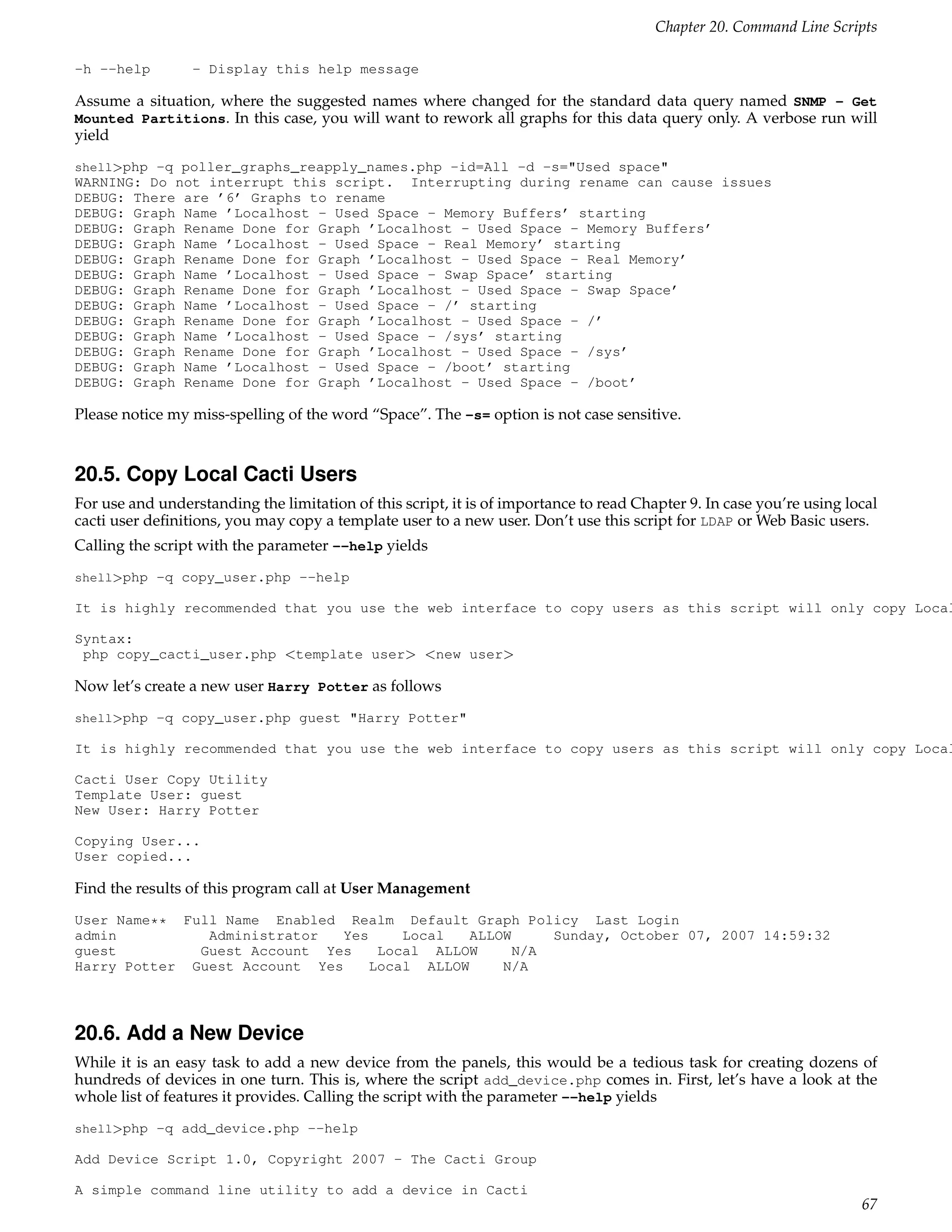
11-2. Field Description: Data Input Fields.................................................................................................................................31
12-1. Field Description: Data Queries ........................................................................................................................................33
12-2. Field Description: Associated Graph Templates .............................................................................................................33
12-3. SNMP Query XML Field Reference ..................................................................................................................................34
12-4. Script Query XML Field Reference ...................................................................................................................................36
13-1. Data Templates: Field Description of the Data Source Section .....................................................................................39
13-2. Data Templates: Field Description of the Data Source Items Section ..........................................................................40
13-3. Field Description: Graph Templates .................................................................................................................................42
13-4. Field Description: Graph Template Items ........................................................................................................................43
13-5. Field Description: Graph Template Items ........................................................................................................................44
15-1. Spine Specific Execution Parameters ...............................................................................................................................51
18-1. Nth Percentile Argument Description..............................................................................................................................59
18-2. Nth Percentile Types ...........................................................................................................................................................60
18-3. Bandwidth Summation Argument Description..............................................................................................................61
18-4. Host Variables ......................................................................................................................................................................62
19-1. CDEF Item Types .................................................................................................................................................................63
20-1. Re_Index Methods...............................................................................................................................................................65
20-2. Parametes required for an Interface Traffic Graph .........................................................................................................71
Chapter 1. Requirements
Cacti requires that the following software is installed on your system.

• RRDTool   1.0.49 or 1.2.x or greater
• MySQL   4.1.x or 5.x or greater
• PHP   4.3.6 or greater, 5.x greater highly recommended for advanced features
• A Web Server     e.g. Apache or IIS
Chapter 2. Installing Under Unix
Please make sure, the following packages are installed according to your operating systems requirements. Verify, that
httpd and mysqld are started at system startup.


2.1. Required Packages for RPM-based Operating Systems

• httpd

• php

• php-mysql

• php-snmp

• mysql

• mysql-server

• net-snmp


2.2. Ports for FreeBSD

• www/apache2

• net/rrdtool

• net/net-snmp

• www/php4-cgi

• lang/php4   (With MySQL and SNMP Support)
• databases/mysql323-server


2.3. Configure PHP
Please find the file /etc/php.ini and make the following changes to it:
extension_dir = /etc/php.d

This will enable PHP to find more configuration directives in that very directory.
Activate the MySQL extension via /etc/php.d/mysql.ini
; Enable mysql extension module
extension=mysql.so

Activate the SNMP extension via /etc/php.d/snmp.ini
; Enable snmp extension module
extension=snmp.so

If using PHP 4.3.5 or less include the following line. If using 4.3.6 or greater, you should remove this line if present.
session.save_path=/tmp

If you want to allow template importing, uncomment the following line:
file_uploads = On


2.4. Configure the Webserver (Apache)
If you are using Apache 1.3.x, installation of PHP 5 is not recommended.
Please find the file /etc/httpd/conf/httpd.conf or equivalent and make the following changes to it:
# Load config files from the config directory "/etc/httpd/conf.d".
Chapter 2. Installing Under Unix

Include conf.d/*.conf

Now, please locate the PHP configuration file at /etc/httpd/conf.d/php.conf
If using PHP 5, then add the following lines.
# PHP is an HTML-embedded scripting language which attempts to make it
# easy for developers to write dynamically generated webpages.
LoadModule php5_module modules/libphp5.so
#
# Cause the PHP interpreter to handle files with a .php extension.
AddHandler php5-script .php
AddType text/html .php
#
# Add index.php to the list of files that will be served as directory
# indexes.
DirectoryIndex index.php


2.5. Configure MySQL
Set a password for the root user
shell> mysqladmin --user=root password somepassword
shell> mysqladmin --user=root --password reload


2.6. Install and Configure Cacti

   1. Extract the distribution tarball.
     shell> tar xzvf cacti-version.tar.gz
   2. Create the MySQL database:
     shell> mysqladmin --user=root create cacti
   3. Import the default cacti database:
     shell> mysql cacti < cacti.sql
   4. Optional: Create a MySQL username and password for Cacti.
     shell> mysql --user=root mysql
     mysql> GRANT ALL ON cacti.* TO cactiuser@localhost IDENTIFIED BY ’somepassword’;
     mysql> flush privileges;
   5. Edit include/config.php and specify the database type, name, host, user and password for your Cacti config-
      uration.
     $database_type = "mysql";
     $database_default = "cacti";
     $database_hostname = "localhost";
     $database_username = "cactiuser";
     $database_password = "cacti";
   6. Set the appropriate permissions on cacti’s directories for graph/log generation. You should execute these com-
      mands from inside cacti’s directory to change the permissions.
     shell> chown -R cactiuser rra/ log/
     (Enter a valid username for cactiuser, this user will also be used in the next step for data gathering.)
   7. Add a line to your /etc/crontab file similar to:
     */5 * * * * cactiuser php /var/www/html/cacti/poller.php > /dev/null 2>&1
     Replace cactiuser with the valid user specified in the previous step.
     Replace /var/www/html/cacti/ with your full Cacti path.
   8. Point your web browser to:
       http://your-server/cacti/
     Log in the with a username/password of admin. You will be required to change this password immediately.
     Make sure to fill in all of the path variables carefully and correctly on the following screen.
                                                                                                          3
Chapter 2. Installing Under Unix

2.7. (Optional) Install and Configure Spine
Spine is a very fast poller engine, written in C. It is an optional replacement for cmd.php. If you decide to use it, you
will have to install it explicitely. It does not come with cacti itself.
The easiest way is to install Spine using rpm or ports. You will find packages for Spine at the main cacti site or from
your distribution.
To compile Spine, please download it to any location of your liking. Then, please issue from the downloaded directory
following commands
shell>aclocal

shell>libtoolize --force          (glibtoolize --force on Max OS)

shell>autoheader

shell>autoconf

shell>automake

shell>./configure

shell>make

shell>make install

Assuming, you’ve managed to install Spine correctly, you will have to configure it. The configuration file may be
placed in the same directory as Spine itself or at /etc/Spine.conf.
DB_Host 127.0.0.1 or hostname (not localhost)
DB_Database cacti
DB_User cactiuser
DB_Password cacti
DB_Port 3306

All other pre 0.8.6 settings are obsolete.


2.8. Apply Patches
Please visit the Cacti website at http://www.cacti.net/download_patches.php If any patch has been released, you
will find installation instructions there.
As an example, please find patch installation instructions for cacti 0.8.6j here. Do not apply those patches to recent
releases!
wget http://www.cacti.net/downloads/patches/0.8.6j/ping_php_version4_snmpgetnext.patch
wget http://www.cacti.net/downloads/patches/0.8.6j/tree_console_missing_hosts.patch
wget http://www.cacti.net/downloads/patches/0.8.6j/thumbnail_graphs_not_working.patch
wget http://www.cacti.net/downloads/patches/0.8.6j/graph_debug_lockup_fix.patch
wget http://www.cacti.net/downloads/patches/0.8.6j/snmpwalk_fix.patch
patch -p1 -N < ping_php_version4_snmpgetnext.patch
patch -p1 -N < tree_console_missing_hosts.patch
patch -p1 -N < thumbnail_graphs_not_working.patch
patch -p1 -N < graph_debug_lockup_fix.patch
patch -p1 -N < snmpwalk_fix.patch

You might need to reapply file/folder security on the files patched. Double check they are correct.


                                                                                                                       4
Chapter 3. Installing Under Windows

Software Components Required
  1. (Optional) Apache> - This software is optional if running Windows Internet Information Server.
  2. Cacti> - Install from the zip distribution and install in the web root or your choice. Many choose to install into a
     "Cacti" sub folder.
  3. Spine - Install from the zip distribution into the c:cacti directory. Make sure your spine.conf.dist is located
     in that directory as well.
  4. RRDTool - Install from the Cacti website. Install it into the c:cacti directory.
  5. PHP 4.3.6+ or 5.x - Install into the c:php folder. If you choose to install into c:Program Filesphp, you will
     have to use 8.3 filenames to reference it’s binaries in Cacti.
  6. MySQL 4.x or MySQL 5.x - Install into the default location. This is typically c:Program FilesMySQLMySQL
     Server X.XX.
  7. (Optional) Cygwin - Download and execute setup.exe from the Cygwin website. Keep the setup.exe file for
     later use.
  8. (Optional) Net-SNMP - Install to the c:net-snmp directory. If you choose to use c:Program Filesnet-snmp
     you will have tu use 8.3 filenames to reference it’s binaries in Cacti.

Configure PHP
  1. If using PHP 4, move the files in c:phpdlls to c:php
  2. Add the following directory to the existing Windows System PATH environment variable: c:php. The Windows
     path can be accessed via the Control Panel at: System | Advanced | Environment Variables | System Variables.
  3. Add the following directory to a new Windows System environment variable called PHPRC: c:php.
  4. Add a new Windows System environment variable called MIBDIRS. If using PHP 4, set it to c:phpmibs. If
     using PHP 5, set it to c:phpextrasmibs
  5. If using PHP 4.3.5 or less, create the following directory c:tmp.
  6. Rename the file c:phpphp.ini.dist to php.ini, and make the following changes to it:
    If using PHP 4 add/uncomment the following lines.
    extension_dir = c:phpextensions
    extension=php_snmp.dll
    extension=php_sockets.dll
    cgi.force_redirect = 0
    If using PHP 5 uncomment the following lines.
    extension_dir = c:phpext
    extension=php_mysql.dll
    extension=php_snmp.dll
    extension=php_sockets.dll
    cgi.force_redirect = 0
    If using PHP 4.3.5 or less include the following line. If using 4.3.6 or greater, you should remove this line if
    present.
    session.save_path=c:tmp
  7. In earlier installation guides to PHP, they recommended moving certain DLL’s to the c:winntsystem32
     directory. If so, you will have to remove those files. Please review the PHP installation documentation for in-
     structions on removing those files.
  8. If you want to allow template importing, uncomment the following line:
    file_uploads = On
  9. Give the user who will be running the scheduled task, modify rights to the .index file in the location pointed to
     by the MIBDIRS Windows System environment variable.

Configure the Webserver (Apache)
  1. Make sure you have stopped any IIS web servers before you proceed with Apache installation, or make sure
     Apache is configured on an alternate port.
  2. If you are using Apache 1.3.x, installation of PHP 5 is not recommended. If using PHP 4, add the following lines
     to your httpd.conf file. You can edit that file by selecting Start | All Programs | Apache HTTP Server X.XX |
     Configure Server | Edit the httpd.conf file pick from the Taskbar.
Chapter 3. Installing Under Windows

     If using Apache 1.3.x and PHP 4, then add the following lines:
     LoadModule php4_module c:phpsapiphp4apache.dll
     AddModule mod_php4.c
     AddType application/x-httpd-php .php
     DirectoryIndex index.html index.htm index.php
     If using Apache 2.x and PHP 4, then add the following lines:
     LoadModule php4_module c:phpsapiphp4apache2.dll
     AddType application/x-httpd-php .php
     DirectoryIndex index.html index.htm index.php
     If using Apache 2.x and PHP 5, then add the following lines.
     LoadModule php5_module c:phpphp5apache2.dll
     AddType application/x-httpd-php .php
     DirectoryIndex index.html index.htm index.php

Configure the Webserver (IIS)
   1. Start the Internet Information Services (IIS) Manager, right click on the Default Web Site (in most cases) and select
      Properties.
   2. Under the Home Directory tab, select Configuration and click Add. Browse to the path of php4isapi.dll or
      php5isapi.dll, and type in .php as the extension. Note: if using IIS6, Enable All Verbs and Script Engine.
   3. Under the ISAPI Filters tab, click Add and browse to the php4isapi.dll or php5isapi.dll file. Name the filter
      "php" and click OK.
   4. Under the Documents tab, add index.php to the list.
   5. If using IIS6, goto Web Service Extensions and add a new Web Service Extension. Name the extension "php", and
      click Add and browse to the php4isapi.dll or php5isapi.dll file, enable Set Extension status to Enable, and
      click OK.
   6. Give the IUSR_XXXX and IIS_WPG users read & execute permissions to the file %windir%system32cmd.exe.
      They will also need read permissions on cacti_web_root/cacti and it’s subfolders.
   7. If using IIS6, give the IIS_WPG user modify permissions to the folders cacti_web_root/cacti/log and
      cacti_web_root/cacti/rrd.
   8. Completely stop and start the IIS service using the following commands:
     net stop iisadmin
     net start w3svc

Install Cygwin (optional)
   1. Installing a single instance of Cygwin, and using it for all applications that require it is recommended so you do
      not have different versions of the Cygwin dlls laying around on your system, which can cause conflicts.
   2. Run setup.exe you previously download.
   3. Once you reach the portion of setup entitled Select Packages, install the following:
     Base (include all items)
     Libs
      libart_lgpl
      libfreetype26
      libpng12
      zlib
      openssl
     Utils
      patch
     Web
      wget
   4. Add c:cygwinbin to your Windows System PATH environment variable.
   5. Move setup.exe to c:cygwin for future use.

Install RRDTool
   1. Extract the RRDTool zip file from the Cacti web site to c:cactirrdtool.exe.

Install MySQL
   1. Extract the MySQL zip file to a temp directory and run setup.exe.
   2. Install MySQL to the default directory, or for the purposes of this manual to the c:mysql directory.
                                                                                                                         6
Chapter 3. Installing Under Windows

   3. If running an older version of MySQL, start it by running c:mysqlbinwinmysqladmin.exe. In more recent
      versions, this is not required.
   4. Set a password for the root user
     shell> cd mysqlbin
     shell> mysqladmin --user=root password somepassword
     shell> mysqladmin --user=root --password reload
   5. Create the MySQL database:
     shell> mysqladmin --user=root --password create cacti
   6. Import the default Cacti database:
     shell> mysql --user=root --password cacti < c:apache2htdocscacticacti.sql
   7. Create a MySQL username and password for Cacti.
     shell> mysql --user=root --password mysql
     mysql> GRANT ALL ON cacti.* TO cactiuser@localhost IDENTIFIED BY ’somepassword’;
     mysql> flush privileges;
   8. If you are running MySQl 4.1 and above, you will need to apply the old password setting in order to authenticate
      with Cacti. To make this change, stop the MySQL service and add the following to the Start Parameter field. Start
      it again once it has been added.
     --old-password
     You will also need to update the cactiuser account with the old password style.
     shell> UPDATE mysql.user SET Password = OLD_PASSWORD(’cactipwd’)
         WHERE Host = ’localhost’ AND User = ’cactiuser’;
     mysql> FLUSH PRIVILEGES;

Install Net-SNMP
   1. If you plan to use any hosts with SNMP v2c support, and are using early versions of PHP, you must download
      and install the Net-SNMP libraries. Net-SNMP provides installers to install their product. However, caution must
      be taken if you choose to use long file names as Cacti does not them as long file names. You will have to user 8.3
      notation. For example c:Program FilesNet-SNMPbin becomes c:progra~1net-snmpbin.

Install Spine
   1. Extract the Spine zip file to c:cacti and modify the spine.conf.dist file to include the following statements.
     DB_Host 127.0.0.1 or hostname (not localhost)
     DB_Database cacti
     DB_User cactiuser
     DB_Password cacti
     DB_Port 3306
     All other pre 0.8.6 settings are obsolete.
   2. Spine now comes with a binary distribution. However, we strongly suggest that you install Cygwin and then
      remove all the DLL files and sh.exe from the c:cacti directory.

Configure Cacti
   1. Edit cacti_web_root/cacti/include/config.php and specify the MySQL user, password, database, and
      database port for your Cacti configuration.
     $database_default = "cacti";
     $database_hostname = "localhost";
     $database_username = "cactiuser";
     $database_password = "cacti";
     $database_port = "3306";
   2. Point your web browser to:
     http://your-server/cacti/
     Log in using the username and password of admin/admin. You will be required to change this password imme-
     diately.
   3. From Cacti, go to Settings->Paths and verify/udate your paths to point to the correct locations. Recommended
      examples are posted below. If you plan on using Spine, then it is very important that all paths include forward
      slashes instead of backslashes.
     PHP Binary Path:
     c:/php/php.exe

                                                                                                                    7
Chapter 3. Installing Under Windows

  RRDTool Binary Path:
  c:/cacti/rrdtool.exe
  SNMPGET, SNMPWALK, SNMPBULKWALK, SNMPGETNEXT Paths:
  c:/progra~1/net-snmp/bin/snmpget.exe
  c:/progra~1/net-snmp/bin/snmpwalk.exe
  c:/progra~1/net-snmp/bin/snmpbulkwalk.exe
  c:/progra~1/net-snmp/bin/snmpgetnext.exe
  Cacti Logfile Path:
  c:/mycacti/website/cacti/log/cacti.log
  Spine Path:
  c:/cacti/Spine.exe
4. Click on Devices. Delete the Localhost devices as it intended for Linux environments In the upper right corner,
   click Add. Fill in the following information and then click Add.
  Description: My Windows localhost
  Hostname: localhost
  Host Template: Windows 2000/XP
5. You should now be looking at the localhost device screen. Right under it’s name, there should be some SNMP
   information listed, if not you should double check the SNMP settings on the server and firewall settings. In the
   upper right-hand corner, click on Create Graphs for this Host. On the following screen, select a disk partition
   and network interface. At the bottom of the page, click on Create.
6. Log into the user account you’ll be using for the scheduled task and verify starting a Cacti polling cycle works.
   Do this by running the following from the command prompt:
  php c:/cacti_web_root/cacti/poller.php
  The output should look something like the following:
  C:>php c:inetpubwwwrootcactipoller.php
  OK u:0.00 s:0.06 r:1.32
  OK u:0.00 s:0.06 r:1.32
  OK u:0.00 s:0.16 r:2.59
  OK u:0.00 s:0.17 r:2.62
  10/28/2005 04:57:12 PM - SYSTEM STATS: Time:4.7272 Method:cmd.php Processes:1 Threads:N/A Hosts:1 HostsPerProces
  After this has ran once, you should have cacti.log in /cacti/log/ and rrd files in /cacti/rra/.
7. You are going to need to schedule a task while logged on as an Administrator. This task is required to you can
   run poller.php every 5 minutes. Make sure the Task Scheduler service is started and follow the steps below to
   begin.
  Note: The following instructions are based on Windows XP and Windows Server 2003. You should be able to
  follow these instructions close enough for Windows 2000 as well.
     a. Select Start --> Settings --> Control Panel and double click on Scheduled Tasks.
     b. Double click on Add Scheduled Task.
     c. Click Next and Browse on the following screen. Find c:php and select php.exe. Choose Daily on and click
        Next.
     d. Click Next again without changing the time or date settings.
     e. When entering a username and password make sure the user has read and write access to the following
        directories:
       cacti_web_root/cacti/rra
       cacti_web_root/log
       Make sure the user has read, write, and execute access to the following directories:
       c:php
       c:phpsapi
     f. Click Next and Finish to close the wizard.
     g. Right click on the task you just created, and select Properties.
     h. Select the Schedule tab.
      i. Make sure Daily is selected and click the Advanced button.
      j. Check the Repeat checkbox, set it for 5 minutes and set the duration for 24 hours.
                                                                                                                    8
Chapter 3. Installing Under Windows

       k. Click Ok
       l. In the Run textbox enter the following text making sure to use the appropriate paths.
         c:phpphp.exe c:mycactiwebsitecactipoller.php
         The start in box should say c:mycactiwebsitecacti.


Apply Patches
  1. There are two methods of applying patches to Cacti:
       a. If you have Cygwin installed, then the patch instructions which use wget and patch, will work.
       b. The other method requires you to visit http://www.cacti.net/downloads/patches/0.8.6h/pre-patched/
          and manually download and replace the patched files.


  2. You might need to reapply file/folder security on the files patched. Double check they are correct.


                                                                                                                  9
Chapter 4. Upgrading Cacti

  1. Backup the old Cacti database.
    shell> mysqldump -l --add-drop-table cacti > mysql.cacti
    Note: You will probably have to specify the -u and -p flags for the MySQL username and password. This user
    must have permission to read from Cacti’s database or you will end up with an empty backup.
  2. Backup the old Cacti directory.
    shell> mv cacti cacti_old
  3. Extract the distribution tarball.
    shell> tar xzvf cacti-version.tar.gz
  4. Rename the new Cacti directory to match the old one.
    shell> mv cacti-version cacti
  5. Edit include/config.php and specify the MySQL user, password and database for your Cacti configuration.
    $database_type = "mysql";
    $database_default = "cacti";
    $database_hostname = "localhost";
    $database_username = "cactiuser";
    $database_password = "cacti";
  6. Copy the *.rrd files from the old Cacti directory.
    shell> cp cacti_old/rra/* cacti/rra/
  7. Copy any relevant custom scripts from the old Cacti directory. Some script are updated between versions. There-
     fore, make sure you only over write if the scripts either don’t exist or are newer than the distribution’s.
    shell> cp -u cacti_old/scripts/* cacti/scripts/
  8. Copy any relevant custom resource XML files from the old Cacti directory. Some resource XML files are updated
     between versions. Therefore, make sure you only over write if the XML files either don’t exist or are newer than
     the distribution’s.
    shell> cp -u -R cacti_old/resource/* cacti/resource/
  9. Set the appropriate permissions on Cacti’s directories for graph/log generation. You should execute these com-
     mands from inside Cacti’s directory to change the permissions.
    shell> chown -R cactiuser rra/ log/
    (Enter a valid username for cactiuser, this user will also be used in the next step for data gathering.)
 10. Point your web browser to:
      http://your-server/cacti/
    Follow the on-screen instructions so your database can be updated to the new version.
Chapter 5. Principles of Operation
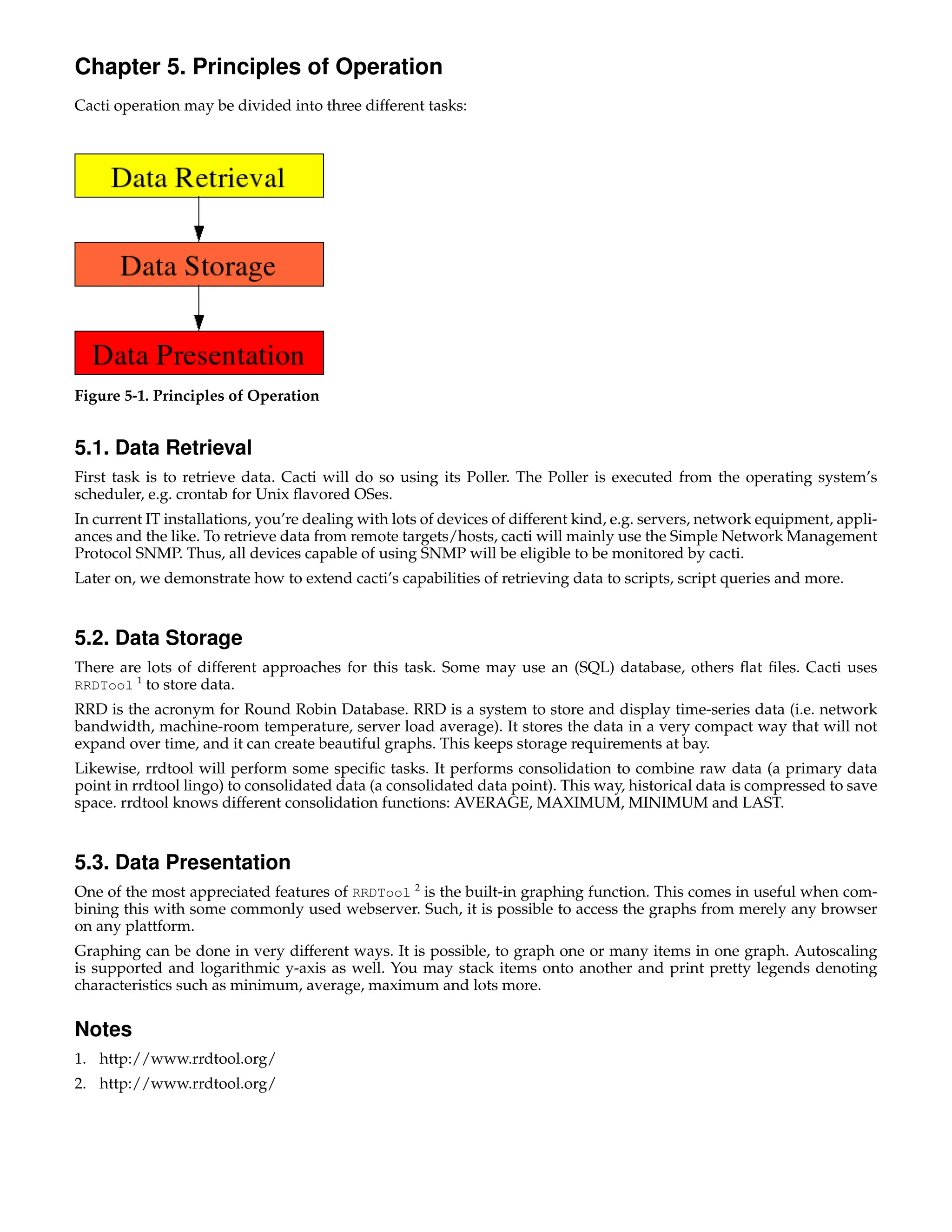
Cacti operation may be divided into three different tasks:


Figure 5-1. Principles of Operation


5.1. Data Retrieval
First task is to retrieve data. Cacti will do so using its Poller. The Poller is executed from the operating system’s
scheduler, e.g. crontab for Unix flavored OSes.
In current IT installations, you’re dealing with lots of devices of different kind, e.g. servers, network equipment, appli-
ances and the like. To retrieve data from remote targets/hosts, cacti will mainly use the Simple Network Management
Protocol SNMP. Thus, all devices capable of using SNMP will be eligible to be monitored by cacti.
Later on, we demonstrate how to extend cacti’s capabilities of retrieving data to scripts, script queries and more.


5.2. Data Storage
There are lots of different approaches for this task. Some may use an (SQL) database, others flat files. Cacti uses
RRDTool 1 to store data.
RRD is the acronym for Round Robin Database. RRD is a system to store and display time-series data (i.e. network
bandwidth, machine-room temperature, server load average). It stores the data in a very compact way that will not
expand over time, and it can create beautiful graphs. This keeps storage requirements at bay.
Likewise, rrdtool will perform some specific tasks. It performs consolidation to combine raw data (a primary data
point in rrdtool lingo) to consolidated data (a consolidated data point). This way, historical data is compressed to save
space. rrdtool knows different consolidation functions: AVERAGE, MAXIMUM, MINIMUM and LAST.


5.3. Data Presentation
One of the most appreciated features of RRDTool 2 is the built-in graphing function. This comes in useful when com-
bining this with some commonly used webserver. Such, it is possible to access the graphs from merely any browser
on any plattform.
Graphing can be done in very different ways. It is possible, to graph one or many items in one graph. Autoscaling
is supported and logarithmic y-axis as well. You may stack items onto another and print pretty legends denoting
characteristics such as minimum, average, maximum and lots more.

Notes
1. http://www.rrdtool.org/
2. http://www.rrdtool.org/
Chapter 6. Graph Overview
Almost everything in Cacti is somehow related to a graph. At any time, you can list all available graphs by clicking
on the Graph Management menu item. While it is possible to manually create graphs through this screen, new users
should follow the instructions provided in the next chapter for creating new graphs in Cacti.
For users that are familiar with RRDTool 1, you will immediately recognize that a graph in Cacti is closely modeled
after RRDTool’s graphs. This makes sense since Cacti provides a user friendly interface to RRDTool without requiring
users to understand how RRDTool works. With this in mind, every graph in Cacti has certain settings and at least one
graph item associated with it. While graph settings define the overall properties of a graph, the graph items define
the data that is to be represented on the graph. So the graph items define which data to display and how it should
displayed, and also define what should be displayed on the legend.
Each graph and graph item has a set of parameters which control various aspects of the graph. Fortunately through the
use of graph templates, it is not necessary to understand the function of each field to create graphs for your network.
When you are ready to take on the task of creating your own graph templates, extensive field descriptions for both
graphs and graph items are provided in that section of the manual.

Notes
1. http://www.rrdtool.org/
Chapter 7. How to Graph Your Network
At this point, you probably realize that graphing is Cacti’s greatest strength. Cacti has many powerful features that
provide complex graphing and data acquisition, some which have a slight learning curve. Do not let that stop you
however, because graphing your network is incredibly simple.
The next two sections will outline the two basic steps which are typically required to create graphs for most devices.


7.1. Creating a Device
The first step to creating graphs for your network is adding a device for each network device that you want to create
graphs for. A device specifies important details such as the network hostname, SNMP parameters, and host type.
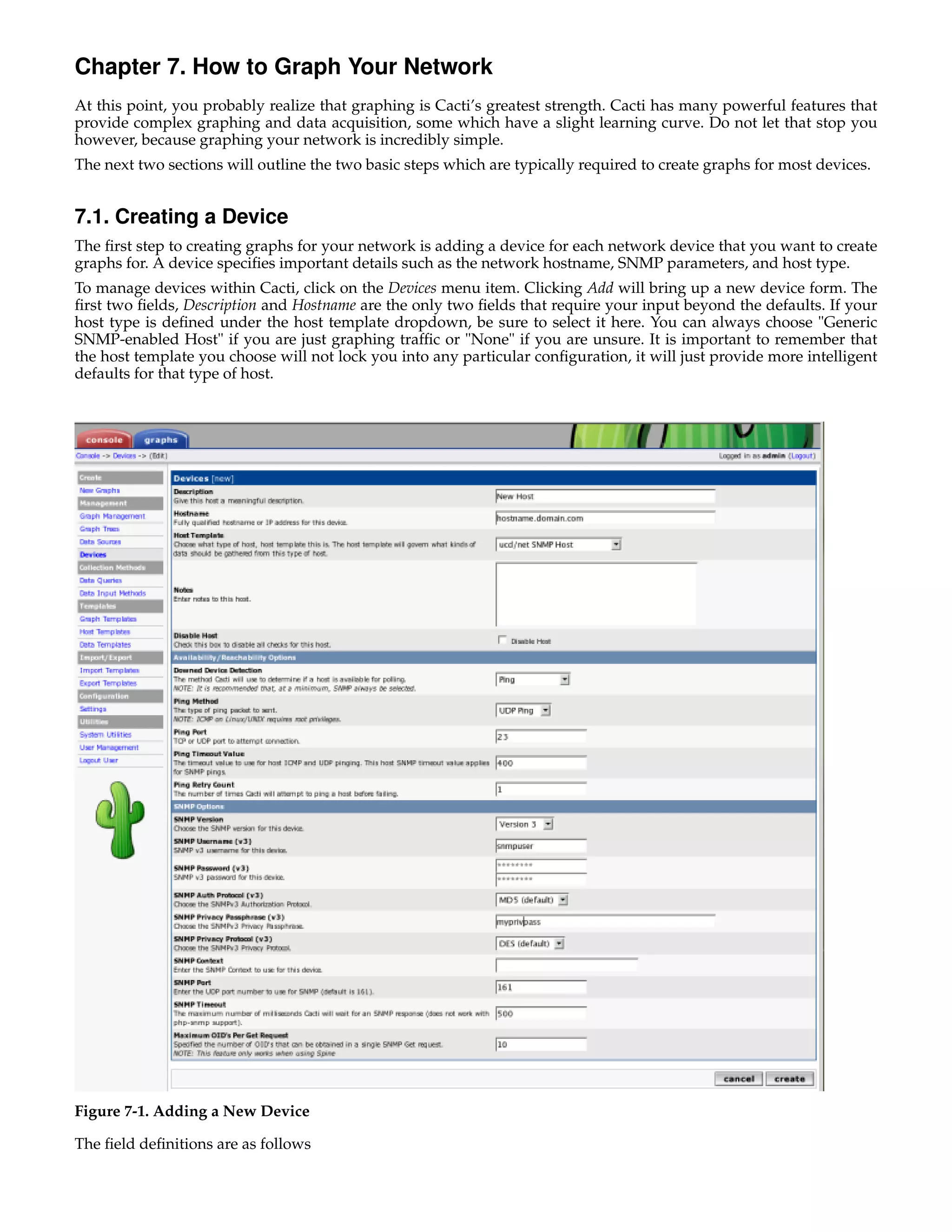
To manage devices within Cacti, click on the Devices menu item. Clicking Add will bring up a new device form. The
first two fields, Description and Hostname are the only two fields that require your input beyond the defaults. If your
host type is defined under the host template dropdown, be sure to select it here. You can always choose "Generic
SNMP-enabled Host" if you are just graphing traffic or "None" if you are unsure. It is important to remember that
the host template you choose will not lock you into any particular configuration, it will just provide more intelligent
defaults for that type of host.


Figure 7-1. Adding a New Device

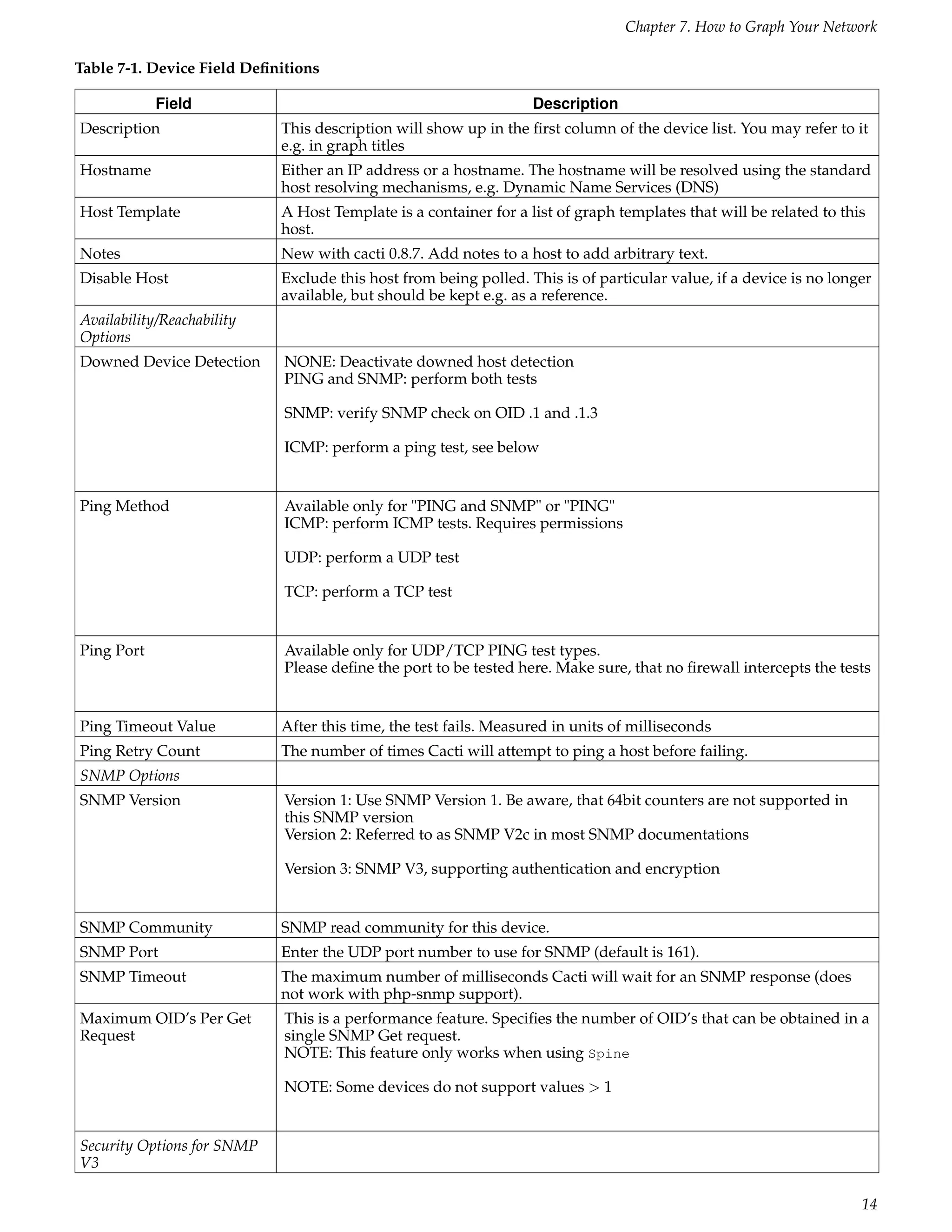
The field definitions are as follows
Chapter 7. How to Graph Your Network

Table 7-1. Device Field Definitions

            Field                                                 Description
Description                 This description will show up in the first column of the device list. You may refer to it
                            e.g. in graph titles
Hostname                    Either an IP address or a hostname. The hostname will be resolved using the standard
                            host resolving mechanisms, e.g. Dynamic Name Services (DNS)
Host Template               A Host Template is a container for a list of graph templates that will be related to this
                            host.
Notes                       New with cacti 0.8.7. Add notes to a host to add arbitrary text.
Disable Host                Exclude this host from being polled. This is of particular value, if a device is no longer
                            available, but should be kept e.g. as a reference.
Availability/Reachability
Options
Downed Device Detection      NONE: Deactivate downed host detection
                             PING and SNMP: perform both tests

                             SNMP: verify SNMP check on OID .1 and .1.3

                             ICMP: perform a ping test, see below


Ping Method                  Available only for "PING and SNMP" or "PING"
                             ICMP: perform ICMP tests. Requires permissions

                             UDP: perform a UDP test

                             TCP: perform a TCP test


Ping Port                    Available only for UDP/TCP PING test types.
                             Please define the port to be tested here. Make sure, that no firewall intercepts the tests


Ping Timeout Value          After this time, the test fails. Measured in units of milliseconds
Ping Retry Count            The number of times Cacti will attempt to ping a host before failing.
SNMP Options
SNMP Version                 Version 1: Use SNMP Version 1. Be aware, that 64bit counters are not supported in
                             this SNMP version
                             Version 2: Referred to as SNMP V2c in most SNMP documentations

                             Version 3: SNMP V3, supporting authentication and encryption


SNMP Community              SNMP read community for this device.
SNMP Port                   Enter the UDP port number to use for SNMP (default is 161).
SNMP Timeout                The maximum number of milliseconds Cacti will wait for an SNMP response (does
                            not work with php-snmp support).
Maximum OID’s Per Get        This is a performance feature. Specifies the number of OID’s that can be obtained in a
Request                      single SNMP Get request.
                             NOTE: This feature only works when using Spine

                             NOTE: Some devices do not support values > 1


Security Options for SNMP
V3

                                                                                                                    14
Chapter 7. How to Graph Your Network

            Field                                                    Description
SNMP Username                  The username of an SNMP V3 createUser statement or equivalent
SNMP Password                  The authpassphrase of an SNMP V3 createUser statement or equivalent
SNMP Auth Protocol             The authentication type of an SNMP V3 createUser statement or equivalent.
                               Select either MD5 or SHA. This entry defaults to MD5.
SNMP Privacy Passphrase        The privacy passphrase of an SNMP V3 createUser statement or equivalent.
SNMP Privacy Protocol          The privacy protocol of an SNMP V3 createUser statement or equivalent. Select
                               either DES or AES. This entry defaults to DES.
SNMP Context                   When using the View-Based Access Control Model (VACM), it is possible to specify an
                               SNMP Context when mapping a community name to a security name with a com2sec
                               directive, with the group directive and the access directive. This allows for defining
                               special access models. If using such a parameter with your target’s SNMP
                               configuration, specify the context name to be used to access that target here.

After saving your new device, you should be redirected back to the same edit form with some additional information.
If you configured SNMP for this host by providing a valid community string, you should see various statistics listed at
the top of the page. If you see "SNMP error" instead, this indicates an SNMP problem between Cacti and your device.
Towards the bottom of the page there will be two addition boxes, Associated Data Queries, and Associated Graph Tem-
plates. If you selected a host template on the previous page, there will probably be a few items in each box. If there is
nothing listed in either box, you will need to associate at least one data query or graph template with your new device
or you will not be able to create graphs in the next step. If no available graph template or data query applies to your
device, you can check the Cacti templates repository or create your own if nothing currently exists.


7.1.1. A Word About SNMP
The SNMP version that you choose can have a great effect on how SNMP works for you in Cacti. Version 1 should be
used for everything unless you have reason to choose otherwise. If you plan on utilizing (and your device supports)
high-speed (64-bit) counters, you must select version 2. Starting with Cacti 0.8.7, version 3 is fully implemented.
The way in which Cacti retrieves SNMP information from a host has an effect on which SNMP-related options are
supported. Currently there are three types of SNMP retrieval methods in Cacti and are outlined below.

Table 7-2. SNMP Retrieval Types

            Type                      Description               Supported Options                  Places Used
External SNMP                  Calls the net-snmp            All SNMP options              Web interface and PHP
                               snmpwalk and snmpget                                        poller (poller.php)
                               binaries that are installed
                               on your system.
Internal SNMP (php-snmp) Uses PHP’s SNMP                     Version 1 Only                Web interface and PHP
                         functions which are linked          (Community and Port)          poller (poller.php)
                         against net-snmp or
                         ucd-snmp at compile time.
Spine SNMP                     Links directly against   All SNMP options                   C-Based Poller (Spine)
                               net-snmp or ucd-snmp and
                               calls the API directly.


7.1.2. SNMP V3 Options Explained
SNMP supports authentication and encryption features when using SNMP protocol version 3 known as View-Based
Access Control Model (VACM). This requires, that the target device in question supports and is configured for SNMP
V3 use. In general, configuration of V3 options is target type dependant. The following is cited from man snmpd.conf
concerning user definitions

[    SNMPv3 Users
        createUser [-e ENGINEID] username (MD5|SHA) authpassphrase [DES|AES] [privpassphrase]

                    MD5 and SHA are the authentication types to use.             DES and AES are the privacy
                    protocols to use. If the privacy passphrase                  is not specified, it is assumed
                    to be the same as the authentication passphrase.             Note that the users created will
                                                                                                                      15
Chapter 7. How to Graph Your Network

                be useless unless they are also added         to   the   VACM access control tables
                described above.

                SHA authentication and DES/AES privacy require OpenSSL to be installed and the
                agent to be built with OpenSSL support. MD5 authentication may be used without
                OpenSSL.

                Warning: the minimum pass phrase length is 8 characters.]


VACM directives are explained from man snmpd.conf as follows

[   VACM Configuration
       The full flexibility of the VACM is available using four configuration directives -
       com2sec, group, view and access. These provide direct configuration of the underlying
       VACM tables.

        com2sec [-Cn CONTEXT] SECNAME SOURCE COMMUNITY
               map an SNMPv1 or SNMPv2c community string to a security name - either from a
               particular range of source addresses, or globally ("default"). A restricted
               source can either be a specific hostname (or address), or a subnet -
               represented as IP/MASK (e.g. 10.10.10.0/255.255.255.0), or IP/BITS
               (e.g. 10.10.10.0/24), or the IPv6 equivalents.

                The same community string can be specified in several separate directives
                (presumably with different source tokens), and the first source/community
                combination that matches the incoming request will be selected. Various
                source/community combinations can also map to the same security name.

                If a CONTEXT is specified (using -Cn), the community string will be mapped
                to a security name in the named SNMPv3 context. Otherwise the default
                context ("") will be used.

        group GROUP {v1|v2c|usm} SECNAME
               maps a security name (in the specified security model) into a named group.
               Several group directives can specify the same group name, allowing a single
               access setting to apply to several users and/or community strings.

                Note that groups must be set up for the two community-based models separately -
                a single com2sec (or equivalent) directive will typically be accompanied by two
                group directives.

        view VNAME TYPE OID [MASK]
               defines a named "view" - a subset of the overall OID tree. This is most commonly
               a single subtree, but several view directives can be given with the same view
               name, to build up a more complex collection of OIDs. TYPE is either included
               or excluded, which can again define a more complex view (e.g by excluding certain
               sensitive objects from an otherwise accessible subtree).

                MASK is a list of hex octets (separated by “.” or “:”)
                with the set bits indicating which subidentifiers in the view OID to match against.
                This can be used to define a view covering a particular row (or rows) in a table.
                If not specified, this defaults to matching the OID exactly (all bits set), thus
                defining a simple OID subtree.

        access GROUP CONTEXT {any|v1|v2c|usm} LEVEL PREFX READ WRITE NOTIFY
               maps from a group of users/communities (with a particular security model
               and minimum security level, and in a specific context) to one of three views,
               depending on the request being processed.

                LEVEL is one of noauth, auth, or priv. PREFX specifies how CONTEXT should be
                matched against the context of the incoming request, either exact or prefix.
                READ, WRITE and NOTIFY specifies the view to be used for GET*, SET and
                TRAP/INFORM requests (althought the NOTIFY view is not currently used). For
                v1 or v2c access, LEVEL will need to be noauth.]


As an example, following definitions in the snmpd configuration create a set of definitions for use with SNMP V3
# sample configuration for SNMP V3


                                                                                                                16
Chapter 7. How to Graph Your Network

# create an SNMP V3 user with an          authpassphrase and a privacy passphrase
##         username   authProto           authpassphrase privProto privpassphrase
##         --------   ---------           -------------- --------- --------------
createUser gandalf    MD5                 myauthpass      DES        myprivpass


# Second, map the security name into a group name:
##    groupName    securityModel securityName
##    ---------    ------------- ------------
group groupv3      usm            gandalf


# Third, create a view       for us to    let the group have rights to:
##          incl/excl        subtree      mask
##          ---------        -------      ----
view    all included         .iso         80


# Fourth, create the access for that group without context
##                context sec.model sec.level prefix read                    write    notif
##                ------- --------- --------- ------ ----                    -----    -----
access groupv3    ""      any       auth      exact all                      all      all

When adding this stuff to your snmp configuration, please remember to restart the agent. Verify this setting using
shell>snmpwalk -v 3 -a MD5 -A myauthpass -x DES 
-X myprivpass -u gandalf -l authpriv localhost interface
IF-MIB::ifNumber.0 = INTEGER: 3
IF-MIB::ifIndex.1 = INTEGER: 1
IF-MIB::ifIndex.2 = INTEGER: 2
IF-MIB::ifIndex.3 = INTEGER: 3
IF-MIB::ifDescr.1 = STRING: lo
IF-MIB::ifDescr.2 = STRING: irda0
IF-MIB::ifDescr.3 = STRING: eth0
IF-MIB::ifType.1 = INTEGER: softwareLoopback(24)
IF-MIB::ifType.2 = INTEGER: other(1)
IF-MIB::ifType.3 = INTEGER: ethernetCsmacd(6)
...


7.2. Creating the Graphs
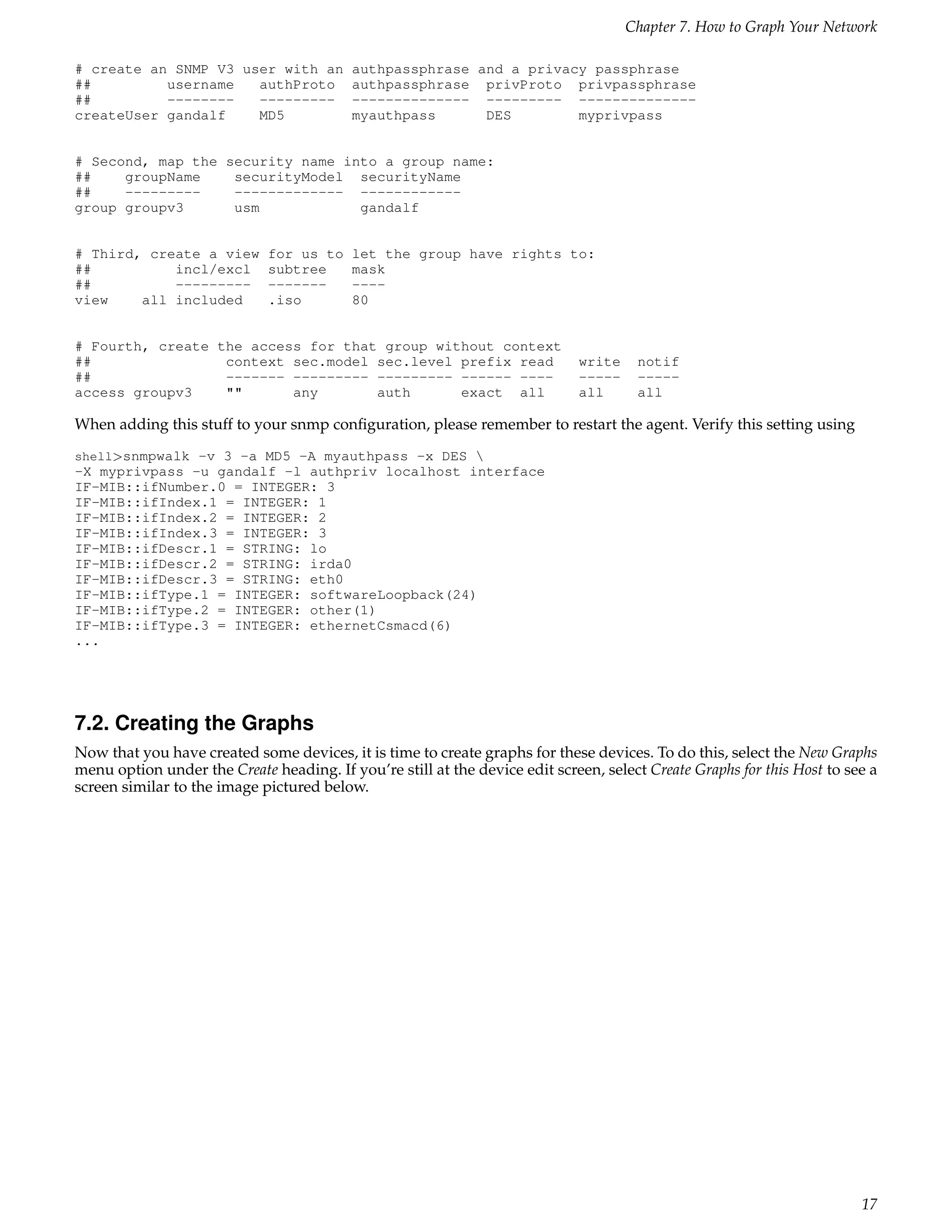
Now that you have created some devices, it is time to create graphs for these devices. To do this, select the New Graphs
menu option under the Create heading. If you’re still at the device edit screen, select Create Graphs for this Host to see a
screen similar to the image pictured below.


                                                                                                                         17
Chapter 7. How to Graph Your Network


Figure 7-2. Creating New Graphs

The dropdown menu that contains each device should be used to select the host that you want to create new graphs
for. The basic concept to this page is simple, place a check in each row that you want to create a graph for and click
Create.
If you are creating graphs from inside a "Data Query" box, there are a few additional things to keep in mind. First
is that you may encounter the situation as pictured above with the "SNMP - Interface Statistics" data query. If this
occurs you may want to consult the section on debugging data queries to see why your data query is not returning
any results. Also, you may see a "Select a graph type" dropdown box under some data query boxes. Changing the
value of this dropdown box affects which type of graph Cacti will make after clicking the Create button. Cacti only
displays this dropdown box when there is more than one type to choose from, so it may not be displayed in all cases.
Once you have selected the graphs that you want to create, simply click the Create button at the bottom of the page.
You will be taken to a new page that allows you to specify additional information about the graphs you are about to
create. You only see the fields here that are not part of each template, otherwise the value automatically comes from
the template. When all of the values on this page look correct, click the Create button one last time to actually create
your graphs.
If you would like to edit or delete your graphs after they have been created, use the Graph Management item on the
menu. Likewise, the Data Source menu item allows you to manage your data sources in Cacti.


                                                                                                                     18
Chapter 8. Viewing Graphs

8.1. Graph Trees
A graph tree can be thought of as a hierarchical way of organizing your graphs. Each graph tree consists of zero or
more headers or branch nodes that contain leaf nodes such as graphs or trees. Multiple graph trees or branches within
a single tree can be combined to form a very powerful way of organizing your graphs.


8.1.1. Creating a Graph Tree
To create a new graph tree, select the Graph Trees menu item under the Management header. Select Add on this page to
create a new tree. The following page will prompt you for a tree name, which will be used to identify the graph tree
throughout Cacti. Along with the Name, you may select one of four currently supported Sorting Types

Table 8-1. Tree Sporting Type Definitions

            Field                                                     Description
Name                           Name of the tree entry. The sort order of all trees themselves is always alphabetical
Sorting Type                    Manual Ordering (No Sorting): You may chance the sequence at your will
                                Alphabetical Ordering: All subtrees are ordered alphabetically, unless specifies other-
                                wise (you may chance sort options at subtree lebel), i.e. 1, Ab, ab

                                Natural Ordering: ie. ab1, ab2, ab7, ab10, ab20

                                Numeric Ordering: Leading zeroes are not taken into account when ordering numeri-
                                cally, i.e. 01, 02, 4, 04


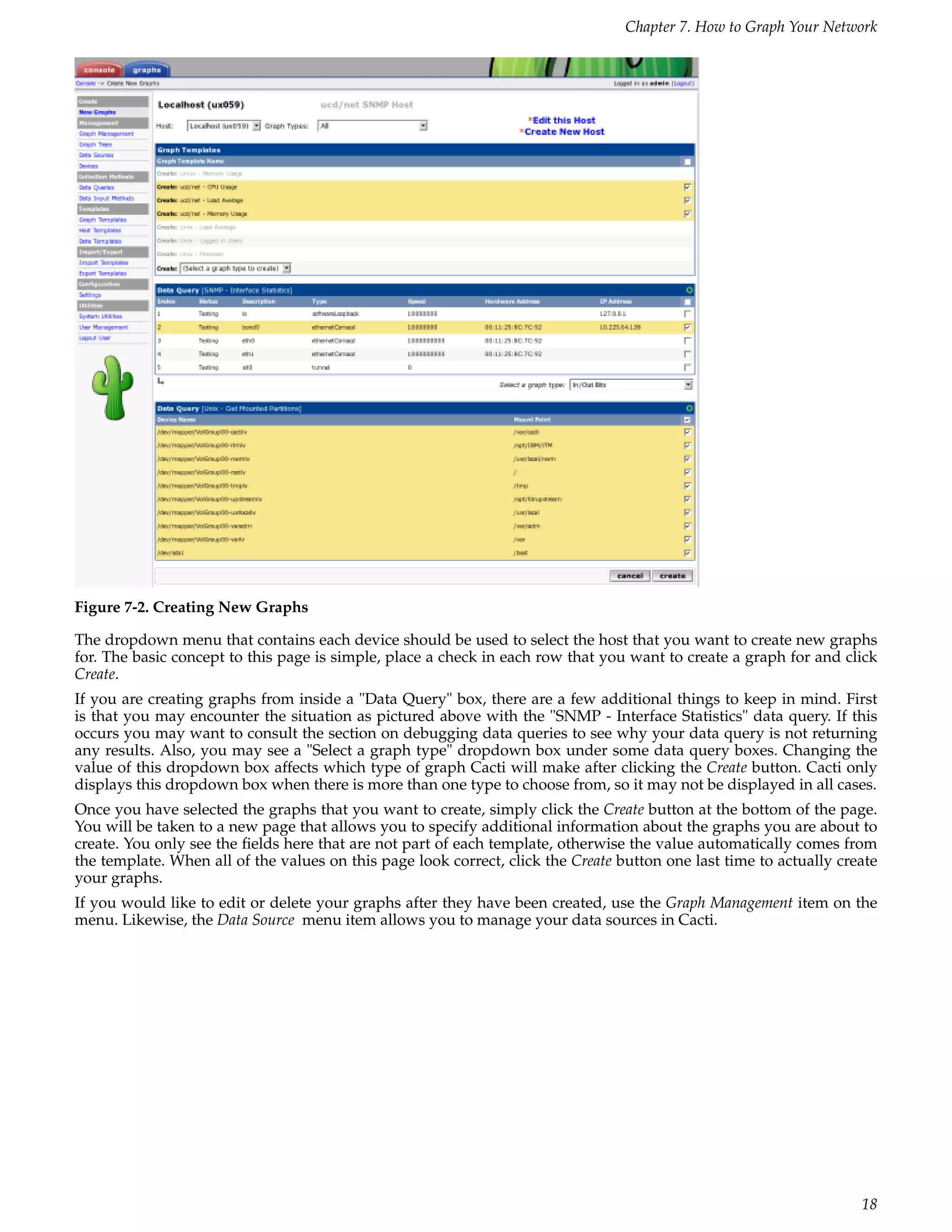
Once you type a name, click the Create button to continue. You will be redirected to a page similar to the one below,
but without all of the items.


Figure 8-1. Editing a Graph Tree

To start adding items to your tree, click add in the Tree Items box. There are currently three different types of tree items
Chapter 8. Viewing Graphs

you can choose from: header, graph, or host. Simply choose the type you want, fill in the value for that type, and click
Create to make your new graph tree item. Clicking the Add link to the right of any branch will add the new item below
that branch, you can change the branch that any item belongs to by changing its Parent Item field.
Please note the "++" and the "--" buttons. They will help you managing large trees. Pressing the "--" will collapse all
tree levels while "++" expands all of them. You may expand each single subtree of a collapsed tree to reorder, add or
delete entries without much scrolling.


                                                                                                                    20
Chapter 9. User Management
In addition to giving you the tools to create sophisticated graphs, Cacti enables you to create users that are tailored
specifically to their requirements. Each user has certain settings such as login actions, as well as graph viewing set-
tings. There are also two levels of permissions control, realm permissions and graph permissions which enable you to
control what the user can see and change.


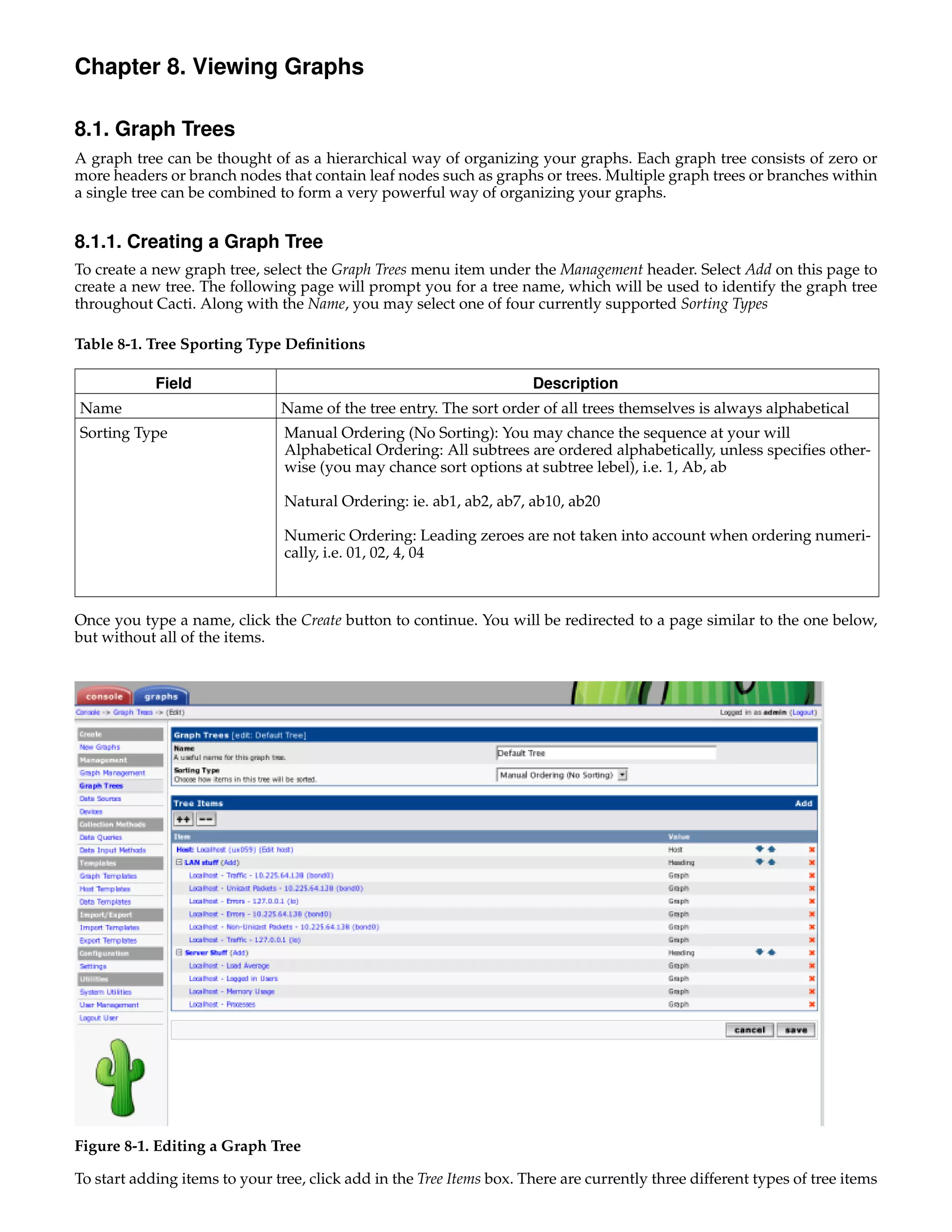
Figure 9-1. User Management

Out of the box, there are two users that come with every Cacti installation. The "admin" user, is the main user that
by default has access to see and change everything in Cacti. This is the user that you first login with in Cacti, and is
probably a good idea to keep around unless you know otherwise. The second user is the "guest" user, which controls
which areas/graphs are allowed for unauthenticated users. By default this user only has rights to view, but not change
all graphs. This enables any unauthenticated user to visit ’graph_view.php’ and view your graphs. This behavior can
be changed by either changing the realm permissions for the "guest" user, or disabling the guest user altogether
under Cacti Settings. By default in 0.8.7 and later, the "guest" user is not set in the setting, effectively disabling "guest"
(Unauthenticated) access to Cacti.


9.1. Editing an existing User
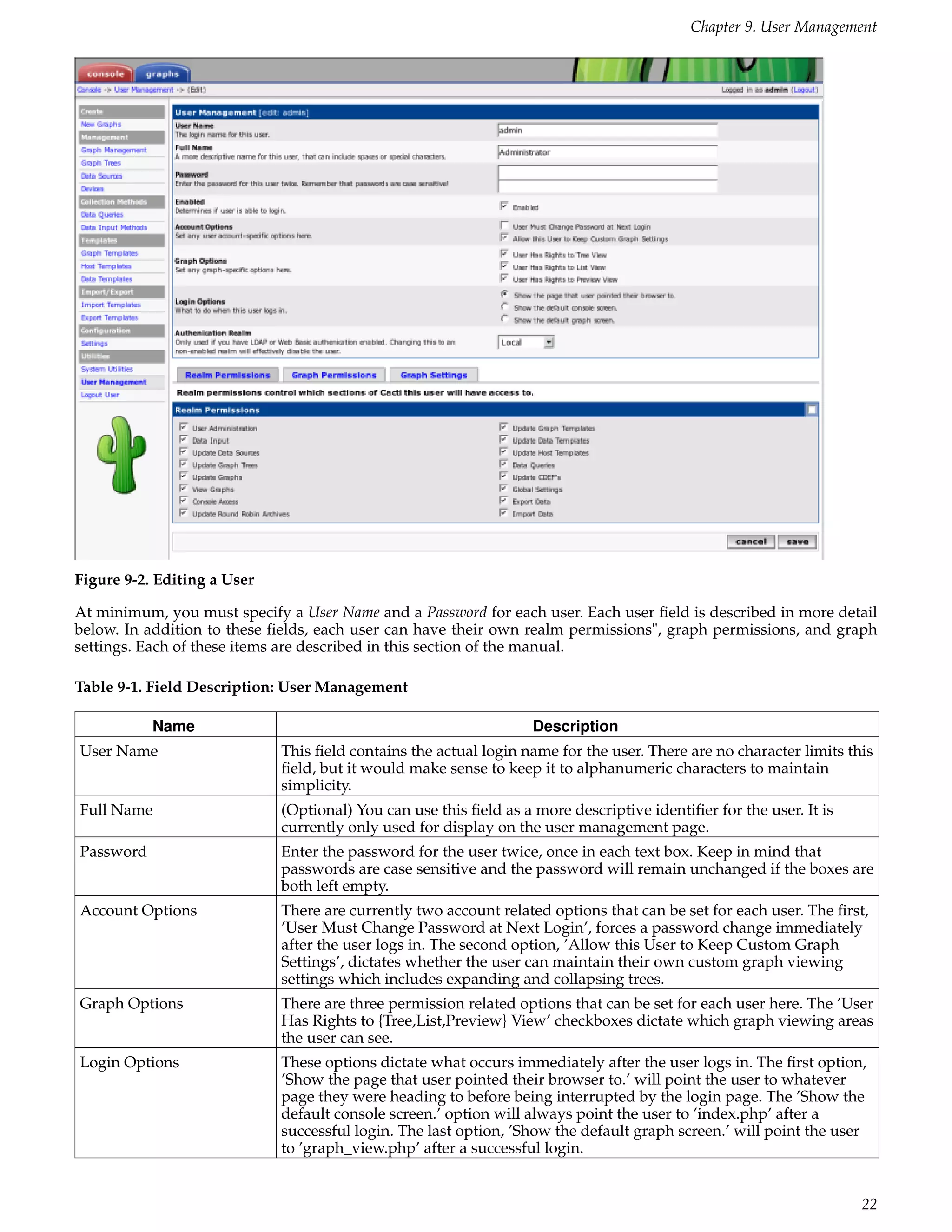
To edit an existing user, select the User Management item under the Utilities heading on the Cacti menu. Once at the
user management screen, click username of the user you wish to edit. You will see a screen that looks similar to the
image below.
Chapter 9. User Management


Figure 9-2. Editing a User

At minimum, you must specify a User Name and a Password for each user. Each user field is described in more detail
below. In addition to these fields, each user can have their own realm permissions", graph permissions, and graph
settings. Each of these items are described in this section of the manual.

Table 9-1. Field Description: User Management

           Name                                                    Description
User Name                    This field contains the actual login name for the user. There are no character limits this
                             field, but it would make sense to keep it to alphanumeric characters to maintain
                             simplicity.
Full Name                    (Optional) You can use this field as a more descriptive identifier for the user. It is
                             currently only used for display on the user management page.
Password                     Enter the password for the user twice, once in each text box. Keep in mind that
                             passwords are case sensitive and the password will remain unchanged if the boxes are
                             both left empty.
Account Options              There are currently two account related options that can be set for each user. The first,
                             ’User Must Change Password at Next Login’, forces a password change immediately
                             after the user logs in. The second option, ’Allow this User to Keep Custom Graph
                             Settings’, dictates whether the user can maintain their own custom graph viewing
                             settings which includes expanding and collapsing trees.
Graph Options                There are three permission related options that can be set for each user here. The ’User
                             Has Rights to {Tree,List,Preview} View’ checkboxes dictate which graph viewing areas
                             the user can see.
Login Options                These options dictate what occurs immediately after the user logs in. The first option,
                             ’Show the page that user pointed their browser to.’ will point the user to whatever
                             page they were heading to before being interrupted by the login page. The ’Show the
                             default console screen.’ option will always point the user to ’index.php’ after a
                             successful login. The last option, ’Show the default graph screen.’ will point the user
                             to ’graph_view.php’ after a successful login.


                                                                                                                    22
Chapter 9. User Management

           Name                                                     Description
Authenication Realm           Multiple types of users can exist in Cacti. This setting allows you to specify a user for
                              use with Local, Web Basic or LDAP authenication. Template users must be Local.


9.1.1. Realm Permissions
Realm permissions control which areas of Cacti a user can access. You can edit a user’s realm permissions by selecting
User Management and choosing the user you want to edit the permissions for. The Realm Permissions box will be
displayed in the lower part of the screen. Each "realm" is a grouping that represents common tasks in Cacti, making it
easier to fine tune each user’s access.
If you want to create a user that can only view graphs, you should select the View Graphs realm and leave everything
else unchecked. See the Graph Permissions section for more information about how to fine tune this even more on a
per-graph basis. Conversely, if the user needs to access the console, they will need Console Access and any additional
realms that you see fit.


9.1.2. Graph Permissions
Graph permissions control which graphs a user is allowed to view, it does not apply to editing graphs. You can edit
a user’s graph permissions by selecting User Management and choosing the user you want to edit the permissions for.
Now select the Graph Permissions tab to view this user’s graph permissions. There are three different ways that you
can apply graph permissions, by graph, by host, or by graph template. This works by allowing or denying the user to
all graphs associated with the particular group. So you can deny a user to a single graph, all graphs associated with
a particular host, or all graphs associated with a particular graph template. Combining these three types of assigning
graph permissions results in a very powerful graph policy editor.
Each assignment type contains a Default Policy dropdown which can be used to control whether the user should be
allowed to view everything or be denied from everything by default in the particular group. It is very important to
remember that these policies are evaluated in the order: graph, host, graph template. Therefore, if you set graph’s
default policy to Deny, but kept host and graph template at Allow, the user’s effective policy would be Deny since the
graph assignment type is evaluated first. You typically either want to set all default policies to Deny for a restrictive
user, or Allow for a non-restrictive user. If you thoroughly understand Cacti’s graph permissions system, these default
policies can be combined to provide very complex results.


9.1.3. Graph Settings
Cacti stores certain graph viewing settings for each user, which enables each user to view graphs in an optimal way.
These preferences controls things such as the preview graph size or the default graph viewing mode to use. In addition
to managing these settings here under user management, each user can change their own settings by clicking on the
Graphs tab and selecting the Settings tab on the following page. If you want to prevent a user from being able to keep
their own graph preferences, uncheck the Allow this User to Keep Custom Graph Settings checkbox in user management.
The user will be presented with an "Access Denied" error message if they attempt to click the Settings tab when this
box is checked.


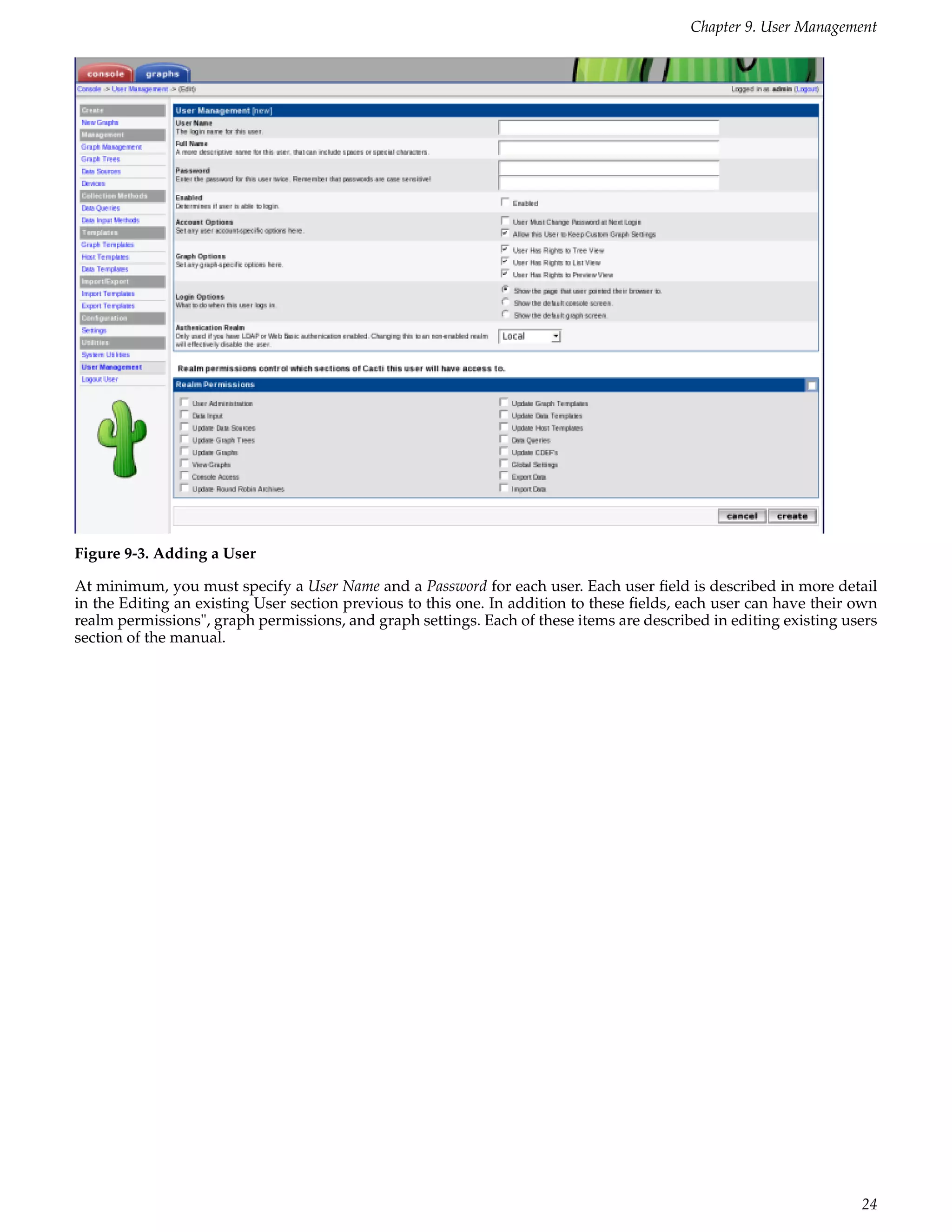
9.2. Creating a New User
To create a new user, select the User Management item under the Utilities heading on the Cacti menu. Once at the user
management screen, click Add.


                                                                                                                      23
Chapter 9. User Management


Figure 9-3. Adding a User

At minimum, you must specify a User Name and a Password for each user. Each user field is described in more detail
in the Editing an existing User section previous to this one. In addition to these fields, each user can have their own
realm permissions", graph permissions, and graph settings. Each of these items are described in editing existing users
section of the manual.


                                                                                                                   24
Chapter 9. User Management

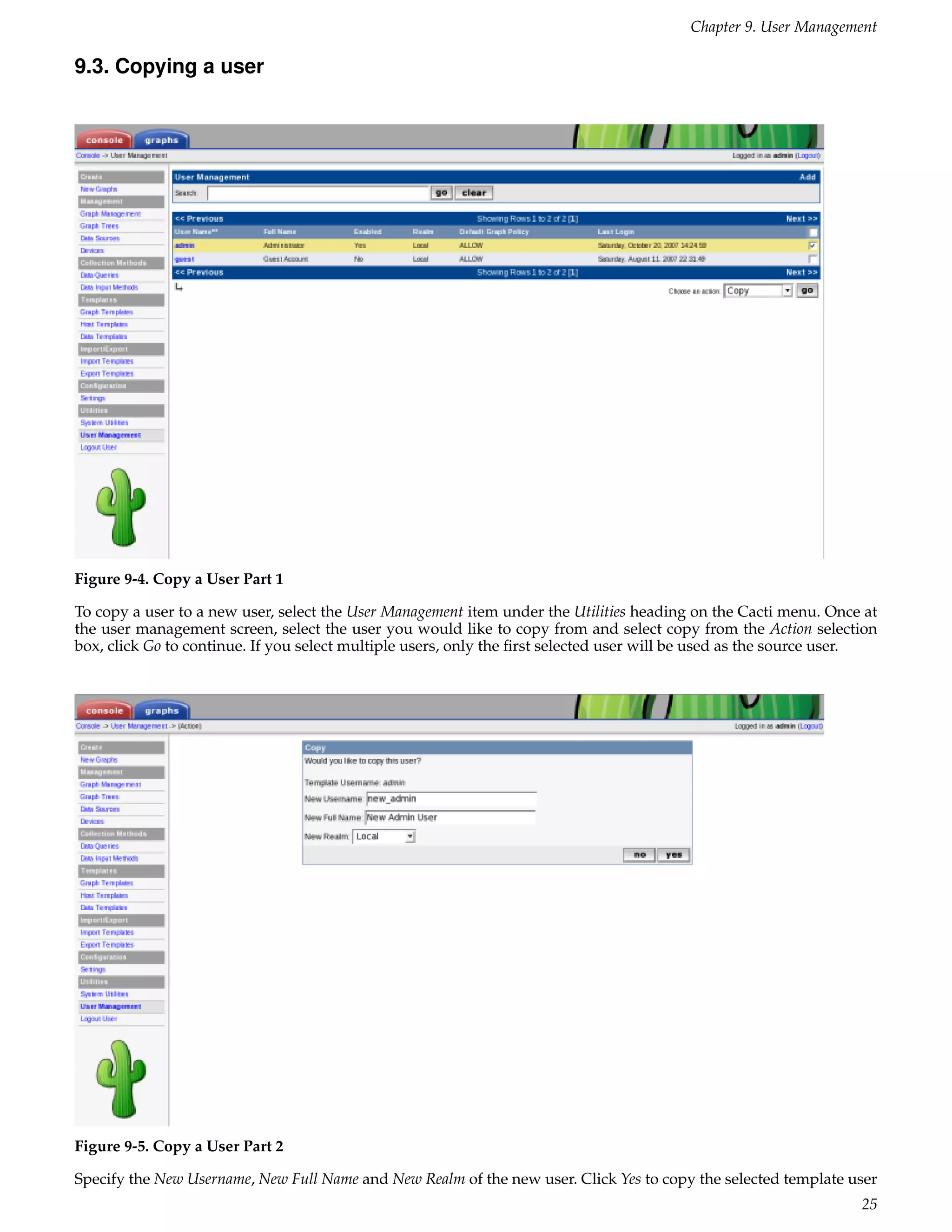
9.3. Copying a user


Figure 9-4. Copy a User Part 1

To copy a user to a new user, select the User Management item under the Utilities heading on the Cacti menu. Once at
the user management screen, select the user you would like to copy from and select copy from the Action selection
box, click Go to continue. If you select multiple users, only the first selected user will be used as the source user.


Figure 9-5. Copy a User Part 2

Specify the New Username, New Full Name and New Realm of the new user. Click Yes to copy the selected template user
                                                                                                                  25
Chapter 9. User Management

to the the designated new user. An error will be returned if you attempt to copy over an existing user. If you would
like to copy over an existing user, use Batch Copy.


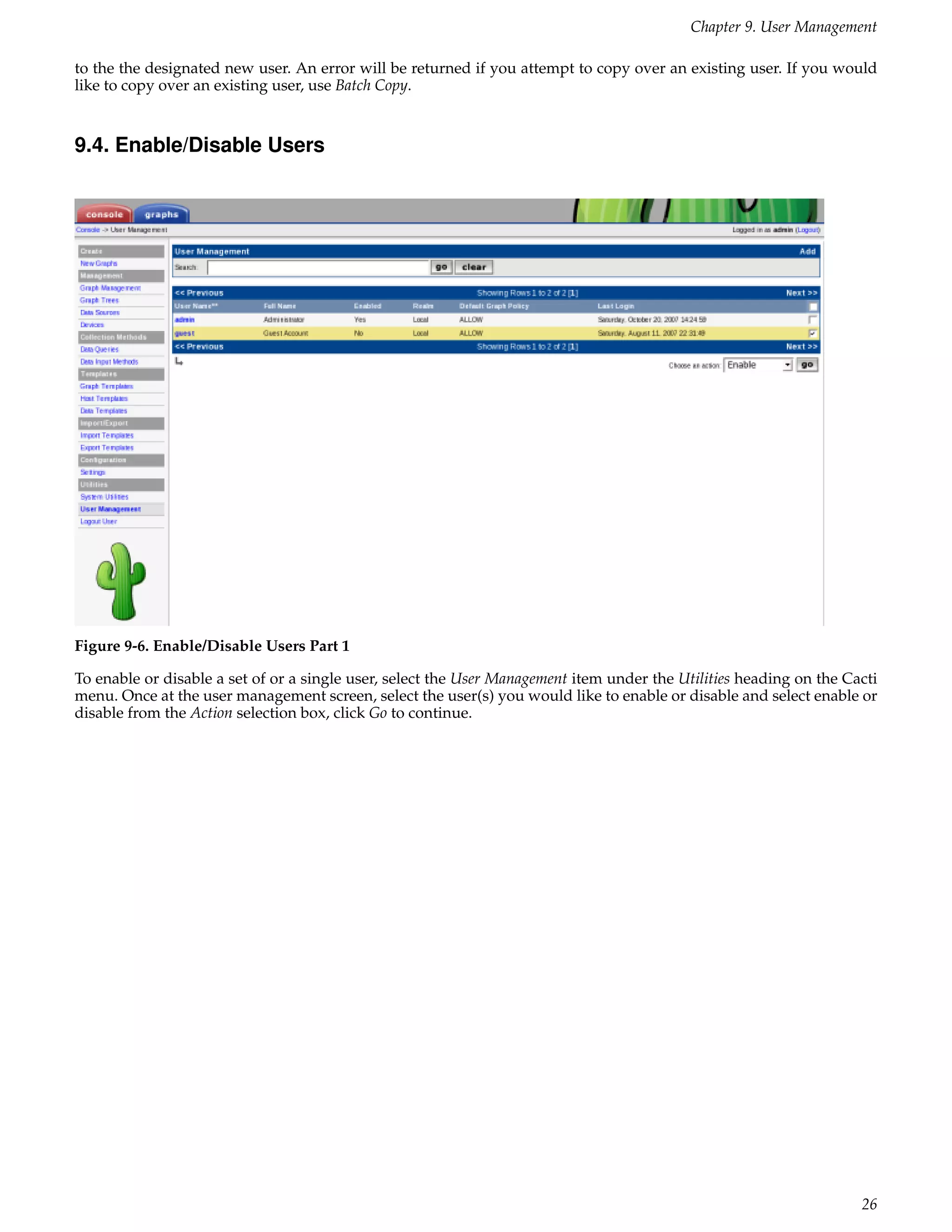
9.4. Enable/Disable Users


Figure 9-6. Enable/Disable Users Part 1

To enable or disable a set of or a single user, select the User Management item under the Utilities heading on the Cacti
menu. Once at the user management screen, select the user(s) you would like to enable or disable and select enable or
disable from the Action selection box, click Go to continue.


                                                                                                                     26
Chapter 9. User Management


Figure 9-7. Enable/Disable Users Part 2

Confirm that you want to disable or enable the listed users. Click Yes to perform the action. Disabling your own
account is possible and not recommended, as once you logoff you will not be able to return.


9.5. Batch Copy Users
Batch Copy is a helpful utility that helps Cacti Administrators maintain users. Because Cacti does not yet support
groups, it is important that there is some way to mass update users. This what Batch Copy does for you.


Figure 9-8. Batch Copy Users Part 1

To Batch Copy a set of or a single user, select the User Management item under the Utilities heading on the Cacti menu.
Once at the user management screen, select the user(s) you would like to batch copy information to and select "Batch
Copy" from the Action selection box, click Go to continue.


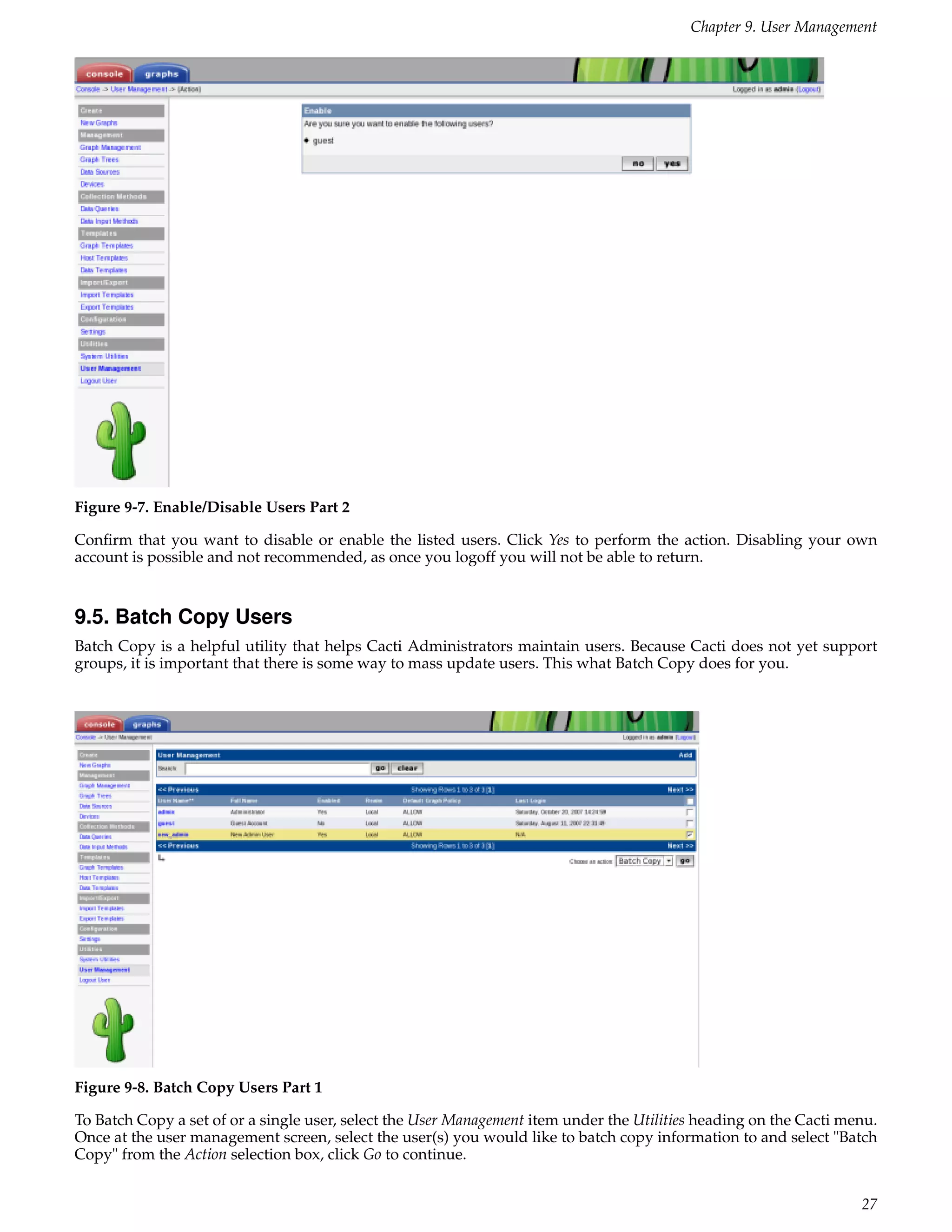
                                                                                                                    27
Chapter 9. User Management


Figure 9-9. Batch Copy Users Part 2

Select the Template User and confirm that you want to Batch Copy the listed users. Click Yes to perform the action.
It is important to note that when using Batch Copy the original user(s) Full Name, Password, Realm and Enable status
will be retained, all other fields will be overwritten with values from the selected template user.


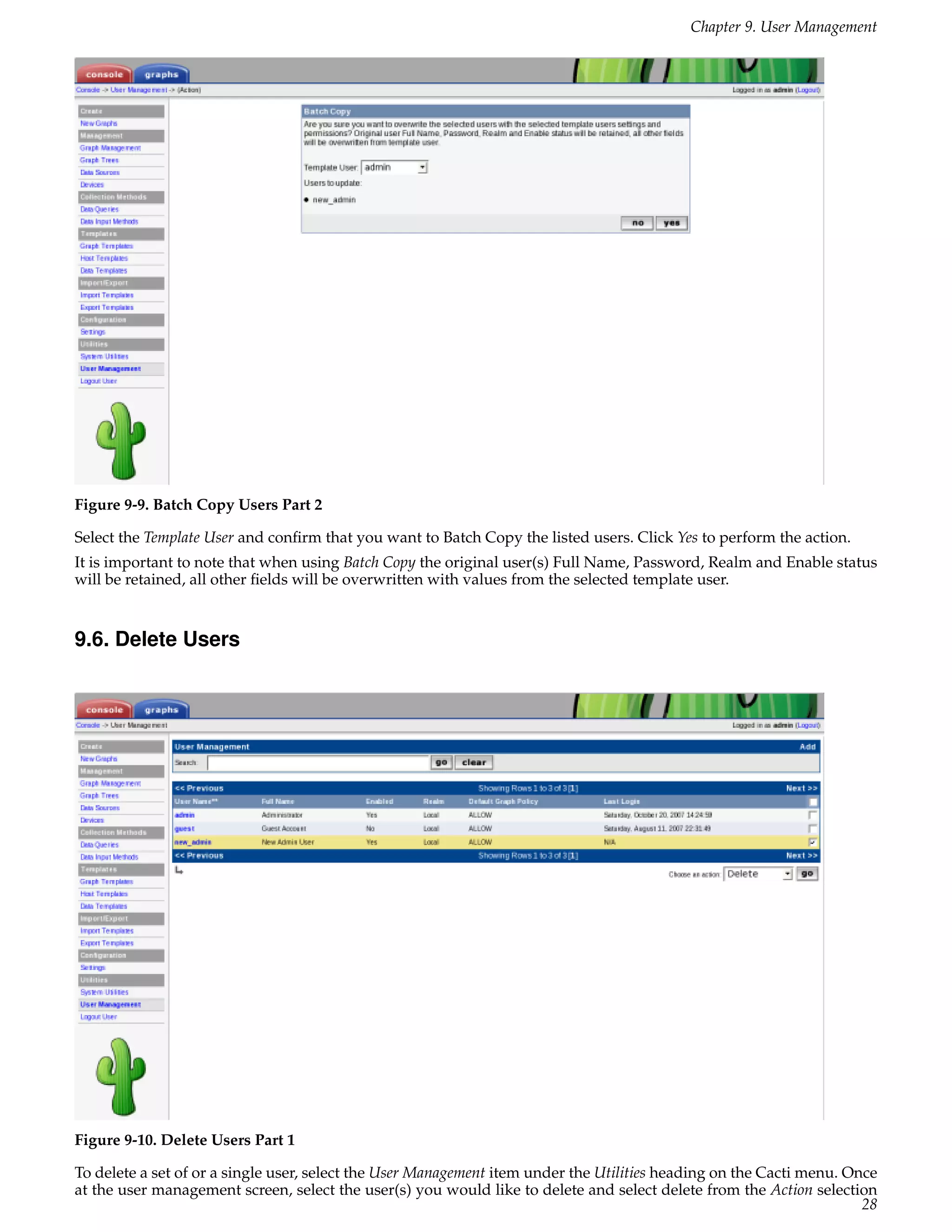
9.6. Delete Users


Figure 9-10. Delete Users Part 1

To delete a set of or a single user, select the User Management item under the Utilities heading on the Cacti menu. Once
at the user management screen, select the user(s) you would like to delete and select delete from the Action selection
                                                                                                                      28
Chapter 9. User Management

box, click Go to continue.


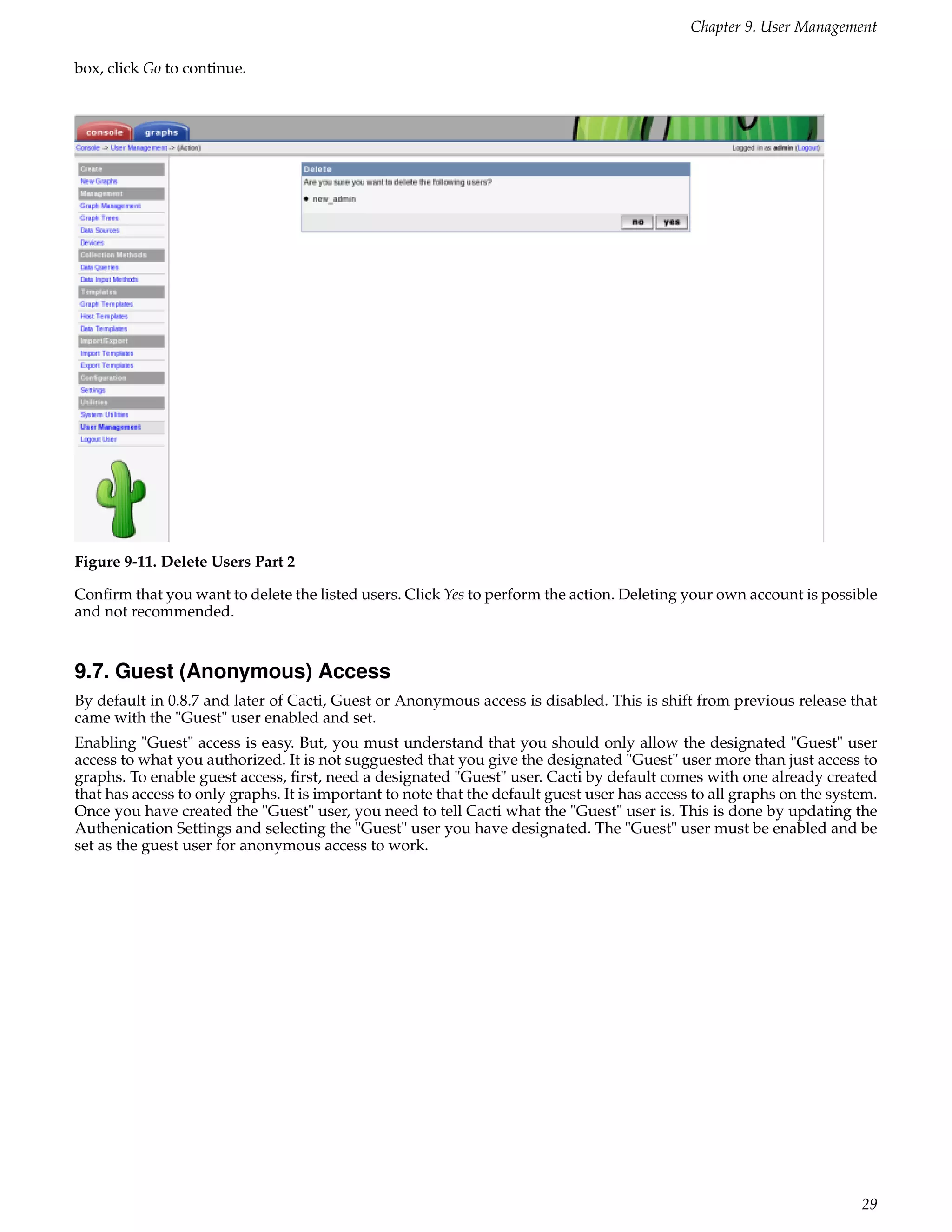
Figure 9-11. Delete Users Part 2

Confirm that you want to delete the listed users. Click Yes to perform the action. Deleting your own account is possible
and not recommended.


9.7. Guest (Anonymous) Access
By default in 0.8.7 and later of Cacti, Guest or Anonymous access is disabled. This is shift from previous release that
came with the "Guest" user enabled and set.
Enabling "Guest" access is easy. But, you must understand that you should only allow the designated "Guest" user
access to what you authorized. It is not sugguested that you give the designated "Guest" user more than just access to
graphs. To enable guest access, first, need a designated "Guest" user. Cacti by default comes with one already created
that has access to only graphs. It is important to note that the default guest user has access to all graphs on the system.
Once you have created the "Guest" user, you need to tell Cacti what the "Guest" user is. This is done by updating the
Authenication Settings and selecting the "Guest" user you have designated. The "Guest" user must be enabled and be
set as the guest user for anonymous access to work.


                                                                                                                        29
Chapter 10. Graph a Single SNMP OID
When dealing with SNMP-enabled devices, there are often times when you want to graph the value of a single OID.
This tutorial explains how to do this in Cacti. It also assumes that you have the "SNMP - Generic OID Template"
graph template, which is now included in Cacti as of version 0.8.5. If you do not see this template listed under Graph
Templates, download the template from the Cacti website in XML form and import it using the Import Templates menu
item.
To start the process of creating a new graph for your OID, click the New Graphs menu item and select the host that
contains the target OID from the dropdown. Under the Graph Templates box, you will see a dropdown on the last line
that reads (Select a graph type to create). From this dropdown, choose "SNMP - Generic OID Template" and click the
Create button at the bottom of the page.
You will be presented with several fields that will require input before the new graph can be created. They are de-
scribed in more detail below.

Table 10-1. Field Description: SNMP - Generic OID Template

           Name                                                     Description
(Graph) Title                 The title that is to be used for the new graph. It is generally a good idea to keep
                              |host_description| in the title, as to make the graph easier to identify later.
(Graph) Vertical Label        The text that will be printed along the y-axis of the graph. It is generally used to
                              describe units, such as ’bytes’ or ’percent’.
(Graph Items) Legend          The color that will be used to reprent the data on the graph.
Color
(Graph Items) Legend Text     The text that will be used to describe the data on the graph legend.
(Data Source) Name            The title that is to be used for the new data source. It is generally a good idea to keep
                              |host_description| in the title, as to make the data source easier to identify later.
(Data Source) Maximum         The maximum value that will be accepted from the OID. Make sure you choose a
Value [snmp_oid]              value that is reasonable for the data you are trying to graph because anything larger
                              than the maximum will be ignored. If you are graphing a percentage, you should use
                              ’100’ as the value should never exceed this.
(Data Source) Data Source     How the data from the OID should be stored by RRDTool and interpreted on the
Type [snmp_oid]               graph. If the value of the OID represents the actual data, you should use GAUGE for
                              this field. If the OID value is a constantly incrimenting number, you should use
                              COUNTER for this field. The two remaining field values, DERIVE and ABSOLUTE can
                              be ignored in most situations.
(Custom Data) OID             The actual SNMP OID to graph. It is typically a good idea to enter the number OID
                              here as opposed to using MIB names. For instance, to get the number of open files on a
                              Netware server, you would use ".1.3.6.1.4.1.23.2.28.2.7.0" as the OID.

When finished filling in values for these fields, click the Create button. Your new graph can now be accessed through
the Graph Management page or the Graphs tab inside of Cacti.
Chapter 11. Data Input Methods
Data input methods allow Cacti to retrieve data to insert into data sources and ultimately put on a graph. There are
different ways for Cacti to retrieve data, the most popular being through an external script or from SNMP.


11.1. Creating a Data Input Method
To create a new data input method, select the Data Input Methods option under the Management heading. Once on that
screen, click Add on the right. You will be presented with a few fields to populate on the following screen.

Table 11-1. Field Description: Data Input Methods

           Name                                                     Description
Name                          Give the data query a name that you will use to identify it. This name will be used
                              throughout Cacti to identify the data input method.
Input Type                    Select the type of data input method you are trying to create. Valid options here are
                              ’Script/Command’, ’SNMP’, ’SNMP Query’, and ’Script Query’.
Input String                   This field is only used when the Input Type is set to ’Script/Command’. It specifies the
                               full path to the script including any per data source variables inside <>’s from the
                               user. For instance, if you are passing an IP address to a script, your input string might
                               look something like:
                               /path/to/script.pl <ip>

                               When the user creates a data source based on this data input method, they will be
                               prompted for an IP address to pass onto the script.


Output String                 This field is only here for legacy purposes and will probably go away in a future
                              version of Cacti.

When you are finished filling in all necessary fields, click the Create button to continue. You will be redirected back to
the same page, but this time with two new boxes, Input Fields and Output Fields. The Input Fields box is used to define
any fields that require information from the user. Any input fields referenced to in the input string must be defined
here. The Output Fields box is used to define each field that you expect back from the script. All data input methods must
have at least one output field defined, but may have more for a script.


11.1.1. Data Input Fields
To define a new field, click Add next to the input or output field boxes. You will be presented with some or all of the
fields below depending on whether you are adding an input or output field.

Table 11-2. Field Description: Data Input Fields

           Name                                                     Description
Field/Field Name              Either select or type in the name of the field you want to define. No spaces or other
                              non-alphanumeric characters (except ’-’ or ’_’) should be used in this field.
Friendly Name                 Enter a more descriptive name for this field which will be used for identification
                              throughout Cacti.
Regular Expression Match      If you want to enforce a certain regular expression pattern when the user enters a
(Input Only)                  value for this field, enter it here. The regular expression must follow POSIX syntax as
                              it will be passed to PHP’s ereg() function.
Allow Empty Input (Input      Select whether you want to allow the user to leave the value of this field blank or not.
Only)
Special Type Code (Input      Sometimes Cacti needs to reference a field internally, but needs to rely on more than
Only)                         just the field name. For instance, if your field requires an IP address from the user, you
                              can enter ’management_ip’ here and Cacti will fill this field in with the current IP
                              address of the selected host. Valid values for this field are: ’hostname’,
                              ’management_ip’, ’snmp_community’, ’snmp_username’, ’snmp_password’, and
                              ’snmp_version’.
Chapter 11. Data Input Methods

            Name                                                     Description
Update RRD File (Output        Check this box if you want Cacti to insert the return value from this field into the RRD
Only)                          file. Obviously, this box needs to be checked for at least one output field per data input
                               source, but can be left blank to have Cacti store the value in the database instead.

When you are finished filling in all necessary fields, click the Create button to continue. You will be redirected back
to the data input method edit page. From here you can continue to add additional fields, or click Save on this screen
when finished.


11.2. Making Your Scripts Work With Cacti
The simplest way to extend Cacti’s data gathering functionality is through external scripts. Cacti comes with a number
of scripts out of the box which are located in the scripts/ directory. These scripts are used by the data input methods
that are present in a new installation of Cacti.
To have Cacti call an external script to gather data you must create a new data input method, making sure to specify
Script/Command for the Input Type field. See the previous section, Creating a Data Input Method1 for more information
about how to create a data input method. To gather data using your data input method, Cacti simply executes the
shell command specified in the Input String field. Because of this, you can have Cacti run any shell command or call
any script which can be written in almost any language.
What Cacti is concerned with is the output of the script. When you define your data input method, you are required to
define one or more output fields. The number of output fields that you define here is important to your script’s output.
For a data input method with only one output field, your script should output its value in the following format:
<value_1>

So if I wrote a script that outputs the number of running processes, its output might look like the following:

Example 11-1. Example script output using 1 field

67


Data input methods with more than one output field are handled a bit differently when writing scripts. Scripts that
output more than one value should be formatted like the following:
<fieldname_1>:<value_1> <fieldname_2>:<value_2> ... <fieldname_n>:<value_n>

Lets say that I write a script that outputs the 1, 5, and 10 minute load average of a Unix machine. In Cacti, I name the
output fields ’1min’, ’5min’, and ’10min’, respectively. Based on these two things, the output of the script should look
like the following:

Example 11-2. Example script output using 3 fields

1min:0.40 5min:0.32 10min:0.01


One last thing to keep in mind when writing scripts for Cacti is that they will be executed as the user the data gatherer
runs as. Sometimes a script may work correctly when executed as root, but fails due to permissions problems when
executed as a less privileged user.

Notes
1. data_input_methods.html


                                                                                                                      32
Chapter 12. Data Queries
Data queries are not a replacement for data input methods in Cacti. Instead they provide an easy way to query, or list
data based upon an index, making the data easier to graph. The most common use of a data query within Cacti is to
retrieve a list of network interfaces via SNMP. If you want to graph the traffic of a network interface, first Cacti must
retrieve a list of interfaces on the host. Second, Cacti can use that information to create the necessary graphs and data
sources. Data queries are only concerned with the first step of the process, that is obtaining a list of network interfaces
and not creating the graphs/data sources for them. While listing network interfaces is a common use for data queries,
they also have other uses such as listing partitions, processors, or even cards in a router.
One requirement for any data query in Cacti, is that it has some unique value that defines each row in the list. This
concept follows that of a ’primary key’ in SQL, and makes sure that each row in the list can be uniquely referenced.
Examples of these index values are ’ifIndex’ for SNMP network interfaces or the device name for partitions.
There are two types of data queries that you will see referred to throughout Cacti. They are script queries and SNMP
queries. Script and SNMP queries are virtually identical in their functionality and only differ in how they obtain their
information. A script query will call an external command or script and an SNMP query will make an SNMP call to
retrieve a list of data.
All data queries have two parts, the XML file and the definition within Cacti. An XML file must be created for each
query, that defines where each piece of information is and how to retrieve it. This could be thought of as the actual
query. The second part is a definition within Cacti, which tells Cacti where to find the XML file and associates the data
query with one or more graph templates.


12.1. Creating a Data Query
Once you have created the XML file that defines your data query, you must add the data query within Cacti. To do
this you must click on Data Queries under the Data Gathering heading, and select Add. You will be prompted for some
basic information about the data query, described in more detail below.

Table 12-1. Field Description: Data Queries

           Name                                                      Description
Name                           Give the data query a name that you will use to identify it. This name will be used
                               throughout Cacti when presented with a list of data queries.
Description                    (Optional) Enter a more detailed description of the data query including the
                               information it queries or additional requirements.
XML Path                       Fill in the full path to the XML file that defines this query. You can optionally use the
                               <path_cacti> variable that will be substituted with the full path to Cacti. On the next
                               screen, Cacti will check to make sure that it can find the XML file.
Data Input Method              This is how you tell Cacti to handle the data it receives from the data query. Typically,
                               you will select "Get SNMP Data (Indexed)" for an SNMP query and "Get Script Data
                               (Indexed)" for a script query.

When you are finished filling in all necessary fields, click the Create button to continue. You will be redirected back to
the same page, but this time with some additional information to fill in. If you receive a red warning that says ’XML
File Does Not Exist’, correct the value specified in the ’XML Path’ field.


12.1.1. Associated Graph Templates
Every data query must have at least one graph template associated with it, and possibly more depending on the
number of output fields specified in the XML file. This is where you get to choose what kind of graphs to generate
from this query. For instance, the interface data query has multiple graph template associations, used to graph traffic,
errors, or packets. To add a new graph template association, simply click Add at the right of the Associated Graph
Templates box. You will be presented with a few fields to fill in:

Table 12-2. Field Description: Associated Graph Templates

           Name                                                      Description
Name                           Give a name describing what kind of data you are trying to represent or graph. When
                               the user creates a graph using this data query, they will see a list of graph template
                               associations that they will have to choose from.
Chapter 12. Data Queries

            Name                                                         Description
Graph Template                  Choose the actual graph template that you want to make the association with.

When you are finished filling in these fields, click the Create button. You will be redirected back to the same page with
some additional information to fill in. Cacti will make a list of each data template referenced to in your selected graph
template and display them under the Associated Data Templates box. For each data source item listed, you must selected
the data query output field that corresponds with it. Do not forget to check the checkbox to the right of each selection, or your
settings will not be saved.
The Suggested Values box gives you a way to control field values of data sources and graphs created using this data
query. If you specify multiple suggested values for the same field, Cacti will evaluate them in order which you can
control using the up or down arrow icons. For more information about valid field names and variables, read the
section on suggested values.
When you are finished filling in all necessary fields on this form, click the Save button to return to the data queries edit
screen. Repeat the steps under this heading as many times as necessary to represent all data in your XML file. When
you are finished with this, you should be ready to start adding your data query to hosts.


12.2. SNMP Query XML Syntax
<query>
   <name>Get SNMP Interfaces</name>
   <description>Queries a host for a list of monitorable interfaces</description>
   <oid_uptime>.1.3.x.x.x</oid_uptime>
   <oid_index>.1.3.6.1.2.1.2.2.1.1</oid_index>
   <oid_index_parse>OID/REGEXP:.*.([0-9]{1,3}.[0-9]{1,3})$</oid_index_parse>
   <oid_num_indexes>.1.3.6.1.2.1.2.1.0</oid_num_indexes>
   <index_order>ifDescr:ifName:ifIndex</index_order>
   <index_order_type>numeric</index_order_type>
   <index_title_format>|chosen_order_field|</index_title_format>

   <fields>
      <ifIndex>
         <name>Index</name>
         <method>walk</method>
         <source>value</source>
         <direction>input</direction>
         <oid>.1.3.6.1.2.1.2.2.1.1</oid>
      </ifIndex>
   </fields>
</query>


Table 12-3. SNMP Query XML Field Reference

                  Field                                                       Description
query->name                                (Optional) You can enter a "friendly name" for the SNMP query here. It will
                                           not be used by Cacti, and is for identification only.
query->description                         (Optional) You can enter a description for the SNMP query here. It will not
                                           be used by Cacti, and is for identification only.
query->oid_uptime                          New with 0.8.7: If you have another OID that contains timetics, say for
                                           example a Java VM. Then, you can create a data query that specifies an
                                           alternate Uptime OID. To implement this for a data query, simply add the
                                           oid_uptime XML parameter to your XML file. Then, if you select your
                                           re-index method to be Uptime Goes Backaward, Cacti will use that OID to
                                           detect whether it is time to re-index the host instead of the standard snmp
                                           OID for uptime.


                                                                                                                             34
Chapter 12. Data Queries

               Field                                             Description
query->oid_index                Every SNMP query must have an OID that represents the index values for
                                the query when walked. As described above, any data query in Cacti must
                                contain a field that uniquely identifies each row returned by the query. In
                                the example above, the oid_index points to the OID of ifIndex in the
                                interface MIB.
                                Note: Starting with version 0.8.6c, Cacti is able to parse unique indexes from
                                the OID itself. While the regular expression used for parsing the value from
                                the OID is defined below, you must still specify an OID that can be walked
                                by Cacti in order to obtain the list of OID’s. Any OID defined for one of
                                your input fields should work in this case. The values returned from the
                                snmpwalk walk will be completely disregarded.


query->oid_index_parse          This field should only be used if you are trying to parse the unique index
                                from the OID itself. If this field is defined, to obtain a list of indexes, Cacti
                                walks the OID provided in the oid_index field above. It then applies the
                                regular expression provided in this field to the list of OID’s that are
                                returned. The matched substrings that remain become the list of indexes for
                                this SNMP query.
query->oid_num_indexes          An OID that can be queried to determine the total number of available
                                indexes. If specified, this will be used to determine when to automatically
                                recache this SNMP query when it is attached to a device.
query->index_order              As of version 0.8.6, Cacti will attempt to find the best field to index off of
                                based on whether each row in the query is unique and non-null. If specified,
                                Cacti will perform this check on the fields listed here in the order specified.
                                Only input fields can be specified and multiple fields should be delimited
                                with a colon.
query->index_order_type         For sorting purposes, specify whether the index is numeric or
                                alphanumeric.
                                numeric: The indexes in this SNMP query are to be sorted numerically (ie.
                                1,2,3,10,20,31)

                                alphabetic: The indexes in this SNMP query are to be sorted alphabetically
                                (1,10,2,20,3,31).


query->index_title_format       Specify the title format to use when representing an index to the user. Any
                                input field name can be used as a variable if enclosed in pipes (|). The
                                variable |chosen_order_field| will be substituted with the field chosen
                                by Cacti to index off of (see index_order above).
query->fields                    Each field contained within the SNMP query must be defined under this tag.

query->fields->ifIndex           Each defined field in the SNMP query must have a unique name given to it.
                                Do not use spaces or any non-alphanumeric characters, this name must be
                                identifiable within Cacti.
query->fields->ifIndex->name     Here you can specify a "friendly name" for the field. This name will be used
                                by Cacti to help the user identify this field.
query->fields->ifIndex->method   Tell Cacti how you want it to gather SNMP information for this field.
                                get: The ’get’ method obtains a list of indexes and does an snmpget for each
                                index of the OID specified for this field.

                                walk : The ’walk’ method does a walk of the OID specified for this field.
                                Both methods will return the same values, even though the ’walk’ method
                                is typically more efficient.


                                                                                                              35
Chapter 12. Data Queries

               Field                                                  Description
query->fields->ifIndex->source        When Cacti obtains a list for this field, you need to tell it how to derive its
                                     value for each row.
                                     value: The ’value’ option simply returns the result of the snmpget for each
                                     row.

                                     OID/REGEXP:(regexp_match): The ’OID/REGEXP:(regexp_match)’ can be
                                     used when you need to use a POSIX-based regular expression to derive the
                                     value from the OID. The most common example of this is to retreive the IP
                                     address of an interface, and can be seen in the ’interface.xml’ file.

                                     VALUE/REGEXP:(regexp_match): The ’OID/REGEXP:(regexp_match)’ op-
                                     tion can be used to parse the value based on a regular expression, returning
                                     the first match.

                                     index : Simply use the value of the index for this row as the value. If the
                                     index is being parsed from the OID using the oid_index_parse field, you
                                     must specify index here.


query->fields->ifIndex->direction     input: Input values are the "known" values that you will use to derive the
                                     output values, this is where the "query" part of SNMP query comes in.
                                     When you create a graph based on an SNMP query, Cacti will prompt you
                                     to choose the input value to base the graph on.
                                     output: Output values are "unknown" values that are returned from the
                                     script. An SNMP query may return multiple statistics for a single index. For
                                     instance, a single interface could return bytes/sec in, errors, packets/sec, etc.

                                     A rule of thumb is that input fields contain semi-static data that is not graph-
                                     able, while the output fields contain the data that will be graphed.


query->fields->ifIndex->oid           You must specify the actual OID that corresponds with the field. Each value
                                     for this field can be obtained by doing an snmpget on
                                     ’oid.(each)snmpindex’.


12.3. Script Query XML Syntax
<query>
   <name>Get Unix Mounted Partitions</name>
   <description>Queries a list of mounted partitions on a unix-based host with the ’df’ command.</descri
   <script_path>perl |path_cacti|/scripts/query_unix_partitions.pl</script_path>
   <arg_index>index</arg_index>
   <arg_query>query</arg_query>
   <arg_get>get</arg_get>
   <arg_num_indexes>num_indexes</arg_num_indexes>
   <output_delimeter>:</output_delimeter>
   <index_order>dskDevice:dskMount</index_order>
   <index_order_type>alphabetic</index_order_type>
   <index_title_format>|chosen_order_field|</index_title_format>

   <fields>
      <dskDevice>
         <name>Device Name</name>
         <direction>input</direction>
         <query_name>device</query_name>
      </dskDevice>
   </fields>
</query>


Table 12-4. Script Query XML Field Reference

               Field                                                  Description

                                                                                                                    36
Chapter 12. Data Queries

                 Field                                           Description
query->name                     (Optional) You can enter a "friendly name" for the script query here. It will
                                not be used by Cacti, and is for identification only.
query->description              (Optional) You can enter a description for the script query here. It will not be
                                used by Cacti, and is for identification only.
query->script_path              Enter the complete path to the script or executable that is going to handle
                                your script query. When in doubt, specify the pull path to all binaries
                                referenced in this path, the query may not execute otherwise.
query->arg_index                Enter the argument that is to be passed to the script to retrieve a list of
                                indexes.
query->arg_query                Enter the argument that is to be passed to the script to retrieve a list of
                                values given a field name.
query->arg_get                  Enter the argument that is to be passed to the script to retrieve a single value
                                given a field name and index value.
query->arg_num_indexes          Enter the argument that is to be passed to the script to determine the total
                                number of available indexes. If specified, this will be used to determine
                                when to automatically recache this script query when it is attached to a
                                device.
query->output_delimeter         Enter the one character delimiter that will be used to separate output values.
                                This is only used when you "query" the script in which case it outputs
                                ’index(delimiter)value’.
query->index_order              As of version 0.8.6, Cacti will attempt to find the best field to index off of
                                based on whether each row in the query is unique and non-null. If specified,
                                Cacti will perform this check on the fields listed here in the order specified.
                                Only input fields can be specified and multiple fields should be delimited
                                with a comma.
query->index_order_type         For sorting purposes, specify whether the index is numeric or
                                alphanumeric.
                                numeric: The indexes in this script query are to be sorted numerically (ie.
                                1,2,3,10,20,31)

                                alphabetic: The indexes in this script query are to be sorted alphabetically
                                (1,10,2,20,3,31).


query->index_title_format       Specify the title format to use when representing an index to the user. Any
                                input field name can be used as a variable if enclosed in pipes (|). The
                                variable |chosen_order_field| will be substituted with the field chosen
                                by Cacti to index off of (see index_order above).
query->fields                    Each field contained within the script query must be defined under this tag.
query->fields->dskDevice         Each defined field in the script query must have a unique name given to it.
                                Do not use spaces or any non-alphanumeric characters, this name must be
                                identifiable within Cacti.
query->fields->dskDevice->name   Here you can specify a "friendly name" for the field. This name will be used
                                by Cacti to help the user identify this field.
query->fields->dskDevice-        input: Input values are the "known" values that you will use to derive the
>direction                      output values, this is where the "query" part of script query comes in. When
                                you create a graph based on a script query, Cacti will prompt you to choose
                                the input value to base the graph on.
                                output: Output values are "unknown" values that are returned from the
                                script. A script query may return multiple statistics for a single index. For
                                instance, a single partition could return free disk space, total disk space, frag-
                                mentation percentage, etc.

                                A rule of thumb is that input fields contain semi-static data that is not graph-
                                able, while the output fields contain the data that will be graphed.


                                                                                                                37
Chapter 12. Data Queries

             Field                                        Description
query->fields->dskDevice-   Enter the name that Cacti must use when asking the script for information
>query_name                about this field. For instance, the following should return values:
                           ’(script_name) query (query_name)’.


                                                                                                       38
Chapter 13. Templates
The real strength of Cacti is unleashed by using templates. There are three different types of templates with the basic
Cacti installation: Data Templates, Graph Templates and Host Templates. While it is perfectly fine to define all data sources
and graphs without using Templates at all, the burden of this approach is high. In most installations, there are lots
of devices of the same kind. And there are lots of data of the same kind, e.g. traffic information is needed for almost
every device. Therefor, the parameters needed to create a traffic rrd file are defined by a Data Template, in this case
known as "Interface - Traffic". These definitions are used by all Traffic-related rrd files.
The same approach is used for defining Graph Templates. This is done only once. And all parameters defined within
such a Graph Template are copied to all Graphs that are created using this Template.
The last type of Templates are the Host Templates. They are not related to some rrdtool stuff. The purpose of Host
Templates is to group all Graph Templates and Data Queries (these are explained later) for a given device type. So you
will make up a Host Template e.g. for a specific type of router, switch, host and the like. By assigning the correct Host
Template to each new Device, you’ll never forget to create all needed Graphs.
There’s no need to create all Templates on your own! Apart from the fact, that many common templates are provided
out-of-the-box, there’s a very simple machnism to Import Templates and to Export Templates.


13.1. Data Templates
In Cacti, a data template provides a skeleton for an actual data source. If you have many data sources that share
most of their characteristics, using a data template would probably make sense. No change of a Data Template is
propagated to already existing rrd files. But most of them may be changed by using rrdtool tune from command
line. Pay attention to not append new Data Source Items to already existing rrd files. There’s no rrdtool command to
achieve this!


13.1.1. Creating a Data Template
To create a new data template, select Data Templates under the Templates heading and click Add.
The first thing you must do is give the template a name. This name has nothing to do with the data source name, but
is what you will use to identify the template throughout Cacti.
Second, you will notice a list of data source/data source item field names with Use Per-Data Source Value checkboxes
next to each one. The nice thing about templates in Cacti is that you can choose whether to template each field on a
per-field basis. If you leave the checkbox unchecked, every data source attached to the template will inherit its value
from the template. If the checkbox is checked, every data source attached to the template will contain its own value
for that particular field. When generating a real data source, you will be prompted to fill those non-templated fields.

Table 13-1. Data Templates: Field Description of the Data Source Section

           Name                                                       Description
Name                           The name of the Data Source that will be created by using this Template. You can use
                               the keyword |host_description| in this field, which will be automatically substituted
                               with the current host description.
Data Input Method              Here is where you tell cacti how it is supposed to fetch data for this data source. There
                               are several data input sources that come with cacti, and you can add your own by
                               going to Data Input Methods. If this RRD file is being populated outside of cacti, make
                               sure to leave this field set to "None".
Associated RRAs                You need to associate the data source with at least one RRA so RRDTool knows how
                               often and for how long to keep its data. You will almost always want to select all of
                               these values however so you can render daily, weekly, monthly, and yearly graphs.
Step                           This tells RRDTool how many seconds there will be between updates. The default is
                               300 seconds (5 minutes), and is sufficient for most installations.
Data Source Active             This is a quick and easy to tell Cacti to stop gathering data for this data source. The
                               data source can still be used on graphs, but no data will be fed to it until it is made
                               active again.

Note: For most data templates, you will want to check the Use Per-Graph Value checkbox for the name field so each
data source using this template has its own unique name. It also makes sense to enter an inital value in this field that
includes the variable |host_description| for organizational purposes.
When you are finished filling in values for the data template, click Create and you will be presented with a screen
Chapter 13. Templates

similar to the data source edit screen.


Figure 13-1. Adding a Data Template


13.1.1.1. Data Source Items
Like a graph, a data source can have more than one items. This is useful in situations where a script returns more than
piece of data at one time. This also applies to data queries, so you can have a single data template that contains both
inbound and outbound traffic, rather than having to create a separate data template for each.

Table 13-2. Data Templates: Field Description of the Data Source Items Section

           Name                                                    Description
Internal Data Source Name This is the name used by RRDTool to identify this particular data source within the
                          RRD file. RRDTool places a limit of 19 alphanumeric characters (plus ’_’ and ’-’) on this
                          field.
Minimum Value                  Here is where you specify the minimum value that is expected for this data source in
                               the RRD file. If a value lower than the minimum is given, it will be stored as Unknown
                               (U).
Maximum Value                   Here is where you specify the maximum value that is expected for this data source in
                                the RRD file. If a value higher than the maximum is given, it will be stored as
                                Unknown (U).
                                Note: It often makes sense to define a reasonable maximum value here to avoid spikes
                                in case of a COUNTER wrap


                                                                                                                    40
Chapter 13. Templates

            Name                                                          Description
Data Source Type                 Cacti currently supports four types of data that RRDTool can represent for any given
                                 data source:
                                 COUNTER: is for continuous incrementing counters like the ifInOctets counter in a
                                 router. The COUNTER data source assumes that the counter never decreases, except
                                 when a counter overflows. The update function takes the overflow into account. The
                                 counter is stored as a per-second rate. When the counter overflows, RRDTool checks if
                                 the overflow happened at the 32bit or 64bit border and acts accordingly by adding an
                                 appropriate value to the result.

                                 GAUGE: numbers that are not continuously incrementing, e.g. a temperature reading

                                 ABSOLUTE: counters that are reset upon reading

                                 DERIVE: like COUNTER but without overflow checks


Heartbeat                        As defined by RRDTool: “The maximum amount of time that can pass before data is
                                 entered as "unknown". This field is usually ’600’ or 2 data gathering intervals”.


13.1.1.2. Custom Data
Assuming you selected a data input source on the previous screen, you should now be presented with a Custom Data
box. It will show a single line for every single parameter required for that very data input method. This is how the
Data Source glues together with the data input method to provide all run time parameters.
Each custom data field is per-field templatable as all of the other data source fields are. Even if you select the Use
Per-Data Source Value checkbox, it might be useful to specify a value that will be used as an "inital value" for any data
source using this data template.


13.1.2. Applying Data Templates to Data Sources
Applying a data template to a data source is a very simple process. The first thing you must do is select the data source
you want to apply the template to under Data Sources. Under the Data Template Selection box, select the data template
that you want to apply to the data source and click Save.
Once the template is applied to the data source, you will notice that you can only change values for the fields that you
checked Use Per-Data Source Value for.
Now any time a change is made to the data template, it will be automatically propagated to the data sources attached to it.


                                                 No change of existing rrd files
           When changing parameters of a Data Template, existing rrd files will never be changed. If this is required, you will have
           to apply rrdtool tune commands to any related rrd file manually.


13.2. Graph Templates
In Cacti, a graph template provides a skeleton for an actual graph. If you have many graphs that share most of their
characteristics, using a graph template would probably make sense. After a graph is attached to a particular graph
template, all changes made to the graph template will propagate out to all of its graphs, unless Use Per-Graph Value
has been checked.


13.2.1. Creating a Graph Template
To create a new graph template, select Graph Templates under the Templates heading and click Add.
The first thing you must do is give the template a name. This name has nothing to do with the graph title, but is what
you will use to identify the template throughout Cacti. Second, you will notice a list of graph field names with Use
Per-Graph Value checkboxes next to each one. The nice thing about templates in Cacti is that you can choose whether
                                                                                                                                41
Chapter 13. Templates

to template each field on a per-field basis. If you leave the checkbox uncheked, every graph attached to the template
will inherit its value from the template. If the checkbox is checked, every graph attached to the template will contain
its own value for that particular field.

Table 13-3. Field Description: Graph Templates

            Name                                                      Description
Title                           The title of the graph within Cacti and the title that will be printed on the actual
                                graph itself.
                                Note: You can use the keyword |host_description| in this field, which will be auto-
                                matically substituted with the current host description.


Image Format                   Choose whether you would prefer to output your graph images in PNG or SVG. GIF
                               is supported only with rrdtool 1.0.x and has been deleted from rrdtool 1.2.x and later
Height                         The height of the graph area in pixels
Width                          The width of the graph area in pixels
Slope Mode                     RRDtool graphs are composed of stair case curves by default. This is in line with the
                               way RRDtool calculates its data. Some people favor a more "organic" look for their
                               graphs. RRDTool version 1.2 and above support smoothing of graphs, know as slope
                               mode.
Auto Scale                     Enable auto scale for the graph. This option must be check to use the next two options.
                               Upper/Lower limit values are ignored when using autoscale since these boundaries
                               are determined automatically.
Auto Scale Options             Choose whether you would like to use --alt-autoscale or --alt-autoscale-max on the
                               graph. The RRDTool graph manual1 says: “Where --alt-autoscale will modify both the
                               absolute maximum AND minimum values, this option will only affect the maximum
                               value. The minimum value, if not defined on the command line, will be 0. This option
                               can be useful when graphing router traffic when the WAN line uses compression, and
                               thus the throughput may be higher than the WAN line speed”.
Logarithmic Auto Scaling       Choose if you want logarithmic y-axis scaling.
Rigid Boundaries Mode          From the RRDTool manual “Normally rrdgraph will automatically expand the lower
                               and upper limit if the graph contains a value outside the valid range. With this option
                               you can disable this behavior”.
Auto Padding                   If you have ever created RRDTool-based graphs manually, you may have realized how
                               annoying it can be to get text to line up properly. With this option Cacti will do its best
                               to make the columns on your graph legend line up. This option works best when your
                               graph legend has a consistent number of columns.
Allow Graph Export             If you choose to use Cacti’s static HTML/image export, you can choose whether you
                               want each individual graph to be exported.
Upper Limit                    The maximum value that will be displayed on the y-axis. This value is ignored is
                               auto-scaling is turned on.
Lower Limit                    The minimum value that will be displayed on the y-axis. This value is ignored is
                               auto-scaling is turned on.
Base Value                     Whether you want to base the y-axis labels on 1000 or 1024. This field will typically be
                               set to 1024 for memory and 1000 for traffic measurements.
Unit Grid Value                Sets the unit value for the y-axis (--y-grid). You should probably keep the unit short as
                               to keep it readable.
Unit Exponent Value            Sets the 10^e scaling of the y-axis. Valid values for this field are between -18 and 18.
                               For example, you could use 3 to display everything in ’k’ (kilo) or -6 to display
                               everything in ’u’ (micro).
Vertical Label                 The text to print on the left edge of the graph. Usually is the units the data on the
                               graph is measured in.

Note: For most graph templates, you will want to check the Use Per-Graph Value checkbox for the title field so each
graph using this template has its own unique title. It also makes sense to enter an initial value in this field that includes
the variable |host_description| for organizational purposes.
When you are finished filling in values for the graph template, click Create and you will be presented with a page
                                                                                                              42
Chapter 13. Templates

similar to the graph edit page.


Figure 13-2. Adding a Graph Template


13.2.1.1. Graph Items
The first thing you should do is create graph items for this graph template, just like for a regular graph. One dif-
ference you will notice is that the Data Sources dropdown will contain a list of data template items rather than data
source items. It is important that Cacti can make this association here, so that Cacti doesn’t have to make unnecessary
assumptions later.

Table 13-4. Field Description: Graph Template Items

           Name                                                      Description
Data Source                   If this graph item is to represent some sort of data, you must select a your data source
                              here. Keep in mind that not all graph items have a data source. Graph item types such
                              as COMMENT, VRULE, and HRULE typically do not.
Color                         Depending on the graph item type, you can select a color for the graph item. This field
                              only applies to the graph item types AREA, STACK, LINE1, LINE2, and LINE3.
Graph Item Type                   This field is important because it defines what kind of graph item this is. Types such
                                  as AREA, STACK, LINE1, LINE2, and LINE3 are used to represent data on the graph,
                                  while COMMENT and GPRINT are used put on the legend. The LEGEND type is
                                  specific to Cacti only and can be used if you want to Cacti to automatically create a
                                  GPRINT-LAST/GPRINT-AVERAGE/GPRINT-MAXIMUM graph item for you.
                                  Note:: You must always put an AREA item before using STACK or your graph will not
                                  render.


                                                                                                                    43
Chapter 13. Templates

             Name                                                        Description
Consolidation Function           This tells RRDTool which consolidation function to use when representing this data on
                                 the graph. You will typically use AVERAGE for most things on the graph area, and
                                 LAST/MAXIMUM as well for GPRINT items.
CDEF Function                    If you want to apply a CDEF function to the graph item, select one here. Check out the
                                 CDEF section of the manual for more information.
Value                            This field is only used with the HRULE/VRULE graph item types. Type any valid
                                 integer to draw the line at for HRULE or the time of the day HH:MM for VRULE.
GPRINT Type                      If this item is a GPRINT, you can choose how you want the number to be formatted.
                                 You can add your own in the GPRINT Presets section of Cacti.
Text Format                      You can enter text to be displayed on the legend here. This field is applicable for all
                                 graph item types except for the virtual LEGEND type.
Hard Return                      Check this box to force graph items onto the next line.


13.2.1.2. Graph Item Inputs
After creating graph items for your template, you will need to create some graph item inputs. Graph item inputs are
unique to graph templates because of the large number of items they sometimes contain. Graph item inputs enable
you to take one graph item field, and associate it with multiple graph items.
To create a new graph item input, click Add on the right of the Graph Item Inputs box. There are various fields that must
be filled in for every graph item input:

Table 13-5. Field Description: Graph Template Items

             Name                                                        Description
Name                             This will be the name used to identify the graph item input on both the graph
                                 template and graph edit pages.
Description                      (Optional) This description will be displayed on the graph edit page of any graph
                                 using this template if specified.
Field Type                       You must choose the field that you are going to associate with one or more graph
                                 items.
Associated Graph Items           Choose one or more graph items to associate with the field selected for "Field Type".
                                 When the user specifies a value for the field, it will be applied to all of the items you
                                 select here.


13.2.2. Applying Graph Templates to Graphs
Applying a graph template to a graph is a very simple process. The first thing you must do is select the graph you want
to apply the template to under Graph Management. Under the Graph Template Selection box, select the graph template
that you want to apply to the graph and click Save. If this is a new graph or the graph and graph template contains an
equal number of graph items, the graph template will be automatically applied. If number of graph items varies from
the graph to the target graph template, you will be propmted with a warning that your graph will be changed.
Once the template is applied to the graph, you will notice that you can only change values for the fields that you
checked Use Per-Graph Value for. You will also notice a new box, called Graph Item Inputs. This is where you can
specify values for the graph items inputs that you defined in the graph template. The values specified here will be
applied to each graph item tied to the graph item input.
Now any time a change is made to the graph template, it will be automatically propagated to the graphs attached to it.


13.3. Host Templates
Host templates in Cacti serve a different purpose then data and graph templates. Instead of abstracting the fields of a
host, a host template allows you to associate graph templates and data queries with a given host type. This way when
you assign a host template to a host, all of the relevant graphs to that host type are only one click away from the user.

                                                                                                                            44
Chapter 13. Templates

13.3.1. Adding a Host Template
To create a new host template in Cacti, select the Host Templates option under the Templates heading. Once on that
screen, click Add on the right. Type a unique name for the host template and click the Create button. You will be
redirected back to the edit page with the Associated Graph Templates and Associated Data Queries boxes. These two boxes
allow you to associate certain graph templates or data queries with the host template. Simply select something from
the dropdown menu and click Add to associate it with your host template.


Figure 13-3. Adding a Host Template


13.4. Import Templates
Assume, you’re searching for a specific set of templates to monitor a special type of device. Apart from designing
templates from scratch, there’s a good chance to find a solution in the Scripts and Templates Forum1. The set of
templates is usually provided as a single XML file holding all required definitions for a data template and a graph
template. Depending on the goal of the original author, he/she may have provided a host template as well as part of
this XML file.


                                                                                                                    45
Chapter 13. Templates


Figure 13-4. Import Templates

If the XML file was downloaded, you may import it from the filesystem via the search button. As an alternative, you
may want to cut and paste the XML into the textbox.
Please pay attention the the Import RRA Settings. By default, current RRA settings will be preserved, even if the im-
ported XML file specifies different settings. This is recommended to avoid accidentally overwriting these global RRA
definitions. If you are sure, you may override this default.
For a single OID based template, this will be all. For a script based template, the author will provide the script that
has to be downloaded to the Cacti ./scripts directory. For a SNMP/SCRIPT Data Query, a second XML file holding
the Data Query definitions will have to be downloaded to the appropriate directory under ./resources.
When importing templates, Cacti will perform a version check. All XML templates hold the version of the Cacti system
that generated this XML set. Cacti will import only, if your current Cacti version equals or is higher than the exporting
one.


13.5. Export Templates
Now that you know how to import, you may want to know in which way to export as well. Selecting the Export
Templates gives


Figure 13-5. Export Templates

You may select to export a graph template, a data template, a host template or a data query. When selecting Include
Dependencies, e.g. a host template will include all referred templates (graph template, data template and, if defined,
                                                                                                                   46
Chapter 13. Templates

data query). Output may be written to the browser or to a file for uploading.

Notes
1. http://forums.cacti.net/forum-12.html


                                                                                                 47
Chapter 14. PHP Script Server
The PHP Script Server is a new feature in Cacti 0.8.6. This new feature allows for the rapid execution of PHP based
Data Queries in Cacti. The Script Server process is launched by the poller during every polling cycle. It listens for
commands from the poller, executes them, and then waits for an quit signal.
The reason that it is so fast is that PHP is started in memory only one time, and for every Data Query called, it’s code
is interpreted only once. The resulting Data Query binaries are therefore very efficient. Using the Script Server process
over the traditional POPEN process nets a 20+ fold speed improvement in Cacti.
Since PHP scripts are so powerful, this new feature in Cacti, makes it an excellent choice for collecting non-SNMP and
SNMP based data.


14.1. Using the Script Server
Cacti 0.8.6 contains two sample script server routines. They are for the collection of HostMib CPU and Disk Partition
information. These two examples are based off the traditional POPEN version of the HostMib functions found in
earlier versions of Cacti.
For new installs, the HostMib functions are defaulted to using the PHP Script Server, therefore, you don’t need to do
anything to use it.
For upgrades, you must make several changes to start using the PHP Script Server for the HostMib CPU and HostMib
Partitions Data Queries. To migrate you must follow the step below.


14.2. Upgrade Steps for the Example HostMib Data Queries
If you are using the two built in script queries, "SNMP - Get Mounted Partitions" and "SNMP - Get Processor Infor-
mation", you can migrate to the PHP Script Server using the steps below:

   1. Verify the existence of New Data Input Method - Go to Data Input Methods, verify that you see the "Get Script
      Server Data (Indexed)" Data Input Method exists and that it is using the "Script Query - Script Server" method.
   2. Disable the Poller - Goto Settings->Poller and uncheck the Poller Enabled checkbox. Press Save.
   3. Update Your Data Queries - Go to Data Queries and Edit the two Data Queries below. Change both their
      Data Input Method to "Get Script Server Data (Indexed)" and in the XML path replace "script_query" with
      "script_server" as shown below:
        a. SNMP - Get Mounted Partitions
           <path_cacti>/resource/script_server/host_disk.xml
        b. SNMP - Get Processor Information
           <path_cacti>/resource/script_server/host_cpu.xml


   4. Update Your Data Templates - Goto Data Templates, locate the following two data templates and change their
      data input method to "Get Script Server Data (Indexed)".
        a. Host MIB - Hard Drive Space
        b. Host MIB - CPU Utilization


   5. Re Enable the Poller - Go to Settings->Poller and check the Poller Enabled checkbox. Press Save.
Following those steps should complete your migration to the new PHP Script Server for the two example HostMIB
Data Queries.


14.3. Migration of Existing PHP Scripts to Script Server
If you have other PHP scripts that you wish to migrate, you must follow the steps below to migrate your scripts to the
PHP Script Server required format.
Chapter 14. PHP Script Server

14.3.1. Script File Changes
Each PHP Script file must be changed to the new Script Server format. The changes are not dramatic, but required for
the proper operation of the PHP Script Server. Follow the steps below to complete.

   1. Copy you existing script to a new name. The name must begin "ss_" followed by your script name. The "ss_"
      identifies the script as being a script server variety of the a PHP script. For example, if you previously had a
      script called "get_mysql_stats.php", it’s new name would be "ss_get_mysql_stats.php".
   2. Edit the new PHP script and add the following required lines to the file, where "ss_myfunction" is the same as
      your filename.
     <?php
     $no_http_headers = true;

     /* display No errors */
     error_reporting(E_ERROR);

     include_once(dirname(__FILE__) . "/../include/config.php");
     include_once(dirname(__FILE__) . "/../lib/snmp.php");

     if (!isset($called_by_script_server)) {
      array_shift($_SERVER["argv"]);
      print call_user_func_array("ss_myfunction", $_SERVER["argv"]);
     }
   3. What was originally just mainline code, must be replaced with a function name. For example, if your program
      previously contained the following three lines of code:
     <?php
     $a = 100;
     $b = $a / 10;
     print $b;
     ?>
     Would become:
     function ss_myfunction() {
      $a = 100;
      $b = $a / 10;
      Print $b;
     }
   4. If you have any additional functions declared within your script file, you must prefix them to make then unique
      amongst all functions. Our recommendation would be to prefix all functions with the name of the main func-
      tion. For example if you have a function called "meme" you would rename it to "ss_myfunction_meme". This
      guarantee’s correct Script Server functionality.
   5. The last step is to change the function call that could have traditionally returned the value to the Cacti poller
      using the PRINT function. You must change that line or lines in your code to utilize the RETURN function
      instead. However, this does not apply to PRINT statements that are not called from the Poller.


14.3.2. XML File Changes
If you are using a "Script Query" type function, then you must also change your XML file. Please reference the XML
files in the <path_cacti>/resource/script_server directory for the specifics related to your required modifica-
tions. However, you may also follow the instructions below:

   1. Modify the <script_path> tag. Change it from:
     <script_path>|path_php_binary| -q |path_cacti|/scripts/myfucntion.php</script_path>
     to simply the following:
     <script_path>|path_cacti|/scripts/ss_myfunction.php</script_path>
   2. Add the following two XML tags below the <script_path> tag. Replace ss_myfunction with your function name:
     <script_function>ss_myfunction</script_function>
     <script_server>php</script_server>
   3. Save the XML file.


                                                                                                                    49
Chapter 14. PHP Script Server

14.3.3. Data Query & Data Template Changes
Your Data Queries and Data Templates must be also changed. Although somewhat self explanatory by now, you must
make the following changes:

   1. Change it’s Input Method to "Get Script Server Data" or "Get Script Server Data (Index)" depending on it’s type.
     Change the XML file path to point to the new XML file in the <path_cacti>/resources/script_server/*.xml
     path.
     For all data templates that use the data query you must change their "Data Input Method" accordingly.
Your final step is to go to the System Utilities and Clear Poller Cache to apply the new settings. If you script is operating
correctly, you should now be migrated to the script server.


14.4. Testing Your Script in the Script Server
To test your script in the script server, simply follow the instructions below. When you have finished you testing,
simply type "quit" <cr< at the Script Server command line to exit the script server.

   1. Start the script server - You can do this by typing the following command:
     shell> php <path_cacti>/script_server.php
     NOTE: Due to a bug in Windows implementation of PHP, you must type the full path name to the
     script_server.php file.
   2. Type in your command - Using the example from above, you would type in the following:
     script server> <path_myfunction> my_function argument1 argument2 ...
     In the Windows environment, your example could be the following:
     script server> c:wwwrootcactiscriptsss_myfunction.php ss_myfunction localhost public 1 get duddle
   3. If your function is operating properly, you should get a result.
   4. To quit the script server, simply type "quit" <cr> at the command line.
NOTE: If there are errors in your script, you must restart the script server before your retest your code.


                                                                                                                         50
Chapter 15. Spine
Spine is the fast replacement for cmd.php. It is written in C to ensure ultimate performance for device polling. Expect
a decrease in polling time of an order of magnitude. Polling times far less than 60 seconds for about 20,000 data sources
are achievable e.g. on a dual XEON system supplied with 4 GB RAM and standard local disks.
When using Spine, don’t change crontab settings! Always use poller.php with crontab! To activate Spine instead of
cmd.php, please visit Settings and select the Poller tab. Select Spine and save. Now, poller.php will use Spine on all
subsequent polling cycles.
While Spine is really fast, choosing the correct setup will ensure, that all processor resources are used. Required
settings for Maximum Concurrent Poller Processes are 1-2 times the number of CPU cores available for Spine.

Table 15-1. Spine Specific Execution Parameters

           Name                                                      Description
Maximum Threads per            The maximum threads allowed per process. Using a higher number when using
Process                        Spine will improve performance. Required settings are 10-15. Values above 50 are
                               most often insane and may degrade preformance
Number of PHP Script           The number of concurrent script server processes to run per Spine process. Settings
Servers                        between 1 and 10 are accepted. Script Servers will pre-load a PHP environment. Then,
                               the Script Server Scripts are included into that environment to save the overhead of
                               reloading PHP each and every time.
Script and Script Server       The maximum time that Spine will wait on a script to complete, in units of seconds. If
Timeout Value                  a Script Server Script is terminated due to timeout conditions, the value entered into
                               the rrd file will be NaN
The Maximum SNMP               The maximum number of snmp get OID’s to issue per snmp request. Increasing this
OID’s Per SNMP Get             value speeds poller performance over slow links. The maximum value is 60 OID’s.
Request                        Please bear in mind, that some type of devices do not accept huge OID numbers and
                               may fail if set above 1. That’s why cacti 0.8.7 allows to define this value at device level
Chapter 16. How To

16.1. Simplest Method of Going from Script to Graph (Walkthrough)

Written by Kevin der Kinderen, http://kdeuja.com/~kevin/


This HOWTO walks you through the simplest steps of graphing the output of a single value from a script. As a
new user of cacti, I had a difficult time understanding how to graph anything that wasn’t canned with the original
load. After a lot of playing around, I came up with these procedures which can be built upon for more sophisticated
collections and graphs.
I do not use templates in this HOWTO. Templates provide a significant advantage if you are graphing the output for
multiple instances or creating graphs for multiple hosts. They help to maintain consistency and simplify setup.
The example here is not realistic, but can be used and expanded upon as a model for creating your own graphs.
I’ve not put a lot of explanations in the procedures. Refer to the Cacti manual for more details.
Have a tested script ready to go. I used the following script located in /home/cactiuser/bin called random2.pl:
#!/usr/bin/perl -w

print int(rand(10));

This script simply prints out a random integer between 0 and 9 every time it’s called.

The minimal steps to create a graph from a script are simply:
   1. Create a Data Input Method to tell Cacti how to call the script and what to expect from it.
   2. Create a Data Source to tell cacti how and where the data will be stored.
   3. Create a Graph to tell cacti how the data will be presented in graph form.
   4. Add Graph to Graph View so you can view the graph.
   5. View the Graph

The details are below:
   1. Create Data Input Method
     •   Click the Console tab at the top
     •   Click Data Input Methods under Management
     •   Click Add
     •   Name: Random 2 Input
     •   Input Type: Script/Command
     •   Input String: /home/cactiuser/bin/random2.pl
     •   Click Create
     •   Should see "Save Successful." at the top of the page.
     •   Click Add by Output Fields (there are no input fields for this example)
     •   Field [Output]: random_number
     •   Friendly Name: Random Number
     •   Update RRD File: checked
     •   Click Create
     •   Should see "Save Successful." and random_number listed under Output Fields.
     •   Click Save
     •   Should see "Save Successful." and Random Input listed in Data Input Methods.


   2. Create a Data Source
     •   Click Data Sources under Management
Chapter 16. How To

  •   Click Add in the top right
  •   The Data Template Section should be None and None, we’re not using templates for this example.
  •   Click Create.
  •   Name: random2ds
  •   Data Source Path: blank (Cacti will fill this in)
  •   Data Input Source: Random 2 Input (this is the data input method you created in step 1)
  •   Highlight each of the Associated RRA’s using control-click
  •   Step: 300 (300 seconds = 5 minutes)
  •   Data Source Active: checked
  •   Describe the Data Source Item inside the RRA by...
  •   Internal Data Source Name: random_number
  •   Minimum Value: 0
  •   Maximum Value: 0
  •   Data Source Type: GAUGE
  •   Heartbeat: 600
  •   Click Create
  •   Should see "Save Successful." at the top and the Data Source Path should now have a value (my example
      <path_rra>/random_number_286.rrd)
  •   Click Turn On Data Source Debugging Mode to see the results of this step.
  •   Click Save
  •   Should see "Save Successful" and your new Data Source listed.


3. Create Graph
  •   Select Graph Management under Management
  •   Click Add
  •   Selected Graph Template: None
  •   Host: None
  •   Click Create
  •   Title: RANDOM NUMBERS
  •   Image Format: PNG
  •   Height: 120
  •   Width: 500
  •   Auto Scale: checked
  •   Auto Scale Options: Use --alt-autoscale-max
  •   Logarithmic Auto Scaling: unchecked
  •   Rigid Boundaries: unchecked
  •   Auto Padding: checked
  •   Allow Graph Export: checked
  •   Upper Limit: 100
  •   Lower Limit: 0
  •   Base Value: 1000
  •   Unit Value: blank
  •   Unit Exponent Value: 0
  •   Vertical Label: Random Number
  •   Click Create
  •   Should see "Save Successful."
                                                                                                               53
Chapter 16. How To

  •   If you click "Turn On Graph Debug Mode." now you will see: "Error: can’t make a graph without contents."
      We need to add Graph Items:
  •   Click Add by Graph Items
  •   Data Source: (from list) No Host - random2ds (random_number)
  •   Color: 0000FF (Blue)
  •   Graph Item Type: LINE2
  •   Consolidation Function: AVERAGE
  •   CDEF Function: None
  •   Value: blank
  •   GPRINT Type: Normal
  •   Text Format: blank
  •   Insert Hard Return: unchecked
  •   Click Create
  •   Should see "Save Successful.", Item #1 listed and a graph under debug (probably with nothing in it yet)
  •   To add a legend, click Add by Graph Items again
  •   Data Source: No Host - random2ds (random_number)
  •   Color: None
  •   Graph Item Type: GPRINT
  •   Consolidation Function: LAST
  •   CDEF Function: None
  •   Value: blank
  •   GPRINT Type: Normal
  •   Text Format: Cur:
  •   Insert Hard Return: unchecked
  •   Click Create
  •   Should see "Save Successful." and the graph will have a legend showing the current value. Note: your integer
      random number has been averaged over the past 5 minutes. At the bottom of the page, click save.
  •   At the bottom of the page, click Save.
  •   Should see "Save Successful." and your graph listed.


4. Add graph to the graph view
  •   Click Graph Trees under Management
  •   We’ll create a tree called "test" to place our graph
  •   Click Add
  •   Name: test
  •   Should see "Save Successful"
  •   Click Add beside Tree Items (to add our graph to this tree)
  •   Under Tree Items [graph]...
  •   Graph: RANDOM NUMBERS (we named this in step 3)
  •   Round Robin Archive: Daily (5 Minute Average)
  •   Click Create
  •   Should see "Save Successful." and RANDOM NUMBERS listed under Tree Items
  •   Click Save
  •   Should see "Save Successful." and test listed under Graph Trees


5. View Graph

                                                                                                                54
Chapter 16. How To

    •   Select Graphs tab
    •   Select tree view (Tree beside settings tab)
    •   Select test tree on left
    •   You may see "Random Graph" but no graph. It takes two or three polls (10 - 15 minutes) to see a graph. I
        believe poll 1 to create the rrd, poll 2 to get the first data point and poll 3 to have graphable points.
    •   While waiting, you can click the RANDOM NUMBERS graph. You’ll see place holders for 4 graphs. Select
        [source] under Daily (5 Minute Average). You’ll see the source for the call to rrdtool graph. Give it a sanity
        check.
    •   Now be patient. Hit your refresh button every few minutes. After the first poll I got a few empty graphs. A
        few minutes later data started showing up.


Notes
1. http://kdeuja.com/~kevin/


                                                                                                                   55
Chapter 17. Frequently Asked Questions

1. Using Cacti


     How do I create traffic graphs?

     Before you can create traffic graphs, Cacti must have working SNMP support. One way to do this is to compile
     PHP with SNMP support built in, many times you can install the ’php-snmp’ package to do this. The second
     option is to have Cacti call the snmpget and snmpwalk binaries from your ucd-snmp or net-snmp installation.
     You can use the about page to determine whether to are using "built-in" or "external" SNMP support.
     Now that you have working SNMP support, follow these steps.

        1. Click Devices on Cacti’s menu.
        2. Click Add to add a new device.
        3. Type a description, hostname, management IP, and SNMP community. Make sure to select "Generic SNMP-
           enabled Host" under Host Template and click Create.
        4. Click Create Graphs for this Host at the top of the page.
        5. You should see one or more interfaces listed under the Data Query [SNMP - Interface Statistics] box. Place a
           check next to each interface that you want to graph. Below the box, select type of graph that you want to
           create (bits, bytes, summation, etc).
        6. Click Create, and Create again on the following screen to create your graphs.


2. General


     I get a "Undefined variable: _SERVER" error message from Cacti.

     Cacti 0.8.6 and above requires that you have at least PHP 4.1 or greater installed.

     I get a "Call to undefined function: mysql_connect()" error message from Cacti.

     Your installation of PHP does not have MySQL installed or enabled. On binary-based distributions, make sure
     you have the ’php-mysql’ package installed. Also make sure that ’extension=mysql.so’ is uncommented in your
     php.ini file.

     I have forgotten my ’admin’ password to Cacti, how do I reset it?

     To reset the admin account password back to the default of ’admin’, connect to your Cacti database at the com-
     mand line.
     shell> mysql -u root -p cacti

     Now execute the following SQL:
     mysql> update user_auth set password=md5(’admin’) where username=’admin’;


3. Monitoring


     I am polling thousands of items and poller.php takes more than 5 minutes to run.

     Give Spine, the fast replacement for poller.php a try. Unlike poller.php, Spine is written in c and makes use of
     pthreads. On a typical installation, it is not uncommon for Spine to poll about 500 items in less then 10 seconds.

     I changed x, and now some of my graphs are not updating.

     The best thing to do here is to force Cacti to rebuild its poller cache. To do this click Utilities on the Cacti menu,
     and select Clear Poller Cache.

     I am using Redhat 8.0 and SNMP is not working.
Chapter 17. Frequently Asked Questions

    Redhat 8.0 comes with a broken php-snmp package. Updating your ’php-snmp’ and ’net-snmp’ packages to
    their latest versions should fix this problem.

    How do I configure net-snmp so it will work with Cacti?

    Run snmpconf -g basic_setup and follow the prompts. Also check that the file being used by snmpd
    is the correct config file. For Redhat Linux, snmpconf creates the /etc/snmpd.conf, but snmpd uses
    /etc/snmpd/snmpd.conf.
    If this doesn’t work a very simple config file is:
    # contact
    syslocation Something
    syscontact "root@someone.com"

    # auth
    rocommunity public

    # disk monitoring
    disk /


4. Graphs


    I just installed Cacti and all of my graphs appear as broken images.

    For you to actually get graph images, poller.php must run at least once so it can create .rrd files in Cacti’s ’rra/’
    directory. Double check that you configured your /etc/crontab file to execute poller.php every five minutes.
    Also make sure that the user poller.php runs as has permission to create new files in Cacti’s ’rra/’ directory.
    If all of your settings appear correct, try running poller.php manually by cd’ing to Cacti’s directory and typing:
    shell> php poller.php

    If you have files in your ’rra/’ directory, but your graphs still appear as broken images, you should enable graph
    debug mode see exactly why the graphs are not rendering. To do this go into Cacti, select Graph Management
    from the menu, select any graph listed, and select Turn On Graph Debug Mode.


    My graphs render, but they do not contain any data.

    More often than not, this problem’s cause is permissions. For instance if you run poller.php manually as root for
    testing, any .rrd files that it creates will be owned by root. Now when poller.php runs from cron, it will not be
    able to update these .rrd files because they are owned by root. You can double check the owner of your .rrd files
    by running the following command in your Cacti directory:
    shell> ls -al rra/

    If only some of your graphs are not updating correctly, double check the Maximum Value field for all data sources
    used by these graphs. If the value being fed to the .rrd file exceeds its Maximum Value, RRDTool will insert an
    Unknown and you will see no data on the graph.


    A lot of my graphs contain long ifAlias names, but they are being truncated to 15 characters.

    Cacti does this by default to better control graph title formatting. You can change this limit, by going to Cacti
    Settings on the Cacti menu, selecting the Visual tab, and changing the value for Data Queries - Maximum Field
    Length.

    One of my devices rebooted and now I have a huge spike on my graph!

    This occurs because the reboot causes SNMP’s counters to reset, which can cause a rather large spike on the
    graph when RRDTool tries to determine the change between the new small counter value and the large previous
    value. One way to combat this issue is to specify realistic maximum values for your data sources. RRDTool will
    ignore any value that is larger than the maximum value.
    If you already have a spike on one or more of your graphs, there is a really useful Perl script1 that will remove
    them for you.
                                                                                                                   57
Chapter 17. Frequently Asked Questions


     RRDTool Says: ERROR: unknown option ’--slope-mode’ or RRDTool Says: ERROR: Garbage ’:39:24 To
     2005/10/22 16:39:24c’ after command: COMMENT:From 2005/10/21 16:39:24 To 2005/10/22 16:39:24c

     This occurs because the version of RRDTool that you are running does not match the RRDTool version Cacti
     is configured to use. Double check your Cacti Settings and make sure that the RRDTool version matches what
     version of RRDTool you are running.

5. Windows Related


     I get a "Fatal error: Cannot redeclare title_trim()" error message from Cacti.

     Contrary to previous versions of Cacti, you must not put Cacti in your PHP include path. Check your php.ini
     file to make sure there is not something like include_path = C:/Apache2/htdocs/cacti.


Notes
1. http://cricket.sourceforge.net/contrib/files/killspike2


                                                                                                                   58
Chapter 18. Variables

18.1. Graph Variables
The following variables can be used in the Text Format and Value graph item fields. Below is a description of each of
these variables.


18.1.1. Date/Time
|date_time|

This variable will place the date and time of the last poller run on the graph. It can be used to replicate MRTG’s "graph
last updated" feature.


18.1.2. Data Query Fields
|query_field_name|

You can place the value of any data query field on the by including this variable. Make sure to substitute "field_name"
with the actual data query field name.

Example 18-1. Print the IP Address on a traffic graph

|query_ifIP|


Example 18-2. Print the mount point on net-snmp disk graph

|query_dskPath|


18.1.3. Nth Percentile
|[0-9]:(bits|bytes):[0-9]:(current|total|max|total_peak|all_max_current|all_max_peak|aggregate_max|aggregate_sum|aggr

Nth percentile is often used by hosting providers to bill customers based on their peak traffic usage while ignoring
their top (100 - Nth) percent. This way if a customer has a fairly consistent traffic pattern and decides to download a
huge file one day, the large spike will be ignored. Common Nth percentile is 95, which would cut off the top 5% of the
traffic.
In Cacti, Nth percentile works just like any other graph variable. To use this variable you must give it five arguments:

Table 18-1. Nth Percentile Argument Description

           Name                                                      Description
[0-9]                          The first argument is a number between 1 and 99. This number represents the Nth
                               percentile that you would like to calculate.
(bits|bytes)                   Choose whether you want to represent your Nth percentile in bits or bytes. The only
                               valid values for this field are ’bits’ and ’bytes’.
[0-9]                          This field determines the power of 10 divisor that will be applied to your Nth
                               percentile number. Enter ’0’ to leave the number alone, ’3’ for kilo or ’6’ for mega, etc.
Chapter 18. Variables

          Name                                                     Description
( current | total |          Nth Percentile Type - Refer to Nth Types
max | total_peak |
all_max_current |
all_max_peak |
aggregate_max |
aggregate_sum |
aggregate_current |
aggregate )
[0-9]                        Enter the number of digits to use for floating point precision when printing out the
                             final number. The default value for this field is two decimal places.


Table 18-2. Nth Percentile Types

           Type                                                    Description
current                      Calculates the Nth percentile based off the selected data source on the graph item
                             wich the variable is used. This type requires a selected Data Source Item in the graph
                             item in which it is defined.
total                        Calculates the Nth percentile based off the selected data source on the graph item
                             wich the variable is used. But unlike current, this function totals the Nth percentile
                             results of all same named data source names on the graph. Example, all traffic_in
                             would have their Nth percentile calculated and then totaled. This type requires a
                             selected Data Source Item in the graph item in which it is defined.
max                          Calculates the Nth percentile based off the selected data source on the graph item
                             which the variable is used, but it is important to note that it selects the higher of the
                             values for each row in data source and then uses the resulting set to calculate the Nth
                             percentile. Example, you have selected a interface data source for traffic_in, this will
                             evaluate traffic_out and traffic_in for that selected data source (rrdtool file) and select
                             the higher of the two values for each row of data. The resulting max values are used to
                             calculate the Nth percentile value. This type requires a selected Data Source Item in
                             the graph item in which it is defined.
total_peak                   Calculates the Nth percentile based on the max for each data source defined on the
                             graph. Example, the max is taken for each data source defined on the graph, but it’s
                             the max of traffic_in or traffic_out for that data source (rrdtool file). The resulting max
                             values are summed and returned.
all_max_current              Calculates the Nth percentile based off the selected data source on the graph item
                             which the variable is used, but it only selects the highest (max) value of all the data
                             source items on the graph. Example, there are 3 data sources defined on the graph, the
                             selected data source is traffic_in, all data sources for traffic_in will be compared
                             against each other and the highest Nth value of all graph items will be selected as the
                             result. This type requires a selected Data Source Item in the graph item in which it is
                             defined.
all_max_peak                 Calculates the Nth percentile by selecting the highest (max) calculated max Nth
                             percentile value for each data source (rrdtool file) selected on the graph. Example, 3
                             data sources are defined on the graph, for each data source, the max Nth percentile is
                             calculated, and out of the resulting set of values, the highest value is selected and
                             returned.
aggregate_max                Calculates the Nth percentile by selecting the highest value for each summed value of
                             like data sources and selecting the maximum value of that set to calculate the Nth
                             percentile value. Example, you have a graph with 5 traffic_in and 18 traffic_out data
                             sources. The traffic_in rows are summed together, then the traffic_out rows are
                             summed together, then for each row, the higher of the 2 values is selected. The Nth
                             percentile is calculated from the resulting maximum values.
aggregate_sum                Calculates the Nth percentile by summing all data sources on the graph row for row
                             and calculates the Nth value on the resulting summed data. Example, you have a
                             graph with 4 traffic_in and 3 traffic_out data sources defined. All the defined traffic_in
                             and traffic_out are summed together and then the Nth percentile value is calculated
                             from that set.


                                                                                                                      60
Chapter 18. Variables

            Type                                                         Description
aggregate_current               Calculates the Nth percentile by summing items matching the selected data source
                                name row for row from each data source defined on the graph with the same data
                                source name and then returning the Nth percent value calculated. Example, you have
                                a graph with 3 traffic_out and 5 traffic_in data sources defined. The traffic_in is
                                selected on the graph item where this variable is used, so all graph items for traffic_in
                                are summed and then the Nth value is calculated and returned as the variable.
aggregate                       Calculates the Nth percentile by summing like data source names row for row from
                                each data source defined on the graph and then returning the highest Nth percent
                                value calculated for like data source names. Example, you have a graph with 3
                                traffic_out and 5 traffic_in data sources defined. The traffic_in and traffic_out are
                                summed then the Nth value is calculated and the higher of the 2 values is returned as
                                the variable.


    Concerning aggregate Nth percentile functions and rra definitions: All data sources used in a graph MUST have the same
    rra definitions. If the number of rows do not match when calculations are attempted, the results may produce errors and invalid
    results. Please also be aware the aggregate functions take more memory and processor power when used. Recommended
    minimum of 64 megs memory limit for php when querying large ranges or graphs with a large ammount of aggregated data
    sources.


Example 18-3. Output in the following format, for 95th percentile: 42.58 mbit

|95:bits:6:max:2|


18.1.4. Bandwidth Summation
|sum:([0-9]|auto):(current|total):([0-9]):([0-9]+|auto)|

Bandwidth summation is useful for summing up all values in an RRD file for a given time range. This is typically
useful on traffic graphs where you can see a total of all traffic that has gone through an interface in a given time
period.
In Cacti, bandwidth summation works just like any other graph variable. To use this variable you must give it three
arguments:

Table 18-3. Bandwidth Summation Argument Description

           Name                                                          Description
([0-9]|auto)                    This field determines the power of 10 divisor that will be applied to your number.
                                Enter ’0’ to leave the number alone, ’3’ for kilo or ’6’ for mega, etc. You can also enter
                                ’auto’ for this field to have Cacti automatically scale the number and insert the
                                appropriate label.
(current|total)                 You can choose to calculate the summation based on the current data source or a total
                                of all data sources used on the graph. The only valid values for this field are ’current’
                                and ’total’.
[0-9]                           Enter the number of digits to use for floating point precision when printing out the
                                final number. The default value for this field is two decimal places.
([0-9]+|auto)                   Enter the number of seconds in the past to perform the summation calculation for. For
                                instance ’86400’ for 24 hours, ’172800’ for 48 hours, etc. You can also enter ’auto’ for
                                this field to have Cacti use the graph timespan.


Example 18-4. Output in the following format: 36.47 GB

|sum:auto:current:2:auto|


                                                                                                                               61
Chapter 18. Variables

18.2. Host Variables
Host variables represent host data and can be placed in graph or data source titles. The following table describes
which host variables can be used and which host fields the correspond to.

Table 18-4. Host Variables

      Variable Name                                              Description
|host_description|           Description
|host_hostname|              Hostname
|host_snmp_community|        SNMP Community
|host_snmp_version|          SNMP Version
|host_snmp_username|         SNMP Username (v3)
|host_snmp_password|         SNMP Password (v3)


                                                                                                                62
Chapter 19. RRDTool Specific Features

19.1. GPRINT Presets
A GPRINT is a graph item type that enables you to print the values of data sources on a graph. They are typically used
to represent legend values on the graph. The output format of these numbers are controlled by a printf-like format
string. Cacti enables you to keep a global list of these strings that can be applied to any graph item throughout Cacti.


19.1.1. Creating a GPRINT Preset
To create a new GPRINT preset, select the Graph Management menu item under the Management heading, and select
GPRINT Presets. Click Add to the right and you will be presented with an edit page containing two fields. Enter a name
for your GPRINT preset, and the actual printf-like string in the GPRINT Text field. When you are finished, click the
Create button to create your new GPRINT preset.


19.2. CDEFs
CDEFs allow you to apply mathematical functions to graph data to alter output. The concept of a CDEF comes straight
from RRDTool, and are written in reverse polish notation (RPN). For more information regarding the syntax of CDEFs,
check out the CDEF tutorial1.


19.2.1. Creating a CDEF
To create a new CDEF in Cacti, select the Graph Management option under the Management heading, and select CDEFs.
Once at this screen, click Add to the right. You will be prompted for a CDEF name, for which you can type anything
used to describe your CDEF. Click the Create button so you are redirected back to the edit page, now with an empty
CDEF Items box. Construct your CDEF by adding an item for each element in the CDEF string, common types such as
operators and functions are enumerated for your convenience. Below is a basic description of each CDEF item type.

Table 19-1. CDEF Item Types

            Type                                                    Description
Function                      You can choose a CDEF function to use as the item. The RRDTool graph manual2
                              describes the purpose of each CDEF function.
Operator                      Just your standard math operators, including modulo (%).
Special Data Source           A special data source is basically a flag to tell Cacti to do some special processing
                              when it encounters this CDEF item. The "Current Graph Item Data Source" type
                              basically inserts the name of the data source that is referenced by the graph item that
                              references to this CDEF. Both of the "All Data Sources" types insert a summation of all
                              data sources used on a graph.
Another CDEF                  You can recursively use another CDEF within this CDEF.
Custom String                 Sometimes it’s just easier to type out the literal CDEF string manually. When
                              referencing to data sources on the graph, remember that Cacti names them ’a’, ’b’, ’c’,
                              ’...’, starting with the first data source on the graph.


Notes
1. http://people.ee.ethz.ch/~oetiker/webtools/rrdtool/doc/rrdgraph_data.en.html
Chapter 20. Command Line Scripts
Cacti support a number of command line scripts. Please find them in the ./cli directory. As of current, following
scripts are supported:
add_device.php
add_graphs.php
add_perms.php
add_tree.php
copy_user.php
poller_graphs_reapply_names.php
poller_output_empty.php
poller_reindex_hosts.php
rebuild_poller_cache.php


                                                      Numbers may vary!
          In the following examples, several numbers are shown as output from various scripts. They will vary between different
          installations. So don’t bother, if your numbers will vary


20.1. Rebuild Poller Cache
The poller cache holds all commands that cacti will issue during the polling process in an internal format. It is possible,
to review the currenty contents of the poller cache by visiting System Utilities, View Poller Cache. It is possible
to apply filters to this view; it will show up like
Localhost - Hard Drive Space    Script Server: /var/www/html/cacti/scripts/ss_host_disk.php ss_host_disk
                         RRD: /var/www/html/cacti/rra/localhost_hdd_total_61.rrd
Localhost - Load Average Script: /usr/bin/perl /var/www/html/cacti/scripts/loadavg_multi.pl
                         RRD: /var/www/html/cacti/rra/localhost_load_1min_5.rrd
Localhost - Logged in Users Script: /usr/bin/perl /var/www/html/cacti/scripts/unix_users.pl
                         RRD: /var/www/html/cacti/rra/localhost_users_6.rrd
Localhost - Memory - Free Script: /usr/bin/perl /var/www/html/cacti/scripts/linux_memory.pl MemFree:
                         RRD: /var/www/html/cacti/rra/localhost_mem_buffers_3.rrd
Localhost - Memory - Free Swap Script: /usr/bin/perl /var/www/html/cacti/scripts/linux_memory.pl SwapFre
                         RRD: /var/www/html/cacti/rra/localhost_mem_swap_4.rrd
Localhost - mtaReceivedMessages SNMP Version: 1, Community: somesecret, OID: .1.3.6.1.2.1.28.1.1.1.1
                         RRD: /var/www/html/cacti/rra/localhost_mtareceivedmessages_47.rrd
Localhost - mtaReceivedVolume SNMP Version: 1, Community: somesecret, OID: .1.3.6.1.2.1.28.1.1.4.1
                         RRD: /var/www/html/cacti/rra/localhost_mtareceivedvolume_49.rrd

There are several circumstances, that may result in the poller cache being out of sync. An example would be a change
of the name of a script used in a Data Input Method. This change is not automatically propagated to the poller cache.
It is required, to run php -q rebuild poller_cache.php manually.
Calling the script with the parameter --help yields
shell>php -q rebuild_poller_cache.php --help
Cacti Rebuild Poller Cache Script 1.0, Copyright 2007 - The Cacti Group

usage: rebuild_poller_cache.php [-d] [-h] [--help] [-v] [--version]

-d                - Display verbose output during execution
-v --version      - Display this help message
-h --help         - Display this help message

Debug mode lists the data sources items that are worked upon.
shell>php -q rebuild_poller_cache.php -d
WARNING: Do not interrupt this script. Rebuilding the Poller Cache can take quite some time
DEBUG: There are ’38’ data source elements to update.
DEBUG: Data Source Item ’1’ of ’38’ updated
DEBUG: Data Source Item ’2’ of ’38’ updated
DEBUG: Data Source Item ’3’ of ’38’ updated
DEBUG: Data Source Item ’4’ of ’38’ updated
....

Without any parameter, some dots are shown as progress indicators.
shell>php -q rebuild_poller_cache.php
Chapter 20. Command Line Scripts

WARNING: Do not interrupt this script.                Rebuilding the Poller Cache can take quite some time
......................................
shell>


                                  Stop the Poller when Rebuilding the Poller Cache
          Rebuilding the poller cache interferes with the poller operation. Please make sure, that the poller is not running and will
          not start during a rebuild operation


20.2. Re-Index Hosts
Re-Indexing is required only for SNMP/Script Data Queries. Remember, that whan applying a Data Query to a Host, a
Re-Index Method has to be chosen. This reindex method governs the automatic re-indexing based on specific events.

Table 20-1. Re_Index Methods

     Re-Index Method                                                       Description
Uptime Goes Backwards           Refers to a system reboot. Cacti will detect if the target has been rebootet by querying
                                sysUptime (.1.3.6.1.2.1.1.3.0). If the current value for the uptime is lower than the
                                previous one (uptime goes backwards), a reboot is assumed and a re-index is
                                performed
Index Count Changed             Refers to a change of the number of indexed items, e.g. interfaces, without checking
                                sysUptime. It is of particular interest in cases, where indexed entries may change
                                without the need of a reboot. As modern operating systems seldom require reboots for
                                system configuration changes, you may want to consider this setting for many cases
                                (e.g. creating of a new filesystem without a reboot). The index to be considered is
                                defined by the according XML file.
Verify All Fields               All index fields of the according XML file are checked for changes. This is of particular
                                interest e.g. in cases, where the index is non-numeric (e.g. a MAC address).

If you feel the need for manual re-indexing, you may run it from cli. Calling the script with the parameter --help
yields
shell>php -q poller_reindex_hosts.php --help
Cacti Reindex Host Script 1.0, Copyright 2007 - The Cacti Group

usage: poller_reindex_hosts.php -id=[host_id|All] [-d] [-h] [--help] [-v] [--version]

-id=host_id         -   The host_id to have data queries reindexed or ’All’ to reindex all hosts
-d                  -   Display verbose output during execution
-v --version        -   Display this help message
-h --help           -   Display this help message

Running it in debug mode for the host with id=2 may yield
shell>php -q poller_reindex_hosts.php -id=2 -d
WARNING: Do not interrupt this script. Reindexing can take quite some time
DEBUG: There are ’1’ data queries to run
DEBUG: Data query number ’1’ starting
DEBUG: Data query number ’1’ ending

A silent run for all devices is issued by
shell>php -q poller_reindex_hosts.php -id=All
WARNING: Do not interrupt this script.                Reindexing can take quite some time
.....shell>


                                             Stop the Poller during Re-Indexing
          Re-Indexing interferes with the poller operation. Please make sure, that the poller is not running and will not start during
          a reindex operation


                                                                                                                                  65
Chapter 20. Command Line Scripts

20.3. Empty Poller Output Table
During normal poller operation, all retrieved results are intermediately stored in the table named poller_output Af-
ter execution of cmd.php or Spine, this table holds all results. The poller.php finally issues all rrdtool update
operations. Thus, after polling has completed, the table should be empty.
Conditions may arise, where the table is not (completely) emptied. The most often known issue is lack of php memory.
In those cases, the table is bigger than the php memory size, thus not all items are handled correctly. If that issue occurs,
you may save all pending updates after increasing PHP memory appropriately by running this very script. Calling the
script with the parameter --help yields
shell>php -q poller_output_empty.php --help
Cacti Empty Poller Output Table Script 1.0, Copyright 2007 - The Cacti Group

usage: poller_output_empty.php [-h] [--help] [-v] [--version]

-v --version      - Display this help message
-h --help         - Display this help message

You see, no parameter is required for operating successfully. Under normal circumstances, running this script should
yield
shell>php -q poller_output_empty.php
There were 0, RRD updates made this pass
shell>

In case, you hit the poller process or if the table was really not fully processed, you may find
shell>php -q poller_output_empty.php
OK u:0.00 s:0.00 r:0.04
OK u:0.00 s:0.00 r:0.05
OK u:0.00 s:0.01 r:0.06
There were 21, RRD updates made this pass
shell>

If logging level verbosity was switched to DEBUG you may find additional debug messages that usually show up in
cacti.log


20.4. Reapply Suggested Names to Graphs
For a general understanding of suggested names used with data queries, please see Section 12.1.1>. Be aware, that
changes to the Suggested Names section of a data query will not automatically be propagated to all existing graphs.
This is, where poller_graphs_reapply_names.php drops in. Calling the script with the parameter --help yields
shell>php -q poller_graphs_reapply_names.php --help
Cacti Reapply Graph Names Script 1.0, Copyright 2007 - The Cacti Group

usage: poller_graphs_reapply_names.php -id=[host_id|All][host_id1|host_id2|...] [-s=[search_string] [-d]

-id=host_id       -   The host_id or ’All’ or a pipe delimited list of host_id’s
-s=search_str     -   A graph template name or graph title to search for
-d                -   Display verbose output during execution
-v --version      -   Display this help message
                                                                                                                          66
Chapter 20. Command Line Scripts

-h --help        - Display this help message

Assume a situation, where the suggested names where changed for the standard data query named SNMP - Get
Mounted Partitions. In this case, you will want to rework all graphs for this data query only. A verbose run will
yield
shell>php -q poller_graphs_reapply_names.php -id=All -d -s="Used space"
WARNING: Do not interrupt this script. Interrupting during rename can cause issues
DEBUG: There are ’6’ Graphs to rename
DEBUG: Graph Name ’Localhost - Used Space - Memory Buffers’ starting
DEBUG: Graph Rename Done for Graph ’Localhost - Used Space - Memory Buffers’
DEBUG: Graph Name ’Localhost - Used Space - Real Memory’ starting
DEBUG: Graph Rename Done for Graph ’Localhost - Used Space - Real Memory’
DEBUG: Graph Name ’Localhost - Used Space - Swap Space’ starting
DEBUG: Graph Rename Done for Graph ’Localhost - Used Space - Swap Space’
DEBUG: Graph Name ’Localhost - Used Space - /’ starting
DEBUG: Graph Rename Done for Graph ’Localhost - Used Space - /’
DEBUG: Graph Name ’Localhost - Used Space - /sys’ starting
DEBUG: Graph Rename Done for Graph ’Localhost - Used Space - /sys’
DEBUG: Graph Name ’Localhost - Used Space - /boot’ starting
DEBUG: Graph Rename Done for Graph ’Localhost - Used Space - /boot’

Please notice my miss-spelling of the word “Space”. The -s= option is not case sensitive.


20.5. Copy Local Cacti Users
For use and understanding the limitation of this script, it is of importance to read Chapter 9. In case you’re using local
cacti user definitions, you may copy a template user to a new user. Don’t use this script for LDAP or Web Basic users.
Calling the script with the parameter --help yields
shell>php -q copy_user.php --help

It is highly recommended that you use the web interface to copy users as this script will only copy Local

Syntax:
 php copy_cacti_user.php <template user> <new user>

Now let’s create a new user Harry Potter as follows
shell>php -q copy_user.php guest "Harry Potter"

It is highly recommended that you use the web interface to copy users as this script will only copy Local

Cacti User Copy Utility
Template User: guest
New User: Harry Potter

Copying User...
User copied...

Find the results of this program call at User Management
User Name** Full Name Enabled Realm Default Graph Policy Last Login
admin          Administrator   Yes    Local   ALLOW     Sunday, October 07, 2007 14:59:32
guest         Guest Account Yes    Local ALLOW      N/A
Harry Potter Guest Account Yes    Local ALLOW     N/A


20.6. Add a New Device
While it is an easy task to add a new device from the panels, this would be a tedious task for creating dozens of
hundreds of devices in one turn. This is, where the script add_device.php comes in. First, let’s have a look at the
whole list of features it provides. Calling the script with the parameter --help yields
shell>php -q add_device.php --help

Add Device Script 1.0, Copyright 2007 - The Cacti Group

A simple command line utility to add a device in Cacti
                                                                                                                       67
Chapter 20. Command Line Scripts


usage: add_device.php --description=[description] --ip=[IP] --template=[ID] [--notes="[]"] [--disable]
    [--avail=[ping]] --ping_method=[icmp] --ping_port=[N/A, 1-65534] --ping_retries=[2]
    [--version=[1|2|3]] [--community=] [--port=161] [--timeout=500]
    [--username= --password=] [--authproto=] [--privpass= --privproto=] [--context=]
    [--quiet]

Required:
    --description        the name that will be displayed by Cacti in the graphs
    --ip                 self explanatory (can also be a FQDN)
Optional:
    --template           0, is a number (read below to get a list of templates)
    --notes              ”, General information about this host. Must be enclosed using double quotes.
    --disable            0, 1 to add this host but to disable checks and 0 to enable it
    --avail              pingsnmp, [ping][none, snmp, pingsnmp]
    --ping_method        tcp, icmp|tcp|udp
    --ping_port          ”, 1-65534
    --ping_retries       2, the number of time to attempt to communicate with a host
    --version            1, 1|2|3, snmp version
    --community          ”, snmp community string for snmpv1 and snmpv2. Leave blank for no community
    --port               161
    --timeout            500
    --username           ”, snmp username for snmpv3
    --password           ”, snmp password for snmpv3
    --authproto          ”, snmp authentication protocol for snmpv3
    --privpass           ”, snmp privacy passphrase for snmpv3
    --privproto          ”, snmp privacy protocol for snmpv3
    --context            ”, snmp context for snmpv3

List Options:
    --list-host-templates
    --list-communities
    --quiet - batch mode value return

Wow, that’s quite a lot of options. To better understand it’s use, let’s first stick to the listing options


20.6.1. List all Host Templates
shell>php -q add_device.php --list-host-templates

Valid Host Templates: (id, name)
1       Generic SNMP-enabled Host
3       ucd/net SNMP Host
4       Karlnet Wireless Bridge
5       Cisco Router
6       Netware 4/5 Server
7       Windows 2000/XP Host
8       Local Linux Machine

Why are those Host Templates of such importance for this script? Well, when using this script to add a new device,
there are 3 required parameters. The description and the device ip address are of course left to you. But for
assigning the correct Host Template Id, you should first know the correct id of that very parameter. For the purpose
of this chapter we assume to add a device that will be associated to a ucd/net SNMP Host, so the id of 3 is required.
If you do not want to associate the host to any Host Template Id, known as host template None, please provide the
parameter --template=0 or omit this parameter.


20.6.2. List all Community Strings
shell>php -q add_device.php --list-communities

Known communities are: (community)

public
snmp-get

Of course, your list will vary


                                                                                                                       68
Chapter 20. Command Line Scripts

20.6.3. Create a New Device
Now, let’s set up the most basic command to add a new device. The description shall be "Device Add Test", the ip
will be given as a FQDN, router.mydomain.com. As a SNMP enabled device, surely a community string has to be
provided; in this case given as public. In total, this makes the following command
shell>php -q add_device.php --description="Device Add Test" --ip="router.mydomain.com" --template=3 --com

Adding Device Add Test (router.mydomain.com) as "ucd/net SNMP Host" using SNMP v1 with community "public"
Success - new device-id: (11)

Please visit Devices to see the result:
Description**  Graphs          Data Sources Status Hostname              Current (ms)     Average (ms)     Availability
Device Add Test 0 0            Unknown router.mydomain.com 0             0   100

Please use any other combination of parameters in the same way as via the web browser console. You may want to
remember the new device id, 11 in this case, for the next steps.


20.7. Add a New Graph
You won’t stop now as you’ve just created a device from cli. Surely, the task of setting up graphs is the next step. This
is done using add_graphs.php. Calling the script with the parameter --help yields
shell>php -q add_graphs.php

Add Graphs Script 1.0, Copyright 2007 - The Cacti Group

A simple command line utility to add graphs in Cacti

usage: add_graphs.php --graph-type=[cg|ds] --graph-template-id=[ID]
    --host-id=[ID] [--graph-title=title] [graph options] [--force] [--quiet]

For cg graphs:
    [--input-fields="[data-template-id:]field-name=value ..."] [--force]

      --input-fields      If your data template allows for custom input data, you may specify that
                          here. The data template id is optional and applies where two input fields
                          have the same name.
      --force             If you set this flag, then new cg graphs will be created, even though they
                          may already exist

For ds graphs:
    --snmp-query-id=[ID] --snmp-query-type-id=[ID] --snmp-field=[SNMP Field] --snmp-value=[SNMP Value]

      [--graph-title=] Defaults to what ever is in the graph template/data-source template.

List Options:
    --list-hosts
    --list-graph-templates
    --list-input-fields --graph-template-id=[ID]
    --list-snmp-queries
    --list-query-types --snmp-query-id [ID]
    --list-snmp-fields --host-id=[ID]
    --list-snmp-values --host-id=[ID] --snmp-field=[Field]

’cg’ graphs are for things like CPU temp/fan speed, while
’ds’ graphs are for data-source based graphs (interface stats etc.)

Like the graph creation from the console, this task is split into two different ones:

•   Associated Graph Templates: These are named cg graph_type for this script.
•   Associated Data Queries: These are named ds graph_type for this script. Additional SNMP parameters are required
    to define those graphs.


                                                                                                                      69
Chapter 20. Command Line Scripts


                                                        Exact typing required
           When running this cli script, caution must be taken to avoid typos. Sometimes, list options take an ending “s”, where the
           option for graph creation comes without “s”. Error messages are not issued to indicate this typo; instead you will see the
           general help screen.


20.7.1. List Options for Associated Graph Templates
The first list option, --list-hosts, is required only if you do not know the id of the device you want to add graphs
for. It will produce output as follows
shell>php -q add_graphs.php --list-hosts

Known Hosts: (id, hostname, template, description)
...
11      router.mydomain.com 3       Device Add Test

You surely recognize the device we’ve just added?
The next list option, --list-graph-templates, is required to identify the number of an Associated Graph
Templates.

shell>php -q add_graphs.php --list-graph-templates

Known Graph Templates:(id, name)
2       Interface - Traffic (bits/sec)
3       ucd/net - Available Disk Space
4       ucd/net - CPU Usage
5       Karlnet - Wireless Levels
6       Karlnet - Wireless Transmissions
7       Unix - Ping Latency
8       Unix - Processes
9       Unix - Load Average
...

We will need the graph template id of the ucd/net - CPU Usage template later. So note the number 4 for it.


20.7.2. List Options for Associated Data Queries
First task is to find all id’s for available data queries.
shell>php -q add_graphs.php --host-id=2 --list-snmp-queries

Known SNMP Queries:(id, name)
1       SNMP - Interface Statistics
2       ucd/net - Get Monitored Partitions
3       Karlnet - Wireless Bridge Statistics
4       Netware - Get Available Volumes
6       Unix - Get Mounted Partitions
7       Netware - Get Processor Information
8       SNMP - Get Mounted Partitions
9       SNMP - Get Processor Information

For standard interface statistics, we note the id of 1
Next task is to find the query_type as done by issuing
shell>php -q add_graphs.php --snmp-query-id=1 --list-query-types

Known SNMP Query Types: (id, name)
2       In/Out Errors/Discarded Packets
3       In/Out Non-Unicast Packets
4       In/Out Unicast Packets
9       In/Out Bytes (64-bit Counters)
13      In/Out Bits
14      In/Out Bits (64-bit Counters)
16      In/Out Bytes
20      In/Out Bits with 95th Percentile
21      In/Out Bits with Total Bandwidth
22      In/Out Bytes with Total Bandwidth
                                                                                                                                  70
Chapter 20. Command Line Scripts

23        In/Out Bits 1 min
24        In/Out Bits 1 min (64-bit Counters)

For a standard In/Out Bits type, we note the id of 13
Next issue is to select the SNMP Field that shall be used for a new graph.
shell>php -q add_graphs.php --host-id=11 --list-snmp-fields

Known SNMP Fields for host-id 11: (name)
ifAlias
ifDescr
ifHwAddr
ifIndex
ifIP
ifName
ifOperStatus
ifSpeed
ifType

For our graph, we will use the field ifOperStatus to select the correct interfaces.
In general, you will next determine the values available for the SNMP Field, in our case ifOperStatus. This is done
by
shell>php -q add_graphs.php --host-id=11 --snmp-field=ifOperStatus --list-snmp-values

Known values for ifOperStatus for host 11: (name)
Down
Up

This is no surprise, of course. Now, all paarmeters required for creating a new graph are determined.


20.7.3. Add Non-Indexed Graphs
We will create a graph for ucd/net - CPU Usage. Above, we’ve identified the graph template it to be 4. In total, that
makes up for the following command
shell>php -q add_graphs.php --host-id=11 --graph-type=cg --graph-template-id=4

Graph Added - graph-id: (39) - data-source-id: (63)

Find the result when visiting Graph Management
Graph Title**    Template Name  Size
Device Add Test - CPU Usage ucd/net - CPU Usage                   120x500


20.7.4. Add Indexed Graphs
First, let’s sum up the id’s of all resources required for this task:

Table 20-2. Parametes required for an Interface Traffic Graph

        Object                    Value                                           Description
Graph Template Id                               2 Interface - Traffic (bits/sec)
SNMP Query Id                                   1 SNMP - Interface Statistics
SNMP Query Type Id                             13 In/Out Bits

SNMP Field                         ifOperStatus
SNMP Value                                    Up

This will make up for the following command
shell>php -q add_graphs.php --host-id=11 --graph-type=ds --graph-template-id=2 --snmp-query-id=1 --snmp-q


                                                                                                                      71
Chapter 20. Command Line Scripts

Graph Added - graph-id: (40) - data-source-id: (65)

Find the result when visiting Graph Management
Graph Title**     Template Name      Size
Device Add Test - CPU Usage    ucd/net - CPU Usage    120x500
Device Add Test - Traffic - lo    Interface - Traffic (bits/sec)                 120x500


20.8. Add Items to a Tree
Now, that we’ve created some nice graphs, they should be put the graph trees. This is done using add_tree.php. As
you will notice soon, it is possible to even add header items, hosts and graphs to a tree as well as adding a new tree
itself. But let us first see the help output. Calling the script with the parameter --help yields
shell>php -q add_tree.php --help

Add Tree Script 1.0, Copyright 2007 - The Cacti Group

A simple command line utility to add objects to a tree in Cacti

usage: add_tree.php       --type=[tree|node] [type-options] [--quiet]

Tree options:
    --name=[Tree Name]
    --sort-method=[manual|alpha|natural|numeric]

Node options:
    --node-type=[header|host|graph]
    --tree-id=[ID]
    [--parent-node=[ID] [Node Type Options]]

Header node options:
    --name=[Name]

Host node options:
    --host-id=[ID]
    [--host-group-style=[1|2]]
    (host group styles:
     1 = Graph Template,
     2 = Data Query Index)

Graph node options:
    --graph-id=[ID]
    [--rra-id=[ID]]

List Options:
    --list-hosts
    --list-trees
    --list-nodes --tree-id=[ID]
    --list-rras
    --list-graphs --host-id=[ID]


20.8.1. List Hosts
The first try is dedicated to the list option --list-hosts. It goes like
shell>php -q add_tree.php --list-hosts

Known Hosts: (id, hostname, template, description)
1       127.0.0.1        8         Localhost
2       gandalf   3        gandalf
...
11      router.mydomain.com 3         Device Add Test


                                                                                                                   72
Chapter 20. Command Line Scripts

20.8.2. List Trees
Now, let us --list-trees. It goes like
shell>php -q add_tree.php --list-trees

Known Trees:
id      sort method                               name
1       Manual Ordering (No Sorting)              Default Tree


20.8.3. List Nodes
Listing all existend node of a given tree is done by
shell>php -q add_tree.php --list-nodes --tree-id=1

Known Tree Nodes:
type    id      text
Host    7       127.0.0.1      Graph Template
Host    9       gandalf Graph Template
Host    12      gandalf Graph Template


20.8.4. List RRAs
For special tree add options, you will require the id of the RRA definition to completly specify the add request. That’s
why the corresponding --list-rras option is implemented. It goes this way
shell>php -q add_tree.php --list-rras

Known RRAs:
id      steps       rows      timespan            name
1       1           600       86400               Daily (5 Minute Average)
2       6           700       604800              Weekly (30 Minute Average)
3       24          775       2678400             Monthly (2 Hour Average)
4       288         797       33053184            Yearly (1 Day Average)


20.8.5. List Graphs for given Hosts
To be able to add a Graph, the id of that very graph is required. Thus, a --list-graphs --host-id=[id] option was
implemented
shell>php -q add_tree.php --list-graphs --host-id=1

Known Host Graphs: (id, name, template)
1       Localhost - Memory Usage          Linux - Memory Usage
2       Localhost - Load Average          Unix - Load Average
3       Localhost - Logged in Users       Unix - Logged in Users
4       Localhost - Processes      Unix - Processes
5       Localhost - Traffic - eth0        Interface - Traffic (bits/sec, 95th Percentile)
33      Localhost - Used Space - Memory Buffers Host MIB - Available Disk Space
34      Localhost - Used Space - Real Memory     Host MIB - Available Disk Space
35      Localhost - Used Space - Swap Space      Host MIB - Available Disk Space
36      Localhost - Used Space - /        Host MIB - Available Disk Space
37      Localhost - Used Space - /sys     Host MIB - Available Disk Space
38      Localhost - Used Space - /boot    Host MIB - Available Disk Space


20.8.6. Add a new Tree
Cacti comes with a single tree, named Default Tree. Console entry Graph Trees is used to add more trees. With
add_tree.php, you may now do so from command line as well:

shell>php -q add_tree.php --type=tree --name="Test Tree Add" --sort-method=manual

Tree Created - tree-id: (6)

                                                                                                                    73
Chapter 20. Command Line Scripts

Verify this from console, Graph Trees to find
Default Tree
Test Tree Add

as expected.


20.8.7. Add a new Header Node to a Tree
Now, that a new tree has been created, you may want to add a new header to that very tree. Use
shell>php -q add_tree.php --type=node --node-type=header --tree-id=6 --name="Header Test"

Added Node node-id: (21)

You will want to save the id returned if willing to add further nodes to exactly this new Header Node
Please pay attention, that it is currently not possible to add another header with the same options even if this is
possible from console
But it is possible to add a subheader to an already defined header. Even in this case, the name has to be unique
shell>php -q add_tree.php --type=node --node-type=header --tree-id=6 --parent-node=21                         --name="SubHeader

Added Node node-id: (22)


20.8.8. Add a new Host Node to a Tree
We will distinguish several options adding a host to a tree. First, let’s add a Host directly to a tree. For this example,
we use the tree id returned from adding our own Test Tree Add known with id=6
shell>php -q add_tree.php --type=node --node-type=host --tree-id=6 --host-id=1

Added Node node-id: (23)

As no --parent-node was given, this host is directly added to the tree itself. If you wish to add a host to a (sub)header,
please specify as follows
shell>php -q add_tree.php --type=node --node-type=host --tree-id=6 --parent-node=21 --host-id=1

Added Node node-id: (24)

Both example come without a --host-group-style option. For those cases, Graph Template host group style is
default. Here’s an example for providing a host group option of Data Query Index instead
shell>php -q add_tree.php --type=node --node-type=host --tree-id=6 --parent-node=22 --host-id=1 --host-gr

Added Node node-id: (25)


20.8.9. Add a new Graph Node to a Tree
Like above, instead of hosts it is possible to add a single graph to a tree or a (sub)header of any tree. Of course, you
again will require the id of the tree and optionally of the header. This results in
shell>php -q add_tree.php --type=node --node-type=graph --tree-id=6 --graph-id=5

Added Node node-id: (26)

Like above, this graph now was added directly to the tree itself. To add a graph to a header, proceed as follows
shell>php -q add_tree.php --type=node --node-type=graph --tree-id=6 --parent-node=21 --graph-id=5

Added Node node-id: (27)

In both cases, no explicit --rra-id was given. This will default to the Daily (5 Minute Average). Specify any other
--rra-id as given

                                                                                                                       74
Chapter 20. Command Line Scripts

shell>php -q add_tree.php --type=node --node-type=graph --tree-id=6 --parent-node=21 --graph-id=1 --rra-i

Added Node node-id: (28)

to provide the --rra-id for a rra of Yearly (1 Day Average).


20.9. Add Graph Permissions
This script is used to specify special graph permissions to users. The list of parameters is displyed as usual when
calling the script with the parameter --help
shell>php -q add_perms.php --help

Add Permissions Script 1.0, Copyright 2007 - The Cacti Group

A simple command line utility to add permissions to tree items in Cacti

usage: add_perms.php [ --user-id=[ID] ]
    --item-type=[graph|tree|host|graph_template]
    --item-id [--quiet]

Where item-id is the id of the object of type item-type
List Options:
    --list-users
    --list-trees
    --list-graph-templates
    --list-graphs --host-id=[ID]


20.9.1. List Users
The list of users is retrieved by calling the script with the parameter --list-users. It goes like
shell>php -q add_perms.php --list-users

Known Users:
id      username         full_name
1       admin    Administrator
3       guest    Guest Account


20.9.2. List Trees
The list of trees is retrieved by calling the script with the parameter --list-trees. It goes like
shell>php -q add_perms.php --list-trees

Known Trees:
id      sort method                               name
1       Manual Ordering (No Sorting)              Default Tree


20.9.3. List Graph Templates
The list of available graph templates is retrieved by calling the script with the parameter --list-graph-templates.
It goes like
shell>php -q add_perms.php --list-graph-templates

Known Graph Templates:(id, name)
2       Interface - Traffic (bits/sec)
3       ucd/net - Available Disk Space
4       ucd/net - CPU Usage
5       Karlnet - Wireless Levels
6       Karlnet - Wireless Transmissions
7       Unix - Ping Latency
8       Unix - Processes
9       Unix - Load Average
                                                                                                                    75
Chapter 20. Command Line Scripts

...


20.9.4. List Graphs for given Hosts
To be able to add a permissions to a specific Graph, the id of that very graph is required. Thus, a --list-graphs
--host-id=[id] option was implemented

shell>php -q add_perms.php --list-graphs --host-id=1

Known Host Graphs: (id, name, template)
1       Localhost - Memory Usage          Linux - Memory Usage
2       Localhost - Load Average          Unix - Load Average
3       Localhost - Logged in Users       Unix - Logged in Users
4       Localhost - Processes      Unix - Processes
5       Localhost - Traffic - eth0        Interface - Traffic (bits/sec, 95th Percentile)
33      Localhost - Used Space - Memory Buffers Host MIB - Available Disk Space
34      Localhost - Used Space - Real Memory     Host MIB - Available Disk Space
35      Localhost - Used Space - Swap Space      Host MIB - Available Disk Space
36      Localhost - Used Space - /        Host MIB - Available Disk Space
37      Localhost - Used Space - /sys     Host MIB - Available Disk Space
38      Localhost - Used Space - /boot    Host MIB - Available Disk Space


20.9.5. Add Graph Permissions to specific Users
There are various ways to define graph permissions to specific users. First, we will add graph permissions for a given
host. This is done using the parameter --item-type=host as follows
shell>php -q add_perms.php --user-id=4 --item-type=host --item-id=1

--user-id=4 must specify an existing users. Else, an error message will be printed. As --item-type=host is given,
--item-id=1 must specify a valid host. Again, if no host with this specific id exists, an error message will be printed.
No output is produced on successful operations.
Next, we will add graph permissions for a given tree. This is done using the parameter --item-type=tree as follows
shell>php -q add_perms.php --user-id=4 --item-type=tree --item-id=1

--user-id=4 must specify an existing users. Else, an error message will be printed. As --item-type=tree is given,
--item-id=1 must specify a valid tree (the Default Tree in this case). Again, if no tree with this specific id exists, an
error message will be printed. No output is produced on successful operations.
Adding graph permissions for a given graph template is done using the parameter --item-type=graph_template
as follows
shell>php -q add_perms.php --user-id=4 --item-type=graph_template --item-id=25

--user-id=4 must specify an existing users. Else, an error message will be printed. As
--item-type=graph_template is given, --item-id=1 must specify a valid graph_template (the Interface - Traffic
(bytes/sec) in this case). Again, if no graph template with this specific id exists, an error message will be printed. No
output is produced on successful operations.
Last but not least we add graph permissions for a given graph by using the parameter --item-type=graph as follows
shell>php -q add_perms.php --user-id=4 --item-type=graph --item-id=8

--user-id=4 must specify an existing users. Else, an error message will be printed. As --item-type=graph is given,
--item-id=1 must specify a valid graph. Again, if no graph template with this specific id exists, an error message
will be printed. No output is produced on successful operations.


                                                                                                                     76
Chapter 21. Debugging
Cacti users sometimes complain about NaN’s in their graphs. Unfortunately, there are several reasons for this result.
The following is a step-by-step procedure recommended for debugging.


21.1. Check Cacti Log File
Please have a look at your cacti log file. Usually, you’ll find it at <path_cacti>/log/cacti.log. Else see Settings,
Paths. Check for this kind of error:

CACTID: Host[...] DS[....] WARNING: SNMP timeout detected [500 ms], ignoring host ’........’

For "reasonable" timeouts, this may be related to a snmpbulkwalk issue. To change this, see Settings, Poller and
lower the value for The Maximum SNMP OID’s Per SNMP Get Request. Start at a value of 1 and increase it again, if
the poller starts working. Some agent’s don’t have the horsepower to deliver that many OID’s at a time. Therefore,
we can reduce the number for those older/underpowered devices.


21.2. Check Basic Data Gathering
For scripts, run them as cactiuser from cli to check basic functionality. E.g. for a perl script named
your-perl-script.pl with parameters "p1 p2" under *nix this would look like:

su - cactiuser
/full/path/to/perl your-perl-script.pl p1 p2
... (check output)

For snmp, snmpget the _exact_ OID you’re asking for, using same community string and snmp version as defined
within cacti. For an OID of .1.3.6.1.4.something, community string of very-secret and version 2 for target host
target-host this would look like

snmpget -c very-secret -v 2c target-host .1.3.6.1.4.something
.... (check output)


21.3. Check cacti’s poller
First make sure that crontab always shows poller.php. This program will either call cmd.php, the PHP based poller
_or_ cactid, the fast alternative, written in C. Define the poller you’re using at Settings, Poller. Cactid has to be
implemented seperately, it does not come with cacti by default.
Now, clear ./log/cacti.log (or rename it to get a fresh start)
Then, change Settings, Poller Logging Level to DEBUG for _one_ polling cycle. You may rename this log as well
to avoid more stuff added to it with subsequent polling cycles.
Now, find the host/data source in question. The Host[<id>] is given numerically, the <id> being a specific number
for that host. Find this <id> from the Devices menue when editing the host: The url contains a string like
id=<id>

Check, whether the output is as expected. If not, check your script (e.g. /full/path/to/perl). If ok, proceed to next
step
This procedure may be replaced by running the poller manually for the failing host only. To do so, you need the <id>,
again. If you’re using cmd.php, set the DEBUG logging level as defined above and run
php -q cmd.php <id> <id>

If you’re using cactid, you may override logging level when calling the poller:
./cactid --verbosity=5 <id> <id>

All output is printed to STDOUT in both cases. This procdure allows for repeated tests without waiting for the next
polling interval. And there’s no need to manually search for the failing host between hundreds of lines of output.
Chapter 21. Debugging

21.4. Check MySQL updating
In most cases, this step make be skipped. You may want to return to this step, if the next one fails (e.g. no rrdtool
update to be found)
From debug log, please find the MySQL update statement for that host concerning table poller_output. On very rare
occasions, this will fail. So please copy that sql statement and paste it to a mysql session started from cli. This may as
well be done from some tool like phpMyAdmin. Check the sql return code.


21.5. Check rrd file updating
Down in the same log, you should find some
rrdtool update <filename> --template ...

You should find exactly one update statement for each file.
RRD files should be created by the poller. If it does not create them, it will not fill them either. If it does, please check
your Poller Cache from Utilities and search for your target. Does the query show up here?


21.6. Check rrd file ownership
If rrd files were created e.g. with root ownership, a poller running as cactiuser will not be able to update those files
cd /var/www/html/cacti/rra
ls -l localhost*
-rw-r--r-- 1 root       root               463824   May 31 12:40 localhost_load_1min_5.rrd
-rw-r--r-- 1 cactiuser cactiuser           155584   Jun 1 17:10 localhost_mem_buffers_3.rrd
-rw-r--r-- 1 cactiuser cactiuser           155584   Jun 1 17:10 localhost_mem_swap_4.rrd
-rw-r--r-- 1 cactiuser cactiuser           155584   Jun 1 17:10 localhost_proc_7.rrd
-rw-r--r-- 1 cactiuser cactiuser           155584   Jun 1 17:10 localhost_users_6.rrd

Run the following command to cure this problem
chown cactiuser:cactiuser *.rrd


21.7. Check rrd file numbers
You’re perhaps wondering about this step, if the former was ok. But due to data sources MINIMUM and MAXIMUM
definitions, it is possible, that valid updates for rrd files are suppressed, because MINIMUM was not reached or
MAXIMUM was exceeded.
Assuming, you’ve got some valid rrdtool update in step 3, perform a
rrdtool fetch <rrd file> AVERAGE

and look at the last 10-20 lines. If you find NaN’s there, perform
rrdtool info <rrd file>

and check the ds[...].min and ds[...].max entries, e.g.
ds[loss].min = 0.0000000000e+00
ds[loss].max = 1.0000000000e+02

In this example, MINIMUM = 0 and MAXIMUM = 100. For a ds.[...].type=GAUGE verify, that e.g. the number
returned by the script does not exceed ds[...].MAX (same holds for MINIMUM, respectively).
If you run into this, please do not only update the data source definition within the Data Template, but perform a
rrdtool tune <rrd file> --maximum <ds-name>:<new ds maximum>

for all existing rrd files belonging to that Data Template.
At this step, it is wise to check step and heartbeat of the rrd file as well. For standard 300 seconds polling intervals
(step=300), it is wise to set minimal_heartbeat to 600 seconds. If a single update is missing and the next one occurs


                                                                                                                         78
Chapter 21. Debugging

in less than 600 seconds from the last one, rrdtool will interpolate the missing update. Thus, gaps are "filled" automat-
ically by interpolation. Be aware of the fact, that this is no "real" data! Again, this must be done in the Data Template
itself and by using rrdtool tune for all existing rrd files of this type.


21.8. Check rrdtool graph statement
Last resort would be to check, that the correct data sources are used. Goto Graph Management and select your Graph.
Enable DEBUG Mode to find the whole rrdtool graph statement. You should notice the DEF statements. They specify
the rrd file and data source to be used. You may check, that all of them are as wanted.


21.9. Miscellaneous
Up to current cacti 0.8.6h, table poller_output may increase beyond reasonable size.
This is commonly due to php.ini’s memory settings of 8MB default. Change this to at least 64 MB.
To check this, please run following sql from mysql cli (or phpmyadmin or the like)
select count(*) from poller_output;

If the result is huge, you may get rid of those stuff by
truncate table poller_output;

As of current SVN code for upcoming cacti 0.9, I saw measures were taken on both issues (memory size, truncating
poller_output).


21.10. RPM Installation?
Most rpm installations will setup the crontab entry now. If you’ve followed the installation instructions to the letter
(which you should always do ;-) ), you may now have two poller running. That’s not a good thing, though. Most rpm
installations will setup cron in /etc/cron.d/cacti
Now, please check all your crontabs, especially /etc/crontab and crontabs of users root and cactiuser. Leave only
one poller entry for all of them. Personally, I’ve chosen /etc/cron.d/cacti to avoid problems when updating rpm’s.
Mosten often, you won’t remember this item when updating lots of rpm’s, so I felt more secure to put it here. And
I’ve made some slight modifications, see
shell> vi /etc/cron.d/cacti
*/5 * * * *     cactiuser                /usr/bin/php -q /var/www/html/cacti/poller.php > /var/local/log/poller.lo

This will produce a file /var/local/log/poller.log, which includes some additional informations from each
poller’s run, such as rrdtool errors. It occupies only some few bytes and will be overwritten each time.
If you’re using the crontab of user "cactiuser" instead, this will look like
shell> crontab -e -u cactiuser
*/5 * * * *         /usr/bin/php -q /var/www/html/cacti/poller.php > /var/local/log/poller.log 2>&1


21.11. Not NaN, but 0 (zero) values?
Pay attention to custom scripts. It is required, that external commands called from there are in the $PATH of the
cactiuser running the poller. It is therefor recommended to provide /full/path/to/external/command
User "criggie" reported an issue with running smartctl. It was complaining "you are not root" so a quick chmod +s on
the script fixed that problem.
Secondly, the script was taking several seconds to run. So cacti was logging a "U" for unparseable in the debug output,
and was recording NAN. So my fix there was to make the script run faster - it has to complete in less than one second,
and the age of my box made it difficult to accomplish.


                                                                                                                      79

Cacti manual

  • 1.
    The Cacti Manual Ian Berry Tony Roman Larry Adams J.P. Pasnak Jimmy Conner Reinhard Scheck
  • 2.
    The Cacti Manual byIan Berry, Tony Roman, Larry Adams, J.P. Pasnak, Jimmy Conner, and Reinhard Scheck Published 2007 Copyright © 2007 The Cacti Group This project is licensed under the terms of the GPL. This program is free software; you can redistribute it and/or modify it under the terms of the GNU General Public License as published by the Free Software Foundation; either version 2 of the License, or (at your option) any later version. This program is distributed in the hope that it will be useful, but WITHOUT ANY WARRANTY; without even the implied warranty of MERCHANTABILITY or FITNESS FOR A PARTICULAR PURPOSE. See the GNU General Public License for more details. All product names are property of their respective owners. Such names are used for identification purposes only and are not indicative of endorsement by or of any company, organization, product, or platform.
  • 3.
    Table of Contents I.Installation...................................................................................................................................................................................1 1. Requirements .....................................................................................................................................................................1 2. Installing Under Unix .......................................................................................................................................................2 2.1. Required Packages for RPM-based Operating Systems..................................................................................2 2.2. Ports for FreeBSD..................................................................................................................................................2 2.3. Configure PHP ......................................................................................................................................................2 2.4. Configure the Webserver (Apache) ....................................................................................................................2 2.5. Configure MySQL.................................................................................................................................................3 2.6. Install and Configure Cacti..................................................................................................................................3 2.7. (Optional) Install and Configure Spine.............................................................................................................4 2.8. Apply Patches........................................................................................................................................................4 3. Installing Under Windows...............................................................................................................................................5 4. Upgrading Cacti ..............................................................................................................................................................10 II. Basics .........................................................................................................................................................................................11 5. Principles of Operation...................................................................................................................................................11 5.1. Data Retrieval ......................................................................................................................................................11 5.2. Data Storage.........................................................................................................................................................11 5.3. Data Presentation................................................................................................................................................11 6. Graph Overview ..............................................................................................................................................................12 7. How to Graph Your Network........................................................................................................................................13 7.1. Creating a Device................................................................................................................................................13 7.2. Creating the Graphs ...........................................................................................................................................17 8. Viewing Graphs ...............................................................................................................................................................19 8.1. Graph Trees..........................................................................................................................................................19 9. User Management ...........................................................................................................................................................21 9.1. Editing an existing User.....................................................................................................................................21 9.2. Creating a New User ..........................................................................................................................................23 9.3. Copying a user ....................................................................................................................................................24 9.4. Enable/Disable Users.........................................................................................................................................26 9.5. Batch Copy Users................................................................................................................................................27 9.6. Delete Users .........................................................................................................................................................28 9.7. Guest (Anonymous) Access ..............................................................................................................................29 III. Advanced Topics....................................................................................................................................................................30 10. Graph a Single SNMP OID ..........................................................................................................................................30 11. Data Input Methods ......................................................................................................................................................31 11.1. Creating a Data Input Method........................................................................................................................31 11.2. Making Your Scripts Work With Cacti...........................................................................................................32 12. Data Queries...................................................................................................................................................................33 12.1. Creating a Data Query .....................................................................................................................................33 12.2. SNMP Query XML Syntax ..............................................................................................................................34 12.3. Script Query XML Syntax................................................................................................................................36 13. Templates........................................................................................................................................................................39 13.1. Data Templates..................................................................................................................................................39 13.2. Graph Templates ...............................................................................................................................................41 13.3. Host Templates..................................................................................................................................................44 13.4. Import Templates ..............................................................................................................................................45 13.5. Export Templates ..............................................................................................................................................46 14. PHP Script Server ..........................................................................................................................................................48 14.1. Using the Script Server.....................................................................................................................................48 14.2. Upgrade Steps for the Example HostMib Data Queries .............................................................................48 14.3. Migration of Existing PHP Scripts to Script Server .....................................................................................48 14.4. Testing Your Script in the Script Server .........................................................................................................50 15. Spine ...............................................................................................................................................................................51 IV. Help..........................................................................................................................................................................................52 16. How To............................................................................................................................................................................52 16.1. Simplest Method of Going from Script to Graph (Walkthrough)..............................................................52 17. Frequently Asked Questions .......................................................................................................................................56
  • 4.
    V. Reference ..................................................................................................................................................................................59 18. Variables..........................................................................................................................................................................59 18.1. Graph Variables.................................................................................................................................................59 18.2. Host Variables....................................................................................................................................................62 19. RRDTool Specific Features ...........................................................................................................................................63 19.1. GPRINT Presets.................................................................................................................................................63 19.2. CDEFs .................................................................................................................................................................63 20. Command Line Scripts .................................................................................................................................................64 20.1. Rebuild Poller Cache ........................................................................................................................................64 20.2. Re-Index Hosts ..................................................................................................................................................65 20.3. Empty Poller Output Table..............................................................................................................................65 20.4. Reapply Suggested Names to Graphs ...........................................................................................................66 20.5. Copy Local Cacti Users ....................................................................................................................................67 20.6. Add a New Device............................................................................................................................................67 20.7. Add a New Graph ............................................................................................................................................69 20.8. Add Items to a Tree...........................................................................................................................................72 20.9. Add Graph Permissions...................................................................................................................................75 21. Debugging ......................................................................................................................................................................77 21.1. Check Cacti Log File.........................................................................................................................................77 21.2. Check Basic Data Gathering............................................................................................................................77 21.3. Check cacti’s poller ...........................................................................................................................................77 21.4. Check MySQL updating ..................................................................................................................................77 21.5. Check rrd file updating ....................................................................................................................................78 21.6. Check rrd file ownership .................................................................................................................................78 21.7. Check rrd file numbers.....................................................................................................................................78 21.8. Check rrdtool graph statement .......................................................................................................................79 21.9. Miscellaneous ....................................................................................................................................................79 21.10. RPM Installation?............................................................................................................................................79 21.11. Not NaN, but 0 (zero) values? ......................................................................................................................79 iv
  • 5.
    List of Tables 7-1.Device Field Definitions........................................................................................................................................................13 7-2. SNMP Retrieval Types ..........................................................................................................................................................15 8-1. Tree Sporting Type Definitions ............................................................................................................................................19 9-1. Field Description: User Management .................................................................................................................................22 10-1. Field Description: SNMP - Generic OID Template .........................................................................................................30 11-1. Field Description: Data Input Methods............................................................................................................................31 11-2. Field Description: Data Input Fields.................................................................................................................................31 12-1. Field Description: Data Queries ........................................................................................................................................33 12-2. Field Description: Associated Graph Templates .............................................................................................................33 12-3. SNMP Query XML Field Reference ..................................................................................................................................34 12-4. Script Query XML Field Reference ...................................................................................................................................36 13-1. Data Templates: Field Description of the Data Source Section .....................................................................................39 13-2. Data Templates: Field Description of the Data Source Items Section ..........................................................................40 13-3. Field Description: Graph Templates .................................................................................................................................42 13-4. Field Description: Graph Template Items ........................................................................................................................43 13-5. Field Description: Graph Template Items ........................................................................................................................44 15-1. Spine Specific Execution Parameters ...............................................................................................................................51 18-1. Nth Percentile Argument Description..............................................................................................................................59 18-2. Nth Percentile Types ...........................................................................................................................................................60 18-3. Bandwidth Summation Argument Description..............................................................................................................61 18-4. Host Variables ......................................................................................................................................................................62 19-1. CDEF Item Types .................................................................................................................................................................63 20-1. Re_Index Methods...............................................................................................................................................................65 20-2. Parametes required for an Interface Traffic Graph .........................................................................................................71
  • 6.
    Chapter 1. Requirements Cactirequires that the following software is installed on your system. • RRDTool 1.0.49 or 1.2.x or greater • MySQL 4.1.x or 5.x or greater • PHP 4.3.6 or greater, 5.x greater highly recommended for advanced features • A Web Server e.g. Apache or IIS
  • 7.
    Chapter 2. InstallingUnder Unix Please make sure, the following packages are installed according to your operating systems requirements. Verify, that httpd and mysqld are started at system startup. 2.1. Required Packages for RPM-based Operating Systems • httpd • php • php-mysql • php-snmp • mysql • mysql-server • net-snmp 2.2. Ports for FreeBSD • www/apache2 • net/rrdtool • net/net-snmp • www/php4-cgi • lang/php4 (With MySQL and SNMP Support) • databases/mysql323-server 2.3. Configure PHP Please find the file /etc/php.ini and make the following changes to it: extension_dir = /etc/php.d This will enable PHP to find more configuration directives in that very directory. Activate the MySQL extension via /etc/php.d/mysql.ini ; Enable mysql extension module extension=mysql.so Activate the SNMP extension via /etc/php.d/snmp.ini ; Enable snmp extension module extension=snmp.so If using PHP 4.3.5 or less include the following line. If using 4.3.6 or greater, you should remove this line if present. session.save_path=/tmp If you want to allow template importing, uncomment the following line: file_uploads = On 2.4. Configure the Webserver (Apache) If you are using Apache 1.3.x, installation of PHP 5 is not recommended. Please find the file /etc/httpd/conf/httpd.conf or equivalent and make the following changes to it: # Load config files from the config directory "/etc/httpd/conf.d".
  • 8.
    Chapter 2. InstallingUnder Unix Include conf.d/*.conf Now, please locate the PHP configuration file at /etc/httpd/conf.d/php.conf If using PHP 5, then add the following lines. # PHP is an HTML-embedded scripting language which attempts to make it # easy for developers to write dynamically generated webpages. LoadModule php5_module modules/libphp5.so # # Cause the PHP interpreter to handle files with a .php extension. AddHandler php5-script .php AddType text/html .php # # Add index.php to the list of files that will be served as directory # indexes. DirectoryIndex index.php 2.5. Configure MySQL Set a password for the root user shell> mysqladmin --user=root password somepassword shell> mysqladmin --user=root --password reload 2.6. Install and Configure Cacti 1. Extract the distribution tarball. shell> tar xzvf cacti-version.tar.gz 2. Create the MySQL database: shell> mysqladmin --user=root create cacti 3. Import the default cacti database: shell> mysql cacti < cacti.sql 4. Optional: Create a MySQL username and password for Cacti. shell> mysql --user=root mysql mysql> GRANT ALL ON cacti.* TO cactiuser@localhost IDENTIFIED BY ’somepassword’; mysql> flush privileges; 5. Edit include/config.php and specify the database type, name, host, user and password for your Cacti config- uration. $database_type = "mysql"; $database_default = "cacti"; $database_hostname = "localhost"; $database_username = "cactiuser"; $database_password = "cacti"; 6. Set the appropriate permissions on cacti’s directories for graph/log generation. You should execute these com- mands from inside cacti’s directory to change the permissions. shell> chown -R cactiuser rra/ log/ (Enter a valid username for cactiuser, this user will also be used in the next step for data gathering.) 7. Add a line to your /etc/crontab file similar to: */5 * * * * cactiuser php /var/www/html/cacti/poller.php > /dev/null 2>&1 Replace cactiuser with the valid user specified in the previous step. Replace /var/www/html/cacti/ with your full Cacti path. 8. Point your web browser to: http://your-server/cacti/ Log in the with a username/password of admin. You will be required to change this password immediately. Make sure to fill in all of the path variables carefully and correctly on the following screen. 3
  • 9.
    Chapter 2. InstallingUnder Unix 2.7. (Optional) Install and Configure Spine Spine is a very fast poller engine, written in C. It is an optional replacement for cmd.php. If you decide to use it, you will have to install it explicitely. It does not come with cacti itself. The easiest way is to install Spine using rpm or ports. You will find packages for Spine at the main cacti site or from your distribution. To compile Spine, please download it to any location of your liking. Then, please issue from the downloaded directory following commands shell>aclocal shell>libtoolize --force (glibtoolize --force on Max OS) shell>autoheader shell>autoconf shell>automake shell>./configure shell>make shell>make install Assuming, you’ve managed to install Spine correctly, you will have to configure it. The configuration file may be placed in the same directory as Spine itself or at /etc/Spine.conf. DB_Host 127.0.0.1 or hostname (not localhost) DB_Database cacti DB_User cactiuser DB_Password cacti DB_Port 3306 All other pre 0.8.6 settings are obsolete. 2.8. Apply Patches Please visit the Cacti website at http://www.cacti.net/download_patches.php If any patch has been released, you will find installation instructions there. As an example, please find patch installation instructions for cacti 0.8.6j here. Do not apply those patches to recent releases! wget http://www.cacti.net/downloads/patches/0.8.6j/ping_php_version4_snmpgetnext.patch wget http://www.cacti.net/downloads/patches/0.8.6j/tree_console_missing_hosts.patch wget http://www.cacti.net/downloads/patches/0.8.6j/thumbnail_graphs_not_working.patch wget http://www.cacti.net/downloads/patches/0.8.6j/graph_debug_lockup_fix.patch wget http://www.cacti.net/downloads/patches/0.8.6j/snmpwalk_fix.patch patch -p1 -N < ping_php_version4_snmpgetnext.patch patch -p1 -N < tree_console_missing_hosts.patch patch -p1 -N < thumbnail_graphs_not_working.patch patch -p1 -N < graph_debug_lockup_fix.patch patch -p1 -N < snmpwalk_fix.patch You might need to reapply file/folder security on the files patched. Double check they are correct. 4
  • 10.
    Chapter 3. InstallingUnder Windows Software Components Required 1. (Optional) Apache> - This software is optional if running Windows Internet Information Server. 2. Cacti> - Install from the zip distribution and install in the web root or your choice. Many choose to install into a "Cacti" sub folder. 3. Spine - Install from the zip distribution into the c:cacti directory. Make sure your spine.conf.dist is located in that directory as well. 4. RRDTool - Install from the Cacti website. Install it into the c:cacti directory. 5. PHP 4.3.6+ or 5.x - Install into the c:php folder. If you choose to install into c:Program Filesphp, you will have to use 8.3 filenames to reference it’s binaries in Cacti. 6. MySQL 4.x or MySQL 5.x - Install into the default location. This is typically c:Program FilesMySQLMySQL Server X.XX. 7. (Optional) Cygwin - Download and execute setup.exe from the Cygwin website. Keep the setup.exe file for later use. 8. (Optional) Net-SNMP - Install to the c:net-snmp directory. If you choose to use c:Program Filesnet-snmp you will have tu use 8.3 filenames to reference it’s binaries in Cacti. Configure PHP 1. If using PHP 4, move the files in c:phpdlls to c:php 2. Add the following directory to the existing Windows System PATH environment variable: c:php. The Windows path can be accessed via the Control Panel at: System | Advanced | Environment Variables | System Variables. 3. Add the following directory to a new Windows System environment variable called PHPRC: c:php. 4. Add a new Windows System environment variable called MIBDIRS. If using PHP 4, set it to c:phpmibs. If using PHP 5, set it to c:phpextrasmibs 5. If using PHP 4.3.5 or less, create the following directory c:tmp. 6. Rename the file c:phpphp.ini.dist to php.ini, and make the following changes to it: If using PHP 4 add/uncomment the following lines. extension_dir = c:phpextensions extension=php_snmp.dll extension=php_sockets.dll cgi.force_redirect = 0 If using PHP 5 uncomment the following lines. extension_dir = c:phpext extension=php_mysql.dll extension=php_snmp.dll extension=php_sockets.dll cgi.force_redirect = 0 If using PHP 4.3.5 or less include the following line. If using 4.3.6 or greater, you should remove this line if present. session.save_path=c:tmp 7. In earlier installation guides to PHP, they recommended moving certain DLL’s to the c:winntsystem32 directory. If so, you will have to remove those files. Please review the PHP installation documentation for in- structions on removing those files. 8. If you want to allow template importing, uncomment the following line: file_uploads = On 9. Give the user who will be running the scheduled task, modify rights to the .index file in the location pointed to by the MIBDIRS Windows System environment variable. Configure the Webserver (Apache) 1. Make sure you have stopped any IIS web servers before you proceed with Apache installation, or make sure Apache is configured on an alternate port. 2. If you are using Apache 1.3.x, installation of PHP 5 is not recommended. If using PHP 4, add the following lines to your httpd.conf file. You can edit that file by selecting Start | All Programs | Apache HTTP Server X.XX | Configure Server | Edit the httpd.conf file pick from the Taskbar.
  • 11.
    Chapter 3. InstallingUnder Windows If using Apache 1.3.x and PHP 4, then add the following lines: LoadModule php4_module c:phpsapiphp4apache.dll AddModule mod_php4.c AddType application/x-httpd-php .php DirectoryIndex index.html index.htm index.php If using Apache 2.x and PHP 4, then add the following lines: LoadModule php4_module c:phpsapiphp4apache2.dll AddType application/x-httpd-php .php DirectoryIndex index.html index.htm index.php If using Apache 2.x and PHP 5, then add the following lines. LoadModule php5_module c:phpphp5apache2.dll AddType application/x-httpd-php .php DirectoryIndex index.html index.htm index.php Configure the Webserver (IIS) 1. Start the Internet Information Services (IIS) Manager, right click on the Default Web Site (in most cases) and select Properties. 2. Under the Home Directory tab, select Configuration and click Add. Browse to the path of php4isapi.dll or php5isapi.dll, and type in .php as the extension. Note: if using IIS6, Enable All Verbs and Script Engine. 3. Under the ISAPI Filters tab, click Add and browse to the php4isapi.dll or php5isapi.dll file. Name the filter "php" and click OK. 4. Under the Documents tab, add index.php to the list. 5. If using IIS6, goto Web Service Extensions and add a new Web Service Extension. Name the extension "php", and click Add and browse to the php4isapi.dll or php5isapi.dll file, enable Set Extension status to Enable, and click OK. 6. Give the IUSR_XXXX and IIS_WPG users read & execute permissions to the file %windir%system32cmd.exe. They will also need read permissions on cacti_web_root/cacti and it’s subfolders. 7. If using IIS6, give the IIS_WPG user modify permissions to the folders cacti_web_root/cacti/log and cacti_web_root/cacti/rrd. 8. Completely stop and start the IIS service using the following commands: net stop iisadmin net start w3svc Install Cygwin (optional) 1. Installing a single instance of Cygwin, and using it for all applications that require it is recommended so you do not have different versions of the Cygwin dlls laying around on your system, which can cause conflicts. 2. Run setup.exe you previously download. 3. Once you reach the portion of setup entitled Select Packages, install the following: Base (include all items) Libs libart_lgpl libfreetype26 libpng12 zlib openssl Utils patch Web wget 4. Add c:cygwinbin to your Windows System PATH environment variable. 5. Move setup.exe to c:cygwin for future use. Install RRDTool 1. Extract the RRDTool zip file from the Cacti web site to c:cactirrdtool.exe. Install MySQL 1. Extract the MySQL zip file to a temp directory and run setup.exe. 2. Install MySQL to the default directory, or for the purposes of this manual to the c:mysql directory. 6
  • 12.
    Chapter 3. InstallingUnder Windows 3. If running an older version of MySQL, start it by running c:mysqlbinwinmysqladmin.exe. In more recent versions, this is not required. 4. Set a password for the root user shell> cd mysqlbin shell> mysqladmin --user=root password somepassword shell> mysqladmin --user=root --password reload 5. Create the MySQL database: shell> mysqladmin --user=root --password create cacti 6. Import the default Cacti database: shell> mysql --user=root --password cacti < c:apache2htdocscacticacti.sql 7. Create a MySQL username and password for Cacti. shell> mysql --user=root --password mysql mysql> GRANT ALL ON cacti.* TO cactiuser@localhost IDENTIFIED BY ’somepassword’; mysql> flush privileges; 8. If you are running MySQl 4.1 and above, you will need to apply the old password setting in order to authenticate with Cacti. To make this change, stop the MySQL service and add the following to the Start Parameter field. Start it again once it has been added. --old-password You will also need to update the cactiuser account with the old password style. shell> UPDATE mysql.user SET Password = OLD_PASSWORD(’cactipwd’) WHERE Host = ’localhost’ AND User = ’cactiuser’; mysql> FLUSH PRIVILEGES; Install Net-SNMP 1. If you plan to use any hosts with SNMP v2c support, and are using early versions of PHP, you must download and install the Net-SNMP libraries. Net-SNMP provides installers to install their product. However, caution must be taken if you choose to use long file names as Cacti does not them as long file names. You will have to user 8.3 notation. For example c:Program FilesNet-SNMPbin becomes c:progra~1net-snmpbin. Install Spine 1. Extract the Spine zip file to c:cacti and modify the spine.conf.dist file to include the following statements. DB_Host 127.0.0.1 or hostname (not localhost) DB_Database cacti DB_User cactiuser DB_Password cacti DB_Port 3306 All other pre 0.8.6 settings are obsolete. 2. Spine now comes with a binary distribution. However, we strongly suggest that you install Cygwin and then remove all the DLL files and sh.exe from the c:cacti directory. Configure Cacti 1. Edit cacti_web_root/cacti/include/config.php and specify the MySQL user, password, database, and database port for your Cacti configuration. $database_default = "cacti"; $database_hostname = "localhost"; $database_username = "cactiuser"; $database_password = "cacti"; $database_port = "3306"; 2. Point your web browser to: http://your-server/cacti/ Log in using the username and password of admin/admin. You will be required to change this password imme- diately. 3. From Cacti, go to Settings->Paths and verify/udate your paths to point to the correct locations. Recommended examples are posted below. If you plan on using Spine, then it is very important that all paths include forward slashes instead of backslashes. PHP Binary Path: c:/php/php.exe 7
  • 13.
    Chapter 3. InstallingUnder Windows RRDTool Binary Path: c:/cacti/rrdtool.exe SNMPGET, SNMPWALK, SNMPBULKWALK, SNMPGETNEXT Paths: c:/progra~1/net-snmp/bin/snmpget.exe c:/progra~1/net-snmp/bin/snmpwalk.exe c:/progra~1/net-snmp/bin/snmpbulkwalk.exe c:/progra~1/net-snmp/bin/snmpgetnext.exe Cacti Logfile Path: c:/mycacti/website/cacti/log/cacti.log Spine Path: c:/cacti/Spine.exe 4. Click on Devices. Delete the Localhost devices as it intended for Linux environments In the upper right corner, click Add. Fill in the following information and then click Add. Description: My Windows localhost Hostname: localhost Host Template: Windows 2000/XP 5. You should now be looking at the localhost device screen. Right under it’s name, there should be some SNMP information listed, if not you should double check the SNMP settings on the server and firewall settings. In the upper right-hand corner, click on Create Graphs for this Host. On the following screen, select a disk partition and network interface. At the bottom of the page, click on Create. 6. Log into the user account you’ll be using for the scheduled task and verify starting a Cacti polling cycle works. Do this by running the following from the command prompt: php c:/cacti_web_root/cacti/poller.php The output should look something like the following: C:>php c:inetpubwwwrootcactipoller.php OK u:0.00 s:0.06 r:1.32 OK u:0.00 s:0.06 r:1.32 OK u:0.00 s:0.16 r:2.59 OK u:0.00 s:0.17 r:2.62 10/28/2005 04:57:12 PM - SYSTEM STATS: Time:4.7272 Method:cmd.php Processes:1 Threads:N/A Hosts:1 HostsPerProces After this has ran once, you should have cacti.log in /cacti/log/ and rrd files in /cacti/rra/. 7. You are going to need to schedule a task while logged on as an Administrator. This task is required to you can run poller.php every 5 minutes. Make sure the Task Scheduler service is started and follow the steps below to begin. Note: The following instructions are based on Windows XP and Windows Server 2003. You should be able to follow these instructions close enough for Windows 2000 as well. a. Select Start --> Settings --> Control Panel and double click on Scheduled Tasks. b. Double click on Add Scheduled Task. c. Click Next and Browse on the following screen. Find c:php and select php.exe. Choose Daily on and click Next. d. Click Next again without changing the time or date settings. e. When entering a username and password make sure the user has read and write access to the following directories: cacti_web_root/cacti/rra cacti_web_root/log Make sure the user has read, write, and execute access to the following directories: c:php c:phpsapi f. Click Next and Finish to close the wizard. g. Right click on the task you just created, and select Properties. h. Select the Schedule tab. i. Make sure Daily is selected and click the Advanced button. j. Check the Repeat checkbox, set it for 5 minutes and set the duration for 24 hours. 8
  • 14.
    Chapter 3. InstallingUnder Windows k. Click Ok l. In the Run textbox enter the following text making sure to use the appropriate paths. c:phpphp.exe c:mycactiwebsitecactipoller.php The start in box should say c:mycactiwebsitecacti. Apply Patches 1. There are two methods of applying patches to Cacti: a. If you have Cygwin installed, then the patch instructions which use wget and patch, will work. b. The other method requires you to visit http://www.cacti.net/downloads/patches/0.8.6h/pre-patched/ and manually download and replace the patched files. 2. You might need to reapply file/folder security on the files patched. Double check they are correct. 9
  • 15.
    Chapter 4. UpgradingCacti 1. Backup the old Cacti database. shell> mysqldump -l --add-drop-table cacti > mysql.cacti Note: You will probably have to specify the -u and -p flags for the MySQL username and password. This user must have permission to read from Cacti’s database or you will end up with an empty backup. 2. Backup the old Cacti directory. shell> mv cacti cacti_old 3. Extract the distribution tarball. shell> tar xzvf cacti-version.tar.gz 4. Rename the new Cacti directory to match the old one. shell> mv cacti-version cacti 5. Edit include/config.php and specify the MySQL user, password and database for your Cacti configuration. $database_type = "mysql"; $database_default = "cacti"; $database_hostname = "localhost"; $database_username = "cactiuser"; $database_password = "cacti"; 6. Copy the *.rrd files from the old Cacti directory. shell> cp cacti_old/rra/* cacti/rra/ 7. Copy any relevant custom scripts from the old Cacti directory. Some script are updated between versions. There- fore, make sure you only over write if the scripts either don’t exist or are newer than the distribution’s. shell> cp -u cacti_old/scripts/* cacti/scripts/ 8. Copy any relevant custom resource XML files from the old Cacti directory. Some resource XML files are updated between versions. Therefore, make sure you only over write if the XML files either don’t exist or are newer than the distribution’s. shell> cp -u -R cacti_old/resource/* cacti/resource/ 9. Set the appropriate permissions on Cacti’s directories for graph/log generation. You should execute these com- mands from inside Cacti’s directory to change the permissions. shell> chown -R cactiuser rra/ log/ (Enter a valid username for cactiuser, this user will also be used in the next step for data gathering.) 10. Point your web browser to: http://your-server/cacti/ Follow the on-screen instructions so your database can be updated to the new version.
  • 16.
    Chapter 5. Principlesof Operation Cacti operation may be divided into three different tasks: Figure 5-1. Principles of Operation 5.1. Data Retrieval First task is to retrieve data. Cacti will do so using its Poller. The Poller is executed from the operating system’s scheduler, e.g. crontab for Unix flavored OSes. In current IT installations, you’re dealing with lots of devices of different kind, e.g. servers, network equipment, appli- ances and the like. To retrieve data from remote targets/hosts, cacti will mainly use the Simple Network Management Protocol SNMP. Thus, all devices capable of using SNMP will be eligible to be monitored by cacti. Later on, we demonstrate how to extend cacti’s capabilities of retrieving data to scripts, script queries and more. 5.2. Data Storage There are lots of different approaches for this task. Some may use an (SQL) database, others flat files. Cacti uses RRDTool 1 to store data. RRD is the acronym for Round Robin Database. RRD is a system to store and display time-series data (i.e. network bandwidth, machine-room temperature, server load average). It stores the data in a very compact way that will not expand over time, and it can create beautiful graphs. This keeps storage requirements at bay. Likewise, rrdtool will perform some specific tasks. It performs consolidation to combine raw data (a primary data point in rrdtool lingo) to consolidated data (a consolidated data point). This way, historical data is compressed to save space. rrdtool knows different consolidation functions: AVERAGE, MAXIMUM, MINIMUM and LAST. 5.3. Data Presentation One of the most appreciated features of RRDTool 2 is the built-in graphing function. This comes in useful when com- bining this with some commonly used webserver. Such, it is possible to access the graphs from merely any browser on any plattform. Graphing can be done in very different ways. It is possible, to graph one or many items in one graph. Autoscaling is supported and logarithmic y-axis as well. You may stack items onto another and print pretty legends denoting characteristics such as minimum, average, maximum and lots more. Notes 1. http://www.rrdtool.org/ 2. http://www.rrdtool.org/
  • 17.
    Chapter 6. GraphOverview Almost everything in Cacti is somehow related to a graph. At any time, you can list all available graphs by clicking on the Graph Management menu item. While it is possible to manually create graphs through this screen, new users should follow the instructions provided in the next chapter for creating new graphs in Cacti. For users that are familiar with RRDTool 1, you will immediately recognize that a graph in Cacti is closely modeled after RRDTool’s graphs. This makes sense since Cacti provides a user friendly interface to RRDTool without requiring users to understand how RRDTool works. With this in mind, every graph in Cacti has certain settings and at least one graph item associated with it. While graph settings define the overall properties of a graph, the graph items define the data that is to be represented on the graph. So the graph items define which data to display and how it should displayed, and also define what should be displayed on the legend. Each graph and graph item has a set of parameters which control various aspects of the graph. Fortunately through the use of graph templates, it is not necessary to understand the function of each field to create graphs for your network. When you are ready to take on the task of creating your own graph templates, extensive field descriptions for both graphs and graph items are provided in that section of the manual. Notes 1. http://www.rrdtool.org/
  • 18.
    Chapter 7. Howto Graph Your Network At this point, you probably realize that graphing is Cacti’s greatest strength. Cacti has many powerful features that provide complex graphing and data acquisition, some which have a slight learning curve. Do not let that stop you however, because graphing your network is incredibly simple. The next two sections will outline the two basic steps which are typically required to create graphs for most devices. 7.1. Creating a Device The first step to creating graphs for your network is adding a device for each network device that you want to create graphs for. A device specifies important details such as the network hostname, SNMP parameters, and host type. To manage devices within Cacti, click on the Devices menu item. Clicking Add will bring up a new device form. The first two fields, Description and Hostname are the only two fields that require your input beyond the defaults. If your host type is defined under the host template dropdown, be sure to select it here. You can always choose "Generic SNMP-enabled Host" if you are just graphing traffic or "None" if you are unsure. It is important to remember that the host template you choose will not lock you into any particular configuration, it will just provide more intelligent defaults for that type of host. Figure 7-1. Adding a New Device The field definitions are as follows
  • 19.
    Chapter 7. Howto Graph Your Network Table 7-1. Device Field Definitions Field Description Description This description will show up in the first column of the device list. You may refer to it e.g. in graph titles Hostname Either an IP address or a hostname. The hostname will be resolved using the standard host resolving mechanisms, e.g. Dynamic Name Services (DNS) Host Template A Host Template is a container for a list of graph templates that will be related to this host. Notes New with cacti 0.8.7. Add notes to a host to add arbitrary text. Disable Host Exclude this host from being polled. This is of particular value, if a device is no longer available, but should be kept e.g. as a reference. Availability/Reachability Options Downed Device Detection NONE: Deactivate downed host detection PING and SNMP: perform both tests SNMP: verify SNMP check on OID .1 and .1.3 ICMP: perform a ping test, see below Ping Method Available only for "PING and SNMP" or "PING" ICMP: perform ICMP tests. Requires permissions UDP: perform a UDP test TCP: perform a TCP test Ping Port Available only for UDP/TCP PING test types. Please define the port to be tested here. Make sure, that no firewall intercepts the tests Ping Timeout Value After this time, the test fails. Measured in units of milliseconds Ping Retry Count The number of times Cacti will attempt to ping a host before failing. SNMP Options SNMP Version Version 1: Use SNMP Version 1. Be aware, that 64bit counters are not supported in this SNMP version Version 2: Referred to as SNMP V2c in most SNMP documentations Version 3: SNMP V3, supporting authentication and encryption SNMP Community SNMP read community for this device. SNMP Port Enter the UDP port number to use for SNMP (default is 161). SNMP Timeout The maximum number of milliseconds Cacti will wait for an SNMP response (does not work with php-snmp support). Maximum OID’s Per Get This is a performance feature. Specifies the number of OID’s that can be obtained in a Request single SNMP Get request. NOTE: This feature only works when using Spine NOTE: Some devices do not support values > 1 Security Options for SNMP V3 14
  • 20.
    Chapter 7. Howto Graph Your Network Field Description SNMP Username The username of an SNMP V3 createUser statement or equivalent SNMP Password The authpassphrase of an SNMP V3 createUser statement or equivalent SNMP Auth Protocol The authentication type of an SNMP V3 createUser statement or equivalent. Select either MD5 or SHA. This entry defaults to MD5. SNMP Privacy Passphrase The privacy passphrase of an SNMP V3 createUser statement or equivalent. SNMP Privacy Protocol The privacy protocol of an SNMP V3 createUser statement or equivalent. Select either DES or AES. This entry defaults to DES. SNMP Context When using the View-Based Access Control Model (VACM), it is possible to specify an SNMP Context when mapping a community name to a security name with a com2sec directive, with the group directive and the access directive. This allows for defining special access models. If using such a parameter with your target’s SNMP configuration, specify the context name to be used to access that target here. After saving your new device, you should be redirected back to the same edit form with some additional information. If you configured SNMP for this host by providing a valid community string, you should see various statistics listed at the top of the page. If you see "SNMP error" instead, this indicates an SNMP problem between Cacti and your device. Towards the bottom of the page there will be two addition boxes, Associated Data Queries, and Associated Graph Tem- plates. If you selected a host template on the previous page, there will probably be a few items in each box. If there is nothing listed in either box, you will need to associate at least one data query or graph template with your new device or you will not be able to create graphs in the next step. If no available graph template or data query applies to your device, you can check the Cacti templates repository or create your own if nothing currently exists. 7.1.1. A Word About SNMP The SNMP version that you choose can have a great effect on how SNMP works for you in Cacti. Version 1 should be used for everything unless you have reason to choose otherwise. If you plan on utilizing (and your device supports) high-speed (64-bit) counters, you must select version 2. Starting with Cacti 0.8.7, version 3 is fully implemented. The way in which Cacti retrieves SNMP information from a host has an effect on which SNMP-related options are supported. Currently there are three types of SNMP retrieval methods in Cacti and are outlined below. Table 7-2. SNMP Retrieval Types Type Description Supported Options Places Used External SNMP Calls the net-snmp All SNMP options Web interface and PHP snmpwalk and snmpget poller (poller.php) binaries that are installed on your system. Internal SNMP (php-snmp) Uses PHP’s SNMP Version 1 Only Web interface and PHP functions which are linked (Community and Port) poller (poller.php) against net-snmp or ucd-snmp at compile time. Spine SNMP Links directly against All SNMP options C-Based Poller (Spine) net-snmp or ucd-snmp and calls the API directly. 7.1.2. SNMP V3 Options Explained SNMP supports authentication and encryption features when using SNMP protocol version 3 known as View-Based Access Control Model (VACM). This requires, that the target device in question supports and is configured for SNMP V3 use. In general, configuration of V3 options is target type dependant. The following is cited from man snmpd.conf concerning user definitions [ SNMPv3 Users createUser [-e ENGINEID] username (MD5|SHA) authpassphrase [DES|AES] [privpassphrase] MD5 and SHA are the authentication types to use. DES and AES are the privacy protocols to use. If the privacy passphrase is not specified, it is assumed to be the same as the authentication passphrase. Note that the users created will 15
  • 21.
    Chapter 7. Howto Graph Your Network be useless unless they are also added to the VACM access control tables described above. SHA authentication and DES/AES privacy require OpenSSL to be installed and the agent to be built with OpenSSL support. MD5 authentication may be used without OpenSSL. Warning: the minimum pass phrase length is 8 characters.] VACM directives are explained from man snmpd.conf as follows [ VACM Configuration The full flexibility of the VACM is available using four configuration directives - com2sec, group, view and access. These provide direct configuration of the underlying VACM tables. com2sec [-Cn CONTEXT] SECNAME SOURCE COMMUNITY map an SNMPv1 or SNMPv2c community string to a security name - either from a particular range of source addresses, or globally ("default"). A restricted source can either be a specific hostname (or address), or a subnet - represented as IP/MASK (e.g. 10.10.10.0/255.255.255.0), or IP/BITS (e.g. 10.10.10.0/24), or the IPv6 equivalents. The same community string can be specified in several separate directives (presumably with different source tokens), and the first source/community combination that matches the incoming request will be selected. Various source/community combinations can also map to the same security name. If a CONTEXT is specified (using -Cn), the community string will be mapped to a security name in the named SNMPv3 context. Otherwise the default context ("") will be used. group GROUP {v1|v2c|usm} SECNAME maps a security name (in the specified security model) into a named group. Several group directives can specify the same group name, allowing a single access setting to apply to several users and/or community strings. Note that groups must be set up for the two community-based models separately - a single com2sec (or equivalent) directive will typically be accompanied by two group directives. view VNAME TYPE OID [MASK] defines a named "view" - a subset of the overall OID tree. This is most commonly a single subtree, but several view directives can be given with the same view name, to build up a more complex collection of OIDs. TYPE is either included or excluded, which can again define a more complex view (e.g by excluding certain sensitive objects from an otherwise accessible subtree). MASK is a list of hex octets (separated by “.” or “:”) with the set bits indicating which subidentifiers in the view OID to match against. This can be used to define a view covering a particular row (or rows) in a table. If not specified, this defaults to matching the OID exactly (all bits set), thus defining a simple OID subtree. access GROUP CONTEXT {any|v1|v2c|usm} LEVEL PREFX READ WRITE NOTIFY maps from a group of users/communities (with a particular security model and minimum security level, and in a specific context) to one of three views, depending on the request being processed. LEVEL is one of noauth, auth, or priv. PREFX specifies how CONTEXT should be matched against the context of the incoming request, either exact or prefix. READ, WRITE and NOTIFY specifies the view to be used for GET*, SET and TRAP/INFORM requests (althought the NOTIFY view is not currently used). For v1 or v2c access, LEVEL will need to be noauth.] As an example, following definitions in the snmpd configuration create a set of definitions for use with SNMP V3 # sample configuration for SNMP V3 16
  • 22.
    Chapter 7. Howto Graph Your Network # create an SNMP V3 user with an authpassphrase and a privacy passphrase ## username authProto authpassphrase privProto privpassphrase ## -------- --------- -------------- --------- -------------- createUser gandalf MD5 myauthpass DES myprivpass # Second, map the security name into a group name: ## groupName securityModel securityName ## --------- ------------- ------------ group groupv3 usm gandalf # Third, create a view for us to let the group have rights to: ## incl/excl subtree mask ## --------- ------- ---- view all included .iso 80 # Fourth, create the access for that group without context ## context sec.model sec.level prefix read write notif ## ------- --------- --------- ------ ---- ----- ----- access groupv3 "" any auth exact all all all When adding this stuff to your snmp configuration, please remember to restart the agent. Verify this setting using shell>snmpwalk -v 3 -a MD5 -A myauthpass -x DES -X myprivpass -u gandalf -l authpriv localhost interface IF-MIB::ifNumber.0 = INTEGER: 3 IF-MIB::ifIndex.1 = INTEGER: 1 IF-MIB::ifIndex.2 = INTEGER: 2 IF-MIB::ifIndex.3 = INTEGER: 3 IF-MIB::ifDescr.1 = STRING: lo IF-MIB::ifDescr.2 = STRING: irda0 IF-MIB::ifDescr.3 = STRING: eth0 IF-MIB::ifType.1 = INTEGER: softwareLoopback(24) IF-MIB::ifType.2 = INTEGER: other(1) IF-MIB::ifType.3 = INTEGER: ethernetCsmacd(6) ... 7.2. Creating the Graphs Now that you have created some devices, it is time to create graphs for these devices. To do this, select the New Graphs menu option under the Create heading. If you’re still at the device edit screen, select Create Graphs for this Host to see a screen similar to the image pictured below. 17
  • 23.
    Chapter 7. Howto Graph Your Network Figure 7-2. Creating New Graphs The dropdown menu that contains each device should be used to select the host that you want to create new graphs for. The basic concept to this page is simple, place a check in each row that you want to create a graph for and click Create. If you are creating graphs from inside a "Data Query" box, there are a few additional things to keep in mind. First is that you may encounter the situation as pictured above with the "SNMP - Interface Statistics" data query. If this occurs you may want to consult the section on debugging data queries to see why your data query is not returning any results. Also, you may see a "Select a graph type" dropdown box under some data query boxes. Changing the value of this dropdown box affects which type of graph Cacti will make after clicking the Create button. Cacti only displays this dropdown box when there is more than one type to choose from, so it may not be displayed in all cases. Once you have selected the graphs that you want to create, simply click the Create button at the bottom of the page. You will be taken to a new page that allows you to specify additional information about the graphs you are about to create. You only see the fields here that are not part of each template, otherwise the value automatically comes from the template. When all of the values on this page look correct, click the Create button one last time to actually create your graphs. If you would like to edit or delete your graphs after they have been created, use the Graph Management item on the menu. Likewise, the Data Source menu item allows you to manage your data sources in Cacti. 18
  • 24.
    Chapter 8. ViewingGraphs 8.1. Graph Trees A graph tree can be thought of as a hierarchical way of organizing your graphs. Each graph tree consists of zero or more headers or branch nodes that contain leaf nodes such as graphs or trees. Multiple graph trees or branches within a single tree can be combined to form a very powerful way of organizing your graphs. 8.1.1. Creating a Graph Tree To create a new graph tree, select the Graph Trees menu item under the Management header. Select Add on this page to create a new tree. The following page will prompt you for a tree name, which will be used to identify the graph tree throughout Cacti. Along with the Name, you may select one of four currently supported Sorting Types Table 8-1. Tree Sporting Type Definitions Field Description Name Name of the tree entry. The sort order of all trees themselves is always alphabetical Sorting Type Manual Ordering (No Sorting): You may chance the sequence at your will Alphabetical Ordering: All subtrees are ordered alphabetically, unless specifies other- wise (you may chance sort options at subtree lebel), i.e. 1, Ab, ab Natural Ordering: ie. ab1, ab2, ab7, ab10, ab20 Numeric Ordering: Leading zeroes are not taken into account when ordering numeri- cally, i.e. 01, 02, 4, 04 Once you type a name, click the Create button to continue. You will be redirected to a page similar to the one below, but without all of the items. Figure 8-1. Editing a Graph Tree To start adding items to your tree, click add in the Tree Items box. There are currently three different types of tree items
  • 25.
    Chapter 8. ViewingGraphs you can choose from: header, graph, or host. Simply choose the type you want, fill in the value for that type, and click Create to make your new graph tree item. Clicking the Add link to the right of any branch will add the new item below that branch, you can change the branch that any item belongs to by changing its Parent Item field. Please note the "++" and the "--" buttons. They will help you managing large trees. Pressing the "--" will collapse all tree levels while "++" expands all of them. You may expand each single subtree of a collapsed tree to reorder, add or delete entries without much scrolling. 20
  • 26.
    Chapter 9. UserManagement In addition to giving you the tools to create sophisticated graphs, Cacti enables you to create users that are tailored specifically to their requirements. Each user has certain settings such as login actions, as well as graph viewing set- tings. There are also two levels of permissions control, realm permissions and graph permissions which enable you to control what the user can see and change. Figure 9-1. User Management Out of the box, there are two users that come with every Cacti installation. The "admin" user, is the main user that by default has access to see and change everything in Cacti. This is the user that you first login with in Cacti, and is probably a good idea to keep around unless you know otherwise. The second user is the "guest" user, which controls which areas/graphs are allowed for unauthenticated users. By default this user only has rights to view, but not change all graphs. This enables any unauthenticated user to visit ’graph_view.php’ and view your graphs. This behavior can be changed by either changing the realm permissions for the "guest" user, or disabling the guest user altogether under Cacti Settings. By default in 0.8.7 and later, the "guest" user is not set in the setting, effectively disabling "guest" (Unauthenticated) access to Cacti. 9.1. Editing an existing User To edit an existing user, select the User Management item under the Utilities heading on the Cacti menu. Once at the user management screen, click username of the user you wish to edit. You will see a screen that looks similar to the image below.
  • 27.
    Chapter 9. UserManagement Figure 9-2. Editing a User At minimum, you must specify a User Name and a Password for each user. Each user field is described in more detail below. In addition to these fields, each user can have their own realm permissions", graph permissions, and graph settings. Each of these items are described in this section of the manual. Table 9-1. Field Description: User Management Name Description User Name This field contains the actual login name for the user. There are no character limits this field, but it would make sense to keep it to alphanumeric characters to maintain simplicity. Full Name (Optional) You can use this field as a more descriptive identifier for the user. It is currently only used for display on the user management page. Password Enter the password for the user twice, once in each text box. Keep in mind that passwords are case sensitive and the password will remain unchanged if the boxes are both left empty. Account Options There are currently two account related options that can be set for each user. The first, ’User Must Change Password at Next Login’, forces a password change immediately after the user logs in. The second option, ’Allow this User to Keep Custom Graph Settings’, dictates whether the user can maintain their own custom graph viewing settings which includes expanding and collapsing trees. Graph Options There are three permission related options that can be set for each user here. The ’User Has Rights to {Tree,List,Preview} View’ checkboxes dictate which graph viewing areas the user can see. Login Options These options dictate what occurs immediately after the user logs in. The first option, ’Show the page that user pointed their browser to.’ will point the user to whatever page they were heading to before being interrupted by the login page. The ’Show the default console screen.’ option will always point the user to ’index.php’ after a successful login. The last option, ’Show the default graph screen.’ will point the user to ’graph_view.php’ after a successful login. 22
  • 28.
    Chapter 9. UserManagement Name Description Authenication Realm Multiple types of users can exist in Cacti. This setting allows you to specify a user for use with Local, Web Basic or LDAP authenication. Template users must be Local. 9.1.1. Realm Permissions Realm permissions control which areas of Cacti a user can access. You can edit a user’s realm permissions by selecting User Management and choosing the user you want to edit the permissions for. The Realm Permissions box will be displayed in the lower part of the screen. Each "realm" is a grouping that represents common tasks in Cacti, making it easier to fine tune each user’s access. If you want to create a user that can only view graphs, you should select the View Graphs realm and leave everything else unchecked. See the Graph Permissions section for more information about how to fine tune this even more on a per-graph basis. Conversely, if the user needs to access the console, they will need Console Access and any additional realms that you see fit. 9.1.2. Graph Permissions Graph permissions control which graphs a user is allowed to view, it does not apply to editing graphs. You can edit a user’s graph permissions by selecting User Management and choosing the user you want to edit the permissions for. Now select the Graph Permissions tab to view this user’s graph permissions. There are three different ways that you can apply graph permissions, by graph, by host, or by graph template. This works by allowing or denying the user to all graphs associated with the particular group. So you can deny a user to a single graph, all graphs associated with a particular host, or all graphs associated with a particular graph template. Combining these three types of assigning graph permissions results in a very powerful graph policy editor. Each assignment type contains a Default Policy dropdown which can be used to control whether the user should be allowed to view everything or be denied from everything by default in the particular group. It is very important to remember that these policies are evaluated in the order: graph, host, graph template. Therefore, if you set graph’s default policy to Deny, but kept host and graph template at Allow, the user’s effective policy would be Deny since the graph assignment type is evaluated first. You typically either want to set all default policies to Deny for a restrictive user, or Allow for a non-restrictive user. If you thoroughly understand Cacti’s graph permissions system, these default policies can be combined to provide very complex results. 9.1.3. Graph Settings Cacti stores certain graph viewing settings for each user, which enables each user to view graphs in an optimal way. These preferences controls things such as the preview graph size or the default graph viewing mode to use. In addition to managing these settings here under user management, each user can change their own settings by clicking on the Graphs tab and selecting the Settings tab on the following page. If you want to prevent a user from being able to keep their own graph preferences, uncheck the Allow this User to Keep Custom Graph Settings checkbox in user management. The user will be presented with an "Access Denied" error message if they attempt to click the Settings tab when this box is checked. 9.2. Creating a New User To create a new user, select the User Management item under the Utilities heading on the Cacti menu. Once at the user management screen, click Add. 23
  • 29.
    Chapter 9. UserManagement Figure 9-3. Adding a User At minimum, you must specify a User Name and a Password for each user. Each user field is described in more detail in the Editing an existing User section previous to this one. In addition to these fields, each user can have their own realm permissions", graph permissions, and graph settings. Each of these items are described in editing existing users section of the manual. 24
  • 30.
    Chapter 9. UserManagement 9.3. Copying a user Figure 9-4. Copy a User Part 1 To copy a user to a new user, select the User Management item under the Utilities heading on the Cacti menu. Once at the user management screen, select the user you would like to copy from and select copy from the Action selection box, click Go to continue. If you select multiple users, only the first selected user will be used as the source user. Figure 9-5. Copy a User Part 2 Specify the New Username, New Full Name and New Realm of the new user. Click Yes to copy the selected template user 25
  • 31.
    Chapter 9. UserManagement to the the designated new user. An error will be returned if you attempt to copy over an existing user. If you would like to copy over an existing user, use Batch Copy. 9.4. Enable/Disable Users Figure 9-6. Enable/Disable Users Part 1 To enable or disable a set of or a single user, select the User Management item under the Utilities heading on the Cacti menu. Once at the user management screen, select the user(s) you would like to enable or disable and select enable or disable from the Action selection box, click Go to continue. 26
  • 32.
    Chapter 9. UserManagement Figure 9-7. Enable/Disable Users Part 2 Confirm that you want to disable or enable the listed users. Click Yes to perform the action. Disabling your own account is possible and not recommended, as once you logoff you will not be able to return. 9.5. Batch Copy Users Batch Copy is a helpful utility that helps Cacti Administrators maintain users. Because Cacti does not yet support groups, it is important that there is some way to mass update users. This what Batch Copy does for you. Figure 9-8. Batch Copy Users Part 1 To Batch Copy a set of or a single user, select the User Management item under the Utilities heading on the Cacti menu. Once at the user management screen, select the user(s) you would like to batch copy information to and select "Batch Copy" from the Action selection box, click Go to continue. 27
  • 33.
    Chapter 9. UserManagement Figure 9-9. Batch Copy Users Part 2 Select the Template User and confirm that you want to Batch Copy the listed users. Click Yes to perform the action. It is important to note that when using Batch Copy the original user(s) Full Name, Password, Realm and Enable status will be retained, all other fields will be overwritten with values from the selected template user. 9.6. Delete Users Figure 9-10. Delete Users Part 1 To delete a set of or a single user, select the User Management item under the Utilities heading on the Cacti menu. Once at the user management screen, select the user(s) you would like to delete and select delete from the Action selection 28
  • 34.
    Chapter 9. UserManagement box, click Go to continue. Figure 9-11. Delete Users Part 2 Confirm that you want to delete the listed users. Click Yes to perform the action. Deleting your own account is possible and not recommended. 9.7. Guest (Anonymous) Access By default in 0.8.7 and later of Cacti, Guest or Anonymous access is disabled. This is shift from previous release that came with the "Guest" user enabled and set. Enabling "Guest" access is easy. But, you must understand that you should only allow the designated "Guest" user access to what you authorized. It is not sugguested that you give the designated "Guest" user more than just access to graphs. To enable guest access, first, need a designated "Guest" user. Cacti by default comes with one already created that has access to only graphs. It is important to note that the default guest user has access to all graphs on the system. Once you have created the "Guest" user, you need to tell Cacti what the "Guest" user is. This is done by updating the Authenication Settings and selecting the "Guest" user you have designated. The "Guest" user must be enabled and be set as the guest user for anonymous access to work. 29
  • 35.
    Chapter 10. Grapha Single SNMP OID When dealing with SNMP-enabled devices, there are often times when you want to graph the value of a single OID. This tutorial explains how to do this in Cacti. It also assumes that you have the "SNMP - Generic OID Template" graph template, which is now included in Cacti as of version 0.8.5. If you do not see this template listed under Graph Templates, download the template from the Cacti website in XML form and import it using the Import Templates menu item. To start the process of creating a new graph for your OID, click the New Graphs menu item and select the host that contains the target OID from the dropdown. Under the Graph Templates box, you will see a dropdown on the last line that reads (Select a graph type to create). From this dropdown, choose "SNMP - Generic OID Template" and click the Create button at the bottom of the page. You will be presented with several fields that will require input before the new graph can be created. They are de- scribed in more detail below. Table 10-1. Field Description: SNMP - Generic OID Template Name Description (Graph) Title The title that is to be used for the new graph. It is generally a good idea to keep |host_description| in the title, as to make the graph easier to identify later. (Graph) Vertical Label The text that will be printed along the y-axis of the graph. It is generally used to describe units, such as ’bytes’ or ’percent’. (Graph Items) Legend The color that will be used to reprent the data on the graph. Color (Graph Items) Legend Text The text that will be used to describe the data on the graph legend. (Data Source) Name The title that is to be used for the new data source. It is generally a good idea to keep |host_description| in the title, as to make the data source easier to identify later. (Data Source) Maximum The maximum value that will be accepted from the OID. Make sure you choose a Value [snmp_oid] value that is reasonable for the data you are trying to graph because anything larger than the maximum will be ignored. If you are graphing a percentage, you should use ’100’ as the value should never exceed this. (Data Source) Data Source How the data from the OID should be stored by RRDTool and interpreted on the Type [snmp_oid] graph. If the value of the OID represents the actual data, you should use GAUGE for this field. If the OID value is a constantly incrimenting number, you should use COUNTER for this field. The two remaining field values, DERIVE and ABSOLUTE can be ignored in most situations. (Custom Data) OID The actual SNMP OID to graph. It is typically a good idea to enter the number OID here as opposed to using MIB names. For instance, to get the number of open files on a Netware server, you would use ".1.3.6.1.4.1.23.2.28.2.7.0" as the OID. When finished filling in values for these fields, click the Create button. Your new graph can now be accessed through the Graph Management page or the Graphs tab inside of Cacti.
  • 36.
    Chapter 11. DataInput Methods Data input methods allow Cacti to retrieve data to insert into data sources and ultimately put on a graph. There are different ways for Cacti to retrieve data, the most popular being through an external script or from SNMP. 11.1. Creating a Data Input Method To create a new data input method, select the Data Input Methods option under the Management heading. Once on that screen, click Add on the right. You will be presented with a few fields to populate on the following screen. Table 11-1. Field Description: Data Input Methods Name Description Name Give the data query a name that you will use to identify it. This name will be used throughout Cacti to identify the data input method. Input Type Select the type of data input method you are trying to create. Valid options here are ’Script/Command’, ’SNMP’, ’SNMP Query’, and ’Script Query’. Input String This field is only used when the Input Type is set to ’Script/Command’. It specifies the full path to the script including any per data source variables inside <>’s from the user. For instance, if you are passing an IP address to a script, your input string might look something like: /path/to/script.pl <ip> When the user creates a data source based on this data input method, they will be prompted for an IP address to pass onto the script. Output String This field is only here for legacy purposes and will probably go away in a future version of Cacti. When you are finished filling in all necessary fields, click the Create button to continue. You will be redirected back to the same page, but this time with two new boxes, Input Fields and Output Fields. The Input Fields box is used to define any fields that require information from the user. Any input fields referenced to in the input string must be defined here. The Output Fields box is used to define each field that you expect back from the script. All data input methods must have at least one output field defined, but may have more for a script. 11.1.1. Data Input Fields To define a new field, click Add next to the input or output field boxes. You will be presented with some or all of the fields below depending on whether you are adding an input or output field. Table 11-2. Field Description: Data Input Fields Name Description Field/Field Name Either select or type in the name of the field you want to define. No spaces or other non-alphanumeric characters (except ’-’ or ’_’) should be used in this field. Friendly Name Enter a more descriptive name for this field which will be used for identification throughout Cacti. Regular Expression Match If you want to enforce a certain regular expression pattern when the user enters a (Input Only) value for this field, enter it here. The regular expression must follow POSIX syntax as it will be passed to PHP’s ereg() function. Allow Empty Input (Input Select whether you want to allow the user to leave the value of this field blank or not. Only) Special Type Code (Input Sometimes Cacti needs to reference a field internally, but needs to rely on more than Only) just the field name. For instance, if your field requires an IP address from the user, you can enter ’management_ip’ here and Cacti will fill this field in with the current IP address of the selected host. Valid values for this field are: ’hostname’, ’management_ip’, ’snmp_community’, ’snmp_username’, ’snmp_password’, and ’snmp_version’.
  • 37.
    Chapter 11. DataInput Methods Name Description Update RRD File (Output Check this box if you want Cacti to insert the return value from this field into the RRD Only) file. Obviously, this box needs to be checked for at least one output field per data input source, but can be left blank to have Cacti store the value in the database instead. When you are finished filling in all necessary fields, click the Create button to continue. You will be redirected back to the data input method edit page. From here you can continue to add additional fields, or click Save on this screen when finished. 11.2. Making Your Scripts Work With Cacti The simplest way to extend Cacti’s data gathering functionality is through external scripts. Cacti comes with a number of scripts out of the box which are located in the scripts/ directory. These scripts are used by the data input methods that are present in a new installation of Cacti. To have Cacti call an external script to gather data you must create a new data input method, making sure to specify Script/Command for the Input Type field. See the previous section, Creating a Data Input Method1 for more information about how to create a data input method. To gather data using your data input method, Cacti simply executes the shell command specified in the Input String field. Because of this, you can have Cacti run any shell command or call any script which can be written in almost any language. What Cacti is concerned with is the output of the script. When you define your data input method, you are required to define one or more output fields. The number of output fields that you define here is important to your script’s output. For a data input method with only one output field, your script should output its value in the following format: <value_1> So if I wrote a script that outputs the number of running processes, its output might look like the following: Example 11-1. Example script output using 1 field 67 Data input methods with more than one output field are handled a bit differently when writing scripts. Scripts that output more than one value should be formatted like the following: <fieldname_1>:<value_1> <fieldname_2>:<value_2> ... <fieldname_n>:<value_n> Lets say that I write a script that outputs the 1, 5, and 10 minute load average of a Unix machine. In Cacti, I name the output fields ’1min’, ’5min’, and ’10min’, respectively. Based on these two things, the output of the script should look like the following: Example 11-2. Example script output using 3 fields 1min:0.40 5min:0.32 10min:0.01 One last thing to keep in mind when writing scripts for Cacti is that they will be executed as the user the data gatherer runs as. Sometimes a script may work correctly when executed as root, but fails due to permissions problems when executed as a less privileged user. Notes 1. data_input_methods.html 32
  • 38.
    Chapter 12. DataQueries Data queries are not a replacement for data input methods in Cacti. Instead they provide an easy way to query, or list data based upon an index, making the data easier to graph. The most common use of a data query within Cacti is to retrieve a list of network interfaces via SNMP. If you want to graph the traffic of a network interface, first Cacti must retrieve a list of interfaces on the host. Second, Cacti can use that information to create the necessary graphs and data sources. Data queries are only concerned with the first step of the process, that is obtaining a list of network interfaces and not creating the graphs/data sources for them. While listing network interfaces is a common use for data queries, they also have other uses such as listing partitions, processors, or even cards in a router. One requirement for any data query in Cacti, is that it has some unique value that defines each row in the list. This concept follows that of a ’primary key’ in SQL, and makes sure that each row in the list can be uniquely referenced. Examples of these index values are ’ifIndex’ for SNMP network interfaces or the device name for partitions. There are two types of data queries that you will see referred to throughout Cacti. They are script queries and SNMP queries. Script and SNMP queries are virtually identical in their functionality and only differ in how they obtain their information. A script query will call an external command or script and an SNMP query will make an SNMP call to retrieve a list of data. All data queries have two parts, the XML file and the definition within Cacti. An XML file must be created for each query, that defines where each piece of information is and how to retrieve it. This could be thought of as the actual query. The second part is a definition within Cacti, which tells Cacti where to find the XML file and associates the data query with one or more graph templates. 12.1. Creating a Data Query Once you have created the XML file that defines your data query, you must add the data query within Cacti. To do this you must click on Data Queries under the Data Gathering heading, and select Add. You will be prompted for some basic information about the data query, described in more detail below. Table 12-1. Field Description: Data Queries Name Description Name Give the data query a name that you will use to identify it. This name will be used throughout Cacti when presented with a list of data queries. Description (Optional) Enter a more detailed description of the data query including the information it queries or additional requirements. XML Path Fill in the full path to the XML file that defines this query. You can optionally use the <path_cacti> variable that will be substituted with the full path to Cacti. On the next screen, Cacti will check to make sure that it can find the XML file. Data Input Method This is how you tell Cacti to handle the data it receives from the data query. Typically, you will select "Get SNMP Data (Indexed)" for an SNMP query and "Get Script Data (Indexed)" for a script query. When you are finished filling in all necessary fields, click the Create button to continue. You will be redirected back to the same page, but this time with some additional information to fill in. If you receive a red warning that says ’XML File Does Not Exist’, correct the value specified in the ’XML Path’ field. 12.1.1. Associated Graph Templates Every data query must have at least one graph template associated with it, and possibly more depending on the number of output fields specified in the XML file. This is where you get to choose what kind of graphs to generate from this query. For instance, the interface data query has multiple graph template associations, used to graph traffic, errors, or packets. To add a new graph template association, simply click Add at the right of the Associated Graph Templates box. You will be presented with a few fields to fill in: Table 12-2. Field Description: Associated Graph Templates Name Description Name Give a name describing what kind of data you are trying to represent or graph. When the user creates a graph using this data query, they will see a list of graph template associations that they will have to choose from.
  • 39.
    Chapter 12. DataQueries Name Description Graph Template Choose the actual graph template that you want to make the association with. When you are finished filling in these fields, click the Create button. You will be redirected back to the same page with some additional information to fill in. Cacti will make a list of each data template referenced to in your selected graph template and display them under the Associated Data Templates box. For each data source item listed, you must selected the data query output field that corresponds with it. Do not forget to check the checkbox to the right of each selection, or your settings will not be saved. The Suggested Values box gives you a way to control field values of data sources and graphs created using this data query. If you specify multiple suggested values for the same field, Cacti will evaluate them in order which you can control using the up or down arrow icons. For more information about valid field names and variables, read the section on suggested values. When you are finished filling in all necessary fields on this form, click the Save button to return to the data queries edit screen. Repeat the steps under this heading as many times as necessary to represent all data in your XML file. When you are finished with this, you should be ready to start adding your data query to hosts. 12.2. SNMP Query XML Syntax <query> <name>Get SNMP Interfaces</name> <description>Queries a host for a list of monitorable interfaces</description> <oid_uptime>.1.3.x.x.x</oid_uptime> <oid_index>.1.3.6.1.2.1.2.2.1.1</oid_index> <oid_index_parse>OID/REGEXP:.*.([0-9]{1,3}.[0-9]{1,3})$</oid_index_parse> <oid_num_indexes>.1.3.6.1.2.1.2.1.0</oid_num_indexes> <index_order>ifDescr:ifName:ifIndex</index_order> <index_order_type>numeric</index_order_type> <index_title_format>|chosen_order_field|</index_title_format> <fields> <ifIndex> <name>Index</name> <method>walk</method> <source>value</source> <direction>input</direction> <oid>.1.3.6.1.2.1.2.2.1.1</oid> </ifIndex> </fields> </query> Table 12-3. SNMP Query XML Field Reference Field Description query->name (Optional) You can enter a "friendly name" for the SNMP query here. It will not be used by Cacti, and is for identification only. query->description (Optional) You can enter a description for the SNMP query here. It will not be used by Cacti, and is for identification only. query->oid_uptime New with 0.8.7: If you have another OID that contains timetics, say for example a Java VM. Then, you can create a data query that specifies an alternate Uptime OID. To implement this for a data query, simply add the oid_uptime XML parameter to your XML file. Then, if you select your re-index method to be Uptime Goes Backaward, Cacti will use that OID to detect whether it is time to re-index the host instead of the standard snmp OID for uptime. 34
  • 40.
    Chapter 12. DataQueries Field Description query->oid_index Every SNMP query must have an OID that represents the index values for the query when walked. As described above, any data query in Cacti must contain a field that uniquely identifies each row returned by the query. In the example above, the oid_index points to the OID of ifIndex in the interface MIB. Note: Starting with version 0.8.6c, Cacti is able to parse unique indexes from the OID itself. While the regular expression used for parsing the value from the OID is defined below, you must still specify an OID that can be walked by Cacti in order to obtain the list of OID’s. Any OID defined for one of your input fields should work in this case. The values returned from the snmpwalk walk will be completely disregarded. query->oid_index_parse This field should only be used if you are trying to parse the unique index from the OID itself. If this field is defined, to obtain a list of indexes, Cacti walks the OID provided in the oid_index field above. It then applies the regular expression provided in this field to the list of OID’s that are returned. The matched substrings that remain become the list of indexes for this SNMP query. query->oid_num_indexes An OID that can be queried to determine the total number of available indexes. If specified, this will be used to determine when to automatically recache this SNMP query when it is attached to a device. query->index_order As of version 0.8.6, Cacti will attempt to find the best field to index off of based on whether each row in the query is unique and non-null. If specified, Cacti will perform this check on the fields listed here in the order specified. Only input fields can be specified and multiple fields should be delimited with a colon. query->index_order_type For sorting purposes, specify whether the index is numeric or alphanumeric. numeric: The indexes in this SNMP query are to be sorted numerically (ie. 1,2,3,10,20,31) alphabetic: The indexes in this SNMP query are to be sorted alphabetically (1,10,2,20,3,31). query->index_title_format Specify the title format to use when representing an index to the user. Any input field name can be used as a variable if enclosed in pipes (|). The variable |chosen_order_field| will be substituted with the field chosen by Cacti to index off of (see index_order above). query->fields Each field contained within the SNMP query must be defined under this tag. query->fields->ifIndex Each defined field in the SNMP query must have a unique name given to it. Do not use spaces or any non-alphanumeric characters, this name must be identifiable within Cacti. query->fields->ifIndex->name Here you can specify a "friendly name" for the field. This name will be used by Cacti to help the user identify this field. query->fields->ifIndex->method Tell Cacti how you want it to gather SNMP information for this field. get: The ’get’ method obtains a list of indexes and does an snmpget for each index of the OID specified for this field. walk : The ’walk’ method does a walk of the OID specified for this field. Both methods will return the same values, even though the ’walk’ method is typically more efficient. 35
  • 41.
    Chapter 12. DataQueries Field Description query->fields->ifIndex->source When Cacti obtains a list for this field, you need to tell it how to derive its value for each row. value: The ’value’ option simply returns the result of the snmpget for each row. OID/REGEXP:(regexp_match): The ’OID/REGEXP:(regexp_match)’ can be used when you need to use a POSIX-based regular expression to derive the value from the OID. The most common example of this is to retreive the IP address of an interface, and can be seen in the ’interface.xml’ file. VALUE/REGEXP:(regexp_match): The ’OID/REGEXP:(regexp_match)’ op- tion can be used to parse the value based on a regular expression, returning the first match. index : Simply use the value of the index for this row as the value. If the index is being parsed from the OID using the oid_index_parse field, you must specify index here. query->fields->ifIndex->direction input: Input values are the "known" values that you will use to derive the output values, this is where the "query" part of SNMP query comes in. When you create a graph based on an SNMP query, Cacti will prompt you to choose the input value to base the graph on. output: Output values are "unknown" values that are returned from the script. An SNMP query may return multiple statistics for a single index. For instance, a single interface could return bytes/sec in, errors, packets/sec, etc. A rule of thumb is that input fields contain semi-static data that is not graph- able, while the output fields contain the data that will be graphed. query->fields->ifIndex->oid You must specify the actual OID that corresponds with the field. Each value for this field can be obtained by doing an snmpget on ’oid.(each)snmpindex’. 12.3. Script Query XML Syntax <query> <name>Get Unix Mounted Partitions</name> <description>Queries a list of mounted partitions on a unix-based host with the ’df’ command.</descri <script_path>perl |path_cacti|/scripts/query_unix_partitions.pl</script_path> <arg_index>index</arg_index> <arg_query>query</arg_query> <arg_get>get</arg_get> <arg_num_indexes>num_indexes</arg_num_indexes> <output_delimeter>:</output_delimeter> <index_order>dskDevice:dskMount</index_order> <index_order_type>alphabetic</index_order_type> <index_title_format>|chosen_order_field|</index_title_format> <fields> <dskDevice> <name>Device Name</name> <direction>input</direction> <query_name>device</query_name> </dskDevice> </fields> </query> Table 12-4. Script Query XML Field Reference Field Description 36
  • 42.
    Chapter 12. DataQueries Field Description query->name (Optional) You can enter a "friendly name" for the script query here. It will not be used by Cacti, and is for identification only. query->description (Optional) You can enter a description for the script query here. It will not be used by Cacti, and is for identification only. query->script_path Enter the complete path to the script or executable that is going to handle your script query. When in doubt, specify the pull path to all binaries referenced in this path, the query may not execute otherwise. query->arg_index Enter the argument that is to be passed to the script to retrieve a list of indexes. query->arg_query Enter the argument that is to be passed to the script to retrieve a list of values given a field name. query->arg_get Enter the argument that is to be passed to the script to retrieve a single value given a field name and index value. query->arg_num_indexes Enter the argument that is to be passed to the script to determine the total number of available indexes. If specified, this will be used to determine when to automatically recache this script query when it is attached to a device. query->output_delimeter Enter the one character delimiter that will be used to separate output values. This is only used when you "query" the script in which case it outputs ’index(delimiter)value’. query->index_order As of version 0.8.6, Cacti will attempt to find the best field to index off of based on whether each row in the query is unique and non-null. If specified, Cacti will perform this check on the fields listed here in the order specified. Only input fields can be specified and multiple fields should be delimited with a comma. query->index_order_type For sorting purposes, specify whether the index is numeric or alphanumeric. numeric: The indexes in this script query are to be sorted numerically (ie. 1,2,3,10,20,31) alphabetic: The indexes in this script query are to be sorted alphabetically (1,10,2,20,3,31). query->index_title_format Specify the title format to use when representing an index to the user. Any input field name can be used as a variable if enclosed in pipes (|). The variable |chosen_order_field| will be substituted with the field chosen by Cacti to index off of (see index_order above). query->fields Each field contained within the script query must be defined under this tag. query->fields->dskDevice Each defined field in the script query must have a unique name given to it. Do not use spaces or any non-alphanumeric characters, this name must be identifiable within Cacti. query->fields->dskDevice->name Here you can specify a "friendly name" for the field. This name will be used by Cacti to help the user identify this field. query->fields->dskDevice- input: Input values are the "known" values that you will use to derive the >direction output values, this is where the "query" part of script query comes in. When you create a graph based on a script query, Cacti will prompt you to choose the input value to base the graph on. output: Output values are "unknown" values that are returned from the script. A script query may return multiple statistics for a single index. For instance, a single partition could return free disk space, total disk space, frag- mentation percentage, etc. A rule of thumb is that input fields contain semi-static data that is not graph- able, while the output fields contain the data that will be graphed. 37
  • 43.
    Chapter 12. DataQueries Field Description query->fields->dskDevice- Enter the name that Cacti must use when asking the script for information >query_name about this field. For instance, the following should return values: ’(script_name) query (query_name)’. 38
  • 44.
    Chapter 13. Templates Thereal strength of Cacti is unleashed by using templates. There are three different types of templates with the basic Cacti installation: Data Templates, Graph Templates and Host Templates. While it is perfectly fine to define all data sources and graphs without using Templates at all, the burden of this approach is high. In most installations, there are lots of devices of the same kind. And there are lots of data of the same kind, e.g. traffic information is needed for almost every device. Therefor, the parameters needed to create a traffic rrd file are defined by a Data Template, in this case known as "Interface - Traffic". These definitions are used by all Traffic-related rrd files. The same approach is used for defining Graph Templates. This is done only once. And all parameters defined within such a Graph Template are copied to all Graphs that are created using this Template. The last type of Templates are the Host Templates. They are not related to some rrdtool stuff. The purpose of Host Templates is to group all Graph Templates and Data Queries (these are explained later) for a given device type. So you will make up a Host Template e.g. for a specific type of router, switch, host and the like. By assigning the correct Host Template to each new Device, you’ll never forget to create all needed Graphs. There’s no need to create all Templates on your own! Apart from the fact, that many common templates are provided out-of-the-box, there’s a very simple machnism to Import Templates and to Export Templates. 13.1. Data Templates In Cacti, a data template provides a skeleton for an actual data source. If you have many data sources that share most of their characteristics, using a data template would probably make sense. No change of a Data Template is propagated to already existing rrd files. But most of them may be changed by using rrdtool tune from command line. Pay attention to not append new Data Source Items to already existing rrd files. There’s no rrdtool command to achieve this! 13.1.1. Creating a Data Template To create a new data template, select Data Templates under the Templates heading and click Add. The first thing you must do is give the template a name. This name has nothing to do with the data source name, but is what you will use to identify the template throughout Cacti. Second, you will notice a list of data source/data source item field names with Use Per-Data Source Value checkboxes next to each one. The nice thing about templates in Cacti is that you can choose whether to template each field on a per-field basis. If you leave the checkbox unchecked, every data source attached to the template will inherit its value from the template. If the checkbox is checked, every data source attached to the template will contain its own value for that particular field. When generating a real data source, you will be prompted to fill those non-templated fields. Table 13-1. Data Templates: Field Description of the Data Source Section Name Description Name The name of the Data Source that will be created by using this Template. You can use the keyword |host_description| in this field, which will be automatically substituted with the current host description. Data Input Method Here is where you tell cacti how it is supposed to fetch data for this data source. There are several data input sources that come with cacti, and you can add your own by going to Data Input Methods. If this RRD file is being populated outside of cacti, make sure to leave this field set to "None". Associated RRAs You need to associate the data source with at least one RRA so RRDTool knows how often and for how long to keep its data. You will almost always want to select all of these values however so you can render daily, weekly, monthly, and yearly graphs. Step This tells RRDTool how many seconds there will be between updates. The default is 300 seconds (5 minutes), and is sufficient for most installations. Data Source Active This is a quick and easy to tell Cacti to stop gathering data for this data source. The data source can still be used on graphs, but no data will be fed to it until it is made active again. Note: For most data templates, you will want to check the Use Per-Graph Value checkbox for the name field so each data source using this template has its own unique name. It also makes sense to enter an inital value in this field that includes the variable |host_description| for organizational purposes. When you are finished filling in values for the data template, click Create and you will be presented with a screen
  • 45.
    Chapter 13. Templates similarto the data source edit screen. Figure 13-1. Adding a Data Template 13.1.1.1. Data Source Items Like a graph, a data source can have more than one items. This is useful in situations where a script returns more than piece of data at one time. This also applies to data queries, so you can have a single data template that contains both inbound and outbound traffic, rather than having to create a separate data template for each. Table 13-2. Data Templates: Field Description of the Data Source Items Section Name Description Internal Data Source Name This is the name used by RRDTool to identify this particular data source within the RRD file. RRDTool places a limit of 19 alphanumeric characters (plus ’_’ and ’-’) on this field. Minimum Value Here is where you specify the minimum value that is expected for this data source in the RRD file. If a value lower than the minimum is given, it will be stored as Unknown (U). Maximum Value Here is where you specify the maximum value that is expected for this data source in the RRD file. If a value higher than the maximum is given, it will be stored as Unknown (U). Note: It often makes sense to define a reasonable maximum value here to avoid spikes in case of a COUNTER wrap 40
  • 46.
    Chapter 13. Templates Name Description Data Source Type Cacti currently supports four types of data that RRDTool can represent for any given data source: COUNTER: is for continuous incrementing counters like the ifInOctets counter in a router. The COUNTER data source assumes that the counter never decreases, except when a counter overflows. The update function takes the overflow into account. The counter is stored as a per-second rate. When the counter overflows, RRDTool checks if the overflow happened at the 32bit or 64bit border and acts accordingly by adding an appropriate value to the result. GAUGE: numbers that are not continuously incrementing, e.g. a temperature reading ABSOLUTE: counters that are reset upon reading DERIVE: like COUNTER but without overflow checks Heartbeat As defined by RRDTool: “The maximum amount of time that can pass before data is entered as "unknown". This field is usually ’600’ or 2 data gathering intervals”. 13.1.1.2. Custom Data Assuming you selected a data input source on the previous screen, you should now be presented with a Custom Data box. It will show a single line for every single parameter required for that very data input method. This is how the Data Source glues together with the data input method to provide all run time parameters. Each custom data field is per-field templatable as all of the other data source fields are. Even if you select the Use Per-Data Source Value checkbox, it might be useful to specify a value that will be used as an "inital value" for any data source using this data template. 13.1.2. Applying Data Templates to Data Sources Applying a data template to a data source is a very simple process. The first thing you must do is select the data source you want to apply the template to under Data Sources. Under the Data Template Selection box, select the data template that you want to apply to the data source and click Save. Once the template is applied to the data source, you will notice that you can only change values for the fields that you checked Use Per-Data Source Value for. Now any time a change is made to the data template, it will be automatically propagated to the data sources attached to it. No change of existing rrd files When changing parameters of a Data Template, existing rrd files will never be changed. If this is required, you will have to apply rrdtool tune commands to any related rrd file manually. 13.2. Graph Templates In Cacti, a graph template provides a skeleton for an actual graph. If you have many graphs that share most of their characteristics, using a graph template would probably make sense. After a graph is attached to a particular graph template, all changes made to the graph template will propagate out to all of its graphs, unless Use Per-Graph Value has been checked. 13.2.1. Creating a Graph Template To create a new graph template, select Graph Templates under the Templates heading and click Add. The first thing you must do is give the template a name. This name has nothing to do with the graph title, but is what you will use to identify the template throughout Cacti. Second, you will notice a list of graph field names with Use Per-Graph Value checkboxes next to each one. The nice thing about templates in Cacti is that you can choose whether 41
  • 47.
    Chapter 13. Templates totemplate each field on a per-field basis. If you leave the checkbox uncheked, every graph attached to the template will inherit its value from the template. If the checkbox is checked, every graph attached to the template will contain its own value for that particular field. Table 13-3. Field Description: Graph Templates Name Description Title The title of the graph within Cacti and the title that will be printed on the actual graph itself. Note: You can use the keyword |host_description| in this field, which will be auto- matically substituted with the current host description. Image Format Choose whether you would prefer to output your graph images in PNG or SVG. GIF is supported only with rrdtool 1.0.x and has been deleted from rrdtool 1.2.x and later Height The height of the graph area in pixels Width The width of the graph area in pixels Slope Mode RRDtool graphs are composed of stair case curves by default. This is in line with the way RRDtool calculates its data. Some people favor a more "organic" look for their graphs. RRDTool version 1.2 and above support smoothing of graphs, know as slope mode. Auto Scale Enable auto scale for the graph. This option must be check to use the next two options. Upper/Lower limit values are ignored when using autoscale since these boundaries are determined automatically. Auto Scale Options Choose whether you would like to use --alt-autoscale or --alt-autoscale-max on the graph. The RRDTool graph manual1 says: “Where --alt-autoscale will modify both the absolute maximum AND minimum values, this option will only affect the maximum value. The minimum value, if not defined on the command line, will be 0. This option can be useful when graphing router traffic when the WAN line uses compression, and thus the throughput may be higher than the WAN line speed”. Logarithmic Auto Scaling Choose if you want logarithmic y-axis scaling. Rigid Boundaries Mode From the RRDTool manual “Normally rrdgraph will automatically expand the lower and upper limit if the graph contains a value outside the valid range. With this option you can disable this behavior”. Auto Padding If you have ever created RRDTool-based graphs manually, you may have realized how annoying it can be to get text to line up properly. With this option Cacti will do its best to make the columns on your graph legend line up. This option works best when your graph legend has a consistent number of columns. Allow Graph Export If you choose to use Cacti’s static HTML/image export, you can choose whether you want each individual graph to be exported. Upper Limit The maximum value that will be displayed on the y-axis. This value is ignored is auto-scaling is turned on. Lower Limit The minimum value that will be displayed on the y-axis. This value is ignored is auto-scaling is turned on. Base Value Whether you want to base the y-axis labels on 1000 or 1024. This field will typically be set to 1024 for memory and 1000 for traffic measurements. Unit Grid Value Sets the unit value for the y-axis (--y-grid). You should probably keep the unit short as to keep it readable. Unit Exponent Value Sets the 10^e scaling of the y-axis. Valid values for this field are between -18 and 18. For example, you could use 3 to display everything in ’k’ (kilo) or -6 to display everything in ’u’ (micro). Vertical Label The text to print on the left edge of the graph. Usually is the units the data on the graph is measured in. Note: For most graph templates, you will want to check the Use Per-Graph Value checkbox for the title field so each graph using this template has its own unique title. It also makes sense to enter an initial value in this field that includes the variable |host_description| for organizational purposes. When you are finished filling in values for the graph template, click Create and you will be presented with a page 42
  • 48.
    Chapter 13. Templates similarto the graph edit page. Figure 13-2. Adding a Graph Template 13.2.1.1. Graph Items The first thing you should do is create graph items for this graph template, just like for a regular graph. One dif- ference you will notice is that the Data Sources dropdown will contain a list of data template items rather than data source items. It is important that Cacti can make this association here, so that Cacti doesn’t have to make unnecessary assumptions later. Table 13-4. Field Description: Graph Template Items Name Description Data Source If this graph item is to represent some sort of data, you must select a your data source here. Keep in mind that not all graph items have a data source. Graph item types such as COMMENT, VRULE, and HRULE typically do not. Color Depending on the graph item type, you can select a color for the graph item. This field only applies to the graph item types AREA, STACK, LINE1, LINE2, and LINE3. Graph Item Type This field is important because it defines what kind of graph item this is. Types such as AREA, STACK, LINE1, LINE2, and LINE3 are used to represent data on the graph, while COMMENT and GPRINT are used put on the legend. The LEGEND type is specific to Cacti only and can be used if you want to Cacti to automatically create a GPRINT-LAST/GPRINT-AVERAGE/GPRINT-MAXIMUM graph item for you. Note:: You must always put an AREA item before using STACK or your graph will not render. 43
  • 49.
    Chapter 13. Templates Name Description Consolidation Function This tells RRDTool which consolidation function to use when representing this data on the graph. You will typically use AVERAGE for most things on the graph area, and LAST/MAXIMUM as well for GPRINT items. CDEF Function If you want to apply a CDEF function to the graph item, select one here. Check out the CDEF section of the manual for more information. Value This field is only used with the HRULE/VRULE graph item types. Type any valid integer to draw the line at for HRULE or the time of the day HH:MM for VRULE. GPRINT Type If this item is a GPRINT, you can choose how you want the number to be formatted. You can add your own in the GPRINT Presets section of Cacti. Text Format You can enter text to be displayed on the legend here. This field is applicable for all graph item types except for the virtual LEGEND type. Hard Return Check this box to force graph items onto the next line. 13.2.1.2. Graph Item Inputs After creating graph items for your template, you will need to create some graph item inputs. Graph item inputs are unique to graph templates because of the large number of items they sometimes contain. Graph item inputs enable you to take one graph item field, and associate it with multiple graph items. To create a new graph item input, click Add on the right of the Graph Item Inputs box. There are various fields that must be filled in for every graph item input: Table 13-5. Field Description: Graph Template Items Name Description Name This will be the name used to identify the graph item input on both the graph template and graph edit pages. Description (Optional) This description will be displayed on the graph edit page of any graph using this template if specified. Field Type You must choose the field that you are going to associate with one or more graph items. Associated Graph Items Choose one or more graph items to associate with the field selected for "Field Type". When the user specifies a value for the field, it will be applied to all of the items you select here. 13.2.2. Applying Graph Templates to Graphs Applying a graph template to a graph is a very simple process. The first thing you must do is select the graph you want to apply the template to under Graph Management. Under the Graph Template Selection box, select the graph template that you want to apply to the graph and click Save. If this is a new graph or the graph and graph template contains an equal number of graph items, the graph template will be automatically applied. If number of graph items varies from the graph to the target graph template, you will be propmted with a warning that your graph will be changed. Once the template is applied to the graph, you will notice that you can only change values for the fields that you checked Use Per-Graph Value for. You will also notice a new box, called Graph Item Inputs. This is where you can specify values for the graph items inputs that you defined in the graph template. The values specified here will be applied to each graph item tied to the graph item input. Now any time a change is made to the graph template, it will be automatically propagated to the graphs attached to it. 13.3. Host Templates Host templates in Cacti serve a different purpose then data and graph templates. Instead of abstracting the fields of a host, a host template allows you to associate graph templates and data queries with a given host type. This way when you assign a host template to a host, all of the relevant graphs to that host type are only one click away from the user. 44
  • 50.
    Chapter 13. Templates 13.3.1.Adding a Host Template To create a new host template in Cacti, select the Host Templates option under the Templates heading. Once on that screen, click Add on the right. Type a unique name for the host template and click the Create button. You will be redirected back to the edit page with the Associated Graph Templates and Associated Data Queries boxes. These two boxes allow you to associate certain graph templates or data queries with the host template. Simply select something from the dropdown menu and click Add to associate it with your host template. Figure 13-3. Adding a Host Template 13.4. Import Templates Assume, you’re searching for a specific set of templates to monitor a special type of device. Apart from designing templates from scratch, there’s a good chance to find a solution in the Scripts and Templates Forum1. The set of templates is usually provided as a single XML file holding all required definitions for a data template and a graph template. Depending on the goal of the original author, he/she may have provided a host template as well as part of this XML file. 45
  • 51.
    Chapter 13. Templates Figure13-4. Import Templates If the XML file was downloaded, you may import it from the filesystem via the search button. As an alternative, you may want to cut and paste the XML into the textbox. Please pay attention the the Import RRA Settings. By default, current RRA settings will be preserved, even if the im- ported XML file specifies different settings. This is recommended to avoid accidentally overwriting these global RRA definitions. If you are sure, you may override this default. For a single OID based template, this will be all. For a script based template, the author will provide the script that has to be downloaded to the Cacti ./scripts directory. For a SNMP/SCRIPT Data Query, a second XML file holding the Data Query definitions will have to be downloaded to the appropriate directory under ./resources. When importing templates, Cacti will perform a version check. All XML templates hold the version of the Cacti system that generated this XML set. Cacti will import only, if your current Cacti version equals or is higher than the exporting one. 13.5. Export Templates Now that you know how to import, you may want to know in which way to export as well. Selecting the Export Templates gives Figure 13-5. Export Templates You may select to export a graph template, a data template, a host template or a data query. When selecting Include Dependencies, e.g. a host template will include all referred templates (graph template, data template and, if defined, 46
  • 52.
    Chapter 13. Templates dataquery). Output may be written to the browser or to a file for uploading. Notes 1. http://forums.cacti.net/forum-12.html 47
  • 53.
    Chapter 14. PHPScript Server The PHP Script Server is a new feature in Cacti 0.8.6. This new feature allows for the rapid execution of PHP based Data Queries in Cacti. The Script Server process is launched by the poller during every polling cycle. It listens for commands from the poller, executes them, and then waits for an quit signal. The reason that it is so fast is that PHP is started in memory only one time, and for every Data Query called, it’s code is interpreted only once. The resulting Data Query binaries are therefore very efficient. Using the Script Server process over the traditional POPEN process nets a 20+ fold speed improvement in Cacti. Since PHP scripts are so powerful, this new feature in Cacti, makes it an excellent choice for collecting non-SNMP and SNMP based data. 14.1. Using the Script Server Cacti 0.8.6 contains two sample script server routines. They are for the collection of HostMib CPU and Disk Partition information. These two examples are based off the traditional POPEN version of the HostMib functions found in earlier versions of Cacti. For new installs, the HostMib functions are defaulted to using the PHP Script Server, therefore, you don’t need to do anything to use it. For upgrades, you must make several changes to start using the PHP Script Server for the HostMib CPU and HostMib Partitions Data Queries. To migrate you must follow the step below. 14.2. Upgrade Steps for the Example HostMib Data Queries If you are using the two built in script queries, "SNMP - Get Mounted Partitions" and "SNMP - Get Processor Infor- mation", you can migrate to the PHP Script Server using the steps below: 1. Verify the existence of New Data Input Method - Go to Data Input Methods, verify that you see the "Get Script Server Data (Indexed)" Data Input Method exists and that it is using the "Script Query - Script Server" method. 2. Disable the Poller - Goto Settings->Poller and uncheck the Poller Enabled checkbox. Press Save. 3. Update Your Data Queries - Go to Data Queries and Edit the two Data Queries below. Change both their Data Input Method to "Get Script Server Data (Indexed)" and in the XML path replace "script_query" with "script_server" as shown below: a. SNMP - Get Mounted Partitions <path_cacti>/resource/script_server/host_disk.xml b. SNMP - Get Processor Information <path_cacti>/resource/script_server/host_cpu.xml 4. Update Your Data Templates - Goto Data Templates, locate the following two data templates and change their data input method to "Get Script Server Data (Indexed)". a. Host MIB - Hard Drive Space b. Host MIB - CPU Utilization 5. Re Enable the Poller - Go to Settings->Poller and check the Poller Enabled checkbox. Press Save. Following those steps should complete your migration to the new PHP Script Server for the two example HostMIB Data Queries. 14.3. Migration of Existing PHP Scripts to Script Server If you have other PHP scripts that you wish to migrate, you must follow the steps below to migrate your scripts to the PHP Script Server required format.
  • 54.
    Chapter 14. PHPScript Server 14.3.1. Script File Changes Each PHP Script file must be changed to the new Script Server format. The changes are not dramatic, but required for the proper operation of the PHP Script Server. Follow the steps below to complete. 1. Copy you existing script to a new name. The name must begin "ss_" followed by your script name. The "ss_" identifies the script as being a script server variety of the a PHP script. For example, if you previously had a script called "get_mysql_stats.php", it’s new name would be "ss_get_mysql_stats.php". 2. Edit the new PHP script and add the following required lines to the file, where "ss_myfunction" is the same as your filename. <?php $no_http_headers = true; /* display No errors */ error_reporting(E_ERROR); include_once(dirname(__FILE__) . "/../include/config.php"); include_once(dirname(__FILE__) . "/../lib/snmp.php"); if (!isset($called_by_script_server)) { array_shift($_SERVER["argv"]); print call_user_func_array("ss_myfunction", $_SERVER["argv"]); } 3. What was originally just mainline code, must be replaced with a function name. For example, if your program previously contained the following three lines of code: <?php $a = 100; $b = $a / 10; print $b; ?> Would become: function ss_myfunction() { $a = 100; $b = $a / 10; Print $b; } 4. If you have any additional functions declared within your script file, you must prefix them to make then unique amongst all functions. Our recommendation would be to prefix all functions with the name of the main func- tion. For example if you have a function called "meme" you would rename it to "ss_myfunction_meme". This guarantee’s correct Script Server functionality. 5. The last step is to change the function call that could have traditionally returned the value to the Cacti poller using the PRINT function. You must change that line or lines in your code to utilize the RETURN function instead. However, this does not apply to PRINT statements that are not called from the Poller. 14.3.2. XML File Changes If you are using a "Script Query" type function, then you must also change your XML file. Please reference the XML files in the <path_cacti>/resource/script_server directory for the specifics related to your required modifica- tions. However, you may also follow the instructions below: 1. Modify the <script_path> tag. Change it from: <script_path>|path_php_binary| -q |path_cacti|/scripts/myfucntion.php</script_path> to simply the following: <script_path>|path_cacti|/scripts/ss_myfunction.php</script_path> 2. Add the following two XML tags below the <script_path> tag. Replace ss_myfunction with your function name: <script_function>ss_myfunction</script_function> <script_server>php</script_server> 3. Save the XML file. 49
  • 55.
    Chapter 14. PHPScript Server 14.3.3. Data Query & Data Template Changes Your Data Queries and Data Templates must be also changed. Although somewhat self explanatory by now, you must make the following changes: 1. Change it’s Input Method to "Get Script Server Data" or "Get Script Server Data (Index)" depending on it’s type. Change the XML file path to point to the new XML file in the <path_cacti>/resources/script_server/*.xml path. For all data templates that use the data query you must change their "Data Input Method" accordingly. Your final step is to go to the System Utilities and Clear Poller Cache to apply the new settings. If you script is operating correctly, you should now be migrated to the script server. 14.4. Testing Your Script in the Script Server To test your script in the script server, simply follow the instructions below. When you have finished you testing, simply type "quit" <cr< at the Script Server command line to exit the script server. 1. Start the script server - You can do this by typing the following command: shell> php <path_cacti>/script_server.php NOTE: Due to a bug in Windows implementation of PHP, you must type the full path name to the script_server.php file. 2. Type in your command - Using the example from above, you would type in the following: script server> <path_myfunction> my_function argument1 argument2 ... In the Windows environment, your example could be the following: script server> c:wwwrootcactiscriptsss_myfunction.php ss_myfunction localhost public 1 get duddle 3. If your function is operating properly, you should get a result. 4. To quit the script server, simply type "quit" <cr> at the command line. NOTE: If there are errors in your script, you must restart the script server before your retest your code. 50
  • 56.
    Chapter 15. Spine Spineis the fast replacement for cmd.php. It is written in C to ensure ultimate performance for device polling. Expect a decrease in polling time of an order of magnitude. Polling times far less than 60 seconds for about 20,000 data sources are achievable e.g. on a dual XEON system supplied with 4 GB RAM and standard local disks. When using Spine, don’t change crontab settings! Always use poller.php with crontab! To activate Spine instead of cmd.php, please visit Settings and select the Poller tab. Select Spine and save. Now, poller.php will use Spine on all subsequent polling cycles. While Spine is really fast, choosing the correct setup will ensure, that all processor resources are used. Required settings for Maximum Concurrent Poller Processes are 1-2 times the number of CPU cores available for Spine. Table 15-1. Spine Specific Execution Parameters Name Description Maximum Threads per The maximum threads allowed per process. Using a higher number when using Process Spine will improve performance. Required settings are 10-15. Values above 50 are most often insane and may degrade preformance Number of PHP Script The number of concurrent script server processes to run per Spine process. Settings Servers between 1 and 10 are accepted. Script Servers will pre-load a PHP environment. Then, the Script Server Scripts are included into that environment to save the overhead of reloading PHP each and every time. Script and Script Server The maximum time that Spine will wait on a script to complete, in units of seconds. If Timeout Value a Script Server Script is terminated due to timeout conditions, the value entered into the rrd file will be NaN The Maximum SNMP The maximum number of snmp get OID’s to issue per snmp request. Increasing this OID’s Per SNMP Get value speeds poller performance over slow links. The maximum value is 60 OID’s. Request Please bear in mind, that some type of devices do not accept huge OID numbers and may fail if set above 1. That’s why cacti 0.8.7 allows to define this value at device level
  • 57.
    Chapter 16. HowTo 16.1. Simplest Method of Going from Script to Graph (Walkthrough) Written by Kevin der Kinderen, http://kdeuja.com/~kevin/ This HOWTO walks you through the simplest steps of graphing the output of a single value from a script. As a new user of cacti, I had a difficult time understanding how to graph anything that wasn’t canned with the original load. After a lot of playing around, I came up with these procedures which can be built upon for more sophisticated collections and graphs. I do not use templates in this HOWTO. Templates provide a significant advantage if you are graphing the output for multiple instances or creating graphs for multiple hosts. They help to maintain consistency and simplify setup. The example here is not realistic, but can be used and expanded upon as a model for creating your own graphs. I’ve not put a lot of explanations in the procedures. Refer to the Cacti manual for more details. Have a tested script ready to go. I used the following script located in /home/cactiuser/bin called random2.pl: #!/usr/bin/perl -w print int(rand(10)); This script simply prints out a random integer between 0 and 9 every time it’s called. The minimal steps to create a graph from a script are simply: 1. Create a Data Input Method to tell Cacti how to call the script and what to expect from it. 2. Create a Data Source to tell cacti how and where the data will be stored. 3. Create a Graph to tell cacti how the data will be presented in graph form. 4. Add Graph to Graph View so you can view the graph. 5. View the Graph The details are below: 1. Create Data Input Method • Click the Console tab at the top • Click Data Input Methods under Management • Click Add • Name: Random 2 Input • Input Type: Script/Command • Input String: /home/cactiuser/bin/random2.pl • Click Create • Should see "Save Successful." at the top of the page. • Click Add by Output Fields (there are no input fields for this example) • Field [Output]: random_number • Friendly Name: Random Number • Update RRD File: checked • Click Create • Should see "Save Successful." and random_number listed under Output Fields. • Click Save • Should see "Save Successful." and Random Input listed in Data Input Methods. 2. Create a Data Source • Click Data Sources under Management
  • 58.
    Chapter 16. HowTo • Click Add in the top right • The Data Template Section should be None and None, we’re not using templates for this example. • Click Create. • Name: random2ds • Data Source Path: blank (Cacti will fill this in) • Data Input Source: Random 2 Input (this is the data input method you created in step 1) • Highlight each of the Associated RRA’s using control-click • Step: 300 (300 seconds = 5 minutes) • Data Source Active: checked • Describe the Data Source Item inside the RRA by... • Internal Data Source Name: random_number • Minimum Value: 0 • Maximum Value: 0 • Data Source Type: GAUGE • Heartbeat: 600 • Click Create • Should see "Save Successful." at the top and the Data Source Path should now have a value (my example <path_rra>/random_number_286.rrd) • Click Turn On Data Source Debugging Mode to see the results of this step. • Click Save • Should see "Save Successful" and your new Data Source listed. 3. Create Graph • Select Graph Management under Management • Click Add • Selected Graph Template: None • Host: None • Click Create • Title: RANDOM NUMBERS • Image Format: PNG • Height: 120 • Width: 500 • Auto Scale: checked • Auto Scale Options: Use --alt-autoscale-max • Logarithmic Auto Scaling: unchecked • Rigid Boundaries: unchecked • Auto Padding: checked • Allow Graph Export: checked • Upper Limit: 100 • Lower Limit: 0 • Base Value: 1000 • Unit Value: blank • Unit Exponent Value: 0 • Vertical Label: Random Number • Click Create • Should see "Save Successful." 53
  • 59.
    Chapter 16. HowTo • If you click "Turn On Graph Debug Mode." now you will see: "Error: can’t make a graph without contents." We need to add Graph Items: • Click Add by Graph Items • Data Source: (from list) No Host - random2ds (random_number) • Color: 0000FF (Blue) • Graph Item Type: LINE2 • Consolidation Function: AVERAGE • CDEF Function: None • Value: blank • GPRINT Type: Normal • Text Format: blank • Insert Hard Return: unchecked • Click Create • Should see "Save Successful.", Item #1 listed and a graph under debug (probably with nothing in it yet) • To add a legend, click Add by Graph Items again • Data Source: No Host - random2ds (random_number) • Color: None • Graph Item Type: GPRINT • Consolidation Function: LAST • CDEF Function: None • Value: blank • GPRINT Type: Normal • Text Format: Cur: • Insert Hard Return: unchecked • Click Create • Should see "Save Successful." and the graph will have a legend showing the current value. Note: your integer random number has been averaged over the past 5 minutes. At the bottom of the page, click save. • At the bottom of the page, click Save. • Should see "Save Successful." and your graph listed. 4. Add graph to the graph view • Click Graph Trees under Management • We’ll create a tree called "test" to place our graph • Click Add • Name: test • Should see "Save Successful" • Click Add beside Tree Items (to add our graph to this tree) • Under Tree Items [graph]... • Graph: RANDOM NUMBERS (we named this in step 3) • Round Robin Archive: Daily (5 Minute Average) • Click Create • Should see "Save Successful." and RANDOM NUMBERS listed under Tree Items • Click Save • Should see "Save Successful." and test listed under Graph Trees 5. View Graph 54
  • 60.
    Chapter 16. HowTo • Select Graphs tab • Select tree view (Tree beside settings tab) • Select test tree on left • You may see "Random Graph" but no graph. It takes two or three polls (10 - 15 minutes) to see a graph. I believe poll 1 to create the rrd, poll 2 to get the first data point and poll 3 to have graphable points. • While waiting, you can click the RANDOM NUMBERS graph. You’ll see place holders for 4 graphs. Select [source] under Daily (5 Minute Average). You’ll see the source for the call to rrdtool graph. Give it a sanity check. • Now be patient. Hit your refresh button every few minutes. After the first poll I got a few empty graphs. A few minutes later data started showing up. Notes 1. http://kdeuja.com/~kevin/ 55
  • 61.
    Chapter 17. FrequentlyAsked Questions 1. Using Cacti How do I create traffic graphs? Before you can create traffic graphs, Cacti must have working SNMP support. One way to do this is to compile PHP with SNMP support built in, many times you can install the ’php-snmp’ package to do this. The second option is to have Cacti call the snmpget and snmpwalk binaries from your ucd-snmp or net-snmp installation. You can use the about page to determine whether to are using "built-in" or "external" SNMP support. Now that you have working SNMP support, follow these steps. 1. Click Devices on Cacti’s menu. 2. Click Add to add a new device. 3. Type a description, hostname, management IP, and SNMP community. Make sure to select "Generic SNMP- enabled Host" under Host Template and click Create. 4. Click Create Graphs for this Host at the top of the page. 5. You should see one or more interfaces listed under the Data Query [SNMP - Interface Statistics] box. Place a check next to each interface that you want to graph. Below the box, select type of graph that you want to create (bits, bytes, summation, etc). 6. Click Create, and Create again on the following screen to create your graphs. 2. General I get a "Undefined variable: _SERVER" error message from Cacti. Cacti 0.8.6 and above requires that you have at least PHP 4.1 or greater installed. I get a "Call to undefined function: mysql_connect()" error message from Cacti. Your installation of PHP does not have MySQL installed or enabled. On binary-based distributions, make sure you have the ’php-mysql’ package installed. Also make sure that ’extension=mysql.so’ is uncommented in your php.ini file. I have forgotten my ’admin’ password to Cacti, how do I reset it? To reset the admin account password back to the default of ’admin’, connect to your Cacti database at the com- mand line. shell> mysql -u root -p cacti Now execute the following SQL: mysql> update user_auth set password=md5(’admin’) where username=’admin’; 3. Monitoring I am polling thousands of items and poller.php takes more than 5 minutes to run. Give Spine, the fast replacement for poller.php a try. Unlike poller.php, Spine is written in c and makes use of pthreads. On a typical installation, it is not uncommon for Spine to poll about 500 items in less then 10 seconds. I changed x, and now some of my graphs are not updating. The best thing to do here is to force Cacti to rebuild its poller cache. To do this click Utilities on the Cacti menu, and select Clear Poller Cache. I am using Redhat 8.0 and SNMP is not working.
  • 62.
    Chapter 17. FrequentlyAsked Questions Redhat 8.0 comes with a broken php-snmp package. Updating your ’php-snmp’ and ’net-snmp’ packages to their latest versions should fix this problem. How do I configure net-snmp so it will work with Cacti? Run snmpconf -g basic_setup and follow the prompts. Also check that the file being used by snmpd is the correct config file. For Redhat Linux, snmpconf creates the /etc/snmpd.conf, but snmpd uses /etc/snmpd/snmpd.conf. If this doesn’t work a very simple config file is: # contact syslocation Something syscontact "root@someone.com" # auth rocommunity public # disk monitoring disk / 4. Graphs I just installed Cacti and all of my graphs appear as broken images. For you to actually get graph images, poller.php must run at least once so it can create .rrd files in Cacti’s ’rra/’ directory. Double check that you configured your /etc/crontab file to execute poller.php every five minutes. Also make sure that the user poller.php runs as has permission to create new files in Cacti’s ’rra/’ directory. If all of your settings appear correct, try running poller.php manually by cd’ing to Cacti’s directory and typing: shell> php poller.php If you have files in your ’rra/’ directory, but your graphs still appear as broken images, you should enable graph debug mode see exactly why the graphs are not rendering. To do this go into Cacti, select Graph Management from the menu, select any graph listed, and select Turn On Graph Debug Mode. My graphs render, but they do not contain any data. More often than not, this problem’s cause is permissions. For instance if you run poller.php manually as root for testing, any .rrd files that it creates will be owned by root. Now when poller.php runs from cron, it will not be able to update these .rrd files because they are owned by root. You can double check the owner of your .rrd files by running the following command in your Cacti directory: shell> ls -al rra/ If only some of your graphs are not updating correctly, double check the Maximum Value field for all data sources used by these graphs. If the value being fed to the .rrd file exceeds its Maximum Value, RRDTool will insert an Unknown and you will see no data on the graph. A lot of my graphs contain long ifAlias names, but they are being truncated to 15 characters. Cacti does this by default to better control graph title formatting. You can change this limit, by going to Cacti Settings on the Cacti menu, selecting the Visual tab, and changing the value for Data Queries - Maximum Field Length. One of my devices rebooted and now I have a huge spike on my graph! This occurs because the reboot causes SNMP’s counters to reset, which can cause a rather large spike on the graph when RRDTool tries to determine the change between the new small counter value and the large previous value. One way to combat this issue is to specify realistic maximum values for your data sources. RRDTool will ignore any value that is larger than the maximum value. If you already have a spike on one or more of your graphs, there is a really useful Perl script1 that will remove them for you. 57
  • 63.
    Chapter 17. FrequentlyAsked Questions RRDTool Says: ERROR: unknown option ’--slope-mode’ or RRDTool Says: ERROR: Garbage ’:39:24 To 2005/10/22 16:39:24c’ after command: COMMENT:From 2005/10/21 16:39:24 To 2005/10/22 16:39:24c This occurs because the version of RRDTool that you are running does not match the RRDTool version Cacti is configured to use. Double check your Cacti Settings and make sure that the RRDTool version matches what version of RRDTool you are running. 5. Windows Related I get a "Fatal error: Cannot redeclare title_trim()" error message from Cacti. Contrary to previous versions of Cacti, you must not put Cacti in your PHP include path. Check your php.ini file to make sure there is not something like include_path = C:/Apache2/htdocs/cacti. Notes 1. http://cricket.sourceforge.net/contrib/files/killspike2 58
  • 64.
    Chapter 18. Variables 18.1.Graph Variables The following variables can be used in the Text Format and Value graph item fields. Below is a description of each of these variables. 18.1.1. Date/Time |date_time| This variable will place the date and time of the last poller run on the graph. It can be used to replicate MRTG’s "graph last updated" feature. 18.1.2. Data Query Fields |query_field_name| You can place the value of any data query field on the by including this variable. Make sure to substitute "field_name" with the actual data query field name. Example 18-1. Print the IP Address on a traffic graph |query_ifIP| Example 18-2. Print the mount point on net-snmp disk graph |query_dskPath| 18.1.3. Nth Percentile |[0-9]:(bits|bytes):[0-9]:(current|total|max|total_peak|all_max_current|all_max_peak|aggregate_max|aggregate_sum|aggr Nth percentile is often used by hosting providers to bill customers based on their peak traffic usage while ignoring their top (100 - Nth) percent. This way if a customer has a fairly consistent traffic pattern and decides to download a huge file one day, the large spike will be ignored. Common Nth percentile is 95, which would cut off the top 5% of the traffic. In Cacti, Nth percentile works just like any other graph variable. To use this variable you must give it five arguments: Table 18-1. Nth Percentile Argument Description Name Description [0-9] The first argument is a number between 1 and 99. This number represents the Nth percentile that you would like to calculate. (bits|bytes) Choose whether you want to represent your Nth percentile in bits or bytes. The only valid values for this field are ’bits’ and ’bytes’. [0-9] This field determines the power of 10 divisor that will be applied to your Nth percentile number. Enter ’0’ to leave the number alone, ’3’ for kilo or ’6’ for mega, etc.
  • 65.
    Chapter 18. Variables Name Description ( current | total | Nth Percentile Type - Refer to Nth Types max | total_peak | all_max_current | all_max_peak | aggregate_max | aggregate_sum | aggregate_current | aggregate ) [0-9] Enter the number of digits to use for floating point precision when printing out the final number. The default value for this field is two decimal places. Table 18-2. Nth Percentile Types Type Description current Calculates the Nth percentile based off the selected data source on the graph item wich the variable is used. This type requires a selected Data Source Item in the graph item in which it is defined. total Calculates the Nth percentile based off the selected data source on the graph item wich the variable is used. But unlike current, this function totals the Nth percentile results of all same named data source names on the graph. Example, all traffic_in would have their Nth percentile calculated and then totaled. This type requires a selected Data Source Item in the graph item in which it is defined. max Calculates the Nth percentile based off the selected data source on the graph item which the variable is used, but it is important to note that it selects the higher of the values for each row in data source and then uses the resulting set to calculate the Nth percentile. Example, you have selected a interface data source for traffic_in, this will evaluate traffic_out and traffic_in for that selected data source (rrdtool file) and select the higher of the two values for each row of data. The resulting max values are used to calculate the Nth percentile value. This type requires a selected Data Source Item in the graph item in which it is defined. total_peak Calculates the Nth percentile based on the max for each data source defined on the graph. Example, the max is taken for each data source defined on the graph, but it’s the max of traffic_in or traffic_out for that data source (rrdtool file). The resulting max values are summed and returned. all_max_current Calculates the Nth percentile based off the selected data source on the graph item which the variable is used, but it only selects the highest (max) value of all the data source items on the graph. Example, there are 3 data sources defined on the graph, the selected data source is traffic_in, all data sources for traffic_in will be compared against each other and the highest Nth value of all graph items will be selected as the result. This type requires a selected Data Source Item in the graph item in which it is defined. all_max_peak Calculates the Nth percentile by selecting the highest (max) calculated max Nth percentile value for each data source (rrdtool file) selected on the graph. Example, 3 data sources are defined on the graph, for each data source, the max Nth percentile is calculated, and out of the resulting set of values, the highest value is selected and returned. aggregate_max Calculates the Nth percentile by selecting the highest value for each summed value of like data sources and selecting the maximum value of that set to calculate the Nth percentile value. Example, you have a graph with 5 traffic_in and 18 traffic_out data sources. The traffic_in rows are summed together, then the traffic_out rows are summed together, then for each row, the higher of the 2 values is selected. The Nth percentile is calculated from the resulting maximum values. aggregate_sum Calculates the Nth percentile by summing all data sources on the graph row for row and calculates the Nth value on the resulting summed data. Example, you have a graph with 4 traffic_in and 3 traffic_out data sources defined. All the defined traffic_in and traffic_out are summed together and then the Nth percentile value is calculated from that set. 60
  • 66.
    Chapter 18. Variables Type Description aggregate_current Calculates the Nth percentile by summing items matching the selected data source name row for row from each data source defined on the graph with the same data source name and then returning the Nth percent value calculated. Example, you have a graph with 3 traffic_out and 5 traffic_in data sources defined. The traffic_in is selected on the graph item where this variable is used, so all graph items for traffic_in are summed and then the Nth value is calculated and returned as the variable. aggregate Calculates the Nth percentile by summing like data source names row for row from each data source defined on the graph and then returning the highest Nth percent value calculated for like data source names. Example, you have a graph with 3 traffic_out and 5 traffic_in data sources defined. The traffic_in and traffic_out are summed then the Nth value is calculated and the higher of the 2 values is returned as the variable. Concerning aggregate Nth percentile functions and rra definitions: All data sources used in a graph MUST have the same rra definitions. If the number of rows do not match when calculations are attempted, the results may produce errors and invalid results. Please also be aware the aggregate functions take more memory and processor power when used. Recommended minimum of 64 megs memory limit for php when querying large ranges or graphs with a large ammount of aggregated data sources. Example 18-3. Output in the following format, for 95th percentile: 42.58 mbit |95:bits:6:max:2| 18.1.4. Bandwidth Summation |sum:([0-9]|auto):(current|total):([0-9]):([0-9]+|auto)| Bandwidth summation is useful for summing up all values in an RRD file for a given time range. This is typically useful on traffic graphs where you can see a total of all traffic that has gone through an interface in a given time period. In Cacti, bandwidth summation works just like any other graph variable. To use this variable you must give it three arguments: Table 18-3. Bandwidth Summation Argument Description Name Description ([0-9]|auto) This field determines the power of 10 divisor that will be applied to your number. Enter ’0’ to leave the number alone, ’3’ for kilo or ’6’ for mega, etc. You can also enter ’auto’ for this field to have Cacti automatically scale the number and insert the appropriate label. (current|total) You can choose to calculate the summation based on the current data source or a total of all data sources used on the graph. The only valid values for this field are ’current’ and ’total’. [0-9] Enter the number of digits to use for floating point precision when printing out the final number. The default value for this field is two decimal places. ([0-9]+|auto) Enter the number of seconds in the past to perform the summation calculation for. For instance ’86400’ for 24 hours, ’172800’ for 48 hours, etc. You can also enter ’auto’ for this field to have Cacti use the graph timespan. Example 18-4. Output in the following format: 36.47 GB |sum:auto:current:2:auto| 61
  • 67.
    Chapter 18. Variables 18.2.Host Variables Host variables represent host data and can be placed in graph or data source titles. The following table describes which host variables can be used and which host fields the correspond to. Table 18-4. Host Variables Variable Name Description |host_description| Description |host_hostname| Hostname |host_snmp_community| SNMP Community |host_snmp_version| SNMP Version |host_snmp_username| SNMP Username (v3) |host_snmp_password| SNMP Password (v3) 62
  • 68.
    Chapter 19. RRDToolSpecific Features 19.1. GPRINT Presets A GPRINT is a graph item type that enables you to print the values of data sources on a graph. They are typically used to represent legend values on the graph. The output format of these numbers are controlled by a printf-like format string. Cacti enables you to keep a global list of these strings that can be applied to any graph item throughout Cacti. 19.1.1. Creating a GPRINT Preset To create a new GPRINT preset, select the Graph Management menu item under the Management heading, and select GPRINT Presets. Click Add to the right and you will be presented with an edit page containing two fields. Enter a name for your GPRINT preset, and the actual printf-like string in the GPRINT Text field. When you are finished, click the Create button to create your new GPRINT preset. 19.2. CDEFs CDEFs allow you to apply mathematical functions to graph data to alter output. The concept of a CDEF comes straight from RRDTool, and are written in reverse polish notation (RPN). For more information regarding the syntax of CDEFs, check out the CDEF tutorial1. 19.2.1. Creating a CDEF To create a new CDEF in Cacti, select the Graph Management option under the Management heading, and select CDEFs. Once at this screen, click Add to the right. You will be prompted for a CDEF name, for which you can type anything used to describe your CDEF. Click the Create button so you are redirected back to the edit page, now with an empty CDEF Items box. Construct your CDEF by adding an item for each element in the CDEF string, common types such as operators and functions are enumerated for your convenience. Below is a basic description of each CDEF item type. Table 19-1. CDEF Item Types Type Description Function You can choose a CDEF function to use as the item. The RRDTool graph manual2 describes the purpose of each CDEF function. Operator Just your standard math operators, including modulo (%). Special Data Source A special data source is basically a flag to tell Cacti to do some special processing when it encounters this CDEF item. The "Current Graph Item Data Source" type basically inserts the name of the data source that is referenced by the graph item that references to this CDEF. Both of the "All Data Sources" types insert a summation of all data sources used on a graph. Another CDEF You can recursively use another CDEF within this CDEF. Custom String Sometimes it’s just easier to type out the literal CDEF string manually. When referencing to data sources on the graph, remember that Cacti names them ’a’, ’b’, ’c’, ’...’, starting with the first data source on the graph. Notes 1. http://people.ee.ethz.ch/~oetiker/webtools/rrdtool/doc/rrdgraph_data.en.html
  • 69.
    Chapter 20. CommandLine Scripts Cacti support a number of command line scripts. Please find them in the ./cli directory. As of current, following scripts are supported: add_device.php add_graphs.php add_perms.php add_tree.php copy_user.php poller_graphs_reapply_names.php poller_output_empty.php poller_reindex_hosts.php rebuild_poller_cache.php Numbers may vary! In the following examples, several numbers are shown as output from various scripts. They will vary between different installations. So don’t bother, if your numbers will vary 20.1. Rebuild Poller Cache The poller cache holds all commands that cacti will issue during the polling process in an internal format. It is possible, to review the currenty contents of the poller cache by visiting System Utilities, View Poller Cache. It is possible to apply filters to this view; it will show up like Localhost - Hard Drive Space Script Server: /var/www/html/cacti/scripts/ss_host_disk.php ss_host_disk RRD: /var/www/html/cacti/rra/localhost_hdd_total_61.rrd Localhost - Load Average Script: /usr/bin/perl /var/www/html/cacti/scripts/loadavg_multi.pl RRD: /var/www/html/cacti/rra/localhost_load_1min_5.rrd Localhost - Logged in Users Script: /usr/bin/perl /var/www/html/cacti/scripts/unix_users.pl RRD: /var/www/html/cacti/rra/localhost_users_6.rrd Localhost - Memory - Free Script: /usr/bin/perl /var/www/html/cacti/scripts/linux_memory.pl MemFree: RRD: /var/www/html/cacti/rra/localhost_mem_buffers_3.rrd Localhost - Memory - Free Swap Script: /usr/bin/perl /var/www/html/cacti/scripts/linux_memory.pl SwapFre RRD: /var/www/html/cacti/rra/localhost_mem_swap_4.rrd Localhost - mtaReceivedMessages SNMP Version: 1, Community: somesecret, OID: .1.3.6.1.2.1.28.1.1.1.1 RRD: /var/www/html/cacti/rra/localhost_mtareceivedmessages_47.rrd Localhost - mtaReceivedVolume SNMP Version: 1, Community: somesecret, OID: .1.3.6.1.2.1.28.1.1.4.1 RRD: /var/www/html/cacti/rra/localhost_mtareceivedvolume_49.rrd There are several circumstances, that may result in the poller cache being out of sync. An example would be a change of the name of a script used in a Data Input Method. This change is not automatically propagated to the poller cache. It is required, to run php -q rebuild poller_cache.php manually. Calling the script with the parameter --help yields shell>php -q rebuild_poller_cache.php --help Cacti Rebuild Poller Cache Script 1.0, Copyright 2007 - The Cacti Group usage: rebuild_poller_cache.php [-d] [-h] [--help] [-v] [--version] -d - Display verbose output during execution -v --version - Display this help message -h --help - Display this help message Debug mode lists the data sources items that are worked upon. shell>php -q rebuild_poller_cache.php -d WARNING: Do not interrupt this script. Rebuilding the Poller Cache can take quite some time DEBUG: There are ’38’ data source elements to update. DEBUG: Data Source Item ’1’ of ’38’ updated DEBUG: Data Source Item ’2’ of ’38’ updated DEBUG: Data Source Item ’3’ of ’38’ updated DEBUG: Data Source Item ’4’ of ’38’ updated .... Without any parameter, some dots are shown as progress indicators. shell>php -q rebuild_poller_cache.php
  • 70.
    Chapter 20. CommandLine Scripts WARNING: Do not interrupt this script. Rebuilding the Poller Cache can take quite some time ...................................... shell> Stop the Poller when Rebuilding the Poller Cache Rebuilding the poller cache interferes with the poller operation. Please make sure, that the poller is not running and will not start during a rebuild operation 20.2. Re-Index Hosts Re-Indexing is required only for SNMP/Script Data Queries. Remember, that whan applying a Data Query to a Host, a Re-Index Method has to be chosen. This reindex method governs the automatic re-indexing based on specific events. Table 20-1. Re_Index Methods Re-Index Method Description Uptime Goes Backwards Refers to a system reboot. Cacti will detect if the target has been rebootet by querying sysUptime (.1.3.6.1.2.1.1.3.0). If the current value for the uptime is lower than the previous one (uptime goes backwards), a reboot is assumed and a re-index is performed Index Count Changed Refers to a change of the number of indexed items, e.g. interfaces, without checking sysUptime. It is of particular interest in cases, where indexed entries may change without the need of a reboot. As modern operating systems seldom require reboots for system configuration changes, you may want to consider this setting for many cases (e.g. creating of a new filesystem without a reboot). The index to be considered is defined by the according XML file. Verify All Fields All index fields of the according XML file are checked for changes. This is of particular interest e.g. in cases, where the index is non-numeric (e.g. a MAC address). If you feel the need for manual re-indexing, you may run it from cli. Calling the script with the parameter --help yields shell>php -q poller_reindex_hosts.php --help Cacti Reindex Host Script 1.0, Copyright 2007 - The Cacti Group usage: poller_reindex_hosts.php -id=[host_id|All] [-d] [-h] [--help] [-v] [--version] -id=host_id - The host_id to have data queries reindexed or ’All’ to reindex all hosts -d - Display verbose output during execution -v --version - Display this help message -h --help - Display this help message Running it in debug mode for the host with id=2 may yield shell>php -q poller_reindex_hosts.php -id=2 -d WARNING: Do not interrupt this script. Reindexing can take quite some time DEBUG: There are ’1’ data queries to run DEBUG: Data query number ’1’ starting DEBUG: Data query number ’1’ ending A silent run for all devices is issued by shell>php -q poller_reindex_hosts.php -id=All WARNING: Do not interrupt this script. Reindexing can take quite some time .....shell> Stop the Poller during Re-Indexing Re-Indexing interferes with the poller operation. Please make sure, that the poller is not running and will not start during a reindex operation 65
  • 71.
    Chapter 20. CommandLine Scripts 20.3. Empty Poller Output Table During normal poller operation, all retrieved results are intermediately stored in the table named poller_output Af- ter execution of cmd.php or Spine, this table holds all results. The poller.php finally issues all rrdtool update operations. Thus, after polling has completed, the table should be empty. Conditions may arise, where the table is not (completely) emptied. The most often known issue is lack of php memory. In those cases, the table is bigger than the php memory size, thus not all items are handled correctly. If that issue occurs, you may save all pending updates after increasing PHP memory appropriately by running this very script. Calling the script with the parameter --help yields shell>php -q poller_output_empty.php --help Cacti Empty Poller Output Table Script 1.0, Copyright 2007 - The Cacti Group usage: poller_output_empty.php [-h] [--help] [-v] [--version] -v --version - Display this help message -h --help - Display this help message You see, no parameter is required for operating successfully. Under normal circumstances, running this script should yield shell>php -q poller_output_empty.php There were 0, RRD updates made this pass shell> In case, you hit the poller process or if the table was really not fully processed, you may find shell>php -q poller_output_empty.php OK u:0.00 s:0.00 r:0.04 OK u:0.00 s:0.00 r:0.04 OK u:0.00 s:0.00 r:0.04 OK u:0.00 s:0.00 r:0.04 OK u:0.00 s:0.00 r:0.04 OK u:0.00 s:0.00 r:0.04 OK u:0.00 s:0.00 r:0.04 OK u:0.00 s:0.00 r:0.04 OK u:0.00 s:0.00 r:0.04 OK u:0.00 s:0.00 r:0.05 OK u:0.00 s:0.00 r:0.05 OK u:0.00 s:0.00 r:0.05 OK u:0.00 s:0.00 r:0.05 OK u:0.00 s:0.00 r:0.05 OK u:0.00 s:0.00 r:0.05 OK u:0.00 s:0.00 r:0.05 OK u:0.00 s:0.00 r:0.05 OK u:0.00 s:0.00 r:0.05 OK u:0.00 s:0.00 r:0.05 OK u:0.00 s:0.00 r:0.05 OK u:0.00 s:0.01 r:0.06 There were 21, RRD updates made this pass shell> If logging level verbosity was switched to DEBUG you may find additional debug messages that usually show up in cacti.log 20.4. Reapply Suggested Names to Graphs For a general understanding of suggested names used with data queries, please see Section 12.1.1>. Be aware, that changes to the Suggested Names section of a data query will not automatically be propagated to all existing graphs. This is, where poller_graphs_reapply_names.php drops in. Calling the script with the parameter --help yields shell>php -q poller_graphs_reapply_names.php --help Cacti Reapply Graph Names Script 1.0, Copyright 2007 - The Cacti Group usage: poller_graphs_reapply_names.php -id=[host_id|All][host_id1|host_id2|...] [-s=[search_string] [-d] -id=host_id - The host_id or ’All’ or a pipe delimited list of host_id’s -s=search_str - A graph template name or graph title to search for -d - Display verbose output during execution -v --version - Display this help message 66
  • 72.
    Chapter 20. CommandLine Scripts -h --help - Display this help message Assume a situation, where the suggested names where changed for the standard data query named SNMP - Get Mounted Partitions. In this case, you will want to rework all graphs for this data query only. A verbose run will yield shell>php -q poller_graphs_reapply_names.php -id=All -d -s="Used space" WARNING: Do not interrupt this script. Interrupting during rename can cause issues DEBUG: There are ’6’ Graphs to rename DEBUG: Graph Name ’Localhost - Used Space - Memory Buffers’ starting DEBUG: Graph Rename Done for Graph ’Localhost - Used Space - Memory Buffers’ DEBUG: Graph Name ’Localhost - Used Space - Real Memory’ starting DEBUG: Graph Rename Done for Graph ’Localhost - Used Space - Real Memory’ DEBUG: Graph Name ’Localhost - Used Space - Swap Space’ starting DEBUG: Graph Rename Done for Graph ’Localhost - Used Space - Swap Space’ DEBUG: Graph Name ’Localhost - Used Space - /’ starting DEBUG: Graph Rename Done for Graph ’Localhost - Used Space - /’ DEBUG: Graph Name ’Localhost - Used Space - /sys’ starting DEBUG: Graph Rename Done for Graph ’Localhost - Used Space - /sys’ DEBUG: Graph Name ’Localhost - Used Space - /boot’ starting DEBUG: Graph Rename Done for Graph ’Localhost - Used Space - /boot’ Please notice my miss-spelling of the word “Space”. The -s= option is not case sensitive. 20.5. Copy Local Cacti Users For use and understanding the limitation of this script, it is of importance to read Chapter 9. In case you’re using local cacti user definitions, you may copy a template user to a new user. Don’t use this script for LDAP or Web Basic users. Calling the script with the parameter --help yields shell>php -q copy_user.php --help It is highly recommended that you use the web interface to copy users as this script will only copy Local Syntax: php copy_cacti_user.php <template user> <new user> Now let’s create a new user Harry Potter as follows shell>php -q copy_user.php guest "Harry Potter" It is highly recommended that you use the web interface to copy users as this script will only copy Local Cacti User Copy Utility Template User: guest New User: Harry Potter Copying User... User copied... Find the results of this program call at User Management User Name** Full Name Enabled Realm Default Graph Policy Last Login admin Administrator Yes Local ALLOW Sunday, October 07, 2007 14:59:32 guest Guest Account Yes Local ALLOW N/A Harry Potter Guest Account Yes Local ALLOW N/A 20.6. Add a New Device While it is an easy task to add a new device from the panels, this would be a tedious task for creating dozens of hundreds of devices in one turn. This is, where the script add_device.php comes in. First, let’s have a look at the whole list of features it provides. Calling the script with the parameter --help yields shell>php -q add_device.php --help Add Device Script 1.0, Copyright 2007 - The Cacti Group A simple command line utility to add a device in Cacti 67
  • 73.
    Chapter 20. CommandLine Scripts usage: add_device.php --description=[description] --ip=[IP] --template=[ID] [--notes="[]"] [--disable] [--avail=[ping]] --ping_method=[icmp] --ping_port=[N/A, 1-65534] --ping_retries=[2] [--version=[1|2|3]] [--community=] [--port=161] [--timeout=500] [--username= --password=] [--authproto=] [--privpass= --privproto=] [--context=] [--quiet] Required: --description the name that will be displayed by Cacti in the graphs --ip self explanatory (can also be a FQDN) Optional: --template 0, is a number (read below to get a list of templates) --notes ”, General information about this host. Must be enclosed using double quotes. --disable 0, 1 to add this host but to disable checks and 0 to enable it --avail pingsnmp, [ping][none, snmp, pingsnmp] --ping_method tcp, icmp|tcp|udp --ping_port ”, 1-65534 --ping_retries 2, the number of time to attempt to communicate with a host --version 1, 1|2|3, snmp version --community ”, snmp community string for snmpv1 and snmpv2. Leave blank for no community --port 161 --timeout 500 --username ”, snmp username for snmpv3 --password ”, snmp password for snmpv3 --authproto ”, snmp authentication protocol for snmpv3 --privpass ”, snmp privacy passphrase for snmpv3 --privproto ”, snmp privacy protocol for snmpv3 --context ”, snmp context for snmpv3 List Options: --list-host-templates --list-communities --quiet - batch mode value return Wow, that’s quite a lot of options. To better understand it’s use, let’s first stick to the listing options 20.6.1. List all Host Templates shell>php -q add_device.php --list-host-templates Valid Host Templates: (id, name) 1 Generic SNMP-enabled Host 3 ucd/net SNMP Host 4 Karlnet Wireless Bridge 5 Cisco Router 6 Netware 4/5 Server 7 Windows 2000/XP Host 8 Local Linux Machine Why are those Host Templates of such importance for this script? Well, when using this script to add a new device, there are 3 required parameters. The description and the device ip address are of course left to you. But for assigning the correct Host Template Id, you should first know the correct id of that very parameter. For the purpose of this chapter we assume to add a device that will be associated to a ucd/net SNMP Host, so the id of 3 is required. If you do not want to associate the host to any Host Template Id, known as host template None, please provide the parameter --template=0 or omit this parameter. 20.6.2. List all Community Strings shell>php -q add_device.php --list-communities Known communities are: (community) public snmp-get Of course, your list will vary 68
  • 74.
    Chapter 20. CommandLine Scripts 20.6.3. Create a New Device Now, let’s set up the most basic command to add a new device. The description shall be "Device Add Test", the ip will be given as a FQDN, router.mydomain.com. As a SNMP enabled device, surely a community string has to be provided; in this case given as public. In total, this makes the following command shell>php -q add_device.php --description="Device Add Test" --ip="router.mydomain.com" --template=3 --com Adding Device Add Test (router.mydomain.com) as "ucd/net SNMP Host" using SNMP v1 with community "public" Success - new device-id: (11) Please visit Devices to see the result: Description** Graphs Data Sources Status Hostname Current (ms) Average (ms) Availability Device Add Test 0 0 Unknown router.mydomain.com 0 0 100 Please use any other combination of parameters in the same way as via the web browser console. You may want to remember the new device id, 11 in this case, for the next steps. 20.7. Add a New Graph You won’t stop now as you’ve just created a device from cli. Surely, the task of setting up graphs is the next step. This is done using add_graphs.php. Calling the script with the parameter --help yields shell>php -q add_graphs.php Add Graphs Script 1.0, Copyright 2007 - The Cacti Group A simple command line utility to add graphs in Cacti usage: add_graphs.php --graph-type=[cg|ds] --graph-template-id=[ID] --host-id=[ID] [--graph-title=title] [graph options] [--force] [--quiet] For cg graphs: [--input-fields="[data-template-id:]field-name=value ..."] [--force] --input-fields If your data template allows for custom input data, you may specify that here. The data template id is optional and applies where two input fields have the same name. --force If you set this flag, then new cg graphs will be created, even though they may already exist For ds graphs: --snmp-query-id=[ID] --snmp-query-type-id=[ID] --snmp-field=[SNMP Field] --snmp-value=[SNMP Value] [--graph-title=] Defaults to what ever is in the graph template/data-source template. List Options: --list-hosts --list-graph-templates --list-input-fields --graph-template-id=[ID] --list-snmp-queries --list-query-types --snmp-query-id [ID] --list-snmp-fields --host-id=[ID] --list-snmp-values --host-id=[ID] --snmp-field=[Field] ’cg’ graphs are for things like CPU temp/fan speed, while ’ds’ graphs are for data-source based graphs (interface stats etc.) Like the graph creation from the console, this task is split into two different ones: • Associated Graph Templates: These are named cg graph_type for this script. • Associated Data Queries: These are named ds graph_type for this script. Additional SNMP parameters are required to define those graphs. 69
  • 75.
    Chapter 20. CommandLine Scripts Exact typing required When running this cli script, caution must be taken to avoid typos. Sometimes, list options take an ending “s”, where the option for graph creation comes without “s”. Error messages are not issued to indicate this typo; instead you will see the general help screen. 20.7.1. List Options for Associated Graph Templates The first list option, --list-hosts, is required only if you do not know the id of the device you want to add graphs for. It will produce output as follows shell>php -q add_graphs.php --list-hosts Known Hosts: (id, hostname, template, description) ... 11 router.mydomain.com 3 Device Add Test You surely recognize the device we’ve just added? The next list option, --list-graph-templates, is required to identify the number of an Associated Graph Templates. shell>php -q add_graphs.php --list-graph-templates Known Graph Templates:(id, name) 2 Interface - Traffic (bits/sec) 3 ucd/net - Available Disk Space 4 ucd/net - CPU Usage 5 Karlnet - Wireless Levels 6 Karlnet - Wireless Transmissions 7 Unix - Ping Latency 8 Unix - Processes 9 Unix - Load Average ... We will need the graph template id of the ucd/net - CPU Usage template later. So note the number 4 for it. 20.7.2. List Options for Associated Data Queries First task is to find all id’s for available data queries. shell>php -q add_graphs.php --host-id=2 --list-snmp-queries Known SNMP Queries:(id, name) 1 SNMP - Interface Statistics 2 ucd/net - Get Monitored Partitions 3 Karlnet - Wireless Bridge Statistics 4 Netware - Get Available Volumes 6 Unix - Get Mounted Partitions 7 Netware - Get Processor Information 8 SNMP - Get Mounted Partitions 9 SNMP - Get Processor Information For standard interface statistics, we note the id of 1 Next task is to find the query_type as done by issuing shell>php -q add_graphs.php --snmp-query-id=1 --list-query-types Known SNMP Query Types: (id, name) 2 In/Out Errors/Discarded Packets 3 In/Out Non-Unicast Packets 4 In/Out Unicast Packets 9 In/Out Bytes (64-bit Counters) 13 In/Out Bits 14 In/Out Bits (64-bit Counters) 16 In/Out Bytes 20 In/Out Bits with 95th Percentile 21 In/Out Bits with Total Bandwidth 22 In/Out Bytes with Total Bandwidth 70
  • 76.
    Chapter 20. CommandLine Scripts 23 In/Out Bits 1 min 24 In/Out Bits 1 min (64-bit Counters) For a standard In/Out Bits type, we note the id of 13 Next issue is to select the SNMP Field that shall be used for a new graph. shell>php -q add_graphs.php --host-id=11 --list-snmp-fields Known SNMP Fields for host-id 11: (name) ifAlias ifDescr ifHwAddr ifIndex ifIP ifName ifOperStatus ifSpeed ifType For our graph, we will use the field ifOperStatus to select the correct interfaces. In general, you will next determine the values available for the SNMP Field, in our case ifOperStatus. This is done by shell>php -q add_graphs.php --host-id=11 --snmp-field=ifOperStatus --list-snmp-values Known values for ifOperStatus for host 11: (name) Down Up This is no surprise, of course. Now, all paarmeters required for creating a new graph are determined. 20.7.3. Add Non-Indexed Graphs We will create a graph for ucd/net - CPU Usage. Above, we’ve identified the graph template it to be 4. In total, that makes up for the following command shell>php -q add_graphs.php --host-id=11 --graph-type=cg --graph-template-id=4 Graph Added - graph-id: (39) - data-source-id: (63) Find the result when visiting Graph Management Graph Title** Template Name Size Device Add Test - CPU Usage ucd/net - CPU Usage 120x500 20.7.4. Add Indexed Graphs First, let’s sum up the id’s of all resources required for this task: Table 20-2. Parametes required for an Interface Traffic Graph Object Value Description Graph Template Id 2 Interface - Traffic (bits/sec) SNMP Query Id 1 SNMP - Interface Statistics SNMP Query Type Id 13 In/Out Bits SNMP Field ifOperStatus SNMP Value Up This will make up for the following command shell>php -q add_graphs.php --host-id=11 --graph-type=ds --graph-template-id=2 --snmp-query-id=1 --snmp-q 71
  • 77.
    Chapter 20. CommandLine Scripts Graph Added - graph-id: (40) - data-source-id: (65) Find the result when visiting Graph Management Graph Title** Template Name Size Device Add Test - CPU Usage ucd/net - CPU Usage 120x500 Device Add Test - Traffic - lo Interface - Traffic (bits/sec) 120x500 20.8. Add Items to a Tree Now, that we’ve created some nice graphs, they should be put the graph trees. This is done using add_tree.php. As you will notice soon, it is possible to even add header items, hosts and graphs to a tree as well as adding a new tree itself. But let us first see the help output. Calling the script with the parameter --help yields shell>php -q add_tree.php --help Add Tree Script 1.0, Copyright 2007 - The Cacti Group A simple command line utility to add objects to a tree in Cacti usage: add_tree.php --type=[tree|node] [type-options] [--quiet] Tree options: --name=[Tree Name] --sort-method=[manual|alpha|natural|numeric] Node options: --node-type=[header|host|graph] --tree-id=[ID] [--parent-node=[ID] [Node Type Options]] Header node options: --name=[Name] Host node options: --host-id=[ID] [--host-group-style=[1|2]] (host group styles: 1 = Graph Template, 2 = Data Query Index) Graph node options: --graph-id=[ID] [--rra-id=[ID]] List Options: --list-hosts --list-trees --list-nodes --tree-id=[ID] --list-rras --list-graphs --host-id=[ID] 20.8.1. List Hosts The first try is dedicated to the list option --list-hosts. It goes like shell>php -q add_tree.php --list-hosts Known Hosts: (id, hostname, template, description) 1 127.0.0.1 8 Localhost 2 gandalf 3 gandalf ... 11 router.mydomain.com 3 Device Add Test 72
  • 78.
    Chapter 20. CommandLine Scripts 20.8.2. List Trees Now, let us --list-trees. It goes like shell>php -q add_tree.php --list-trees Known Trees: id sort method name 1 Manual Ordering (No Sorting) Default Tree 20.8.3. List Nodes Listing all existend node of a given tree is done by shell>php -q add_tree.php --list-nodes --tree-id=1 Known Tree Nodes: type id text Host 7 127.0.0.1 Graph Template Host 9 gandalf Graph Template Host 12 gandalf Graph Template 20.8.4. List RRAs For special tree add options, you will require the id of the RRA definition to completly specify the add request. That’s why the corresponding --list-rras option is implemented. It goes this way shell>php -q add_tree.php --list-rras Known RRAs: id steps rows timespan name 1 1 600 86400 Daily (5 Minute Average) 2 6 700 604800 Weekly (30 Minute Average) 3 24 775 2678400 Monthly (2 Hour Average) 4 288 797 33053184 Yearly (1 Day Average) 20.8.5. List Graphs for given Hosts To be able to add a Graph, the id of that very graph is required. Thus, a --list-graphs --host-id=[id] option was implemented shell>php -q add_tree.php --list-graphs --host-id=1 Known Host Graphs: (id, name, template) 1 Localhost - Memory Usage Linux - Memory Usage 2 Localhost - Load Average Unix - Load Average 3 Localhost - Logged in Users Unix - Logged in Users 4 Localhost - Processes Unix - Processes 5 Localhost - Traffic - eth0 Interface - Traffic (bits/sec, 95th Percentile) 33 Localhost - Used Space - Memory Buffers Host MIB - Available Disk Space 34 Localhost - Used Space - Real Memory Host MIB - Available Disk Space 35 Localhost - Used Space - Swap Space Host MIB - Available Disk Space 36 Localhost - Used Space - / Host MIB - Available Disk Space 37 Localhost - Used Space - /sys Host MIB - Available Disk Space 38 Localhost - Used Space - /boot Host MIB - Available Disk Space 20.8.6. Add a new Tree Cacti comes with a single tree, named Default Tree. Console entry Graph Trees is used to add more trees. With add_tree.php, you may now do so from command line as well: shell>php -q add_tree.php --type=tree --name="Test Tree Add" --sort-method=manual Tree Created - tree-id: (6) 73
  • 79.
    Chapter 20. CommandLine Scripts Verify this from console, Graph Trees to find Default Tree Test Tree Add as expected. 20.8.7. Add a new Header Node to a Tree Now, that a new tree has been created, you may want to add a new header to that very tree. Use shell>php -q add_tree.php --type=node --node-type=header --tree-id=6 --name="Header Test" Added Node node-id: (21) You will want to save the id returned if willing to add further nodes to exactly this new Header Node Please pay attention, that it is currently not possible to add another header with the same options even if this is possible from console But it is possible to add a subheader to an already defined header. Even in this case, the name has to be unique shell>php -q add_tree.php --type=node --node-type=header --tree-id=6 --parent-node=21 --name="SubHeader Added Node node-id: (22) 20.8.8. Add a new Host Node to a Tree We will distinguish several options adding a host to a tree. First, let’s add a Host directly to a tree. For this example, we use the tree id returned from adding our own Test Tree Add known with id=6 shell>php -q add_tree.php --type=node --node-type=host --tree-id=6 --host-id=1 Added Node node-id: (23) As no --parent-node was given, this host is directly added to the tree itself. If you wish to add a host to a (sub)header, please specify as follows shell>php -q add_tree.php --type=node --node-type=host --tree-id=6 --parent-node=21 --host-id=1 Added Node node-id: (24) Both example come without a --host-group-style option. For those cases, Graph Template host group style is default. Here’s an example for providing a host group option of Data Query Index instead shell>php -q add_tree.php --type=node --node-type=host --tree-id=6 --parent-node=22 --host-id=1 --host-gr Added Node node-id: (25) 20.8.9. Add a new Graph Node to a Tree Like above, instead of hosts it is possible to add a single graph to a tree or a (sub)header of any tree. Of course, you again will require the id of the tree and optionally of the header. This results in shell>php -q add_tree.php --type=node --node-type=graph --tree-id=6 --graph-id=5 Added Node node-id: (26) Like above, this graph now was added directly to the tree itself. To add a graph to a header, proceed as follows shell>php -q add_tree.php --type=node --node-type=graph --tree-id=6 --parent-node=21 --graph-id=5 Added Node node-id: (27) In both cases, no explicit --rra-id was given. This will default to the Daily (5 Minute Average). Specify any other --rra-id as given 74
  • 80.
    Chapter 20. CommandLine Scripts shell>php -q add_tree.php --type=node --node-type=graph --tree-id=6 --parent-node=21 --graph-id=1 --rra-i Added Node node-id: (28) to provide the --rra-id for a rra of Yearly (1 Day Average). 20.9. Add Graph Permissions This script is used to specify special graph permissions to users. The list of parameters is displyed as usual when calling the script with the parameter --help shell>php -q add_perms.php --help Add Permissions Script 1.0, Copyright 2007 - The Cacti Group A simple command line utility to add permissions to tree items in Cacti usage: add_perms.php [ --user-id=[ID] ] --item-type=[graph|tree|host|graph_template] --item-id [--quiet] Where item-id is the id of the object of type item-type List Options: --list-users --list-trees --list-graph-templates --list-graphs --host-id=[ID] 20.9.1. List Users The list of users is retrieved by calling the script with the parameter --list-users. It goes like shell>php -q add_perms.php --list-users Known Users: id username full_name 1 admin Administrator 3 guest Guest Account 20.9.2. List Trees The list of trees is retrieved by calling the script with the parameter --list-trees. It goes like shell>php -q add_perms.php --list-trees Known Trees: id sort method name 1 Manual Ordering (No Sorting) Default Tree 20.9.3. List Graph Templates The list of available graph templates is retrieved by calling the script with the parameter --list-graph-templates. It goes like shell>php -q add_perms.php --list-graph-templates Known Graph Templates:(id, name) 2 Interface - Traffic (bits/sec) 3 ucd/net - Available Disk Space 4 ucd/net - CPU Usage 5 Karlnet - Wireless Levels 6 Karlnet - Wireless Transmissions 7 Unix - Ping Latency 8 Unix - Processes 9 Unix - Load Average 75
  • 81.
    Chapter 20. CommandLine Scripts ... 20.9.4. List Graphs for given Hosts To be able to add a permissions to a specific Graph, the id of that very graph is required. Thus, a --list-graphs --host-id=[id] option was implemented shell>php -q add_perms.php --list-graphs --host-id=1 Known Host Graphs: (id, name, template) 1 Localhost - Memory Usage Linux - Memory Usage 2 Localhost - Load Average Unix - Load Average 3 Localhost - Logged in Users Unix - Logged in Users 4 Localhost - Processes Unix - Processes 5 Localhost - Traffic - eth0 Interface - Traffic (bits/sec, 95th Percentile) 33 Localhost - Used Space - Memory Buffers Host MIB - Available Disk Space 34 Localhost - Used Space - Real Memory Host MIB - Available Disk Space 35 Localhost - Used Space - Swap Space Host MIB - Available Disk Space 36 Localhost - Used Space - / Host MIB - Available Disk Space 37 Localhost - Used Space - /sys Host MIB - Available Disk Space 38 Localhost - Used Space - /boot Host MIB - Available Disk Space 20.9.5. Add Graph Permissions to specific Users There are various ways to define graph permissions to specific users. First, we will add graph permissions for a given host. This is done using the parameter --item-type=host as follows shell>php -q add_perms.php --user-id=4 --item-type=host --item-id=1 --user-id=4 must specify an existing users. Else, an error message will be printed. As --item-type=host is given, --item-id=1 must specify a valid host. Again, if no host with this specific id exists, an error message will be printed. No output is produced on successful operations. Next, we will add graph permissions for a given tree. This is done using the parameter --item-type=tree as follows shell>php -q add_perms.php --user-id=4 --item-type=tree --item-id=1 --user-id=4 must specify an existing users. Else, an error message will be printed. As --item-type=tree is given, --item-id=1 must specify a valid tree (the Default Tree in this case). Again, if no tree with this specific id exists, an error message will be printed. No output is produced on successful operations. Adding graph permissions for a given graph template is done using the parameter --item-type=graph_template as follows shell>php -q add_perms.php --user-id=4 --item-type=graph_template --item-id=25 --user-id=4 must specify an existing users. Else, an error message will be printed. As --item-type=graph_template is given, --item-id=1 must specify a valid graph_template (the Interface - Traffic (bytes/sec) in this case). Again, if no graph template with this specific id exists, an error message will be printed. No output is produced on successful operations. Last but not least we add graph permissions for a given graph by using the parameter --item-type=graph as follows shell>php -q add_perms.php --user-id=4 --item-type=graph --item-id=8 --user-id=4 must specify an existing users. Else, an error message will be printed. As --item-type=graph is given, --item-id=1 must specify a valid graph. Again, if no graph template with this specific id exists, an error message will be printed. No output is produced on successful operations. 76
  • 82.
    Chapter 21. Debugging Cactiusers sometimes complain about NaN’s in their graphs. Unfortunately, there are several reasons for this result. The following is a step-by-step procedure recommended for debugging. 21.1. Check Cacti Log File Please have a look at your cacti log file. Usually, you’ll find it at <path_cacti>/log/cacti.log. Else see Settings, Paths. Check for this kind of error: CACTID: Host[...] DS[....] WARNING: SNMP timeout detected [500 ms], ignoring host ’........’ For "reasonable" timeouts, this may be related to a snmpbulkwalk issue. To change this, see Settings, Poller and lower the value for The Maximum SNMP OID’s Per SNMP Get Request. Start at a value of 1 and increase it again, if the poller starts working. Some agent’s don’t have the horsepower to deliver that many OID’s at a time. Therefore, we can reduce the number for those older/underpowered devices. 21.2. Check Basic Data Gathering For scripts, run them as cactiuser from cli to check basic functionality. E.g. for a perl script named your-perl-script.pl with parameters "p1 p2" under *nix this would look like: su - cactiuser /full/path/to/perl your-perl-script.pl p1 p2 ... (check output) For snmp, snmpget the _exact_ OID you’re asking for, using same community string and snmp version as defined within cacti. For an OID of .1.3.6.1.4.something, community string of very-secret and version 2 for target host target-host this would look like snmpget -c very-secret -v 2c target-host .1.3.6.1.4.something .... (check output) 21.3. Check cacti’s poller First make sure that crontab always shows poller.php. This program will either call cmd.php, the PHP based poller _or_ cactid, the fast alternative, written in C. Define the poller you’re using at Settings, Poller. Cactid has to be implemented seperately, it does not come with cacti by default. Now, clear ./log/cacti.log (or rename it to get a fresh start) Then, change Settings, Poller Logging Level to DEBUG for _one_ polling cycle. You may rename this log as well to avoid more stuff added to it with subsequent polling cycles. Now, find the host/data source in question. The Host[<id>] is given numerically, the <id> being a specific number for that host. Find this <id> from the Devices menue when editing the host: The url contains a string like id=<id> Check, whether the output is as expected. If not, check your script (e.g. /full/path/to/perl). If ok, proceed to next step This procedure may be replaced by running the poller manually for the failing host only. To do so, you need the <id>, again. If you’re using cmd.php, set the DEBUG logging level as defined above and run php -q cmd.php <id> <id> If you’re using cactid, you may override logging level when calling the poller: ./cactid --verbosity=5 <id> <id> All output is printed to STDOUT in both cases. This procdure allows for repeated tests without waiting for the next polling interval. And there’s no need to manually search for the failing host between hundreds of lines of output.
  • 83.
    Chapter 21. Debugging 21.4.Check MySQL updating In most cases, this step make be skipped. You may want to return to this step, if the next one fails (e.g. no rrdtool update to be found) From debug log, please find the MySQL update statement for that host concerning table poller_output. On very rare occasions, this will fail. So please copy that sql statement and paste it to a mysql session started from cli. This may as well be done from some tool like phpMyAdmin. Check the sql return code. 21.5. Check rrd file updating Down in the same log, you should find some rrdtool update <filename> --template ... You should find exactly one update statement for each file. RRD files should be created by the poller. If it does not create them, it will not fill them either. If it does, please check your Poller Cache from Utilities and search for your target. Does the query show up here? 21.6. Check rrd file ownership If rrd files were created e.g. with root ownership, a poller running as cactiuser will not be able to update those files cd /var/www/html/cacti/rra ls -l localhost* -rw-r--r-- 1 root root 463824 May 31 12:40 localhost_load_1min_5.rrd -rw-r--r-- 1 cactiuser cactiuser 155584 Jun 1 17:10 localhost_mem_buffers_3.rrd -rw-r--r-- 1 cactiuser cactiuser 155584 Jun 1 17:10 localhost_mem_swap_4.rrd -rw-r--r-- 1 cactiuser cactiuser 155584 Jun 1 17:10 localhost_proc_7.rrd -rw-r--r-- 1 cactiuser cactiuser 155584 Jun 1 17:10 localhost_users_6.rrd Run the following command to cure this problem chown cactiuser:cactiuser *.rrd 21.7. Check rrd file numbers You’re perhaps wondering about this step, if the former was ok. But due to data sources MINIMUM and MAXIMUM definitions, it is possible, that valid updates for rrd files are suppressed, because MINIMUM was not reached or MAXIMUM was exceeded. Assuming, you’ve got some valid rrdtool update in step 3, perform a rrdtool fetch <rrd file> AVERAGE and look at the last 10-20 lines. If you find NaN’s there, perform rrdtool info <rrd file> and check the ds[...].min and ds[...].max entries, e.g. ds[loss].min = 0.0000000000e+00 ds[loss].max = 1.0000000000e+02 In this example, MINIMUM = 0 and MAXIMUM = 100. For a ds.[...].type=GAUGE verify, that e.g. the number returned by the script does not exceed ds[...].MAX (same holds for MINIMUM, respectively). If you run into this, please do not only update the data source definition within the Data Template, but perform a rrdtool tune <rrd file> --maximum <ds-name>:<new ds maximum> for all existing rrd files belonging to that Data Template. At this step, it is wise to check step and heartbeat of the rrd file as well. For standard 300 seconds polling intervals (step=300), it is wise to set minimal_heartbeat to 600 seconds. If a single update is missing and the next one occurs 78
  • 84.
    Chapter 21. Debugging inless than 600 seconds from the last one, rrdtool will interpolate the missing update. Thus, gaps are "filled" automat- ically by interpolation. Be aware of the fact, that this is no "real" data! Again, this must be done in the Data Template itself and by using rrdtool tune for all existing rrd files of this type. 21.8. Check rrdtool graph statement Last resort would be to check, that the correct data sources are used. Goto Graph Management and select your Graph. Enable DEBUG Mode to find the whole rrdtool graph statement. You should notice the DEF statements. They specify the rrd file and data source to be used. You may check, that all of them are as wanted. 21.9. Miscellaneous Up to current cacti 0.8.6h, table poller_output may increase beyond reasonable size. This is commonly due to php.ini’s memory settings of 8MB default. Change this to at least 64 MB. To check this, please run following sql from mysql cli (or phpmyadmin or the like) select count(*) from poller_output; If the result is huge, you may get rid of those stuff by truncate table poller_output; As of current SVN code for upcoming cacti 0.9, I saw measures were taken on both issues (memory size, truncating poller_output). 21.10. RPM Installation? Most rpm installations will setup the crontab entry now. If you’ve followed the installation instructions to the letter (which you should always do ;-) ), you may now have two poller running. That’s not a good thing, though. Most rpm installations will setup cron in /etc/cron.d/cacti Now, please check all your crontabs, especially /etc/crontab and crontabs of users root and cactiuser. Leave only one poller entry for all of them. Personally, I’ve chosen /etc/cron.d/cacti to avoid problems when updating rpm’s. Mosten often, you won’t remember this item when updating lots of rpm’s, so I felt more secure to put it here. And I’ve made some slight modifications, see shell> vi /etc/cron.d/cacti */5 * * * * cactiuser /usr/bin/php -q /var/www/html/cacti/poller.php > /var/local/log/poller.lo This will produce a file /var/local/log/poller.log, which includes some additional informations from each poller’s run, such as rrdtool errors. It occupies only some few bytes and will be overwritten each time. If you’re using the crontab of user "cactiuser" instead, this will look like shell> crontab -e -u cactiuser */5 * * * * /usr/bin/php -q /var/www/html/cacti/poller.php > /var/local/log/poller.log 2>&1 21.11. Not NaN, but 0 (zero) values? Pay attention to custom scripts. It is required, that external commands called from there are in the $PATH of the cactiuser running the poller. It is therefor recommended to provide /full/path/to/external/command User "criggie" reported an issue with running smartctl. It was complaining "you are not root" so a quick chmod +s on the script fixed that problem. Secondly, the script was taking several seconds to run. So cacti was logging a "U" for unparseable in the debug output, and was recording NAN. So my fix there was to make the script run faster - it has to complete in less than one second, and the age of my box made it difficult to accomplish. 79