Delivering Economic Growth through Place
Welcome Tim Wates Vice-Chair, Coast to Capital Board Lead on ‘Place’  Director, Wates Construction
Scene setting Ron Crank  Coast to Capital Director


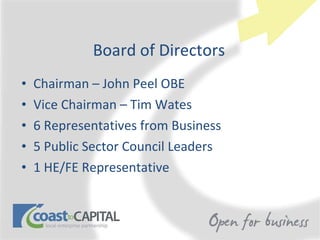
Board of Directors Chairman – John Peel OBE Vice Chairman – Tim Wates 6 Representatives from Business 5 Public Sector Council Leaders 1 HE/FE Representative
C2C Vision  Aim = employment growth Growth will be driven by a clear focus on the twin priorities of  Enterprise  and  International Growth
Place To create the best possible  physical and fiscal environment  for businesses to start-up, grow, compete and invest.
Enterprise Zones (EZs) New business and jobs Simplified planning – e.g. LDOs Business rate incentives Financial tools – e.g TIF Super fast broadband
Enterprise Zones (EZs) Summer 2011, LEPs asked to submit 1 bid Enterprise@BognorRegis bid unsuccessful C2C support partners with local EZ models Dedicated DCLG link officer for C2C
£15m allocation for Coast to Capital addressing  immediate  infrastructure and site constraints to promote employment growth sustainable  revolving  fund Criteria and briefing published 5 December 2011 Growing Places
Transport  Growth & Innovation Fund Regional Growth Fund
From central to local From public to private From south to north From finance to monitoring From target to incentive National context
Strategic role  Co-ordinate and facilitate best use of resources, expertise, best practice, links to DCLG… Development of frameworks Challenge, lobby and support partners in removing barriers/clearing blockages Coast to Capital’s role
Further information www.Coast2Capital.org.uk [email_address]
Infrastructure
Infrastructure Sean Clemons, MRICS   Robinson Low Francis
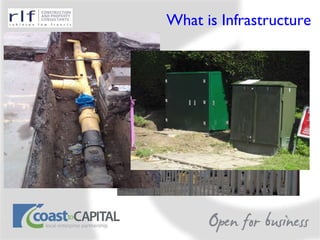
What is Infrastructure
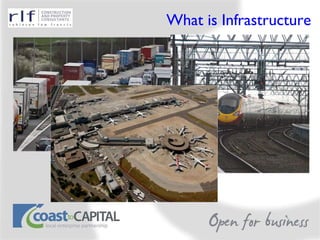
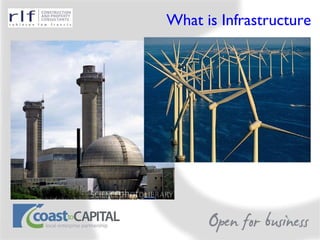
What is Infrastructure General Definition The basic facilities, services, and installations needed for the functioning of a community or society, such as transportation and communications systems, water and power lines, and public institutions including schools, post offices, and prisons. It can be generally defined as the set of interconnected structural elements that provide the framework supporting an entire structure of development.   What is Infrastructure at a Local Site Level? In principle it is the basic structures and components that facilitate the operation of a site.
What is Infrastructure Local Site Infrastructure Utilities – power, gas, water, drainage & telecoms  Transport – new pedestrian & vehicular access, adaptation / improvement of surrounding roads, car parking Site Improvement – Flood risk mitigation, contaminated land remediation, existing service diversions, legal title issues, floor slabs and foundations
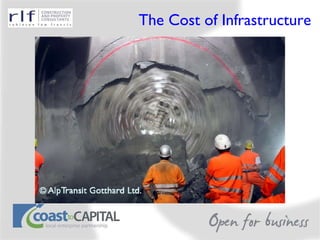
The Cost of Infrastructure
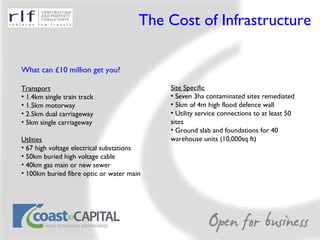
The Cost of Infrastructure What can £10 million get you? Transport 1.4km single train track 1.5km motorway 2.5km dual carriageway 5km single carriageway Utlities 67 high voltage electrical substations 50km buried high voltage cable 40km gas main or new sewer 100km buried fibre optic or water main Site Specific Seven 3ha contaminated sites remediated 5km of 4m high flood defence wall Utility service connections to at least 50 sites Ground slab and foundations for 40 warehouse units (10,000sq ft)
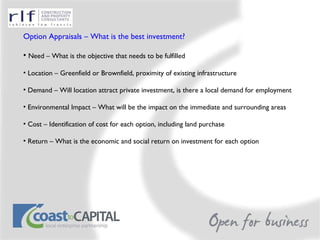
Viability Option Appraisals – What is the best investment? Need – What is the objective that needs to be fulfilled Location – Greenfield or Brownfield, proximity of existing infrastructure Demand – Will location attract private investment, is there a local demand for employment Environmental Impact – What will be the impact on the immediate and surrounding areas Cost – Identification of cost for each option, including land purchase Return – What is the economic and social return on investment for each option
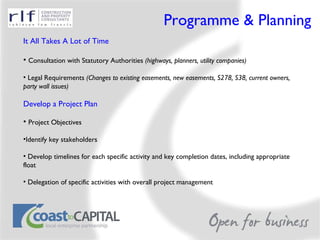
Programme & Planning It All Takes A Lot of Time Consultation with Statutory Authorities  (highways, planners, utility companies) Legal Requirements  (Changes to existing easements, new easements, S278, S38, current owners, party wall issues) Develop a Project Plan Project Objectives Identify key stakeholders Develop timelines for each specific activity and key completion dates, including appropriate float Delegation of specific activities with overall project management
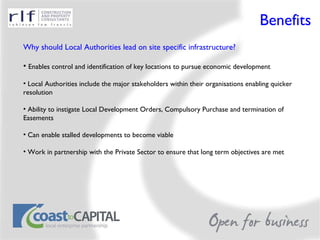
Benefits Why should Local Authorities lead on site specific infrastructure? Enables control and identification of key locations to pursue economic development Local Authorities include the major stakeholders within their organisations enabling quicker resolution Ability to instigate Local Development Orders, Compulsory Purchase and termination of Easements Can enable stalled developments to become viable Work in partnership with the Private Sector to ensure that long term objectives are met
Questions for discussion Part 1 -  Planning  - a barrier or just a scapegoat? -  Key infrastructure challenges for Coast to Capital? - Opportunities & challenges? - Where can the LEP can add value?
 
Questions for discussion Part 2 -  Cash flow or funding gap? -  Opportunities & challenges? - Where can the LEP can add value?
Close

C2C intro presentation

  • 1.
  • 2.
    Welcome Tim WatesVice-Chair, Coast to Capital Board Lead on ‘Place’ Director, Wates Construction
  • 3.
    Scene setting RonCrank Coast to Capital Director
  • 4.
  • 5.
  • 6.
  • 7.
    Board of DirectorsChairman – John Peel OBE Vice Chairman – Tim Wates 6 Representatives from Business 5 Public Sector Council Leaders 1 HE/FE Representative
  • 8.
    C2C Vision Aim = employment growth Growth will be driven by a clear focus on the twin priorities of Enterprise and International Growth
  • 9.
    Place To createthe best possible physical and fiscal environment for businesses to start-up, grow, compete and invest.
  • 10.
    Enterprise Zones (EZs)New business and jobs Simplified planning – e.g. LDOs Business rate incentives Financial tools – e.g TIF Super fast broadband
  • 11.
    Enterprise Zones (EZs)Summer 2011, LEPs asked to submit 1 bid Enterprise@BognorRegis bid unsuccessful C2C support partners with local EZ models Dedicated DCLG link officer for C2C
  • 12.
    £15m allocation forCoast to Capital addressing immediate infrastructure and site constraints to promote employment growth sustainable revolving fund Criteria and briefing published 5 December 2011 Growing Places
  • 13.
    Transport Growth& Innovation Fund Regional Growth Fund
  • 14.
    From central tolocal From public to private From south to north From finance to monitoring From target to incentive National context
  • 15.
    Strategic role Co-ordinate and facilitate best use of resources, expertise, best practice, links to DCLG… Development of frameworks Challenge, lobby and support partners in removing barriers/clearing blockages Coast to Capital’s role
  • 16.
  • 17.
  • 18.
    Infrastructure Sean Clemons,MRICS Robinson Low Francis
  • 19.
  • 20.
  • 21.
  • 22.
    What is InfrastructureGeneral Definition The basic facilities, services, and installations needed for the functioning of a community or society, such as transportation and communications systems, water and power lines, and public institutions including schools, post offices, and prisons. It can be generally defined as the set of interconnected structural elements that provide the framework supporting an entire structure of development. What is Infrastructure at a Local Site Level? In principle it is the basic structures and components that facilitate the operation of a site.
  • 23.
    What is InfrastructureLocal Site Infrastructure Utilities – power, gas, water, drainage & telecoms Transport – new pedestrian & vehicular access, adaptation / improvement of surrounding roads, car parking Site Improvement – Flood risk mitigation, contaminated land remediation, existing service diversions, legal title issues, floor slabs and foundations
  • 24.
    The Cost ofInfrastructure
  • 25.
    The Cost ofInfrastructure What can £10 million get you? Transport 1.4km single train track 1.5km motorway 2.5km dual carriageway 5km single carriageway Utlities 67 high voltage electrical substations 50km buried high voltage cable 40km gas main or new sewer 100km buried fibre optic or water main Site Specific Seven 3ha contaminated sites remediated 5km of 4m high flood defence wall Utility service connections to at least 50 sites Ground slab and foundations for 40 warehouse units (10,000sq ft)
  • 26.
    Viability Option Appraisals– What is the best investment? Need – What is the objective that needs to be fulfilled Location – Greenfield or Brownfield, proximity of existing infrastructure Demand – Will location attract private investment, is there a local demand for employment Environmental Impact – What will be the impact on the immediate and surrounding areas Cost – Identification of cost for each option, including land purchase Return – What is the economic and social return on investment for each option
  • 27.
    Programme & PlanningIt All Takes A Lot of Time Consultation with Statutory Authorities (highways, planners, utility companies) Legal Requirements (Changes to existing easements, new easements, S278, S38, current owners, party wall issues) Develop a Project Plan Project Objectives Identify key stakeholders Develop timelines for each specific activity and key completion dates, including appropriate float Delegation of specific activities with overall project management
  • 28.
    Benefits Why shouldLocal Authorities lead on site specific infrastructure? Enables control and identification of key locations to pursue economic development Local Authorities include the major stakeholders within their organisations enabling quicker resolution Ability to instigate Local Development Orders, Compulsory Purchase and termination of Easements Can enable stalled developments to become viable Work in partnership with the Private Sector to ensure that long term objectives are met
  • 29.
    Questions for discussionPart 1 - Planning - a barrier or just a scapegoat? - Key infrastructure challenges for Coast to Capital? - Opportunities & challenges? - Where can the LEP can add value?
  • 30.
  • 31.
    Questions for discussionPart 2 - Cash flow or funding gap? - Opportunities & challenges? - Where can the LEP can add value?
  • 32.

Editor's Notes

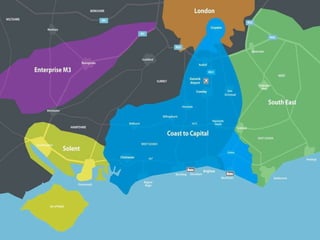
  • #6 Neighbours: Solent Enterprise M3 South East London
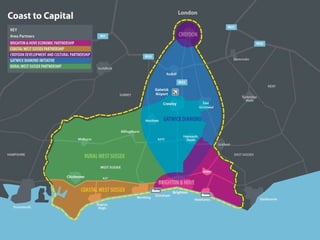
  • #7 These Area Partnerships were selected as part of our bid: GATWICK DIAMOND – recognised as one of the South East’s key growth areas BRIGHTON & HOVE – significant local economy CROYDON – an important link to London COASTAL WEST SUSSEX – Huge potential for employment growth RURAL WEST SUSSEX – Thriving and diverse economy
  • #8 Private Sector Led
  • #9 We Will Release the True Private Sector Potential of Our Area Our vision is straightforward and exciting
  • #10 Creating the Right Conditions for Business to Flourish
  • #30 Who We Are, How We Plan to Work With You What We Will Achieve
  • #32 Who We Are, How We Plan to Work With You What We Will Achieve
  • #33 Who We Are, How We Plan to Work With You What We Will Achieve