C2 C3 C4 & CAM
Variations on the
theme of photosynthesis
C3 Photosynthesis
C3 Photosynthesis
• Light reactions generate high energy
molecules to run the dark reactions (Calvin
cycle)
• The first step of the Calvin cycle is the fixation
of carbon by RUBISCO using carbon dioxide
and ribulose 1,5 bisphosphate as substrates
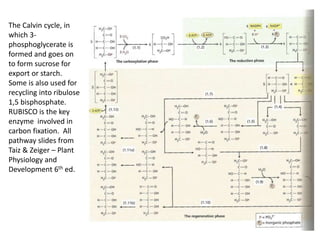
The Calvin cycle, in
which 3-
phosphoglycerate is
formed and goes on
to form sucrose for
export or starch.
Some is also used for
recycling into ribulose
1,5 bisphosphate.
RUBISCO is the key
enzyme involved in
carbon fixation. All
pathway slides from
Taiz & Zeiger – Plant
Physiology and
Development 6th ed.
C2 Photosynthesis
• RUBISCO is an ancient enzyme, and evolved
when oxygenation was insignificant
• With oxygenic photosynthesis and higher O2
levels in the atmosphere, oxygenation by
RUBISCO became significant
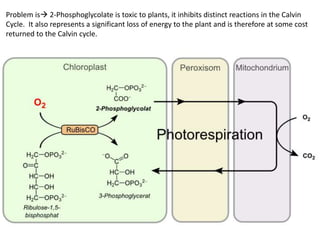
Problem is 2-Phosphoglycolate is toxic to plants, it inhibits distinct reactions in the Calvin
Cycle. It also represents a significant loss of energy to the plant and is therefore at some cost
returned to the Calvin cycle.
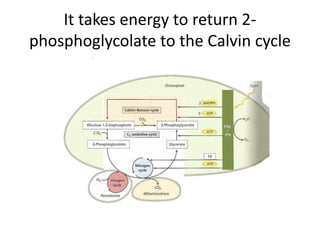
It takes energy to return 2-
phosphoglycolate to the Calvin cycle
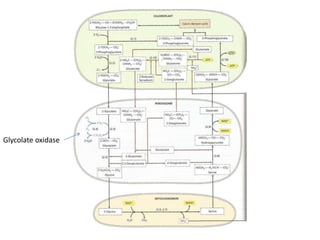
Glycolate oxidase
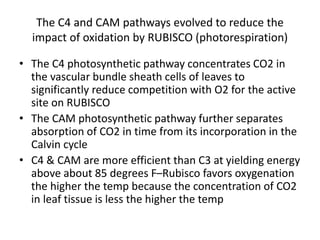
The C4 and CAM pathways evolved to reduce the
impact of oxidation by RUBISCO (photorespiration)
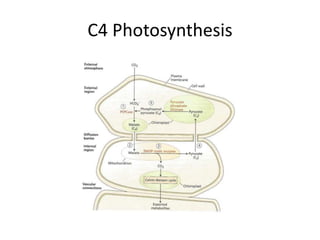
• The C4 photosynthetic pathway concentrates CO2 in
the vascular bundle sheath cells of leaves to
significantly reduce competition with O2 for the active
site on RUBISCO
• The CAM photosynthetic pathway further separates
absorption of CO2 in time from its incorporation in the
Calvin cycle
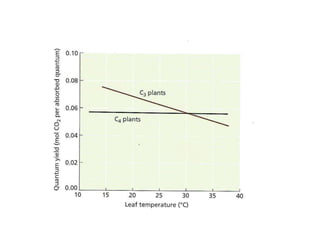
• C4 & CAM are more efficient than C3 at yielding energy
above about 85 degrees F–Rubisco favors oxygenation
the higher the temp because the concentration of CO2
in leaf tissue is less the higher the temp
C4 Photosynthesis
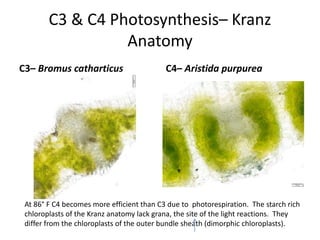
C3 & C4 Photosynthesis– Kranz
Anatomy
C3– Bromus catharticus C4– Aristida purpurea
At 86° F C4 becomes more efficient than C3 due to photorespiration. The starch rich
chloroplasts of the Kranz anatomy lack grana, the site of the light reactions. They
differ from the chloroplasts of the outer bundle sheath (dimorphic chloroplasts).
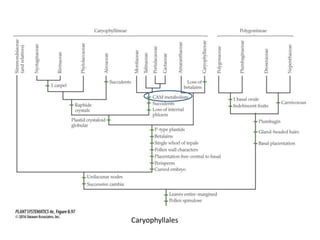
Caryophyllales
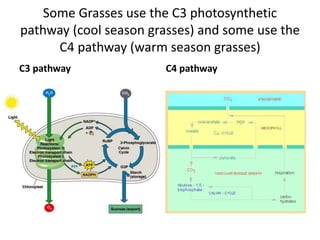
Some Grasses use the C3 photosynthetic
pathway (cool season grasses) and some use the
C4 pathway (warm season grasses)
C3 pathway C4 pathway
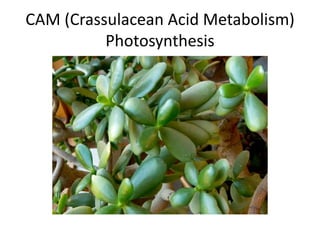
CAM (Crassulacean Acid Metabolism)
Photosynthesis
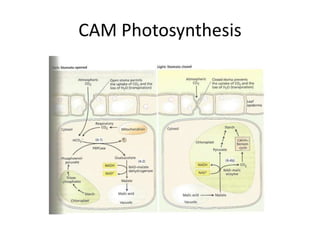
CAM Photosynthesis
CAM Photosynthesis
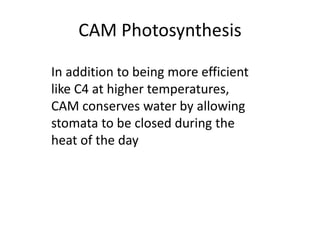
In addition to being more efficient
like C4 at higher temperatures,
CAM conserves water by allowing
stomata to be closed during the
heat of the day
“Since every CO2 molecule has to be
fixed twice, first by 4-carbon organic acid
and second by RuBisCO, the C4 pathway
uses more energy than the C3 pathway.
The C3 pathway requires 18 molecules
of ATP for the synthesis of one molecule
of glucose, whereas the C4 pathway
requires 30 molecules of ATP. This
energy debt is more than paid for by
avoiding losing more than half of
photosynthetic carbon in
photorespiration as occurs in some
tropical plants, making it an adaptive
mechanism for minimizing the loss.”
--quoted from that ubiquitous source,
Wikipedia

C2 C3 C4 and CAM (1).pptx

  • 1.
    C2 C3 C4& CAM Variations on the theme of photosynthesis
  • 2.
  • 3.
    C3 Photosynthesis • Lightreactions generate high energy molecules to run the dark reactions (Calvin cycle) • The first step of the Calvin cycle is the fixation of carbon by RUBISCO using carbon dioxide and ribulose 1,5 bisphosphate as substrates
  • 4.
    The Calvin cycle,in which 3- phosphoglycerate is formed and goes on to form sucrose for export or starch. Some is also used for recycling into ribulose 1,5 bisphosphate. RUBISCO is the key enzyme involved in carbon fixation. All pathway slides from Taiz & Zeiger – Plant Physiology and Development 6th ed.
  • 5.
    C2 Photosynthesis • RUBISCOis an ancient enzyme, and evolved when oxygenation was insignificant • With oxygenic photosynthesis and higher O2 levels in the atmosphere, oxygenation by RUBISCO became significant
  • 6.
    Problem is 2-Phosphoglycolateis toxic to plants, it inhibits distinct reactions in the Calvin Cycle. It also represents a significant loss of energy to the plant and is therefore at some cost returned to the Calvin cycle.
  • 7.
    It takes energyto return 2- phosphoglycolate to the Calvin cycle
  • 8.
  • 9.
    The C4 andCAM pathways evolved to reduce the impact of oxidation by RUBISCO (photorespiration) • The C4 photosynthetic pathway concentrates CO2 in the vascular bundle sheath cells of leaves to significantly reduce competition with O2 for the active site on RUBISCO • The CAM photosynthetic pathway further separates absorption of CO2 in time from its incorporation in the Calvin cycle • C4 & CAM are more efficient than C3 at yielding energy above about 85 degrees F–Rubisco favors oxygenation the higher the temp because the concentration of CO2 in leaf tissue is less the higher the temp
  • 10.
  • 11.
    C3 & C4Photosynthesis– Kranz Anatomy C3– Bromus catharticus C4– Aristida purpurea At 86° F C4 becomes more efficient than C3 due to photorespiration. The starch rich chloroplasts of the Kranz anatomy lack grana, the site of the light reactions. They differ from the chloroplasts of the outer bundle sheath (dimorphic chloroplasts).
  • 12.
  • 13.
    Some Grasses usethe C3 photosynthetic pathway (cool season grasses) and some use the C4 pathway (warm season grasses) C3 pathway C4 pathway
  • 17.
    CAM (Crassulacean AcidMetabolism) Photosynthesis
  • 18.
  • 19.
    CAM Photosynthesis In additionto being more efficient like C4 at higher temperatures, CAM conserves water by allowing stomata to be closed during the heat of the day
  • 20.
    “Since every CO2molecule has to be fixed twice, first by 4-carbon organic acid and second by RuBisCO, the C4 pathway uses more energy than the C3 pathway. The C3 pathway requires 18 molecules of ATP for the synthesis of one molecule of glucose, whereas the C4 pathway requires 30 molecules of ATP. This energy debt is more than paid for by avoiding losing more than half of photosynthetic carbon in photorespiration as occurs in some tropical plants, making it an adaptive mechanism for minimizing the loss.” --quoted from that ubiquitous source, Wikipedia