This document contains 10 multiple choice questions about C programming fundamentals asked in an exam at Dezyne E'Cole College in Ajmer. The questions cover topics like data types, operators, pointers, structures, and memory allocation. The answers provided explain the output or correct the errors in code snippets related to each question.
![Dezyne E’Cole College, Ajmer
B.C.A (Part 1) Examination, 2013
Fundamental of C Programming
1. What will be the output of the following code
int x=40000;
printf (“%d”, x);
Ans: Garbage value
2. Arrange following operators in ascending order according to their precedence.
a. &&
b. ||
c. !
d. ? :
e. & (Bitwise)
Ans: !, &, &&, ||, ?:
3. What will be the output of following code for
(i=1, j=10; i<6; ++i, j--)
printf (“%d %d”, i, j);
Ans:
I J
1 10
2 9
3 8
4 7
5 6
4. What is the meaning of
int (*P)[10];
Ans: P, Array of pointer (10 values)
5. What is the meaning of
int *P [10];
Ans: P, 10 array of pointer, that stores 10 different addresses.
6. Find errors (if any) and remove them otherwise give output of the following](https://image.slidesharecdn.com/cprogramming-130401025833-phpapp02/85/C-programming-Part-1-1-320.jpg)
![Dezyne E’Cole College, Ajmer
B.C.A (Part 1) Examination, 2013
Fundamental of C Programming
1. What will be the output of the following code
int x=40000;
printf (“%d”, x);
Ans: Garbage value
2. Arrange following operators in ascending order according to their precedence.
a. &&
b. ||
c. !
d. ? :
e. & (Bitwise)
Ans: !, &, &&, ||, ?:
3. What will be the output of following code for
(i=1, j=10; i<6; ++i, j--)
printf (“%d %d”, i, j);
Ans:
I J
1 10
2 9
3 8
4 7
5 6
4. What is the meaning of
int (*P)[10];
Ans: P, Array of pointer (10 values)
5. What is the meaning of
int *P [10];
Ans: P, 10 array of pointer, that stores 10 different addresses.
6. Find errors (if any) and remove them otherwise give output of the following](https://image.slidesharecdn.com/cprogramming-130401025833-phpapp02/75/C-programming-Part-1-1-2048.jpg)
![Dezyne E’Cole College, Ajmer
Char C=’A’;
int x=10, y;
y=x+c;
putchar(y);
Ans: char C=’A’;
int x=10,y;
y=x+C;
putchar(y);
Output: K
7. Find errors and remove them (if any) otherwise give output of the following
printf(“%d”,++5);
Ans: printf(“%d”,5);
output: 5
8. Find errors and remove them (if any) otherwise give output of the following
printf[“%d”,sizeof(“”)];
Ans: printf(“%d”,sizeof(“”));
output: 1
9. What will be the output of the following:
int x=10, y=20;
(x>y)? ++x: ++y;
printf(“n x=%d, y=%d”,x,y);
Ans: x=10, y=21
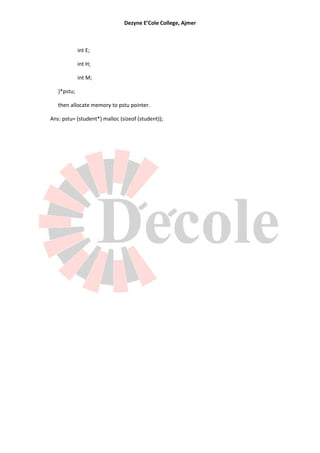
10. if student structure is given as
struct student
{
char name[10];](https://image.slidesharecdn.com/cprogramming-130401025833-phpapp02/85/C-programming-Part-1-2-320.jpg)