
Arindam Mukherjee 
Pune C++ and Boost Meetup 
C++TEMPLATE METAPROGRAMMING
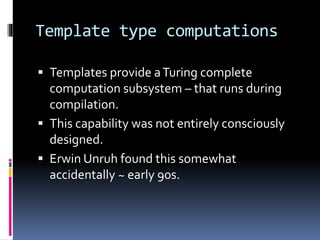
Template type computations 
 Templates provide a Turing complete 
computation subsystem – that runs during 
compilation. 
 This capability was not entirely consciously 
designed. 
 Erwin Unruh found this somewhat 
accidentally ~ early 90s.
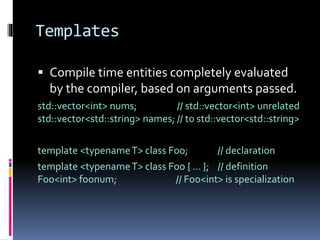
Templates 
 Compile time entities completely evaluated 
by the compiler, based on arguments passed. 
std::vector<int> nums; // std::vector<int> unrelated 
std::vector<std::string> names; // to std::vector<std::string> 
template <typenameT> class Foo; // declaration 
template <typenameT> class Foo { … }; // definition 
Foo<int> foonum; // Foo<int> is specialization
Non-type template parameters 
 Templates can have non-type parameters: 
template <typename T, int N> 
struct array { 
T data[N]; 
…. 
} 
 Non-type args are compile time constants. 
array<int, 10> arr; // array of 10 ints 
 sizeof is evaluated at compile time. 
int arr[sizeof(int)]; // array of 4* ints
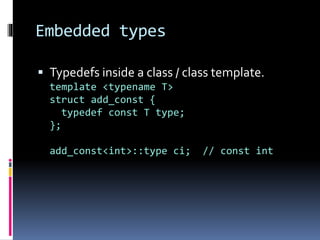
Embedded types 
 Typedefs inside a class / class template. 
template <typename T> 
struct add_const { 
typedef const T type; 
}; 
add_const<int>::type ci; // const int
Embedded constants 
 Enums inside a class / class template. 
template <int M, int N> struct add { 
enum { value = M + N } 
} 
int array[add<10, 20>::value];
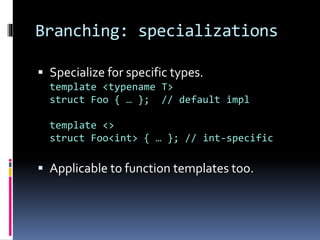
Branching: specializations 
 Specialize for specific types. 
template <typename T> 
struct Foo { … }; // default impl 
template <> 
struct Foo<int> { … }; // int-specific 
 Applicable to function templates too.
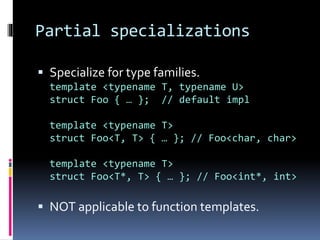
Partial specializations 
 Specialize for type families. 
template <typename T, typename U> 
struct Foo { … }; // default impl 
template <typename T> 
struct Foo<T, T> { … }; // Foo<char, char> 
template <typename T> 
struct Foo<T*, T> { … }; // Foo<int*, int> 
 NOT applicable to function templates.
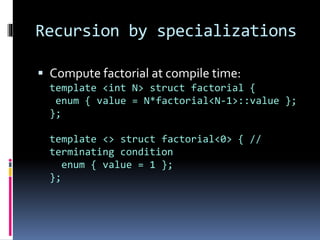
Recursion by specializations 
 Compute factorial at compile time: 
template <int N> struct factorial { 
enum { value = N*factorial<N-1>::value }; 
}; 
template <> struct factorial<0> { // 
terminating condition 
enum { value = 1 }; 
};
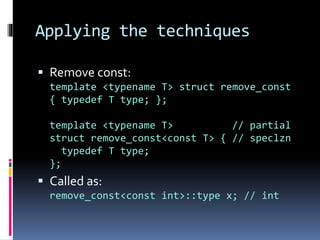
Applying the techniques 
 Remove const: 
template <typename T> struct remove_const 
{ typedef T type; }; 
template <typename T> // partial 
struct remove_const<const T> { // speclzn 
typedef T type; 
}; 
 Called as: 
remove_const<const int>::type x; // int
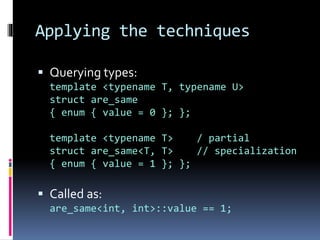
Applying the techniques 
 Querying types: 
template <typename T, typename U> 
struct are_same 
{ enum { value = 0 }; }; 
template <typename T> / partial 
struct are_same<T, T> // specialization 
{ enum { value = 1 }; }; 
 Called as: 
are_same<int, int>::value == 1;
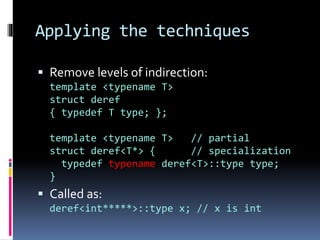
Applying the techniques 
 Remove levels of indirection: 
template <typename T> 
struct deref 
{ typedef T type; }; 
template <typename T> // partial 
struct deref<T*> { // specialization 
typedef typename deref<T>::type type; 
} 
 Called as: 
deref<int*****>::type x; // x is int
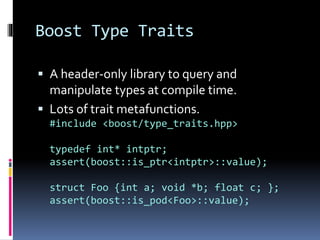
Boost Type Traits 
 A header-only library to query and 
manipulate types at compile time. 
 Lots of trait metafunctions. 
#include <boost/type_traits.hpp> 
typedef int* intptr; 
assert(boost::is_ptr<intptr>::value); 
struct Foo {int a; void *b; float c; }; 
assert(boost::is_pod<Foo>::value);
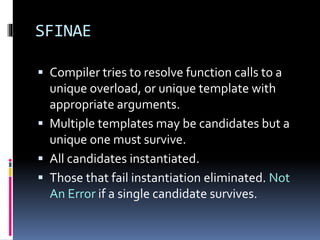
SFINAE 
 Compiler tries to resolve function calls to a 
unique overload, or unique template with 
appropriate arguments. 
 Multiple templates may be candidates but a 
unique one must survive. 
 All candidates instantiated. 
 Those that fail instantiation eliminated. Not 
An Error if a single candidate survives.
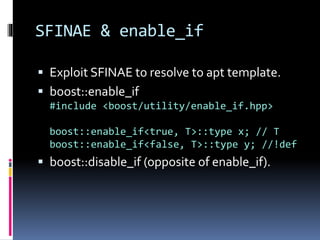
SFINAE & enable_if 
 Exploit SFINAE to resolve to apt template. 
 boost::enable_if 
#include <boost/utility/enable_if.hpp> 
boost::enable_if<true, T>::type x; // T 
boost::enable_if<false, T>::type y; //!def 
 boost::disable_if (opposite of enable_if).
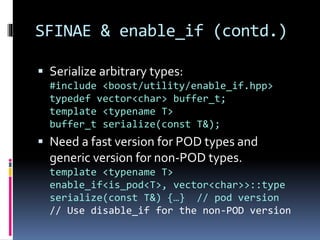
SFINAE & enable_if (contd.) 
 Serialize arbitrary types: 
#include <boost/utility/enable_if.hpp> 
typedef vector<char> buffer_t; 
template <typename T> 
buffer_t serialize(const T&); 
 Need a fast version for POD types and 
generic version for non-POD types. 
template <typename T> 
enable_if<is_pod<T>, vector<char>>::type 
serialize(const T&) {…} // pod version 
// Use disable_if for the non-POD version
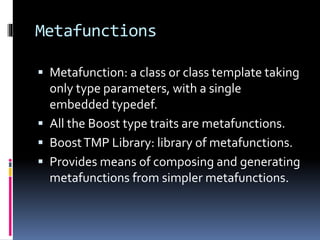
Metafunctions 
 Metafunction: a class or class template taking 
only type parameters, with a single 
embedded typedef. 
 All the Boost type traits are metafunctions. 
 Boost TMP Library: library of metafunctions. 
 Provides means of composing and generating 
metafunctions from simpler metafunctions.
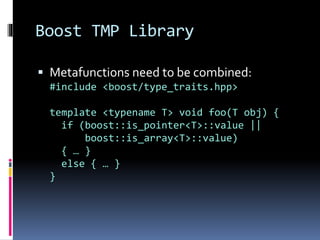
Boost TMP Library 
 Metafunctions need to be combined: 
#include <boost/type_traits.hpp> 
template <typename T> void foo(T obj) { 
if (boost::is_pointer<T>::value || 
boost::is_array<T>::value) 
{ … } 
else { … } 
}
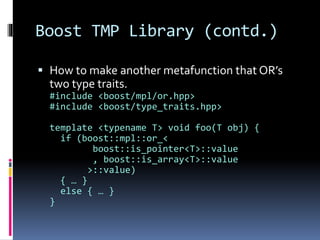
Boost TMP Library (contd.) 
 How to make another metafunction that OR’s 
two type traits. 
#include <boost/mpl/or.hpp> 
#include <boost/type_traits.hpp> 
template <typename T> void foo(T obj) { 
if (boost::mpl::or_< 
boost::is_pointer<T>::value 
, boost::is_array<T>::value 
>::value) 
{ … } 
else { … } 
}
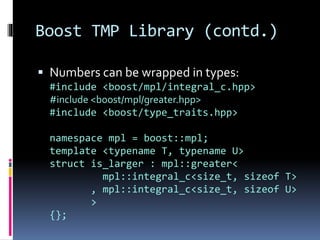
Boost TMP Library (contd.) 
 Numbers can be wrapped in types: 
#include <boost/mpl/integral_c.hpp> 
#include <boost/mpl/greater.hpp> 
#include <boost/type_traits.hpp> 
namespace mpl = boost::mpl; 
template <typename T, typename U> 
struct is_larger : mpl::greater< 
mpl::integral_c<size_t, sizeof T> 
, mpl::integral_c<size_t, sizeof U> 
> 
{};
Thank you! 
 Q & A 
 Book: Modern C++ Design – Andrei 
Alexandrescu 
 Book: Advanced C++ Template 
Metaprogramming – Davide di Gennaro 
 Book: C++ Template Metaprogramming – 
Dave Abrahams, Aleksey Gurtovoy

C++ metaprogramming

  • 1.
    Arindam Mukherjee PuneC++ and Boost Meetup C++TEMPLATE METAPROGRAMMING
  • 2.
    Template type computations  Templates provide a Turing complete computation subsystem – that runs during compilation.  This capability was not entirely consciously designed.  Erwin Unruh found this somewhat accidentally ~ early 90s.
  • 3.
    Templates  Compiletime entities completely evaluated by the compiler, based on arguments passed. std::vector<int> nums; // std::vector<int> unrelated std::vector<std::string> names; // to std::vector<std::string> template <typenameT> class Foo; // declaration template <typenameT> class Foo { … }; // definition Foo<int> foonum; // Foo<int> is specialization
  • 4.
    Non-type template parameters  Templates can have non-type parameters: template <typename T, int N> struct array { T data[N]; …. }  Non-type args are compile time constants. array<int, 10> arr; // array of 10 ints  sizeof is evaluated at compile time. int arr[sizeof(int)]; // array of 4* ints
  • 5.
    Embedded types Typedefs inside a class / class template. template <typename T> struct add_const { typedef const T type; }; add_const<int>::type ci; // const int
  • 6.
    Embedded constants Enums inside a class / class template. template <int M, int N> struct add { enum { value = M + N } } int array[add<10, 20>::value];
  • 7.
    Branching: specializations Specialize for specific types. template <typename T> struct Foo { … }; // default impl template <> struct Foo<int> { … }; // int-specific  Applicable to function templates too.
  • 8.
    Partial specializations Specialize for type families. template <typename T, typename U> struct Foo { … }; // default impl template <typename T> struct Foo<T, T> { … }; // Foo<char, char> template <typename T> struct Foo<T*, T> { … }; // Foo<int*, int>  NOT applicable to function templates.
  • 9.
    Recursion by specializations  Compute factorial at compile time: template <int N> struct factorial { enum { value = N*factorial<N-1>::value }; }; template <> struct factorial<0> { // terminating condition enum { value = 1 }; };
  • 10.
    Applying the techniques  Remove const: template <typename T> struct remove_const { typedef T type; }; template <typename T> // partial struct remove_const<const T> { // speclzn typedef T type; };  Called as: remove_const<const int>::type x; // int
  • 11.
    Applying the techniques  Querying types: template <typename T, typename U> struct are_same { enum { value = 0 }; }; template <typename T> / partial struct are_same<T, T> // specialization { enum { value = 1 }; };  Called as: are_same<int, int>::value == 1;
  • 12.
    Applying the techniques  Remove levels of indirection: template <typename T> struct deref { typedef T type; }; template <typename T> // partial struct deref<T*> { // specialization typedef typename deref<T>::type type; }  Called as: deref<int*****>::type x; // x is int
  • 13.
    Boost Type Traits  A header-only library to query and manipulate types at compile time.  Lots of trait metafunctions. #include <boost/type_traits.hpp> typedef int* intptr; assert(boost::is_ptr<intptr>::value); struct Foo {int a; void *b; float c; }; assert(boost::is_pod<Foo>::value);
  • 14.
    SFINAE  Compilertries to resolve function calls to a unique overload, or unique template with appropriate arguments.  Multiple templates may be candidates but a unique one must survive.  All candidates instantiated.  Those that fail instantiation eliminated. Not An Error if a single candidate survives.
  • 15.
    SFINAE & enable_if  Exploit SFINAE to resolve to apt template.  boost::enable_if #include <boost/utility/enable_if.hpp> boost::enable_if<true, T>::type x; // T boost::enable_if<false, T>::type y; //!def  boost::disable_if (opposite of enable_if).
  • 16.
    SFINAE & enable_if(contd.)  Serialize arbitrary types: #include <boost/utility/enable_if.hpp> typedef vector<char> buffer_t; template <typename T> buffer_t serialize(const T&);  Need a fast version for POD types and generic version for non-POD types. template <typename T> enable_if<is_pod<T>, vector<char>>::type serialize(const T&) {…} // pod version // Use disable_if for the non-POD version
  • 17.
    Metafunctions  Metafunction:a class or class template taking only type parameters, with a single embedded typedef.  All the Boost type traits are metafunctions.  Boost TMP Library: library of metafunctions.  Provides means of composing and generating metafunctions from simpler metafunctions.
  • 18.
    Boost TMP Library  Metafunctions need to be combined: #include <boost/type_traits.hpp> template <typename T> void foo(T obj) { if (boost::is_pointer<T>::value || boost::is_array<T>::value) { … } else { … } }
  • 19.
    Boost TMP Library(contd.)  How to make another metafunction that OR’s two type traits. #include <boost/mpl/or.hpp> #include <boost/type_traits.hpp> template <typename T> void foo(T obj) { if (boost::mpl::or_< boost::is_pointer<T>::value , boost::is_array<T>::value >::value) { … } else { … } }
  • 20.
    Boost TMP Library(contd.)  Numbers can be wrapped in types: #include <boost/mpl/integral_c.hpp> #include <boost/mpl/greater.hpp> #include <boost/type_traits.hpp> namespace mpl = boost::mpl; template <typename T, typename U> struct is_larger : mpl::greater< mpl::integral_c<size_t, sizeof T> , mpl::integral_c<size_t, sizeof U> > {};
  • 21.
    Thank you! Q & A  Book: Modern C++ Design – Andrei Alexandrescu  Book: Advanced C++ Template Metaprogramming – Davide di Gennaro  Book: C++ Template Metaprogramming – Dave Abrahams, Aleksey Gurtovoy