Types, classes and concepts.
Nicola Bonelli :: nicola@pfq.io
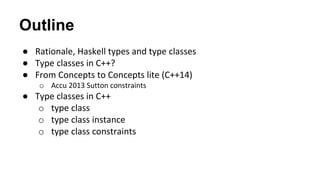
Outline
● Rationale, Haskell types and type classes
● Type classes in C++?
● From Concepts to Concepts lite (C++14)
o Accu 2013 Sutton constraints
● Type classes in C++
o type class
o type class instance
o type class constraints
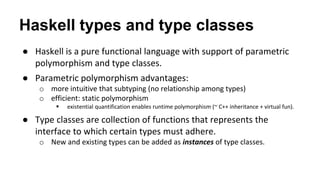
Haskell types and type classes
● Haskell is a pure functional language with support of parametric
polymorphism and type classes.
● Parametric polymorphism advantages:
o more intuitive that subtyping (no relationship among types)
o efficient: static polymorphism
 existential quantification enables runtime polymorphism (~ C++ inheritance + virtual fun).
● Type classes are collection of functions that represents the
interface to which certain types must adhere.
o New and existing types can be added as instances of type classes.
Typeclass: a simple example
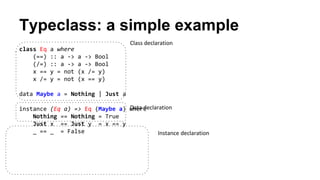
class Eq a where
(==) :: a -> a -> Bool
(/=) :: a -> a -> Bool
x == y = not (x /= y)
x /= y = not (x == y)
data Maybe a = Nothing | Just a
instance (Eq a) => Eq (Maybe a) where
Nothing == Nothing = True
Just x == Just y = x == y
_ == _ = False
Class declaration
Data declaration
Instance declaration
What about C++?
● Parametric polymorphism is enabled by template (generic
programming)
● Overloading is fundamental
o semantically equivalent operations with the same name
● Abuse of inheritance
● Functions are already first-class citizen (high-order functions).
o pointer to functions, lambdas and std::function
o C++ functors (not to confuse with functors from category theory)
Type classes in C++?
● ADL, ad-hoc polymorphism (overloading) and template are not
enough!
● Functions need a support to restrict the types they take, to
improve the quality of error messages.
o very long errors with no a clear location.
● Constraining types by annotations is error prone.
o comments in source codes are not a viable solution!
Concepts!?
● C++ Concepts were proposed as an extension (to be included into C++11)
a construct that specify what a type must provide
o to codify formal properties of types (also semantically).
o to improve compiler diagnostics.
● In addition, concept map is a mechanism to bind types to concepts.
o Types can then be converted into an interface that generic functions can
utilize.
● Concepts were dropped due to some concerns.
o Mainly because they were “not ready” for C++11...
Concepts Lite!
● Simplified implementation as template constraints for functions
and classes template (in C++14 Technical specification).
o Semantic check and concept map are not implemented.
● Used to check template arguments at the point of use.
● No runtime overhead.
Constraints
● A constraint is a constexpr function template
o Can use type traits, call other constexpr functions
● Constraints check syntactic requirements
o Is this expression valid for objects of type T?
o Is the result type of an expression convertible to U?
© 2013 Andrew Sutton
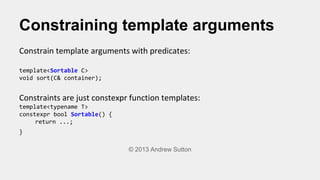
Constraining template arguments
Constrain template arguments with predicates:
template<Sortable C>
void sort(C& container);
Constraints are just constexpr function templates:
template<typename T>
constexpr bool Sortable() {
return ...;
}
© 2013 Andrew Sutton
Concepts Lite
● Concept lite are intended to:
o specify properties and constraints of generic types.
o extend overloading (most constrained overload wins).
o select the most suitable class specialization.
o … enable_if is somehow deprecated.
● They do not represent the C++ version of type classes per se.
o constraint are only half of the problem.
 concept map will be not available, Stroustrup says.
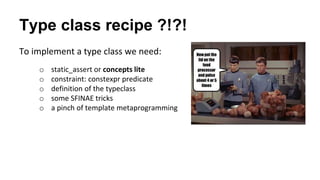
Type class recipe ?!?!
To implement a type class we need:
o static_assert or concepts lite
o constraint: constexpr predicate
o definition of the typeclass
o some SFINAE tricks
o a pinch of template metaprogramming
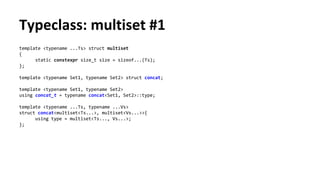
Typeclass: multiset #1
template <typename ...Ts> struct multiset
{
static constexpr size_t size = sizeof...(Ts);
};
template <typename Set1, typename Set2> struct concat;
template <typename Set1, typename Set2>
using concat_t = typename concat<Set1, Set2>::type;
template <typename ...Ts, typename ...Vs>
struct concat<multiset<Ts...>, multiset<Vs...>>{
using type = multiset<Ts..., Vs...>;
};
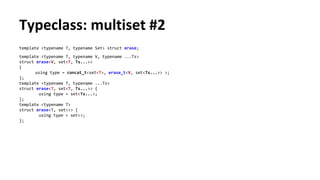
Typeclass: multiset #2
template <typename T, typename Set> struct erase;
template <typename T, typename V, typename ...Ts>
struct erase<V, set<T, Ts...>>
{
using type = concat_t<set<T>, erase_t<V, set<Ts...>> >;
};
template <typename T, typename ...Ts>
struct erase<T, set<T, Ts...>> {
using type = set<Ts...>;
};
template <typename T>
struct erase<T, set<>> {
using type = set<>;
};
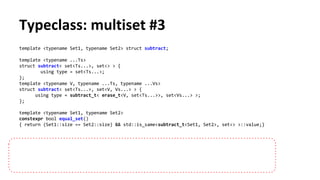
Typeclass: multiset #3
template <typename Set1, typename Set2> struct subtract;
template <typename ...Ts>
struct subtract< set<Ts...>, set<> > {
using type = set<Ts...>;
};
template <typename V, typename ...Ts, typename ...Vs>
struct subtract< set<Ts...>, set<V, Vs...> > {
using type = subtract_t< erase_t<V, set<Ts...>>, set<Vs...> >;
};
template <typename Set1, typename Set2>
constexpr bool equal_set()
{ return (Set1::size == Set2::size) && std::is_same<subtract_t<Set1, Set2>, set<> >::value;}
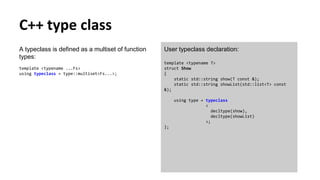
C++ type class
A typeclass is defined as a multiset of function
types:
template <typename ...Fs>
using typeclass = type::multiset<Fs...>;
User typeclass declaration:
template <typename T>
struct Show
{
static std::string show(T const &);
static std::string showList(std::list<T> const
&);
using type = typeclass
<
decltype(show),
decltype(showList)
>;
};
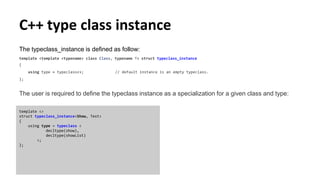
C++ type class instance
The typeclass_instance is defined as follow:
template <template <typename> class Class, typename T> struct typeclass_instance
{
using type = typeclass<>; // default instance is an empty typeclass.
};
The user is required to define the typeclass instance as a specialization for a given class and type:
template <>
struct typeclass_instance<Show, Test>
{
using type = typeclass <
decltype(show),
decltype(showList)
>;
};
C++ type class instance (example)
Example:
struct Test { };
std::string show(Test const &)
{ return "Test"; }
std::string showList(std::list<Test> const &)
{ return "[Test]"; }
template <>
struct typeclass_instance<Show, Test>
{
using type = typeclass <
decltype(show),
decltype(showList)
>;
};
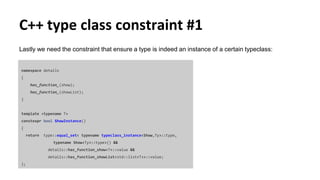
C++ type class constraint #1
Lastly we need the constraint that ensure a type is indeed an instance of a certain typeclass:
namespace details
{
has_function_(show);
has_function_(showList);
}
template <typename T>
constexpr bool ShowInstance()
{
return type::equal_set< typename typeclass_instance<Show,Ty>::type,
typename Show<Ty>::type>() &&
details::has_function_show<T>::value &&
details::has_function_showList<std::list<T>>::value;
};
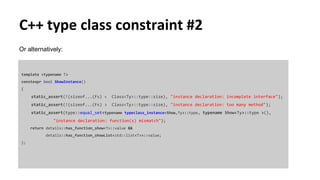
C++ type class constraint #2
Or alternatively:
template <typename T>
constexpr bool ShowInstance()
{
static_assert(!(sizeof...(Fs) < Class<Ty>::type::size), "instance declaration: incomplete interface");
static_assert(!(sizeof...(Fs) > Class<Ty>::type::size), "instance declaration: too many method");
static_assert(type::equal_set<typename typeclass_instance<Show,Ty>::type, typename Show<Ty>::type >(),
"instance declaration: function(s) mismatch");
return details::has_function_show<T>::value &&
details::has_function_showList<std::list<T>>::value;
};
C++ type class SFINAE
Where the has_function_ is a macro that generate a proper SFINAE test to check the existence of a
certain function (fun). A compiler intrinsic would be very welcome!
#define has_function_(fun) 
template <typename __Type> 
struct has_function_ ## fun 
{ 
using yes = char[1]; 
using no = char[2]; 

template <typename __Type2> static yes& check(typename std::decay<decltype(fun(std::declval<__Type2>()))>::type *); 
template <typename __Type2> static no& check(...); 

static constexpr bool value = sizeof(check<__Type>(0)) == sizeof(yes); 
};
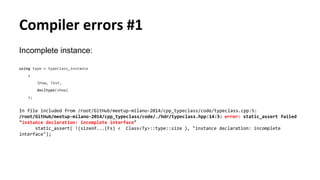
Compiler errors #1
Incomplete instance:
using type = typeclass_instance
<
Show, Test,
decltype(show)
>;
In file included from /root/GitHub/meetup-milano-2014/cpp_typeclass/code/typeclass.cpp:5:
/root/GitHub/meetup-milano-2014/cpp_typeclass/code/./hdr/typeclass.hpp:14:5: error: static_assert failed
"instance declaration: incomplete interface"
static_assert( !(sizeof...(Fs) < Class<Ty>::type::size ), "instance declaration: incomplete
interface");
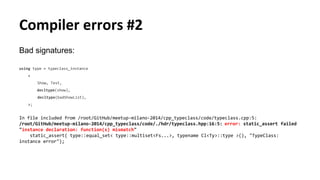
Compiler errors #2
Bad signatures:
using type = typeclass_instance
<
Show, Test,
decltype(show),
decltype(badShowList),
>;
In file included from /root/GitHub/meetup-milano-2014/cpp_typeclass/code/typeclass.cpp:5:
/root/GitHub/meetup-milano-2014/cpp_typeclass/code/./hdr/typeclass.hpp:16:5: error: static_assert failed
"instance declaration: function(s) mismatch"
static_assert( type::equal_set< type::multiset<Fs...>, typename Cl<Ty>::type >(), "TypeClass:
instance error");
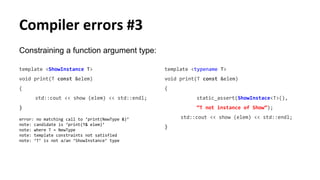
Constraining a function argument type:
template <ShowInstance T>
void print(T const &elem)
{
std::cout << show (elem) << std::endl;
}
error: no matching call to ‘print(NewType &)’
note: candidate is ‘print(T& elem)’
note: where T = NewType
note: template constraints not satisfied
note: ‘T’ is not a/an ‘ShowInstance’ type
Compiler errors #3
template <typename T>
void print(T const &elem)
{
static_assert(ShowInstace<T>(),
“T not instance of Show”);
std::cout << show (elem) << std::endl;
}
Types, classes and concepts

Types, classes and concepts

  • 1.
    Types, classes andconcepts. Nicola Bonelli :: nicola@pfq.io
  • 2.
    Outline ● Rationale, Haskelltypes and type classes ● Type classes in C++? ● From Concepts to Concepts lite (C++14) o Accu 2013 Sutton constraints ● Type classes in C++ o type class o type class instance o type class constraints
  • 3.
    Haskell types andtype classes ● Haskell is a pure functional language with support of parametric polymorphism and type classes. ● Parametric polymorphism advantages: o more intuitive that subtyping (no relationship among types) o efficient: static polymorphism  existential quantification enables runtime polymorphism (~ C++ inheritance + virtual fun). ● Type classes are collection of functions that represents the interface to which certain types must adhere. o New and existing types can be added as instances of type classes.
  • 4.
    Typeclass: a simpleexample class Eq a where (==) :: a -> a -> Bool (/=) :: a -> a -> Bool x == y = not (x /= y) x /= y = not (x == y) data Maybe a = Nothing | Just a instance (Eq a) => Eq (Maybe a) where Nothing == Nothing = True Just x == Just y = x == y _ == _ = False Class declaration Data declaration Instance declaration
  • 5.
    What about C++? ●Parametric polymorphism is enabled by template (generic programming) ● Overloading is fundamental o semantically equivalent operations with the same name ● Abuse of inheritance ● Functions are already first-class citizen (high-order functions). o pointer to functions, lambdas and std::function o C++ functors (not to confuse with functors from category theory)
  • 6.
    Type classes inC++? ● ADL, ad-hoc polymorphism (overloading) and template are not enough! ● Functions need a support to restrict the types they take, to improve the quality of error messages. o very long errors with no a clear location. ● Constraining types by annotations is error prone. o comments in source codes are not a viable solution!
  • 7.
    Concepts!? ● C++ Conceptswere proposed as an extension (to be included into C++11) a construct that specify what a type must provide o to codify formal properties of types (also semantically). o to improve compiler diagnostics. ● In addition, concept map is a mechanism to bind types to concepts. o Types can then be converted into an interface that generic functions can utilize. ● Concepts were dropped due to some concerns. o Mainly because they were “not ready” for C++11...
  • 8.
    Concepts Lite! ● Simplifiedimplementation as template constraints for functions and classes template (in C++14 Technical specification). o Semantic check and concept map are not implemented. ● Used to check template arguments at the point of use. ● No runtime overhead.
  • 9.
    Constraints ● A constraintis a constexpr function template o Can use type traits, call other constexpr functions ● Constraints check syntactic requirements o Is this expression valid for objects of type T? o Is the result type of an expression convertible to U? © 2013 Andrew Sutton
  • 10.
    Constraining template arguments Constraintemplate arguments with predicates: template<Sortable C> void sort(C& container); Constraints are just constexpr function templates: template<typename T> constexpr bool Sortable() { return ...; } © 2013 Andrew Sutton
  • 11.
    Concepts Lite ● Conceptlite are intended to: o specify properties and constraints of generic types. o extend overloading (most constrained overload wins). o select the most suitable class specialization. o … enable_if is somehow deprecated. ● They do not represent the C++ version of type classes per se. o constraint are only half of the problem.  concept map will be not available, Stroustrup says.
  • 12.
    Type class recipe?!?! To implement a type class we need: o static_assert or concepts lite o constraint: constexpr predicate o definition of the typeclass o some SFINAE tricks o a pinch of template metaprogramming
  • 13.
    Typeclass: multiset #1 template<typename ...Ts> struct multiset { static constexpr size_t size = sizeof...(Ts); }; template <typename Set1, typename Set2> struct concat; template <typename Set1, typename Set2> using concat_t = typename concat<Set1, Set2>::type; template <typename ...Ts, typename ...Vs> struct concat<multiset<Ts...>, multiset<Vs...>>{ using type = multiset<Ts..., Vs...>; };
  • 14.
    Typeclass: multiset #2 template<typename T, typename Set> struct erase; template <typename T, typename V, typename ...Ts> struct erase<V, set<T, Ts...>> { using type = concat_t<set<T>, erase_t<V, set<Ts...>> >; }; template <typename T, typename ...Ts> struct erase<T, set<T, Ts...>> { using type = set<Ts...>; }; template <typename T> struct erase<T, set<>> { using type = set<>; };
  • 15.
    Typeclass: multiset #3 template<typename Set1, typename Set2> struct subtract; template <typename ...Ts> struct subtract< set<Ts...>, set<> > { using type = set<Ts...>; }; template <typename V, typename ...Ts, typename ...Vs> struct subtract< set<Ts...>, set<V, Vs...> > { using type = subtract_t< erase_t<V, set<Ts...>>, set<Vs...> >; }; template <typename Set1, typename Set2> constexpr bool equal_set() { return (Set1::size == Set2::size) && std::is_same<subtract_t<Set1, Set2>, set<> >::value;}
  • 16.
    C++ type class Atypeclass is defined as a multiset of function types: template <typename ...Fs> using typeclass = type::multiset<Fs...>; User typeclass declaration: template <typename T> struct Show { static std::string show(T const &); static std::string showList(std::list<T> const &); using type = typeclass < decltype(show), decltype(showList) >; };
  • 17.
    C++ type classinstance The typeclass_instance is defined as follow: template <template <typename> class Class, typename T> struct typeclass_instance { using type = typeclass<>; // default instance is an empty typeclass. }; The user is required to define the typeclass instance as a specialization for a given class and type: template <> struct typeclass_instance<Show, Test> { using type = typeclass < decltype(show), decltype(showList) >; };
  • 18.
    C++ type classinstance (example) Example: struct Test { }; std::string show(Test const &) { return "Test"; } std::string showList(std::list<Test> const &) { return "[Test]"; } template <> struct typeclass_instance<Show, Test> { using type = typeclass < decltype(show), decltype(showList) >; };
  • 19.
    C++ type classconstraint #1 Lastly we need the constraint that ensure a type is indeed an instance of a certain typeclass: namespace details { has_function_(show); has_function_(showList); } template <typename T> constexpr bool ShowInstance() { return type::equal_set< typename typeclass_instance<Show,Ty>::type, typename Show<Ty>::type>() && details::has_function_show<T>::value && details::has_function_showList<std::list<T>>::value; };
  • 20.
    C++ type classconstraint #2 Or alternatively: template <typename T> constexpr bool ShowInstance() { static_assert(!(sizeof...(Fs) < Class<Ty>::type::size), "instance declaration: incomplete interface"); static_assert(!(sizeof...(Fs) > Class<Ty>::type::size), "instance declaration: too many method"); static_assert(type::equal_set<typename typeclass_instance<Show,Ty>::type, typename Show<Ty>::type >(), "instance declaration: function(s) mismatch"); return details::has_function_show<T>::value && details::has_function_showList<std::list<T>>::value; };
  • 21.
    C++ type classSFINAE Where the has_function_ is a macro that generate a proper SFINAE test to check the existence of a certain function (fun). A compiler intrinsic would be very welcome! #define has_function_(fun) template <typename __Type> struct has_function_ ## fun { using yes = char[1]; using no = char[2]; template <typename __Type2> static yes& check(typename std::decay<decltype(fun(std::declval<__Type2>()))>::type *); template <typename __Type2> static no& check(...); static constexpr bool value = sizeof(check<__Type>(0)) == sizeof(yes); };
  • 22.
    Compiler errors #1 Incompleteinstance: using type = typeclass_instance < Show, Test, decltype(show) >; In file included from /root/GitHub/meetup-milano-2014/cpp_typeclass/code/typeclass.cpp:5: /root/GitHub/meetup-milano-2014/cpp_typeclass/code/./hdr/typeclass.hpp:14:5: error: static_assert failed "instance declaration: incomplete interface" static_assert( !(sizeof...(Fs) < Class<Ty>::type::size ), "instance declaration: incomplete interface");
  • 23.
    Compiler errors #2 Badsignatures: using type = typeclass_instance < Show, Test, decltype(show), decltype(badShowList), >; In file included from /root/GitHub/meetup-milano-2014/cpp_typeclass/code/typeclass.cpp:5: /root/GitHub/meetup-milano-2014/cpp_typeclass/code/./hdr/typeclass.hpp:16:5: error: static_assert failed "instance declaration: function(s) mismatch" static_assert( type::equal_set< type::multiset<Fs...>, typename Cl<Ty>::type >(), "TypeClass: instance error");
  • 24.
    Constraining a functionargument type: template <ShowInstance T> void print(T const &elem) { std::cout << show (elem) << std::endl; } error: no matching call to ‘print(NewType &)’ note: candidate is ‘print(T& elem)’ note: where T = NewType note: template constraints not satisfied note: ‘T’ is not a/an ‘ShowInstance’ type Compiler errors #3 template <typename T> void print(T const &elem) { static_assert(ShowInstace<T>(), “T not instance of Show”); std::cout << show (elem) << std::endl; }