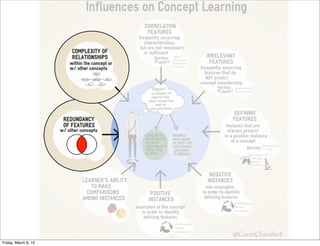
Friday, March 6, 15
OBJECTIVES
1) increase our understanding of ‘concept’ research
as it relates to human cognition, human
development, & teacher practice
2) explore & experience a variety of learning
activities & strategies designed to improve
students’ conceptual understanding
3a) identify which elements of research & practice are
most relevant to your anticipated content area/
teaching situation
3b) articulate when, where, & how you will utilize them
over the next 3 years
Friday, March 6, 15
OBJECTIVES
1) increase our understanding of ‘concept’ research
as it relates to human cognition, human
development, & teacher practice
2) explore & experience a variety of learning
activities & strategies designed to improve
students’ conceptual understanding
3a) identify which elements of research & practice are
most relevant to your anticipated content area/
teaching situation
3b) articulate when, where, & how you will utilize them
over the next 3 years
Friday, March 6, 15
OBJECTIVES
1) increase our understanding of ‘concept’ research
as it relates to human cognition, human
development, & teacher practice
2) explore & experience a variety of learning
activities & strategies designed to improve
students’ conceptual understanding
3a) identify which elements of concept research &
practice are most relevant to your anticipated
content area/teaching situation
3b) articulate when, where, & how you will utilize
them (the identified elements) over the next 3
years
Friday, March 6, 15
My view as a student...
Friday, March 6, 15
My view as a student...___
perspective
Friday, March 6, 15
Friday, March 6, 15
Friday, March 6, 15
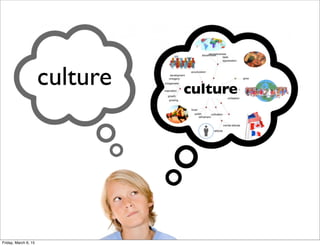
culture
Friday, March 6, 15
culture culture
Friday, March 6, 15
Friday, March 6, 15
Friday, March 6, 15
Friday, March 6, 15
Friday, March 6, 15
Friday, March 6, 15
So what?
Friday, March 6, 15
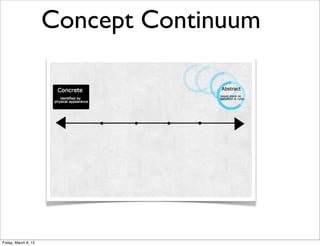
Concept Continuum
Friday, March 6, 15
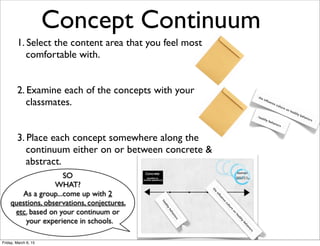
Concept Continuum
1. Select the content area that you feel most
comfortable with.
2. Examine each of the concepts with your
classmates.
3. Place each concept somewhere along the
continuum either on or between concrete/
abstract .
Friday, March 6, 15
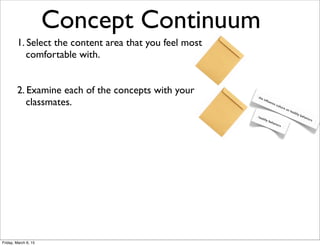
Concept Continuum
1. Select the content area that you feel most
comfortable with.
2. Examine each of the concepts with your
classmates.
3. Place each concept somewhere along the
continuum either on or between concrete/
abstract .
healthy behaviors
the influence culture on healthy behaviors
Friday, March 6, 15
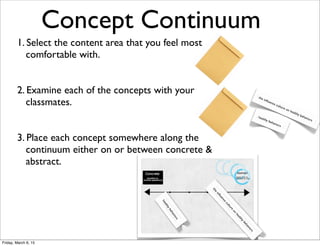
Concept Continuum
1. Select the content area that you feel most
comfortable with.
2. Examine each of the concepts with your
classmates.
3. Place each concept somewhere along the
continuum either on or between concrete &
abstract.
healthy behaviors
the influence culture on healthy behaviors
healthybehaviors
the
influence
culture
on
healthybehaviors
Friday, March 6, 15
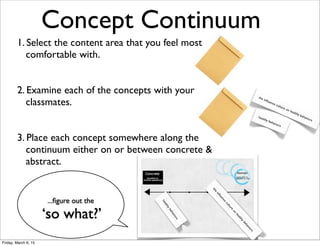
Concept Continuum
1. Select the content area that you feel most
comfortable with.
2. Examine each of the concepts with your
classmates.
3. Place each concept somewhere along the
continuum either on or between concrete &
abstract.
healthy behaviors
the influence culture on healthy behaviors
healthybehaviors
the
influence
culture
on
healthybehaviors
...figure out the
‘so what?’
Friday, March 6, 15
Concept Continuum
1. Select the content area that you feel most
comfortable with.
2. Examine each of the concepts with your
classmates.
3. Place each concept somewhere along the
continuum either on or between concrete &
abstract.
healthy behaviors
the influence culture on healthy behaviors
healthybehaviors
the
influence
culture
on
healthybehaviors
SO
WHAT?
As a group...come up with 2
questions, observations, conjectures,
etc. based on your continuum or
your experience in schools.
Friday, March 6, 15
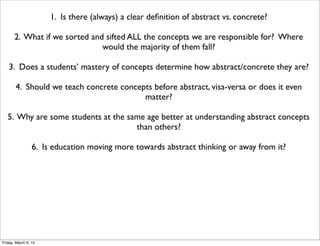
1. Is there (always) a clear definition of abstract vs. concrete?
2. What if we sorted and sifted ALL the concepts we are responsible for? Where
would the majority of them fall?
3. Does a students’ mastery of concepts determine how abstract/concrete they are?
4. Should we teach concrete concepts before abstract, visa-versa or does it even
matter?
5. Why are some students at the same age better at understanding abstract concepts
than others?
6. Is education moving more towards abstract thinking or away from it?
Friday, March 6, 15
Friday, March 6, 15
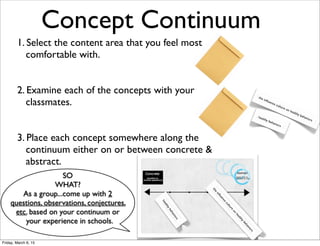
Concept Continuum
1. Select the content area that you feel most
comfortable with.
2. Examine each of the concepts with your
classmates.
3. Place each concept somewhere along the
continuum either on or between concrete &
abstract.
healthy behaviors
the influence culture on healthy behaviors
healthybehaviors
the
influence
culture
on
healthybehaviors
SO
WHAT?
As a group...come up with 2
questions, observations, conjectures,
etc. based on your continuum or
your experience in schools.
Friday, March 6, 15
Friday, March 6, 15
Friday, March 6, 15
Friday, March 6, 15
Friday, March 6, 15
Friday, March 6, 15
Friday, March 6, 15
Friday, March 6, 15
Friday, March 6, 15
Friday, March 6, 15
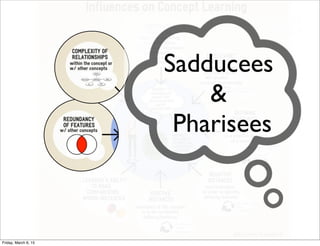
Sadducees
&
Pharisees
Friday, March 6, 15
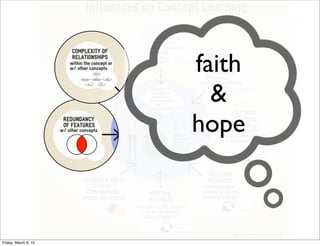
faith
&
hope
Friday, March 6, 15
the Holy Ghost
&
the Light of Christ
Friday, March 6, 15
Friday, March 6, 15
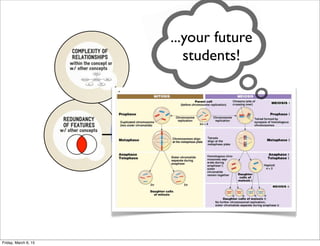
...your future
students!
Friday, March 6, 15
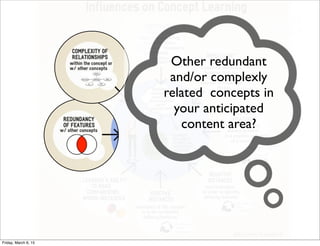
Other redundant
and/or complexly
related concepts in
your anticipated
content area?
Friday, March 6, 15
So what?
Friday, March 6, 15
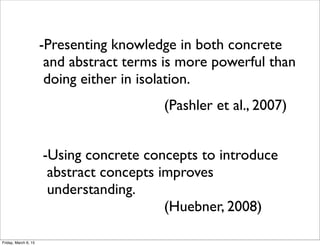
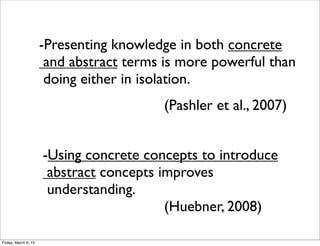
-Using concrete concepts to introduce
abstract concepts improves
understanding.
(Huebner, 2008)
-Presenting knowledge in both concrete
and abstract terms is more powerful than
doing either in isolation.
(Pashler et al., 2007)
Friday, March 6, 15
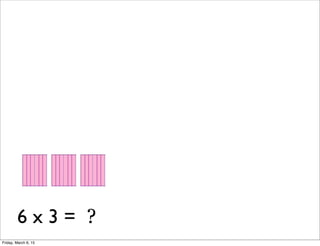
6 x 3 = ?
Friday, March 6, 15
6 x 3 = ?
Friday, March 6, 15
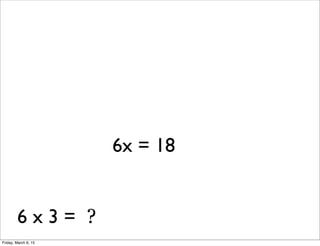
6x = 18
6 x 3 = ?
Friday, March 6, 15
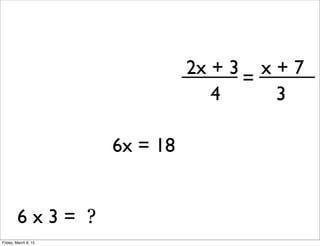
6x = 18
2x + 3 x + 7
4 3
_____ _____
=
6 x 3 = ?
Friday, March 6, 15
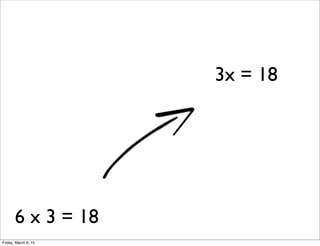
6 x 3 = 18
3x = 18
Friday, March 6, 15
-Using concrete concepts to introduce
abstract concepts improves
understanding.
(Huebner, 2008)
-Presenting knowledge in both concrete
and abstract terms is more powerful than
doing either in isolation.
(Pashler et al., 2007)
Friday, March 6, 15
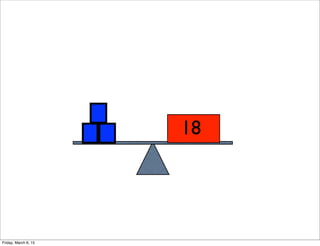
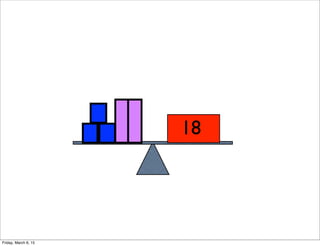
18
Friday, March 6, 15
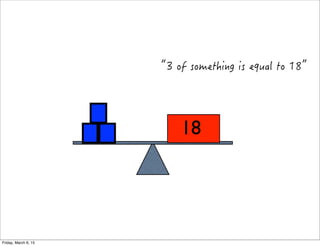
18
Friday, March 6, 15
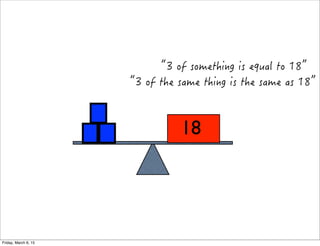
18
Friday, March 6, 15
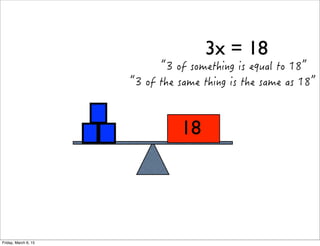
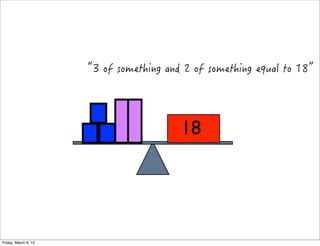
18
3x = 18
Friday, March 6, 15
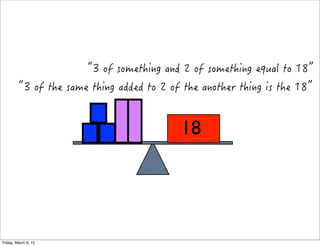
18
Friday, March 6, 15
18
Friday, March 6, 15
18
Friday, March 6, 15
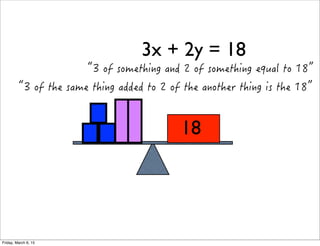
18
3x + 2y = 18
Friday, March 6, 15
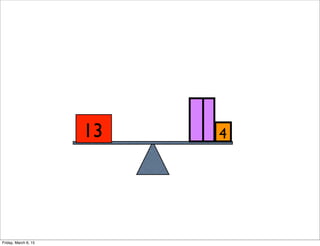
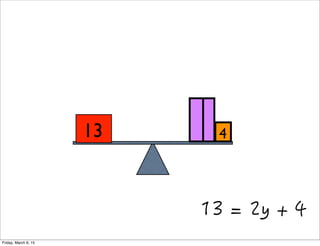
13 4
Friday, March 6, 15
13 4
Friday, March 6, 15
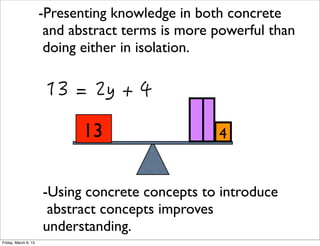
13 4
-Presenting knowledge in both concrete
and abstract terms is more powerful than
doing either in isolation.
-Using concrete concepts to introduce
abstract concepts improves
understanding.
Friday, March 6, 15
Friday, March 6, 15
Friday, March 6, 15
Friday, March 6, 15
Friday, March 6, 15
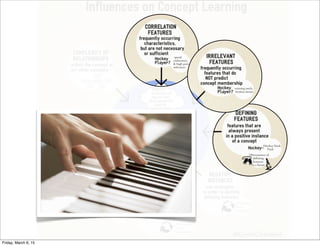
What’s
hockey ?
Friday, March 6, 15
Friday, March 6, 15
Friday, March 6, 15
Friday, March 6, 15
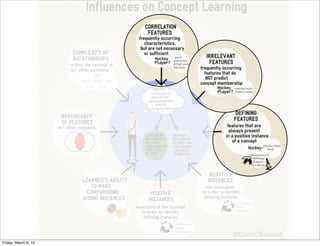
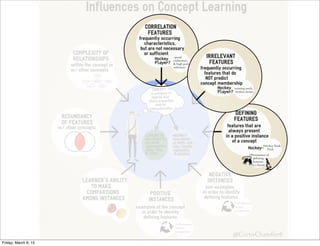
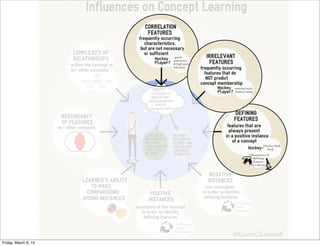
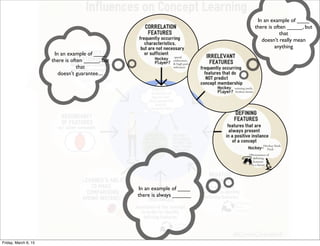
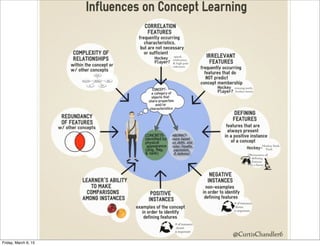
In an example of ____
there is always ______
In an example of ____
there is often _____, but
that
doesn’t really mean
anything
In an example of ____
there is often _____, but
that
doesn’t guarantee....
Friday, March 6, 15
Friday, March 6, 15
So what?
Friday, March 6, 15
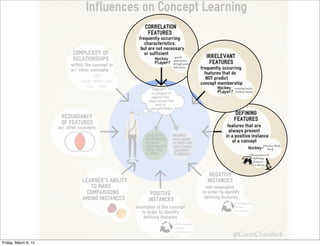
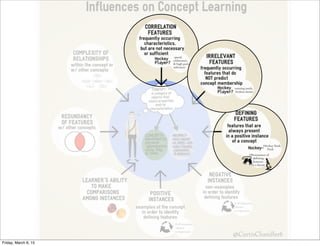
We need to be aware of
the characteristics of
these concepts.
Friday, March 6, 15
Friday, March 6, 15
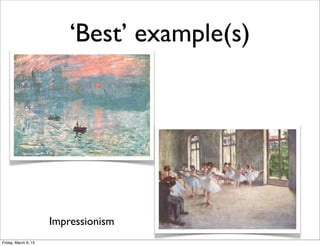
‘Best’ example(s)
Friday, March 6, 15
‘Best’ example(s)
Impressionism
Friday, March 6, 15
Friday, March 6, 15
Friday, March 6, 15
Friday, March 6, 15
Friday, March 6, 15
Friday, March 6, 15
Yes
Friday, March 6, 15
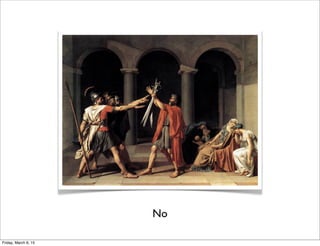
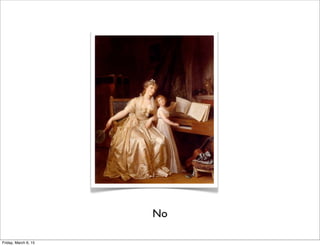
No
Friday, March 6, 15
Yes
Friday, March 6, 15
No
Friday, March 6, 15
Yes
Friday, March 6, 15
Friday, March 6, 15
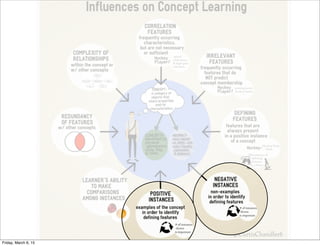
Concept Attainment
Strategy
(Bruner, Goodnow, & Austin, 1956)
Friday, March 6, 15
Concept Attainment
Strategy
(Bruner, Goodnow, & Austin, 1956)
Friday, March 6, 15
Concept Attainment
Strategy
(Bruner, Goodnow, & Austin, 1956)
- akin to inductive thinking
- focusses on decision-making,
categorization, & creation
Friday, March 6, 15
Concept Attainment
Strategy
1. word sort
2. sample scenario/case study
3. introduction of term/concept
4. students create a definition
Jodi & Shara (Los Angeles)2015-
@21centuryteachr
Friday, March 6, 15
Concept Attainment
Strategy
1. word sort
2. sample scenario/case study
3. introduction of term/concept
4. students create a definition
Jodi & Shara (Los Angeles)2015-
@21centuryteachr
Friday, March 6, 15
Concept Attainment
Strategy
1. word sort
2. sample scenario/case study
3. introduction of term/concept
4. students create a definition
Jodi & Shara (Los Angeles)2015-
@21centuryteachr
Friday, March 6, 15
Concept Attainment
Strategy
1. word sort
2. sample scenario/case study
3. introduction of term/concept
4. students create a definition
Jodi & Shara (Los Angeles)2015-
@21centuryteachr
Friday, March 6, 15
Concept Attainment
Strategy
1. word sort
2. sample scenario/case study
3. introduction of term/concept
4. students create a definition
Jodi & Shara (Los Angeles)2015-
@21centuryteachr
Friday, March 6, 15
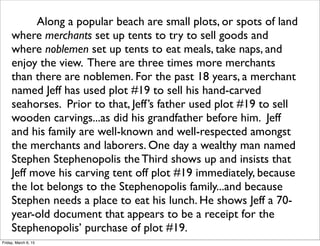
Along a popular beach are small plots, or spots of land
where merchants set up tents to try to sell goods and
where noblemen set up tents to eat meals, take naps, and
enjoy the view. There are three times more merchants
than there are noblemen. For the past 18 years, a merchant
named Jeff has used plot #19 to sell his hand-carved
seahorses. Prior to that, Jeff’s father used plot #19 to sell
wooden carvings...as did his grandfather before him. Jeff
and his family are well-known and well-respected amongst
the merchants and laborers. One day a wealthy man named
Stephen Stephenopolis the Third shows up and insists that
Jeff move his carving tent off plot #19 immediately, because
the lot belongs to the Stephenopolis family...and because
Stephen needs a place to eat his lunch. He shows Jeff a 70-
year-old document that appears to be a receipt for the
Stephenopolis’ purchase of plot #19.
Friday, March 6, 15
Concept Attainment
Strategy
1. word sort
2. sample scenario/case study
3. introduction of term/concept
4. students create a definition
Jodi & Shara (Los Angeles)2015-
@21centuryteachr
Friday, March 6, 15
Concept Attainment
Strategy
1. word sort
2. sample scenario/case study
3. introduction of term/concept
4. students create a definition
Jodi & Shara (Los Angeles)2015-
@21centuryteachr
Friday, March 6, 15
Why does
this work?
Friday, March 6, 15
-This results in deep learning because it is
the way that human beings instinctively learn.
(Silver, Strong, & Perini, 2007; Marzano, Pickering, & Pollock, 2001)
-As we experience the world, we naturally
organize things into categories based on
common attributes.
-Identifying similarities and differences and
differences and generating/testing hypotheses
result in significant gains in student learning.
Friday, March 6, 15
-This results in deep learning because it is
the way that human beings instinctively learn.
(Silver, Strong, & Perini, 2007; Marzano, Pickering, & Pollock, 2001)
-As we experience the world, we naturally
organize things into categories based on
common attributes.
-Identifying similarities and differences and
differences and generating/testing hypotheses
result in significant gains in student learning.
Friday, March 6, 15
-This results in deep learning because it is
the way that human beings instinctively learn.
(Silver, Strong, & Perini, 2007; Marzano, Pickering, & Pollock, 2001)
-As we experience the world, we naturally
organize things into categories based on
common attributes.
-Identifying similarities/differences and generating/
testing hypotheses are among the most effective
learning strategies
Friday, March 6, 15
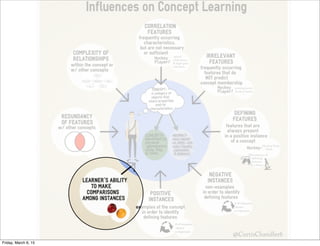
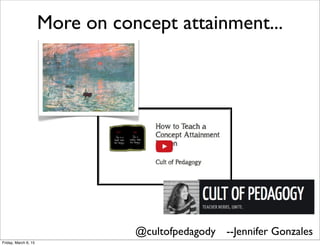
More on concept attainment...
@cultofpedagody --Jennifer Gonzales
Friday, March 6, 15
Friday, March 6, 15
Friday, March 6, 15
Friday, March 6, 15
Friday, March 6, 15
Friday, March 6, 15
Friday, March 6, 15
Friday, March 6, 15
“ Sport?”
Friday, March 6, 15
“ Sport? ”
Friday, March 6, 15
Friday, March 6, 15
Friday, March 6, 15
Friday, March 6, 15
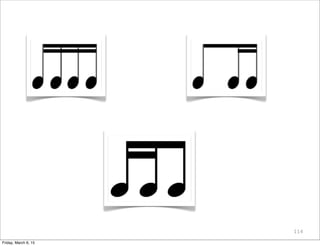
114
Friday, March 6, 15
Friday, March 6, 15
116
Friday, March 6, 15
Friday, March 6, 15
Friday, March 6, 15
Friday, March 6, 15
Friday, March 6, 15
Friday, March 6, 15
Friday, March 6, 15
123
Friday, March 6, 15
Friday, March 6, 15
So what?
Friday, March 6, 15
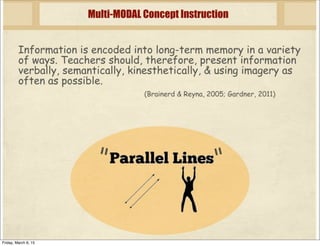
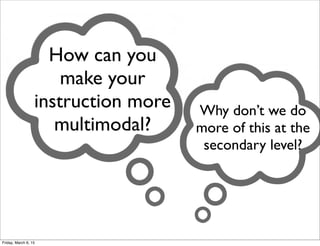
How can you
make your
instruction more
multimodal?
Why don’t we do
more of this at the
secondary level?
Friday, March 6, 15
Friday, March 6, 15
Friday, March 6, 15
lugubrious
antithesis
copious
capitulate
dubious
sanguine
accolade
archaic
matriculate
enigma
nefarious
prodigious
Friday, March 6, 15
lugubrious
antithesis
copious
capitulate
dubious
sanguine
accolade
archaic
matriculate
enigma
nefarious
prodigious
Friday, March 6, 15
lugubrious
antithesis
copious
capitulate
dubious
sanguine
accolade
archaic
matriculate
enigma
nefarious
prodigious
Friday, March 6, 15
lugubrious
antithesis
copious
capitulate
dubious
sanguine
accolade
archaic
matriculate
enigma
nefarious
prodigious
Friday, March 6, 15
Thoughts?
Friday, March 6, 15
Thoughts?
Friday, March 6, 15
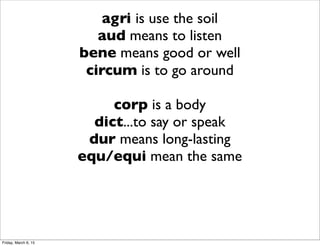
agri is use the soil
aud means to listen
bene means good or well
circum is to go around
corp is a body
dict...to say or speak
dur means long-lasting
equ/equi mean the same
Friday, March 6, 15
How can you
make your
instruction more
multimodal?
Why don’t we do
more of this at the
secondary level?
Friday, March 6, 15
Friday, March 6, 15
Friday, March 6, 15
Friday, March 6, 15
Friday, March 6, 15
OBJECTIVES
1) increase our understanding of ‘concept’ research
as it relates to human cognition, human
development, & teacher practice
2) explore & experience a variety of learning
activities & strategies designed to improve
students’ conceptual understanding
3a) identify which elements of concept research &
practice are most relevant to your anticipated
content area/teaching situation
3b) articulate when, where, & how you will utilize
them (the identified elements) over the next 3
years
Friday, March 6, 15
1) increase our understanding of ‘concept’ research
as it relates to human cognition, human
development, & teacher practice
2) explore & experience a variety of learning
activities & strategies designed to improve
students’ conceptual understanding
3a) identify which elements of concept research &
practice are most relevant to your anticipated
content area/teaching situation
3b) articulate when, where, & how you will utilize
them (the identified elements) over the next 3
years
http://padlet.com/curtisc/concept
Friday, March 6, 15
1) increase our understanding of ‘concept’ research
as it relates to human cognition, human
development, & teacher practice
2) explore & experience a variety of learning
activities & strategies designed to improve
students’ conceptual understanding
3a) identify which elements of concept research &
practice are most relevant to your anticipated
content area/teaching situation
3b) articulate when, where, & how you will utilize
them (the identified elements) over the next 3
years
http://padlet.com/curtisc/concept
Back up plan-- email me at
curtisc@essdack.org
Friday, March 6, 15
Friday, March 6, 15
Friday, March 6, 15
1) increase our understanding of ‘concept’ research
as it relates to human cognition, human
development, & teacher practice
2) explore & experience a variety of learning
activities & strategies designed to improve
students’ conceptual understanding
3a) identify which elements of concept research &
practice are most relevant to your anticipated
content area/teaching situation
3b) articulate when, where, & how you will utilize
them (the identified elements) over the next 3
years
http://padlet.com/curtisc/concept
Back up plan-- email me at
curtisc@essdack.org
Friday, March 6, 15

BYU Idaho Helping Students Develop Conceptual Understanding