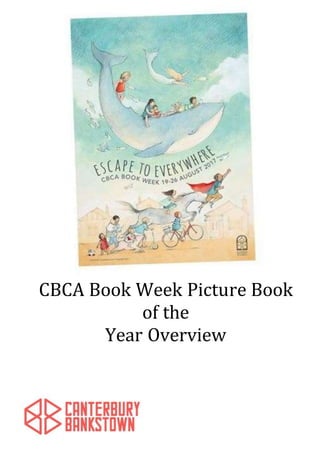
CBCA Book Week Picture Book
of the
Year Overview
One Photo
by Ross Watkins and Liz Anelli
NOTE: Educators are advised to be mindful of students’ individual circumstances when commencing this
unit of study. Students could also encounter distressing information and images in their research—
educators should closely supervise any research and possibly curate image and video collections for
students to study.
First Impressions
Why the film camera over a digital camera?
- What he remembers?
- The perceived permanence of film over digital
- A photo meant something in film, had worth rather than a digital image clicked in a second, shared
in a second for free and then it’s gone (forgotten)
End pages
Front end pages have the classical photographs of family and friends at important events
Back end pages have the images from the book, the everyday images that the father of the story
founds surprising and worth keeping.
Surprisingly everyday images
Film Ideas
- how many kids would these days would have used a film camera or even seen film? Get a hold of
processed film to share with the group, note that the image is reversed, that it is a physical thing
(as opposed to digital)
- talk about the permanence of this media over digital and not being dependent on technology to
gain access to the information (you can see what a negative has on it with your own eyes though it
may be very small and reversed)
- how is this like or unlike human memory? Once the mechanism to read the information is broken
(the brain) our memories are as inaccessible as digital images in a broken phone or digital camera
Activities Ideas
- cheap digital cameras out to the group. Ask them to take photos of the everyday that they find
surprising. Print out many of the images for a display
- images from home or from local studies collection for a display. What makes an image important?
Teachers’ Notes
http://www.lamontbooks.com.au/media/71046/september-2016-ps-one-photo.pdf
Video
https://www.youtube.com/watch?v=9k3Mq0WP25I
The Patchwork Bike
by Maxine Benebe Clarke and Van T Rudd
First Impressions
Images of poverty in a semi urban area:
o painted onto corrugated cardboard (boxes)
o fiori tree - flower tree (Italian)
o Desert – no-go desert? dangerous
o Village
o Mud-for-walls home
o Sand hill they built
o Broken police car is a toy
o Fed-up Mother in white full body wraps – white is a mourning colour??
- Evokoing images of somewhere else (Africa) but right now
- Family
- Brothers having fun together and sharing their patchwork bike (last double spread). The best
time though things around them aren’t so good
End pages
Corregated cardboard painted with streaks of colour we come to associate with the Patchwork bike
moving fast (used throughout)
Language Use
- No-go desert
- Stretching-out sky
- Fed-up mum
- Mud-for-walls
- Me and my brothers’ bike – highlighting their shared bike. Not ‘our’ or ‘the’.
- Wood-cut
- Shicketty shake, Winketty wonk, Bumpetty bump: alliteration describing movement and sound
- Glide right through our mud-for –walls home
-
Activities Ideas
- Try reading with and without pictures. Different impressions of story?
- Recycling materials, found objects to make new toys
- Painting pictures of everyday life on cardboard boxes. What does that tell us about this sort of
life? (poor, cheap, transitory)
- Pictures of bicycles cut up and spread around the space for children to find in a treasure hunt.
Can be made a team activity by having different coloured bicycle pieces, the first team to complete
their bike (all the same colour) the winners.
Teachers’ Notes
http://www.lamontbooks.com.au/media/68219/july-2016-ps-my-brother.pdf
Video
https://www.youtube.com/watch?v=l7v9FC4vSdA
Home in the Rain
by Bob Graham
First Impressions
- John Updike quote about rain being grace, from Self-Consciousness: Memoirs (1989)
- “A1 Francie’s House” Highway sign
- Petrol station called HOPe
- Cyclist pulling the boat trailer
- Family and belonging. Names
- Again looking at a moment in time through many people’s experiences as with Silver Buttons
Language:
- “It rocked them in road spray and washed them up into the picnic area.”
- People and animals in this one place dealing and benefitting from the rain.
- After talking about an accident, “And not looking where it was going, the countryside ran straight
into the edge of the highway.”
- Baby sister mentioned as a person in the car though not actually born yet
Activities /Ideas
- What’s in a name? What does your name mean? Is it special in your family? Who picked it? Look
up baby name books and write the name and meaning onto a display.
- Grace can also mean gift. Why would rain be seen as a gift? Why would a baby?
- Weather. Lots of people and animals just have to get by in the rain. What do people do in
different kinds of weather match up game e.g. Windy, fly kites, go sailing; Sunny, go to the beach;
Snowy, ski
- Car games e.g. I spy (with my little eye), Punch bugs, counting red cars, number plate games etc…
- Map reading skills.
Teachers’ Notes
http://www.lamontbooks.com.au/media/81855/october-2016-ps-home-in-the-rain.pdf
Mechanica
by Lance Balchin
First Impressions
https://www.mechanica.com.au/a-brief-history
- Premise: a post-apocalyptic world that has lost all animals. Drones built for war ‘escape’ into the
wild while Mechanica built as pets also escape and “breed’ with wild drones. Mechanic and future
book Aquatic are field guilds to the mechanical creatures that are found in the wild.
- Sampled images from animals and from machinery, collaged together
- OS program that uses the same sampling to allow the creation of collages in the style of the book
Activities /Idea
- Children can use images from old nature and car (mechanical)magazines to create their own
Mechanica
- Use the parts provided in OS Mechanica to create a library beast that can go on display. See how
many of the parts children can identify from machinery and animals.
Teachers Notes
https://www.mechanica.com.au/os-mechanica-teachers
Video
https://www.youtube.com/watch?v=YYO9u3Em9-8
My Brother
by Dee, Oliver and Tiffany Huxley
NOTE: Educators are advised to be mindful of students’ individual circumstances when commencing this
unit of study. Students could also encounter distressing information and images in their research—
educators should closely supervise any research and possibly curate image and video collections for
students to study.
First Impressions
- Close personal loss – used and unused items in first picture
- Interesting use of space in words “l o s t” or “I need to find him”
- Birds and duck? What do they mean?: depression
- Walking donkey animation? Mood of character? Continuing journey of searcher.
- Brother appearing at the lowest moment just before the realization (he is always with me)
Nursery Rhymes
- Sing a song of sixpence “Four and twenty black birds”
- Owl and the Pussycat
- Hickory Dickory Dock
- Hey Diddle Diddle
- Warm colours of remembering
- Full colour last page with realization and acceptance
http://www.smh.com.au/good-weekend/the-brutal-
murder-of-businessman-morgan-huxley-drew-
feverish-headlines-that-bore-no-resemblance-to-the-
real-person-how-did-his-family-cope-20170405-
gve24t.html
Activities/ Ideas
- Not recommended for groups as you can’t know
the effect the book will have on each child in a group
and you can’t be there to help but very useful one on
one with a child suffering from loss
- Teachers’ Notes suggest grief support
information from Kids Matter(see below)
- Group discussion on front cover to show how
Dee Huxley conveys the loss of a brother in the picture.
The duck that follows the creature? (shared journey,
you are not alone)
- Recommend staff read the news article of the
murder and the family’s loss to discover how their
experiences have influenced the creation of this
book
-
Teachers’ Notes
http://www.workingtitlepress.com.au/teachers_notes/Teacher%20Notes%20My%20Brother%20Re
vised.pdf
Out
by Angela May George and Owen Swan
NOTE: Educators are advised to be mindful of students’ individual circumstances when commencing this
unit of study. Students could also encounter distressing information and images in their research—
educators should closely supervise any research and possibly curate image and video collections for
students to study.
First Impressions
- Yellow string (ribbon) identifies the girl (narrator) in all images as well as being a reminder of the
memories she carries
- Soft sketches, almost memories
End pages and Cover
- Cover two characters in colour from above an overcrowded ship
- Worn and water stained. Travelled far or hard.
- Yellow string writing the title
Language
- Why “Out?”
- “ I am called an asylum seeker, but that’s not my name.”
- “Brave is waiting and believing in your heart that everything will be okay.”
- “…My dad.”
Activities/ Ideas
- “ I am called an asylum seeker, but that’s not my name.” Though we never find out the girls name.
Why is that important? (She could come from anywhere) Other phrases besides Asylum Seekers
are used (boat people, refugees, illegal immigrants)
- Cover: Where have we seen images like this before (news) What do you think “Out” means in this
context.
- The yellow ribbon runs through the whole story. In the western world, a yellow ribbon (like
yellow roses) is a symbol of rememberance. How does that inform us about images of her at
school, dancing or riding in the car (memories of how things are different, memories of what
happened always with her and changes the way she thinks about things
Teachers’ Notes
http://resource.scholastic.com.au/resourceFiles/Teacher_Notes/8410573_57333.pdf
Thanks to:
Alison Coutinho
Ana-Margerida Moreira
Anne Sullivan
Ben Yorugao
Elizabeth Luchjenbroers
Tara Cordina

Bwf2017 picturebook

  • 1.
    CBCA Book WeekPicture Book of the Year Overview
  • 2.
    One Photo by RossWatkins and Liz Anelli NOTE: Educators are advised to be mindful of students’ individual circumstances when commencing this unit of study. Students could also encounter distressing information and images in their research— educators should closely supervise any research and possibly curate image and video collections for students to study. First Impressions Why the film camera over a digital camera? - What he remembers? - The perceived permanence of film over digital - A photo meant something in film, had worth rather than a digital image clicked in a second, shared in a second for free and then it’s gone (forgotten) End pages Front end pages have the classical photographs of family and friends at important events Back end pages have the images from the book, the everyday images that the father of the story founds surprising and worth keeping. Surprisingly everyday images Film Ideas - how many kids would these days would have used a film camera or even seen film? Get a hold of processed film to share with the group, note that the image is reversed, that it is a physical thing (as opposed to digital) - talk about the permanence of this media over digital and not being dependent on technology to gain access to the information (you can see what a negative has on it with your own eyes though it may be very small and reversed) - how is this like or unlike human memory? Once the mechanism to read the information is broken (the brain) our memories are as inaccessible as digital images in a broken phone or digital camera Activities Ideas - cheap digital cameras out to the group. Ask them to take photos of the everyday that they find surprising. Print out many of the images for a display - images from home or from local studies collection for a display. What makes an image important?
  • 3.
  • 4.
    The Patchwork Bike byMaxine Benebe Clarke and Van T Rudd First Impressions Images of poverty in a semi urban area: o painted onto corrugated cardboard (boxes) o fiori tree - flower tree (Italian) o Desert – no-go desert? dangerous o Village o Mud-for-walls home o Sand hill they built o Broken police car is a toy o Fed-up Mother in white full body wraps – white is a mourning colour?? - Evokoing images of somewhere else (Africa) but right now - Family - Brothers having fun together and sharing their patchwork bike (last double spread). The best time though things around them aren’t so good End pages Corregated cardboard painted with streaks of colour we come to associate with the Patchwork bike moving fast (used throughout) Language Use - No-go desert - Stretching-out sky - Fed-up mum - Mud-for-walls - Me and my brothers’ bike – highlighting their shared bike. Not ‘our’ or ‘the’. - Wood-cut - Shicketty shake, Winketty wonk, Bumpetty bump: alliteration describing movement and sound - Glide right through our mud-for –walls home - Activities Ideas - Try reading with and without pictures. Different impressions of story? - Recycling materials, found objects to make new toys - Painting pictures of everyday life on cardboard boxes. What does that tell us about this sort of life? (poor, cheap, transitory) - Pictures of bicycles cut up and spread around the space for children to find in a treasure hunt. Can be made a team activity by having different coloured bicycle pieces, the first team to complete their bike (all the same colour) the winners. Teachers’ Notes
  • 5.
  • 6.
    Home in theRain by Bob Graham First Impressions - John Updike quote about rain being grace, from Self-Consciousness: Memoirs (1989) - “A1 Francie’s House” Highway sign - Petrol station called HOPe - Cyclist pulling the boat trailer - Family and belonging. Names - Again looking at a moment in time through many people’s experiences as with Silver Buttons Language: - “It rocked them in road spray and washed them up into the picnic area.” - People and animals in this one place dealing and benefitting from the rain. - After talking about an accident, “And not looking where it was going, the countryside ran straight into the edge of the highway.” - Baby sister mentioned as a person in the car though not actually born yet Activities /Ideas - What’s in a name? What does your name mean? Is it special in your family? Who picked it? Look up baby name books and write the name and meaning onto a display. - Grace can also mean gift. Why would rain be seen as a gift? Why would a baby? - Weather. Lots of people and animals just have to get by in the rain. What do people do in different kinds of weather match up game e.g. Windy, fly kites, go sailing; Sunny, go to the beach; Snowy, ski - Car games e.g. I spy (with my little eye), Punch bugs, counting red cars, number plate games etc… - Map reading skills. Teachers’ Notes http://www.lamontbooks.com.au/media/81855/october-2016-ps-home-in-the-rain.pdf
  • 7.
    Mechanica by Lance Balchin FirstImpressions https://www.mechanica.com.au/a-brief-history - Premise: a post-apocalyptic world that has lost all animals. Drones built for war ‘escape’ into the wild while Mechanica built as pets also escape and “breed’ with wild drones. Mechanic and future book Aquatic are field guilds to the mechanical creatures that are found in the wild. - Sampled images from animals and from machinery, collaged together - OS program that uses the same sampling to allow the creation of collages in the style of the book Activities /Idea - Children can use images from old nature and car (mechanical)magazines to create their own Mechanica - Use the parts provided in OS Mechanica to create a library beast that can go on display. See how many of the parts children can identify from machinery and animals. Teachers Notes https://www.mechanica.com.au/os-mechanica-teachers Video https://www.youtube.com/watch?v=YYO9u3Em9-8
  • 8.
    My Brother by Dee,Oliver and Tiffany Huxley NOTE: Educators are advised to be mindful of students’ individual circumstances when commencing this unit of study. Students could also encounter distressing information and images in their research— educators should closely supervise any research and possibly curate image and video collections for students to study. First Impressions - Close personal loss – used and unused items in first picture - Interesting use of space in words “l o s t” or “I need to find him” - Birds and duck? What do they mean?: depression - Walking donkey animation? Mood of character? Continuing journey of searcher. - Brother appearing at the lowest moment just before the realization (he is always with me) Nursery Rhymes - Sing a song of sixpence “Four and twenty black birds” - Owl and the Pussycat - Hickory Dickory Dock - Hey Diddle Diddle - Warm colours of remembering - Full colour last page with realization and acceptance http://www.smh.com.au/good-weekend/the-brutal- murder-of-businessman-morgan-huxley-drew- feverish-headlines-that-bore-no-resemblance-to-the- real-person-how-did-his-family-cope-20170405- gve24t.html Activities/ Ideas - Not recommended for groups as you can’t know the effect the book will have on each child in a group and you can’t be there to help but very useful one on one with a child suffering from loss - Teachers’ Notes suggest grief support information from Kids Matter(see below) - Group discussion on front cover to show how Dee Huxley conveys the loss of a brother in the picture. The duck that follows the creature? (shared journey, you are not alone) - Recommend staff read the news article of the murder and the family’s loss to discover how their experiences have influenced the creation of this book -
  • 9.
  • 10.
    Out by Angela MayGeorge and Owen Swan NOTE: Educators are advised to be mindful of students’ individual circumstances when commencing this unit of study. Students could also encounter distressing information and images in their research— educators should closely supervise any research and possibly curate image and video collections for students to study. First Impressions - Yellow string (ribbon) identifies the girl (narrator) in all images as well as being a reminder of the memories she carries - Soft sketches, almost memories End pages and Cover - Cover two characters in colour from above an overcrowded ship - Worn and water stained. Travelled far or hard. - Yellow string writing the title Language - Why “Out?” - “ I am called an asylum seeker, but that’s not my name.” - “Brave is waiting and believing in your heart that everything will be okay.” - “…My dad.” Activities/ Ideas - “ I am called an asylum seeker, but that’s not my name.” Though we never find out the girls name. Why is that important? (She could come from anywhere) Other phrases besides Asylum Seekers are used (boat people, refugees, illegal immigrants) - Cover: Where have we seen images like this before (news) What do you think “Out” means in this context. - The yellow ribbon runs through the whole story. In the western world, a yellow ribbon (like yellow roses) is a symbol of rememberance. How does that inform us about images of her at school, dancing or riding in the car (memories of how things are different, memories of what happened always with her and changes the way she thinks about things Teachers’ Notes http://resource.scholastic.com.au/resourceFiles/Teacher_Notes/8410573_57333.pdf
  • 11.
    Thanks to: Alison Coutinho Ana-MargeridaMoreira Anne Sullivan Ben Yorugao Elizabeth Luchjenbroers Tara Cordina