TRUSTS
TRUSTS: 
A LEGACY OR A 
LIABILITY AND WHAT 
ABOUT THE 
ADMINISTRATION?
BENEFITS OF A TRUST 
• Ensures the smooth handover of assets from 
one generation to the next. 
• Cares for assets for those who are unable to 
look after the assets themselves i.e. minors and 
elderly battling with dementia. Alternative to 
the Guardians Fund. 
• Donations tax. 
 If a natural person makes a donation greater than 
R100k then donations tax at 20%. A distribution from 
a trust attracts no donations tax.
BENEFITS OF A TRUST 
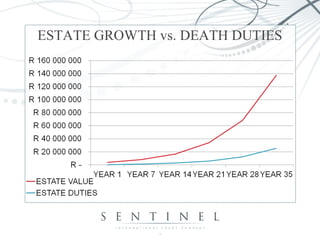
• Reduction of death duties which are made 
up of :- 
– Deemed Capital Gains Tax – max 13.3%. 
– Executor fees – max 3.99%. 
– Estate duty tax – 20% . 
• Ability to split income and capital gains to 
multiple beneficiaries to reduce income tax. 
• Possible protection of assets from creditors.
ESTATE GROWTH vs. DEATH DUTIES
DISADVANTAGES OF A TRUST 
• In order for a valid trust to come into existence the 
donor must hand over ownership and control to 
the trustees. 
• The trustees become owners of the asset. 
• Decision making is now made in terms of the deed 
and not by 1 trustee i.e. the original donor. 
• Costs: Banks normally charge between 1 – 2% of 
capital to act as trustees plus 6% on income 
collected.
TRUST DEED AND ADMINISTRATION
TRUST DEED 
1. The Deed of Trust is the trustees’ constitution and if 
a responsibility, duty or power is not expressly stated 
then it cannot be implied by the trustees. The 
trustees have no authority to ‘assume’ that they may 
carry out a particular duty or power and if they do so 
then they are acting ultra vires. 
2. It is a dynamic document that must be reviewed 
regularly. Tax and trust laws change! 
3. Experience has shown that at least 9 out of 10 trusts 
either have wrong clauses or are missing clauses.
SUMMARY OF PROBLEM CLAUSES 
1. Key terms used throughout the trust deed are not 
adequately defined or are incorrectly worded. 
2. Incorrect Beneficiaries. 
3. Mistakes dealing with the power and authority of 
trustees. 
4. Insufficient clarity when dealing with administrative 
matters. 
5. Manner in which income and capital are allocated. 
6. Termination date of trust. Pre-emptorary clauses. 
7. Control clauses granted to one trustee.
IMPROPER MANAGEMENT OF TRUST 
1. Requirements as laid down in the Trust Deed are 
not complied with by the Trustees. 
2. All the Trustees are not fulfilling their fiduciary 
responsibilities. 
1. Ensuring property is adequately insured. 
2. Determining the correct risk profile. 
3. Determining the asset allocation to match the income 
requirements of the Beneficiaries. 
3. Trust income is paid directly to a Trustee / 
Beneficiary and not into the Trust bank account.
IMPROPER MANAGEMENT OF TRUST 
4. Trustee meetings are not held. 
5. Trustee /s never attend meetings. 
6. Trust transactions are not recorded through 
minutes or resolutions. 
7. Annual Financial Statements are not prepared. 
8. Trust income / capital gains are not treated in the 
most efficient manner. 
9. Testator / testatrix Wills are not synchronized 
with the trust.
MYTHS & LEGENDS #1 
SARS will use section 3(3)(d) to 
deem assets to form part of your 
estate!
MYTHS & LEGENDS #1 
By Default this section can only 
be applied on death as it forms 
part of the Estate Duty Act and 
not the Income Tax Act! SARS 
cannot use it during your 
lifetime.
MYTHS & LEGENDS #1 
Section 3(3)(d) states: 
Property which is deemed to be property of the deceased 
includes — 
property (being property not otherwise chargeable under this 
Act or the full value of which is not otherwise required to be 
taken into account in the determination of the dutiable 
amount of the estate) of which the deceased was immediately 
prior to his death competent to dispose for his own benefit or for 
the benefit of his estate.
MYTHS & LEGENDS #1 
For purposes of paragraph (d) of subsection (3)— 
(a) the term “property” shall be deemed to include the profits of any 
property; 
(b) a person shall be deemed to have been competent to dispose of any 
property— 
(i) if he had such power as would have enabled him, if he were sui 
juris, to appropriate or dispose of such property as he saw fit 
whether exercisable by will, power of appointment or in any 
other manner; 
(ii) if under any deed of donation, settlement, trust or other 
disposition made by him he retained the power to revoke or 
vary the provisions thereof relating to such property;
MYTHS & LEGENDS #1 
“Alter ego” = Control 
• 2 Test for control: 
1. Control is given to a specific person in the trust deed. 
Stipulations in the deed can establish de jure control. 
2. Check the facts whether, irrespective of the stipulations of 
the trust deed, a trustee has exercised / abused his / her 
powers on his / her own and ignored the rest of the trustees 
and the trust deed. These surrounding facts will determine 
de facto control. (This is the most common)
MYTHS & LEGENDS #1 
First stage of test for control: 
1. First check the powers to control in the trust deed 
e.g.: 
• Sole trusteeships, 
• Veto rights especially positive veto rights, 
• Sole right to appoint and dismiss co-trustees, 
• Sole right to amend trust deed i.e. 
“testamentary reservation”.
MYTHS & LEGENDS #1 
• These reserved powers, on their own, may not be 
conclusive to establish control on the part of an individual. 
Simply because the trust deed contains certain powers to 
control being bestowed on one person is not indicative of 
whether those powers have indeed been used or abused. 
• There can even be no stipulation in the deed reserving 
control power in the hands of one person but the conduct 
of one individual may reveal an abuse of power and 
control. 
For this abuse of power the person’s conduct has to be 
checked in the 2nd tier of the test (i.e. for de facto 
control).
MYTHS & LEGENDS #1 
2. The second stage of the test is the important de facto 
control check for a party’s conduct during the 
existence of the trust. A trustee may actually abuse 
his position as a trustee even in a trust deed which, 
on its face value, may appear to be “clean” of any 
specific powers of control granted/reserved for one 
person.
MYTHS & LEGENDS #1 
In Badenhorst v Badenhorst 2006 2 SA 255 (SCA) 
(Delivered on 29/11/05) Combrinck AJA held the 
following on the two tier test for control: 
“That control would have to be de facto and not 
necessarily de jure, and to determine whether a party 
had such control it was necessary to first have a regard 
to the terms of the trust deed and to consider how the 
affairs of the trust were conducted during the marriage”.
MYTHS & LEGENDS #2 
Trusts ALWAYS pay Income Tax at 40% and 
Capital Gains Tax at 26.6%!
MYTHS & LEGENDS #2 
• Section 25B & paragraph 80(2); 
• Income / capital gains are distributed to the 
beneficiaries and are taxed in their hands at 
their tax rates. Income and capital gains 
retain their identity. Trust is ignored for tax. 
• Opportunities through distribution i.e. 
university fees for children and school fees 
for grandchildren.
MYTHS & LEGENDS #2 
• Section 7(8) & paragraph 70; 
• Attribution of income and capital gains to the 
Lendor. Income and capital gains retain their 
identity. 
• To the extent that the trust has benefitted from the 
interest-free loan the income and/or capital gains 
is deemed to belong to the Lendor. 
• Income and / or capital gains is taxed at natural 
persons rates with no impact on loan account. 
• Attribution MUST be applied! Not an option.
MYTHS & LEGENDS #3 
Loan must attract interest!
MYTHS & LEGENDS #3 
Decision of Commissioner, South African Revenue 
Services v Brummeria Renaissance (Pty) Ltd and Others 
2007 (6) SA 601 (SCA) 
• Only if there is a quid pro quo relationship 
between the lender and the borrower. 
•Reason is the right to retain and use loan capital 
on an interest-free basis constitutes a right 
which has an ascertainable money value which 
accrues to the borrower.
MYTHS & LEGENDS #4 
Independent trustee must be a professional!
MYTHS & LEGENDS #4 
Post the decision in the Land and Agricultural Bank 
of South Africa v Parker 2005 2 SA 77 (SCA) the 
Master has to insist on the appointment of an 
‘independent trustee’ in situations where all the 
beneficiaries are related and some or all of them are 
also the only trustees. This independent outsider can 
be a person related to the other trustees, provided 
that such person is not a beneficiary to the trust. In 
terms of Cameron’s judgement in the above 
mentioned case the independent outsider;
MYTHS & LEGENDS #4 
“does not have to be a professional person, such as an 
attorney or accountant, but someone who with proper 
realisation of the responsibilities of trusteeship 
accepts office in order to ensure that the trust 
functions properly, that the provisions of the trust deed 
are observed, and that the conduct of the trustees who 
lack a sufficiently independent interest in the 
observance of substantive and procedural 
requirements arising from the trust deed can be 
scrutinised and checked”.
ROLE OF INDEPENDENT TRUSTEE 
• As mentioned it is now required after 
decision of Land & Agricultural Bank v 
Parker. 
• Shouldn’t just appear in name. 
• Must be party to all decisions and should 
attend all trustee meetings. 
• His/her conduct could show if the trust is a 
bona fide trust or a sham.
TRUSTS AND YOUR WILL 
• Don’t take it for granted that you can 
automatically bequeath assets to your IV trust. If 
the definition of beneficiaries are too wide the 
bequest could fail Braun v Blann & Botha. 
• Nominating a replacement trustee. 
• Great opportunity to transfer fixed property as 
there are no transfer duties. 
• Section 9(4) of the transfer duty act.
Inter Vivos Trusts 
Conclusion 
– Ensure that one of the trustees is independent. 
– Ensure that your trust deed is “compliant” with 
current legislation and case law. 
– Ensure that all the statutory requirements are 
complied with i.e. trustee meetings, minutes of 
all decisions etc. 
– Ensure your will “compliments” your trust. 
– Remember, both are dynamic documents and 
should be reviewed on a regular basis!
QUESTIONS?

Bvk 2014

  • 1.
  • 2.
    TRUSTS: A LEGACYOR A LIABILITY AND WHAT ABOUT THE ADMINISTRATION?
  • 3.
    BENEFITS OF ATRUST • Ensures the smooth handover of assets from one generation to the next. • Cares for assets for those who are unable to look after the assets themselves i.e. minors and elderly battling with dementia. Alternative to the Guardians Fund. • Donations tax.  If a natural person makes a donation greater than R100k then donations tax at 20%. A distribution from a trust attracts no donations tax.
  • 4.
    BENEFITS OF ATRUST • Reduction of death duties which are made up of :- – Deemed Capital Gains Tax – max 13.3%. – Executor fees – max 3.99%. – Estate duty tax – 20% . • Ability to split income and capital gains to multiple beneficiaries to reduce income tax. • Possible protection of assets from creditors.
  • 5.
    ESTATE GROWTH vs.DEATH DUTIES
  • 6.
    DISADVANTAGES OF ATRUST • In order for a valid trust to come into existence the donor must hand over ownership and control to the trustees. • The trustees become owners of the asset. • Decision making is now made in terms of the deed and not by 1 trustee i.e. the original donor. • Costs: Banks normally charge between 1 – 2% of capital to act as trustees plus 6% on income collected.
  • 7.
    TRUST DEED ANDADMINISTRATION
  • 8.
    TRUST DEED 1.The Deed of Trust is the trustees’ constitution and if a responsibility, duty or power is not expressly stated then it cannot be implied by the trustees. The trustees have no authority to ‘assume’ that they may carry out a particular duty or power and if they do so then they are acting ultra vires. 2. It is a dynamic document that must be reviewed regularly. Tax and trust laws change! 3. Experience has shown that at least 9 out of 10 trusts either have wrong clauses or are missing clauses.
  • 9.
    SUMMARY OF PROBLEMCLAUSES 1. Key terms used throughout the trust deed are not adequately defined or are incorrectly worded. 2. Incorrect Beneficiaries. 3. Mistakes dealing with the power and authority of trustees. 4. Insufficient clarity when dealing with administrative matters. 5. Manner in which income and capital are allocated. 6. Termination date of trust. Pre-emptorary clauses. 7. Control clauses granted to one trustee.
  • 10.
    IMPROPER MANAGEMENT OFTRUST 1. Requirements as laid down in the Trust Deed are not complied with by the Trustees. 2. All the Trustees are not fulfilling their fiduciary responsibilities. 1. Ensuring property is adequately insured. 2. Determining the correct risk profile. 3. Determining the asset allocation to match the income requirements of the Beneficiaries. 3. Trust income is paid directly to a Trustee / Beneficiary and not into the Trust bank account.
  • 11.
    IMPROPER MANAGEMENT OFTRUST 4. Trustee meetings are not held. 5. Trustee /s never attend meetings. 6. Trust transactions are not recorded through minutes or resolutions. 7. Annual Financial Statements are not prepared. 8. Trust income / capital gains are not treated in the most efficient manner. 9. Testator / testatrix Wills are not synchronized with the trust.
  • 14.
    MYTHS & LEGENDS#1 SARS will use section 3(3)(d) to deem assets to form part of your estate!
  • 15.
    MYTHS & LEGENDS#1 By Default this section can only be applied on death as it forms part of the Estate Duty Act and not the Income Tax Act! SARS cannot use it during your lifetime.
  • 16.
    MYTHS & LEGENDS#1 Section 3(3)(d) states: Property which is deemed to be property of the deceased includes — property (being property not otherwise chargeable under this Act or the full value of which is not otherwise required to be taken into account in the determination of the dutiable amount of the estate) of which the deceased was immediately prior to his death competent to dispose for his own benefit or for the benefit of his estate.
  • 17.
    MYTHS & LEGENDS#1 For purposes of paragraph (d) of subsection (3)— (a) the term “property” shall be deemed to include the profits of any property; (b) a person shall be deemed to have been competent to dispose of any property— (i) if he had such power as would have enabled him, if he were sui juris, to appropriate or dispose of such property as he saw fit whether exercisable by will, power of appointment or in any other manner; (ii) if under any deed of donation, settlement, trust or other disposition made by him he retained the power to revoke or vary the provisions thereof relating to such property;
  • 18.
    MYTHS & LEGENDS#1 “Alter ego” = Control • 2 Test for control: 1. Control is given to a specific person in the trust deed. Stipulations in the deed can establish de jure control. 2. Check the facts whether, irrespective of the stipulations of the trust deed, a trustee has exercised / abused his / her powers on his / her own and ignored the rest of the trustees and the trust deed. These surrounding facts will determine de facto control. (This is the most common)
  • 19.
    MYTHS & LEGENDS#1 First stage of test for control: 1. First check the powers to control in the trust deed e.g.: • Sole trusteeships, • Veto rights especially positive veto rights, • Sole right to appoint and dismiss co-trustees, • Sole right to amend trust deed i.e. “testamentary reservation”.
  • 20.
    MYTHS & LEGENDS#1 • These reserved powers, on their own, may not be conclusive to establish control on the part of an individual. Simply because the trust deed contains certain powers to control being bestowed on one person is not indicative of whether those powers have indeed been used or abused. • There can even be no stipulation in the deed reserving control power in the hands of one person but the conduct of one individual may reveal an abuse of power and control. For this abuse of power the person’s conduct has to be checked in the 2nd tier of the test (i.e. for de facto control).
  • 21.
    MYTHS & LEGENDS#1 2. The second stage of the test is the important de facto control check for a party’s conduct during the existence of the trust. A trustee may actually abuse his position as a trustee even in a trust deed which, on its face value, may appear to be “clean” of any specific powers of control granted/reserved for one person.
  • 22.
    MYTHS & LEGENDS#1 In Badenhorst v Badenhorst 2006 2 SA 255 (SCA) (Delivered on 29/11/05) Combrinck AJA held the following on the two tier test for control: “That control would have to be de facto and not necessarily de jure, and to determine whether a party had such control it was necessary to first have a regard to the terms of the trust deed and to consider how the affairs of the trust were conducted during the marriage”.
  • 23.
    MYTHS & LEGENDS#2 Trusts ALWAYS pay Income Tax at 40% and Capital Gains Tax at 26.6%!
  • 24.
    MYTHS & LEGENDS#2 • Section 25B & paragraph 80(2); • Income / capital gains are distributed to the beneficiaries and are taxed in their hands at their tax rates. Income and capital gains retain their identity. Trust is ignored for tax. • Opportunities through distribution i.e. university fees for children and school fees for grandchildren.
  • 25.
    MYTHS & LEGENDS#2 • Section 7(8) & paragraph 70; • Attribution of income and capital gains to the Lendor. Income and capital gains retain their identity. • To the extent that the trust has benefitted from the interest-free loan the income and/or capital gains is deemed to belong to the Lendor. • Income and / or capital gains is taxed at natural persons rates with no impact on loan account. • Attribution MUST be applied! Not an option.
  • 26.
    MYTHS & LEGENDS#3 Loan must attract interest!
  • 27.
    MYTHS & LEGENDS#3 Decision of Commissioner, South African Revenue Services v Brummeria Renaissance (Pty) Ltd and Others 2007 (6) SA 601 (SCA) • Only if there is a quid pro quo relationship between the lender and the borrower. •Reason is the right to retain and use loan capital on an interest-free basis constitutes a right which has an ascertainable money value which accrues to the borrower.
  • 28.
    MYTHS & LEGENDS#4 Independent trustee must be a professional!
  • 29.
    MYTHS & LEGENDS#4 Post the decision in the Land and Agricultural Bank of South Africa v Parker 2005 2 SA 77 (SCA) the Master has to insist on the appointment of an ‘independent trustee’ in situations where all the beneficiaries are related and some or all of them are also the only trustees. This independent outsider can be a person related to the other trustees, provided that such person is not a beneficiary to the trust. In terms of Cameron’s judgement in the above mentioned case the independent outsider;
  • 30.
    MYTHS & LEGENDS#4 “does not have to be a professional person, such as an attorney or accountant, but someone who with proper realisation of the responsibilities of trusteeship accepts office in order to ensure that the trust functions properly, that the provisions of the trust deed are observed, and that the conduct of the trustees who lack a sufficiently independent interest in the observance of substantive and procedural requirements arising from the trust deed can be scrutinised and checked”.
  • 31.
    ROLE OF INDEPENDENTTRUSTEE • As mentioned it is now required after decision of Land & Agricultural Bank v Parker. • Shouldn’t just appear in name. • Must be party to all decisions and should attend all trustee meetings. • His/her conduct could show if the trust is a bona fide trust or a sham.
  • 32.
    TRUSTS AND YOURWILL • Don’t take it for granted that you can automatically bequeath assets to your IV trust. If the definition of beneficiaries are too wide the bequest could fail Braun v Blann & Botha. • Nominating a replacement trustee. • Great opportunity to transfer fixed property as there are no transfer duties. • Section 9(4) of the transfer duty act.
  • 33.
    Inter Vivos Trusts Conclusion – Ensure that one of the trustees is independent. – Ensure that your trust deed is “compliant” with current legislation and case law. – Ensure that all the statutory requirements are complied with i.e. trustee meetings, minutes of all decisions etc. – Ensure your will “compliments” your trust. – Remember, both are dynamic documents and should be reviewed on a regular basis!
  • 34.