Trust
(Trust company)
Prepared by:
Velyka Nataliya
Poberezhnyuk Andrii
Page  2
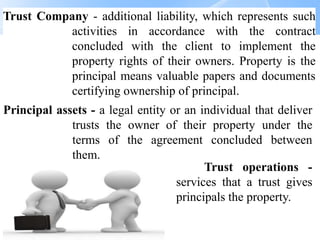
Trust Company - additional liability, which represents such
activities in accordance with the contract
concluded with the client to implement the
property rights of their owners. Property is the
principal means valuable papers and documents
certifying ownership of principal.
Principal assets - a legal entity or an individual that deliver
trusts the owner of their property under the
terms of the agreement concluded between
them.
Trust operations -
services that a trust gives
principals the property.
Page  3
Trust features:
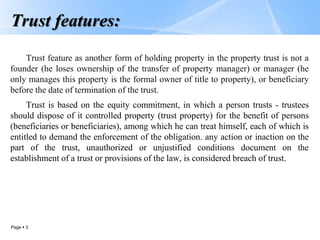
Trust feature as another form of holding property in the property trust is not a
founder (he loses ownership of the transfer of property manager) or manager (he
only manages this property is the formal owner of title to property), or beneficiary
before the date of termination of the trust.
Trust is based on the equity commitment, in which a person trusts - trustees
should dispose of it controlled property (trust property) for the benefit of persons
(beneficiaries or beneficiaries), among which he can treat himself, each of which is
entitled to demand the enforcement of the obligation. any action or inaction on the
part of the trust, unauthorized or unjustified conditions document on the
establishment of a trust or provisions of the law, is considered breach of trust.
Page  4
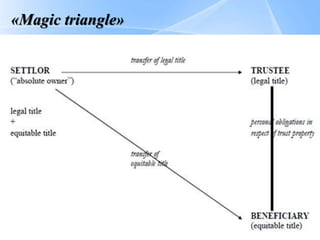
«Magic triangle»
Page  5
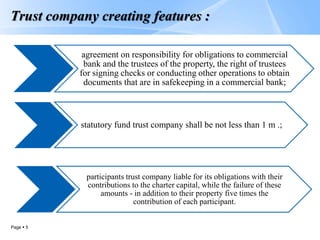
Trust company creating features :
agreement on responsibility for obligations to commercial
bank and the trustees of the property, the right of trustees
for signing checks or conducting other operations to obtain
documents that are in safekeeping in a commercial bank;
statutory fund trust company shall be not less than 1 m .;
participants trust company liable for its obligations with their
contributions to the charter capital, while the failure of these
amounts - in addition to their property five times the
contribution of each participant.
Page  6
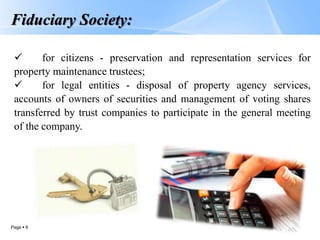
Fiduciary Society:
 for citizens - preservation and representation services for
property maintenance trustees;
 for legal entities - disposal of property agency services,
accounts of owners of securities and management of voting shares
transferred by trust companies to participate in the general meeting
of the company.
Page  7
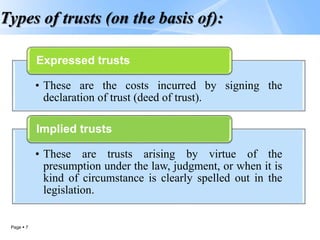
Types of trusts (on the basis of):
• These are the costs incurred by signing the
declaration of trust (deed of trust).
Expressed trusts
• These are trusts arising by virtue of the
presumption under the law, judgment, or when it is
kind of circumstance is clearly spelled out in the
legislation.
Implied trusts
Page  8
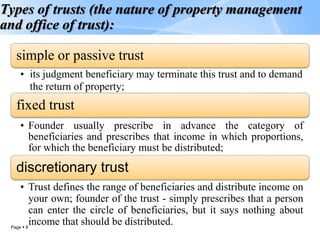
Types of trusts (the nature of property management
and office of trust):
simple or passive trust
• its judgment beneficiary may terminate this trust and to demand
the return of property;
fixed trust
• Founder usually prescribe in advance the category of
beneficiaries and prescribes that income in which proportions,
for which the beneficiary must be distributed;
discretionary trust
• Trust defines the range of beneficiaries and distribute income on
your own; founder of the trust - simply prescribes that a person
can enter the circle of beneficiaries, but it says nothing about
income that should be distributed.
Page  9
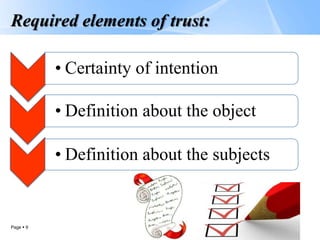
Required elements of trust:
• Certainty of intention
• Definition about the object
• Definition about the subjects
Page  10
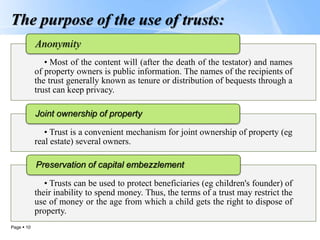
The purpose of the use of trusts:
• Most of the content will (after the death of the testator) and names
of property owners is public information. The names of the recipients of
the trust generally known as tenure or distribution of bequests through a
trust can keep privacy.
Anonymity
• Trust is a convenient mechanism for joint ownership of property (eg
real estate) several owners.
Joint ownership of property
• Trusts can be used to protect beneficiaries (eg children's founder) of
their inability to spend money. Thus, the terms of a trust may restrict the
use of money or the age from which a child gets the right to dispose of
property.
Preservation of capital embezzlement
Page  11
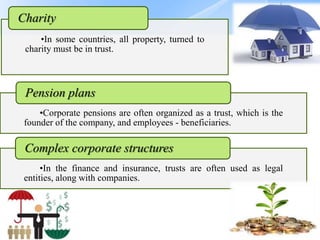
•In some countries, all property, turned to
charity must be in trust.
Charity
•Corporate pensions are often organized as a trust, which is the
founder of the company, and employees - beneficiaries.
Pension plans
•In the finance and insurance, trusts are often used as legal
entities, along with companies.
Complex corporate structures
Page  12
•Trust provides anonymity in which one and the same person can be a
founder and the beneficiary (not the trustee), thereby gaining all the
benefits from the property, but hiding it from creditors.
Hiding property
•Anonymity and separation founder, trustees and beneficiaries of a
trust make convenient mechanism for tax evasion. Thus, the trustee in
many offshore countries are not obliged to report the income trust tax
office (another) country where the beneficiaries reside. These features
are used trust and money laundering. Another way to evade taxes by
using a trust is possible in the case of a progressive income tax when the
income-property formally owned by the trust (in many countries this
loophole is closed, and the tax rate for very high trust). Also, transfer of
property through a trust exempt beneficiaries from paying inheritance
tax, which exists in almost all countries that use trusts.
Tax evasion
Page  13
• Purchase or translation of all significant
assets in the name of trust allows to declare the
absence or insufficient presence of its assets
and to apply, for example, the use of lower tax
rates or to receive assistance from the state.
Hiding income
• When transferring the property to the trust
founder of the trust loses all rights to the property if
the trust agreement is correct. Thus, the property is
inaccessible to creditors of the founder of the trust,
the claims for the division of property and to
separate personal property from business assets.
The latter is particularly important in countries
Anglo-Saxon legal system, where the individual
can be recognized bankrupt person, with
subsequent recovery of personal property for
debts.
Save property
Page  14
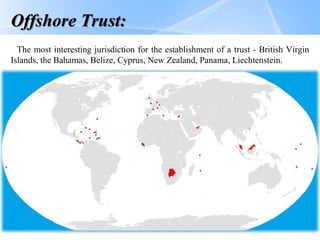
Offshore Trust:
The most interesting jurisdiction for the establishment of a trust - British Virgin
Islands, the Bahamas, Belize, Cyprus, New Zealand, Panama, Liechtenstein.
Page  15
Trusts for inheritance:
One of the main destinations of trust - succession planning. The shape of the Trust
to close the covenant, but has several advantages:
1) provides an opportunity for the life of the founder of the assets separated
from the main property for inheritance;
2) heirs guaranteed inheritance, they need not fear creditors, bankruptcy or other
contingencies;
3) founder entitles establish the conditions under which the beneficiary will
receive the trust assets or income from their use;
4) simplification of international inheritance property overrides the need to
make separate wills in each country where the founder has ownership;
5) after the death of the founder, depending on the terms of the agreement of
trust property or move to beneficiaries, or left in trust for their own benefit.
Page  16
Advantages of modern offshore trust:
 flexibility of employment contract;
 If the beneficiary - resident country of registration of the trust, the
income and capital gains of the trust are not taxed;
 the appointment of a trust protector;
 no restrictions on the trust assets and their geographical location;
 high level of responsibility trustees;
 ability to protect the interests of the beneficiary in court;
 not recognizing the compulsory inheritance;
 consideration litigation law jurisdiction solely on the
operation of the trust;
 complicated procedure for judicial review of lenders.
Page  17
Thank you for your attention!

The Trust (Trust company)

  • 1.
    Trust (Trust company) Prepared by: VelykaNataliya Poberezhnyuk Andrii
  • 2.
    Page  2 TrustCompany - additional liability, which represents such activities in accordance with the contract concluded with the client to implement the property rights of their owners. Property is the principal means valuable papers and documents certifying ownership of principal. Principal assets - a legal entity or an individual that deliver trusts the owner of their property under the terms of the agreement concluded between them. Trust operations - services that a trust gives principals the property.
  • 3.
    Page  3 Trustfeatures: Trust feature as another form of holding property in the property trust is not a founder (he loses ownership of the transfer of property manager) or manager (he only manages this property is the formal owner of title to property), or beneficiary before the date of termination of the trust. Trust is based on the equity commitment, in which a person trusts - trustees should dispose of it controlled property (trust property) for the benefit of persons (beneficiaries or beneficiaries), among which he can treat himself, each of which is entitled to demand the enforcement of the obligation. any action or inaction on the part of the trust, unauthorized or unjustified conditions document on the establishment of a trust or provisions of the law, is considered breach of trust.
  • 4.
  • 5.
    Page  5 Trustcompany creating features : agreement on responsibility for obligations to commercial bank and the trustees of the property, the right of trustees for signing checks or conducting other operations to obtain documents that are in safekeeping in a commercial bank; statutory fund trust company shall be not less than 1 m .; participants trust company liable for its obligations with their contributions to the charter capital, while the failure of these amounts - in addition to their property five times the contribution of each participant.
  • 6.
    Page  6 FiduciarySociety:  for citizens - preservation and representation services for property maintenance trustees;  for legal entities - disposal of property agency services, accounts of owners of securities and management of voting shares transferred by trust companies to participate in the general meeting of the company.
  • 7.
    Page  7 Typesof trusts (on the basis of): • These are the costs incurred by signing the declaration of trust (deed of trust). Expressed trusts • These are trusts arising by virtue of the presumption under the law, judgment, or when it is kind of circumstance is clearly spelled out in the legislation. Implied trusts
  • 8.
    Page  8 Typesof trusts (the nature of property management and office of trust): simple or passive trust • its judgment beneficiary may terminate this trust and to demand the return of property; fixed trust • Founder usually prescribe in advance the category of beneficiaries and prescribes that income in which proportions, for which the beneficiary must be distributed; discretionary trust • Trust defines the range of beneficiaries and distribute income on your own; founder of the trust - simply prescribes that a person can enter the circle of beneficiaries, but it says nothing about income that should be distributed.
  • 9.
    Page  9 Requiredelements of trust: • Certainty of intention • Definition about the object • Definition about the subjects
  • 10.
    Page  10 Thepurpose of the use of trusts: • Most of the content will (after the death of the testator) and names of property owners is public information. The names of the recipients of the trust generally known as tenure or distribution of bequests through a trust can keep privacy. Anonymity • Trust is a convenient mechanism for joint ownership of property (eg real estate) several owners. Joint ownership of property • Trusts can be used to protect beneficiaries (eg children's founder) of their inability to spend money. Thus, the terms of a trust may restrict the use of money or the age from which a child gets the right to dispose of property. Preservation of capital embezzlement
  • 11.
    Page  11 •Insome countries, all property, turned to charity must be in trust. Charity •Corporate pensions are often organized as a trust, which is the founder of the company, and employees - beneficiaries. Pension plans •In the finance and insurance, trusts are often used as legal entities, along with companies. Complex corporate structures
  • 12.
    Page  12 •Trustprovides anonymity in which one and the same person can be a founder and the beneficiary (not the trustee), thereby gaining all the benefits from the property, but hiding it from creditors. Hiding property •Anonymity and separation founder, trustees and beneficiaries of a trust make convenient mechanism for tax evasion. Thus, the trustee in many offshore countries are not obliged to report the income trust tax office (another) country where the beneficiaries reside. These features are used trust and money laundering. Another way to evade taxes by using a trust is possible in the case of a progressive income tax when the income-property formally owned by the trust (in many countries this loophole is closed, and the tax rate for very high trust). Also, transfer of property through a trust exempt beneficiaries from paying inheritance tax, which exists in almost all countries that use trusts. Tax evasion
  • 13.
    Page  13 •Purchase or translation of all significant assets in the name of trust allows to declare the absence or insufficient presence of its assets and to apply, for example, the use of lower tax rates or to receive assistance from the state. Hiding income • When transferring the property to the trust founder of the trust loses all rights to the property if the trust agreement is correct. Thus, the property is inaccessible to creditors of the founder of the trust, the claims for the division of property and to separate personal property from business assets. The latter is particularly important in countries Anglo-Saxon legal system, where the individual can be recognized bankrupt person, with subsequent recovery of personal property for debts. Save property
  • 14.
    Page  14 OffshoreTrust: The most interesting jurisdiction for the establishment of a trust - British Virgin Islands, the Bahamas, Belize, Cyprus, New Zealand, Panama, Liechtenstein.
  • 15.
    Page  15 Trustsfor inheritance: One of the main destinations of trust - succession planning. The shape of the Trust to close the covenant, but has several advantages: 1) provides an opportunity for the life of the founder of the assets separated from the main property for inheritance; 2) heirs guaranteed inheritance, they need not fear creditors, bankruptcy or other contingencies; 3) founder entitles establish the conditions under which the beneficiary will receive the trust assets or income from their use; 4) simplification of international inheritance property overrides the need to make separate wills in each country where the founder has ownership; 5) after the death of the founder, depending on the terms of the agreement of trust property or move to beneficiaries, or left in trust for their own benefit.
  • 16.
    Page  16 Advantagesof modern offshore trust:  flexibility of employment contract;  If the beneficiary - resident country of registration of the trust, the income and capital gains of the trust are not taxed;  the appointment of a trust protector;  no restrictions on the trust assets and their geographical location;  high level of responsibility trustees;  ability to protect the interests of the beneficiary in court;  not recognizing the compulsory inheritance;  consideration litigation law jurisdiction solely on the operation of the trust;  complicated procedure for judicial review of lenders.
  • 17.
    Page  17 Thankyou for your attention!

Editor's Notes