
Serdar Temiz
temiz@kth.se
BMI- KTH 2016
BUSINESS TOOLBOX
Business Model Canvas
Serdar Temiz
Social
Entrepreneur
PhD Candidate
Lecturer Entrepreneurship, Technology Entrepreneurship
Open and User Innovation,
Chairman
Previous life:
IT support,Telecom software Engineer, .NET, Java
developer, Project Manager, Business Developer
B.S, M.Sc, MBA & MA,
www.sciencebacker.com
www.okfn.se /
www.okfn.org
Some Questions
• What is Invention
• What is Innovation
Serdar Temiz & Terrence Brown 20162016-11-20
There are many inventions, but far
fewer
innovations.
An invention is a novel idea
Innovation is the commercialization of
that
novel idea
Serdar Temiz & Terrence Brown
2016
2016-11-20
Types of Innovation
1. Technology innovation
2. Process innovation
3. Product & service innovation
4. Business Model innovation
Serdar Temiz & Terrence Brown
2016
2016-11-20
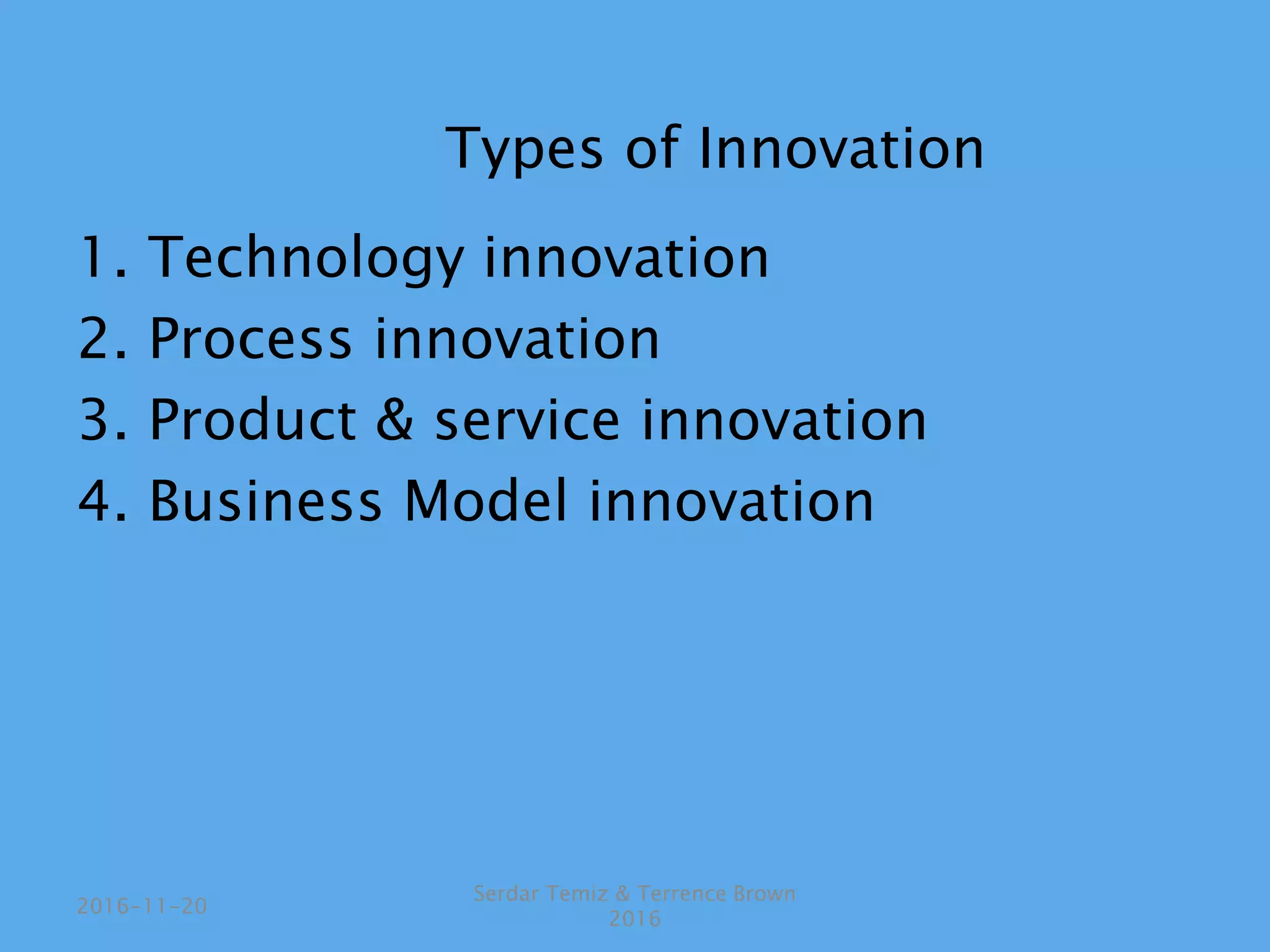
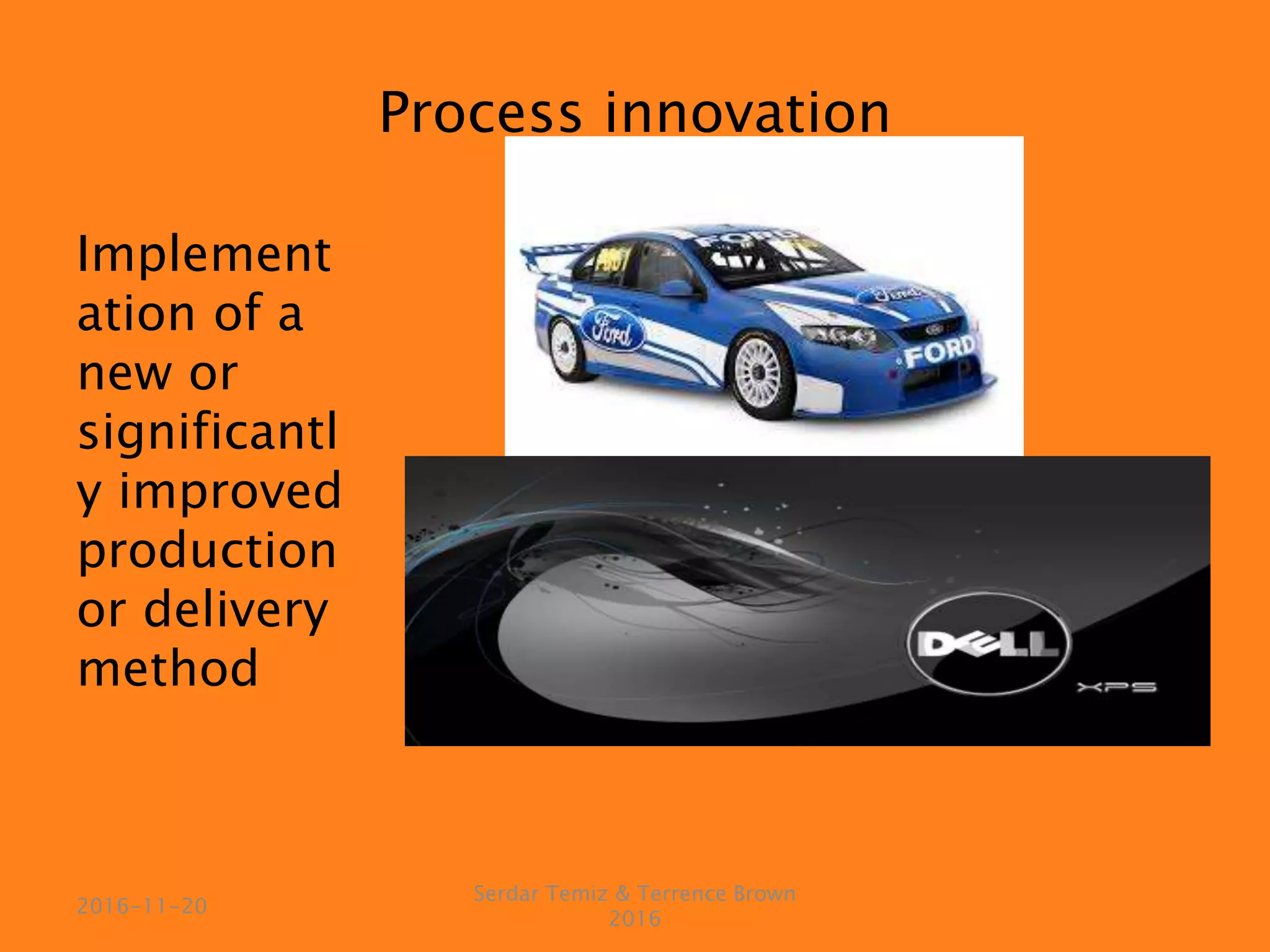
Process innovation
Implement
ation of a
new or
significantl
y improved
production
or delivery
method
Serdar Temiz & Terrence Brown
2016
2016-11-20
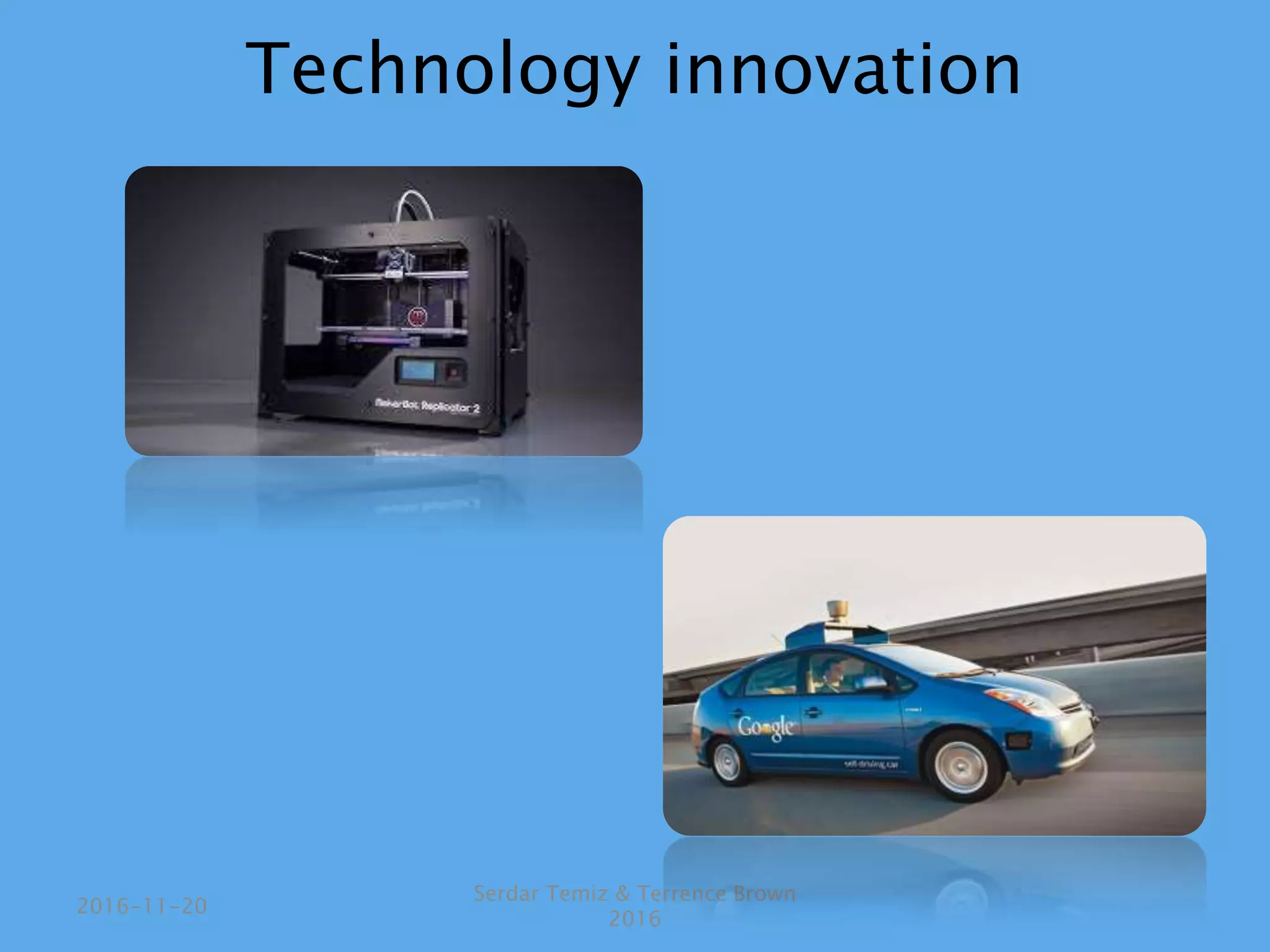
Technology innovation
Serdar Temiz & Terrence Brown
2016
2016-11-20
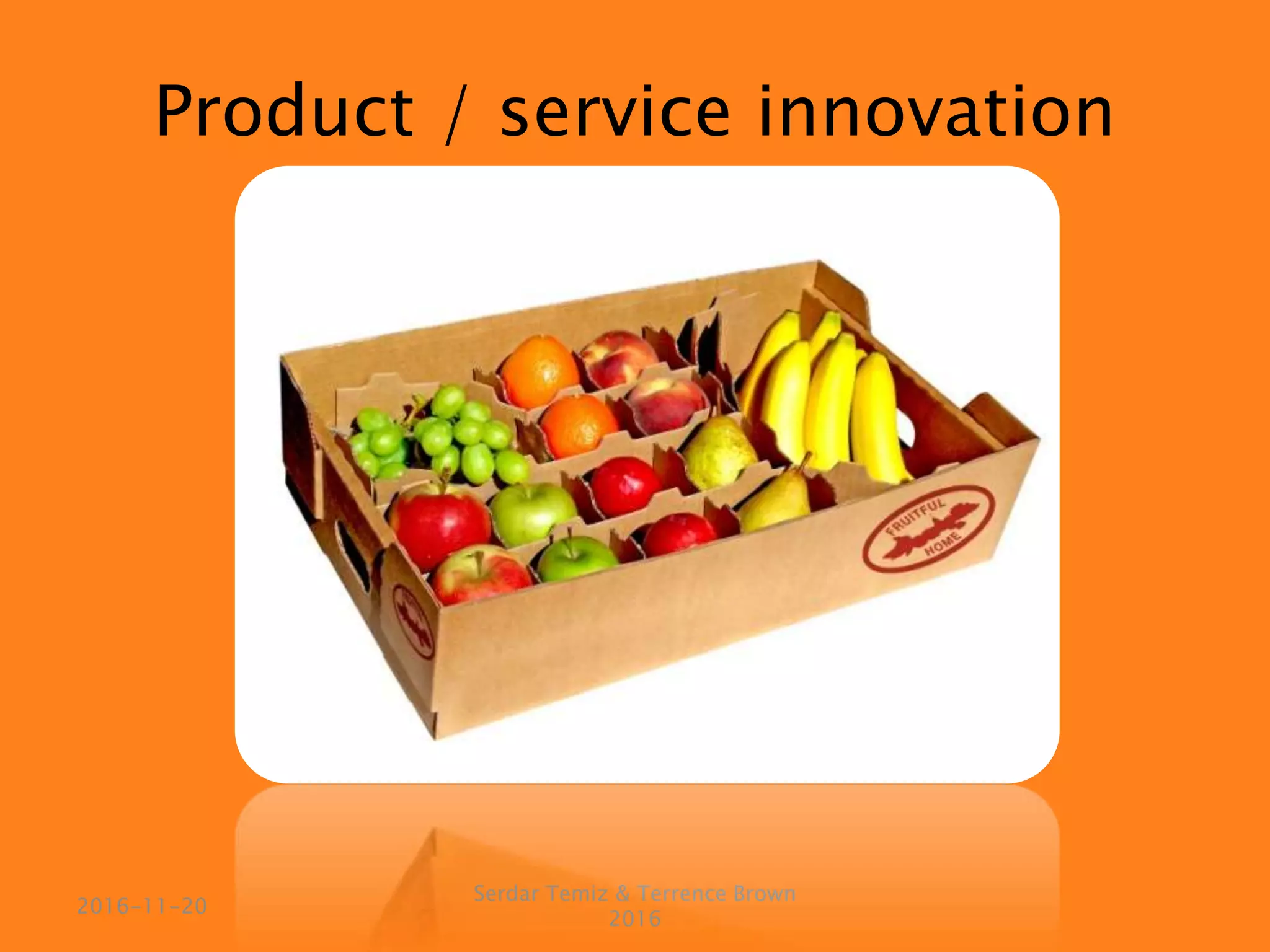
Product / service innovation
Serdar Temiz & Terrence Brown
2016
2016-11-20
Definitions
• “the content, structure, and governance of transactions designed so as to
create value through the exploitation of business opportunities” (Zott & Amit,
2001 p 494-495)
• “defines how the enterprise creates and delivers value to customers, and
then converts payments received to profits” (Teece, 2010 p 173)
• “takes technological characteristics and potentials as inputs and converts
them through customers and markets into economic outputs” (Chesbrough &
Rosenbloom, 2002, p. 532)
• The logic of the firm, the way it operates and how it creates value for its
stakeholder (Casadesus & Ricart)
• “a set of expectations about how the business will be successful in its
environment” (Downing, 2005, p. 186)
• “stories that explain how enterprises work” (Magretta, 2002, p. 87)
A business Model is..
The business model is a strategic plan
to be implemented through
organizational structures, processes,
and systems in order to need customer
needs. (one of many definitions)
Serdar Temiz & Terrence Brown
2016
2016-11-20
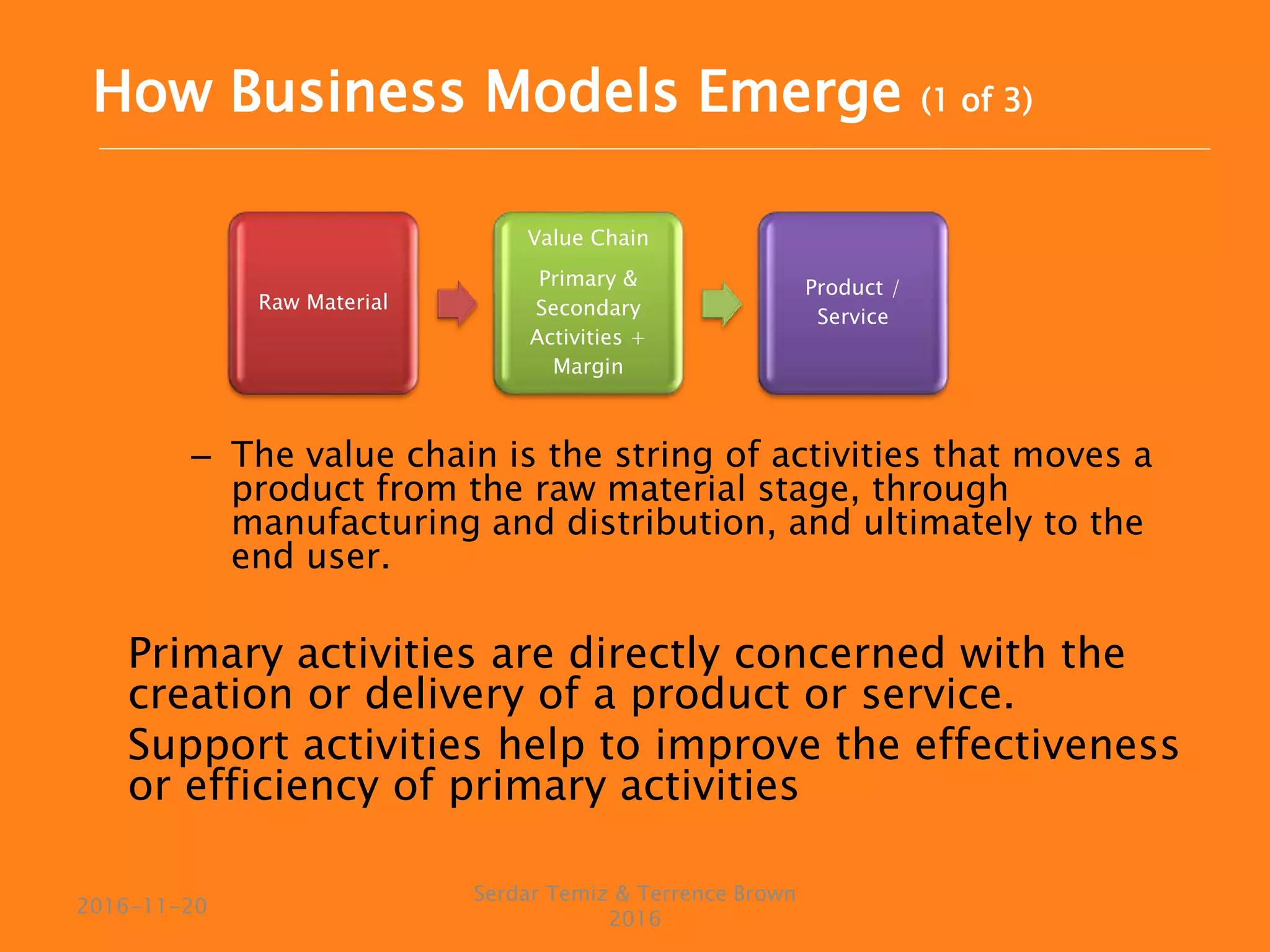
How Business Models Emerge (1 of 3)
– The value chain is the string of activities that moves a
product from the raw material stage, through
manufacturing and distribution, and ultimately to the
end user.
Primary activities are directly concerned with the
creation or delivery of a product or service.
Support activities help to improve the effectiveness
or efficiency of primary activities
Raw Material
Value Chain
Primary &
Secondary
Activities +
Margin
Product /
Service
Serdar Temiz & Terrence Brown
2016
2016-11-20
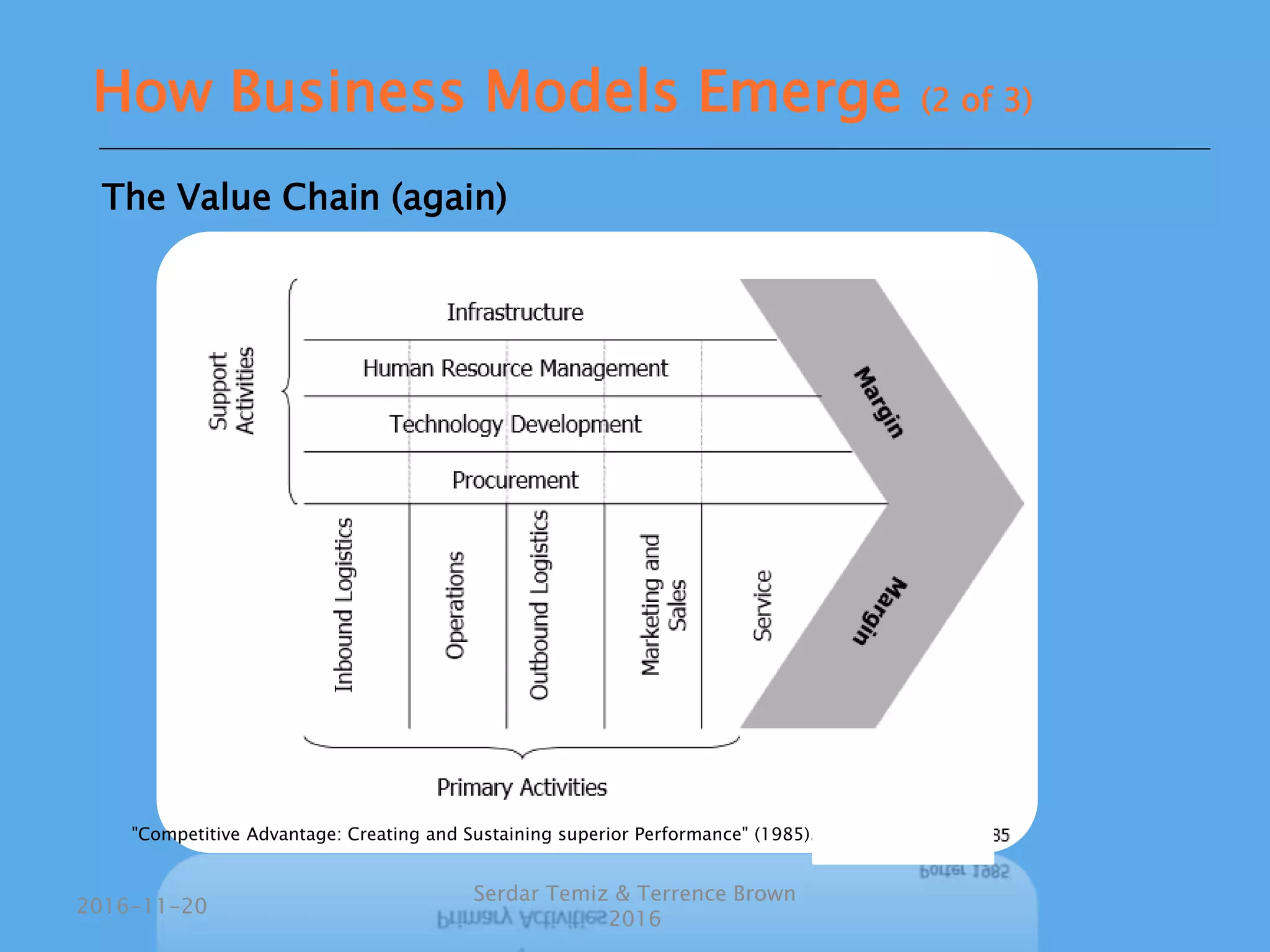
The Value Chain (again)
"Competitive Advantage: Creating and Sustaining superior Performance" (1985).
Serdar Temiz & Terrence Brown
2016
2016-11-20
How Business Models Emerge (2 of 3)
The Value Chain (continued)
Entrepreneurs look at the value chain of a product
or a service to pinpoint where the value chain can
be made more effective or to spot where additional
“value” can be added.
2016-11-20
How Business Models Emerge (3 of 3)
... can be, even more important than tech
innovation!
Serdar Temiz & Terrence Brown
2016
2016-11-20
RIGHT BUSINESS MODEL
Finding and executing the right business
model can be the only/ main reason of the
success
2016-11-20
BUSINESS MODEL INNOVATION
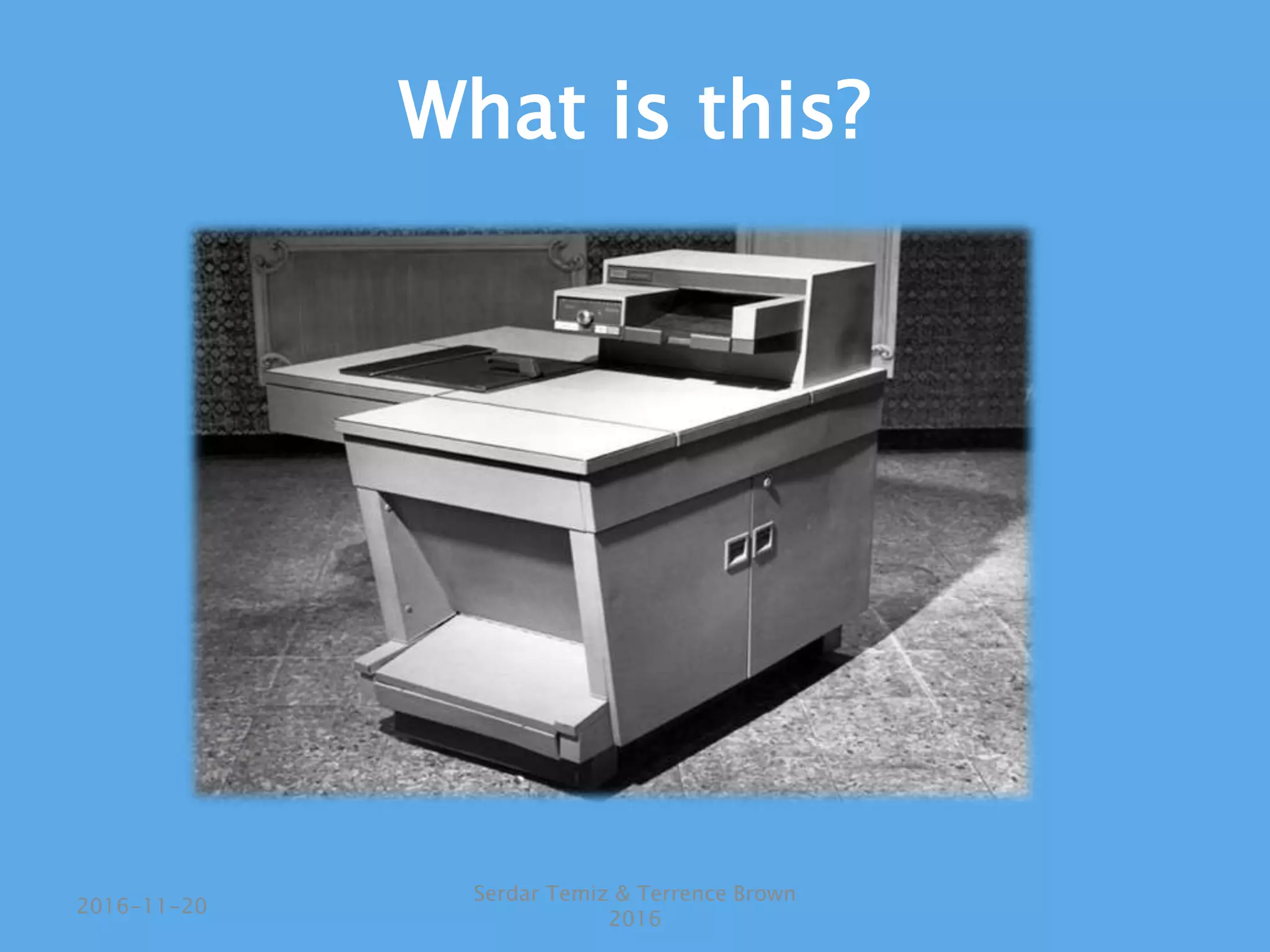
What is this?
Serdar Temiz & Terrence Brown
2016
2016-11-20
Serdar Temiz & Terrence Brown
2016
2016-11-20
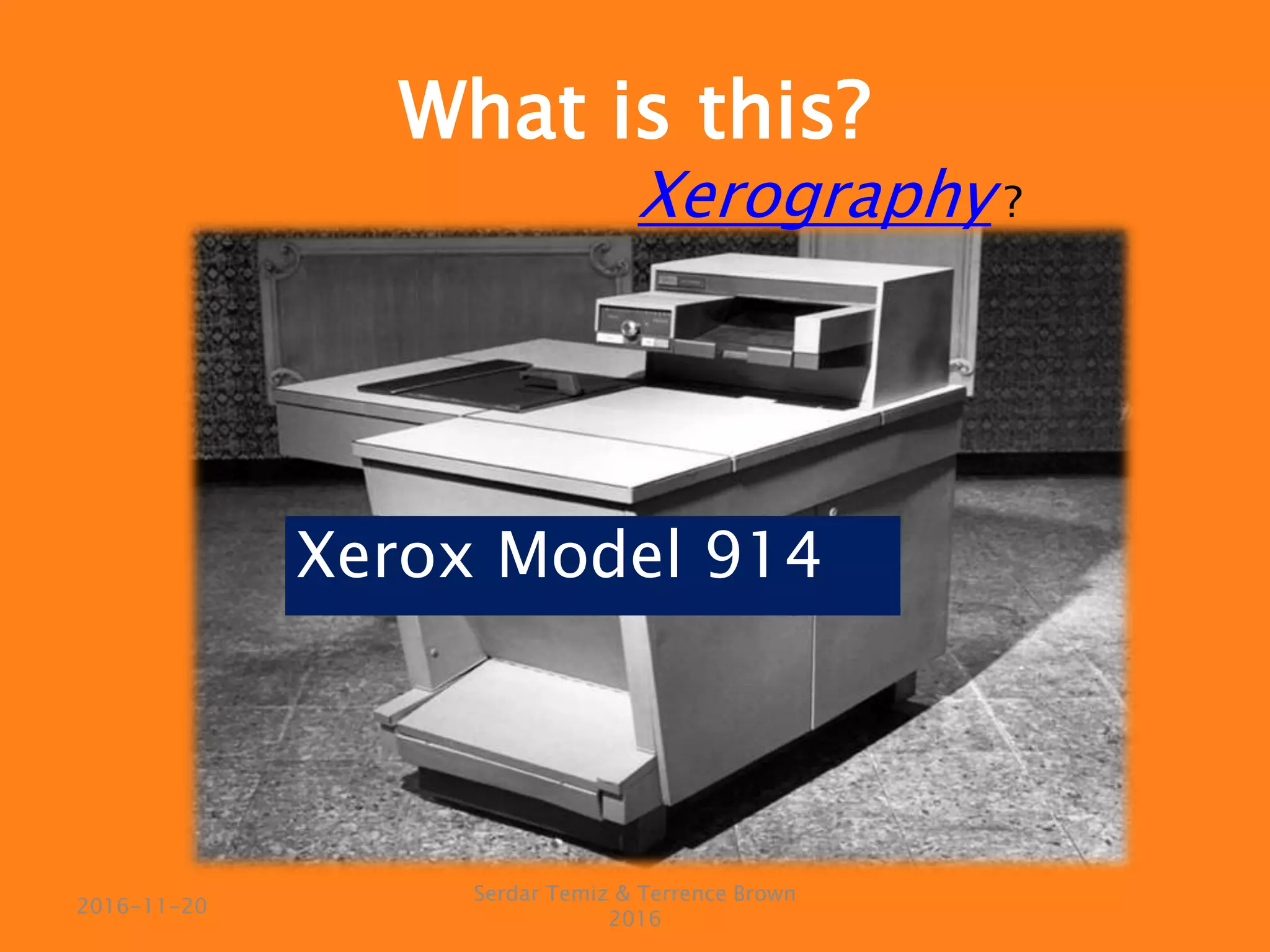
What is this?
Xerox Model 914
Xerography ?
Serdar Temiz & Terrence Brown
2016
2016-11-20
Serdar Temiz & Terrence Brown
2016
2016-11-20
Serdar Temiz & Terrence Brown
2016
2016-11-20
2016-11-20 Serdar Temiz 2015
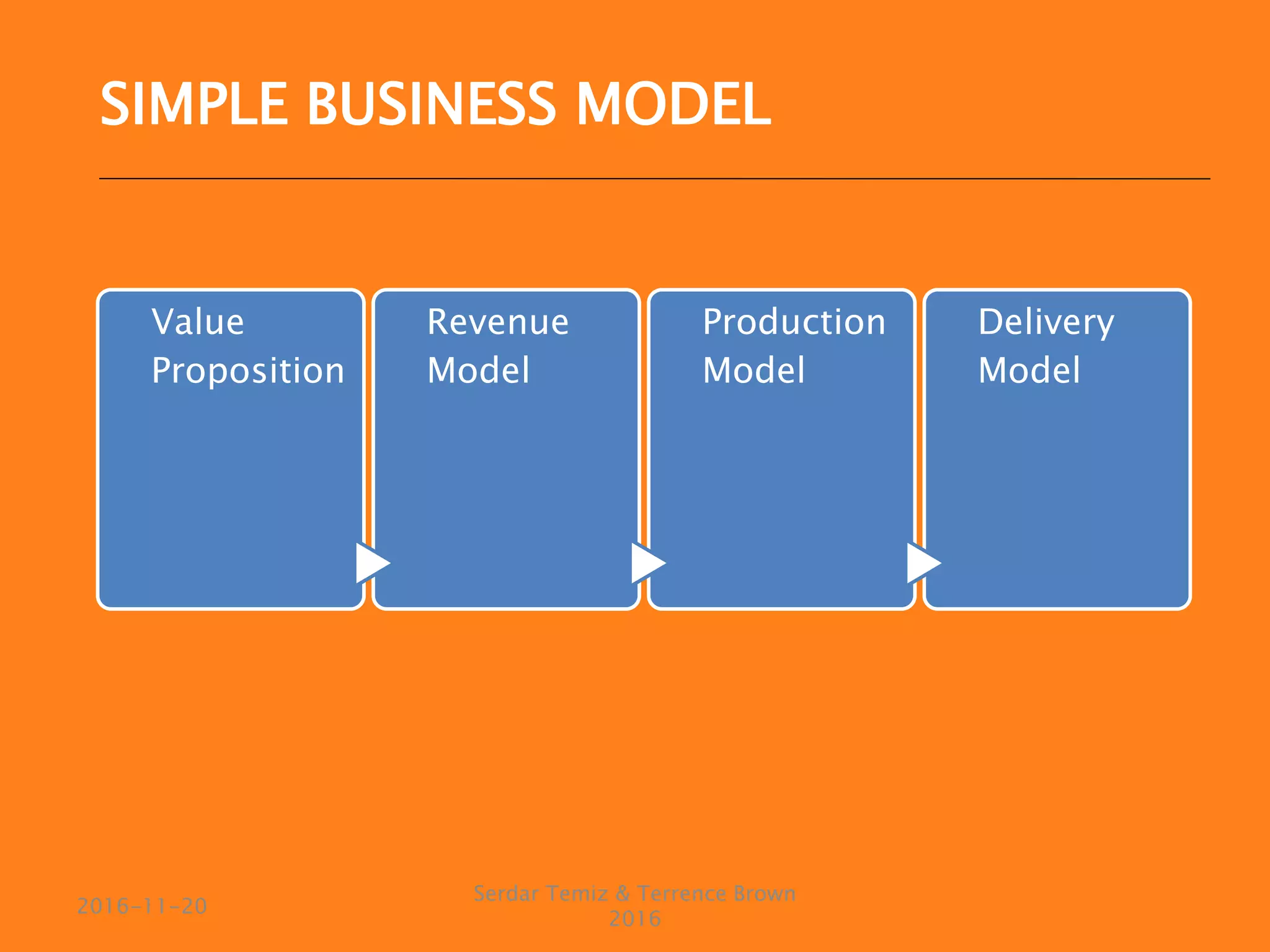
Value
Proposition
Revenue
Model
Production
Model
Delivery
Model
Serdar Temiz & Terrence Brown
2016
2016-11-20
SIMPLE BUSINESS MODEL
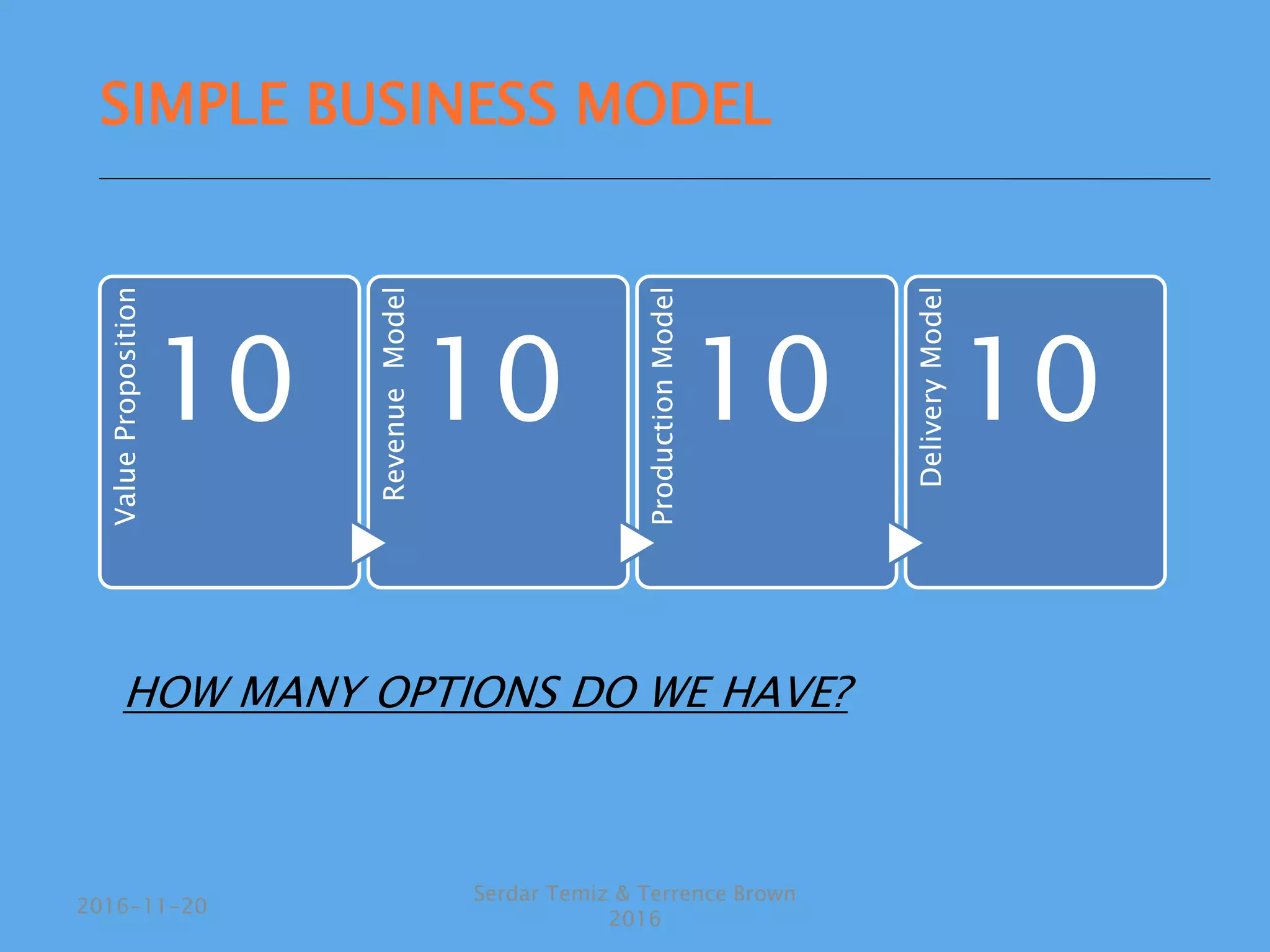
ValueProposition
10 RevenueModel
10
ProductionModel
10
DeliveryModel
10
HOW MANY OPTIONS DO WE HAVE?
Serdar Temiz & Terrence Brown
2016
2016-11-20
SIMPLE BUSINESS MODEL
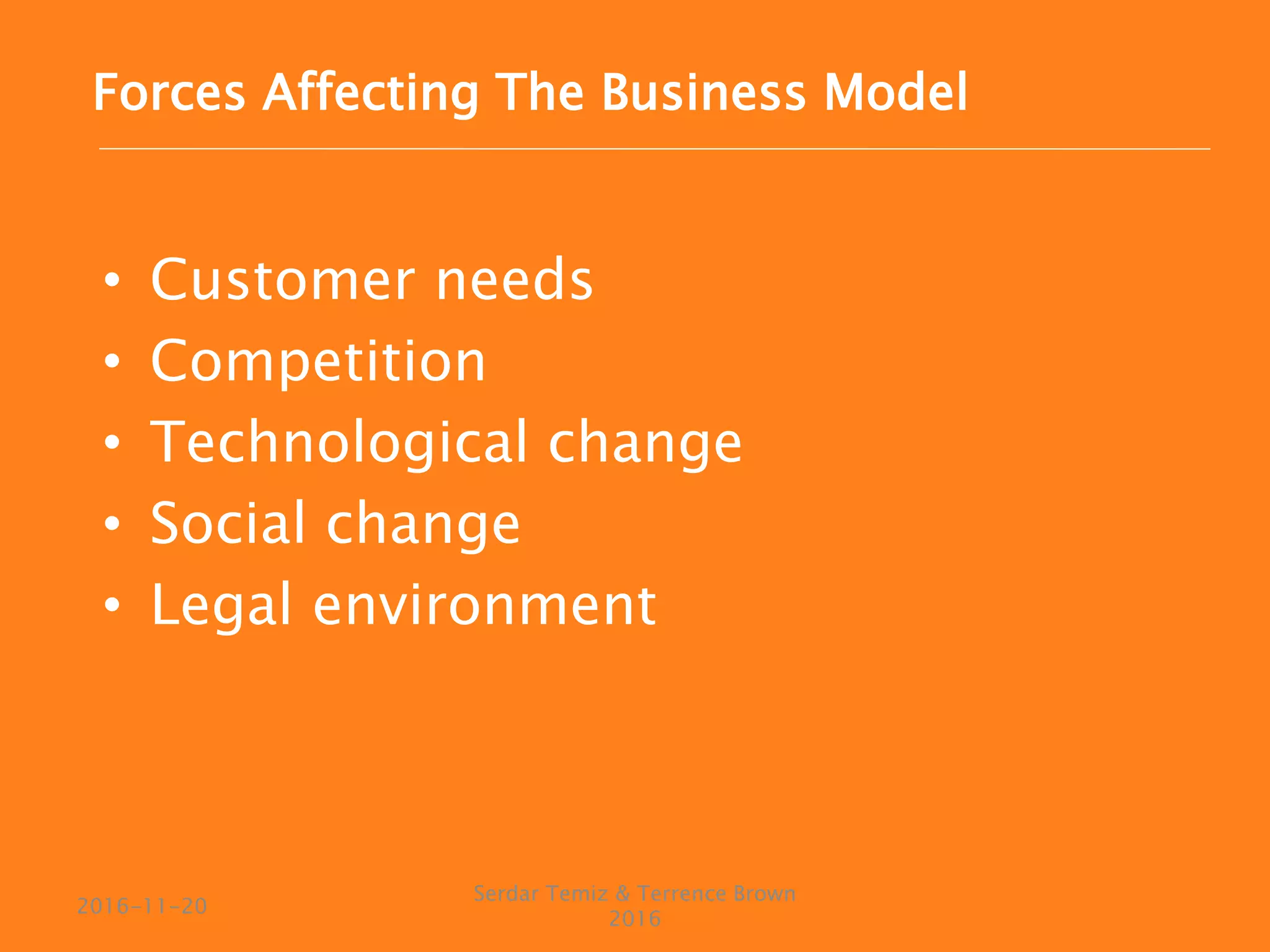
• Customer needs
• Competition
• Technological change
• Social change
• Legal environment
Serdar Temiz & Terrence Brown
2016
2016-11-20
Forces Affecting The Business Model
Serdar Temiz & Terrence Brown
2016
2016-11-20
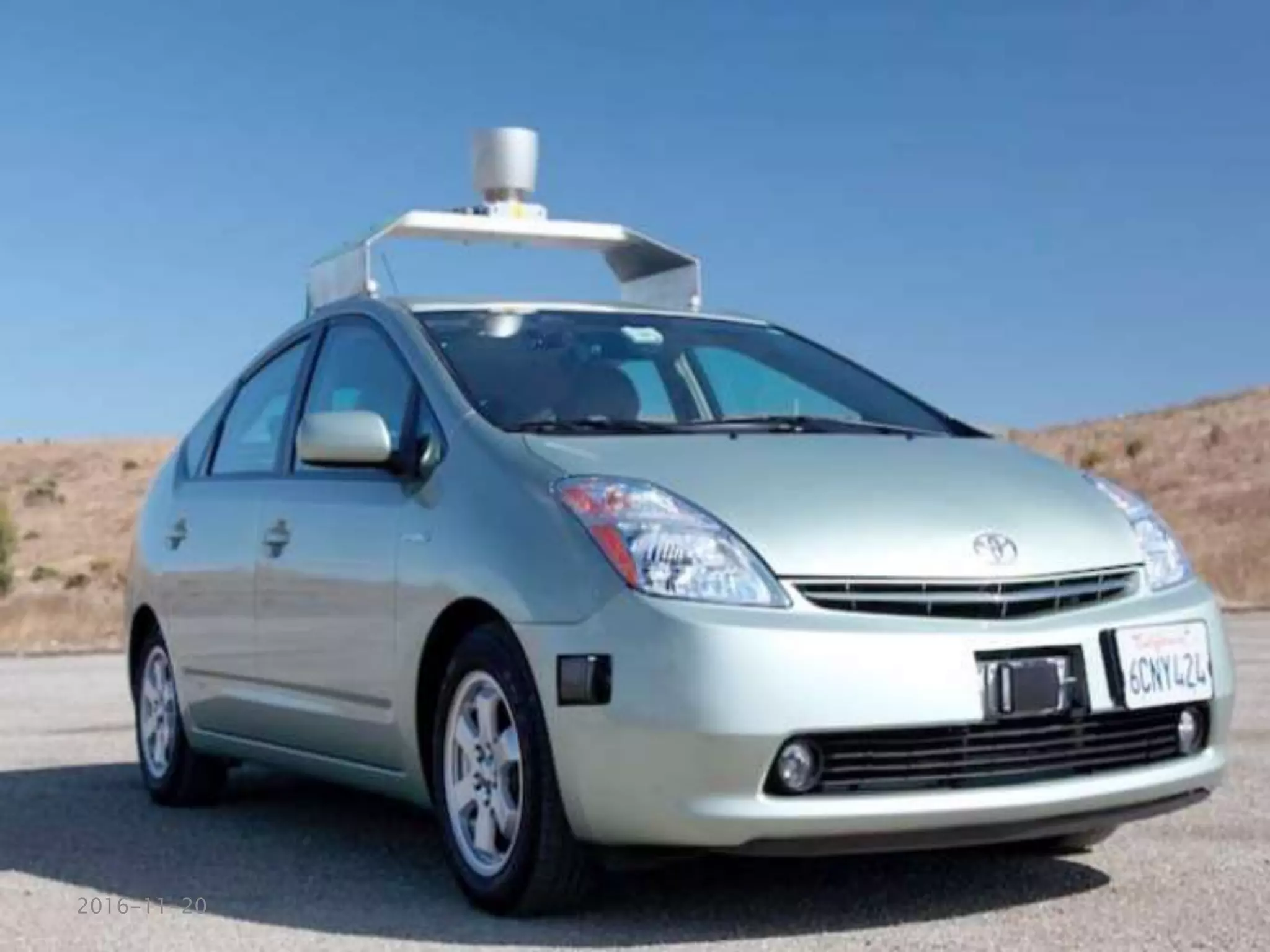
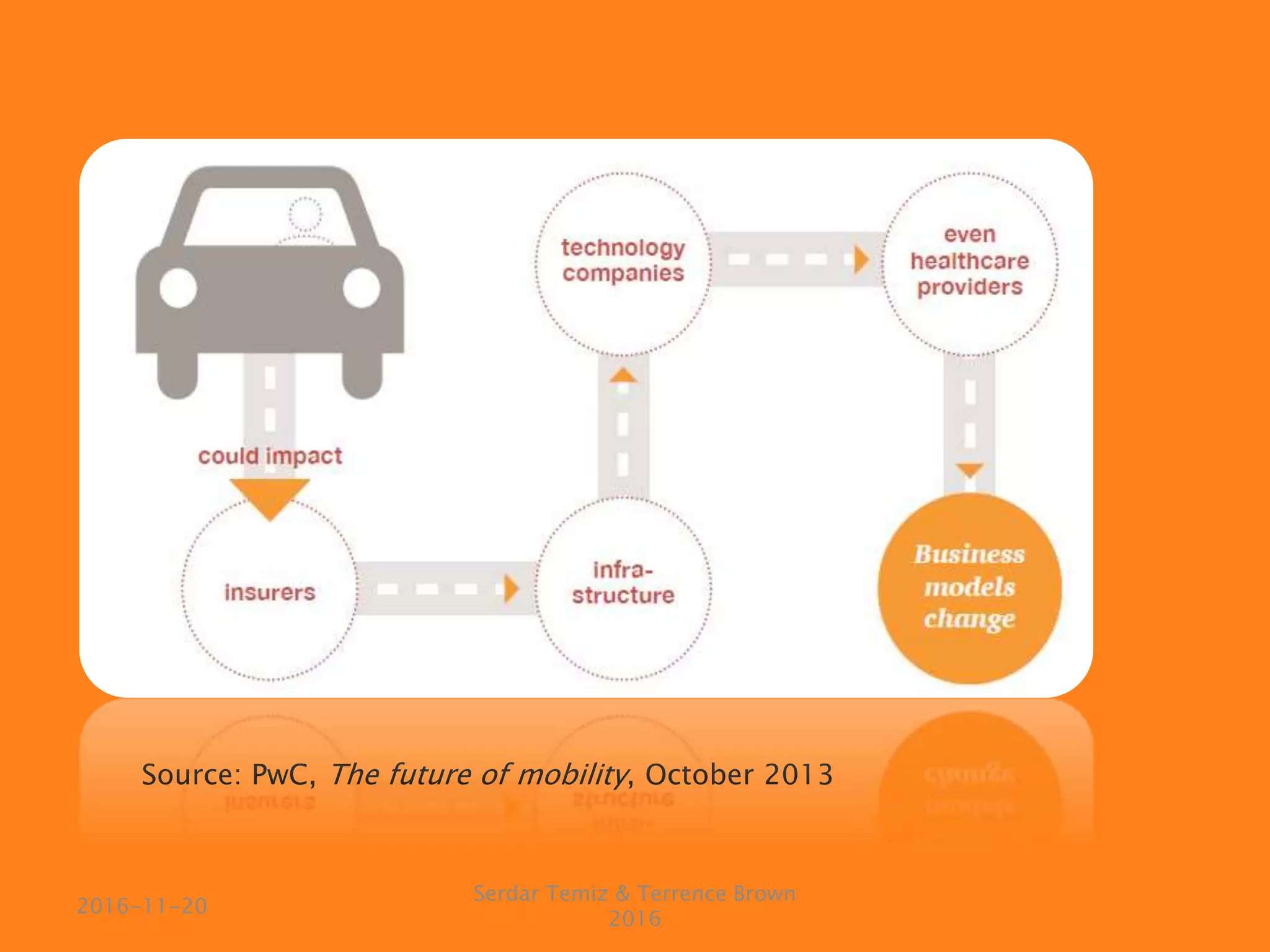
Source: PwC, The future of mobility, October 2013
Serdar Temiz & Terrence Brown
2016
2016-11-20
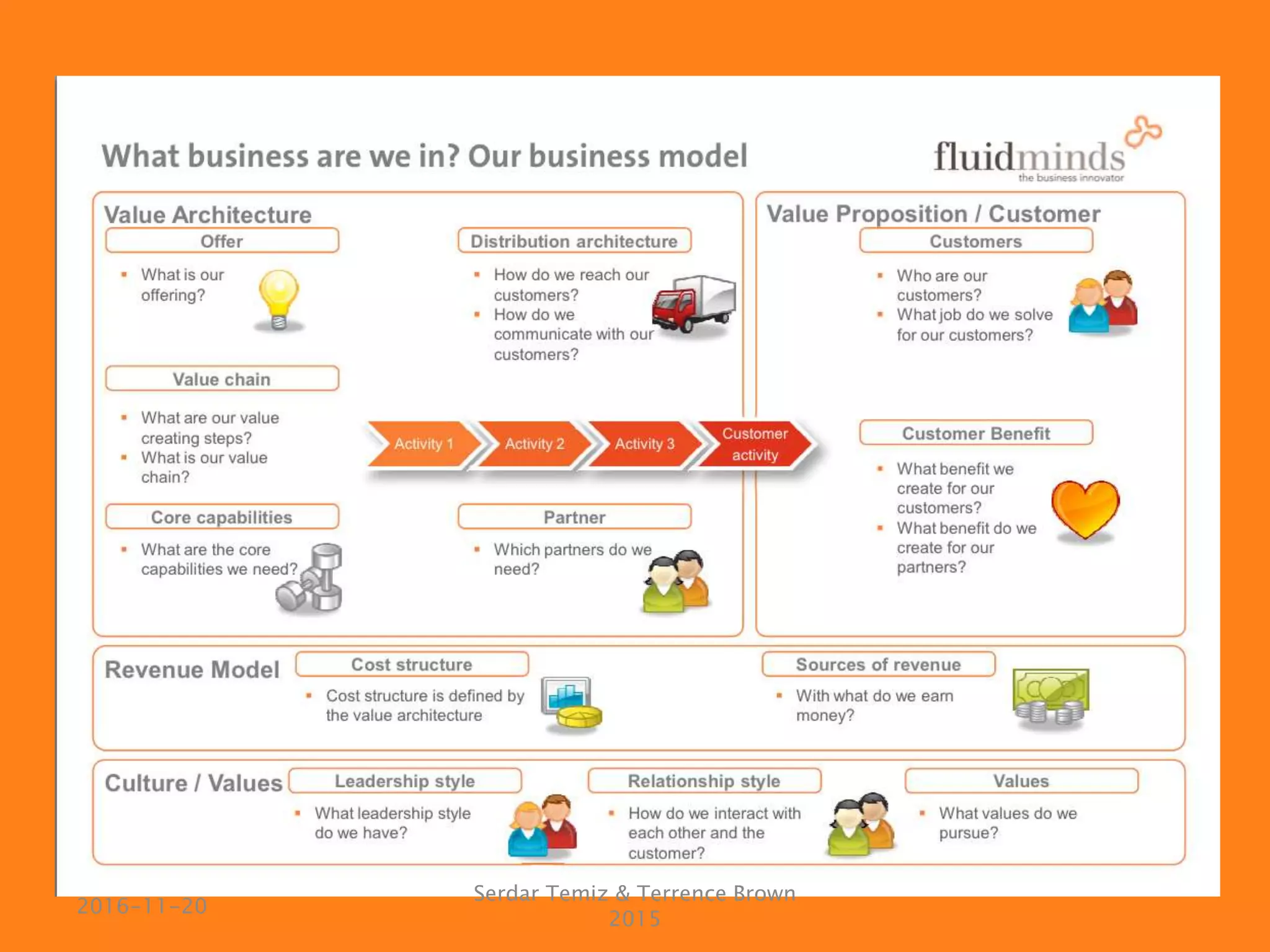
There are different type of Business
Model Maps.
Serdar Temiz & Terrence Brown
2016
2016-11-20
Serdar Temiz & Terrence Brown
2015
2016-11-20
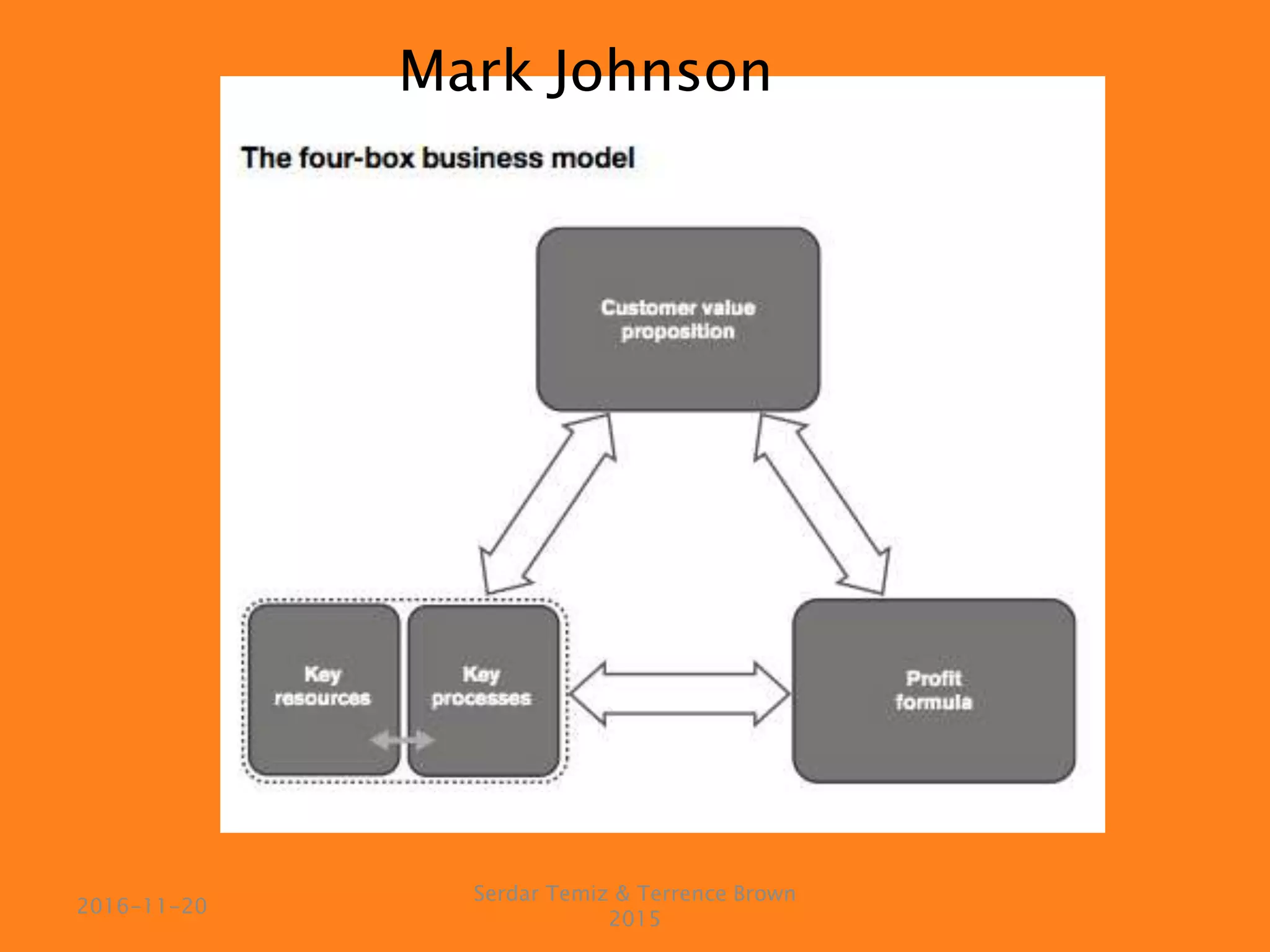
Mark Johnson
Serdar Temiz & Terrence Brown
2015
2016-11-20
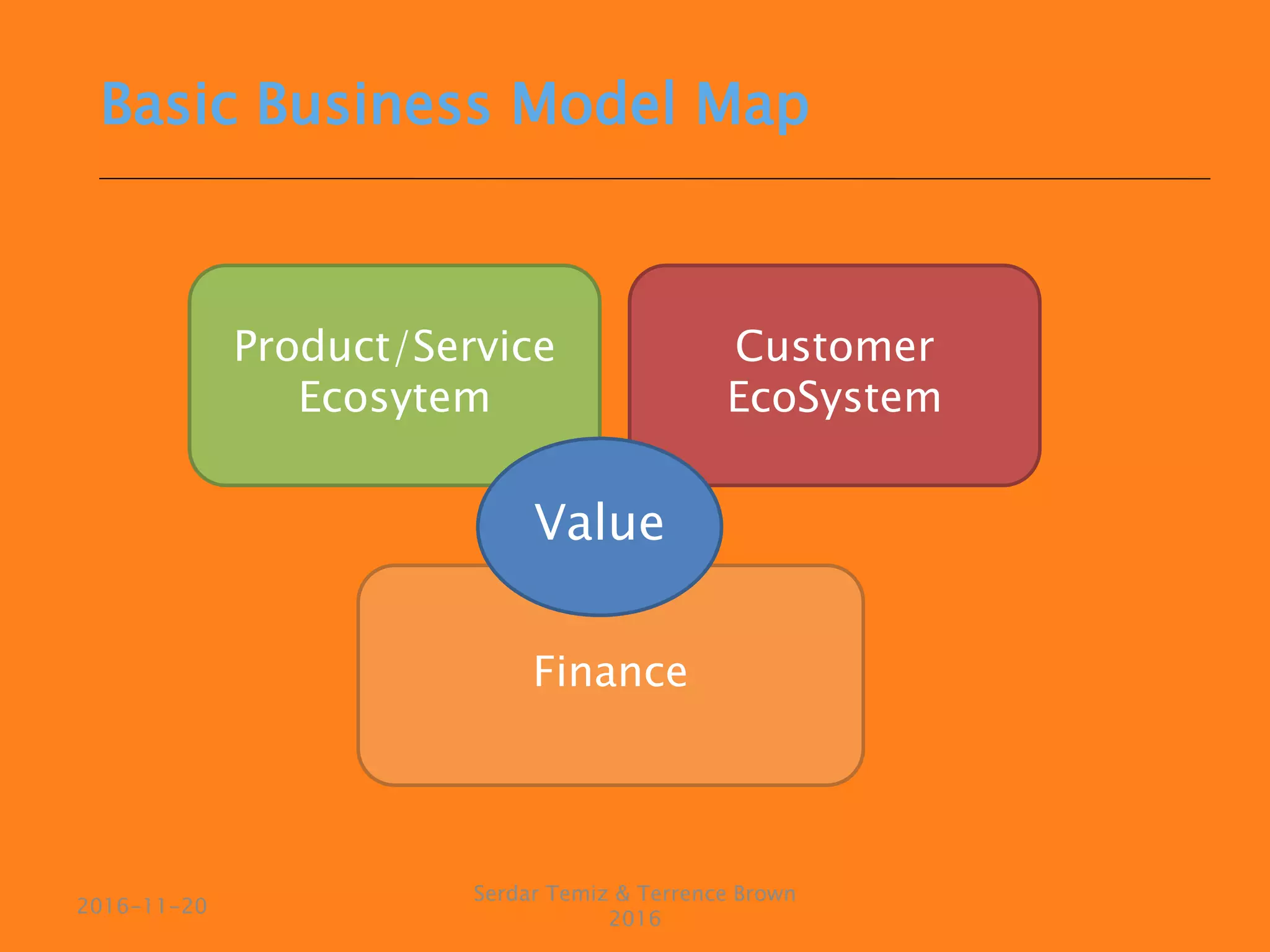
Product/Service
Ecosytem
Customer
EcoSystem
Finance
Value
Serdar Temiz & Terrence Brown
2016
2016-11-20
Basic Business Model Map
• A Value Proposition is an overall view of a company's bundle of
products and services that are of value to the customer.
• Customer Segments: segment(s) of customers a company wants
to offer value to.
• A Channel is a means of getting in touch with the customer.
• The Relationship describes the kind of link a company
establishes between itself and the customer.
• The Key Activities describes the arrangement of activities and
resources that are necessary to create value for the customer.
Key Key Resources that can be deployed by the firm to create
value including those that form the basis for a competitive
advantage
• Key Partnership is cooperative agreement between two or more
companies in order to create value for the customer
• The Cost Structure is the representation in money of all the
means employed in the business model.
• The Revenue Streams describes the way a company makes
money through a variety of revenue flows.
2016-11-20
Serdar Temiz & Terrence Brown
2016
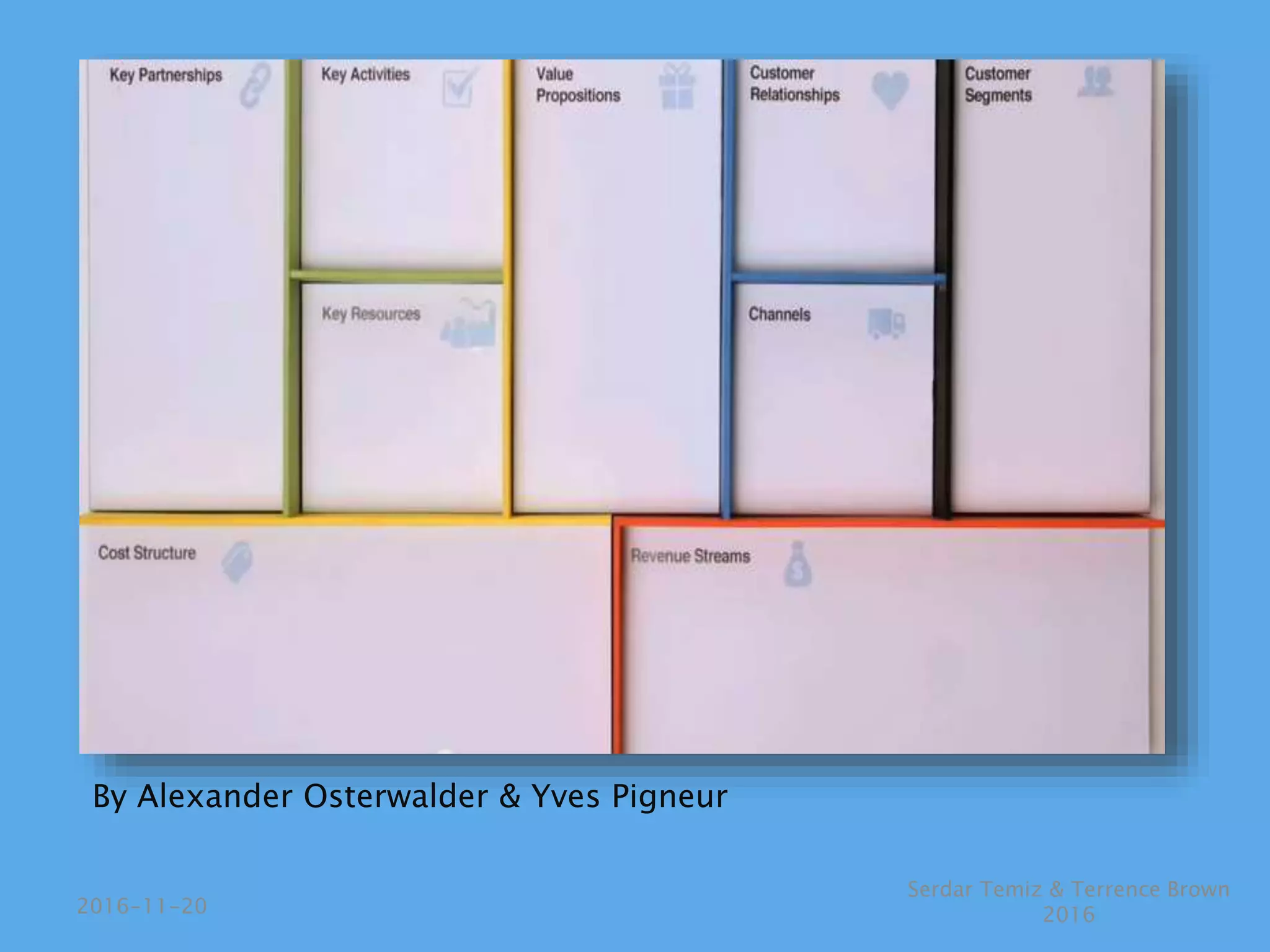
BUSINESS MODEL
CANVAS
the
Osterwalder2016-11-20
Serdar Temiz & Terrence Brown
2016
building
blocks
Osterwalder2016-11-20
Serdar Temiz & Terrence Brown
2016
1. Customer Segments
2. Value proposition
3. Channels
4. Customer Relationships
5. Revenue Streams
6. Key Resource
7. Key Activities
8. Key Partnerships
9. Cost Structure
Serdar Temiz & Terrence Brown
2016
2016-11-20
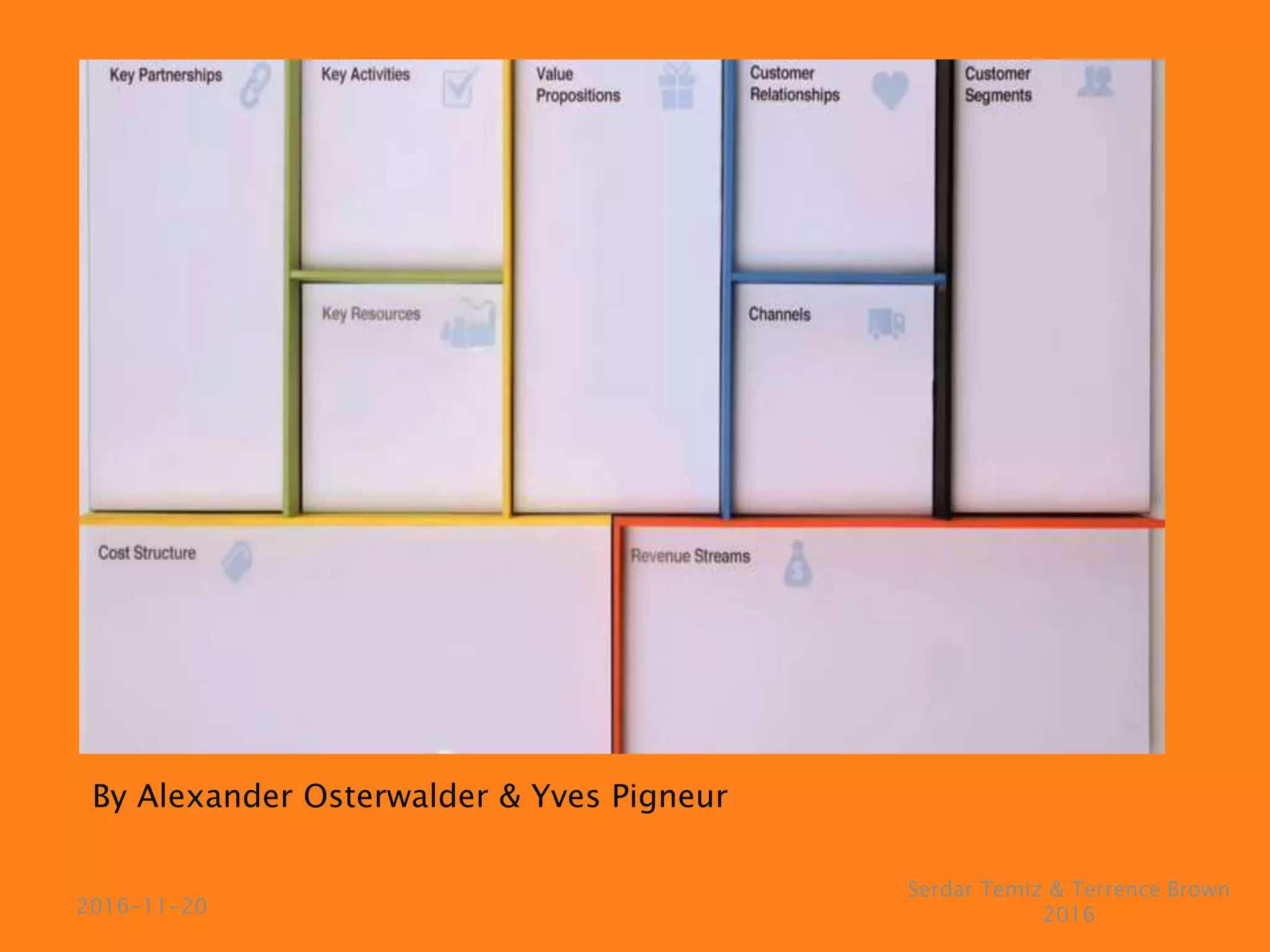
The 9 Building Blocs of Business Model Canvas
• A Value Proposition is an overall view of a company's bundle of
products and services that are of value to the customer.
• Customer Segments: segment(s) of customers a company wants
to offer value to.
• A Channel is a means of getting in touch with the customer.
• The Relationship describes the kind of link a company
establishes between itself and the customer.
• The Key Activities describes the arrangement of activities and
resources that are necessary to create value for the customer.
Key Key Resources that can be deployed by the firm to create
value including those that form the basis for a competitive
advantage
• Key Partnership is cooperative agreement between two or more
companies in order to create value for the customer
• The Cost Structure is the representation in money of all the
means employed in the business model.
• The Revenue Streams describes the way a company makes
money through a variety of revenue flows.
2016-11-20
Serdar Temiz & Terrence Brown
2016
Serdar Temiz & Terrence Brown
2016
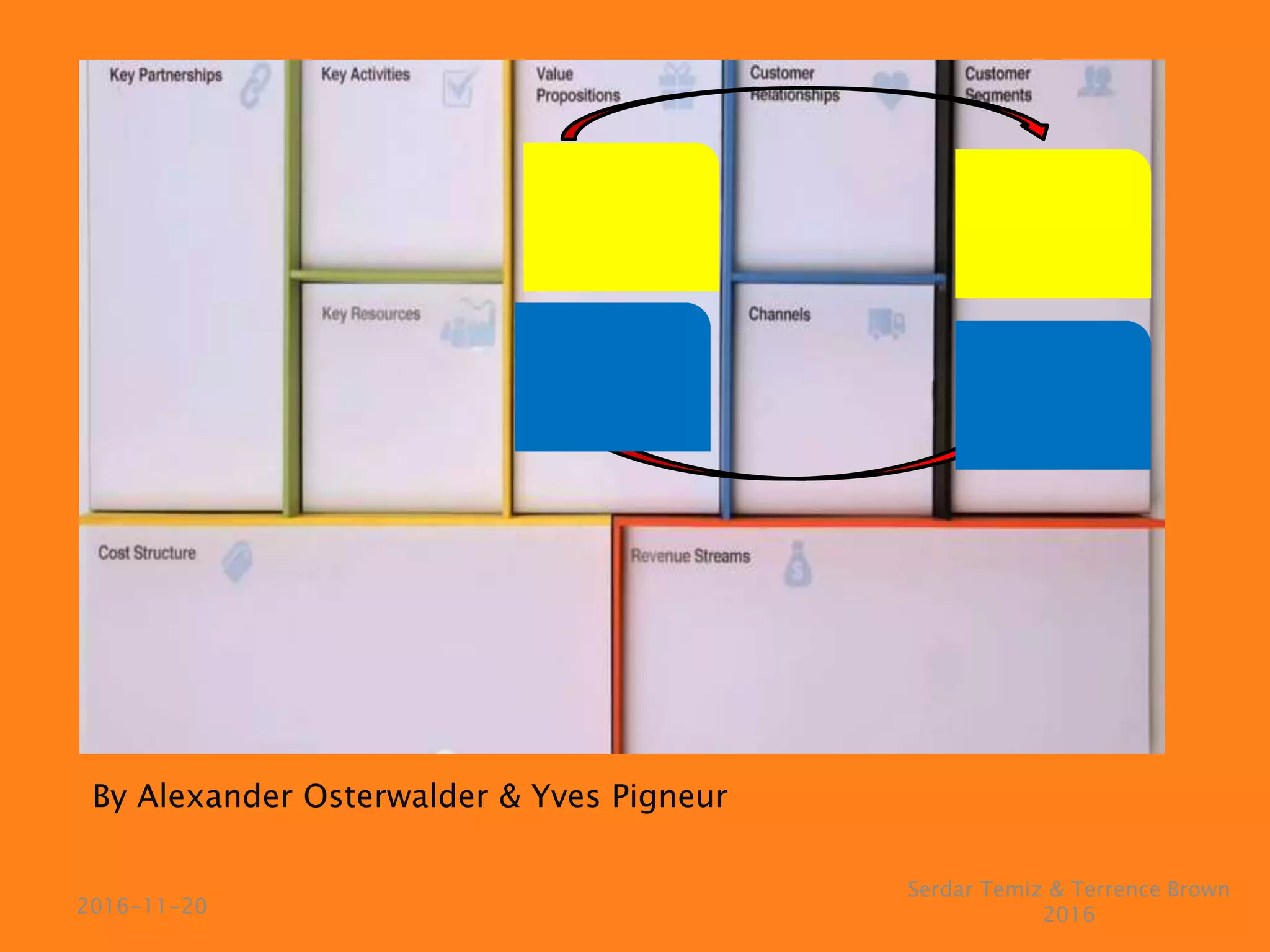
By Alexander Osterwalder & Yves Pigneur
2016-11-20
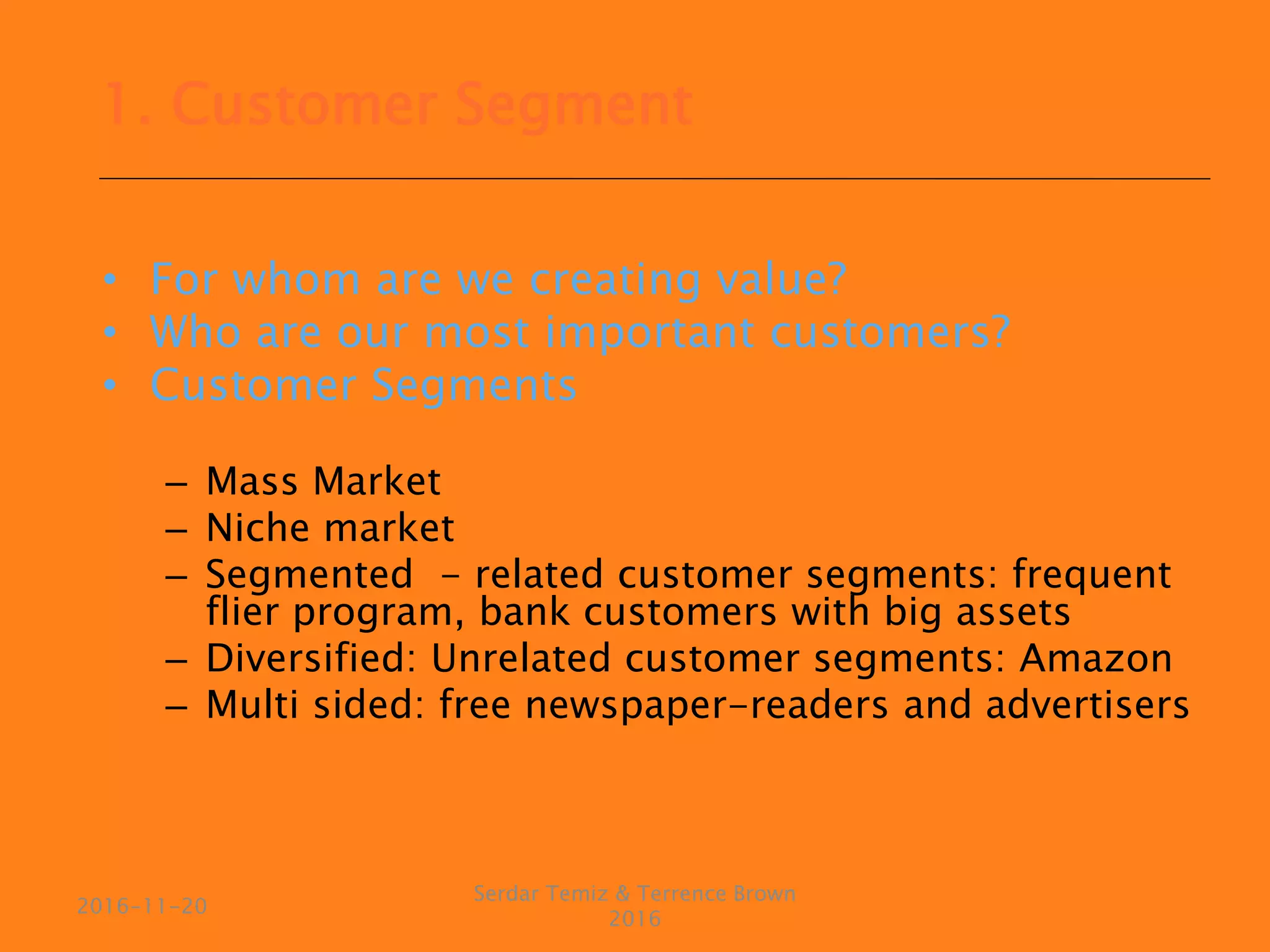
• For whom are we creating value?
• Who are our most important customers?
• Customer Segments
– Mass Market
– Niche market
– Segmented - related customer segments: frequent
flier program, bank customers with big assets
– Diversified: Unrelated customer segments: Amazon
– Multi sided: free newspaper-readers and advertisers
Serdar Temiz & Terrence Brown
2016
2016-11-20
1. Customer Segment
Find a Customer-I
• Why?
• Who is your customer?
Grave, School, hospital, apotek, free
newspaper
• Can everyone be your customer?
• "people who want to buy a flat,"
• "anyone needs job"
• “Everyone who goes to university”
Serdar Temiz & Terrence Brown
KTH Stockholm 2014
Find a Customer-II
• Find a customer for solving a pain
• Use the Customer Profile
• Describe who is making purchasing
decision?
IT ? Operations Group? Management?
• Make sure they are happy
• Market is important but
-do not only think market
• Billion dollar market does not start in few
minutes
Serdar Temiz & Terrence Brown
KTH Stockholm 2014
Q’s for Customer
IDENTIFIABLE – what distinguishes them?
MEASURABLE – how many belong to your
target segment?
REACHABLE – how to reach, communicate
with each segment
WILLING– do they want it?
ABLE– they want but can they afford it?
Serdar Temiz & Terrence Brown
KTH Stockholm 2014
Q’s for Customer - Macro
Level
• Population size
• Population character
• Disposable income levels
• Educational background
• Primary languages
• Infrastructure
• Regulations
• Political affiliation
• And so on…
Serdar Temiz & Terrence Brown
KTH Stockholm 2014
• Customer is important but you can not give all they
want
• Learn to stay No,
• Learn to focus
• Learn to ”change and adopt”
• They may not know/ may not able to explain
what they want: buying process is mysterious
Serdar Temiz & Terrence Brown
2016
2016-11-20
Keep in Mind Paradox
• A bundle that meets that meets a customer's needs or solve
his/her problem.
• Benefits can be tangible and intangible
• Reason why customers pick one business or another.
• Can be
– innovative, new disruptive offer.
– similar to existing offers but just added feature or
attribute in some sort of way.
Serdar Temiz & Terrence Brown
2016
2016-11-20
2. Value Proposition
Some Elements that may add to
value
• newness
• customization
• getting job done
• support
• price
• design
• status/ brand
• Accessibility
• risk deduction
• usability
Serdar Temiz & Terrence Brown
KTH Stockholm 2014
• What pain do we solve for customer?
• What do we deliver for customer?
• What value do we develop for customer
• Which need of customer do we satisfy?
Serdar Temiz & Terrence Brown
2016
2016-11-20
2. Value Proposition – Q’s to Answer
By Alexander Osterwalder & Yves Pigneur
Serdar Temiz & Terrence Brown
20162016-11-20
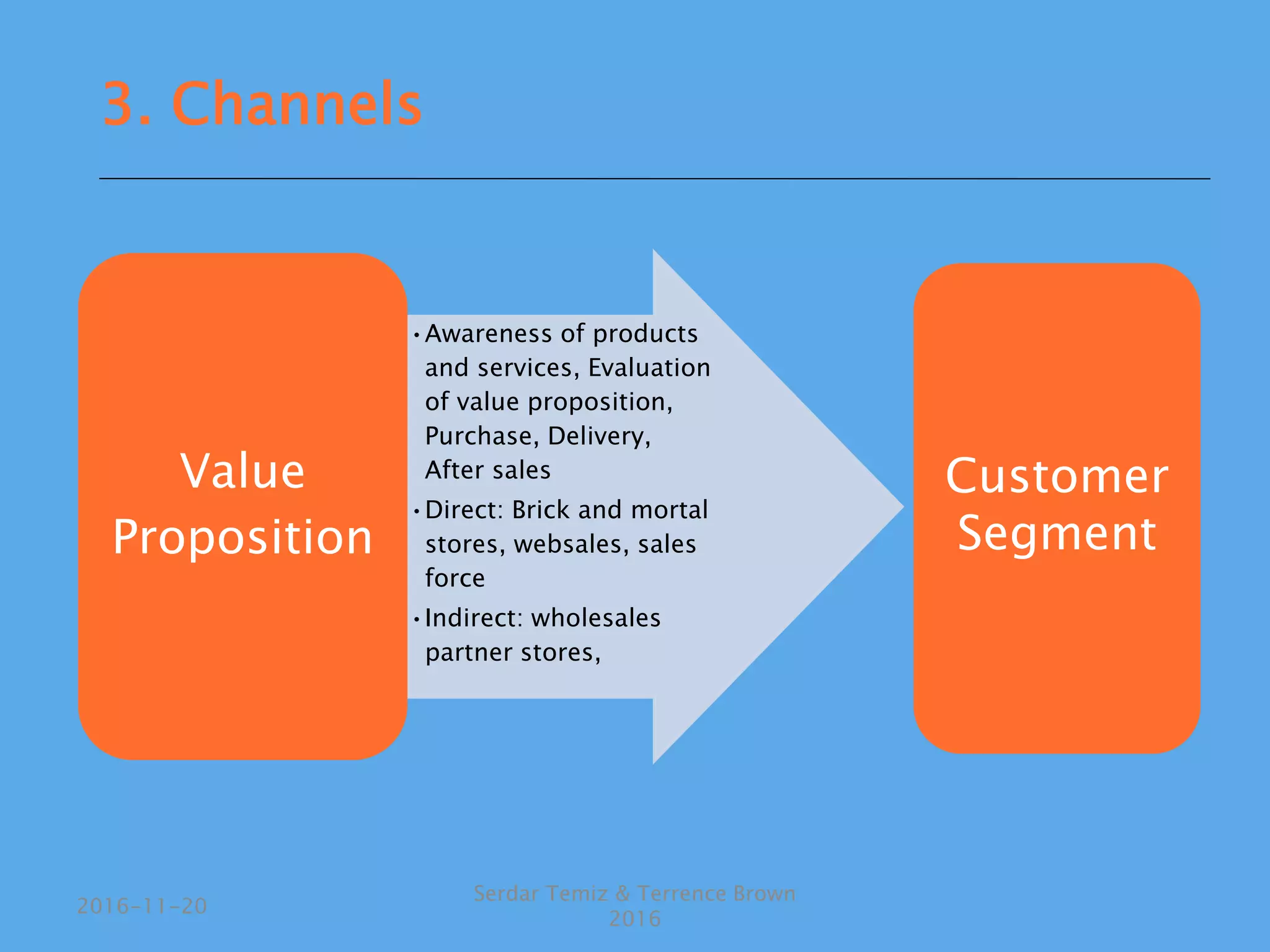
•Awareness of products
and services, Evaluation
of value proposition,
Purchase, Delivery,
After sales
•Direct: Brick and mortal
stores, websales, sales
force
•Indirect: wholesales
partner stores,
Value
Proposition
Customer
Segment
Serdar Temiz & Terrence Brown
2016
2016-11-20
3. Channels
Serdar Temiz & Terrence Brown
2016
2016-11-20
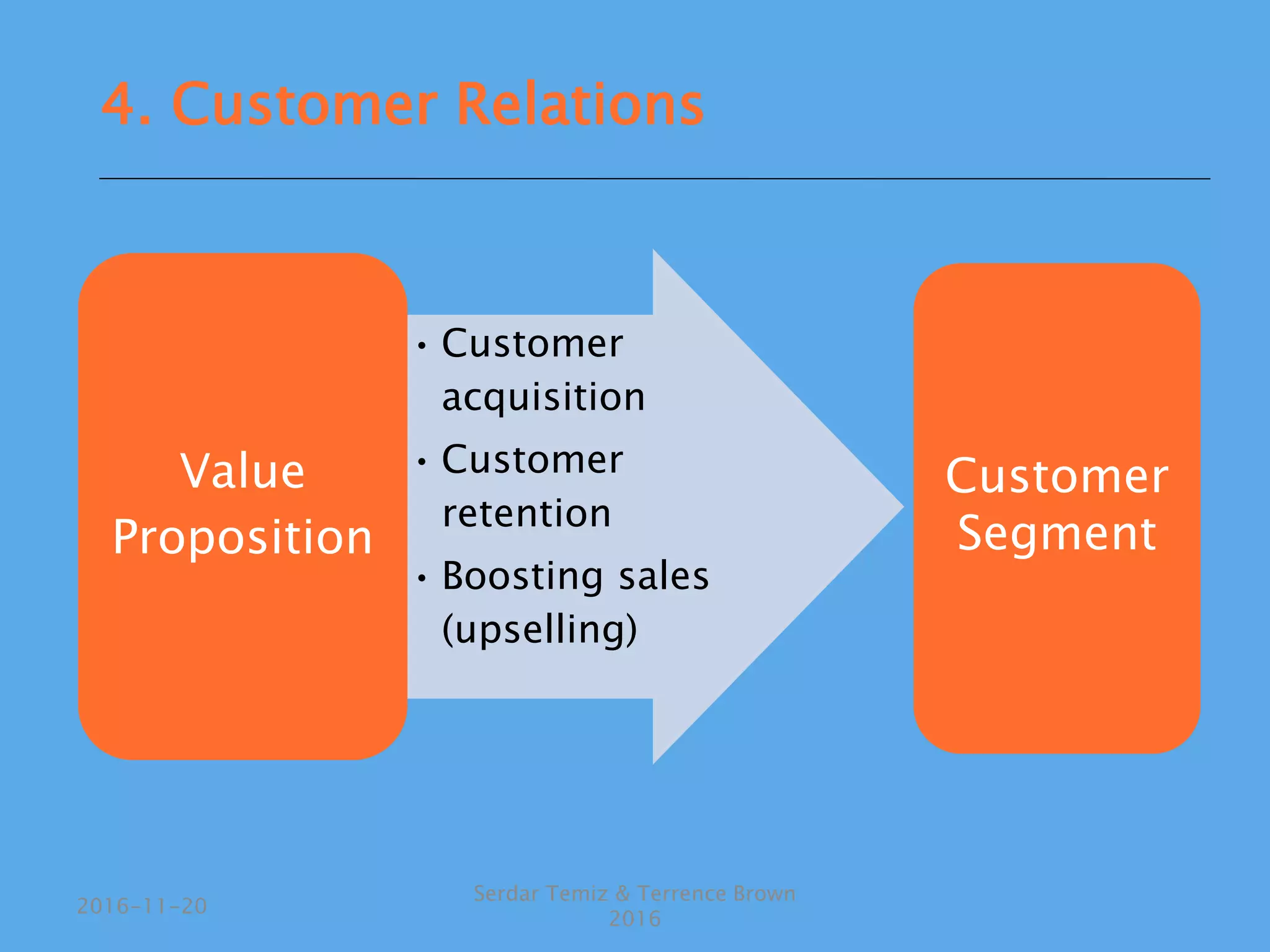
4. Customer Relations
• Customer
acquisition
• Customer
retention
• Boosting sales
(upselling)
Value
Proposition
Customer
Segment
4. Customer Relationships
• What type of relationship does
each of our Customer Segments
expect us to establish and
maintain with them?
• Which ones have we established?
• How costly are they?
• How are they integrated with the
rest of our business model?
Serdar Temiz & Terrence Brown
KTH Stockholm 2014
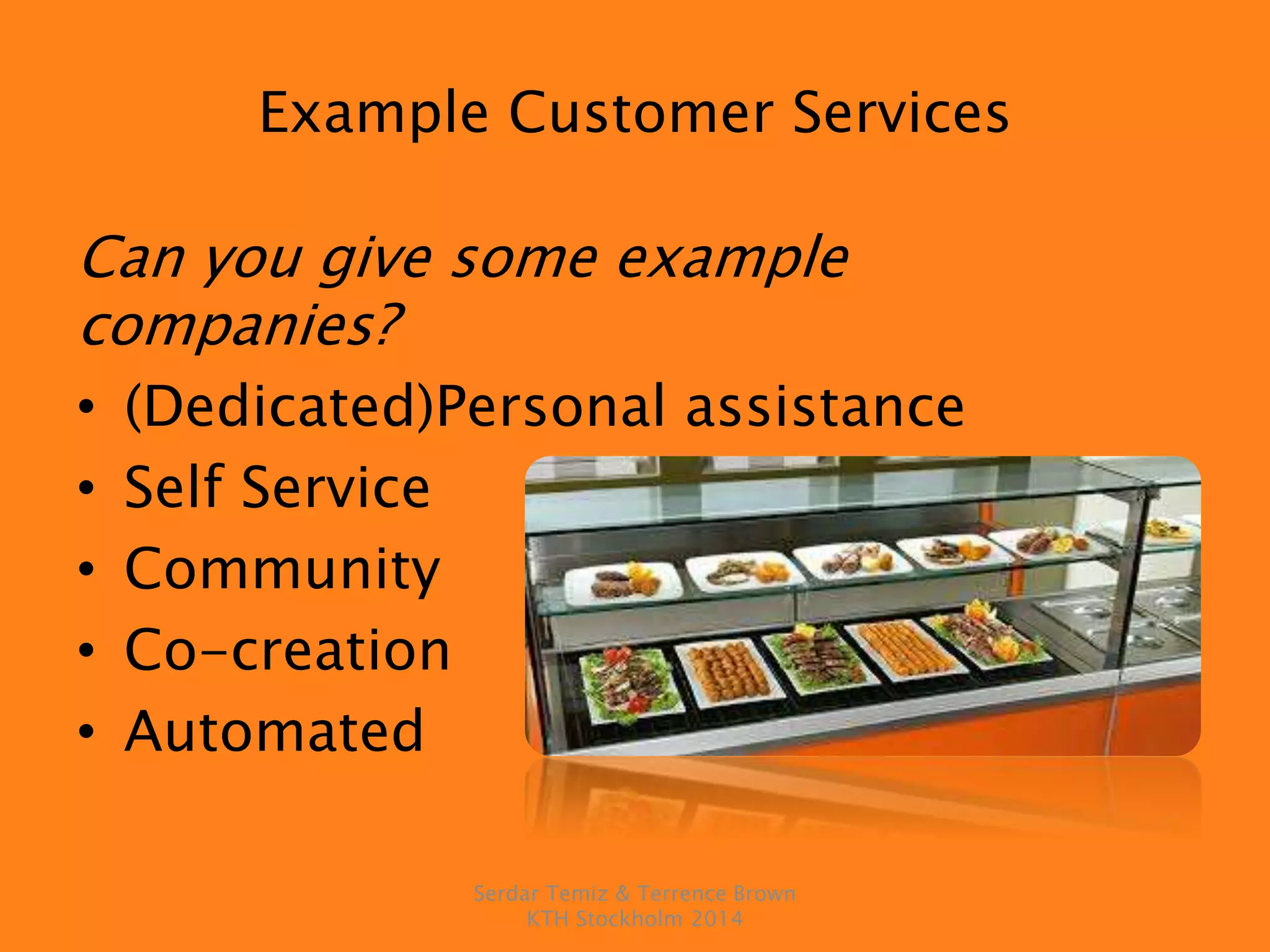
Example Customer Services
Can you give some example
companies?
• (Dedicated)Personal assistance
• Self Service
• Community
• Co-creation
• Automated
Serdar Temiz & Terrence Brown
KTH Stockholm 2014
Value
Proposition
Customer
Segment
• Asset sale
• Usage fee: use more, pay more
• Subscription: monthly, yearly
• Leasing/Lending/Renting
• Licensing: patents, license fee
• Brokerage fees
• Advertising
Fixed
pricing
Dynamic
pricing
Serdar Temiz & Terrence Brown
2016
2016-11-20
Channels
5. Revenue Streams
Fixed
pricing
Dynamic
pricing
• List price
• Product feature
dependent
• Customer segment
dependent
• Volume dependent
• Yield management : hotels,
airlines
• Real-time-market :supply
and demand
• Auctions Price
• Negotiation
Serdar Temiz & Terrence Brown
2016
2016-11-20
Value
Proposition
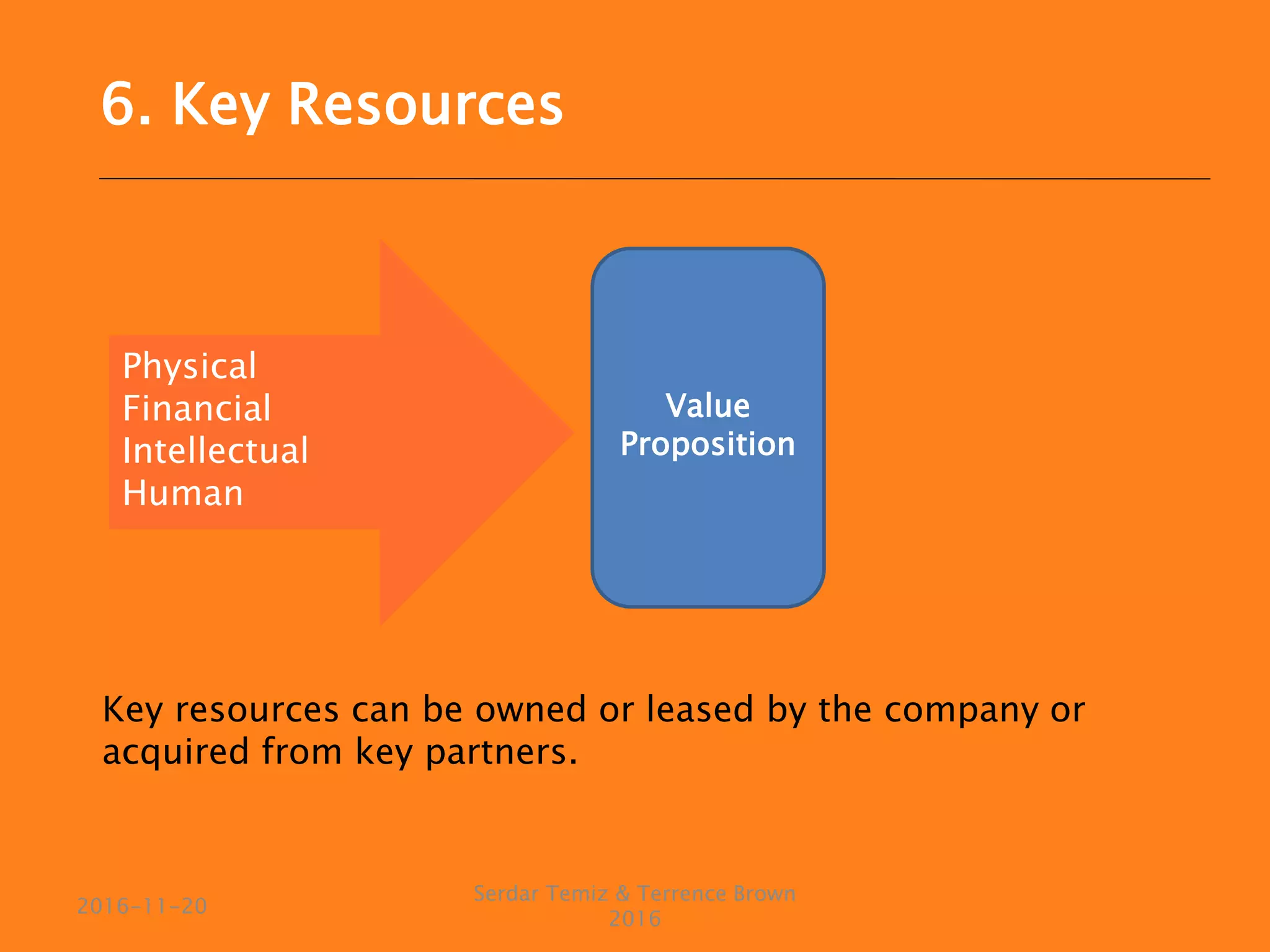
Physical
Financial
Intellectual
Human
Key resources can be owned or leased by the company or
acquired from key partners.
Serdar Temiz & Terrence Brown
2016
2016-11-20
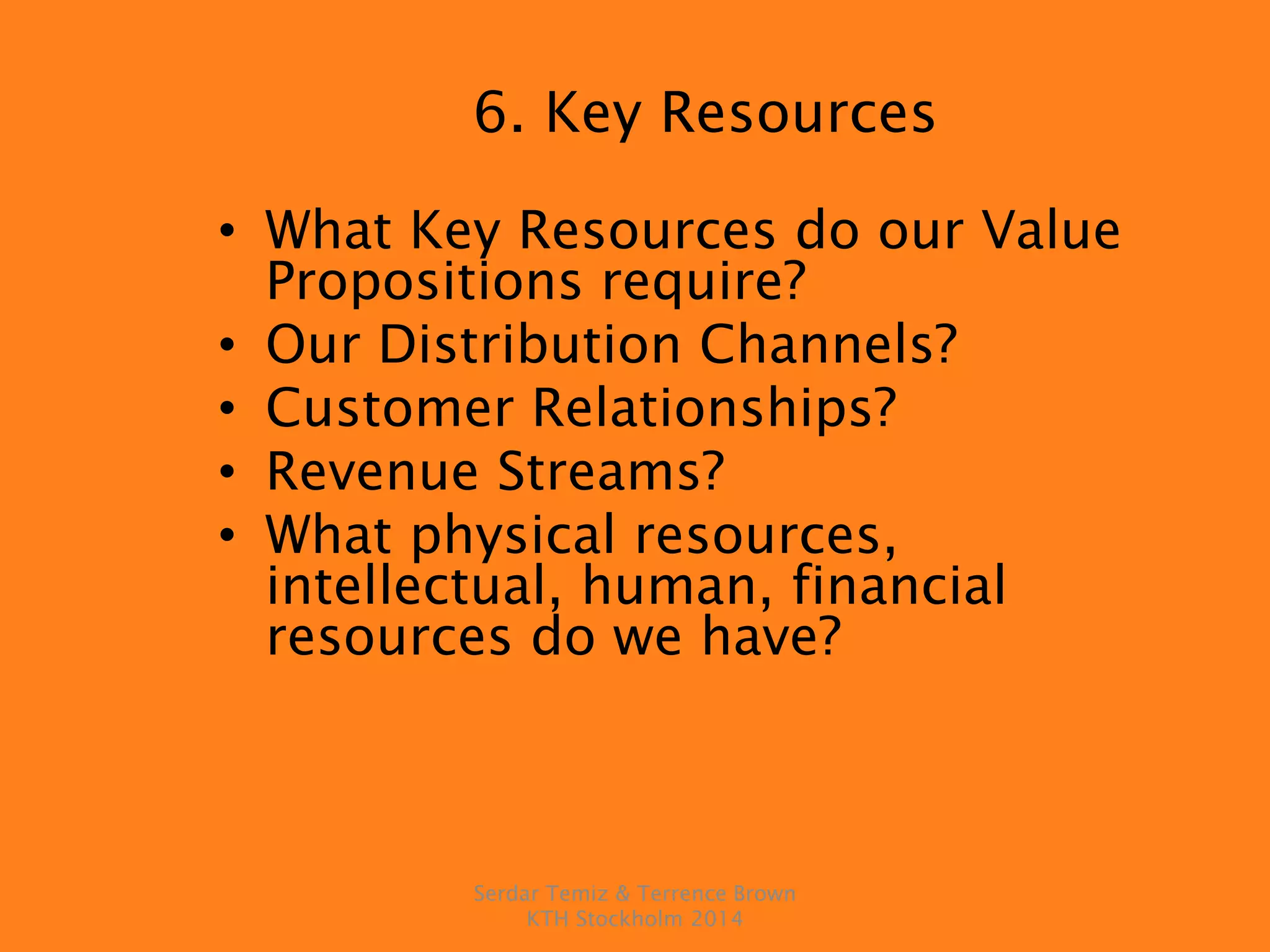
6. Key Resources
6. Key Resources
• What Key Resources do our Value
Propositions require?
• Our Distribution Channels?
• Customer Relationships?
• Revenue Streams?
• What physical resources,
intellectual, human, financial
resources do we have?
Serdar Temiz & Terrence Brown
KTH Stockholm 2014
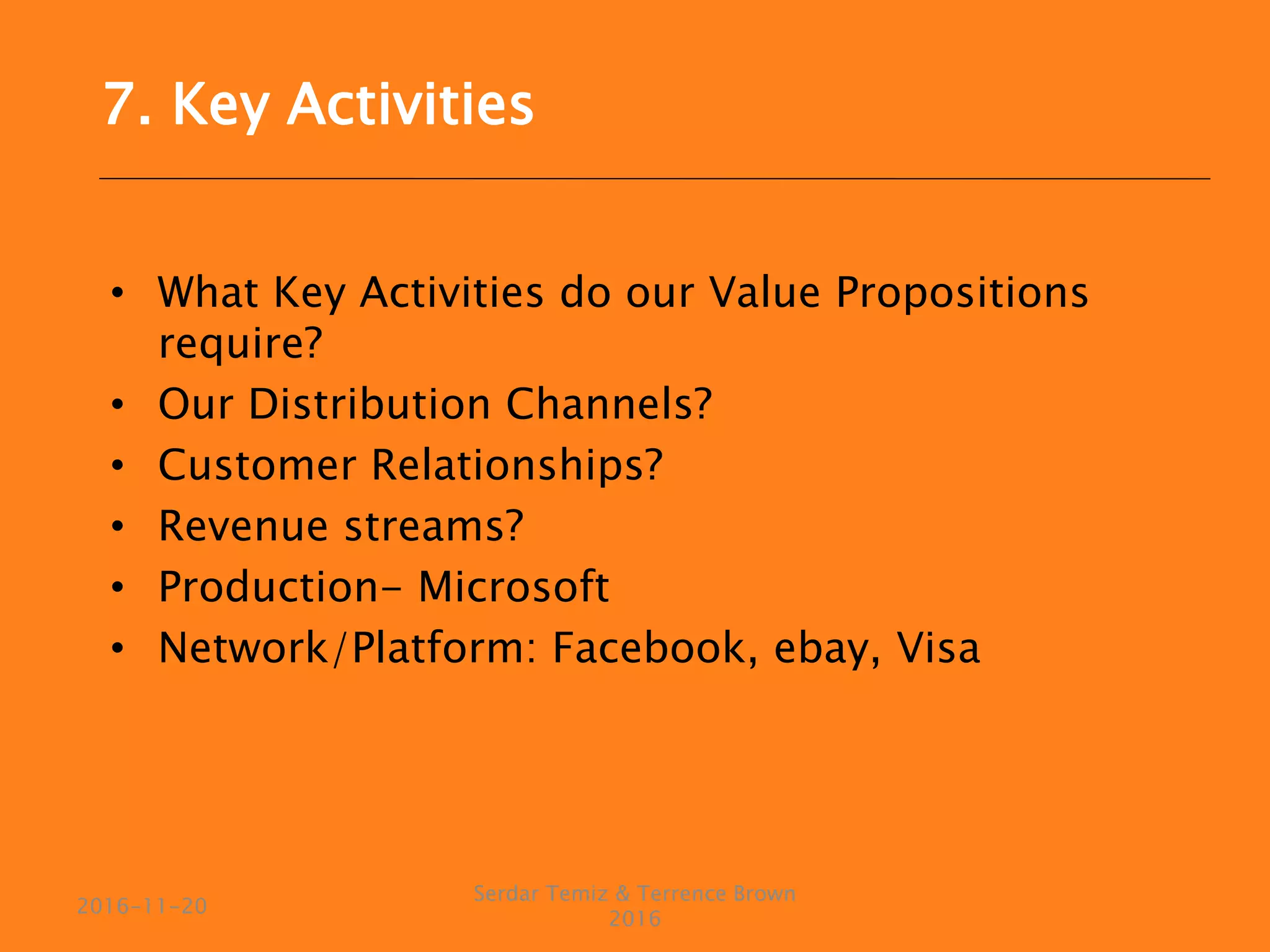
• What Key Activities do our Value Propositions
require?
• Our Distribution Channels?
• Customer Relationships?
• Revenue streams?
• Production- Microsoft
• Network/Platform: Facebook, ebay, Visa
Serdar Temiz & Terrence Brown
2016
2016-11-20
7. Key Activities
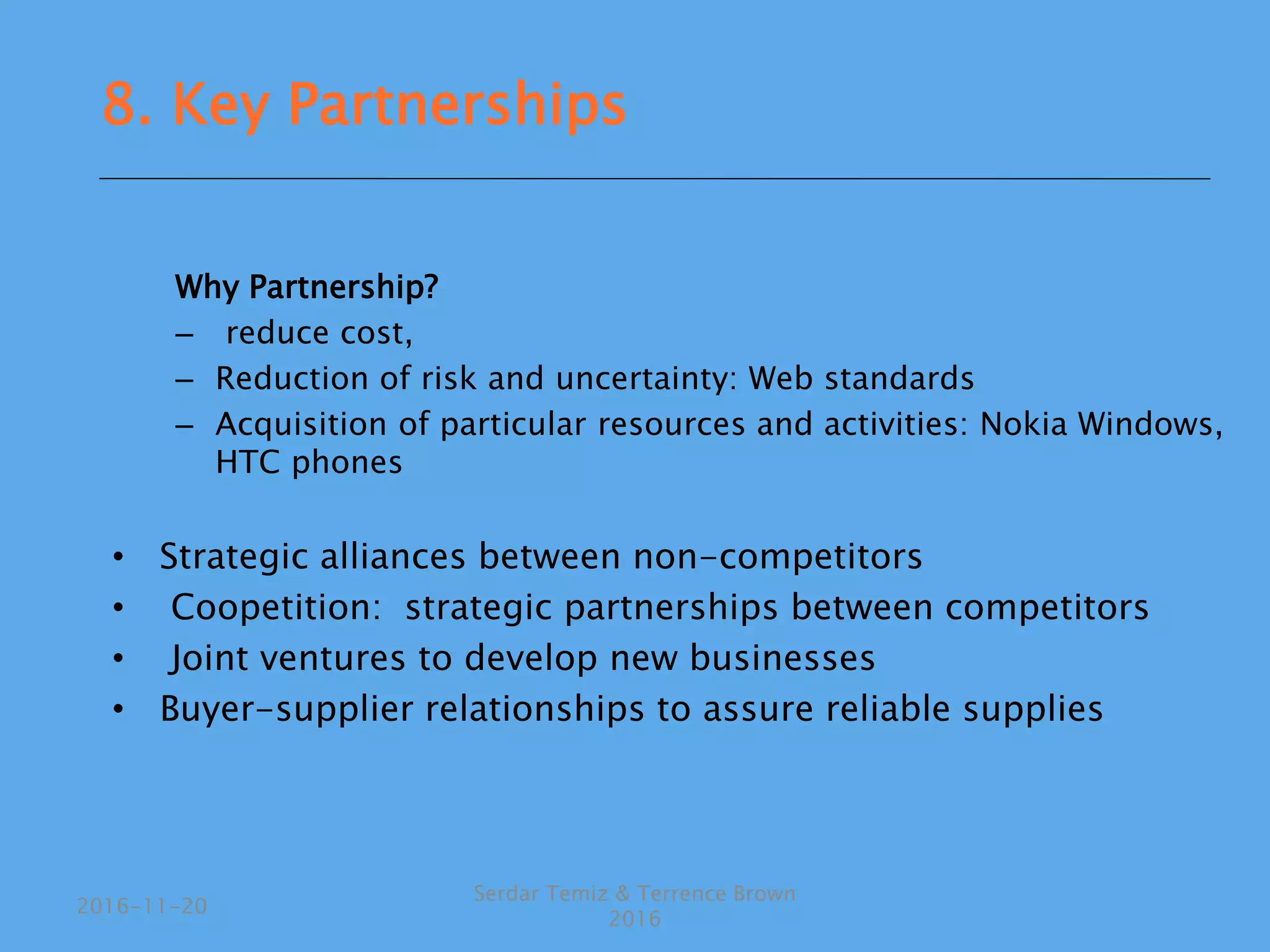
Why Partnership?
– reduce cost,
– Reduction of risk and uncertainty: Web standards
– Acquisition of particular resources and activities: Nokia Windows,
HTC phones
• Strategic alliances between non-competitors
• Coopetition: strategic partnerships between competitors
• Joint ventures to develop new businesses
• Buyer-supplier relationships to assure reliable supplies
Serdar Temiz & Terrence Brown
2016
2016-11-20
8. Key Partnerships
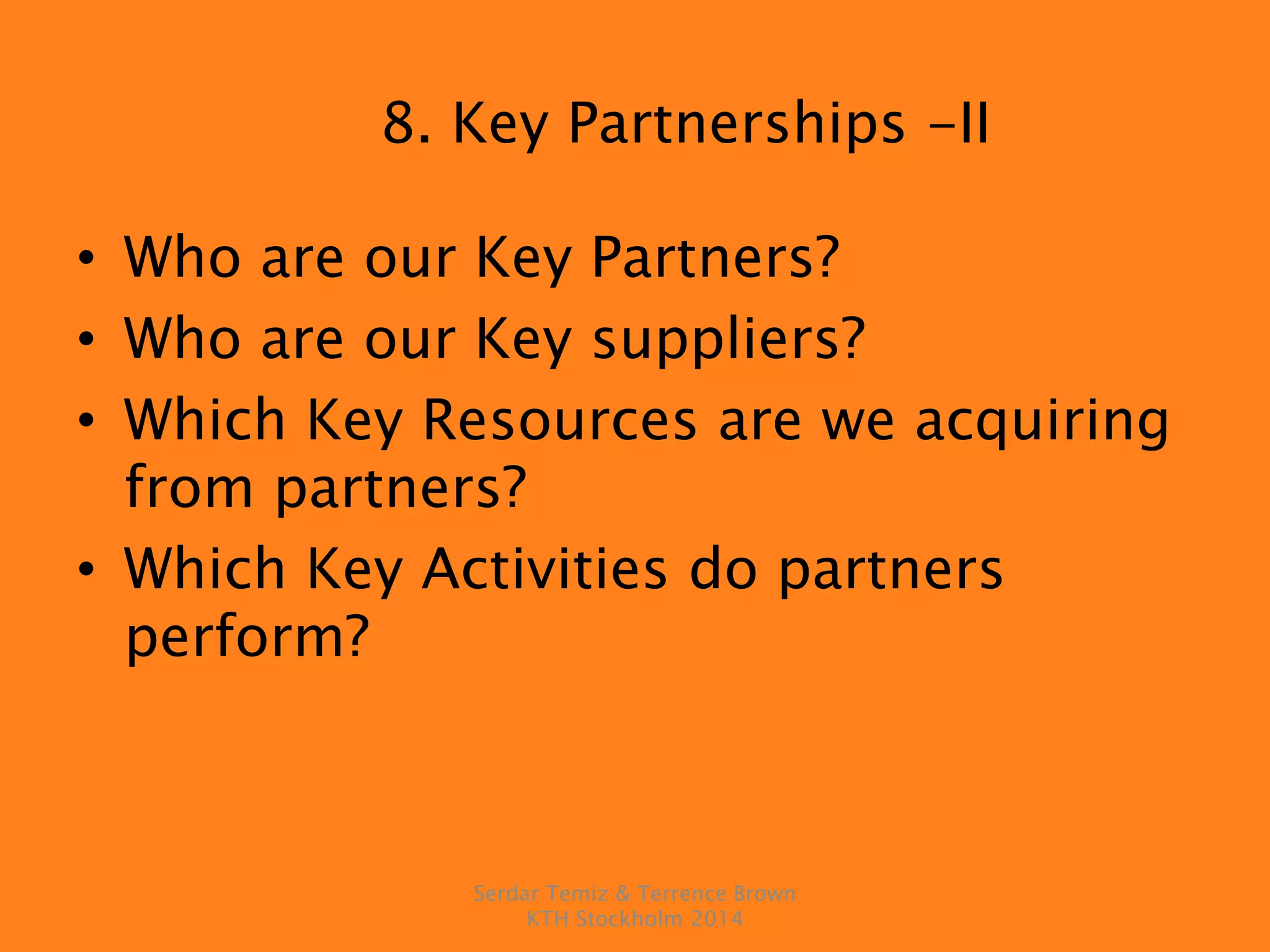
8. Key Partnerships -II
• Who are our Key Partners?
• Who are our Key suppliers?
• Which Key Resources are we acquiring
from partners?
• Which Key Activities do partners
perform?
Serdar Temiz & Terrence Brown
KTH Stockholm 2014
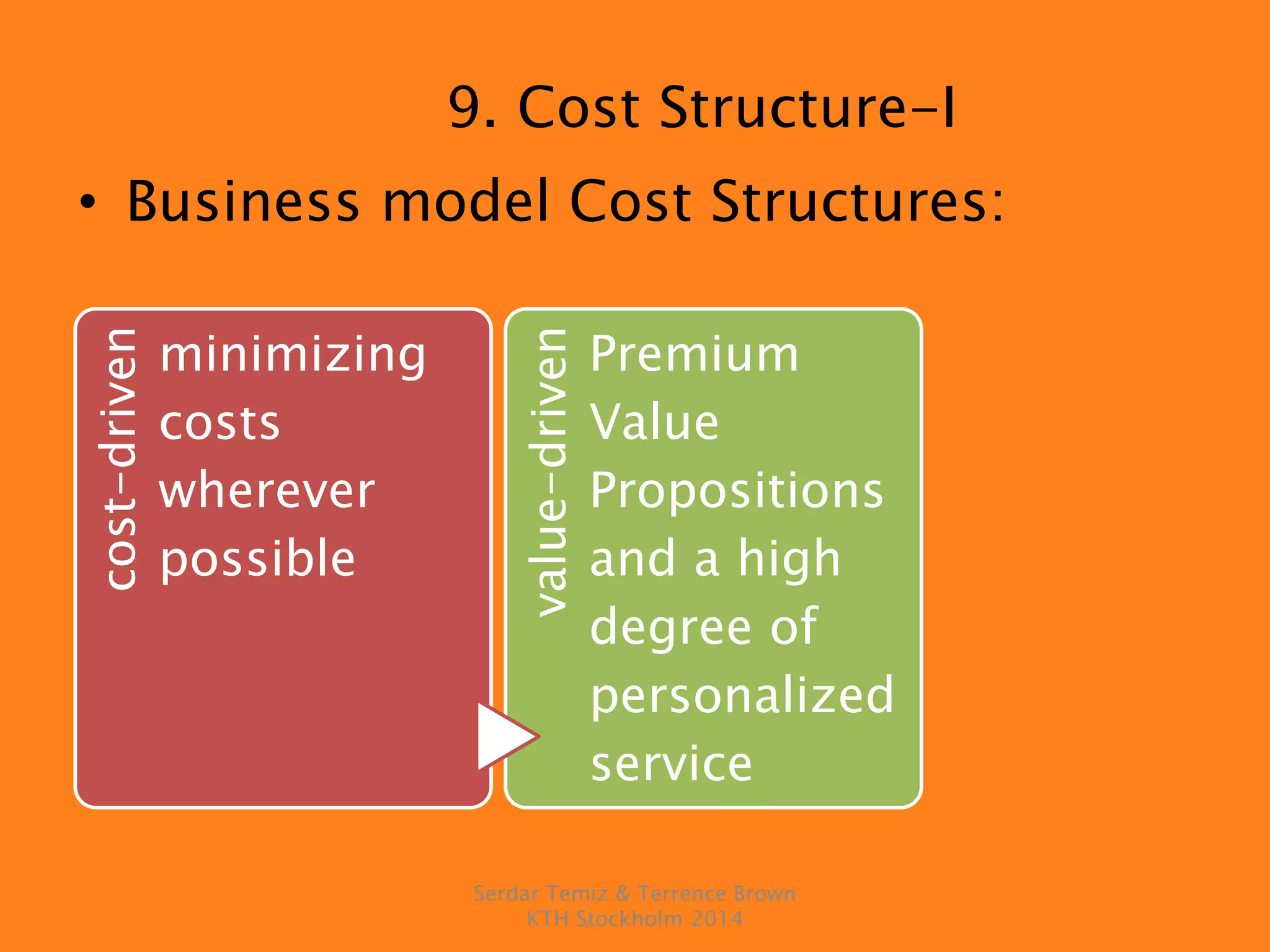
9. Cost Structure-I
• Business model Cost Structures:
cost-driven
minimizing
costs
wherever
possible value-driven
Premium
Value
Propositions
and a high
degree of
personalized
service
Serdar Temiz & Terrence Brown
KTH Stockholm 2014
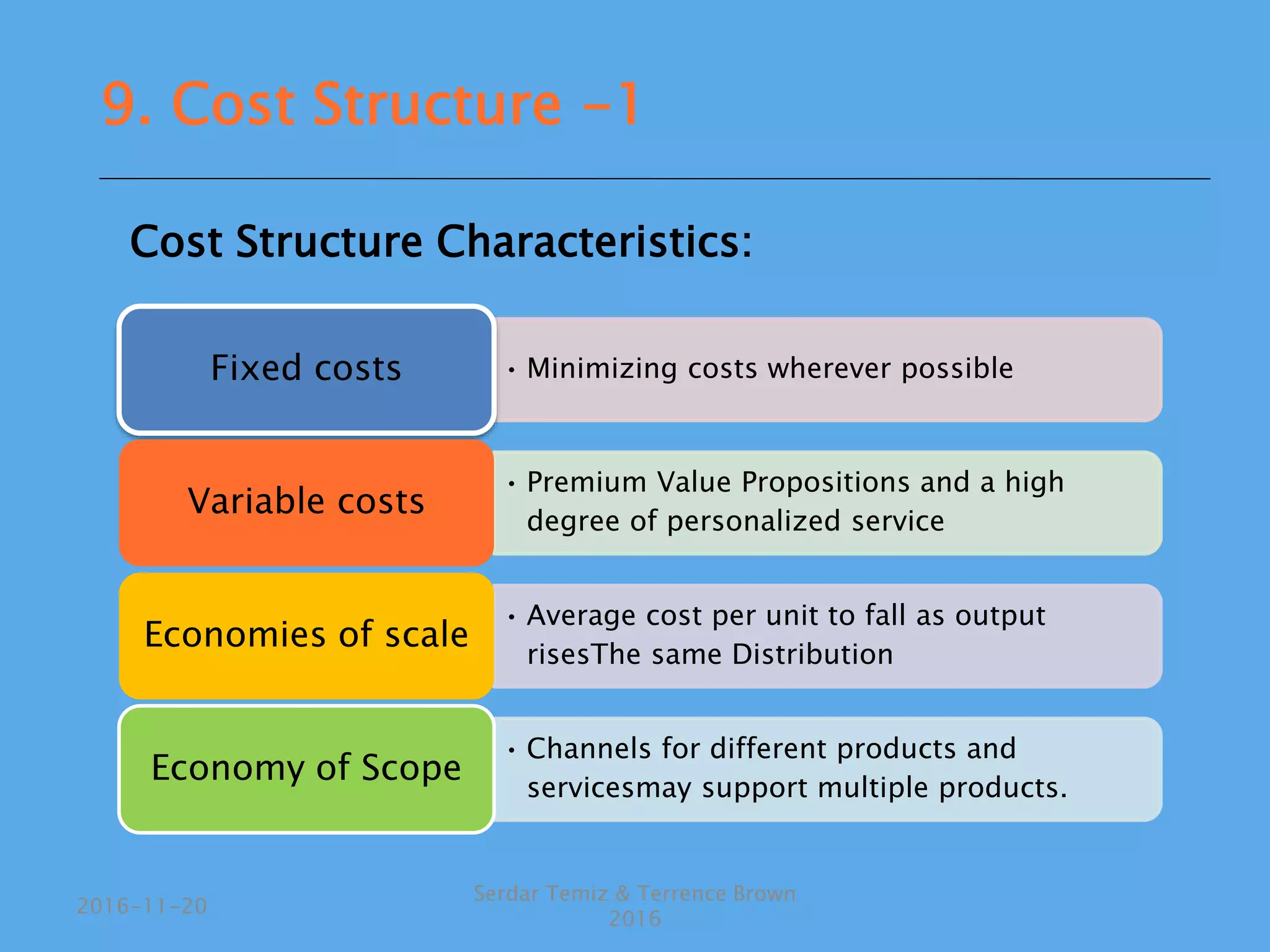
Cost Structure Characteristics:
• Minimizing costs wherever possibleFixed costs
• Premium Value Propositions and a high
degree of personalized service
Variable costs
• Average cost per unit to fall as output
risesThe same Distribution
Economies of scale
• Channels for different products and
servicesmay support multiple products.
Economy of Scope
Serdar Temiz & Terrence Brown
2016
2016-11-20
9. Cost Structure -1
Serdar Temiz & Terrence Brown
20162016-11-20
By Alexander Osterwalder & Yves Pigneur
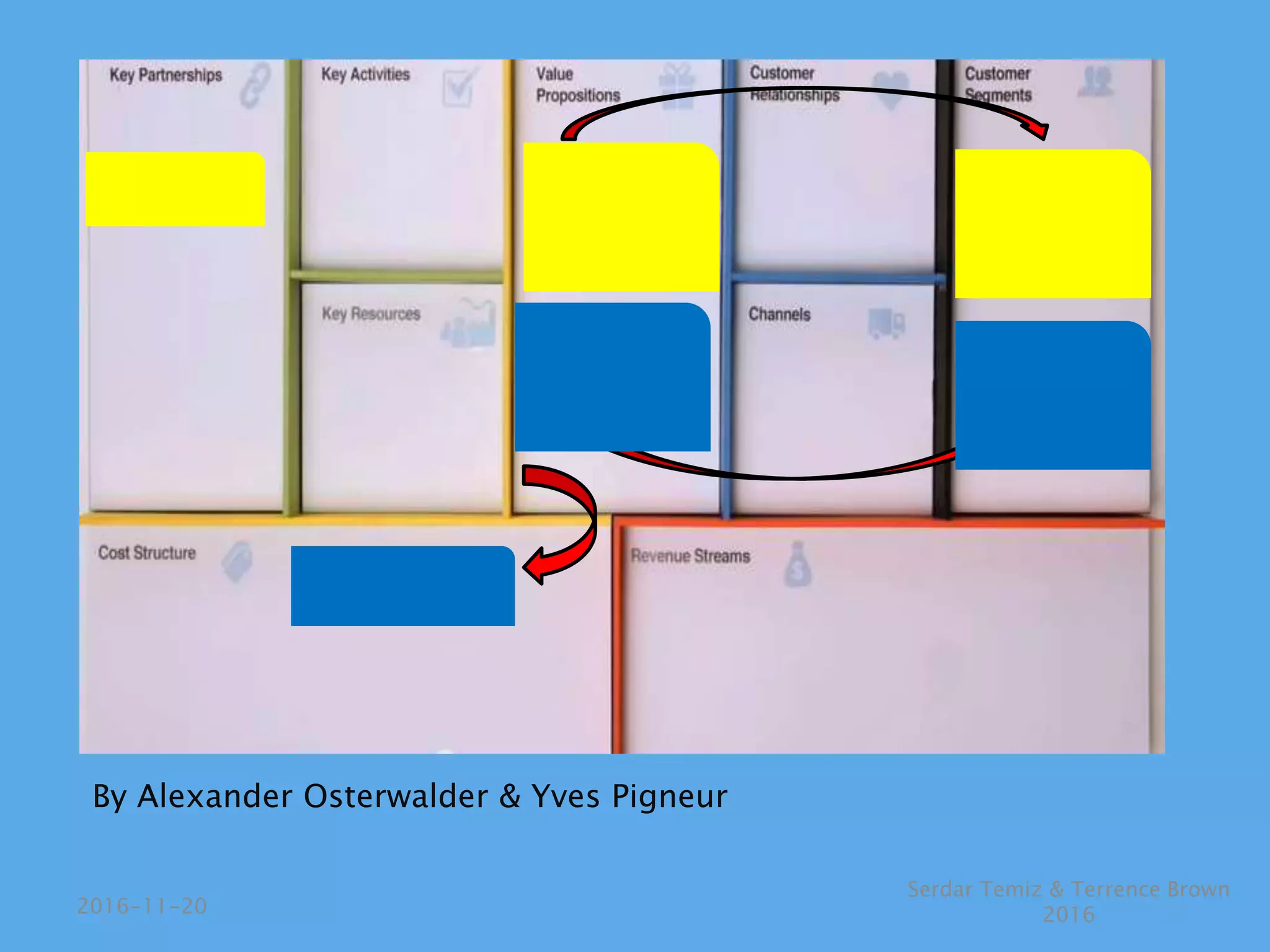
Keep in Mind !
Serdar Temiz & Terrence Brown
2016
2016-11-20
Serdar Temiz & Terrence Brown
20162016-11-20
By Alexander Osterwalder & Yves Pigneur
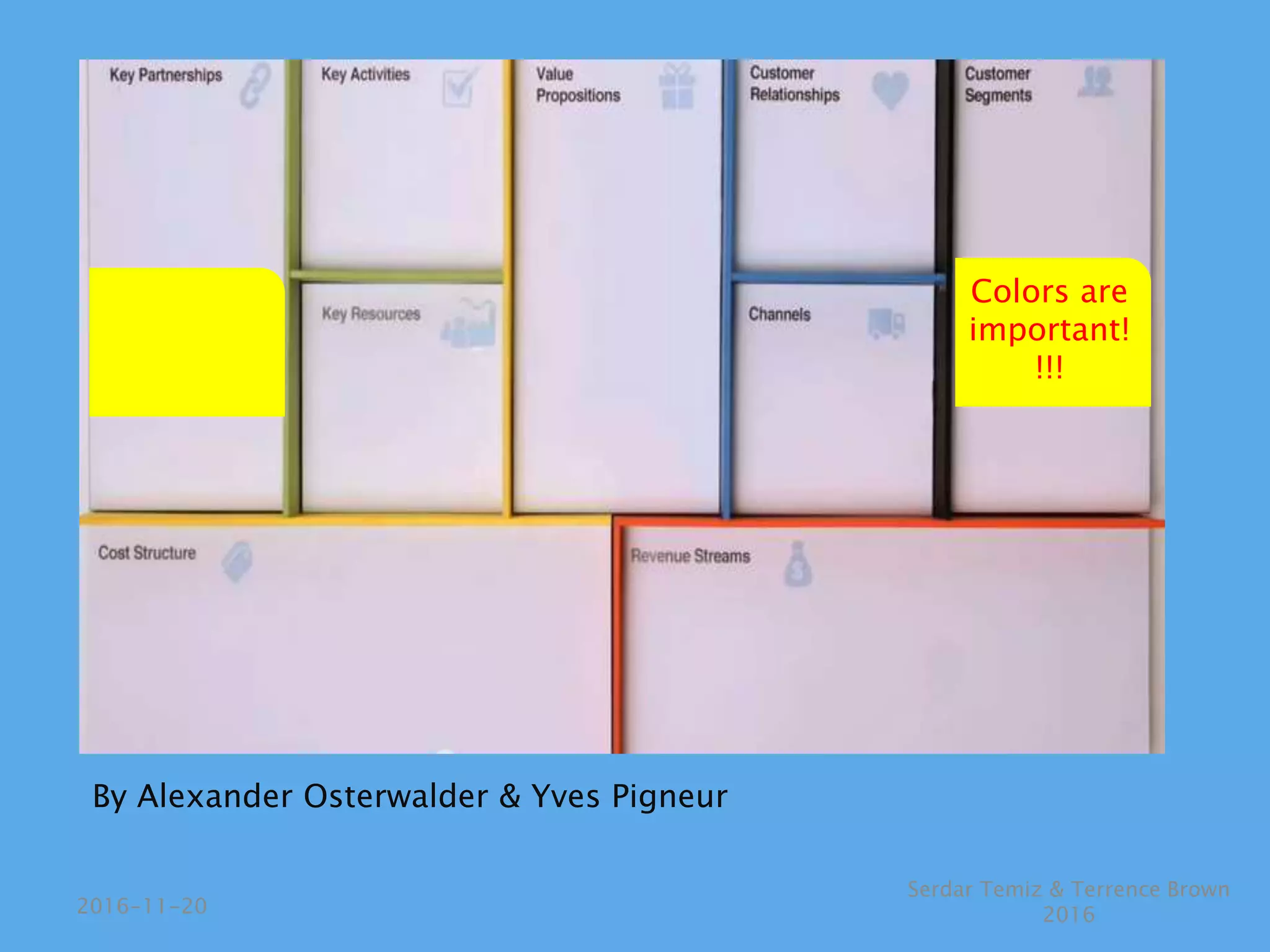
Colors are
important!
!!!
By Alexander Osterwalder & Yves Pigneur
Serdar Temiz & Terrence Brown
20162016-11-20
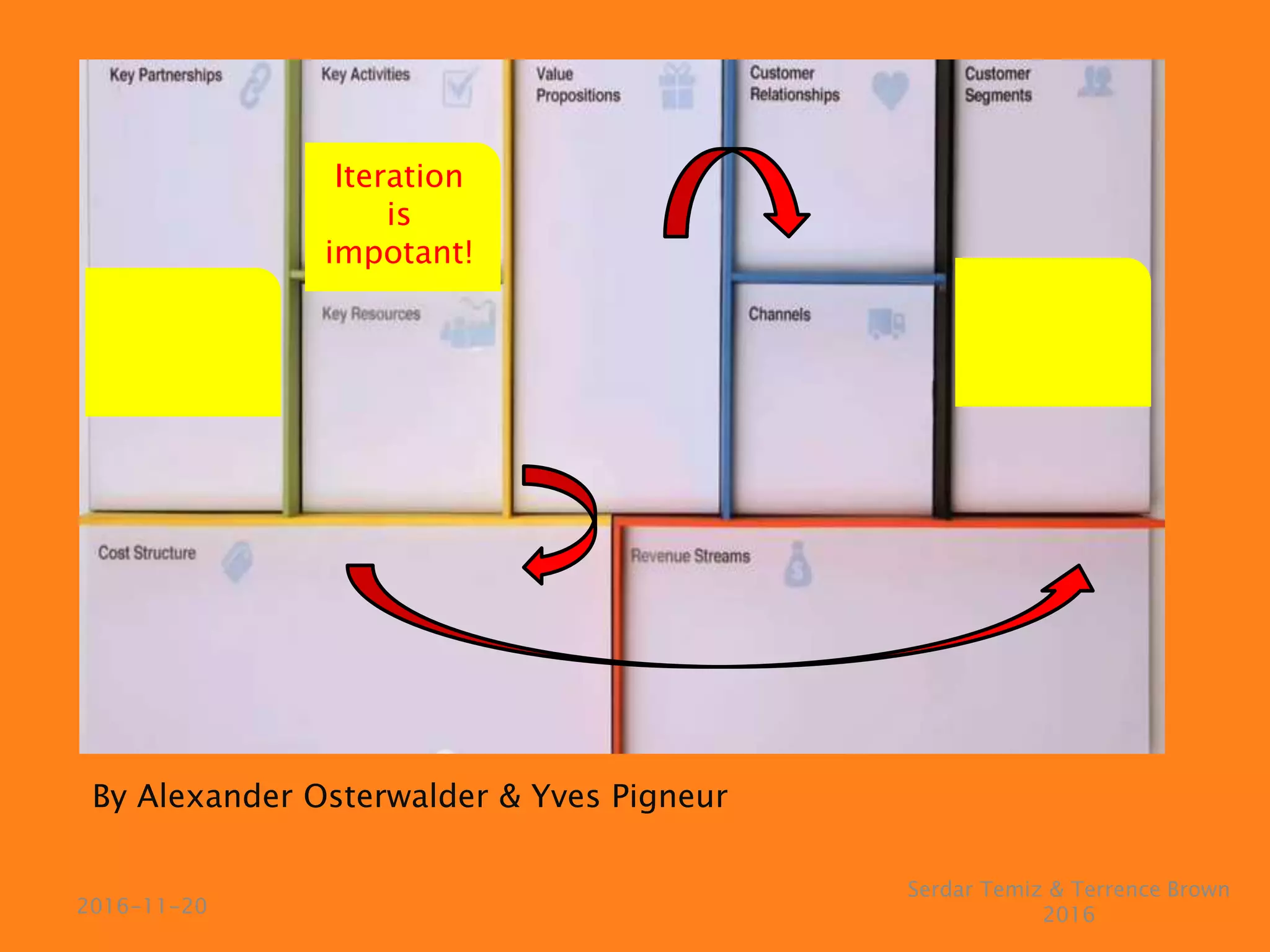
Iteration
is
impotant!
By Alexander Osterwalder & Yves Pigneur
Serdar Temiz & Terrence Brown
20162016-11-20
Thank you!
Slide will be on slideshare
Serdar Temiz
twitter: @serdar_temiz
www.serdartemiz.com
temiz@kth.se
hi@serdartemiz.com
Serdar Temiz & Terrence Brown
2016
2016-11-20

Busıness Model Innovation Business Model Canvas Toolbox 2016

  • 1.
    Serdar Temiz temiz@kth.se BMI- KTH2016 BUSINESS TOOLBOX Business Model Canvas
  • 2.
    Serdar Temiz Social Entrepreneur PhD Candidate LecturerEntrepreneurship, Technology Entrepreneurship Open and User Innovation, Chairman Previous life: IT support,Telecom software Engineer, .NET, Java developer, Project Manager, Business Developer B.S, M.Sc, MBA & MA, www.sciencebacker.com www.okfn.se / www.okfn.org
  • 3.
    Some Questions • Whatis Invention • What is Innovation Serdar Temiz & Terrence Brown 20162016-11-20
  • 4.
    There are manyinventions, but far fewer innovations. An invention is a novel idea Innovation is the commercialization of that novel idea Serdar Temiz & Terrence Brown 2016 2016-11-20
  • 5.
    Types of Innovation 1.Technology innovation 2. Process innovation 3. Product & service innovation 4. Business Model innovation Serdar Temiz & Terrence Brown 2016 2016-11-20
  • 6.
    Process innovation Implement ation ofa new or significantl y improved production or delivery method Serdar Temiz & Terrence Brown 2016 2016-11-20
  • 7.
    Technology innovation Serdar Temiz& Terrence Brown 2016 2016-11-20
  • 8.
    Product / serviceinnovation Serdar Temiz & Terrence Brown 2016 2016-11-20
  • 10.
    Definitions • “the content,structure, and governance of transactions designed so as to create value through the exploitation of business opportunities” (Zott & Amit, 2001 p 494-495) • “defines how the enterprise creates and delivers value to customers, and then converts payments received to profits” (Teece, 2010 p 173) • “takes technological characteristics and potentials as inputs and converts them through customers and markets into economic outputs” (Chesbrough & Rosenbloom, 2002, p. 532) • The logic of the firm, the way it operates and how it creates value for its stakeholder (Casadesus & Ricart) • “a set of expectations about how the business will be successful in its environment” (Downing, 2005, p. 186) • “stories that explain how enterprises work” (Magretta, 2002, p. 87)
  • 11.
    A business Modelis.. The business model is a strategic plan to be implemented through organizational structures, processes, and systems in order to need customer needs. (one of many definitions) Serdar Temiz & Terrence Brown 2016 2016-11-20
  • 12.
    How Business ModelsEmerge (1 of 3) – The value chain is the string of activities that moves a product from the raw material stage, through manufacturing and distribution, and ultimately to the end user. Primary activities are directly concerned with the creation or delivery of a product or service. Support activities help to improve the effectiveness or efficiency of primary activities Raw Material Value Chain Primary & Secondary Activities + Margin Product / Service Serdar Temiz & Terrence Brown 2016 2016-11-20
  • 13.
    The Value Chain(again) "Competitive Advantage: Creating and Sustaining superior Performance" (1985). Serdar Temiz & Terrence Brown 2016 2016-11-20 How Business Models Emerge (2 of 3)
  • 14.
    The Value Chain(continued) Entrepreneurs look at the value chain of a product or a service to pinpoint where the value chain can be made more effective or to spot where additional “value” can be added. 2016-11-20 How Business Models Emerge (3 of 3)
  • 15.
    ... can be,even more important than tech innovation! Serdar Temiz & Terrence Brown 2016 2016-11-20 RIGHT BUSINESS MODEL
  • 16.
    Finding and executingthe right business model can be the only/ main reason of the success 2016-11-20 BUSINESS MODEL INNOVATION
  • 17.
    What is this? SerdarTemiz & Terrence Brown 2016 2016-11-20
  • 18.
    Serdar Temiz &Terrence Brown 2016 2016-11-20 What is this? Xerox Model 914 Xerography ?
  • 19.
    Serdar Temiz &Terrence Brown 2016 2016-11-20
  • 20.
    Serdar Temiz &Terrence Brown 2016 2016-11-20
  • 21.
    Serdar Temiz &Terrence Brown 2016 2016-11-20
  • 22.
  • 23.
  • 24.
  • 25.
    Value Proposition Revenue Model Production Model Delivery Model Serdar Temiz &Terrence Brown 2016 2016-11-20 SIMPLE BUSINESS MODEL
  • 26.
    ValueProposition 10 RevenueModel 10 ProductionModel 10 DeliveryModel 10 HOW MANYOPTIONS DO WE HAVE? Serdar Temiz & Terrence Brown 2016 2016-11-20 SIMPLE BUSINESS MODEL
  • 27.
    • Customer needs •Competition • Technological change • Social change • Legal environment Serdar Temiz & Terrence Brown 2016 2016-11-20 Forces Affecting The Business Model
  • 28.
    Serdar Temiz &Terrence Brown 2016 2016-11-20
  • 29.
    Source: PwC, Thefuture of mobility, October 2013 Serdar Temiz & Terrence Brown 2016 2016-11-20
  • 30.
    There are differenttype of Business Model Maps. Serdar Temiz & Terrence Brown 2016 2016-11-20
  • 31.
    Serdar Temiz &Terrence Brown 2015 2016-11-20
  • 32.
    Mark Johnson Serdar Temiz& Terrence Brown 2015 2016-11-20
  • 33.
    Product/Service Ecosytem Customer EcoSystem Finance Value Serdar Temiz &Terrence Brown 2016 2016-11-20 Basic Business Model Map
  • 34.
    • A ValueProposition is an overall view of a company's bundle of products and services that are of value to the customer. • Customer Segments: segment(s) of customers a company wants to offer value to. • A Channel is a means of getting in touch with the customer. • The Relationship describes the kind of link a company establishes between itself and the customer. • The Key Activities describes the arrangement of activities and resources that are necessary to create value for the customer. Key Key Resources that can be deployed by the firm to create value including those that form the basis for a competitive advantage • Key Partnership is cooperative agreement between two or more companies in order to create value for the customer • The Cost Structure is the representation in money of all the means employed in the business model. • The Revenue Streams describes the way a company makes money through a variety of revenue flows. 2016-11-20 Serdar Temiz & Terrence Brown 2016
  • 35.
  • 36.
  • 37.
    1. Customer Segments 2.Value proposition 3. Channels 4. Customer Relationships 5. Revenue Streams 6. Key Resource 7. Key Activities 8. Key Partnerships 9. Cost Structure Serdar Temiz & Terrence Brown 2016 2016-11-20 The 9 Building Blocs of Business Model Canvas
  • 38.
    • A ValueProposition is an overall view of a company's bundle of products and services that are of value to the customer. • Customer Segments: segment(s) of customers a company wants to offer value to. • A Channel is a means of getting in touch with the customer. • The Relationship describes the kind of link a company establishes between itself and the customer. • The Key Activities describes the arrangement of activities and resources that are necessary to create value for the customer. Key Key Resources that can be deployed by the firm to create value including those that form the basis for a competitive advantage • Key Partnership is cooperative agreement between two or more companies in order to create value for the customer • The Cost Structure is the representation in money of all the means employed in the business model. • The Revenue Streams describes the way a company makes money through a variety of revenue flows. 2016-11-20 Serdar Temiz & Terrence Brown 2016
  • 39.
    Serdar Temiz &Terrence Brown 2016 By Alexander Osterwalder & Yves Pigneur 2016-11-20
  • 40.
    • For whomare we creating value? • Who are our most important customers? • Customer Segments – Mass Market – Niche market – Segmented - related customer segments: frequent flier program, bank customers with big assets – Diversified: Unrelated customer segments: Amazon – Multi sided: free newspaper-readers and advertisers Serdar Temiz & Terrence Brown 2016 2016-11-20 1. Customer Segment
  • 41.
    Find a Customer-I •Why? • Who is your customer? Grave, School, hospital, apotek, free newspaper • Can everyone be your customer? • "people who want to buy a flat," • "anyone needs job" • “Everyone who goes to university” Serdar Temiz & Terrence Brown KTH Stockholm 2014
  • 42.
    Find a Customer-II •Find a customer for solving a pain • Use the Customer Profile • Describe who is making purchasing decision? IT ? Operations Group? Management? • Make sure they are happy • Market is important but -do not only think market • Billion dollar market does not start in few minutes Serdar Temiz & Terrence Brown KTH Stockholm 2014
  • 43.
    Q’s for Customer IDENTIFIABLE– what distinguishes them? MEASURABLE – how many belong to your target segment? REACHABLE – how to reach, communicate with each segment WILLING– do they want it? ABLE– they want but can they afford it? Serdar Temiz & Terrence Brown KTH Stockholm 2014
  • 44.
    Q’s for Customer- Macro Level • Population size • Population character • Disposable income levels • Educational background • Primary languages • Infrastructure • Regulations • Political affiliation • And so on… Serdar Temiz & Terrence Brown KTH Stockholm 2014
  • 45.
    • Customer isimportant but you can not give all they want • Learn to stay No, • Learn to focus • Learn to ”change and adopt” • They may not know/ may not able to explain what they want: buying process is mysterious Serdar Temiz & Terrence Brown 2016 2016-11-20 Keep in Mind Paradox
  • 46.
    • A bundlethat meets that meets a customer's needs or solve his/her problem. • Benefits can be tangible and intangible • Reason why customers pick one business or another. • Can be – innovative, new disruptive offer. – similar to existing offers but just added feature or attribute in some sort of way. Serdar Temiz & Terrence Brown 2016 2016-11-20 2. Value Proposition
  • 47.
    Some Elements thatmay add to value • newness • customization • getting job done • support • price • design • status/ brand • Accessibility • risk deduction • usability Serdar Temiz & Terrence Brown KTH Stockholm 2014
  • 48.
    • What paindo we solve for customer? • What do we deliver for customer? • What value do we develop for customer • Which need of customer do we satisfy? Serdar Temiz & Terrence Brown 2016 2016-11-20 2. Value Proposition – Q’s to Answer
  • 49.
    By Alexander Osterwalder& Yves Pigneur Serdar Temiz & Terrence Brown 20162016-11-20
  • 50.
    •Awareness of products andservices, Evaluation of value proposition, Purchase, Delivery, After sales •Direct: Brick and mortal stores, websales, sales force •Indirect: wholesales partner stores, Value Proposition Customer Segment Serdar Temiz & Terrence Brown 2016 2016-11-20 3. Channels
  • 51.
    Serdar Temiz &Terrence Brown 2016 2016-11-20 4. Customer Relations • Customer acquisition • Customer retention • Boosting sales (upselling) Value Proposition Customer Segment
  • 52.
    4. Customer Relationships •What type of relationship does each of our Customer Segments expect us to establish and maintain with them? • Which ones have we established? • How costly are they? • How are they integrated with the rest of our business model? Serdar Temiz & Terrence Brown KTH Stockholm 2014
  • 53.
    Example Customer Services Canyou give some example companies? • (Dedicated)Personal assistance • Self Service • Community • Co-creation • Automated Serdar Temiz & Terrence Brown KTH Stockholm 2014
  • 54.
    Value Proposition Customer Segment • Asset sale •Usage fee: use more, pay more • Subscription: monthly, yearly • Leasing/Lending/Renting • Licensing: patents, license fee • Brokerage fees • Advertising Fixed pricing Dynamic pricing Serdar Temiz & Terrence Brown 2016 2016-11-20 Channels 5. Revenue Streams
  • 55.
    Fixed pricing Dynamic pricing • List price •Product feature dependent • Customer segment dependent • Volume dependent • Yield management : hotels, airlines • Real-time-market :supply and demand • Auctions Price • Negotiation Serdar Temiz & Terrence Brown 2016 2016-11-20
  • 56.
    Value Proposition Physical Financial Intellectual Human Key resources canbe owned or leased by the company or acquired from key partners. Serdar Temiz & Terrence Brown 2016 2016-11-20 6. Key Resources
  • 57.
    6. Key Resources •What Key Resources do our Value Propositions require? • Our Distribution Channels? • Customer Relationships? • Revenue Streams? • What physical resources, intellectual, human, financial resources do we have? Serdar Temiz & Terrence Brown KTH Stockholm 2014
  • 58.
    • What KeyActivities do our Value Propositions require? • Our Distribution Channels? • Customer Relationships? • Revenue streams? • Production- Microsoft • Network/Platform: Facebook, ebay, Visa Serdar Temiz & Terrence Brown 2016 2016-11-20 7. Key Activities
  • 59.
    Why Partnership? – reducecost, – Reduction of risk and uncertainty: Web standards – Acquisition of particular resources and activities: Nokia Windows, HTC phones • Strategic alliances between non-competitors • Coopetition: strategic partnerships between competitors • Joint ventures to develop new businesses • Buyer-supplier relationships to assure reliable supplies Serdar Temiz & Terrence Brown 2016 2016-11-20 8. Key Partnerships
  • 60.
    8. Key Partnerships-II • Who are our Key Partners? • Who are our Key suppliers? • Which Key Resources are we acquiring from partners? • Which Key Activities do partners perform? Serdar Temiz & Terrence Brown KTH Stockholm 2014
  • 61.
    9. Cost Structure-I •Business model Cost Structures: cost-driven minimizing costs wherever possible value-driven Premium Value Propositions and a high degree of personalized service Serdar Temiz & Terrence Brown KTH Stockholm 2014
  • 62.
    Cost Structure Characteristics: •Minimizing costs wherever possibleFixed costs • Premium Value Propositions and a high degree of personalized service Variable costs • Average cost per unit to fall as output risesThe same Distribution Economies of scale • Channels for different products and servicesmay support multiple products. Economy of Scope Serdar Temiz & Terrence Brown 2016 2016-11-20 9. Cost Structure -1
  • 63.
    Serdar Temiz &Terrence Brown 20162016-11-20 By Alexander Osterwalder & Yves Pigneur
  • 64.
    Keep in Mind! Serdar Temiz & Terrence Brown 2016 2016-11-20
  • 65.
    Serdar Temiz &Terrence Brown 20162016-11-20 By Alexander Osterwalder & Yves Pigneur Colors are important! !!!
  • 66.
    By Alexander Osterwalder& Yves Pigneur Serdar Temiz & Terrence Brown 20162016-11-20 Iteration is impotant!
  • 67.
    By Alexander Osterwalder& Yves Pigneur Serdar Temiz & Terrence Brown 20162016-11-20
  • 68.
    Thank you! Slide willbe on slideshare Serdar Temiz twitter: @serdar_temiz www.serdartemiz.com temiz@kth.se hi@serdartemiz.com Serdar Temiz & Terrence Brown 2016 2016-11-20

Editor's Notes

  • #15 This type of analysis may focus on (1) a single primary activity of the value chain (such as marketing and sales), (2) the interface between one stage of the value chain and another (such as the interface between operations and outgoing logistics), or (3) one of the support activities (such as human resource management).
  • #19 The Model 914 used the relatively new electrophotography process, which is a dry process that avoids the use of wet chemicals. In seeking potential marketing partners, Haloid repeatedly was turned down by the likes of Kodak, GE, and IBM, who had concluded that there was no future in the technology as seen through the lens of the then-prevalent business model. While the technology was superior to earlier copy methods, the cost of the machine was six to seven times more expensive than alternative technologies. The model of selling the equipment below cost and making up the difference by large margins in the sale of supplies was not viable because the cost of the supplies was about the same as that of the alternatives, so there was little room to maneuver. Xerox then decided to market the new product itself and developed a new business model to do so. The new model leased the equipment to the customer at a relatively low cost and then charged a per copy fee for copies in excess of 2000 copies per month. At that time, the average business copier produced an average of only 15-20 copies per day. For this model to be profitable to Xerox, the use of copies would have to increase substantially. Fortunately for Xerox, the quality and convenience of the new copy technology proved itself and companies began to make thousands of copies per day. As a result, Xerox sustained a compound annual growth rate of 41% over a 12 year period. Without this business model, Xerox might not have been successful in commercializing the innovation.
  • #43 A niche market is a focused, targetable portion of a market. By definition, then, a business that focuses on a niche market is addressing a need for a product or service that is not being addressed by mainstream providers. You can think of a niche market as a narrowly defined group of potential customers. In other words, a very specific market segment within a broader segment. A niche market involves specialist goods or services with relatively few or no competitors.
  • #45 Why Swedish start ups are global? Number of Old people increasing.. Which language do you provide service, Customer support language No infrastructure for banking, telecom,