1
2006 Project Management Institute
BUSINESS PROCESS BEST PRACTICES: PROJECT
MANAGEMENT OR SIX SIGMA?
Young Hoon Kwak, PhD
John J. Wetter, PMP
Frank T. Anbari, PhD, PE, PMP
Introduction
The aim of this paper is to evaluate the Six Sigma methodology using the tools and techniques as a proxy.
The central problem will be defining usefulness in a measurable and valid way. A review of the literature on
Six Sigma revealed seven major sources that articulated tool sets; all were incorporated into the study. For
Project Management, A Guide to the Project Management Body of Knowledge (PMBOK
Guide)—Third
Edition was used as the primary source of tools (Project Management Institute, 2004).
The first step will be a literature review to identify what researchers have already learned about the Six
Sigma methodology. Part of the literature review will be the identification of which tools are in use and in
what phase they are used. As a second step, a comparison of the tools and techniques will be made – how
many are used, how well accepted the tools are among various users of the Six Sigma methodology, and
how the tools compare to a similar set of standardized tools, in this case, those employed in Project
Management. The third and final step will be the comparison of the tools.
Limitations
The criteria for selecting Six Sigma tools were simple. The tools must be published. The American Society
for Quality (ASQ) publishes descriptions of Six Sigma tools and quality tools. The authors conducted a
literature review for other sources, and found seven critical sources for Six Sigma tools, all books published
by commercial entities.
In comparing the sources for Six Sigma tools, it quickly became evident that each source tended to use
unique nomenclature to define what seemed to be essentially the same tools. Efforts were made to overcome
this by a tool-to-tool comparison, re-mapping where necessary. Another difficulty encountered was the
singular/plural nature of the tools. If one author cites “Statistical” tools and another cites a specific listing of
individual statistical tools (ANOVA, Regression, etc.) there is some difficulty in comparing the tool lists.
This was managed on a case-by-case basis. Finally, one source for tools, Michalski (2003), had an
extremely well documented but lengthy tool list. Michalski (2003) has 222 tools as compared to an average
of 30 tools in the other six sources. One explanation of this is that Michalski’s tool list represents a
“Quality” list as opposed to a Six Sigma list.
Business Process Best Practices: Project Management or Six Sigma?
2
2006 Project Management Institute
History of the Quality Movement
The roots of the quality movement in the twentieth century can be attributed to Walter Shewhart (1891-
1967). His major work, published in 1931 under the title Economic Control of Quality of Manufactured
Product, is considered the de-facto set of basic principles of quality control. His major accomplishment was
the linking of statistics to managerial decision-making. W. Edwards Deming (1900-1993), a disciple of
Shewhart, went further in securing the link between business and statistics. Deming’s Fourteen Points
defined the quality movement for the last half of the twentieth century and beyond. Deming also popularized
one of the most well known tools in the quality movement, the Plan-Do-Check-Act cycle, originally
contributed by Shewhart.
The tools used in quality differ from implementation to implementation, but generally they align with one of
the categories shown in Figure 1. Figure 2 summarizes the history of the quality movement since 1950.
Seven Quality Control Tools Seven Quality Management Tools
1. PDCA (plan, do, check, act)
2. Data collection and analysis
3. Graphs/charts
4. Check/Tally sheets, and histograms
5. Pareto charts
6. Cause-and-effect diagrams
7. Control charts
1. The affinity diagram
2. The interrelationship diagram
3. The tree diagram
4. The matrix diagram
5. The matrix data analysis plot
6. The process-decision program
7. The arrow diagram
Figure 1. Comparing Quality Control and Quality Management Tools (Adapted from Bhote, 2003)
Date Methodology Pros Cons
1940–
1950
Sampling Plans
Standardization of sampling
methods
The sampling plans were viewed
as end result
1960 Zero Defects
Employees pledged to produce no
defects
No substance
1960 Deming Prize
Introduced statistical analysis of
data
Limited focus on customers,
suppliers, employees
1970 Quality Circles Teams tracked daily issues Lacked solid decision making
1980
Statistical Process
Control (SPC)
Control Charts Interpretation of validity is crucial
1985
Total Quality
Management (TQM)
Systematic approach Limited focus on customer
1987 ISO-9000
Standards defined, common to
each industry
Considers defects “acceptable”
1987
Malcolm Baldridge
Award
National (US) Quality Award
(recognition)
Lacks focus on tools
1987 Six Sigma Customer focused Requires extensive training
1990 QS-9000
Improvement over ISO-9000
(automotive)
First tier supplier-oriented, not auto
manufacturers
1993
European Quality
Award
Patterned after “ Malcom Baldridge
Award”
Lacks focus on tools
1995 ISO-14000 Environmentally oriented Lacks creativity
Figure 2. History of the Quality Movement (Adapted from Bhote, 2003)
Business Process Best Practices: Project Management or Six Sigma?
3
2006 Project Management Institute
Six Sigma
Six Sigma is defined, for purposes of this paper, as a business philosophy, one that attempts to analyze data
as an enablement for improvement (Breyfogle, 2003; Pande, Neuman, & Cavanagh, 2002). It is, in fact, a
business methodology. One should acknowledge, however, that Six Sigma is actually a trademark of
Motorola, which first used the term to refer to the collection of tools and processes in the company’s quality
improvement practice.
In 1979, Motorola, under CEO Bob Galvin, commenced a renewal plan consisting of four key initiatives
involving a) market/product competitiveness, b) participative management, c) quality improvement tied to
executive compensation, and d) creation of Motorola University, a training and education center. An early
training program of Motorola University was “Design for Manufacturability” (DFM). The DFM program
included “Six Steps to Six Sigma.” The program was required training for all worldwide Motorola
employees. By 1985, the program was improved, based on the ideas of quality engineer Bill Smith. This
eventually led to the Six Sigma methodology known as Define, Measure, Analyze, Improve, and Control
(DMAIC). Subsequently, another Motorola University course was developed along the same philosophy,
“Six Sigma Design Methodology.” The course, designed by Craig Fullerton, eventually became what is now
known as “Design for Six Sigma” (DFSS) (Barney & McCarty, 2003).
Many organizations have embraced the Six Sigma philosophy and have employed it widely as described by
Anbari and Kwak (2004, 2005) and Kwak and Anbari (2006). Organizations such as Motorola, General
Electric, 3M, DuPont, Boeing, Sun Microsystems, and Xerox are a few of the major adopters. The methods
employed in Six Sigma are not exclusive to the discipline, but are common business practices originally
developed under other disciplines and appended to existing tools in the quality movement. Some of the most
common tool sets of Six Sigma are borrowed from both statistics and Project Management processes. The
Six Sigma approach uses statistical analysis of data to measure and improve the organizations’ operational
performance. It accomplishes this task through the identification and elimination of defects. The Six Sigma
method may be used for products or services, in manufacturing or service-related industries, in process
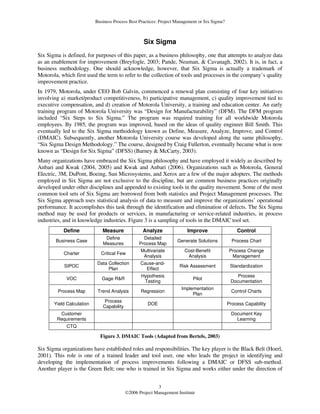
industries, and in knowledge industries. Figure 3 is a sampling of tools in the DMAIC tool set.
Define Measure Analyze Improve Control
Business Case
Define
Measures
Detailed
Process Map
Generate Solutions Process Chart
Charter Critical Few
Multivariate
Analysis
Cost-Benefit
Analysis
Process Change
Management
SIPOC
Data Collection
Plan
Cause-and-
Effect
Risk Assessment Standardization
VOC Gage R&R
Hypothesis
Testing
Pilot
Process
Documentation
Process Map Trend Analysis Regression
Implementation
Plan
Control Charts
Yield Calculation
Process
Capability
DOE Process Capability
Customer
Requirements
Document Key
Learning
CTQ
Figure 3. DMAIC Tools (Adapted from Bertels, 2003)
Six Sigma organizations have established roles and responsibilities. The key player is the Black Belt (Hoerl,
2001). This role is one of a trained leader and tool user, one who leads the project in identifying and
developing the implementation of process improvements following a DMAIC or DFSS sub-method.
Another player is the Green Belt; one who is trained in Six Sigma and works either under the direction of
Business Process Best Practices: Project Management or Six Sigma?
4
2006 Project Management Institute
the Black Belt (on larger projects) or leads smaller projects. The Yellow Belt is a project participant who
receives basic training in Six Sigma. Other roles often found in Six Sigma organizations are a)
Sponsor/Champion – involved in project selection and senior management roles; Master Black Belt – a
senior certified Black Belt functioning as a leader of a group of Black Belts or, in some organizations, a
trainer of Black Belts.
One element of Six Sigma is Design of Experiments (DOE), which should not be confused with DMAIC or
DFSS. DOE is a term for an experiment designed for simultaneous evaluation of two or more factors
(parameters), measuring the effect of the variability of the process (characteristics). One approach to DOE
segregates into three phases: planning, conducting and analyzing. Within DOE, there are twelve steps to be
accomplished by Ross (1996).
1. State the problem or area of concern
2. State the objective of the experiment
3. Select the quality characteristics and measurement systems
4. Select the factors that may influence the selected quality characteristics
5. Identify control and noise factors
6. Select levels for each factor
7. Select the appropriate orthogonal (matrix) array (OA)
8. Select interactions that may influence the selected quality characteristics or go back to step four
(iterative steps)
9. Align factors to OA and locate interactions
10. Conduct test described by trials in OA
11. Analyze and interpret results of the experimental trials
12. Conduct confirmation experiment.
Basic Concepts of Six Sigma
In understanding Six Sigma it is necessary to first understand its basic concepts. At the core, variation, types
of data, and Six Sigma Quality must be appreciated.
1. Variation – the sum total of all the changes that occur when a process is run
a. Special Cause – a specific assignable cause, something unusual that may be identified
and reduced/eliminated
b. Common Cause – chance or random cause, always present
c. Statistical Control – only common cause is present
2. Types of data
a. Continuous – variable can be measured in a smaller unit, may be represented graphically
as a bell curve
b. Discrete – variable is measured as count, list, etc., may be represented graphically as a
histogram or Pareto chart
3. Six Sigma Quality – process defined as one in which the width of the distribution of values is 50% of
the upper specification limit minus the lower specification limit (USL-LSL), subject to a 1.5σ shift.
Simplified, a maximum of 3.4 defects per million opportunities (DPMO) is considered standard.
The two technical areas that distinguish Six Sigma are a) measurement of Voice of the Customer (VOC),
and b) extensive use of statistical analysis to build new processes (Anbari & Kwak, 2004; Bertels, 2003).
Business Process Best Practices: Project Management or Six Sigma?
5
2006 Project Management Institute
The Six Sigma: Certification and Body of Knowledge
The American Society for Quality (ASQ) administers a Six Sigma Black Belt certification process and
publishes a Body of Knowledge (BOK) (American Society for Quality, 2005). The certification process is
rigorous, requiring proof of professionalism (experience, professional standing, and written confirmation by
other professionals) and successful completion of a written exam to test knowledge of the BOK. The
published BOK is a relatively simple listing of the concepts and tools that need to be understood in order to
complete the written exam.
Most of the published material on the Six Sigma process is generated by the plethora of consultants offering
their services for Six Sigma implementations. In the academic community, there is very little published
material on the subject matter (ISix Sigma, 2005). Six Sigma is allowed to be defined and redefined by
practitioners, many of whom are consultants or commercial organizations offering their version of Six
Sigma. Of the material available for research, there seems to be wide variation in the interpretation of Six
Sigma, its definitions, and which tools/techniques are utilized.
Project Management
For purposes related to this paper’s scope, it is assumed that the reader understands the basics of Project
Management methodology and thus it will not be covered in the discussion (Kerzner, 2005). Later, the tools
used in Project Management will be compared to the tools used in Six Sigma. The PMBOK
Guide—Third
Edition includes a total of 187 tools (Project Management Institute, 2004).
Understanding the Population of Six Sigma Tools
Our investigation has uncovered a total of 401 tools and techniques. Figure 4 presents the overall statistics
of different tools and techniques from seven sources. Of the many sources reviewed, only seven contained
listings of tools being used, and all are included. As a note, one of the challenges of this research is the use
of different nomenclature for what is essentially the same tool. For example, one source may cite a tool
name of “Five Whys” and another may cite a tool name of “Root Cause Analysis.” Both of these tools are
essentially the same (Michalski, 2003). As another example, a source may cite “statistics” as a tool and
another may cite “regression,” “ANOVA,” and “correlation”; all may be considered a subset of statistics.
The final tools list has been scrubbed, to the best of our ability, for these types of inconsistencies. The final
count of tools has been adjusted from 401 tools to 293 unique tools after eliminating duplicate citations.
Source Total Unique to Source % of Total
Michalski (2003) 222 175 44%
Stamatis (2004) 27 14 3%
Brue and Launsby (2003) 21 7 2%
Pande and Holpp (2002) 51 19 5%
Breyfolge (2003) 23 2 0%
Bertels (2003) 12 3 1%
George (2002) 45 17 4%
Total 401 237 59%
Figure 4. Summary of Six Sigma Tools
An analysis of the 293 tools was conducted and the number of citations was computed for each tool. Some
tools were cited regularly and others were not cited frequently. The number of tools cited only by a single
source is 237 (81%). This presented concerns for the researchers. If only one source cites the tool, it may not
Business Process Best Practices: Project Management or Six Sigma?
6
2006 Project Management Institute
be sufficiently accepted by practitioners to include in the analysis. It may be assumed that a tool must be
cited more than once to indicate acceptance, but a review of the excluded tools indicates this oversimplified
argument to be faulty. Further analysis of this anomaly may be required.
Of the seven sources for tools use, one source stands out due to the sheer number of tools cited. Michalski
(2003) cites 222 tools for Six Sigma. In comparison to the other sources, it was noted that 175 (44%) of the
tools were cited only in this source. The rate of uniqueness of the other six sources averaged less than 3%.
Therefore, an inference may be made that many of the tools cited in Michalski (2003) are not considered
exclusive to the Six Sigma methodology by the other sources. With the lack of an independent institution to
act as an arbitrator, the conclusion may be valid. A further check of the tools cited indicated that Michalski’s
tools list might be more generalized to the overall quality movement and not exclusive to Six Sigma.
Of the original list of 293 tools, we find a total of 56 tools cited by more than one source. The 56 (108
instances) multi-cited tools are considered stable for analysis and will be used as this research moves
forward.
With the original list reduced and stabilized at 56 shared tools, the analysis continues. No single tool was
cited by 100% of the sources. One tool was cited in six sources (less than 1%), four tools cited by five
sources (1%), eleven tools cited by four sources (4%), fifteen tools cited by three sources (5%), and twenty-
five tools were cited by at least two sources (9%). The population of 56 tools has an average of slightly less
than 2 citations per tool and represents 19% of the initial tool set. Based on earlier assumptions, this average
of 2 demonstrates the significance of the tools under analysis.
Comparisons of Various Six Sigma Tools and Techniques
In this section, we begin our analysis by comparing and contrasting three interesting relationships:
• PMBOK
Guide compared to Six Sigma Tools
• PMBOK
Guide compared to Six Sigma – Abbreviated Tools
• Statistical Tools Included in Six Sigma Tools
At the end of each section, a complete listing of the subset of tools-compared is included.
Comparison of the PMBOK
Guide to Six Sigma Tools
The PMBOK
Guide—Third Edition (2004) contains 187 tools as compared to the 293 tools found in Six
Sigma. To compare the tools sets accurately, each tool was compared individually. Figure 5 shows that 33
PMBOK
Guide tools map to 37 Six Sigma tools. The reason for the lack of one-to-one correlation is
inconsistency in naming conventions between the sources. For example, in the PMBOK
Guide—Third
Edition, “Flowcharting” is listed as a single tool. In Six Sigma, “Cycle Time Flowchart” and “Decision
Process Flowchart” are listed separately. The authors considered this as one PMBOK
Guide tool that maps
to two Six Sigma tools. There are three instances of multiple mapping in the data set: two instances of one
PMBOK
Guide tools mapping to two Six Sigma tools and one instance of one PMBOK
Guide tool
mapping to three Six Sigma tools.
Of the 187 PMBOK
Guide tools, 33 (18%) can be mapped to Six Sigma tools. This roughly one-in-five
ratio would indicate that the PMBOK
Guide tools are significantly correlated to Six Sigma tools. This
relationship suggests a shared dependency between Project Management and Six Sigma methodologies. It
may also suggest a common source of benchmarking between the methods. Of the 293 Six Sigma tools, 37
(13%) can be mapped to PMBOK
Guide tools. This indicates less of a role of Project Management in the
Six Sigma methodology.
Business Process Best Practices: Project Management or Six Sigma?
7
2006 Project Management Institute
PMBOK
Guide—Third Edition Six Sigma (SS)
Knowledge Area Process Code Tools and Techniques
SS
Ref.
Six Sigma Tools
Integration Charter 4.1.2.1 Project Selection Methods 154 Project Prioritization Matrix
Integration Charter 4.1.2.2
Project Management Methodology
(Charter)
249 Charter
Integration Preliminary Scope 4.2.2.1
Project Management Methodology
(Preliminary Scope)
252 Output Requirements
Integration PM Plan 4.3.2.1
Project Management Methodology
(PM Plan)
225 Project Management
Scope Management Scope Planning 5.1.2.2 Templates, forms, standards 240 Customer Requirements
Scope Management Scope Definition 5.2.2.4 Stakeholder Analysis 251 Stakeholder Analysis
Scope Management WBS 5.3.2.1 WBS Templates 87 Gantt Chart
Scope Management WBS 5.3.2.2 Decomposition (WBS) 220 Work Breakdown Structure (WBS)
Time Management Activity Definition 6.1.2.1 Decomposition (WBS) 5 Activity Analysis
6 Activity Cost Matrix
Time Management Activity Definition 6.1.2.2 Templates (Activity Definition) 196 Task Analysis
Time Management Activity Sequencing 6.2.2.1
Precedence Diagramming Method
(PDM)
7 Activity Network Diagram
Time Management Resource Estimate 6.3.2.1 Expert Judgment (Resource Estimate) 163 Resource Requirements Matrix
Time Management
Schedule
Development
6.5.2.2 Critical Path Method 152
Program Evaluation and Review
Technique (PERT)
Time Management
Schedule
Development
6.5.2.4 What-if Scenario Analysis 215 What-If Analysis
Time Management Schedule Control 6.6.2.3 Performance Measurement 199 Team Process Assessment
Time Management Schedule Control 6.6.2.4 PM Software (Schedule Control) 109 Milestones Chart
Cost Management Cost Estimating 7.1.2.8 Cost of Quality (Cost Estimating) 44 Cost of Quality
Quality Management Quality Planning 8.1.2.1 Cost-benefit Analysis 45 Cost-Benefit Analysis
Quality Management Quality Planning 8.1.2.2 Benchmarking 17 Benchmarking
Business Process Best Practices: Project Management or Six Sigma?
8
2006 Project Management Institute
PMBOK
Guide—Third Edition Six Sigma (SS)
Knowledge Area Process Code Tools and Techniques
SS
Ref.
Six Sigma Tools
Quality Management Quality Assurance 8.2.2.3 Process Analysis 146 Process Analysis
Quality Management Quality Control 8.3.2.1 Cause and Effect Diagram 25 Cause and Effect Diagram CED
Quality Management Quality Control 8.3.2.2 Control Charts 222 Yield Chart
Quality Management Quality Control 8.3.2.3 Flowcharting 56 Cycle Time Flowchart
58 Decision Process Flowchart
Quality Management Quality Control 8.3.2.4 Histogram 90 Histogram
Quality Management Quality Control 8.3.2.5 Pareto Charts 101 Line Chart
Quality Management Quality Control 8.3.2.6 Run Charts 171 Run Chart
Quality Management Quality Control 8.3.2.7 Scatter Diagrams 175 Scatter Diagram
Quality Management Quality Control 8.3.2.8 Statistical Sampling 173 Sampling Method
Human Resource
Management
HR Planning 9.1.2.1
Organization Charts - Position
Descriptions
124 Organization Chart
Communications
Management
Performance
Reporting
10.3.2.1 Information Presentation Tools 130 Pareto Chart
262 Dashboards
274 Scorecards
Risk Management Risk Identification 11.2.2.5 Diagramming Techniques 168 Risk Space Analysis
Risk Management
Risk Response
Planning
11.5.2.4 Contingent Response Strategy 261 Response Plan
Risk Management
Risk
Monitor/Control
11.6.2.3 Variance and Trend Analysis 205 Trend Analysis
Figure 5. PMBOK
Guide Tools Compared to Six Sigma Tools
Business Process Best Practices: Project Management or Six Sigma?
9
2006 Project Management Institute
Comparison of PMBOK
Guide to Six Sigma – Abbreviated Tools
In this comparison, we use the abbreviated Six Sigma tool set – only those tools cited two or more times.
The PMBOK
Guide, Third Edition contains 187 tools as compared to the now-56 tools found in Six Sigma
– Abbreviated tool set, as shown in Figure 6.
Of the 187 PMBOK
Guide tools, 16 (12%) can be mapped to Six Sigma tools. This roughly one-in-nine
ratio would indicate that PMBOK
Guide tools are not as significantly related to Six Sigma tools as the
previous comparison. This relationship continues to suggest a shared dependency between Project
Management and Six Sigma methodologies, but at a lower level. Of the 56 Six Sigma tools, 16 (29%) can
be mapped to PMBOK
Guide tools. This indicates a very significant role of Project Management in the Six
Sigma methodology.
Six Sigma – Abbreviated Version
Includes Tools with Two or More Citations
No.
SS
No. Six Sigma Tool Name
Michalski
(2003)
Stamatis
DMAIC
(2004)
Stamatis
DFSS
(2004)
Brue
and
Launsby
(2003)
Pande
and
Holpp
(2002)
Breyfogle
(2003)
Bertels
DFSS
(2003)
George
(2002)
Number
of
Occurrences
PMBOK
®
Guide
Reference
Number
1 74 Failure Mode Effect Analysis (FMEA) x x x x x x 6
2 17 Benchmarking x x x x x 5 8.1.2.2
3 40 Control Chart - c (Attribute) x x x x x 5
4 41 Control Chart - p (Attribute) x x x x x 5
5 42 Control Chart - X-R (Variable) x x x x x 5
6 8 Affinity Diagram x x x x 4
7 10 Analysis of Variance x x x 4
8 25 Cause and Effect Diagram CED x x x x 4 8.3.2.1
9 26
Cause and Effect Diagram Adding Cards
CEDAC
x x x
x 4
10 29 Check sheet x x x x 4
11 91 House of Quality x x x x 4
12 107 Measurement Matrix x x x x 4
13 130 Pareto Chart x x x x 4 10.3.2.1
14 171 Run Chart x x x x 4 8.3.2.6
15 175 Scatter Diagram x x x x 4 8.3.2.7
16 204 Tree Diagram x x x x 4
Business Process Best Practices: Project Management or Six Sigma?
10
2006 Project Management Institute
Six Sigma – Abbreviated Version
Includes Tools with Two or More Citations
No.
SS
No. Six Sigma Tool Name
Michalski
(2003)
Stamatis
DMAIC
(2004)
Stamatis
DFSS
(2004)
Brue
and
Launsby
(2003)
Pande
and
Holpp
(2002)
Breyfogle
(2003)
Bertels
DFSS
(2003)
George
(2002)
Number
of
Occurrences
PMBOK
®
Guide
Reference
Number
17 231 DOE x x x x 4
18 20 Brainstorming x x x 3
19 28 Checklist x x x 3
20 38 Conjoint Analysis x x x 3
21 43 Correlation Analysis x x x 3
22 44 Cost of Quality x x x 3 7.1.2.8
23 58 Decision Process Flowchart x x x 3 8.3.2.3
24 66 Descriptive Statistics x x x 3
25 80 Force Field Analysis (FFA) x x x 3
26 90 Histogram x x x 3 8.3.2.4
27 147 Process Capability Ratios x x x 3
28 150 Process Mapping x x x 3
29 224 Poka-Yoke (mistake proofing) x x x 3
30 227 Regression x x x 3
31 234 Tolerance Design x x x 3
32 7 Activity Network Diagram x x 2 6.2.2.1
33 19 Box Plot x x 2
34 53 Customer Needs Table x x 2
35 77 Five Whys x x 2
36 85 Functional Map x x 2
37 87 Gantt Chart x x x 2 5.3.2.1
38 92 Hypothesis Testing (Chi-Square) x x 2
39 99 Interrelationship Digraph (I.D.) x x 2
40 114 Multivariable Chart x x 2
41 117 Nominal Group Technique (NGT) x x 2
42 125 Organization Mapping x x 2
Business Process Best Practices: Project Management or Six Sigma?
11
2006 Project Management Institute
Six Sigma – Abbreviated Version
Includes Tools with Two or More Citations
No.
SS
No. Six Sigma Tool Name
Michalski
(2003)
Stamatis
DMAIC
(2004)
Stamatis
DFSS
(2004)
Brue
and
Launsby
(2003)
Pande
and
Holpp
(2002)
Breyfogle
(2003)
Bertels
DFSS
(2003)
George
(2002)
Number
of
Occurrences
PMBOK
®
Guide
Reference
Number
43 135 Point-Scoring Evaluation x x 2
44 143 Problem Analysis x x 2
45 146 Process Analysis x x 2 8.2.2.3
46 173 Sampling Method x x 2 8.3.2.8
47 192 Surveying x x 2
48 199 Team Process Assessment x x 2 6.6.2.3
49 205 Trend Analysis x x 2 11.6.2.3
50 210 Value Analysis x x 2
51 222 Yield Chart x x 2 8.3.2.2
52 226 Kano Model x x 2
53 236 Gage R&R x x 2
54 243
Pugh Concept Selection Technique (alternative
evaluation)
x
x 2
55 262 Dashboards x 2 10.3.2.1
56 266 Creativity Techniques x x 2
Figure 6. Six Sigma – Abbreviated Compared to PMBOK
Guide Tools
Business Process Best Practices: Project Management or Six Sigma?
12
2006 Project Management Institute
Illustration of Statistical Tools Included in Six Sigma Tools
In the entire Six Sigma tool set, there are twenty-one distinct statistical tools, representing more than 7%
(21/293) of the total tool set, as shown in Figure 7. While this may show that statistics are a firm basis of Six
Sigma methods, the statistical tool set represents only a small fraction of entire Six Sigma tools set.
Six Sigma Statistical Tools
No.
Six Sigma
Reference Tool Name Common Alternate Name
1 10 Analysis of Variance ANOVA, Hypothesis Testing
2 14 Bar Chart Bar Graph
3 19 Box Plot Box and Whiskers Plot
4 35 Cluster Analysis
5 40 Control Chart - c (Attribute)
6 41 Control Chart - p (Attribute)
7 42 Control Chart - X-R (Variable)
8 43 Correlation Analysis Hypothesis Testing (Correlation)
9 66 Descriptive Statistics
10 73 Factor Analysis
11 83 Frequency Distribution (FD) Frequency Table
12 92 Hypothesis Testing (Chi-Square)
13 114 Multivariable Chart
14 119 Normal Probability Distribution
15 171 Run Chart
16 173 Sampling Method Random Sampling
17 184 Standard Deviation
18 227 Regression
19 259 Sigma Calculation
20 276 Statistical Tolerance
21 281 SSPI Toolkit
Figure 7. Statistical Tools included in Six Sigma tools
Summary of Comparisons
The key findings of the above comparisons are as follows:
• Using the PMBOK
Guide Third Edition as a base, 18% (33) of its tools (187) are mapped to Six
Sigma. In reverse, using Six Sigma as a base, 13% (37) of its tools are found in the PMBOK
Guide. This indicates a high relationship between both methodologies.
• Using the PMBOK
Guide Third Edition as a base and comparing to the Six Sigma – Abbreviated
tools (containing two or more citations), 9% (16) of the PMBOK
Guide tools (187) are mapped to
Business Process Best Practices: Project Management or Six Sigma?
13
2006 Project Management Institute
Six Sigma. Alternately, using Six Sigma – Abbreviated as a base, 29% (16) of its tools (56) are
found in the PMBOK
Guide. This lessens the influence of Six Sigma on the PMBOK
Guide, but
greatly increases the influence of the PMBOK
Guide on Six Sigma tools and techniques. This
almost one-to-three relationship may suggest that the PMBOK
Guide Third Edition is an integral
part of the Six Sigma methodology.
• The Six Sigma tool set (293) is comprised of 13% (37) PMBOK
Guide tools, and 7% (21)
Statistical tools. The balance of Six Sigma tools (80%) may represent legacy “Quality Movement
tool sets” or other sources.
Conclusions and Directions for Future Research
The tools used in Six Sigma are a collection of “Quality Movement” tools (80%), Project Management tools
(13%), and Statistical tools (7%). Six Sigma seems to be more deeply based on the Project Management
discipline when using multi-cited tools.
Earlier, we defined Six Sigma as a “business philosophy, one that attempts to analyze data as an enablement
for improvement.” The first observation arising out of this comparison is that Six Sigma and Project
Management are relatively related; 13% or 18% of the tools map to each other, depending on the
perspective used. Both methodologies seem ready to adopt new tools as the need arises, and neither
methodology attempts to limit the use of different/new tools.
Is the number of tools used indicative of success? Or is the maturity of the tool set more important? These
are interesting questions. Based on the number of tools, Six Sigma employs far more tools than Project
Management. However, when the tool set is inflated (as may be the case of Michalski), this observation may
be off the mark. When the Six Sigma – Abbreviated (more than one citation) tool set is used, the 187 tools
of Project Management far exceed the 56 Six Sigma tools. In this case, the maturity of Project Management,
based on its tools, is far more than the maturity of Six Sigma. This is further supported by the relative age of
each methodology; modern Project Management arose in the 1940’s while Six Sigma traces its origin to the
mid-1980’s.
Analyzing Six Sigma from the perspective of its tools, it is evident that Six Sigma is attempting to manage
projects in addition to conducting statistical analysis of business data. A review of published articles and
books on Six Sigma seems to confirm this Project Management link (Breyfogle, 2003; Michalski, 2003;
Pande & Holp, 2002). However, the Project Management link is not well articulated. In general, the articles
cited discuss projects under Six Sigma, and use Six Sigma tools to achieve results within projects, but do not
sufficiently discuss using Project Management as a methodology, whether as a separate methodology or
combined with Six Sigma.
This implied use of Project Management tools may be acceptable to Six Sigma enthusiasts, but it raises
questions for academic researchers. Concern stems from the unarticulated and extensive use of Project
Management tools, yet the common definition of Six Sigma does not address the management of projects. It
may be implied that “analyzing data” usually requires the use of statistics; but it is not implied that
“analyzing data” must include Project Management tools and practices. This seems to be a subject requiring
further study.
Business Process Best Practices: Project Management or Six Sigma?
14
2006 Project Management Institute
References
American Society for Quality. (2005). Retrieved September 8, 2005, from http://www.asq.org/
Anbari, F. T., & Kwak, Y. H. (2004). Success Factors in Managing Six Sigma Projects. Proceedings of the 2004
Project Management Institute Research Conference. London, UK, July 11-14, 2004.
Anbari, F. T., & Kwak, Y. H. (2005). Six Sigma, Programs and Proactive Risk Management. Proceedings of NASA
Project Management Challenge 2005, Second Annual NASA Project Management Conference, College Park, MD,
March 22-23, 2005.
Barney, M., & McCarty, T. (2003). The New Six Sigma: A Leader's Guide to Achieving Rapid Business Improvement
and Sustainable Results. Upper Saddle River, NJ: Motorola University.
Bertels, T. (2003). Rath & Strong's Six Sigma Leadership Handbook. Hoboken, NJ: John Wiley & Sons, Inc.
Bhote, K. R. (2003). The Ultimate Six Sigma; Beyond Quality Excellence to Total Business Excellence. New York:
AMACOM, American Management Association.
Breyfogle, F. W. (2003). Implementing Six Sigma: Smarter Solutions Using Statistical Methods. Hoboken, NJ: John
Wiley & Sons, Inc.
Brue, G., & Launsby, R. G. (2003). Design for Six Sigma. New York: McGraw-Hill, Inc.
George, M. L. (2002). Lean Six Sigma: Combining Six Sigma Quality with Lean Speed. New York: McGraw-Hill, Inc.
Hoerl, R. (2001), Six Sigma Black Belts: What Do They Need to Know? Journal of Quality Technology, Vol. 33
(4),.pp. 391-406.
ISix Sigma (2005). Retrieved September 8, 2005, from http://www.iSixSigma.com
Kerzner, H. (2005). Project Management: A Systems Approach to Planning, Scheduling, and Controlling, Ninth
Edition. New York: John Wiley & Sons, Inc.
Kwak, Y. H., & Anbari, F. T. (2006). Benefits, Obstacles, and future of Six Sigma Approach. Technovation: The
International Journal of Technical Innovation, Entrepreneurship, and Technology Management. Vol. 26 (5-6), pp.
708-715.
Michalski, W. J. (2003). Six Sigma Tool Navigator: The Master Guide for Teams. New York: Productivity Press.
Pande, P., & Holpp, L. (2002). What is Six Sigma? New York: McGraw-Hill, Inc.
Pande, P. S., Neuman, R. P., & Cavanagh, R. R. (2002). The Six Sigma Way Team Field Book; An Implementation
Guide for Project Improvement Teams. New York: McGraw-Hill, Inc.
Project Management Institute (2004). A Guide to the Project Management Body of Knowledge (PMBOK®
Guide) (3rd
ed.). Newtown Square, PA.
Ross, P. J. (1996). Taguchi Techniques for Quality Engineering; Loss Function, Orthogonal Experiments, Parameter
and Tolerance Design. New York: McGraw-Hill, Inc.
Stamatis, D. H. (2004). Six Sigma Fundamentals: A Complete Guide to the System, Methods, and Tools. New York:
Productivity Press.

BUSINESS_PROCESS_BEST_PRACTICES_PROJECT.pdf

  • 1.
    1 2006 Project ManagementInstitute BUSINESS PROCESS BEST PRACTICES: PROJECT MANAGEMENT OR SIX SIGMA? Young Hoon Kwak, PhD John J. Wetter, PMP Frank T. Anbari, PhD, PE, PMP Introduction The aim of this paper is to evaluate the Six Sigma methodology using the tools and techniques as a proxy. The central problem will be defining usefulness in a measurable and valid way. A review of the literature on Six Sigma revealed seven major sources that articulated tool sets; all were incorporated into the study. For Project Management, A Guide to the Project Management Body of Knowledge (PMBOK Guide)—Third Edition was used as the primary source of tools (Project Management Institute, 2004). The first step will be a literature review to identify what researchers have already learned about the Six Sigma methodology. Part of the literature review will be the identification of which tools are in use and in what phase they are used. As a second step, a comparison of the tools and techniques will be made – how many are used, how well accepted the tools are among various users of the Six Sigma methodology, and how the tools compare to a similar set of standardized tools, in this case, those employed in Project Management. The third and final step will be the comparison of the tools. Limitations The criteria for selecting Six Sigma tools were simple. The tools must be published. The American Society for Quality (ASQ) publishes descriptions of Six Sigma tools and quality tools. The authors conducted a literature review for other sources, and found seven critical sources for Six Sigma tools, all books published by commercial entities. In comparing the sources for Six Sigma tools, it quickly became evident that each source tended to use unique nomenclature to define what seemed to be essentially the same tools. Efforts were made to overcome this by a tool-to-tool comparison, re-mapping where necessary. Another difficulty encountered was the singular/plural nature of the tools. If one author cites “Statistical” tools and another cites a specific listing of individual statistical tools (ANOVA, Regression, etc.) there is some difficulty in comparing the tool lists. This was managed on a case-by-case basis. Finally, one source for tools, Michalski (2003), had an extremely well documented but lengthy tool list. Michalski (2003) has 222 tools as compared to an average of 30 tools in the other six sources. One explanation of this is that Michalski’s tool list represents a “Quality” list as opposed to a Six Sigma list.
  • 2.
    Business Process BestPractices: Project Management or Six Sigma? 2 2006 Project Management Institute History of the Quality Movement The roots of the quality movement in the twentieth century can be attributed to Walter Shewhart (1891- 1967). His major work, published in 1931 under the title Economic Control of Quality of Manufactured Product, is considered the de-facto set of basic principles of quality control. His major accomplishment was the linking of statistics to managerial decision-making. W. Edwards Deming (1900-1993), a disciple of Shewhart, went further in securing the link between business and statistics. Deming’s Fourteen Points defined the quality movement for the last half of the twentieth century and beyond. Deming also popularized one of the most well known tools in the quality movement, the Plan-Do-Check-Act cycle, originally contributed by Shewhart. The tools used in quality differ from implementation to implementation, but generally they align with one of the categories shown in Figure 1. Figure 2 summarizes the history of the quality movement since 1950. Seven Quality Control Tools Seven Quality Management Tools 1. PDCA (plan, do, check, act) 2. Data collection and analysis 3. Graphs/charts 4. Check/Tally sheets, and histograms 5. Pareto charts 6. Cause-and-effect diagrams 7. Control charts 1. The affinity diagram 2. The interrelationship diagram 3. The tree diagram 4. The matrix diagram 5. The matrix data analysis plot 6. The process-decision program 7. The arrow diagram Figure 1. Comparing Quality Control and Quality Management Tools (Adapted from Bhote, 2003) Date Methodology Pros Cons 1940– 1950 Sampling Plans Standardization of sampling methods The sampling plans were viewed as end result 1960 Zero Defects Employees pledged to produce no defects No substance 1960 Deming Prize Introduced statistical analysis of data Limited focus on customers, suppliers, employees 1970 Quality Circles Teams tracked daily issues Lacked solid decision making 1980 Statistical Process Control (SPC) Control Charts Interpretation of validity is crucial 1985 Total Quality Management (TQM) Systematic approach Limited focus on customer 1987 ISO-9000 Standards defined, common to each industry Considers defects “acceptable” 1987 Malcolm Baldridge Award National (US) Quality Award (recognition) Lacks focus on tools 1987 Six Sigma Customer focused Requires extensive training 1990 QS-9000 Improvement over ISO-9000 (automotive) First tier supplier-oriented, not auto manufacturers 1993 European Quality Award Patterned after “ Malcom Baldridge Award” Lacks focus on tools 1995 ISO-14000 Environmentally oriented Lacks creativity Figure 2. History of the Quality Movement (Adapted from Bhote, 2003)
  • 3.
    Business Process BestPractices: Project Management or Six Sigma? 3 2006 Project Management Institute Six Sigma Six Sigma is defined, for purposes of this paper, as a business philosophy, one that attempts to analyze data as an enablement for improvement (Breyfogle, 2003; Pande, Neuman, & Cavanagh, 2002). It is, in fact, a business methodology. One should acknowledge, however, that Six Sigma is actually a trademark of Motorola, which first used the term to refer to the collection of tools and processes in the company’s quality improvement practice. In 1979, Motorola, under CEO Bob Galvin, commenced a renewal plan consisting of four key initiatives involving a) market/product competitiveness, b) participative management, c) quality improvement tied to executive compensation, and d) creation of Motorola University, a training and education center. An early training program of Motorola University was “Design for Manufacturability” (DFM). The DFM program included “Six Steps to Six Sigma.” The program was required training for all worldwide Motorola employees. By 1985, the program was improved, based on the ideas of quality engineer Bill Smith. This eventually led to the Six Sigma methodology known as Define, Measure, Analyze, Improve, and Control (DMAIC). Subsequently, another Motorola University course was developed along the same philosophy, “Six Sigma Design Methodology.” The course, designed by Craig Fullerton, eventually became what is now known as “Design for Six Sigma” (DFSS) (Barney & McCarty, 2003). Many organizations have embraced the Six Sigma philosophy and have employed it widely as described by Anbari and Kwak (2004, 2005) and Kwak and Anbari (2006). Organizations such as Motorola, General Electric, 3M, DuPont, Boeing, Sun Microsystems, and Xerox are a few of the major adopters. The methods employed in Six Sigma are not exclusive to the discipline, but are common business practices originally developed under other disciplines and appended to existing tools in the quality movement. Some of the most common tool sets of Six Sigma are borrowed from both statistics and Project Management processes. The Six Sigma approach uses statistical analysis of data to measure and improve the organizations’ operational performance. It accomplishes this task through the identification and elimination of defects. The Six Sigma method may be used for products or services, in manufacturing or service-related industries, in process industries, and in knowledge industries. Figure 3 is a sampling of tools in the DMAIC tool set. Define Measure Analyze Improve Control Business Case Define Measures Detailed Process Map Generate Solutions Process Chart Charter Critical Few Multivariate Analysis Cost-Benefit Analysis Process Change Management SIPOC Data Collection Plan Cause-and- Effect Risk Assessment Standardization VOC Gage R&R Hypothesis Testing Pilot Process Documentation Process Map Trend Analysis Regression Implementation Plan Control Charts Yield Calculation Process Capability DOE Process Capability Customer Requirements Document Key Learning CTQ Figure 3. DMAIC Tools (Adapted from Bertels, 2003) Six Sigma organizations have established roles and responsibilities. The key player is the Black Belt (Hoerl, 2001). This role is one of a trained leader and tool user, one who leads the project in identifying and developing the implementation of process improvements following a DMAIC or DFSS sub-method. Another player is the Green Belt; one who is trained in Six Sigma and works either under the direction of
  • 4.
    Business Process BestPractices: Project Management or Six Sigma? 4 2006 Project Management Institute the Black Belt (on larger projects) or leads smaller projects. The Yellow Belt is a project participant who receives basic training in Six Sigma. Other roles often found in Six Sigma organizations are a) Sponsor/Champion – involved in project selection and senior management roles; Master Black Belt – a senior certified Black Belt functioning as a leader of a group of Black Belts or, in some organizations, a trainer of Black Belts. One element of Six Sigma is Design of Experiments (DOE), which should not be confused with DMAIC or DFSS. DOE is a term for an experiment designed for simultaneous evaluation of two or more factors (parameters), measuring the effect of the variability of the process (characteristics). One approach to DOE segregates into three phases: planning, conducting and analyzing. Within DOE, there are twelve steps to be accomplished by Ross (1996). 1. State the problem or area of concern 2. State the objective of the experiment 3. Select the quality characteristics and measurement systems 4. Select the factors that may influence the selected quality characteristics 5. Identify control and noise factors 6. Select levels for each factor 7. Select the appropriate orthogonal (matrix) array (OA) 8. Select interactions that may influence the selected quality characteristics or go back to step four (iterative steps) 9. Align factors to OA and locate interactions 10. Conduct test described by trials in OA 11. Analyze and interpret results of the experimental trials 12. Conduct confirmation experiment. Basic Concepts of Six Sigma In understanding Six Sigma it is necessary to first understand its basic concepts. At the core, variation, types of data, and Six Sigma Quality must be appreciated. 1. Variation – the sum total of all the changes that occur when a process is run a. Special Cause – a specific assignable cause, something unusual that may be identified and reduced/eliminated b. Common Cause – chance or random cause, always present c. Statistical Control – only common cause is present 2. Types of data a. Continuous – variable can be measured in a smaller unit, may be represented graphically as a bell curve b. Discrete – variable is measured as count, list, etc., may be represented graphically as a histogram or Pareto chart 3. Six Sigma Quality – process defined as one in which the width of the distribution of values is 50% of the upper specification limit minus the lower specification limit (USL-LSL), subject to a 1.5σ shift. Simplified, a maximum of 3.4 defects per million opportunities (DPMO) is considered standard. The two technical areas that distinguish Six Sigma are a) measurement of Voice of the Customer (VOC), and b) extensive use of statistical analysis to build new processes (Anbari & Kwak, 2004; Bertels, 2003).
  • 5.
    Business Process BestPractices: Project Management or Six Sigma? 5 2006 Project Management Institute The Six Sigma: Certification and Body of Knowledge The American Society for Quality (ASQ) administers a Six Sigma Black Belt certification process and publishes a Body of Knowledge (BOK) (American Society for Quality, 2005). The certification process is rigorous, requiring proof of professionalism (experience, professional standing, and written confirmation by other professionals) and successful completion of a written exam to test knowledge of the BOK. The published BOK is a relatively simple listing of the concepts and tools that need to be understood in order to complete the written exam. Most of the published material on the Six Sigma process is generated by the plethora of consultants offering their services for Six Sigma implementations. In the academic community, there is very little published material on the subject matter (ISix Sigma, 2005). Six Sigma is allowed to be defined and redefined by practitioners, many of whom are consultants or commercial organizations offering their version of Six Sigma. Of the material available for research, there seems to be wide variation in the interpretation of Six Sigma, its definitions, and which tools/techniques are utilized. Project Management For purposes related to this paper’s scope, it is assumed that the reader understands the basics of Project Management methodology and thus it will not be covered in the discussion (Kerzner, 2005). Later, the tools used in Project Management will be compared to the tools used in Six Sigma. The PMBOK Guide—Third Edition includes a total of 187 tools (Project Management Institute, 2004). Understanding the Population of Six Sigma Tools Our investigation has uncovered a total of 401 tools and techniques. Figure 4 presents the overall statistics of different tools and techniques from seven sources. Of the many sources reviewed, only seven contained listings of tools being used, and all are included. As a note, one of the challenges of this research is the use of different nomenclature for what is essentially the same tool. For example, one source may cite a tool name of “Five Whys” and another may cite a tool name of “Root Cause Analysis.” Both of these tools are essentially the same (Michalski, 2003). As another example, a source may cite “statistics” as a tool and another may cite “regression,” “ANOVA,” and “correlation”; all may be considered a subset of statistics. The final tools list has been scrubbed, to the best of our ability, for these types of inconsistencies. The final count of tools has been adjusted from 401 tools to 293 unique tools after eliminating duplicate citations. Source Total Unique to Source % of Total Michalski (2003) 222 175 44% Stamatis (2004) 27 14 3% Brue and Launsby (2003) 21 7 2% Pande and Holpp (2002) 51 19 5% Breyfolge (2003) 23 2 0% Bertels (2003) 12 3 1% George (2002) 45 17 4% Total 401 237 59% Figure 4. Summary of Six Sigma Tools An analysis of the 293 tools was conducted and the number of citations was computed for each tool. Some tools were cited regularly and others were not cited frequently. The number of tools cited only by a single source is 237 (81%). This presented concerns for the researchers. If only one source cites the tool, it may not
  • 6.
    Business Process BestPractices: Project Management or Six Sigma? 6 2006 Project Management Institute be sufficiently accepted by practitioners to include in the analysis. It may be assumed that a tool must be cited more than once to indicate acceptance, but a review of the excluded tools indicates this oversimplified argument to be faulty. Further analysis of this anomaly may be required. Of the seven sources for tools use, one source stands out due to the sheer number of tools cited. Michalski (2003) cites 222 tools for Six Sigma. In comparison to the other sources, it was noted that 175 (44%) of the tools were cited only in this source. The rate of uniqueness of the other six sources averaged less than 3%. Therefore, an inference may be made that many of the tools cited in Michalski (2003) are not considered exclusive to the Six Sigma methodology by the other sources. With the lack of an independent institution to act as an arbitrator, the conclusion may be valid. A further check of the tools cited indicated that Michalski’s tools list might be more generalized to the overall quality movement and not exclusive to Six Sigma. Of the original list of 293 tools, we find a total of 56 tools cited by more than one source. The 56 (108 instances) multi-cited tools are considered stable for analysis and will be used as this research moves forward. With the original list reduced and stabilized at 56 shared tools, the analysis continues. No single tool was cited by 100% of the sources. One tool was cited in six sources (less than 1%), four tools cited by five sources (1%), eleven tools cited by four sources (4%), fifteen tools cited by three sources (5%), and twenty- five tools were cited by at least two sources (9%). The population of 56 tools has an average of slightly less than 2 citations per tool and represents 19% of the initial tool set. Based on earlier assumptions, this average of 2 demonstrates the significance of the tools under analysis. Comparisons of Various Six Sigma Tools and Techniques In this section, we begin our analysis by comparing and contrasting three interesting relationships: • PMBOK Guide compared to Six Sigma Tools • PMBOK Guide compared to Six Sigma – Abbreviated Tools • Statistical Tools Included in Six Sigma Tools At the end of each section, a complete listing of the subset of tools-compared is included. Comparison of the PMBOK Guide to Six Sigma Tools The PMBOK Guide—Third Edition (2004) contains 187 tools as compared to the 293 tools found in Six Sigma. To compare the tools sets accurately, each tool was compared individually. Figure 5 shows that 33 PMBOK Guide tools map to 37 Six Sigma tools. The reason for the lack of one-to-one correlation is inconsistency in naming conventions between the sources. For example, in the PMBOK Guide—Third Edition, “Flowcharting” is listed as a single tool. In Six Sigma, “Cycle Time Flowchart” and “Decision Process Flowchart” are listed separately. The authors considered this as one PMBOK Guide tool that maps to two Six Sigma tools. There are three instances of multiple mapping in the data set: two instances of one PMBOK Guide tools mapping to two Six Sigma tools and one instance of one PMBOK Guide tool mapping to three Six Sigma tools. Of the 187 PMBOK Guide tools, 33 (18%) can be mapped to Six Sigma tools. This roughly one-in-five ratio would indicate that the PMBOK Guide tools are significantly correlated to Six Sigma tools. This relationship suggests a shared dependency between Project Management and Six Sigma methodologies. It may also suggest a common source of benchmarking between the methods. Of the 293 Six Sigma tools, 37 (13%) can be mapped to PMBOK Guide tools. This indicates less of a role of Project Management in the Six Sigma methodology.
  • 7.
    Business Process BestPractices: Project Management or Six Sigma? 7 2006 Project Management Institute PMBOK Guide—Third Edition Six Sigma (SS) Knowledge Area Process Code Tools and Techniques SS Ref. Six Sigma Tools Integration Charter 4.1.2.1 Project Selection Methods 154 Project Prioritization Matrix Integration Charter 4.1.2.2 Project Management Methodology (Charter) 249 Charter Integration Preliminary Scope 4.2.2.1 Project Management Methodology (Preliminary Scope) 252 Output Requirements Integration PM Plan 4.3.2.1 Project Management Methodology (PM Plan) 225 Project Management Scope Management Scope Planning 5.1.2.2 Templates, forms, standards 240 Customer Requirements Scope Management Scope Definition 5.2.2.4 Stakeholder Analysis 251 Stakeholder Analysis Scope Management WBS 5.3.2.1 WBS Templates 87 Gantt Chart Scope Management WBS 5.3.2.2 Decomposition (WBS) 220 Work Breakdown Structure (WBS) Time Management Activity Definition 6.1.2.1 Decomposition (WBS) 5 Activity Analysis 6 Activity Cost Matrix Time Management Activity Definition 6.1.2.2 Templates (Activity Definition) 196 Task Analysis Time Management Activity Sequencing 6.2.2.1 Precedence Diagramming Method (PDM) 7 Activity Network Diagram Time Management Resource Estimate 6.3.2.1 Expert Judgment (Resource Estimate) 163 Resource Requirements Matrix Time Management Schedule Development 6.5.2.2 Critical Path Method 152 Program Evaluation and Review Technique (PERT) Time Management Schedule Development 6.5.2.4 What-if Scenario Analysis 215 What-If Analysis Time Management Schedule Control 6.6.2.3 Performance Measurement 199 Team Process Assessment Time Management Schedule Control 6.6.2.4 PM Software (Schedule Control) 109 Milestones Chart Cost Management Cost Estimating 7.1.2.8 Cost of Quality (Cost Estimating) 44 Cost of Quality Quality Management Quality Planning 8.1.2.1 Cost-benefit Analysis 45 Cost-Benefit Analysis Quality Management Quality Planning 8.1.2.2 Benchmarking 17 Benchmarking
  • 8.
    Business Process BestPractices: Project Management or Six Sigma? 8 2006 Project Management Institute PMBOK Guide—Third Edition Six Sigma (SS) Knowledge Area Process Code Tools and Techniques SS Ref. Six Sigma Tools Quality Management Quality Assurance 8.2.2.3 Process Analysis 146 Process Analysis Quality Management Quality Control 8.3.2.1 Cause and Effect Diagram 25 Cause and Effect Diagram CED Quality Management Quality Control 8.3.2.2 Control Charts 222 Yield Chart Quality Management Quality Control 8.3.2.3 Flowcharting 56 Cycle Time Flowchart 58 Decision Process Flowchart Quality Management Quality Control 8.3.2.4 Histogram 90 Histogram Quality Management Quality Control 8.3.2.5 Pareto Charts 101 Line Chart Quality Management Quality Control 8.3.2.6 Run Charts 171 Run Chart Quality Management Quality Control 8.3.2.7 Scatter Diagrams 175 Scatter Diagram Quality Management Quality Control 8.3.2.8 Statistical Sampling 173 Sampling Method Human Resource Management HR Planning 9.1.2.1 Organization Charts - Position Descriptions 124 Organization Chart Communications Management Performance Reporting 10.3.2.1 Information Presentation Tools 130 Pareto Chart 262 Dashboards 274 Scorecards Risk Management Risk Identification 11.2.2.5 Diagramming Techniques 168 Risk Space Analysis Risk Management Risk Response Planning 11.5.2.4 Contingent Response Strategy 261 Response Plan Risk Management Risk Monitor/Control 11.6.2.3 Variance and Trend Analysis 205 Trend Analysis Figure 5. PMBOK Guide Tools Compared to Six Sigma Tools
  • 9.
    Business Process BestPractices: Project Management or Six Sigma? 9 2006 Project Management Institute Comparison of PMBOK Guide to Six Sigma – Abbreviated Tools In this comparison, we use the abbreviated Six Sigma tool set – only those tools cited two or more times. The PMBOK Guide, Third Edition contains 187 tools as compared to the now-56 tools found in Six Sigma – Abbreviated tool set, as shown in Figure 6. Of the 187 PMBOK Guide tools, 16 (12%) can be mapped to Six Sigma tools. This roughly one-in-nine ratio would indicate that PMBOK Guide tools are not as significantly related to Six Sigma tools as the previous comparison. This relationship continues to suggest a shared dependency between Project Management and Six Sigma methodologies, but at a lower level. Of the 56 Six Sigma tools, 16 (29%) can be mapped to PMBOK Guide tools. This indicates a very significant role of Project Management in the Six Sigma methodology. Six Sigma – Abbreviated Version Includes Tools with Two or More Citations No. SS No. Six Sigma Tool Name Michalski (2003) Stamatis DMAIC (2004) Stamatis DFSS (2004) Brue and Launsby (2003) Pande and Holpp (2002) Breyfogle (2003) Bertels DFSS (2003) George (2002) Number of Occurrences PMBOK ® Guide Reference Number 1 74 Failure Mode Effect Analysis (FMEA) x x x x x x 6 2 17 Benchmarking x x x x x 5 8.1.2.2 3 40 Control Chart - c (Attribute) x x x x x 5 4 41 Control Chart - p (Attribute) x x x x x 5 5 42 Control Chart - X-R (Variable) x x x x x 5 6 8 Affinity Diagram x x x x 4 7 10 Analysis of Variance x x x 4 8 25 Cause and Effect Diagram CED x x x x 4 8.3.2.1 9 26 Cause and Effect Diagram Adding Cards CEDAC x x x x 4 10 29 Check sheet x x x x 4 11 91 House of Quality x x x x 4 12 107 Measurement Matrix x x x x 4 13 130 Pareto Chart x x x x 4 10.3.2.1 14 171 Run Chart x x x x 4 8.3.2.6 15 175 Scatter Diagram x x x x 4 8.3.2.7 16 204 Tree Diagram x x x x 4
  • 10.
    Business Process BestPractices: Project Management or Six Sigma? 10 2006 Project Management Institute Six Sigma – Abbreviated Version Includes Tools with Two or More Citations No. SS No. Six Sigma Tool Name Michalski (2003) Stamatis DMAIC (2004) Stamatis DFSS (2004) Brue and Launsby (2003) Pande and Holpp (2002) Breyfogle (2003) Bertels DFSS (2003) George (2002) Number of Occurrences PMBOK ® Guide Reference Number 17 231 DOE x x x x 4 18 20 Brainstorming x x x 3 19 28 Checklist x x x 3 20 38 Conjoint Analysis x x x 3 21 43 Correlation Analysis x x x 3 22 44 Cost of Quality x x x 3 7.1.2.8 23 58 Decision Process Flowchart x x x 3 8.3.2.3 24 66 Descriptive Statistics x x x 3 25 80 Force Field Analysis (FFA) x x x 3 26 90 Histogram x x x 3 8.3.2.4 27 147 Process Capability Ratios x x x 3 28 150 Process Mapping x x x 3 29 224 Poka-Yoke (mistake proofing) x x x 3 30 227 Regression x x x 3 31 234 Tolerance Design x x x 3 32 7 Activity Network Diagram x x 2 6.2.2.1 33 19 Box Plot x x 2 34 53 Customer Needs Table x x 2 35 77 Five Whys x x 2 36 85 Functional Map x x 2 37 87 Gantt Chart x x x 2 5.3.2.1 38 92 Hypothesis Testing (Chi-Square) x x 2 39 99 Interrelationship Digraph (I.D.) x x 2 40 114 Multivariable Chart x x 2 41 117 Nominal Group Technique (NGT) x x 2 42 125 Organization Mapping x x 2
  • 11.
    Business Process BestPractices: Project Management or Six Sigma? 11 2006 Project Management Institute Six Sigma – Abbreviated Version Includes Tools with Two or More Citations No. SS No. Six Sigma Tool Name Michalski (2003) Stamatis DMAIC (2004) Stamatis DFSS (2004) Brue and Launsby (2003) Pande and Holpp (2002) Breyfogle (2003) Bertels DFSS (2003) George (2002) Number of Occurrences PMBOK ® Guide Reference Number 43 135 Point-Scoring Evaluation x x 2 44 143 Problem Analysis x x 2 45 146 Process Analysis x x 2 8.2.2.3 46 173 Sampling Method x x 2 8.3.2.8 47 192 Surveying x x 2 48 199 Team Process Assessment x x 2 6.6.2.3 49 205 Trend Analysis x x 2 11.6.2.3 50 210 Value Analysis x x 2 51 222 Yield Chart x x 2 8.3.2.2 52 226 Kano Model x x 2 53 236 Gage R&R x x 2 54 243 Pugh Concept Selection Technique (alternative evaluation) x x 2 55 262 Dashboards x 2 10.3.2.1 56 266 Creativity Techniques x x 2 Figure 6. Six Sigma – Abbreviated Compared to PMBOK Guide Tools
  • 12.
    Business Process BestPractices: Project Management or Six Sigma? 12 2006 Project Management Institute Illustration of Statistical Tools Included in Six Sigma Tools In the entire Six Sigma tool set, there are twenty-one distinct statistical tools, representing more than 7% (21/293) of the total tool set, as shown in Figure 7. While this may show that statistics are a firm basis of Six Sigma methods, the statistical tool set represents only a small fraction of entire Six Sigma tools set. Six Sigma Statistical Tools No. Six Sigma Reference Tool Name Common Alternate Name 1 10 Analysis of Variance ANOVA, Hypothesis Testing 2 14 Bar Chart Bar Graph 3 19 Box Plot Box and Whiskers Plot 4 35 Cluster Analysis 5 40 Control Chart - c (Attribute) 6 41 Control Chart - p (Attribute) 7 42 Control Chart - X-R (Variable) 8 43 Correlation Analysis Hypothesis Testing (Correlation) 9 66 Descriptive Statistics 10 73 Factor Analysis 11 83 Frequency Distribution (FD) Frequency Table 12 92 Hypothesis Testing (Chi-Square) 13 114 Multivariable Chart 14 119 Normal Probability Distribution 15 171 Run Chart 16 173 Sampling Method Random Sampling 17 184 Standard Deviation 18 227 Regression 19 259 Sigma Calculation 20 276 Statistical Tolerance 21 281 SSPI Toolkit Figure 7. Statistical Tools included in Six Sigma tools Summary of Comparisons The key findings of the above comparisons are as follows: • Using the PMBOK Guide Third Edition as a base, 18% (33) of its tools (187) are mapped to Six Sigma. In reverse, using Six Sigma as a base, 13% (37) of its tools are found in the PMBOK Guide. This indicates a high relationship between both methodologies. • Using the PMBOK Guide Third Edition as a base and comparing to the Six Sigma – Abbreviated tools (containing two or more citations), 9% (16) of the PMBOK Guide tools (187) are mapped to
  • 13.
    Business Process BestPractices: Project Management or Six Sigma? 13 2006 Project Management Institute Six Sigma. Alternately, using Six Sigma – Abbreviated as a base, 29% (16) of its tools (56) are found in the PMBOK Guide. This lessens the influence of Six Sigma on the PMBOK Guide, but greatly increases the influence of the PMBOK Guide on Six Sigma tools and techniques. This almost one-to-three relationship may suggest that the PMBOK Guide Third Edition is an integral part of the Six Sigma methodology. • The Six Sigma tool set (293) is comprised of 13% (37) PMBOK Guide tools, and 7% (21) Statistical tools. The balance of Six Sigma tools (80%) may represent legacy “Quality Movement tool sets” or other sources. Conclusions and Directions for Future Research The tools used in Six Sigma are a collection of “Quality Movement” tools (80%), Project Management tools (13%), and Statistical tools (7%). Six Sigma seems to be more deeply based on the Project Management discipline when using multi-cited tools. Earlier, we defined Six Sigma as a “business philosophy, one that attempts to analyze data as an enablement for improvement.” The first observation arising out of this comparison is that Six Sigma and Project Management are relatively related; 13% or 18% of the tools map to each other, depending on the perspective used. Both methodologies seem ready to adopt new tools as the need arises, and neither methodology attempts to limit the use of different/new tools. Is the number of tools used indicative of success? Or is the maturity of the tool set more important? These are interesting questions. Based on the number of tools, Six Sigma employs far more tools than Project Management. However, when the tool set is inflated (as may be the case of Michalski), this observation may be off the mark. When the Six Sigma – Abbreviated (more than one citation) tool set is used, the 187 tools of Project Management far exceed the 56 Six Sigma tools. In this case, the maturity of Project Management, based on its tools, is far more than the maturity of Six Sigma. This is further supported by the relative age of each methodology; modern Project Management arose in the 1940’s while Six Sigma traces its origin to the mid-1980’s. Analyzing Six Sigma from the perspective of its tools, it is evident that Six Sigma is attempting to manage projects in addition to conducting statistical analysis of business data. A review of published articles and books on Six Sigma seems to confirm this Project Management link (Breyfogle, 2003; Michalski, 2003; Pande & Holp, 2002). However, the Project Management link is not well articulated. In general, the articles cited discuss projects under Six Sigma, and use Six Sigma tools to achieve results within projects, but do not sufficiently discuss using Project Management as a methodology, whether as a separate methodology or combined with Six Sigma. This implied use of Project Management tools may be acceptable to Six Sigma enthusiasts, but it raises questions for academic researchers. Concern stems from the unarticulated and extensive use of Project Management tools, yet the common definition of Six Sigma does not address the management of projects. It may be implied that “analyzing data” usually requires the use of statistics; but it is not implied that “analyzing data” must include Project Management tools and practices. This seems to be a subject requiring further study.
  • 14.
    Business Process BestPractices: Project Management or Six Sigma? 14 2006 Project Management Institute References American Society for Quality. (2005). Retrieved September 8, 2005, from http://www.asq.org/ Anbari, F. T., & Kwak, Y. H. (2004). Success Factors in Managing Six Sigma Projects. Proceedings of the 2004 Project Management Institute Research Conference. London, UK, July 11-14, 2004. Anbari, F. T., & Kwak, Y. H. (2005). Six Sigma, Programs and Proactive Risk Management. Proceedings of NASA Project Management Challenge 2005, Second Annual NASA Project Management Conference, College Park, MD, March 22-23, 2005. Barney, M., & McCarty, T. (2003). The New Six Sigma: A Leader's Guide to Achieving Rapid Business Improvement and Sustainable Results. Upper Saddle River, NJ: Motorola University. Bertels, T. (2003). Rath & Strong's Six Sigma Leadership Handbook. Hoboken, NJ: John Wiley & Sons, Inc. Bhote, K. R. (2003). The Ultimate Six Sigma; Beyond Quality Excellence to Total Business Excellence. New York: AMACOM, American Management Association. Breyfogle, F. W. (2003). Implementing Six Sigma: Smarter Solutions Using Statistical Methods. Hoboken, NJ: John Wiley & Sons, Inc. Brue, G., & Launsby, R. G. (2003). Design for Six Sigma. New York: McGraw-Hill, Inc. George, M. L. (2002). Lean Six Sigma: Combining Six Sigma Quality with Lean Speed. New York: McGraw-Hill, Inc. Hoerl, R. (2001), Six Sigma Black Belts: What Do They Need to Know? Journal of Quality Technology, Vol. 33 (4),.pp. 391-406. ISix Sigma (2005). Retrieved September 8, 2005, from http://www.iSixSigma.com Kerzner, H. (2005). Project Management: A Systems Approach to Planning, Scheduling, and Controlling, Ninth Edition. New York: John Wiley & Sons, Inc. Kwak, Y. H., & Anbari, F. T. (2006). Benefits, Obstacles, and future of Six Sigma Approach. Technovation: The International Journal of Technical Innovation, Entrepreneurship, and Technology Management. Vol. 26 (5-6), pp. 708-715. Michalski, W. J. (2003). Six Sigma Tool Navigator: The Master Guide for Teams. New York: Productivity Press. Pande, P., & Holpp, L. (2002). What is Six Sigma? New York: McGraw-Hill, Inc. Pande, P. S., Neuman, R. P., & Cavanagh, R. R. (2002). The Six Sigma Way Team Field Book; An Implementation Guide for Project Improvement Teams. New York: McGraw-Hill, Inc. Project Management Institute (2004). A Guide to the Project Management Body of Knowledge (PMBOK® Guide) (3rd ed.). Newtown Square, PA. Ross, P. J. (1996). Taguchi Techniques for Quality Engineering; Loss Function, Orthogonal Experiments, Parameter and Tolerance Design. New York: McGraw-Hill, Inc. Stamatis, D. H. (2004). Six Sigma Fundamentals: A Complete Guide to the System, Methods, and Tools. New York: Productivity Press.