Business Use
Week 1: Assignment #1
Instructions
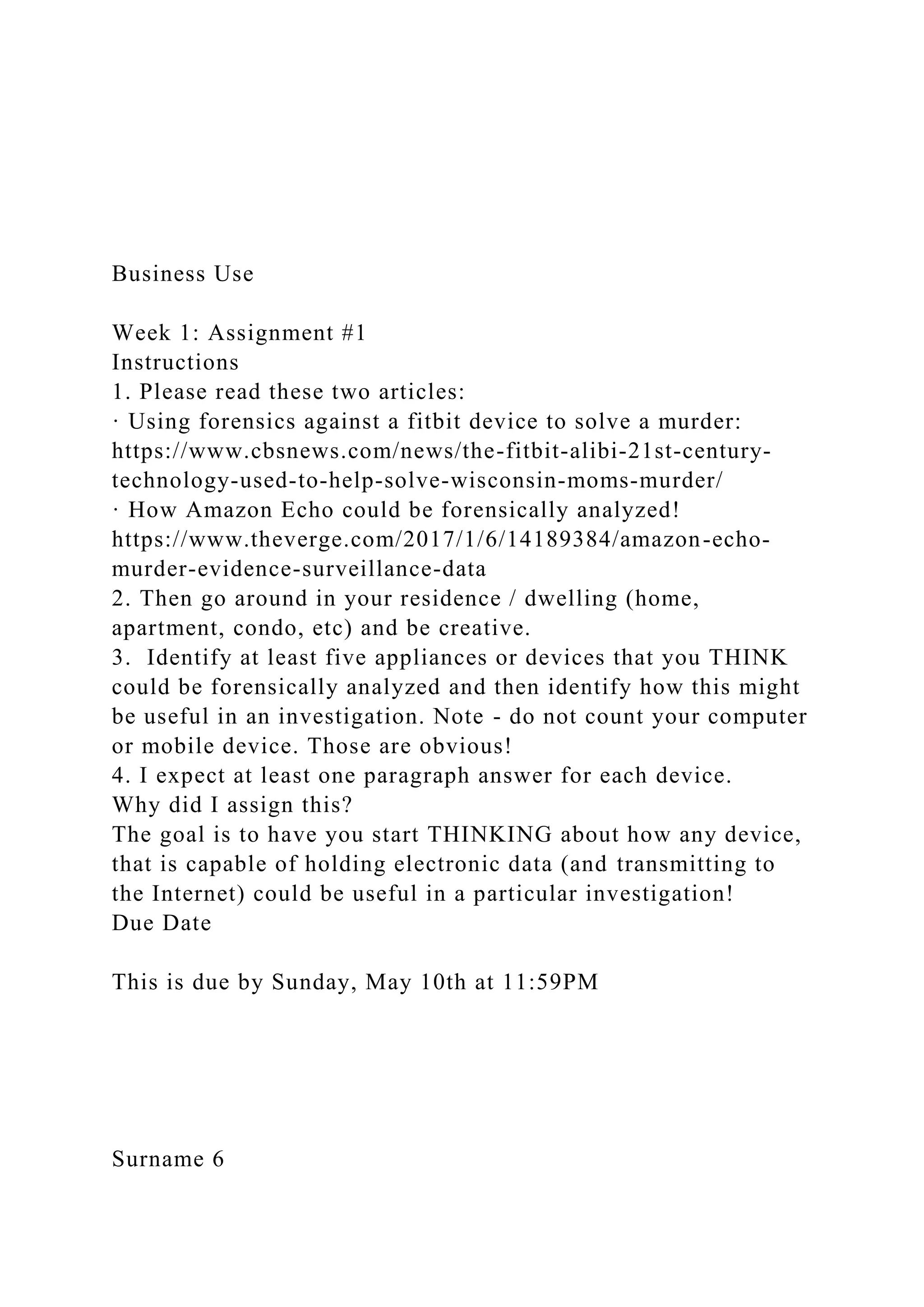
1. Please read these two articles:
· Using forensics against a fitbit device to solve a murder:
https://www.cbsnews.com/news/the-fitbit-alibi-21st-century-
technology-used-to-help-solve-wisconsin-moms-murder/
· How Amazon Echo could be forensically analyzed!
https://www.theverge.com/2017/1/6/14189384/amazon-echo-
murder-evidence-surveillance-data
2. Then go around in your residence / dwelling (home,
apartment, condo, etc) and be creative.
3. Identify at least five appliances or devices that you THINK
could be forensically analyzed and then identify how this might
be useful in an investigation. Note - do not count your computer
or mobile device. Those are obvious!
4. I expect at least one paragraph answer for each device.
Why did I assign this?
The goal is to have you start THINKING about how any device,
that is capable of holding electronic data (and transmitting to
the Internet) could be useful in a particular investigation!
Due Date
This is due by Sunday, May 10th at 11:59PM
Surname 6
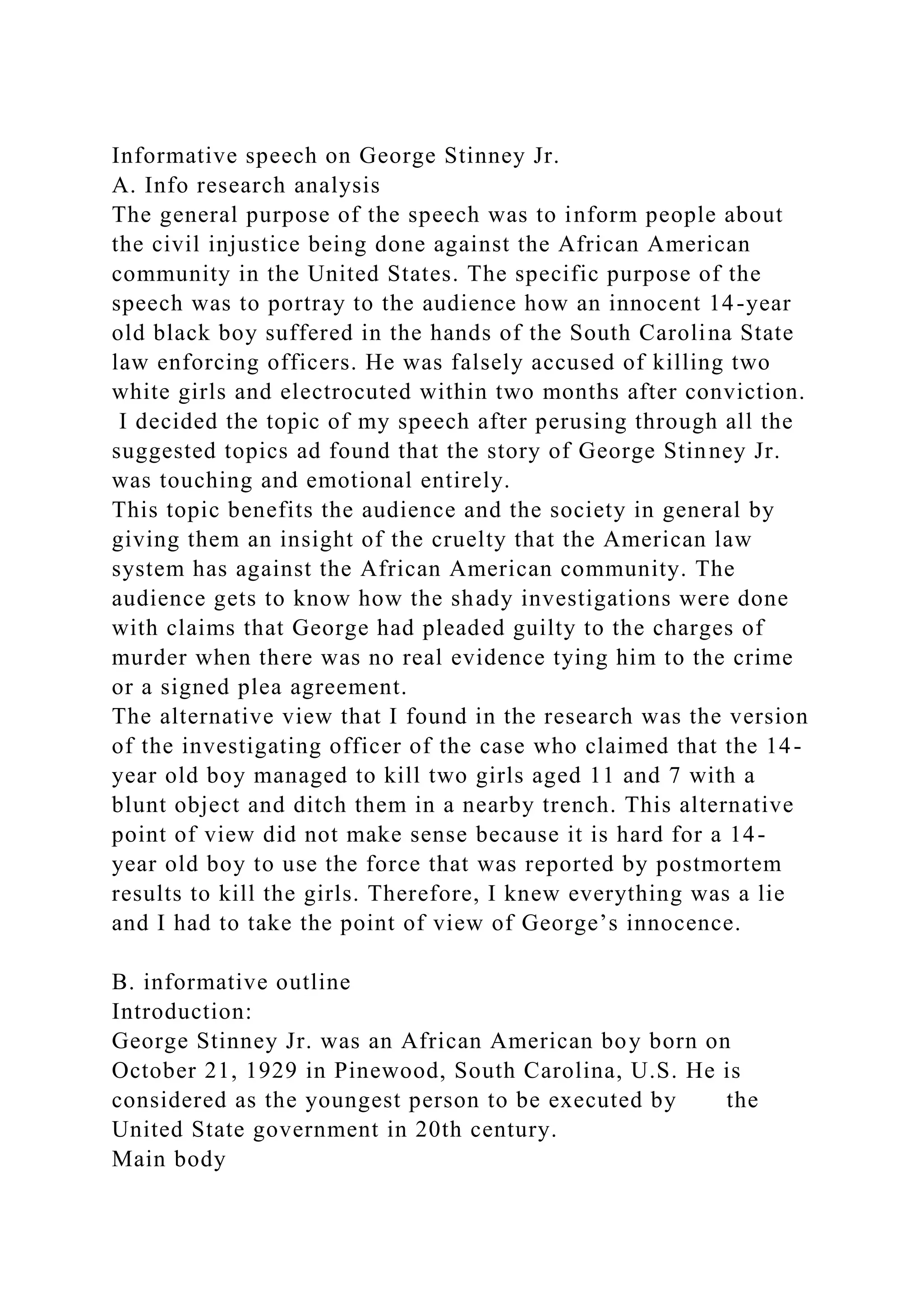
Informative speech on George Stinney Jr.
A. Info research analysis
The general purpose of the speech was to inform people about
the civil injustice being done against the African American
community in the United States. The specific purpose of the
speech was to portray to the audience how an innocent 14-year
old black boy suffered in the hands of the South Carolina State
law enforcing officers. He was falsely accused of killing two
white girls and electrocuted within two months after conviction.
I decided the topic of my speech after perusing through all the
suggested topics ad found that the story of George Stinney Jr.
was touching and emotional entirely.
This topic benefits the audience and the society in general by
giving them an insight of the cruelty that the American law
system has against the African American community. The
audience gets to know how the shady investigations were done
with claims that George had pleaded guilty to the charges of
murder when there was no real evidence tying him to the crime
or a signed plea agreement.
The alternative view that I found in the research was the version
of the investigating officer of the case who claimed that the 14-
year old boy managed to kill two girls aged 11 and 7 with a
blunt object and ditch them in a nearby trench. This alternative
point of view did not make sense because it is hard for a 14-
year old boy to use the force that was reported by postmortem
results to kill the girls. Therefore, I knew everything was a lie
and I had to take the point of view of George’s innocence.
B. informative outline
Introduction:
George Stinney Jr. was an African American boy born on
October 21, 1929 in Pinewood, South Carolina, U.S. He is
considered as the youngest person to be executed by the
United State government in 20th century.
Main body
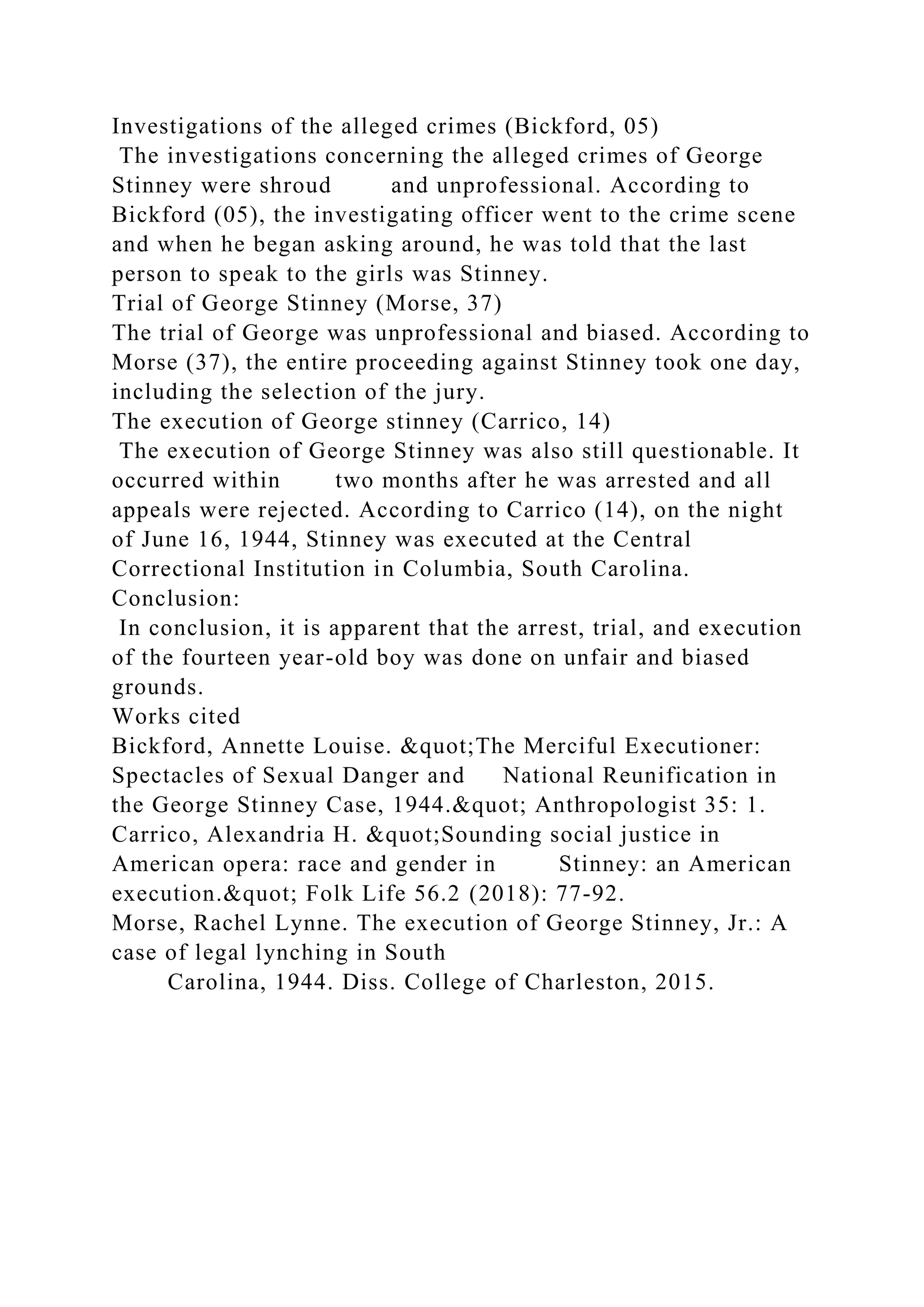
Investigations of the alleged crimes (Bickford, 05)
The investigations concerning the alleged crimes of George
Stinney were shroud and unprofessional. According to
Bickford (05), the investigating officer went to the crime scene
and when he began asking around, he was told that the last
person to speak to the girls was Stinney.
Trial of George Stinney (Morse, 37)
The trial of George was unprofessional and biased. According to
Morse (37), the entire proceeding against Stinney took one day,
including the selection of the jury.
The execution of George stinney (Carrico, 14)
The execution of George Stinney was also still questionable. It
occurred within two months after he was arrested and all
appeals were rejected. According to Carrico (14), on the night
of June 16, 1944, Stinney was executed at the Central
Correctional Institution in Columbia, South Carolina.
Conclusion:
In conclusion, it is apparent that the arrest, trial, and execution
of the fourteen year-old boy was done on unfair and biased
grounds.
Works cited
Bickford, Annette Louise. "The Merciful Executioner:
Spectacles of Sexual Danger and National Reunification in
the George Stinney Case, 1944." Anthropologist 35: 1.
Carrico, Alexandria H. "Sounding social justice in
American opera: race and gender in Stinney: an American
execution." Folk Life 56.2 (2018): 77-92.
Morse, Rachel Lynne. The execution of George Stinney, Jr.: A
case of legal lynching in South
Carolina, 1944. Diss. College of Charleston, 2015.
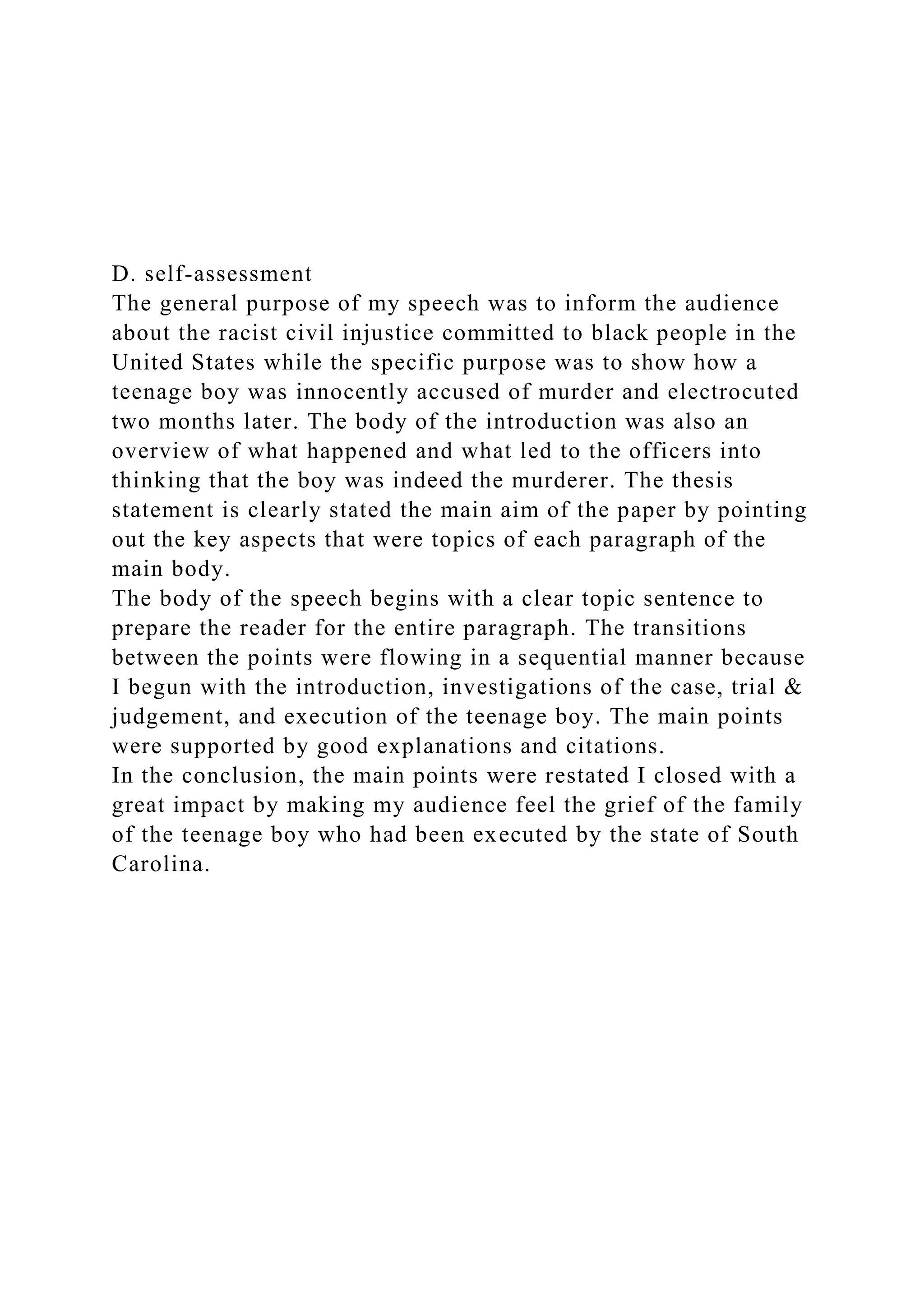
D. self-assessment
The general purpose of my speech was to inform the audience
about the racist civil injustice committed to black people in the
United States while the specific purpose was to show how a
teenage boy was innocently accused of murder and electrocuted
two months later. The body of the introduction was also an
overview of what happened and what led to the officers into
thinking that the boy was indeed the murderer. The thesis
statement is clearly stated the main aim of the paper by pointing
out the key aspects that were topics of each paragraph of the
main body.
The body of the speech begins with a clear topic sentence to
prepare the reader for the entire paragraph. The transitions
between the points were flowing in a sequential manner because
I begun with the introduction, investigations of the case, trial &
judgement, and execution of the teenage boy. The main points
were supported by good explanations and citations.
In the conclusion, the main points were restated I closed with a
great impact by making my audience feel the grief of the family
of the teenage boy who had been executed by the state of South
Carolina.
Works cited
Bickford, Annette Louise. "The Merciful Executioner:
Spectacles of Sexual Danger and National Reunification in
the George Stinney Case, 1944." Anthropologist 35: 1.
Carrico, Alexandria H. "Sounding social justice in
American opera: race and gender in Stinney: an American
execution." Folk Life 56.2 (2018): 77-92.
Morse, Rachel Lynne. The execution of George Stinney, Jr.: A
case of legal lynching in South
Carolina, 1944. Diss. College of Charleston, 2015.
Intro:
If I were to say the names Blue Beetle, Animal Man, or Plastic
Man, most of you wouldn’t know who
was talking about. However, if I were to say the name Wonder
Woman, chances are majority of you
would recognize that name. She’s one of DC Comics’ Holy
Trinity, is the most prominent female
superhero of all time, and has been around for 74 years.
Topic: This speech will give you a working knowledge of
Wonder Woman.
Preview: #1 William Moulton Marston, #2 Her Origin Story, #3
Wonder Woman in the comics.
I. William Moulton Marston (The Man Behind Wonder Woman
Was Inspired By Both Suffragists and
Centerfolds, 2014)
A. His Family
B. The Lie Detector
C. Why She Was Created
II. Her Origin Story (Wonder Woman)
A. Paradise Island
B. Steve Trevor
C. Bullets and Bracelets
III. Wonder Woman in the Comics (Kistler, 2013)
A. Amazons Attack
B. Infinite Crisis
C. New 52 Wonder Woman
Conclusion
Topic Restated: Today I’ve told you all about Wonder Woman.
Review: #1 William Moulton Marston, #2 Her Origin Story, #3
Wonder Woman in the Comics
Clincher: If they could only give her pants...
Works Cited
Kistler, A. (2013, December 4). The 10 Must-Read
WonderWoman Stories for Fans New and Old.
Retrieved April 8, 2015, from newsarama:
http://www.newsarama.com/15452-10-wonder- woman-
stories-worth-checking-out.html
The Man Behind Wonder Woman Was Inspired By Both
Suffragists and Centerfolds. (2014, 10 27).
Retrieved 4 8, 2015, from www.npr.org:
http://www.npr.org/2014/10/27/359078315/the-man- behind-
wonder-woman-was-inspired-by-both-suffragists-and-
centerfolds
Wonder Woman. (n.d.). Retrieved April 8, 2015, from
dccomics.com: http://www.dccomics.com/
characters/wonder-woman
Suggested speech topics Spring 2020
Interesting potential topics
Explore these potential speech topics
Informative speech Topics
1. 60 words and the war without end
2. Acoustic cat
3. Alan Turing
4. Anneliese Michel
5. Berdache
6. Chicken sexing
7. Chuck Wepner
8. Clive Wearing
9. Cognitive biases
10. Cuttlefish
11. Dunning-Kruger effect
12. Edward Snowden
13. Entanglement, quantuum physics
14. Fear pheromone
15. Gate control theory
16. George Stinney
17. Ghost boy
18. Internet Research Agency
19. Intrusive thoughts
20. Jason Padgett
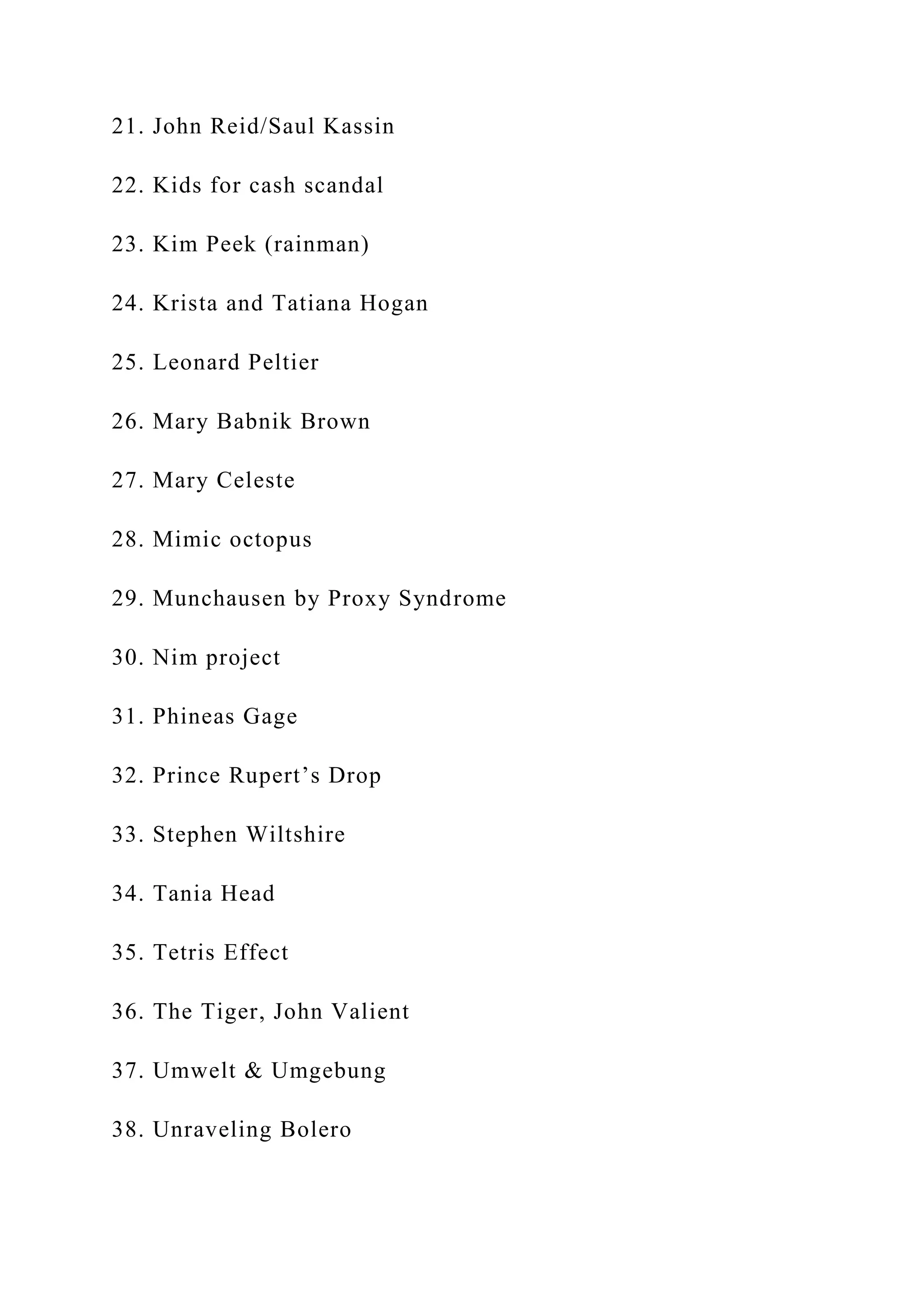
21. John Reid/Saul Kassin
22. Kids for cash scandal
23. Kim Peek (rainman)
24. Krista and Tatiana Hogan
25. Leonard Peltier
26. Mary Babnik Brown
27. Mary Celeste
28. Mimic octopus
29. Munchausen by Proxy Syndrome
30. Nim project
31. Phineas Gage
32. Prince Rupert’s Drop
33. Stephen Wiltshire
34. Tania Head
35. Tetris Effect
36. The Tiger, John Valient
37. Umwelt & Umgebung
38. Unraveling Bolero
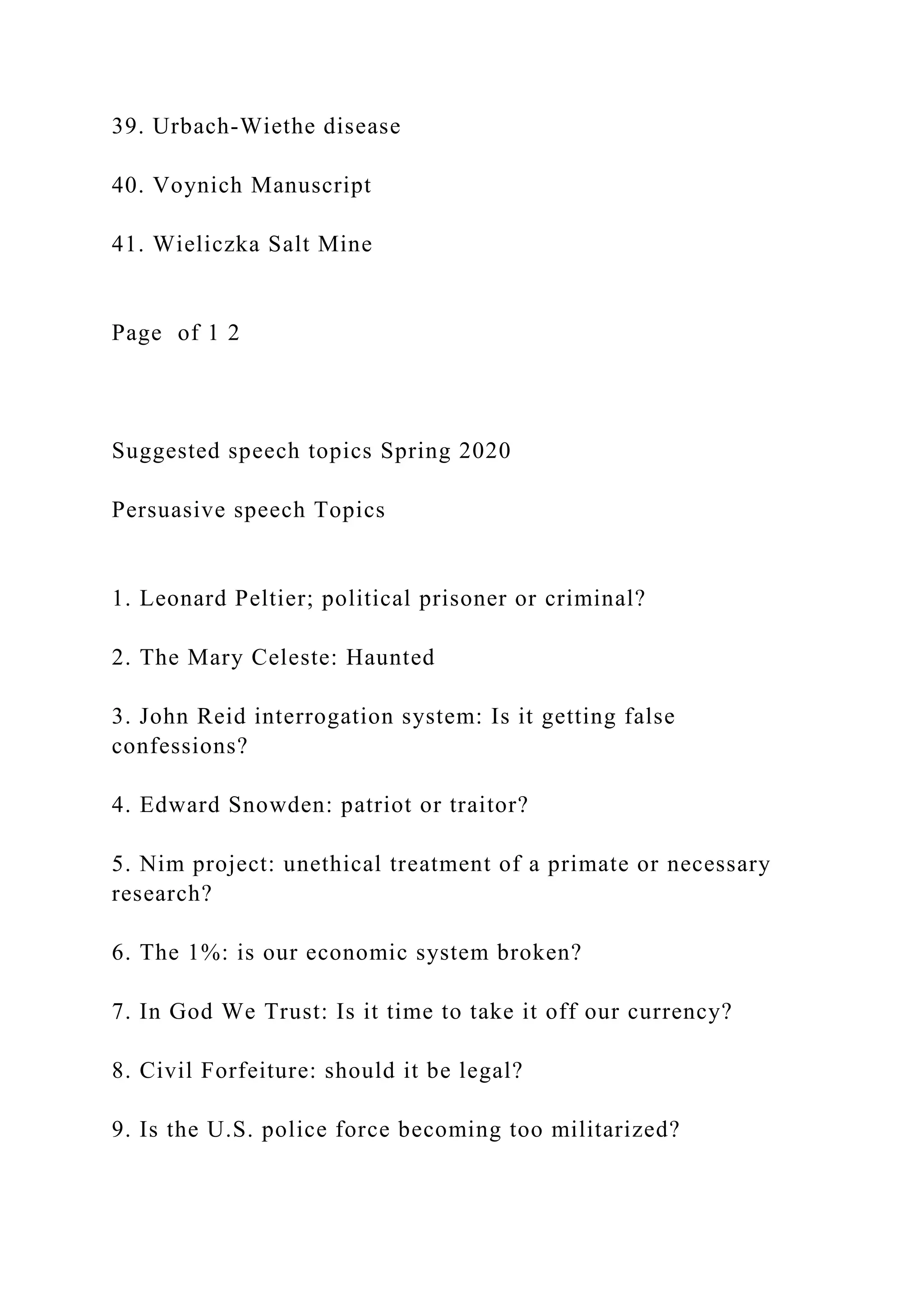
39. Urbach-Wiethe disease
40. Voynich Manuscript
41. Wieliczka Salt Mine
Page of 1 2
Suggested speech topics Spring 2020
Persuasive speech Topics
1. Leonard Peltier; political prisoner or criminal?
2. The Mary Celeste: Haunted
3. John Reid interrogation system: Is it getting false
confessions?
4. Edward Snowden: patriot or traitor?
5. Nim project: unethical treatment of a primate or necessary
research?
6. The 1%: is our economic system broken?
7. In God We Trust: Is it time to take it off our currency?
8. Civil Forfeiture: should it be legal?
9. Is the U.S. police force becoming too militarized?
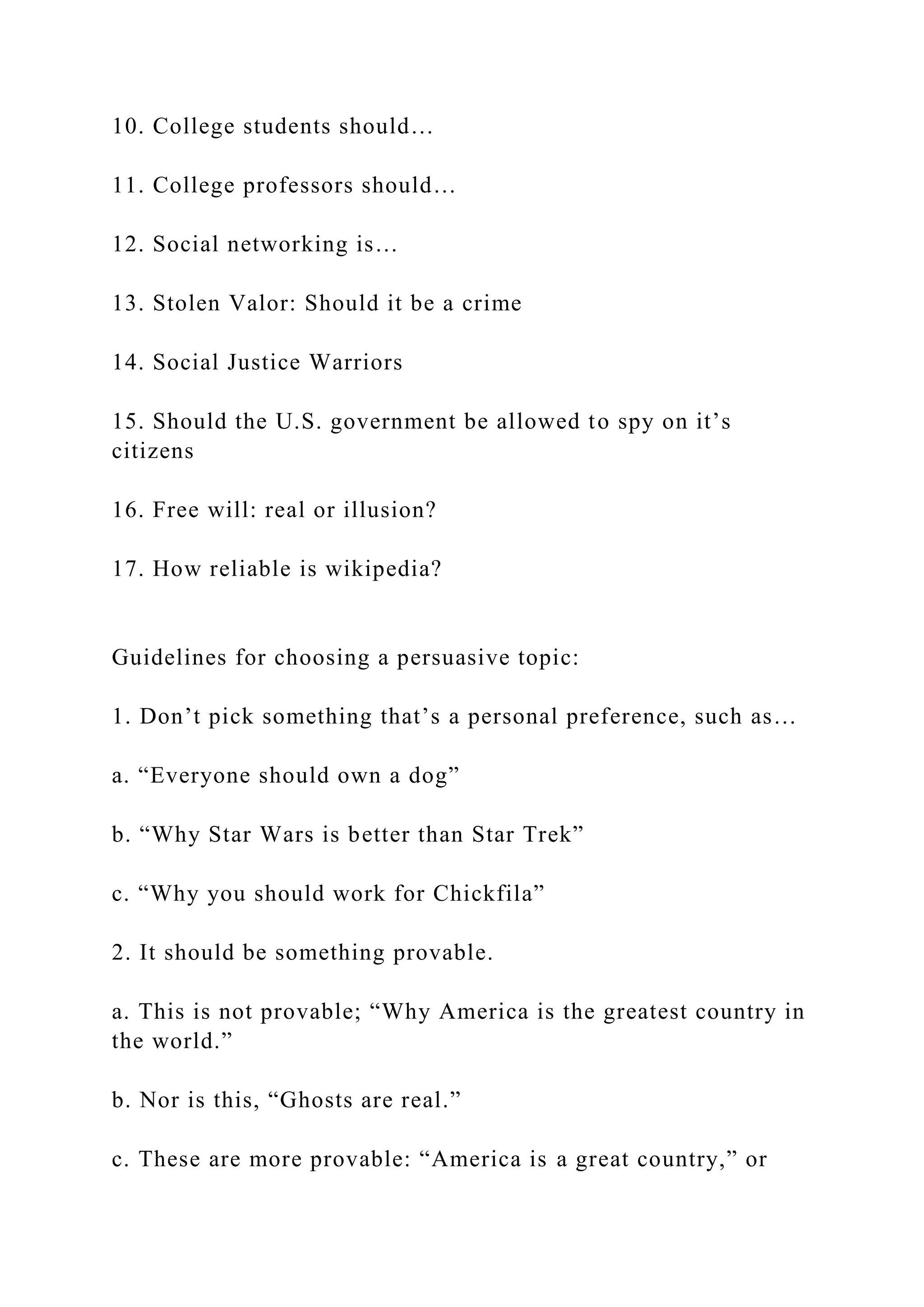
10. College students should…
11. College professors should…
12. Social networking is…
13. Stolen Valor: Should it be a crime
14. Social Justice Warriors
15. Should the U.S. government be allowed to spy on it’s
citizens
16. Free will: real or illusion?
17. How reliable is wikipedia?
Guidelines for choosing a persuasive topic:
1. Don’t pick something that’s a personal preference, such as…
a. “Everyone should own a dog”
b. “Why Star Wars is better than Star Trek”
c. “Why you should work for Chickfila”
2. It should be something provable.
a. This is not provable; “Why America is the greatest country in
the world.”
b. Nor is this, “Ghosts are real.”
c. These are more provable: “America is a great country,” or
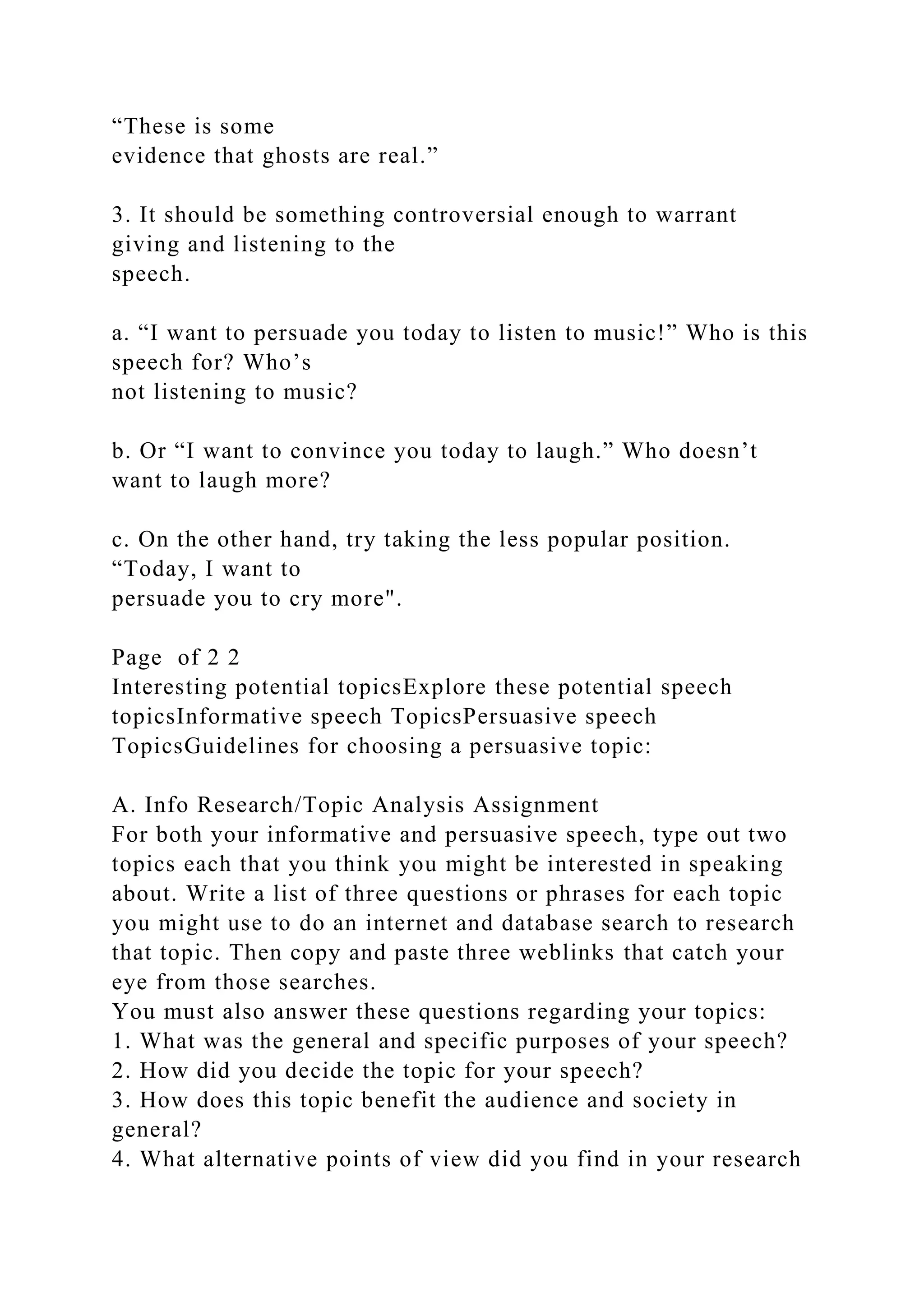
“These is some
evidence that ghosts are real.”
3. It should be something controversial enough to warrant
giving and listening to the
speech.
a. “I want to persuade you today to listen to music!” Who is this
speech for? Who’s
not listening to music?
b. Or “I want to convince you today to laugh.” Who doesn’t
want to laugh more?
c. On the other hand, try taking the less popular position.
“Today, I want to
persuade you to cry more".
Page of 2 2
Interesting potential topicsExplore these potential speech
topicsInformative speech TopicsPersuasive speech
TopicsGuidelines for choosing a persuasive topic:
A. Info Research/Topic Analysis Assignment
For both your informative and persuasive speech, type out two
topics each that you think you might be interested in speaking
about. Write a list of three questions or phrases for each topic
you might use to do an internet and database search to research
that topic. Then copy and paste three weblinks that catch your
eye from those searches.
You must also answer these questions regarding your topics:
1. What was the general and specific purposes of your speech?
2. How did you decide the topic for your speech?
3. How does this topic benefit the audience and society in
general?
4. What alternative points of view did you find in your research
and what made you accept the point of view that you presented
in your speech.
Please remember to check the off-limits speech topic list before
you choose a topic. Also remember, you cannot submit your
informative or persuasive outlines until you get full credit for
each of these assignments. See the sample that’s on eCampus
under the assignment link.
B. Informative Outline
Upload your informative outline, works cited, here in PDF or
Microsoft Word format.
Before you do, make sure:
1. You've gone over the outline infographic and samples;
2. You have a proper introduction and conclusion (Topic/thesis,
review of main points, clincher)
3. Your sources are IN your outline and Works Cited at the end;
C. Informative Speech Self Assessment
One of the best ways to learn public speaking, other than
actually doing it, is to analyze what factors contributed to the
strengths and weaknesses of your speech. For this assessment,
you will watch the video of your informative speech and assess
your speech by writing a five-paragraph essay, typed and
double-spaced in which you will identify your strengths and
weaknesses and make recommendations for improvement.
Incorporate the following elements into your essay:
A header (MLA style) is required. (example… Singer Michael
Jackson: Youth, Career and Death)
1. Introduction: Identify the general and specific purposes of
your speech and summarize your topic with a thesis.
(example… The purpose of my speech is to inform my audience
about the late pop singer Michael Jackson. I covered his youth,
his career with the Jackson 5 and as a solo artist, and his death
in 2009.)
2. Body: How did you open with impact? (example is a
statistic)
1. What did you say to connect your topic with your audience?
(example is asking a question and letting audience answer it)
2. Was your thesis stated clearly? (Yes or no and explain why
yes or why no)
3. Did you present the main points in a clear, concise manner?
(Yes, I did or No, I forgot to state them)
4. Were transitions used between main points? (Yes, I did one-
word, phrase, sentence or question and answer transitions; or
no, I forgot and the instructor gave me a zero for this part)
5. Did you provide ample support for main points? (Yes, here is
where you list the sources used and recorded in NoodleTools)
6. Did you restate your main points in the conclusion? (Yes or
no)
7. How did you close with impact? (I provided another statistic
or surprising fact)
3. Body: Using the rubric, identify your strengths. These are
5’s circled on your informative speech critique sheet. If you
have no 5’s, 4’s are strengths. If you have both, mention only
the 5’s.
4. Body: Using the rubric, identify your weaknesses. These are
any and all 0’s, 1’s and 2’s on your critique sheet. If your
lowest point is a 3, that would be a weakness.
5. Conclusion: State how effective you believe your speech was
and how you will address weaknesses.
1. (example… I believe my speech effectively explored the life
of Michael Jackson. I earned a grade of 88. The instructor must
have agreed it was effective. I could have done a better job on
my posture, on my opener and my closer and will work on those
weaknesses.)
2

Business UseWeek 1 Assignment #1Instructions1. Plea.docx

  • 1.
    Business Use Week 1:Assignment #1 Instructions 1. Please read these two articles: · Using forensics against a fitbit device to solve a murder: https://www.cbsnews.com/news/the-fitbit-alibi-21st-century- technology-used-to-help-solve-wisconsin-moms-murder/ · How Amazon Echo could be forensically analyzed! https://www.theverge.com/2017/1/6/14189384/amazon-echo- murder-evidence-surveillance-data 2. Then go around in your residence / dwelling (home, apartment, condo, etc) and be creative. 3. Identify at least five appliances or devices that you THINK could be forensically analyzed and then identify how this might be useful in an investigation. Note - do not count your computer or mobile device. Those are obvious! 4. I expect at least one paragraph answer for each device. Why did I assign this? The goal is to have you start THINKING about how any device, that is capable of holding electronic data (and transmitting to the Internet) could be useful in a particular investigation! Due Date This is due by Sunday, May 10th at 11:59PM Surname 6
  • 2.
    Informative speech onGeorge Stinney Jr. A. Info research analysis The general purpose of the speech was to inform people about the civil injustice being done against the African American community in the United States. The specific purpose of the speech was to portray to the audience how an innocent 14-year old black boy suffered in the hands of the South Carolina State law enforcing officers. He was falsely accused of killing two white girls and electrocuted within two months after conviction. I decided the topic of my speech after perusing through all the suggested topics ad found that the story of George Stinney Jr. was touching and emotional entirely. This topic benefits the audience and the society in general by giving them an insight of the cruelty that the American law system has against the African American community. The audience gets to know how the shady investigations were done with claims that George had pleaded guilty to the charges of murder when there was no real evidence tying him to the crime or a signed plea agreement. The alternative view that I found in the research was the version of the investigating officer of the case who claimed that the 14- year old boy managed to kill two girls aged 11 and 7 with a blunt object and ditch them in a nearby trench. This alternative point of view did not make sense because it is hard for a 14- year old boy to use the force that was reported by postmortem results to kill the girls. Therefore, I knew everything was a lie and I had to take the point of view of George’s innocence. B. informative outline Introduction: George Stinney Jr. was an African American boy born on October 21, 1929 in Pinewood, South Carolina, U.S. He is considered as the youngest person to be executed by the United State government in 20th century. Main body
  • 3.
    Investigations of thealleged crimes (Bickford, 05) The investigations concerning the alleged crimes of George Stinney were shroud and unprofessional. According to Bickford (05), the investigating officer went to the crime scene and when he began asking around, he was told that the last person to speak to the girls was Stinney. Trial of George Stinney (Morse, 37) The trial of George was unprofessional and biased. According to Morse (37), the entire proceeding against Stinney took one day, including the selection of the jury. The execution of George stinney (Carrico, 14) The execution of George Stinney was also still questionable. It occurred within two months after he was arrested and all appeals were rejected. According to Carrico (14), on the night of June 16, 1944, Stinney was executed at the Central Correctional Institution in Columbia, South Carolina. Conclusion: In conclusion, it is apparent that the arrest, trial, and execution of the fourteen year-old boy was done on unfair and biased grounds. Works cited Bickford, Annette Louise. "The Merciful Executioner: Spectacles of Sexual Danger and National Reunification in the George Stinney Case, 1944." Anthropologist 35: 1. Carrico, Alexandria H. "Sounding social justice in American opera: race and gender in Stinney: an American execution." Folk Life 56.2 (2018): 77-92. Morse, Rachel Lynne. The execution of George Stinney, Jr.: A case of legal lynching in South Carolina, 1944. Diss. College of Charleston, 2015.
  • 4.
    D. self-assessment The generalpurpose of my speech was to inform the audience about the racist civil injustice committed to black people in the United States while the specific purpose was to show how a teenage boy was innocently accused of murder and electrocuted two months later. The body of the introduction was also an overview of what happened and what led to the officers into thinking that the boy was indeed the murderer. The thesis statement is clearly stated the main aim of the paper by pointing out the key aspects that were topics of each paragraph of the main body. The body of the speech begins with a clear topic sentence to prepare the reader for the entire paragraph. The transitions between the points were flowing in a sequential manner because I begun with the introduction, investigations of the case, trial & judgement, and execution of the teenage boy. The main points were supported by good explanations and citations. In the conclusion, the main points were restated I closed with a great impact by making my audience feel the grief of the family of the teenage boy who had been executed by the state of South Carolina.
  • 5.
    Works cited Bickford, AnnetteLouise. "The Merciful Executioner: Spectacles of Sexual Danger and National Reunification in the George Stinney Case, 1944." Anthropologist 35: 1. Carrico, Alexandria H. "Sounding social justice in American opera: race and gender in Stinney: an American execution." Folk Life 56.2 (2018): 77-92. Morse, Rachel Lynne. The execution of George Stinney, Jr.: A case of legal lynching in South Carolina, 1944. Diss. College of Charleston, 2015. Intro: If I were to say the names Blue Beetle, Animal Man, or Plastic Man, most of you wouldn’t know who was talking about. However, if I were to say the name Wonder Woman, chances are majority of you would recognize that name. She’s one of DC Comics’ Holy Trinity, is the most prominent female superhero of all time, and has been around for 74 years. Topic: This speech will give you a working knowledge of Wonder Woman. Preview: #1 William Moulton Marston, #2 Her Origin Story, #3
  • 6.
    Wonder Woman inthe comics. I. William Moulton Marston (The Man Behind Wonder Woman Was Inspired By Both Suffragists and Centerfolds, 2014) A. His Family B. The Lie Detector C. Why She Was Created II. Her Origin Story (Wonder Woman) A. Paradise Island B. Steve Trevor C. Bullets and Bracelets III. Wonder Woman in the Comics (Kistler, 2013) A. Amazons Attack B. Infinite Crisis C. New 52 Wonder Woman Conclusion Topic Restated: Today I’ve told you all about Wonder Woman. Review: #1 William Moulton Marston, #2 Her Origin Story, #3 Wonder Woman in the Comics Clincher: If they could only give her pants...
  • 7.
    Works Cited Kistler, A.(2013, December 4). The 10 Must-Read WonderWoman Stories for Fans New and Old. Retrieved April 8, 2015, from newsarama: http://www.newsarama.com/15452-10-wonder- woman- stories-worth-checking-out.html The Man Behind Wonder Woman Was Inspired By Both Suffragists and Centerfolds. (2014, 10 27). Retrieved 4 8, 2015, from www.npr.org: http://www.npr.org/2014/10/27/359078315/the-man- behind- wonder-woman-was-inspired-by-both-suffragists-and- centerfolds Wonder Woman. (n.d.). Retrieved April 8, 2015, from dccomics.com: http://www.dccomics.com/ characters/wonder-woman Suggested speech topics Spring 2020 Interesting potential topics Explore these potential speech topics Informative speech Topics 1. 60 words and the war without end 2. Acoustic cat
  • 8.
    3. Alan Turing 4.Anneliese Michel 5. Berdache 6. Chicken sexing 7. Chuck Wepner 8. Clive Wearing 9. Cognitive biases 10. Cuttlefish 11. Dunning-Kruger effect 12. Edward Snowden 13. Entanglement, quantuum physics 14. Fear pheromone 15. Gate control theory 16. George Stinney 17. Ghost boy 18. Internet Research Agency 19. Intrusive thoughts 20. Jason Padgett
  • 9.
    21. John Reid/SaulKassin 22. Kids for cash scandal 23. Kim Peek (rainman) 24. Krista and Tatiana Hogan 25. Leonard Peltier 26. Mary Babnik Brown 27. Mary Celeste 28. Mimic octopus 29. Munchausen by Proxy Syndrome 30. Nim project 31. Phineas Gage 32. Prince Rupert’s Drop 33. Stephen Wiltshire 34. Tania Head 35. Tetris Effect 36. The Tiger, John Valient 37. Umwelt & Umgebung 38. Unraveling Bolero
  • 10.
    39. Urbach-Wiethe disease 40.Voynich Manuscript 41. Wieliczka Salt Mine Page of 1 2 Suggested speech topics Spring 2020 Persuasive speech Topics 1. Leonard Peltier; political prisoner or criminal? 2. The Mary Celeste: Haunted 3. John Reid interrogation system: Is it getting false confessions? 4. Edward Snowden: patriot or traitor? 5. Nim project: unethical treatment of a primate or necessary research? 6. The 1%: is our economic system broken? 7. In God We Trust: Is it time to take it off our currency? 8. Civil Forfeiture: should it be legal? 9. Is the U.S. police force becoming too militarized?
  • 11.
    10. College studentsshould… 11. College professors should… 12. Social networking is… 13. Stolen Valor: Should it be a crime 14. Social Justice Warriors 15. Should the U.S. government be allowed to spy on it’s citizens 16. Free will: real or illusion? 17. How reliable is wikipedia? Guidelines for choosing a persuasive topic: 1. Don’t pick something that’s a personal preference, such as… a. “Everyone should own a dog” b. “Why Star Wars is better than Star Trek” c. “Why you should work for Chickfila” 2. It should be something provable. a. This is not provable; “Why America is the greatest country in the world.” b. Nor is this, “Ghosts are real.” c. These are more provable: “America is a great country,” or
  • 12.
    “These is some evidencethat ghosts are real.” 3. It should be something controversial enough to warrant giving and listening to the speech. a. “I want to persuade you today to listen to music!” Who is this speech for? Who’s not listening to music? b. Or “I want to convince you today to laugh.” Who doesn’t want to laugh more? c. On the other hand, try taking the less popular position. “Today, I want to persuade you to cry more". Page of 2 2 Interesting potential topicsExplore these potential speech topicsInformative speech TopicsPersuasive speech TopicsGuidelines for choosing a persuasive topic: A. Info Research/Topic Analysis Assignment For both your informative and persuasive speech, type out two topics each that you think you might be interested in speaking about. Write a list of three questions or phrases for each topic you might use to do an internet and database search to research that topic. Then copy and paste three weblinks that catch your eye from those searches. You must also answer these questions regarding your topics: 1. What was the general and specific purposes of your speech? 2. How did you decide the topic for your speech? 3. How does this topic benefit the audience and society in general? 4. What alternative points of view did you find in your research
  • 13.
    and what madeyou accept the point of view that you presented in your speech. Please remember to check the off-limits speech topic list before you choose a topic. Also remember, you cannot submit your informative or persuasive outlines until you get full credit for each of these assignments. See the sample that’s on eCampus under the assignment link. B. Informative Outline Upload your informative outline, works cited, here in PDF or Microsoft Word format. Before you do, make sure: 1. You've gone over the outline infographic and samples; 2. You have a proper introduction and conclusion (Topic/thesis, review of main points, clincher) 3. Your sources are IN your outline and Works Cited at the end; C. Informative Speech Self Assessment One of the best ways to learn public speaking, other than actually doing it, is to analyze what factors contributed to the strengths and weaknesses of your speech. For this assessment, you will watch the video of your informative speech and assess your speech by writing a five-paragraph essay, typed and double-spaced in which you will identify your strengths and weaknesses and make recommendations for improvement. Incorporate the following elements into your essay: A header (MLA style) is required. (example… Singer Michael Jackson: Youth, Career and Death) 1. Introduction: Identify the general and specific purposes of your speech and summarize your topic with a thesis.
  • 14.
    (example… The purposeof my speech is to inform my audience about the late pop singer Michael Jackson. I covered his youth, his career with the Jackson 5 and as a solo artist, and his death in 2009.) 2. Body: How did you open with impact? (example is a statistic) 1. What did you say to connect your topic with your audience? (example is asking a question and letting audience answer it) 2. Was your thesis stated clearly? (Yes or no and explain why yes or why no) 3. Did you present the main points in a clear, concise manner? (Yes, I did or No, I forgot to state them) 4. Were transitions used between main points? (Yes, I did one- word, phrase, sentence or question and answer transitions; or no, I forgot and the instructor gave me a zero for this part) 5. Did you provide ample support for main points? (Yes, here is where you list the sources used and recorded in NoodleTools) 6. Did you restate your main points in the conclusion? (Yes or no) 7. How did you close with impact? (I provided another statistic or surprising fact) 3. Body: Using the rubric, identify your strengths. These are 5’s circled on your informative speech critique sheet. If you have no 5’s, 4’s are strengths. If you have both, mention only the 5’s. 4. Body: Using the rubric, identify your weaknesses. These are any and all 0’s, 1’s and 2’s on your critique sheet. If your lowest point is a 3, that would be a weakness. 5. Conclusion: State how effective you believe your speech was and how you will address weaknesses. 1. (example… I believe my speech effectively explored the life of Michael Jackson. I earned a grade of 88. The instructor must have agreed it was effective. I could have done a better job on my posture, on my opener and my closer and will work on those weaknesses.)
  • 15.