Requirement Excellence
     Framework™
      Business Rules

     www.enfocussolutions.com
Business Rules


                                                                                                 Project

                                                                                                 Feature
                                                                                                 Impact

               Process Category                    Rule Book                                     Scope
                                                                                               Statement
    • Business rules are maintained
      separate from requirements.                                                        Functional        Supplemental
      They are organized by rule book                                                   Requirement        Requirement
      for various functional topics
      such as vacation and holiday
      leave, travel, customer service,
      etc.
                                                 Business Rule                                    Related Rules

•     Each rule book has a rule book
      owner. Rule books are ideally
      maintained by the business.
      Rules may be linked to
      requirements.                      Confidential - Not for External Distribution                                1
Business Rules

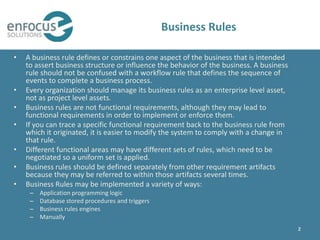
•   A business rule defines or constrains one aspect of the business that is intended
    to assert business structure or influence the behavior of the business. A business
    rule should not be confused with a workflow rule that defines the sequence of
    events to complete a business process.
•   Every organization should manage its business rules as an enterprise level asset,
    not as project level assets.
•   Business rules are not functional requirements, although they may lead to
    functional requirements in order to implement or enforce them.
•   If you can trace a specific functional requirement back to the business rule from
    which it originated, it is easier to modify the system to comply with a change in
    that rule.
•   Different functional areas may have different sets of rules, which need to be
    negotiated so a uniform set is applied.
•   Business rules should be defined separately from other requirement artifacts
    because they may be referred to within those artifacts several times.
•   Business Rules may be implemented a variety of ways:
     –   Application programming logic
     –   Database stored procedures and triggers
     –   Business rules engines
     –   Manually
                                                                                         2
Rule Books

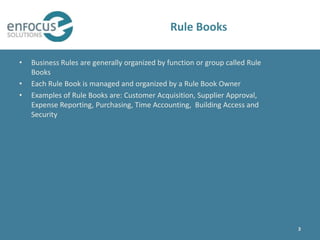
•   Business Rules are generally organized by function or group called Rule
    Books
•   Each Rule Book is managed and organized by a Rule Book Owner
•   Examples of Rule Books are: Customer Acquisition, Supplier Approval,
    Expense Reporting, Purchasing, Time Accounting, Building Access and
    Security


                                                                              3
Business Rules


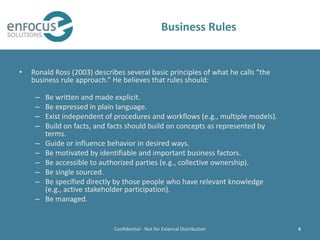
•   Ronald Ross (2003) describes several basic principles of what he calls “the
    business rule approach.” He believes that rules should:

     –   Be written and made explicit.
     –   Be expressed in plain language.
     –   Exist independent of procedures and workflows (e.g., multiple models).
     –   Build on facts, and facts should build on concepts as represented by
         terms.
     –   Guide or influence behavior in desired ways.
     –   Be motivated by identifiable and important business factors.
     –   Be accessible to authorized parties (e.g., collective ownership).
     –   Be single sourced.
     –   Be specified directly by those people who have relevant knowledge
         (e.g., active stakeholder participation).
     –   Be managed.


                              Confidential - Not for External Distribution        4
Types of Business Rules

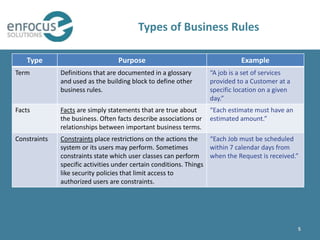
   Type                           Purpose                                    Example
Term          Definitions that are documented in a glossary        “A job is a set of services
              and used as the building block to define other       provided to a Customer at a
              business rules.                                      specific location on a given
                                                                   day.”
Facts         Facts are simply statements that are true about      “Each estimate must have an
              the business. Often facts describe associations or   estimated amount.”
              relationships between important business terms.
Constraints   Constraints place restrictions on the actions the    “Each Job must be scheduled
              system or its users may perform. Sometimes           within 7 calendar days from
              constraints state which user classes can perform     when the Request is received.”
              specific activities under certain conditions. Things
              like security policies that limit access to
              authorized users are constraints.


                                                                                                  5
Types of Business Rules (cont’d)

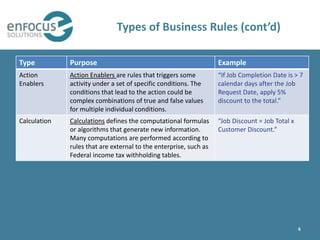
Type          Purpose                                              Example
Action        Action Enablers are rules that triggers some         “If Job Completion Date is > 7
Enablers      activity under a set of specific conditions. The     calendar days after the Job
              conditions that lead to the action could be          Request Date, apply 5%
              complex combinations of true and false values        discount to the total.”
              for multiple individual conditions.
Calculation   Calculations defines the computational formulas      “Job Discount = Job Total x
              or algorithms that generate new information.         Customer Discount.”
              Many computations are performed according to
              rules that are external to the enterprise, such as
              Federal income tax withholding tables.


                                                                                                 6
Business Rule Examples


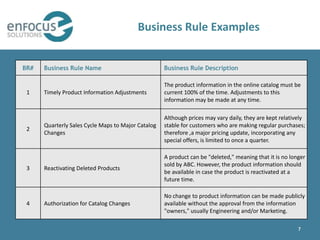
BR#   Business Rule Name                            Business Rule Description

                                                    The product information in the online catalog must be
 1    Timely Product Information Adjustments        current 100% of the time. Adjustments to this
                                                    information may be made at any time.

                                                    Although prices may vary daily, they are kept relatively
      Quarterly Sales Cycle Maps to Major Catalog   stable for customers who are making regular purchases;
 2
      Changes                                       therefore ,a major pricing update, incorporating any
                                                    special offers, is limited to once a quarter.

                                                    A product can be "deleted," meaning that it is no longer
                                                    sold by ABC. However, the product information should
 3    Reactivating Deleted Products
                                                    be available in case the product is reactivated at a
                                                    future time.

                                                    No change to product information can be made publicly
 4    Authorization for Catalog Changes             available without the approval from the information
                                                    "owners," usually Engineering and/or Marketing.

                                                                                                         7

Business Rules

  • 1.
    Requirement Excellence Framework™ Business Rules www.enfocussolutions.com
  • 2.
    Business Rules Project Feature Impact Process Category Rule Book Scope Statement • Business rules are maintained separate from requirements. Functional Supplemental They are organized by rule book Requirement Requirement for various functional topics such as vacation and holiday leave, travel, customer service, etc. Business Rule Related Rules • Each rule book has a rule book owner. Rule books are ideally maintained by the business. Rules may be linked to requirements. Confidential - Not for External Distribution 1
  • 3.
    Business Rules • A business rule defines or constrains one aspect of the business that is intended to assert business structure or influence the behavior of the business. A business rule should not be confused with a workflow rule that defines the sequence of events to complete a business process. • Every organization should manage its business rules as an enterprise level asset, not as project level assets. • Business rules are not functional requirements, although they may lead to functional requirements in order to implement or enforce them. • If you can trace a specific functional requirement back to the business rule from which it originated, it is easier to modify the system to comply with a change in that rule. • Different functional areas may have different sets of rules, which need to be negotiated so a uniform set is applied. • Business rules should be defined separately from other requirement artifacts because they may be referred to within those artifacts several times. • Business Rules may be implemented a variety of ways: – Application programming logic – Database stored procedures and triggers – Business rules engines – Manually 2
  • 4.
    Rule Books • Business Rules are generally organized by function or group called Rule Books • Each Rule Book is managed and organized by a Rule Book Owner • Examples of Rule Books are: Customer Acquisition, Supplier Approval, Expense Reporting, Purchasing, Time Accounting, Building Access and Security 3
  • 5.
    Business Rules • Ronald Ross (2003) describes several basic principles of what he calls “the business rule approach.” He believes that rules should: – Be written and made explicit. – Be expressed in plain language. – Exist independent of procedures and workflows (e.g., multiple models). – Build on facts, and facts should build on concepts as represented by terms. – Guide or influence behavior in desired ways. – Be motivated by identifiable and important business factors. – Be accessible to authorized parties (e.g., collective ownership). – Be single sourced. – Be specified directly by those people who have relevant knowledge (e.g., active stakeholder participation). – Be managed. Confidential - Not for External Distribution 4
  • 6.
    Types of BusinessRules Type Purpose Example Term Definitions that are documented in a glossary “A job is a set of services and used as the building block to define other provided to a Customer at a business rules. specific location on a given day.” Facts Facts are simply statements that are true about “Each estimate must have an the business. Often facts describe associations or estimated amount.” relationships between important business terms. Constraints Constraints place restrictions on the actions the “Each Job must be scheduled system or its users may perform. Sometimes within 7 calendar days from constraints state which user classes can perform when the Request is received.” specific activities under certain conditions. Things like security policies that limit access to authorized users are constraints. 5
  • 7.
    Types of BusinessRules (cont’d) Type Purpose Example Action Action Enablers are rules that triggers some “If Job Completion Date is > 7 Enablers activity under a set of specific conditions. The calendar days after the Job conditions that lead to the action could be Request Date, apply 5% complex combinations of true and false values discount to the total.” for multiple individual conditions. Calculation Calculations defines the computational formulas “Job Discount = Job Total x or algorithms that generate new information. Customer Discount.” Many computations are performed according to rules that are external to the enterprise, such as Federal income tax withholding tables. 6
  • 8.
    Business Rule Examples BR# Business Rule Name Business Rule Description The product information in the online catalog must be 1 Timely Product Information Adjustments current 100% of the time. Adjustments to this information may be made at any time. Although prices may vary daily, they are kept relatively Quarterly Sales Cycle Maps to Major Catalog stable for customers who are making regular purchases; 2 Changes therefore ,a major pricing update, incorporating any special offers, is limited to once a quarter. A product can be "deleted," meaning that it is no longer sold by ABC. However, the product information should 3 Reactivating Deleted Products be available in case the product is reactivated at a future time. No change to product information can be made publicly 4 Authorization for Catalog Changes available without the approval from the information "owners," usually Engineering and/or Marketing. 7