Business Plan for
   Start Ups


                    © ASBTDC 2009 All Rights Reserved
ASBTDC Services

                                    • Training
                                    • Consulting
                                    • Market Research
                                    • Innovation


© ASBTDC 2009 All Rights Reserved
Goals for Today’s Session
                    • Understand how to write and use a business plan.

                    • Discuss the most important points of the plan.

                    • Learn about tools and resources you can use.

                    • Ask questions.

                    • Identify next steps.


© ASBTDC 2009 All Rights Reserved
Why Write a Business Plan
                • It is an organized way to think about each aspect
                  of your business.
                • Writing clarifies and simplifies your thinking.
                • It identifies benchmarks to help evaluate the
                  progress of your business.
                • It is a management tool to assist with
                  making business decisions.
                • It is a living, breathing
                  document – it has
                  to be alive.
© ASBTDC 2009 All Rights Reserved
“To the Point” Business Plan
                      • Covers most important aspects of your
                        business.
                      • Emphasizes the importance of not
                        skipping steps.
                      • Stresses “Quality over Quantity”


© ASBTDC 2009 All Rights Reserved
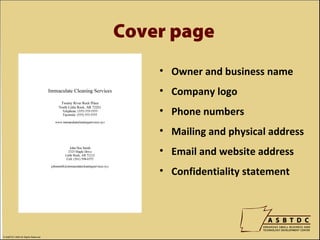
Cover page
                                        • Owner and business name
                                        • Company logo
                                        • Phone numbers
                                        • Mailing and physical address
                                        • Email and website address
                                        • Confidentiality statement


© ASBTDC 2009 All Rights Reserved
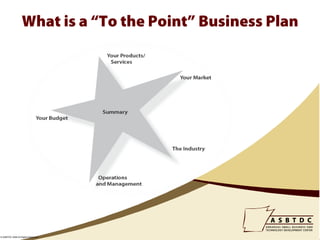
What is a “To the Point” Business Plan


© ASBTDC 2009 All Rights Reserved
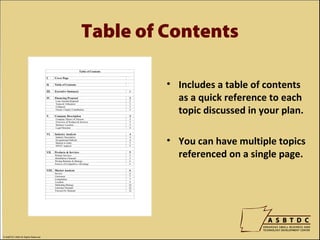
Table of Contents

                                             • Includes a table of contents
                                               as a quick reference to each
                                               topic discussed in your plan.

                                             • You can have multiple topics
                                               referenced on a single page.


© ASBTDC 2009 All Rights Reserved
Point 1: Products/Services
                           • What do you plan to sell?
                           • Where (Online – Storefront – Office)
                           • Pricing Strategy
                           • What need or problem does your
                             Product/Service address?


© ASBTDC 2009 All Rights Reserved
Point 2: Market
                    • Target Market
                    • Competitor Analysis
                    • Location Decision
                    • Marketing and Sales Strategy
                    • Supporting Market Research


© ASBTDC 2009 All Rights Reserved
Point 3: Industry
               • Sales & Marketing – How do firms typically market
                 themselves? Location, advertising, website?

               • Finance & Regulation – Is cyclical cash flow
                 management an issue? Is regulation pending?

               • Business Challenges – What keeps managers
                 “up at night?”

               • Industry Opportunities – Where
                  is the industry trending?
                 Where are the niches?


© ASBTDC 2009 All Rights Reserved
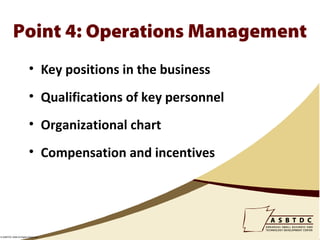
Point 4: Operations Management
                         • Key positions in the business
                         • Qualifications of key personnel
                         • Organizational chart
                         • Compensation and incentives


© ASBTDC 2009 All Rights Reserved
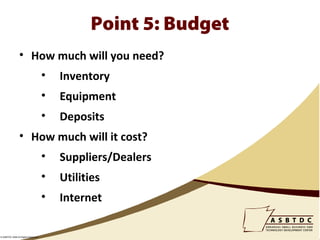
Point 5: Budget
                • How much will you need?
                                    •   Inventory
                                    •   Equipment
                                    •   Deposits
                • How much will it cost?
                                    •   Suppliers/Dealers
                                    •   Utilities
                                    •   Internet

© ASBTDC 2009 All Rights Reserved
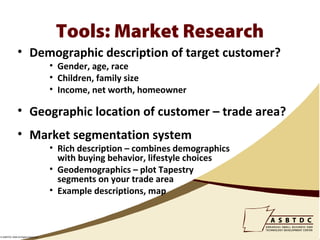
Tools: Market Research
               • Demographic description of target customer?
                                    • Gender, age, race
                                    • Children, family size
                                    • Income, net worth, homeowner

               • Geographic location of customer – trade area?
               • Market segmentation system
                                    • Rich description – combines demographics
                                      with buying behavior, lifestyle choices
                                    • Geodemographics – plot Tapestry
                                      segments on your trade area
                                    • Example descriptions, map


© ASBTDC 2009 All Rights Reserved
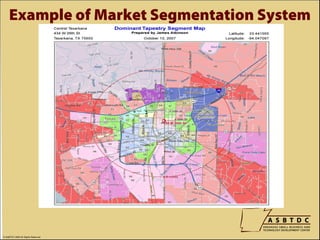
Example of Market Segmentation System


© ASBTDC 2009 All Rights Reserved
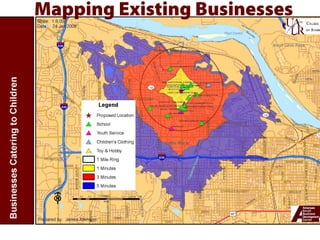
Mapping Existing Businesses


© ASBTDC 2009 All Rights Reserved
Location Decision
                    • Do you need a physical facility?

                    • How does this facility contribute to the competitive
                      advantage of the business?

                    • Consider a smaller advertising budget
                      and a better location.

                    • Enlist an experienced broker
                      or agent.


© ASBTDC 2009 All Rights Reserved
Competitor Analysis
                        • Always competition. No competition means no
                          market for product!

                        • Describe your major competitors

                        • Where are they located – Locator report

                        • What is their share of sales – Dun & Bradstreet

                        • Research them if possible - Company profiles

                        • Look for niche opportunities


© ASBTDC 2009 All Rights Reserved
Critical Issue: Working Capital
                                       & Cash Flow
                 • Focus on not only amount but timing
                 • Allows for planning of potential cash
                   shortfalls
                 • Demonstrates ability to repay debt


© ASBTDC 2009 All Rights Reserved
Tools: Financial Plan &
                                          Projections
                          Tools Available to Help You
                          • RMA (Risk Management Association)

                          • Statement Studies of the Small Business

                          • Profit-Cents Software

                          • ASBTDC staff


© ASBTDC 2009 All Rights Reserved
Commercial Lending Decisions
                              Banks make lending decisions based on:
                              • Repayment Ability

                              • Owner’s Equity

                              • Collateral

                              • Credit

                              • Management Ability

                              • Feasibility

© ASBTDC 2009 All Rights Reserved
Supporting Document
                                      (For Financing Requests)

                        • Resume
                        • Personal Financial Statement
                        • Collateral List
                        • Breakdown of Use of Funds
                        • Price Quotes/Estimates
                        • Tax Returns
© ASBTDC 2009 All Rights Reserved
Next Steps
                • Work up a draft of your business plan.
                            •       Contact your ASBTDC for help with market research, financial
                                    projections, or any other area of concern.

                • Provide a copy of your plan to the ASBTDC
                  and complete Request for Counseling.
                • After review, we will meet to
                      discuss our comments and
                     suggestions.

© ASBTDC 2009 All Rights Reserved
Contact Us
                                          Little Rock - ASBTDC Lead Center
                               University of Arkansas at Little Rock - College of Business
                               Reynolds Center for Business and Economic Development
                                                     2801 S. University
                                               Little Rock, Arkansas 72204
                                                       501.683.7700
                                                    501.683.7720 (fax)
                                                 800-862-2040 (toll-free)
                                                     http://asbtdc.org


© ASBTDC 2009 All Rights Reserved

Business Plan for Startups

  • 1.
    Business Plan for Start Ups © ASBTDC 2009 All Rights Reserved
  • 2.
    ASBTDC Services • Training • Consulting • Market Research • Innovation © ASBTDC 2009 All Rights Reserved
  • 3.
    Goals for Today’sSession • Understand how to write and use a business plan. • Discuss the most important points of the plan. • Learn about tools and resources you can use. • Ask questions. • Identify next steps. © ASBTDC 2009 All Rights Reserved
  • 4.
    Why Write aBusiness Plan • It is an organized way to think about each aspect of your business. • Writing clarifies and simplifies your thinking. • It identifies benchmarks to help evaluate the progress of your business. • It is a management tool to assist with making business decisions. • It is a living, breathing document – it has to be alive. © ASBTDC 2009 All Rights Reserved
  • 5.
    “To the Point”Business Plan • Covers most important aspects of your business. • Emphasizes the importance of not skipping steps. • Stresses “Quality over Quantity” © ASBTDC 2009 All Rights Reserved
  • 6.
    Cover page • Owner and business name • Company logo • Phone numbers • Mailing and physical address • Email and website address • Confidentiality statement © ASBTDC 2009 All Rights Reserved
  • 7.
    What is a“To the Point” Business Plan © ASBTDC 2009 All Rights Reserved
  • 8.
    Table of Contents • Includes a table of contents as a quick reference to each topic discussed in your plan. • You can have multiple topics referenced on a single page. © ASBTDC 2009 All Rights Reserved
  • 9.
    Point 1: Products/Services • What do you plan to sell? • Where (Online – Storefront – Office) • Pricing Strategy • What need or problem does your Product/Service address? © ASBTDC 2009 All Rights Reserved
  • 10.
    Point 2: Market • Target Market • Competitor Analysis • Location Decision • Marketing and Sales Strategy • Supporting Market Research © ASBTDC 2009 All Rights Reserved
  • 11.
    Point 3: Industry • Sales & Marketing – How do firms typically market themselves? Location, advertising, website? • Finance & Regulation – Is cyclical cash flow management an issue? Is regulation pending? • Business Challenges – What keeps managers “up at night?” • Industry Opportunities – Where is the industry trending? Where are the niches? © ASBTDC 2009 All Rights Reserved
  • 12.
    Point 4: OperationsManagement • Key positions in the business • Qualifications of key personnel • Organizational chart • Compensation and incentives © ASBTDC 2009 All Rights Reserved
  • 13.
    Point 5: Budget • How much will you need? • Inventory • Equipment • Deposits • How much will it cost? • Suppliers/Dealers • Utilities • Internet © ASBTDC 2009 All Rights Reserved
  • 14.
    Tools: Market Research • Demographic description of target customer? • Gender, age, race • Children, family size • Income, net worth, homeowner • Geographic location of customer – trade area? • Market segmentation system • Rich description – combines demographics with buying behavior, lifestyle choices • Geodemographics – plot Tapestry segments on your trade area • Example descriptions, map © ASBTDC 2009 All Rights Reserved
  • 15.
    Example of MarketSegmentation System © ASBTDC 2009 All Rights Reserved
  • 16.
    Mapping Existing Businesses ©ASBTDC 2009 All Rights Reserved
  • 17.
    Location Decision • Do you need a physical facility? • How does this facility contribute to the competitive advantage of the business? • Consider a smaller advertising budget and a better location. • Enlist an experienced broker or agent. © ASBTDC 2009 All Rights Reserved
  • 18.
    Competitor Analysis • Always competition. No competition means no market for product! • Describe your major competitors • Where are they located – Locator report • What is their share of sales – Dun & Bradstreet • Research them if possible - Company profiles • Look for niche opportunities © ASBTDC 2009 All Rights Reserved
  • 19.
    Critical Issue: WorkingCapital & Cash Flow • Focus on not only amount but timing • Allows for planning of potential cash shortfalls • Demonstrates ability to repay debt © ASBTDC 2009 All Rights Reserved
  • 20.
    Tools: Financial Plan& Projections Tools Available to Help You • RMA (Risk Management Association) • Statement Studies of the Small Business • Profit-Cents Software • ASBTDC staff © ASBTDC 2009 All Rights Reserved
  • 21.
    Commercial Lending Decisions Banks make lending decisions based on: • Repayment Ability • Owner’s Equity • Collateral • Credit • Management Ability • Feasibility © ASBTDC 2009 All Rights Reserved
  • 22.
    Supporting Document (For Financing Requests) • Resume • Personal Financial Statement • Collateral List • Breakdown of Use of Funds • Price Quotes/Estimates • Tax Returns © ASBTDC 2009 All Rights Reserved
  • 23.
    Next Steps • Work up a draft of your business plan. • Contact your ASBTDC for help with market research, financial projections, or any other area of concern. • Provide a copy of your plan to the ASBTDC and complete Request for Counseling. • After review, we will meet to discuss our comments and suggestions. © ASBTDC 2009 All Rights Reserved
  • 24.
    Contact Us Little Rock - ASBTDC Lead Center University of Arkansas at Little Rock - College of Business Reynolds Center for Business and Economic Development 2801 S. University Little Rock, Arkansas 72204 501.683.7700 501.683.7720 (fax) 800-862-2040 (toll-free) http://asbtdc.org © ASBTDC 2009 All Rights Reserved

Editor's Notes

  • #3 Training • ASBTDC training programs focus on providing current practical information on a wide variety of business topics. Seminars are taught by ASBTDC staff and volunteer speakers who are professionals in the community. Online training is also available. Register or access info at asbdc.ualr.edu/training. Consulting • One-to-one management consulting services emphasize educating the client while working together in finding practical solutions to their business problems. • Consultants review business plans for new ventures, prepare loan requests and offer advice on operating challenges for existing businesses. Consultant meetings are by appointment only. Market Research • High Quality Data and Analysis Mapping Software Identification of store locations and Underserved Market Niches Customer Identification Innovation-Based Business Assistance New Product Development & Commercialization Access to Federal R&D Guidance on Intellectual Property Consideration
  • #4 The purpose of this course is to assist you in putting a draft together for an SBTDC consultant to review and critique. You and your consultant can discuss your draft and make a plan for how to improve. Your consultant may suggest other resources, like market research or more realistic financial projections. You should do all of this BEFORE you give your business plan to another important stakeholder, like a lender, to review. You will not leave here with a business plan, but you WILL leave with the tools to complete a business plan.
  • #5 We have a natural tendency to focus on our strengths and what we are interested in, and avoid the rest. A business plan makes sure you are considering ALL the aspects of your business vital to its success – not just the ones you find interesting or are good at. Remember the old adage, “Put it in writing!” You may THINK you have the area covered, but it is not clear until you have to WRITE about it.
  • #6 Now that I’ve convinced you of why its important, what exactly IS a business plan? It defines why a company exists, what it intends to achieve, and how it intends to do it in a clear and systematic way. We are going to walk through each of these sections individually. NOW… Take the sample Immaculate Cleaning Services business plan out of your packet. We will use this plan as our sample throughout this seminar.
  • #7 Cover sheet from sample plan our staff wrote. This is original work – not from a software package.
  • #8 Now that I’ve convinced you of why its important, what exactly IS a business plan? It defines why a company exists, what it intends to achieve, and how it intends to do it in a clear and systematic way. We are going to walk through each of these sections individually. NOW… Take the sample Immaculate Cleaning Services business plan out of your packet. We will use this plan as our sample throughout this seminar.
  • #9 I think everyone knows what a table of contents looks like. If you use Microsoft Word, the software will make one for you automatically. Remember, you want to make it easy for reader to quickly get to the information they need, or they often won’t read it at all.
  • #10 You can be flexible in how you put executive summary together, but be sure and include a discussion of each of these bullets.
  • #11 Spend discussing each
  • #12 Work off a current First Research profile. Pick an industry you think may interest audience and get a current profile. Present some real snippets of interesting data.
  • #13 Show you know something about the industry you’re proposing to invest your money (and the lender’s money!) in. Try to forecast trade area. What good is “global demand?” Challenging - ASBTDC can help (ESRI, Hillsearch). Seasonality: Does your product/service have a “busy season?” Example: Florist’s busy seasons are Christmas, Valentine’s Day, Mother’s Day Business Cycle: Construction is a leading economic indicator; it is cyclical. Counter-cyclical – discount stores, used cars. Non-cyclical – personal care items. Industry Maturity: new, expanding, stable, or declining. Ex: Department stores are in the declining phase. Discount stores and dollar stores are in the expanding phase. Barriers to Entry: How easy is it to enter the industry? Are there certain licensing requirements, permits, etc?
  • #14 State where your company fits in the marketplace for this good or service. Strategic Positioning: what distinguishes your product from competitors. Why will your customer come to you instead of your competitor? Is it a customer perception factor – price, quality, features, customer service, societal benefit (“green,” no animal testing), or convenience. Are you positioning your business to serve a particular market segment – geographic location, age, income, family size, or a specialized customer need. Distribution Channels: storefront, website, existing channel (Wal-Mart, etc) Pricing strategy: how do you compare with your competition?
  • #16 Best way to describe is read some excerpts from a couple of the 65 segments.
  • #17 Here is a hypothetical example concerning opening a new toy store. The red star depicts the proposed location, and the triangles are complementary businesses and competitors per the legend. Understanding the population of existing businesses near a proposed location can be helpful. Will existing businesses help draw in customers; compete with customers directly; or deter the target customer from coming into the proposed store? The drive time polygons show how long it will take to drive to the new store and are one way to define the trade area. A fixed radius ring (in this case, 1 mile), is another.
  • #18 For many start-ups, location is the most important business decision they will make. People can’t patronize your business if they don’t know you exist. Money spent on a good location is frequently a wise investment. Your location can be a marketing tool! Find a real estate broker with retail experience. You may want to identify successful businesses serving the same target customer and locate near them. Leverage their success, capture their customers.
  • #19 There is always competition, either direct competitors in business now, close substitutes for the product or service you are offering, or the threat of market entrants. Describe major competitors. What are their strengths? Weaknesses? Biggest challenge to your business? Market share - OK – that’s tough. Try and rank them from most share to least. Barriers to entry. Patents? Installed base? Licensing requirements? Specialized expertise? Niche – most successful small businesses.
  • #20 Cash Flow Projections Cash is the life blood of most businesses. A cash flow projection serves as an important planning tool for the small business owner by allowing him/her to determine and plan for cash shortages. Profitability is of little relevance if you don’t have the cash on hand to meet your obligations as they become due. The cash flow projection works a lot like a checkbook. It reconciles the Balance Sheet and Income Statement with the inflows and outflows of cash from the business. When projecting cash flow, we put away all concerns about expenses v. assets and focus on when the cash is paid out. Likewise many businesses sell to their customers using accounts receivable; the cash flow projection helps the business owner plan by showing the collection of cash regardless of when the sale is made. Lenders often give the cash flow projection extra scrutiny. It is here that you will demonstrate to the lender that your business will generate enough cash to meet its obligations as they become due and have enough left over to repay the debt.
  • #21 Okay, once you figure out what you want to tell your customers (Five F’s), figure out HOW you’re going to tell them. Fit – your marketing vehicles must reach your actual target customer Mix – use more than one method to gain exposure to customers Repetition – it takes many exposures before a customer becomes aware of a message Affordability – it’s got to fit within your available resources
  • #22 Here are some examples of marketing vehicles. This is not a marketing class, so I’ll stop here. The ASBTDC has a lot more training and resources in this regard.
  • #23 Market research is HOW you answer the questions in the preceding section.