Business Organizations:
The External Environment
Lecture: 1
1
@RupamChy
Learning Objectives
[1.1] Explain the basic features of business activity.
[1.2] Portray the business organization as a system interacting with
its environment.
[1.3] Recognize the range and complexity of the external influences
on business activity.
2
@RupamChy
Introduction: A Perspective of Business
Organization
Business can be defined as the activities concerned with:
 buying and selling, or
 with trade and commerce, or
 the concern of the profit making organizations.
Clearly all of these would come within the accepted view of
business.
3
@RupamChy
Model of Business Activity
 Most business activity takes place within an organizational
context.
 Wide variety of organizations from the small local supplier to
multinational corporation involved.
 Business organization differentiate between others in terms of
their size, type of product and market, methods of finance, scale
of operations, legal status and so on.
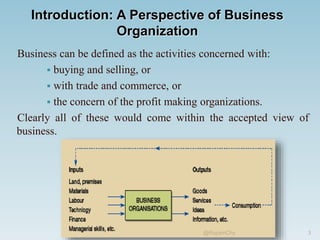
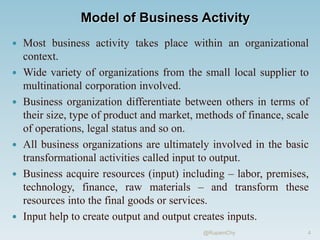
 All business organizations are ultimately involved in the basic
transformational activities called input to output.
 Business acquire resources (input) including – labor, premises,
technology, finance, raw materials – and transform these
resources into the final goods or services.
 Input help to create output and output creates inputs.
4
@RupamChy
The Firm in its Environment
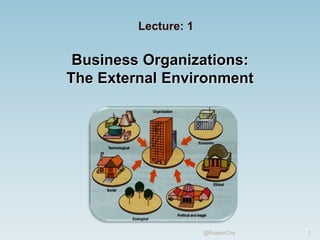
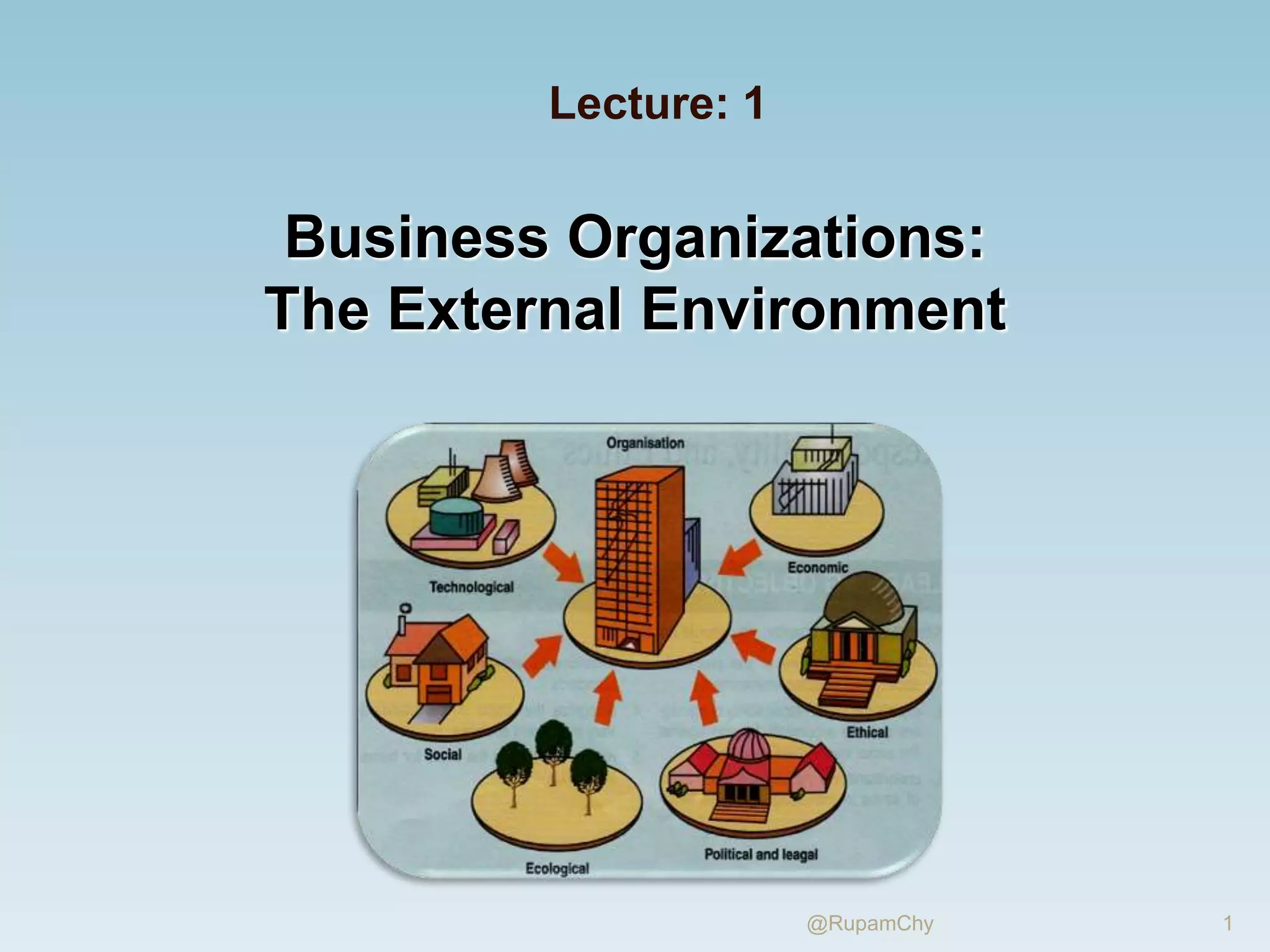
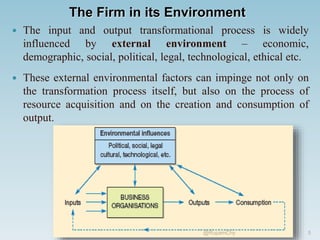
 The input and output transformational process is widely
influenced by external environment – economic,
demographic, social, political, legal, technological, ethical etc.
 These external environmental factors can impinge not only on
the transformation process itself, but also on the process of
resource acquisition and on the creation and consumption of
output.
5
@RupamChy
The Firm in its Environment: Two Levels of
Environment
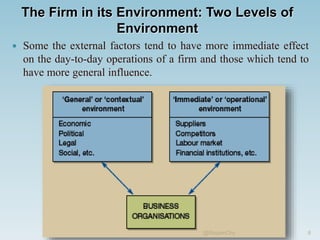
 Some the external factors tend to have more immediate effect
on the day-to-day operations of a firm and those which tend to
have more general influence.
6
@RupamChy
The Firm in its Environment: Functional Areas
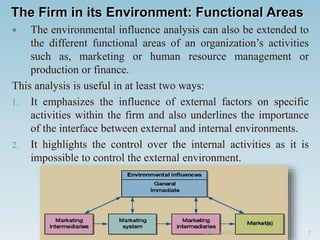
 The environmental influence analysis can also be extended to
the different functional areas of an organization’s activities
such as, marketing or human resource management or
production or finance.
This analysis is useful in at least two ways:
1. It emphasizes the influence of external factors on specific
activities within the firm and also underlines the importance
of the interface between external and internal environments.
2. It highlights the control over the internal activities as it is
impossible to control the external environment.
7
@RupamChy
The General or Contextual Environment
The political environment: It is related to the government
involvement in the working of the economy and its attempts to
influence market structure and behavior.
 Government activities directly and indirectly, influence business
activity.
 Government can also be seen as the biggest business enterprise
at national or local level.
 The increasing trend towards the globalization of markets and
the existence of international trading organization, international
politico-economic influences on business activity represents one
key feature of the business environment.
 Environmental policy and corporate responsibility are the other
public and political influencing factors.
8
@RupamChy
The General or Contextual Environment
(Cont…)
The economic environment: Government plays a major role in
the economy at both national and local level and its activities
influences both the demand and supply side.
 Other economic aspects including various structural aspects of
both firms and markets and a comparison of economic theory and
practices.
The social, cultural and demographic environment: Both
demand and supply are influenced by social, cultural and
demographic factors.
9
@RupamChy
The General or Contextual Environment (Con..)
The technological environment: Technology has a great
influence on both input and output of a business organization.
 investment in technology and innovation is a key to the success
and has been used to achieve global competitive advantages.
 It is also responsible for the development of internal
organization.
The legal environment: Business operate within a framework of
law which has a significant impact on various aspects of their
existence.
 Laws usually governs the status of the organization, its
relationship with its customers and suppliers and certain internal
procedures and activities.
 They may also influence market structures and behavior.
10
@RupamChy
The General or Contextual Environment (Con..)
The ethical environment: Ethical consideration have become an
increasingly important influence on business behavior, particularly
among the larger, more high profile companies.
Companies are demanded to be more responsible to their
community and natural environment.
11
@RupamChy
The Immediate or Operational Environment
Resources and resource markets: An organization’s need for
resources makes it dependent to a large degree on the suppliers of those
resources.
 Again The success of suppliers is closely connected with the decisions
and fortune of their customer.
 Organization seeking advantages in price, quality and delivery by
purchasing resources from overseas my face the uncertainty of exchange
rate fluctuation.
 Organization depending on domestic market may also face the
uncertainty of local market change, technological change and
governmental intervention.
12
@RupamChy
The Immediate or Operational Environment
(Cont..)
Customers: Customers are vital to all organizations and the
ability both to identify and to meet consumer need is seen as one
of the keys to organizational survival and prosperity.
Competitors: Competition both direct and indirect is an important
part of the context in which many firms operate and is a factor
equally applicable to the input as well as the output side of
business.
13
@RupamChy

Business organisations. the external environment

  • 1.
    Business Organizations: The ExternalEnvironment Lecture: 1 1 @RupamChy
  • 2.
    Learning Objectives [1.1] Explainthe basic features of business activity. [1.2] Portray the business organization as a system interacting with its environment. [1.3] Recognize the range and complexity of the external influences on business activity. 2 @RupamChy
  • 3.
    Introduction: A Perspectiveof Business Organization Business can be defined as the activities concerned with:  buying and selling, or  with trade and commerce, or  the concern of the profit making organizations. Clearly all of these would come within the accepted view of business. 3 @RupamChy
  • 4.
    Model of BusinessActivity  Most business activity takes place within an organizational context.  Wide variety of organizations from the small local supplier to multinational corporation involved.  Business organization differentiate between others in terms of their size, type of product and market, methods of finance, scale of operations, legal status and so on.  All business organizations are ultimately involved in the basic transformational activities called input to output.  Business acquire resources (input) including – labor, premises, technology, finance, raw materials – and transform these resources into the final goods or services.  Input help to create output and output creates inputs. 4 @RupamChy
  • 5.
    The Firm inits Environment  The input and output transformational process is widely influenced by external environment – economic, demographic, social, political, legal, technological, ethical etc.  These external environmental factors can impinge not only on the transformation process itself, but also on the process of resource acquisition and on the creation and consumption of output. 5 @RupamChy
  • 6.
    The Firm inits Environment: Two Levels of Environment  Some the external factors tend to have more immediate effect on the day-to-day operations of a firm and those which tend to have more general influence. 6 @RupamChy
  • 7.
    The Firm inits Environment: Functional Areas  The environmental influence analysis can also be extended to the different functional areas of an organization’s activities such as, marketing or human resource management or production or finance. This analysis is useful in at least two ways: 1. It emphasizes the influence of external factors on specific activities within the firm and also underlines the importance of the interface between external and internal environments. 2. It highlights the control over the internal activities as it is impossible to control the external environment. 7 @RupamChy
  • 8.
    The General orContextual Environment The political environment: It is related to the government involvement in the working of the economy and its attempts to influence market structure and behavior.  Government activities directly and indirectly, influence business activity.  Government can also be seen as the biggest business enterprise at national or local level.  The increasing trend towards the globalization of markets and the existence of international trading organization, international politico-economic influences on business activity represents one key feature of the business environment.  Environmental policy and corporate responsibility are the other public and political influencing factors. 8 @RupamChy
  • 9.
    The General orContextual Environment (Cont…) The economic environment: Government plays a major role in the economy at both national and local level and its activities influences both the demand and supply side.  Other economic aspects including various structural aspects of both firms and markets and a comparison of economic theory and practices. The social, cultural and demographic environment: Both demand and supply are influenced by social, cultural and demographic factors. 9 @RupamChy
  • 10.
    The General orContextual Environment (Con..) The technological environment: Technology has a great influence on both input and output of a business organization.  investment in technology and innovation is a key to the success and has been used to achieve global competitive advantages.  It is also responsible for the development of internal organization. The legal environment: Business operate within a framework of law which has a significant impact on various aspects of their existence.  Laws usually governs the status of the organization, its relationship with its customers and suppliers and certain internal procedures and activities.  They may also influence market structures and behavior. 10 @RupamChy
  • 11.
    The General orContextual Environment (Con..) The ethical environment: Ethical consideration have become an increasingly important influence on business behavior, particularly among the larger, more high profile companies. Companies are demanded to be more responsible to their community and natural environment. 11 @RupamChy
  • 12.
    The Immediate orOperational Environment Resources and resource markets: An organization’s need for resources makes it dependent to a large degree on the suppliers of those resources.  Again The success of suppliers is closely connected with the decisions and fortune of their customer.  Organization seeking advantages in price, quality and delivery by purchasing resources from overseas my face the uncertainty of exchange rate fluctuation.  Organization depending on domestic market may also face the uncertainty of local market change, technological change and governmental intervention. 12 @RupamChy
  • 13.
    The Immediate orOperational Environment (Cont..) Customers: Customers are vital to all organizations and the ability both to identify and to meet consumer need is seen as one of the keys to organizational survival and prosperity. Competitors: Competition both direct and indirect is an important part of the context in which many firms operate and is a factor equally applicable to the input as well as the output side of business. 13 @RupamChy