The Business Climate and
Opportunities in Qatar
Alex Schnapp
U.S.-Qatar Business Council
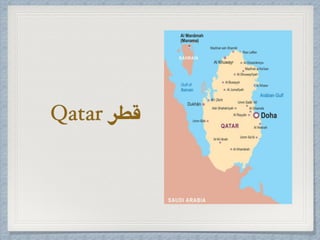
Qatar ‫قطر‬
About the Business Council
Mission - To provide a forum for discussion of key economic, commercial, and other issues
of interest toAmerican companies doing or planning to do business in Qatar, to provide
insight into Qatar and its international and business environment, and to play a leading
role in the expansion of the U.S.-Qatar bilateral relationship
Non-profit (Private Sector Funded)
Over 40 U.S. and Qatari Members
SMEs and Fortune 500 Companies
Operations in multiple industries
Office in Washington, DC
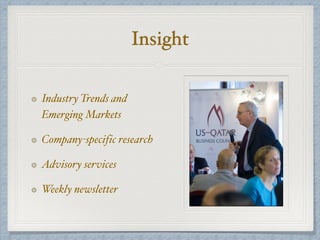
Insight
Industry Trends and
Emerging Markets
Company-specific research
Advisory services
Weekly newsletter
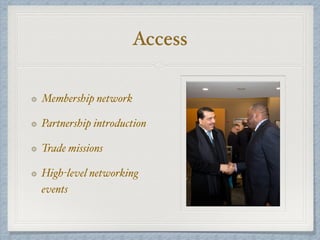
Access
Membership network
Partnership introduction
Trade missions
High-level networking
events
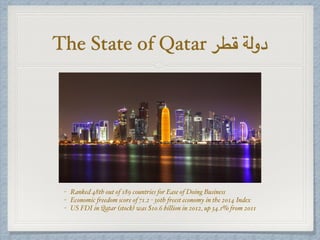
The State of Qatar ‫قطر‬ ‫دولة‬
- Ranked 48th out of 189 countries for Ease of Doing Business
- Economic freedom score of 71.2 - 30th freest economy in the 2014 Index
- US FDI in Qatar (stock) was $10.6 billion in 2012, up 34.1% from 2011
Qatar by the Numbers
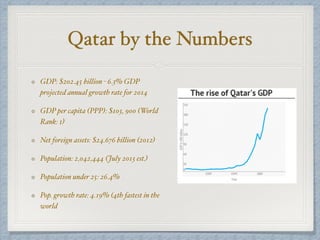
GDP: $202.45 billion - 6.3% GDP
projected annual growth rate for 2014
GDP per capita (PPP): $103, 900 (World
Rank: 1)
Net foreign assets: $24.676 billion (2012)
Population: 2,042,444 (July 2013 est.)
Population under 25: 26.4%
Pop. growth rate: 4.19% (4th fastest in the
world
Qatar by the Numbers
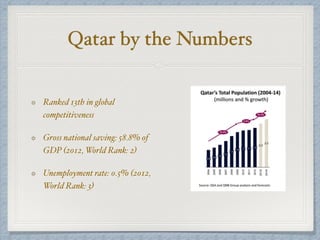
Ranked 13th in global
competitiveness
Gross national saving: 58.8% of
GDP (2012, World Rank: 2)
Unemployment rate: 0.5% (2012,
World Rank: 3)
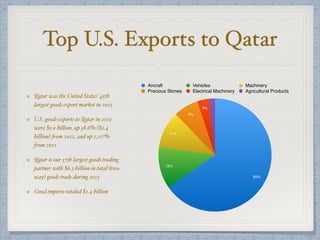
Top U.S. Exports to Qatar
Qatar was the United States’ 45th
largest goods export market in 2013
U.S. goods exports to Qatar in 2013
were $5.0 billion, up 38.6% ($1.4
billion) from 2012, and up 1,117%
from 2011
Qatar is our 57th largest goods trading
partner with $6.3 billion in total (two
way) goods trade during 2013
Good imports totaled $1.4 billion
2%
3%
7%
11%
12%
65%
Aircraft Vehicles Machinery
Precious Stones Electrical Machinery Agricultural Products
In March, Emir Tamim approved the biggest budget in the history of Qatar - $62
billion
Infrastructure and transport costs will jump 21.94% to $20.76 billion
Education spending will rise 7.35% to $7.22 billion
Health care costs will go up 12.14% to $4.31 billion
The budget has increased allocations to provide housing for Qataris by 18% to
nearly $1 billion
Compensation for government employees is also expected to increase and reach
$13.04 billion
Qatar 2014-2015 Budget
Qatar National Vision 2030
The National Vision aims at transforming Qatar into an advanced country by 2030, capable of
sustaining its own development and providing a high standard of living for all of its people for generations
to come.
$220 billion set to be invested over the next 8 years in the spirit of the National Vision and the 2022
World Cup.
Human Development - Development of all its people to enable them to sustain a prosperous society.
Social Development - Development of a just and caring society based on high moral standards, and
capable of playing a significant role in the global partnership for development.
Economic Development - Development of a competitive and diversified economy capable of meeting
the needs of, and securing a high standard of living for, all of its people for the present and for the future.
Environmental Development - Management of the environment such that there is harmony between
economic growth, social development, and environmental protection.
Leading Sectors of Opportunity
Construction
Medicine and Healthcare
Defense and Security
Information Technology
Petrochemicals
Transportation
Water and Wastewater Technologies
Agriculture
Education
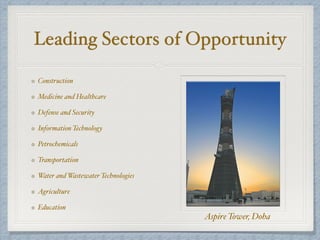
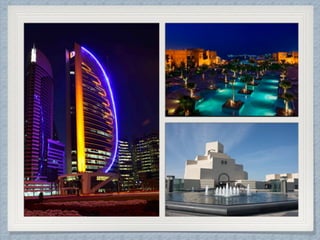
Aspire Tower, Doha
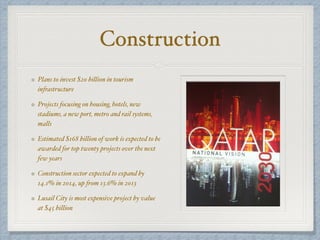
Construction
Plans to invest $20 billion in tourism
infrastructure
Projects focusing on housing, hotels, new
stadiums, a new port, metro and rail systems,
malls
Estimated $168 billion of work is expected to be
awarded for top twenty projects over the next
few years
Construction sector expected to expand by
14.1% in 2014, up from 13.6% in 2013
Lusail City is most expensive project by value
at $45 billion
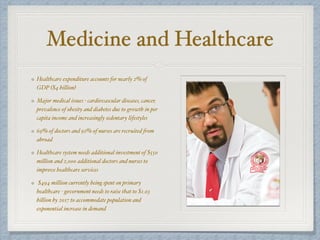
Medicine and Healthcare
Healthcare expenditure accounts for nearly 2% of
GDP ($4 billion)
Major medical issues - cardiovascular diseases, cancer,
prevalence of obesity and diabetes due to growth in per
capita income and increasingly sedentary lifestyles
69% of doctors and 91% of nurses are recruited from
abroad
Healthcare system needs additional investment of $550
million and 2,000 additional doctors and nurses to
improve healthcare services
$494 million currently being spent on primary
healthcare - government needs to raise that to $1.03
billion by 2017 to accommodate population and
exponential increase in demand
Defense and Security
Opportunities in the defense sector are
dominated by large companies, especially in
aerospace engineering
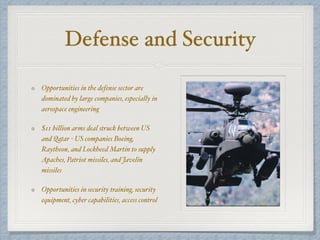
$11 billion arms deal struck between US
and Qatar - US companies Boeing,
Raytheon, and Lockheed Martin to supply
Apaches, Patriot missiles, and Javelin
missiles
Opportunities in security training, security
equipment, cyber capabilities, access control
IT and Telecommunications
Government spending on IT projects will grow at a
high rate over the medium term
National broadband network will expand fibre
broadband infrastructure to 95% of homes and
businesses by 2015, enabling new services such as
cloud computing to grow rapidly
The government is focusing on increasing IT use
through SMEs
The Qatari government has outlined plans to invest
$1.6 billion in information technology and IT
services as part of its ICT-2015 strategy
IT services are expected to increase from 33% of IT
spending in 2013 to 37% by 2017.
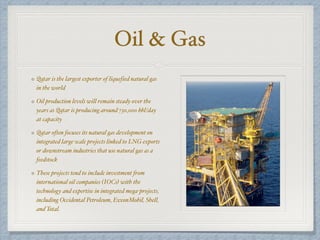
Oil & Gas
Qatar is the largest exporter of liquefied natural gas
in the world
Oil production levels will remain steady over the
years as Qatar is producing around 730,000 bbl/day
at capacity
Qatar often focuses its natural gas development on
integrated large-scale projects linked to LNG exports
or downstream industries that use natural gas as a
feedstock
These projects tend to include investment from
international oil companies (IOCs) with the
technology and expertise in integrated mega-projects,
including Occidental Petroleum, ExxonMobil, Shell,
and Total.
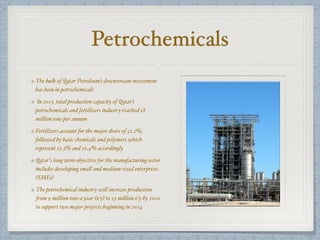
Petrochemicals
The bulk of Qatar Petroleum’s downstream investment
has been in petrochemicals
In 2013, total production capacity of Qatar’s
petrochemicals and fertilizers industry reached 18
million tons per annum
Fertilizers account for the major share of 52.1%,
followed by basic chemicals and polymers which
represent 23.3% and 10.4% accordingly
Qatar's long-term objective for the manufacturing sector
includes developing small and medium-sized enterprises
(SMEs)
The petrochemical industry will increase production
from 9 million tons a year (t/y) to 23 million t/y by 2020
to support two major projects beginning in 2014
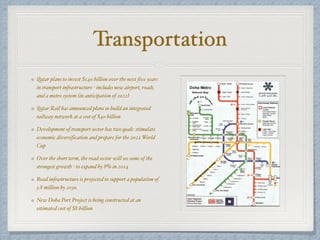
Transportation
Qatar plans to invest $140 billion over the next five years
in transport infrastructure - includes new airport, roads,
and a metro system (in anticipation of 2022)
Qatar Rail has announced plans to build an integrated
railway network at a cost of $40 billion
Development of transport sector has two goals: stimulate
economic diversification and prepare for the 2022 World
Cup
Over the short term, the road sector will see some of the
strongest growth - to expand by 8% in 2014
Road infrastructure is projected to support a population of
3.8 million by 2030.
New Doha Port Project is being constructed at an
estimated cost of $8 billion
Water and Wastewater Treatment
Qatar has budgeted to spend $4.1 billion up to 2015 on
electricity and water projects, aiming to increase the
country’s water reserves by up to 126%
Ashghal, the PWA of Qatar, issued a tender for a
project that involves working on 16 sewage/storm/
groundwater pumping stations in Doha, Rayyan, and
adjacent areas
The PWA will shortly award contracts worth nearly
$1.7 billion and has announced $550 million worth of
new water and sanitation projects to be carried out
Water consumption expected to increase by almost 6%
per year through 2018.
Wastewater sector has also proven fertile ground for
foreign firms
Agriculture
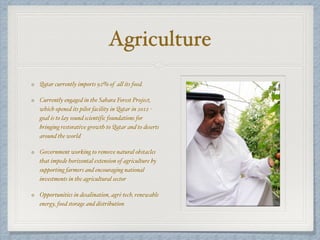
Qatar currently imports 92% of all its food.
Currently engaged in the Sahara Forest Project,
which opened its pilot facility in Qatar in 2012 -
goal is to lay sound scientific foundations for
bringing restorative growth to Qatar and to deserts
around the world
Government working to remove natural obstacles
that impede horizontal extension of agriculture by
supporting farmers and encouraging national
investments in the agricultural sector
Opportunities in desalination, agri-tech, renewable
energy, food storage and distribution
Education
Many universities from the U.S. have
opened up satellite campuses in Education
City: Cornell, Carnegie Mellon,
Georgetown, Northwestern, TexasA&M
About 1,200 Qataris are currently studying
in the United States
The 2014-2015 financial plan includes a
promise to construct 85 new schools over
the next year and a half
Questions?
Thank you!
U.S. Qatar Business Council
1341 ConnecticutAve. NW, Suite 4A
Washington, DC 20036
Phone: 202-457-8555
www.usqbc.org
E-mail: programs@usqbc.org

Business Opportunity in Qatar - Presentation

  • 1.
    The Business Climateand Opportunities in Qatar Alex Schnapp U.S.-Qatar Business Council
  • 2.
  • 3.
    About the BusinessCouncil Mission - To provide a forum for discussion of key economic, commercial, and other issues of interest toAmerican companies doing or planning to do business in Qatar, to provide insight into Qatar and its international and business environment, and to play a leading role in the expansion of the U.S.-Qatar bilateral relationship Non-profit (Private Sector Funded) Over 40 U.S. and Qatari Members SMEs and Fortune 500 Companies Operations in multiple industries Office in Washington, DC
  • 4.
    Insight Industry Trends and EmergingMarkets Company-specific research Advisory services Weekly newsletter
  • 5.
    Access Membership network Partnership introduction Trademissions High-level networking events
  • 6.
    The State ofQatar ‫قطر‬ ‫دولة‬ - Ranked 48th out of 189 countries for Ease of Doing Business - Economic freedom score of 71.2 - 30th freest economy in the 2014 Index - US FDI in Qatar (stock) was $10.6 billion in 2012, up 34.1% from 2011
  • 7.
    Qatar by theNumbers GDP: $202.45 billion - 6.3% GDP projected annual growth rate for 2014 GDP per capita (PPP): $103, 900 (World Rank: 1) Net foreign assets: $24.676 billion (2012) Population: 2,042,444 (July 2013 est.) Population under 25: 26.4% Pop. growth rate: 4.19% (4th fastest in the world
  • 8.
    Qatar by theNumbers Ranked 13th in global competitiveness Gross national saving: 58.8% of GDP (2012, World Rank: 2) Unemployment rate: 0.5% (2012, World Rank: 3)
  • 9.
    Top U.S. Exportsto Qatar Qatar was the United States’ 45th largest goods export market in 2013 U.S. goods exports to Qatar in 2013 were $5.0 billion, up 38.6% ($1.4 billion) from 2012, and up 1,117% from 2011 Qatar is our 57th largest goods trading partner with $6.3 billion in total (two way) goods trade during 2013 Good imports totaled $1.4 billion 2% 3% 7% 11% 12% 65% Aircraft Vehicles Machinery Precious Stones Electrical Machinery Agricultural Products
  • 10.
    In March, EmirTamim approved the biggest budget in the history of Qatar - $62 billion Infrastructure and transport costs will jump 21.94% to $20.76 billion Education spending will rise 7.35% to $7.22 billion Health care costs will go up 12.14% to $4.31 billion The budget has increased allocations to provide housing for Qataris by 18% to nearly $1 billion Compensation for government employees is also expected to increase and reach $13.04 billion Qatar 2014-2015 Budget
  • 11.
    Qatar National Vision2030 The National Vision aims at transforming Qatar into an advanced country by 2030, capable of sustaining its own development and providing a high standard of living for all of its people for generations to come. $220 billion set to be invested over the next 8 years in the spirit of the National Vision and the 2022 World Cup. Human Development - Development of all its people to enable them to sustain a prosperous society. Social Development - Development of a just and caring society based on high moral standards, and capable of playing a significant role in the global partnership for development. Economic Development - Development of a competitive and diversified economy capable of meeting the needs of, and securing a high standard of living for, all of its people for the present and for the future. Environmental Development - Management of the environment such that there is harmony between economic growth, social development, and environmental protection.
  • 12.
    Leading Sectors ofOpportunity Construction Medicine and Healthcare Defense and Security Information Technology Petrochemicals Transportation Water and Wastewater Technologies Agriculture Education Aspire Tower, Doha
  • 14.
    Construction Plans to invest$20 billion in tourism infrastructure Projects focusing on housing, hotels, new stadiums, a new port, metro and rail systems, malls Estimated $168 billion of work is expected to be awarded for top twenty projects over the next few years Construction sector expected to expand by 14.1% in 2014, up from 13.6% in 2013 Lusail City is most expensive project by value at $45 billion
  • 15.
    Medicine and Healthcare Healthcareexpenditure accounts for nearly 2% of GDP ($4 billion) Major medical issues - cardiovascular diseases, cancer, prevalence of obesity and diabetes due to growth in per capita income and increasingly sedentary lifestyles 69% of doctors and 91% of nurses are recruited from abroad Healthcare system needs additional investment of $550 million and 2,000 additional doctors and nurses to improve healthcare services $494 million currently being spent on primary healthcare - government needs to raise that to $1.03 billion by 2017 to accommodate population and exponential increase in demand
  • 16.
    Defense and Security Opportunitiesin the defense sector are dominated by large companies, especially in aerospace engineering $11 billion arms deal struck between US and Qatar - US companies Boeing, Raytheon, and Lockheed Martin to supply Apaches, Patriot missiles, and Javelin missiles Opportunities in security training, security equipment, cyber capabilities, access control
  • 17.
    IT and Telecommunications Governmentspending on IT projects will grow at a high rate over the medium term National broadband network will expand fibre broadband infrastructure to 95% of homes and businesses by 2015, enabling new services such as cloud computing to grow rapidly The government is focusing on increasing IT use through SMEs The Qatari government has outlined plans to invest $1.6 billion in information technology and IT services as part of its ICT-2015 strategy IT services are expected to increase from 33% of IT spending in 2013 to 37% by 2017.
  • 18.
    Oil & Gas Qataris the largest exporter of liquefied natural gas in the world Oil production levels will remain steady over the years as Qatar is producing around 730,000 bbl/day at capacity Qatar often focuses its natural gas development on integrated large-scale projects linked to LNG exports or downstream industries that use natural gas as a feedstock These projects tend to include investment from international oil companies (IOCs) with the technology and expertise in integrated mega-projects, including Occidental Petroleum, ExxonMobil, Shell, and Total.
  • 19.
    Petrochemicals The bulk ofQatar Petroleum’s downstream investment has been in petrochemicals In 2013, total production capacity of Qatar’s petrochemicals and fertilizers industry reached 18 million tons per annum Fertilizers account for the major share of 52.1%, followed by basic chemicals and polymers which represent 23.3% and 10.4% accordingly Qatar's long-term objective for the manufacturing sector includes developing small and medium-sized enterprises (SMEs) The petrochemical industry will increase production from 9 million tons a year (t/y) to 23 million t/y by 2020 to support two major projects beginning in 2014
  • 20.
    Transportation Qatar plans toinvest $140 billion over the next five years in transport infrastructure - includes new airport, roads, and a metro system (in anticipation of 2022) Qatar Rail has announced plans to build an integrated railway network at a cost of $40 billion Development of transport sector has two goals: stimulate economic diversification and prepare for the 2022 World Cup Over the short term, the road sector will see some of the strongest growth - to expand by 8% in 2014 Road infrastructure is projected to support a population of 3.8 million by 2030. New Doha Port Project is being constructed at an estimated cost of $8 billion
  • 21.
    Water and WastewaterTreatment Qatar has budgeted to spend $4.1 billion up to 2015 on electricity and water projects, aiming to increase the country’s water reserves by up to 126% Ashghal, the PWA of Qatar, issued a tender for a project that involves working on 16 sewage/storm/ groundwater pumping stations in Doha, Rayyan, and adjacent areas The PWA will shortly award contracts worth nearly $1.7 billion and has announced $550 million worth of new water and sanitation projects to be carried out Water consumption expected to increase by almost 6% per year through 2018. Wastewater sector has also proven fertile ground for foreign firms
  • 22.
    Agriculture Qatar currently imports92% of all its food. Currently engaged in the Sahara Forest Project, which opened its pilot facility in Qatar in 2012 - goal is to lay sound scientific foundations for bringing restorative growth to Qatar and to deserts around the world Government working to remove natural obstacles that impede horizontal extension of agriculture by supporting farmers and encouraging national investments in the agricultural sector Opportunities in desalination, agri-tech, renewable energy, food storage and distribution
  • 23.
    Education Many universities fromthe U.S. have opened up satellite campuses in Education City: Cornell, Carnegie Mellon, Georgetown, Northwestern, TexasA&M About 1,200 Qataris are currently studying in the United States The 2014-2015 financial plan includes a promise to construct 85 new schools over the next year and a half
  • 24.
  • 25.
    Thank you! U.S. QatarBusiness Council 1341 ConnecticutAve. NW, Suite 4A Washington, DC 20036 Phone: 202-457-8555 www.usqbc.org E-mail: programs@usqbc.org