Business Intelligence in Changing Market Trends.
By,
Vivek Kumar)
Agenda
What is Business
Intelligence?
Why do Companies need BI
Benefits of BI
BI Golden Rules
Major BI Trends
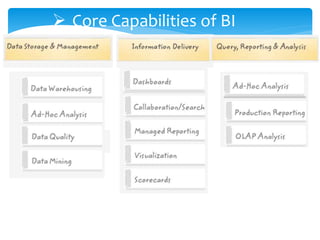
Core Capabilities of BI
Conclusion
 Business Intelligence is a broad category of applications and
technologies for gathering, storing, analysing, and providing
access to data to help clients make better business
decisions.
 Business Intelligence (BI) refers to skills, processes,
technologies, applications and practices used to support
decision making.
 Business Intelligence is an environment in which business
users receive information that is reliable, secure, consistent,
understandable, easily manipulated and timely...facilitating
more informed decision making.
 What is Business Intelligence?
Definition:
© 2008 Accenture. All Rights Reserved.
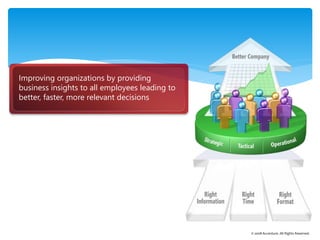
Improving organizations by providing
business insights to all employees leading to
better, faster, more relevant decisions
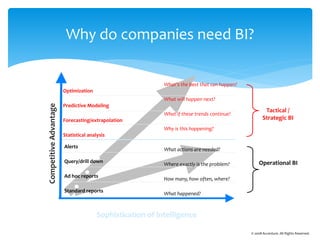
Why do companies need BI?
Tactical /
Strategic BI
What’s the best that can happen?
What will happen next?
What if these trends continue?
Why is this happening?
What actions are needed?
Where exactly is the problem?
How many, how often, where?
What happened?
Sophistication of Intelligence
Operational BI
Optimization
Predictive Modeling
Forecasting/extrapolation
Statistical analysis
Alerts
Query/drill down
Ad hoc reports
Standard reports
CompetitiveAdvantage
© 2008 Accenture. All Rights Reserved.
 Benefits of Business
Intelligence
• Improve Management Processes
– planning, controlling, measuring and/or changing
resulting in increased revenues and reduced costs
• Improve Operational Processes
– fraud detection, order processing, purchasing..
resulting in increased revenues and reduced costs
• Predict the Future
 BI Golden Rules
• Data Quality & Accuracy
• Data Consistency
• Data Timeliness
“Get the right information to the right people at the
right time”
 Mobile
 Cloud Computing
 Social Media
 Advanced Analytics
Major BI Trends
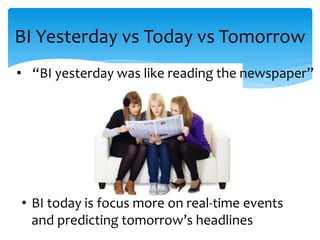
BI Yesterday vs Today vs Tomorrow
• “BI yesterday was like reading the newspaper”
• BI today is focus more on real-time events
and predicting tomorrow’s headlines
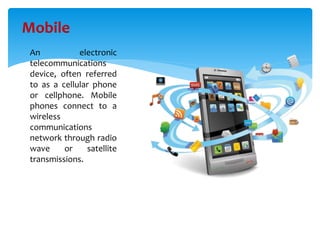
An electronic
telecommunications
device, often referred
to as a cellular phone
or cellphone. Mobile
phones connect to a
wireless
communications
network through radio
wave or satellite
transmissions.
Mobile
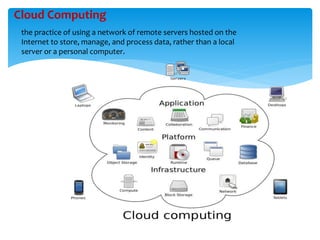
the practice of using a network of remote servers hosted on the
Internet to store, manage, and process data, rather than a local
server or a personal computer.
Cloud Computing
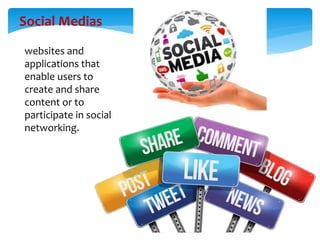
websites and
applications that
enable users to
create and share
content or to
participate in social
networking.
Social Medias
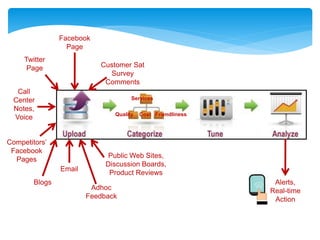
Customer Sat
Survey
Comments
Facebook
Page
Blogs
Competitors’
Facebook
Pages
Public Web Sites,
Discussion Boards,
Product Reviews
Alerts,
Real-time
Action
Twitter
Page
Services
Quality Cost Friendliness
Email
Adhoc
Feedback
Call
Center
Notes,
Voice
 Core Capabilities of BI
Business intelligence will be available to everyone in the
enterprise, and will be embedded in many business systems.
Although many technologies are available to implement this
vision, many challenges remain to make this vision a reality.
We have outlined key challenges like automated analytics,
semantics based information fusion and process
automation, and presented some examples which support
the feasibility of our vision.
Conclusion
Questions
Business Intellenge (BI)

Business Intellenge (BI)

  • 1.
    Business Intelligence inChanging Market Trends. By, Vivek Kumar)
  • 2.
    Agenda What is Business Intelligence? Whydo Companies need BI Benefits of BI BI Golden Rules Major BI Trends Core Capabilities of BI Conclusion
  • 3.
     Business Intelligenceis a broad category of applications and technologies for gathering, storing, analysing, and providing access to data to help clients make better business decisions.  Business Intelligence (BI) refers to skills, processes, technologies, applications and practices used to support decision making.  Business Intelligence is an environment in which business users receive information that is reliable, secure, consistent, understandable, easily manipulated and timely...facilitating more informed decision making.  What is Business Intelligence? Definition:
  • 4.
    © 2008 Accenture.All Rights Reserved. Improving organizations by providing business insights to all employees leading to better, faster, more relevant decisions
  • 5.
    Why do companiesneed BI? Tactical / Strategic BI What’s the best that can happen? What will happen next? What if these trends continue? Why is this happening? What actions are needed? Where exactly is the problem? How many, how often, where? What happened? Sophistication of Intelligence Operational BI Optimization Predictive Modeling Forecasting/extrapolation Statistical analysis Alerts Query/drill down Ad hoc reports Standard reports CompetitiveAdvantage © 2008 Accenture. All Rights Reserved.
  • 6.
     Benefits ofBusiness Intelligence • Improve Management Processes – planning, controlling, measuring and/or changing resulting in increased revenues and reduced costs • Improve Operational Processes – fraud detection, order processing, purchasing.. resulting in increased revenues and reduced costs • Predict the Future
  • 7.
     BI GoldenRules • Data Quality & Accuracy • Data Consistency • Data Timeliness “Get the right information to the right people at the right time”
  • 8.
     Mobile  CloudComputing  Social Media  Advanced Analytics Major BI Trends
  • 9.
    BI Yesterday vsToday vs Tomorrow • “BI yesterday was like reading the newspaper” • BI today is focus more on real-time events and predicting tomorrow’s headlines
  • 10.
    An electronic telecommunications device, oftenreferred to as a cellular phone or cellphone. Mobile phones connect to a wireless communications network through radio wave or satellite transmissions. Mobile
  • 11.
    the practice ofusing a network of remote servers hosted on the Internet to store, manage, and process data, rather than a local server or a personal computer. Cloud Computing
  • 13.
    websites and applications that enableusers to create and share content or to participate in social networking. Social Medias
  • 17.
    Customer Sat Survey Comments Facebook Page Blogs Competitors’ Facebook Pages Public WebSites, Discussion Boards, Product Reviews Alerts, Real-time Action Twitter Page Services Quality Cost Friendliness Email Adhoc Feedback Call Center Notes, Voice
  • 18.
  • 19.
    Business intelligence willbe available to everyone in the enterprise, and will be embedded in many business systems. Although many technologies are available to implement this vision, many challenges remain to make this vision a reality. We have outlined key challenges like automated analytics, semantics based information fusion and process automation, and presented some examples which support the feasibility of our vision. Conclusion
  • 20.