Outcome 2
Ethics – Business, IT and Engineering Perspectives
Business Ethics - Meaning
• It is the application of ethical and moral
principles in a business.
• It deals with what is right and what is wrong
while doing business.
• This applies to all business operations such as
–Manufacturing,
–Sales,
–Marketing,
–Accounting, etc.
Purposes of Business
(or) Objectives of Business
• Earning profits.
• Providing services to the society.
Social objectives of business
• Provide Quality goods and services.
• Sell at reasonable price.
• Provide employment opportunities.
• Utilize scarce national resources properly.
• Welfare of employees.
Ethical Principles of Business
1. Keenness to earn lawful earning.
2. Trade through mutual consent.
3. Trustworthiness in business transactions.
4. Honoring and fulfilling business obligations.
5. Fair treatment of workers.
1. Keenness to earn lawful earning
• According to Islam, a businessman must earn only
through lawful (halal) means.
• He should not earn through illegal (haram) means.
• He should distance himself from matters which are
doubtful.
Interest
• Interest is the extra money the moneylender charges
from the borrower for deferred payment.
• All forms of Riba are illegitimate.
• It involves both oppression and exploitation.
2. Trade through mutual consent
• Mutual consent between parties is a necessary
condition for the validity of a business transaction.
• Follow a sale under coercion is not acceptable.
• A sales transaction is to be regarded as legal only if it
is made through mutual consent of both the buyer
and seller.
3. Trustworthiness in business
transaction
• It is a moral virtue.
• It demands sincerity in work and purity of intention
from every believer.
4. Honoring and fulfilling business
obligations
• A businessman should keep up his trusts, promises,
and contracts.
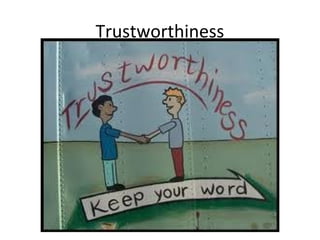
Trustworthiness
5. Fair treatment of workers
• The relation between employer and employees
should be harmonious.
• Employer should take care of the overall welfare and
betterment of his employees.
Ethical responsibilities of employer
towards employees
• Fair treatment of employees and fair salaries.
• Give suitable work for the suitable person.
• Pay on time.
• Provide good working condition.
• Care about health and safety of employees.
• Give relaxation for employees (engaged in manual
and hard work)
• Give relaxation in working hours during peak
summer and in the holy month of Ramadhan.
Ethical responsibilities of employer
towards employees
• Give clear details of the job.
• Do not discriminate between and among employees.
• Train the employees.
Prohibited Matters in Business
1. Dealing in prohibited (Haram) items.
2. Sale of uncertain items.
3. Randomly fixing the prices.
4. Hoarding of foodstuff. withhold
5. Cheating (Al-Ghashsh) and fraud in business
transactions.
6. Swearing.
7. Giving short measures.
8. Dealing in stolen goods.
Information Technology and Ethics
IT ethics is defined as
• the application of ethical principles to the use of
computer or information technology.
IT ethics deals with proper use of technology devices,
data, services, and software.
Ethical issues related to IT
• Privacy
• Security
• Copyright
• Protection
• Intellectual freedom
• Accountability
• Hacking
• Virus creation
• Software piracy
Ethical problems related to
computers
• Privacy of the individual
• Software piracy
• Hacking and cracking
• Virus creation
• Email spam
Examples for unethical practices in IT
• Employers struggle to balance the need to
manage company assets with employees’
desire.
• People download music and movies at no
charge (violation of copy right laws).
• Companies send unwanted emails as a part of
their marketing strategy.
Examples for unethical practices in IT
• Hackers break into databases of financial and
retail institutions to steal customer
information to make false purchases.
• Students download material from the web to
plagiarize.
Ethical policy for IT professionals
1. Shall not use a computer to harm others.
2. Shall not interfere with others’ computer
network.
3. Shall not watch others’ files.
4. Shall not use a computer to steal.
5. Shall not use a computer to bear false
witness.
6. Shall not use or copy unpaid software.
Ethical policy for IT professionals
7. Shall not use others’ computer resources
without authorization.
8. Shall not use others’ intellectual output.
9. Shall think about the social consequences of
your program.
10. Shall use a computer in ways that show
consideration and respect.
Engineering Ethics
Engineering ethics is concerned with the
personal conduct of engineers.
The services provided by engineers require
honesty, impartiality, fairness and equity.
Services of engineers
• The services of engineers require honesty,
impartiality, fairness and equity.
• Engineers must be dedicated to the protection
of the public health, safety and welfare.
• They must perform standard of professional
behavior.
Ethical Responsibilities of Engineers
1. Self as a professional
2. Employer
3. Client (customer)
4. Colleagues and co-workers
5. Public (society)
6. Environment
Ethical Principles for Engineers
• Hold highest standards of honesty and integrity.
• Hold paramount of the safety, health and
welfare of the public.
• Acknowledge their errors and shall not distort
or alter the facts.
• Hold the dignity and integrity of the profession.
• Perform services only in areas of their
competence.
• Avoid deceptive acts.
Engineering Disasters
1. The Chernobyl disaster (Russia)
2. Union Carbide Gas leakage (India)
3. Bridge and building collapses in many
countries.
4. Air line crashes in many countries.
Chernobyl Disaster – 1986 – Russia
• Occurred on 26th
April 1986.
• An explosion happened.
• Fire released large quantities of radioactive
particles into the atmosphere.
• Resulted in death of several people.
• Left thousands with acute health hazards.
Union Carbide Gas leakage – 1984 – India
• Killed 10,000 people.
• Injured 500,000 people.

Business ethics outcome 2

  • 1.
    Outcome 2 Ethics –Business, IT and Engineering Perspectives
  • 2.
    Business Ethics -Meaning • It is the application of ethical and moral principles in a business. • It deals with what is right and what is wrong while doing business. • This applies to all business operations such as –Manufacturing, –Sales, –Marketing, –Accounting, etc.
  • 3.
    Purposes of Business (or)Objectives of Business • Earning profits. • Providing services to the society.
  • 4.
    Social objectives ofbusiness • Provide Quality goods and services. • Sell at reasonable price. • Provide employment opportunities. • Utilize scarce national resources properly. • Welfare of employees.
  • 5.
    Ethical Principles ofBusiness 1. Keenness to earn lawful earning. 2. Trade through mutual consent. 3. Trustworthiness in business transactions. 4. Honoring and fulfilling business obligations. 5. Fair treatment of workers.
  • 6.
    1. Keenness toearn lawful earning • According to Islam, a businessman must earn only through lawful (halal) means. • He should not earn through illegal (haram) means. • He should distance himself from matters which are doubtful.
  • 7.
    Interest • Interest isthe extra money the moneylender charges from the borrower for deferred payment. • All forms of Riba are illegitimate. • It involves both oppression and exploitation.
  • 8.
    2. Trade throughmutual consent • Mutual consent between parties is a necessary condition for the validity of a business transaction. • Follow a sale under coercion is not acceptable. • A sales transaction is to be regarded as legal only if it is made through mutual consent of both the buyer and seller.
  • 9.
    3. Trustworthiness inbusiness transaction • It is a moral virtue. • It demands sincerity in work and purity of intention from every believer.
  • 10.
    4. Honoring andfulfilling business obligations • A businessman should keep up his trusts, promises, and contracts.
  • 11.
  • 12.
    5. Fair treatmentof workers • The relation between employer and employees should be harmonious. • Employer should take care of the overall welfare and betterment of his employees.
  • 13.
    Ethical responsibilities ofemployer towards employees • Fair treatment of employees and fair salaries. • Give suitable work for the suitable person. • Pay on time. • Provide good working condition. • Care about health and safety of employees. • Give relaxation for employees (engaged in manual and hard work) • Give relaxation in working hours during peak summer and in the holy month of Ramadhan.
  • 14.
    Ethical responsibilities ofemployer towards employees • Give clear details of the job. • Do not discriminate between and among employees. • Train the employees.
  • 15.
    Prohibited Matters inBusiness 1. Dealing in prohibited (Haram) items. 2. Sale of uncertain items. 3. Randomly fixing the prices. 4. Hoarding of foodstuff. withhold 5. Cheating (Al-Ghashsh) and fraud in business transactions. 6. Swearing. 7. Giving short measures. 8. Dealing in stolen goods.
  • 16.
    Information Technology andEthics IT ethics is defined as • the application of ethical principles to the use of computer or information technology. IT ethics deals with proper use of technology devices, data, services, and software.
  • 17.
    Ethical issues relatedto IT • Privacy • Security • Copyright • Protection • Intellectual freedom • Accountability • Hacking • Virus creation • Software piracy
  • 18.
    Ethical problems relatedto computers • Privacy of the individual • Software piracy • Hacking and cracking • Virus creation • Email spam
  • 19.
    Examples for unethicalpractices in IT • Employers struggle to balance the need to manage company assets with employees’ desire. • People download music and movies at no charge (violation of copy right laws). • Companies send unwanted emails as a part of their marketing strategy.
  • 20.
    Examples for unethicalpractices in IT • Hackers break into databases of financial and retail institutions to steal customer information to make false purchases. • Students download material from the web to plagiarize.
  • 21.
    Ethical policy forIT professionals 1. Shall not use a computer to harm others. 2. Shall not interfere with others’ computer network. 3. Shall not watch others’ files. 4. Shall not use a computer to steal. 5. Shall not use a computer to bear false witness. 6. Shall not use or copy unpaid software.
  • 22.
    Ethical policy forIT professionals 7. Shall not use others’ computer resources without authorization. 8. Shall not use others’ intellectual output. 9. Shall think about the social consequences of your program. 10. Shall use a computer in ways that show consideration and respect.
  • 23.
    Engineering Ethics Engineering ethicsis concerned with the personal conduct of engineers. The services provided by engineers require honesty, impartiality, fairness and equity.
  • 24.
    Services of engineers •The services of engineers require honesty, impartiality, fairness and equity. • Engineers must be dedicated to the protection of the public health, safety and welfare. • They must perform standard of professional behavior.
  • 25.
    Ethical Responsibilities ofEngineers 1. Self as a professional 2. Employer 3. Client (customer) 4. Colleagues and co-workers 5. Public (society) 6. Environment
  • 26.
    Ethical Principles forEngineers • Hold highest standards of honesty and integrity. • Hold paramount of the safety, health and welfare of the public. • Acknowledge their errors and shall not distort or alter the facts. • Hold the dignity and integrity of the profession. • Perform services only in areas of their competence. • Avoid deceptive acts.
  • 27.
    Engineering Disasters 1. TheChernobyl disaster (Russia) 2. Union Carbide Gas leakage (India) 3. Bridge and building collapses in many countries. 4. Air line crashes in many countries.
  • 28.
    Chernobyl Disaster –1986 – Russia • Occurred on 26th April 1986. • An explosion happened. • Fire released large quantities of radioactive particles into the atmosphere. • Resulted in death of several people. • Left thousands with acute health hazards.
  • 29.
    Union Carbide Gasleakage – 1984 – India • Killed 10,000 people. • Injured 500,000 people.