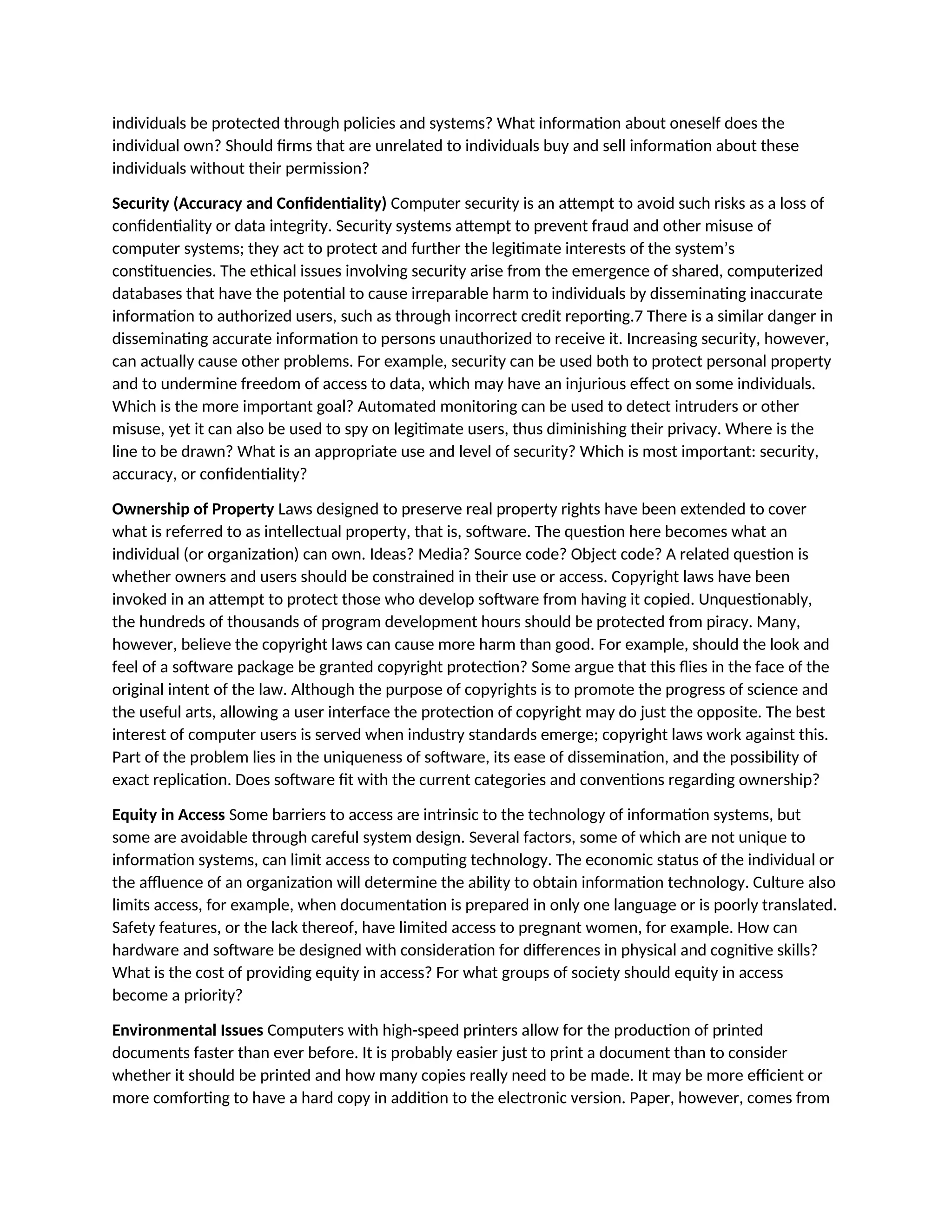
Ethical Issues in Business Ethical standards are derived from societal mores and deep-rooted personal
beliefs about issues of right and wrong that are not universally agreed upon. It is quite possible for two
individuals, both of whom consider themselves to be acting ethically, to be on opposite sides of an issue.
Often, we confuse ethical issues with legal issues. When the Honorable Gentleman from the state of
——, who is charged with ethical misconduct, stands before Congress and proclaims that he is “guilty of
no wrongdoing,” is he really saying that he did not break the law? We have been inundated with
scandals in the stock market, stories of computer crimes and viruses, and almost obscene charges of
impropriety and illegalities by corporate executives. Using covert compensation schemes, Enron’s chief
financial officer (CFO) Andy Fastow managed to improve his personal wealth by approximately $40
million. Similarly, Dennis Kozowski of Tyco, Richard Scrushy of Health-South, and Bernie Ebbers of
WorldCom all became wealthy beyond imagination while driving their companies into the ground.
Indeed, during the period from early 1999 to May 2002, the executives of 25 companies extracted $25
billion worth of special compensation, stock options, and private loans from their organizations while
their companies’ stock plummeted 75 percent or more.1 A thorough treatment of ethics issues is
impossible within this chapter section. Instead, the objective of this section is to heighten the reader’s
awareness of ethical concerns relating to business, information systems, and computer technology.
BUSINESS ETHICS Ethics pertains to the principles of conduct that individuals use in making choices and
guiding their behavior in situations that involve the concepts of right and wrong. More specifically,
business ethics involves finding the answers to two questions: (1) How do managers decide what is right
in conducting their business? and (2) once managers have recognized what is right, how do they achieve
it? Ethical issues in business can be divided into four areas: equity, rights, honesty, and the exercise of
corporate power. Table 3–1 identifies some of the business practices and decisions in each of these
areas that have ethical implications.
Making Ethical Decisions Business organizations have conflicting responsibilities to their employees,
shareholders, customers, and the public. Every major decision has consequences that potentially harm
or benefit these constituents. For example, implementing a new computer information system within an
organization may cause some employees to lose their jobs, while those who remain enjoy the benefit of
improved working conditions. Seeking a balance between these consequences is the managers’ ethical
responsibility. The following ethical principles provide some guidance in the discharge of this
responsibility.2
PROPORTIONALITY. The benefit from a decision must outweigh the risks. Furthermore, there must be
no alternative decision that provides the same or greater benefit with less risk.
Justice. The benefits of the decision should be distributed fairly to those who share the risks. Those who
do not benefit should not carry the burden of risk.
Minimize risk. Even if judged acceptable by the principles, the decision should be implemented so as to
minimize all of the risks and avoid any unnecessary risks.
COMPUTER ETHICS The use of information technology in business has had a major impact on society
and thus raises significant ethical issues regarding computer crime, working conditions, privacy, and
more. Computer ethics is “the analysis of the nature and social impact of computer technology and the
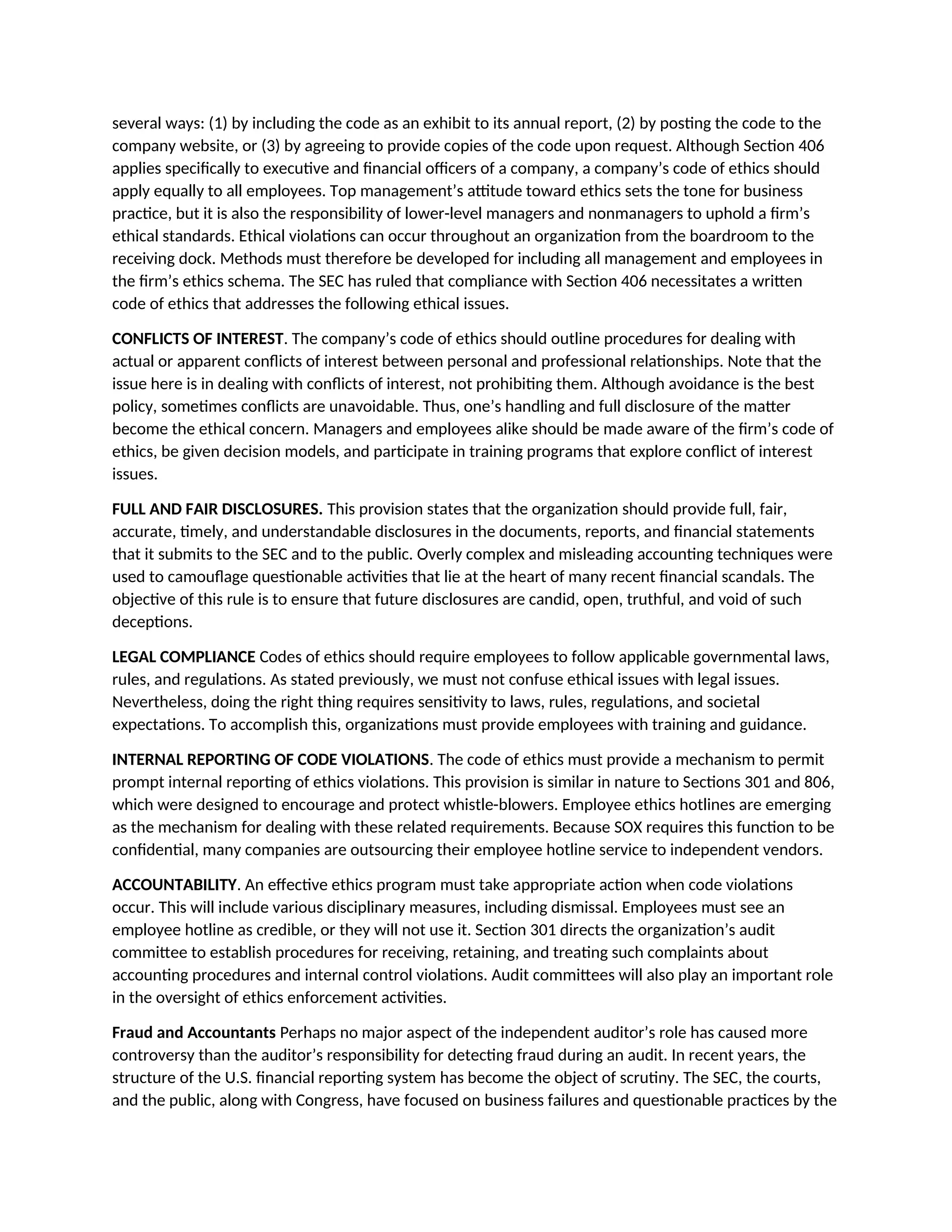
ETHICAL ISSUES IN BUSINESS
Equity Executive Salaries, Comparable Worth, Product Pricing
Rights Corporate Due Process, Employee Health Screening, Employee Privacy, Sexual Harassment,
Diversity, Equal Employment Opportunity, Whistle-Blowing
Honesty Employee and Management Conflicts of Interest, Security of Organization Data and Records,
Misleading Advertising, Questionable Business Practices in Foreign Countries, Accurate Reporting of
Shareholder Interests,
Exercise of Corporate Power Political Action Committees, Workplace Safety, Product Safety,
Environmental Issues, Divestment of Interests, Corporate Political Contributions, Downsizing and Plant
Closures
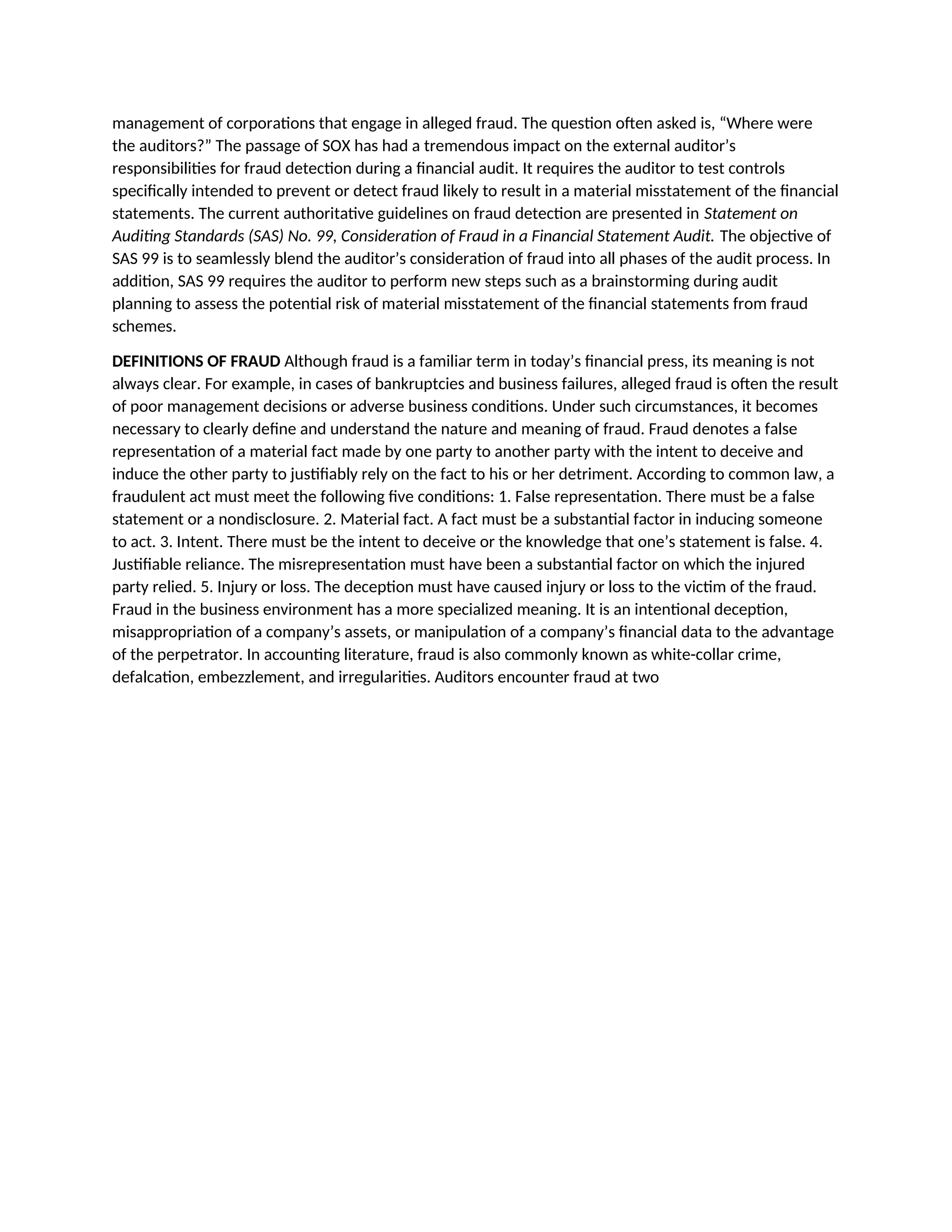
corresponding formulation and justification of policies for the ethical use of such technology.… [This
includes] concerns about software as well as hardware and concerns about networks connecting
computers as well as computers themselves.”3 One researcher has defined three levels of computer
ethics: pop, para, and theoretical.4 Pop computer ethics is simply the exposure to stories and reports
found in the popular media regarding the good or bad ramifications of computer technology. Society at
large needs to be aware of such things as computer viruses and computer systems designed to aid
handicapped persons. Para computer ethics involves taking a real interest in computer ethics cases and
acquiring some level of skill and knowledge in the field. All systems professionals need to reach this level
of competency so they can do their jobs effectively. Students of accounting information systems should
also achieve this level of ethical understanding. The third level, theoretical computer ethics, is of interest
to multidisciplinary researchers who apply the theories of philosophy, sociology, and psychology to
computer science with the goal of bringing some new understanding to the field.
A New Problem or Just a New Twist on an Old Problem? Some argue that all pertinent ethical issues
have already been examined in some other domain. For example, the issue of property rights has been
explored and has resulted in copyright, trade secret, and patent laws. Although computer programs are
a new type of asset, many believe that these programs should be considered no differently from other
forms of property. A fundamental question arising from such debate is whether computers present new
ethical problems or just create new twists on old problems. Where the latter is the case, we need only
to understand the generic values that are at stake and the principles that should then apply.5 A large
contingent, however, vociferously disagrees with the premise that computers are no different from
other technologies. For example, many reject the notion of intellectual property being the same as real
property. There is, as yet, no consensus on this matter. Several issues of concern for students of
accounting information systems are discussed in the following section. This list is not exhaustive, and a
full discussion of each of the issues is beyond the scope of this chapter. Instead, the issues are briefly
defined, and several trigger questions are provided. Hopefully, these questions will provoke thought and
discussion in the classroom.
Privacy People desire to be in full control of what and how much information about themselves is
available to others, and to whom it is available. This is the issue of privacy. The creation and
maintenance of huge, shared databases make it necessary to protect people from the potential misuse
of data. This raises the issue of ownership in the personal information industry.6 Should the privacy of
individuals be protected through policies and systems? What information about oneself does the
individual own? Should firms that are unrelated to individuals buy and sell information about these
individuals without their permission?
Security (Accuracy and Confidentiality) Computer security is an attempt to avoid such risks as a loss of
confidentiality or data integrity. Security systems attempt to prevent fraud and other misuse of
computer systems; they act to protect and further the legitimate interests of the system’s
constituencies. The ethical issues involving security arise from the emergence of shared, computerized
databases that have the potential to cause irreparable harm to individuals by disseminating inaccurate
information to authorized users, such as through incorrect credit reporting.7 There is a similar danger in
disseminating accurate information to persons unauthorized to receive it. Increasing security, however,
can actually cause other problems. For example, security can be used both to protect personal property
and to undermine freedom of access to data, which may have an injurious effect on some individuals.
Which is the more important goal? Automated monitoring can be used to detect intruders or other
misuse, yet it can also be used to spy on legitimate users, thus diminishing their privacy. Where is the
line to be drawn? What is an appropriate use and level of security? Which is most important: security,
accuracy, or confidentiality?
Ownership of Property Laws designed to preserve real property rights have been extended to cover
what is referred to as intellectual property, that is, software. The question here becomes what an
individual (or organization) can own. Ideas? Media? Source code? Object code? A related question is
whether owners and users should be constrained in their use or access. Copyright laws have been
invoked in an attempt to protect those who develop software from having it copied. Unquestionably,
the hundreds of thousands of program development hours should be protected from piracy. Many,
however, believe the copyright laws can cause more harm than good. For example, should the look and
feel of a software package be granted copyright protection? Some argue that this flies in the face of the
original intent of the law. Although the purpose of copyrights is to promote the progress of science and
the useful arts, allowing a user interface the protection of copyright may do just the opposite. The best
interest of computer users is served when industry standards emerge; copyright laws work against this.
Part of the problem lies in the uniqueness of software, its ease of dissemination, and the possibility of
exact replication. Does software fit with the current categories and conventions regarding ownership?
Equity in Access Some barriers to access are intrinsic to the technology of information systems, but
some are avoidable through careful system design. Several factors, some of which are not unique to
information systems, can limit access to computing technology. The economic status of the individual or
the affluence of an organization will determine the ability to obtain information technology. Culture also
limits access, for example, when documentation is prepared in only one language or is poorly translated.
Safety features, or the lack thereof, have limited access to pregnant women, for example. How can
hardware and software be designed with consideration for differences in physical and cognitive skills?
What is the cost of providing equity in access? For what groups of society should equity in access
become a priority?
Environmental Issues Computers with high-speed printers allow for the production of printed
documents faster than ever before. It is probably easier just to print a document than to consider
whether it should be printed and how many copies really need to be made. It may be more efficient or
more comforting to have a hard copy in addition to the electronic version. Paper, however, comes from
trees, which are a precious natural resource that ends up in landfills if not properly recycled. Should
organizations limit nonessential hard copies? Can nonessential be defined? Who can and should define
it? Should proper recycling be required? How can it be enforced?
Artificial Intelligence A new set of social and ethical issues has arisen out of the popularity of expert
systems. Because of the way these systems have been marketed—that is, as decision makers or
replacements for experts—some people rely on them significantly. Therefore, both knowledge
engineers (those who write the programs) and domain experts (those who provide the knowledge about
the task being automated) must be concerned about their responsibility for faulty decisions, incomplete
or inaccurate knowledge bases, and the role given to computers in the decision-making process.8
Further, because expert systems attempt to clone a manager’s decision-making style, an individual’s
prejudices may implicitly or explicitly be included in the knowledge base. Some of the questions that
need to be explored are: Who is responsible for the completeness and appropriateness of the
knowledge base? Who is responsible for a decision made by an expert system that causes harm when
implemented? Who owns the expertise once it is coded into a knowledge base?
Unemployment and Displacement Many jobs have been and are being changed as a result of the
availability of computer technology. People unable or unprepared to change are displaced. Should
employers be responsible for retraining workers who are displaced as a result of the computerization of
their functions?
Misuse of Computers can be misused in many ways. Copying proprietary software, using a company’s
computer for personal benefit, and snooping through other people’s files are just a few obvious
examples.9 Although copying proprietary software (except to make a personal backup copy) is clearly
illegal, it is commonly done. Why do people think that it is not necessary to obey this law? Are there any
good arguments for trying to change this law? What harm is done to the software developer when
people make unauthorized copies? A computer is not an item that deteriorates with use, so is there any
harm to the employer if it is used for an employee’s personal benefit? Does it matter if the computer is
used during company time or outside of work hours? Is there a difference if some profit-making activity
takes place rather than, for example, using the computer to write a personal letter? Does it make a
difference if a profit-making activity takes place during or outside working hours? Is it okay to look
through paper files that clearly belong to someone else? Is there any difference between paper files and
computer files?
SARBANES-OXLEY ACT AND ETHICAL ISSUES Public outcry surrounding ethical misconduct and
fraudulent acts by executives of Enron, Global Crossing, Tyco, Adelphia, WorldCom, and others spurred
Congress into passing the American Competitiveness and Corporate Accountability Act of 2002. This
wide-sweeping legislation, more commonly known as the Sarbanes-Oxley Act (SOX), is the most
significant securities law since the Securities and Exchange Commission (SEC) Acts of 1933 and 1934.
SOX has many provisions designed to deal with specific problems relating to capital markets, corporate
governance, and the auditing profession. Several of these are discussed later in the chapter. At this
point, we are concerned primarily with Section 406 of the act, which pertains to ethical issues.
Section 406—Code of Ethics for Senior Financial Officers Section 406 of SOX requires public companies
to disclose to the SEC whether they have adopted a code of ethics that applies to the organization’s
chief executive officer (CEO), CFO, controller, or persons performing similar functions. If the company
has not adopted such a code, it must explain why. A public company may disclose its code of ethics in
several ways: (1) by including the code as an exhibit to its annual report, (2) by posting the code to the
company website, or (3) by agreeing to provide copies of the code upon request. Although Section 406
applies specifically to executive and financial officers of a company, a company’s code of ethics should
apply equally to all employees. Top management’s attitude toward ethics sets the tone for business
practice, but it is also the responsibility of lower-level managers and nonmanagers to uphold a firm’s
ethical standards. Ethical violations can occur throughout an organization from the boardroom to the
receiving dock. Methods must therefore be developed for including all management and employees in
the firm’s ethics schema. The SEC has ruled that compliance with Section 406 necessitates a written
code of ethics that addresses the following ethical issues.
CONFLICTS OF INTEREST. The company’s code of ethics should outline procedures for dealing with
actual or apparent conflicts of interest between personal and professional relationships. Note that the
issue here is in dealing with conflicts of interest, not prohibiting them. Although avoidance is the best
policy, sometimes conflicts are unavoidable. Thus, one’s handling and full disclosure of the matter
become the ethical concern. Managers and employees alike should be made aware of the firm’s code of
ethics, be given decision models, and participate in training programs that explore conflict of interest
issues.
FULL AND FAIR DISCLOSURES. This provision states that the organization should provide full, fair,
accurate, timely, and understandable disclosures in the documents, reports, and financial statements
that it submits to the SEC and to the public. Overly complex and misleading accounting techniques were
used to camouflage questionable activities that lie at the heart of many recent financial scandals. The
objective of this rule is to ensure that future disclosures are candid, open, truthful, and void of such
deceptions.
LEGAL COMPLIANCE Codes of ethics should require employees to follow applicable governmental laws,
rules, and regulations. As stated previously, we must not confuse ethical issues with legal issues.
Nevertheless, doing the right thing requires sensitivity to laws, rules, regulations, and societal
expectations. To accomplish this, organizations must provide employees with training and guidance.
INTERNAL REPORTING OF CODE VIOLATIONS. The code of ethics must provide a mechanism to permit
prompt internal reporting of ethics violations. This provision is similar in nature to Sections 301 and 806,
which were designed to encourage and protect whistle-blowers. Employee ethics hotlines are emerging
as the mechanism for dealing with these related requirements. Because SOX requires this function to be
confidential, many companies are outsourcing their employee hotline service to independent vendors.
ACCOUNTABILITY. An effective ethics program must take appropriate action when code violations
occur. This will include various disciplinary measures, including dismissal. Employees must see an
employee hotline as credible, or they will not use it. Section 301 directs the organization’s audit
committee to establish procedures for receiving, retaining, and treating such complaints about
accounting procedures and internal control violations. Audit committees will also play an important role
in the oversight of ethics enforcement activities.
Fraud and Accountants Perhaps no major aspect of the independent auditor’s role has caused more
controversy than the auditor’s responsibility for detecting fraud during an audit. In recent years, the
structure of the U.S. financial reporting system has become the object of scrutiny. The SEC, the courts,
and the public, along with Congress, have focused on business failures and questionable practices by the
management of corporations that engage in alleged fraud. The question often asked is, “Where were
the auditors?” The passage of SOX has had a tremendous impact on the external auditor’s
responsibilities for fraud detection during a financial audit. It requires the auditor to test controls
specifically intended to prevent or detect fraud likely to result in a material misstatement of the financial
statements. The current authoritative guidelines on fraud detection are presented in Statement on
Auditing Standards (SAS) No. 99, Consideration of Fraud in a Financial Statement Audit. The objective of
SAS 99 is to seamlessly blend the auditor’s consideration of fraud into all phases of the audit process. In
addition, SAS 99 requires the auditor to perform new steps such as a brainstorming during audit
planning to assess the potential risk of material misstatement of the financial statements from fraud
schemes.
DEFINITIONS OF FRAUD Although fraud is a familiar term in today’s financial press, its meaning is not
always clear. For example, in cases of bankruptcies and business failures, alleged fraud is often the result
of poor management decisions or adverse business conditions. Under such circumstances, it becomes
necessary to clearly define and understand the nature and meaning of fraud. Fraud denotes a false
representation of a material fact made by one party to another party with the intent to deceive and
induce the other party to justifiably rely on the fact to his or her detriment. According to common law, a
fraudulent act must meet the following five conditions: 1. False representation. There must be a false
statement or a nondisclosure. 2. Material fact. A fact must be a substantial factor in inducing someone
to act. 3. Intent. There must be the intent to deceive or the knowledge that one’s statement is false. 4.
Justifiable reliance. The misrepresentation must have been a substantial factor on which the injured
party relied. 5. Injury or loss. The deception must have caused injury or loss to the victim of the fraud.
Fraud in the business environment has a more specialized meaning. It is an intentional deception,
misappropriation of a company’s assets, or manipulation of a company’s financial data to the advantage
of the perpetrator. In accounting literature, fraud is also commonly known as white-collar crime,
defalcation, embezzlement, and irregularities. Auditors encounter fraud at two

chapter 3 AIS by james hall summarize in book

  • 1.
    Ethical Issues inBusiness Ethical standards are derived from societal mores and deep-rooted personal beliefs about issues of right and wrong that are not universally agreed upon. It is quite possible for two individuals, both of whom consider themselves to be acting ethically, to be on opposite sides of an issue. Often, we confuse ethical issues with legal issues. When the Honorable Gentleman from the state of ——, who is charged with ethical misconduct, stands before Congress and proclaims that he is “guilty of no wrongdoing,” is he really saying that he did not break the law? We have been inundated with scandals in the stock market, stories of computer crimes and viruses, and almost obscene charges of impropriety and illegalities by corporate executives. Using covert compensation schemes, Enron’s chief financial officer (CFO) Andy Fastow managed to improve his personal wealth by approximately $40 million. Similarly, Dennis Kozowski of Tyco, Richard Scrushy of Health-South, and Bernie Ebbers of WorldCom all became wealthy beyond imagination while driving their companies into the ground. Indeed, during the period from early 1999 to May 2002, the executives of 25 companies extracted $25 billion worth of special compensation, stock options, and private loans from their organizations while their companies’ stock plummeted 75 percent or more.1 A thorough treatment of ethics issues is impossible within this chapter section. Instead, the objective of this section is to heighten the reader’s awareness of ethical concerns relating to business, information systems, and computer technology. BUSINESS ETHICS Ethics pertains to the principles of conduct that individuals use in making choices and guiding their behavior in situations that involve the concepts of right and wrong. More specifically, business ethics involves finding the answers to two questions: (1) How do managers decide what is right in conducting their business? and (2) once managers have recognized what is right, how do they achieve it? Ethical issues in business can be divided into four areas: equity, rights, honesty, and the exercise of corporate power. Table 3–1 identifies some of the business practices and decisions in each of these areas that have ethical implications. Making Ethical Decisions Business organizations have conflicting responsibilities to their employees, shareholders, customers, and the public. Every major decision has consequences that potentially harm or benefit these constituents. For example, implementing a new computer information system within an organization may cause some employees to lose their jobs, while those who remain enjoy the benefit of improved working conditions. Seeking a balance between these consequences is the managers’ ethical responsibility. The following ethical principles provide some guidance in the discharge of this responsibility.2 PROPORTIONALITY. The benefit from a decision must outweigh the risks. Furthermore, there must be no alternative decision that provides the same or greater benefit with less risk. Justice. The benefits of the decision should be distributed fairly to those who share the risks. Those who do not benefit should not carry the burden of risk. Minimize risk. Even if judged acceptable by the principles, the decision should be implemented so as to minimize all of the risks and avoid any unnecessary risks. COMPUTER ETHICS The use of information technology in business has had a major impact on society and thus raises significant ethical issues regarding computer crime, working conditions, privacy, and more. Computer ethics is “the analysis of the nature and social impact of computer technology and the
  • 2.
    ETHICAL ISSUES INBUSINESS Equity Executive Salaries, Comparable Worth, Product Pricing Rights Corporate Due Process, Employee Health Screening, Employee Privacy, Sexual Harassment, Diversity, Equal Employment Opportunity, Whistle-Blowing Honesty Employee and Management Conflicts of Interest, Security of Organization Data and Records, Misleading Advertising, Questionable Business Practices in Foreign Countries, Accurate Reporting of Shareholder Interests, Exercise of Corporate Power Political Action Committees, Workplace Safety, Product Safety, Environmental Issues, Divestment of Interests, Corporate Political Contributions, Downsizing and Plant Closures corresponding formulation and justification of policies for the ethical use of such technology.… [This includes] concerns about software as well as hardware and concerns about networks connecting computers as well as computers themselves.”3 One researcher has defined three levels of computer ethics: pop, para, and theoretical.4 Pop computer ethics is simply the exposure to stories and reports found in the popular media regarding the good or bad ramifications of computer technology. Society at large needs to be aware of such things as computer viruses and computer systems designed to aid handicapped persons. Para computer ethics involves taking a real interest in computer ethics cases and acquiring some level of skill and knowledge in the field. All systems professionals need to reach this level of competency so they can do their jobs effectively. Students of accounting information systems should also achieve this level of ethical understanding. The third level, theoretical computer ethics, is of interest to multidisciplinary researchers who apply the theories of philosophy, sociology, and psychology to computer science with the goal of bringing some new understanding to the field. A New Problem or Just a New Twist on an Old Problem? Some argue that all pertinent ethical issues have already been examined in some other domain. For example, the issue of property rights has been explored and has resulted in copyright, trade secret, and patent laws. Although computer programs are a new type of asset, many believe that these programs should be considered no differently from other forms of property. A fundamental question arising from such debate is whether computers present new ethical problems or just create new twists on old problems. Where the latter is the case, we need only to understand the generic values that are at stake and the principles that should then apply.5 A large contingent, however, vociferously disagrees with the premise that computers are no different from other technologies. For example, many reject the notion of intellectual property being the same as real property. There is, as yet, no consensus on this matter. Several issues of concern for students of accounting information systems are discussed in the following section. This list is not exhaustive, and a full discussion of each of the issues is beyond the scope of this chapter. Instead, the issues are briefly defined, and several trigger questions are provided. Hopefully, these questions will provoke thought and discussion in the classroom. Privacy People desire to be in full control of what and how much information about themselves is available to others, and to whom it is available. This is the issue of privacy. The creation and maintenance of huge, shared databases make it necessary to protect people from the potential misuse of data. This raises the issue of ownership in the personal information industry.6 Should the privacy of
  • 3.
    individuals be protectedthrough policies and systems? What information about oneself does the individual own? Should firms that are unrelated to individuals buy and sell information about these individuals without their permission? Security (Accuracy and Confidentiality) Computer security is an attempt to avoid such risks as a loss of confidentiality or data integrity. Security systems attempt to prevent fraud and other misuse of computer systems; they act to protect and further the legitimate interests of the system’s constituencies. The ethical issues involving security arise from the emergence of shared, computerized databases that have the potential to cause irreparable harm to individuals by disseminating inaccurate information to authorized users, such as through incorrect credit reporting.7 There is a similar danger in disseminating accurate information to persons unauthorized to receive it. Increasing security, however, can actually cause other problems. For example, security can be used both to protect personal property and to undermine freedom of access to data, which may have an injurious effect on some individuals. Which is the more important goal? Automated monitoring can be used to detect intruders or other misuse, yet it can also be used to spy on legitimate users, thus diminishing their privacy. Where is the line to be drawn? What is an appropriate use and level of security? Which is most important: security, accuracy, or confidentiality? Ownership of Property Laws designed to preserve real property rights have been extended to cover what is referred to as intellectual property, that is, software. The question here becomes what an individual (or organization) can own. Ideas? Media? Source code? Object code? A related question is whether owners and users should be constrained in their use or access. Copyright laws have been invoked in an attempt to protect those who develop software from having it copied. Unquestionably, the hundreds of thousands of program development hours should be protected from piracy. Many, however, believe the copyright laws can cause more harm than good. For example, should the look and feel of a software package be granted copyright protection? Some argue that this flies in the face of the original intent of the law. Although the purpose of copyrights is to promote the progress of science and the useful arts, allowing a user interface the protection of copyright may do just the opposite. The best interest of computer users is served when industry standards emerge; copyright laws work against this. Part of the problem lies in the uniqueness of software, its ease of dissemination, and the possibility of exact replication. Does software fit with the current categories and conventions regarding ownership? Equity in Access Some barriers to access are intrinsic to the technology of information systems, but some are avoidable through careful system design. Several factors, some of which are not unique to information systems, can limit access to computing technology. The economic status of the individual or the affluence of an organization will determine the ability to obtain information technology. Culture also limits access, for example, when documentation is prepared in only one language or is poorly translated. Safety features, or the lack thereof, have limited access to pregnant women, for example. How can hardware and software be designed with consideration for differences in physical and cognitive skills? What is the cost of providing equity in access? For what groups of society should equity in access become a priority? Environmental Issues Computers with high-speed printers allow for the production of printed documents faster than ever before. It is probably easier just to print a document than to consider whether it should be printed and how many copies really need to be made. It may be more efficient or more comforting to have a hard copy in addition to the electronic version. Paper, however, comes from
  • 4.
    trees, which area precious natural resource that ends up in landfills if not properly recycled. Should organizations limit nonessential hard copies? Can nonessential be defined? Who can and should define it? Should proper recycling be required? How can it be enforced? Artificial Intelligence A new set of social and ethical issues has arisen out of the popularity of expert systems. Because of the way these systems have been marketed—that is, as decision makers or replacements for experts—some people rely on them significantly. Therefore, both knowledge engineers (those who write the programs) and domain experts (those who provide the knowledge about the task being automated) must be concerned about their responsibility for faulty decisions, incomplete or inaccurate knowledge bases, and the role given to computers in the decision-making process.8 Further, because expert systems attempt to clone a manager’s decision-making style, an individual’s prejudices may implicitly or explicitly be included in the knowledge base. Some of the questions that need to be explored are: Who is responsible for the completeness and appropriateness of the knowledge base? Who is responsible for a decision made by an expert system that causes harm when implemented? Who owns the expertise once it is coded into a knowledge base? Unemployment and Displacement Many jobs have been and are being changed as a result of the availability of computer technology. People unable or unprepared to change are displaced. Should employers be responsible for retraining workers who are displaced as a result of the computerization of their functions? Misuse of Computers can be misused in many ways. Copying proprietary software, using a company’s computer for personal benefit, and snooping through other people’s files are just a few obvious examples.9 Although copying proprietary software (except to make a personal backup copy) is clearly illegal, it is commonly done. Why do people think that it is not necessary to obey this law? Are there any good arguments for trying to change this law? What harm is done to the software developer when people make unauthorized copies? A computer is not an item that deteriorates with use, so is there any harm to the employer if it is used for an employee’s personal benefit? Does it matter if the computer is used during company time or outside of work hours? Is there a difference if some profit-making activity takes place rather than, for example, using the computer to write a personal letter? Does it make a difference if a profit-making activity takes place during or outside working hours? Is it okay to look through paper files that clearly belong to someone else? Is there any difference between paper files and computer files? SARBANES-OXLEY ACT AND ETHICAL ISSUES Public outcry surrounding ethical misconduct and fraudulent acts by executives of Enron, Global Crossing, Tyco, Adelphia, WorldCom, and others spurred Congress into passing the American Competitiveness and Corporate Accountability Act of 2002. This wide-sweeping legislation, more commonly known as the Sarbanes-Oxley Act (SOX), is the most significant securities law since the Securities and Exchange Commission (SEC) Acts of 1933 and 1934. SOX has many provisions designed to deal with specific problems relating to capital markets, corporate governance, and the auditing profession. Several of these are discussed later in the chapter. At this point, we are concerned primarily with Section 406 of the act, which pertains to ethical issues. Section 406—Code of Ethics for Senior Financial Officers Section 406 of SOX requires public companies to disclose to the SEC whether they have adopted a code of ethics that applies to the organization’s chief executive officer (CEO), CFO, controller, or persons performing similar functions. If the company has not adopted such a code, it must explain why. A public company may disclose its code of ethics in
  • 5.
    several ways: (1)by including the code as an exhibit to its annual report, (2) by posting the code to the company website, or (3) by agreeing to provide copies of the code upon request. Although Section 406 applies specifically to executive and financial officers of a company, a company’s code of ethics should apply equally to all employees. Top management’s attitude toward ethics sets the tone for business practice, but it is also the responsibility of lower-level managers and nonmanagers to uphold a firm’s ethical standards. Ethical violations can occur throughout an organization from the boardroom to the receiving dock. Methods must therefore be developed for including all management and employees in the firm’s ethics schema. The SEC has ruled that compliance with Section 406 necessitates a written code of ethics that addresses the following ethical issues. CONFLICTS OF INTEREST. The company’s code of ethics should outline procedures for dealing with actual or apparent conflicts of interest between personal and professional relationships. Note that the issue here is in dealing with conflicts of interest, not prohibiting them. Although avoidance is the best policy, sometimes conflicts are unavoidable. Thus, one’s handling and full disclosure of the matter become the ethical concern. Managers and employees alike should be made aware of the firm’s code of ethics, be given decision models, and participate in training programs that explore conflict of interest issues. FULL AND FAIR DISCLOSURES. This provision states that the organization should provide full, fair, accurate, timely, and understandable disclosures in the documents, reports, and financial statements that it submits to the SEC and to the public. Overly complex and misleading accounting techniques were used to camouflage questionable activities that lie at the heart of many recent financial scandals. The objective of this rule is to ensure that future disclosures are candid, open, truthful, and void of such deceptions. LEGAL COMPLIANCE Codes of ethics should require employees to follow applicable governmental laws, rules, and regulations. As stated previously, we must not confuse ethical issues with legal issues. Nevertheless, doing the right thing requires sensitivity to laws, rules, regulations, and societal expectations. To accomplish this, organizations must provide employees with training and guidance. INTERNAL REPORTING OF CODE VIOLATIONS. The code of ethics must provide a mechanism to permit prompt internal reporting of ethics violations. This provision is similar in nature to Sections 301 and 806, which were designed to encourage and protect whistle-blowers. Employee ethics hotlines are emerging as the mechanism for dealing with these related requirements. Because SOX requires this function to be confidential, many companies are outsourcing their employee hotline service to independent vendors. ACCOUNTABILITY. An effective ethics program must take appropriate action when code violations occur. This will include various disciplinary measures, including dismissal. Employees must see an employee hotline as credible, or they will not use it. Section 301 directs the organization’s audit committee to establish procedures for receiving, retaining, and treating such complaints about accounting procedures and internal control violations. Audit committees will also play an important role in the oversight of ethics enforcement activities. Fraud and Accountants Perhaps no major aspect of the independent auditor’s role has caused more controversy than the auditor’s responsibility for detecting fraud during an audit. In recent years, the structure of the U.S. financial reporting system has become the object of scrutiny. The SEC, the courts, and the public, along with Congress, have focused on business failures and questionable practices by the
  • 6.
    management of corporationsthat engage in alleged fraud. The question often asked is, “Where were the auditors?” The passage of SOX has had a tremendous impact on the external auditor’s responsibilities for fraud detection during a financial audit. It requires the auditor to test controls specifically intended to prevent or detect fraud likely to result in a material misstatement of the financial statements. The current authoritative guidelines on fraud detection are presented in Statement on Auditing Standards (SAS) No. 99, Consideration of Fraud in a Financial Statement Audit. The objective of SAS 99 is to seamlessly blend the auditor’s consideration of fraud into all phases of the audit process. In addition, SAS 99 requires the auditor to perform new steps such as a brainstorming during audit planning to assess the potential risk of material misstatement of the financial statements from fraud schemes. DEFINITIONS OF FRAUD Although fraud is a familiar term in today’s financial press, its meaning is not always clear. For example, in cases of bankruptcies and business failures, alleged fraud is often the result of poor management decisions or adverse business conditions. Under such circumstances, it becomes necessary to clearly define and understand the nature and meaning of fraud. Fraud denotes a false representation of a material fact made by one party to another party with the intent to deceive and induce the other party to justifiably rely on the fact to his or her detriment. According to common law, a fraudulent act must meet the following five conditions: 1. False representation. There must be a false statement or a nondisclosure. 2. Material fact. A fact must be a substantial factor in inducing someone to act. 3. Intent. There must be the intent to deceive or the knowledge that one’s statement is false. 4. Justifiable reliance. The misrepresentation must have been a substantial factor on which the injured party relied. 5. Injury or loss. The deception must have caused injury or loss to the victim of the fraud. Fraud in the business environment has a more specialized meaning. It is an intentional deception, misappropriation of a company’s assets, or manipulation of a company’s financial data to the advantage of the perpetrator. In accounting literature, fraud is also commonly known as white-collar crime, defalcation, embezzlement, and irregularities. Auditors encounter fraud at two