Submit to Mr. Shoaib Rana
Group#5
Bil@l & Ri@z
DIRECT
APPROACH
&
INDIRECT APPROACH
Contents 
o Direct approach
Identify the objective
Visualize the audience
Gathering supporting information
Organize the information
o Indirect approach
Know your audience
Never start with ‘NO’
Selection of words
Open with Buffer
DIRECT APPROACH:
It is also known as ‘Good News ‘ in Communication.
Identify the objective
To persuade
To inform
To inquire
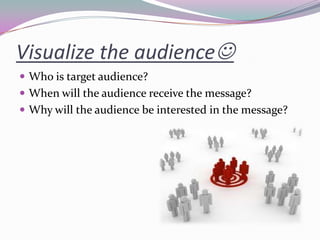
Visualize the audience
 Who is target audience?
 When will the audience receive the message?
 Why will the audience be interested in the message?
Gathering Supporting
Information
 Generate the ideas
 Select the ideas
Organize the Information 
 Prepare an outline using Good news strategy.
 The Good news strategy is based on the direct pattern.
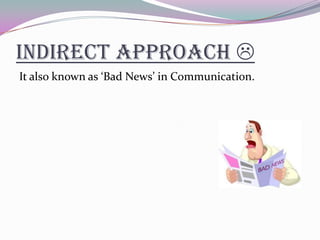
Indirect approach 
It also known as ‘Bad News’ in Communication.
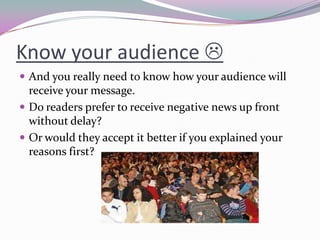
Know your audience 
 And you really need to know how your audience will
receive your message.
 Do readers prefer to receive negative news up front
without delay?
 Or would they accept it better if you explained your
reasons first?
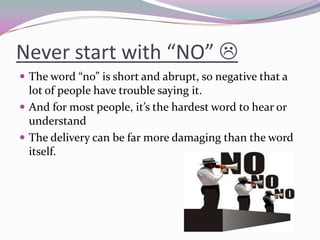
Never start with “NO” 
 The word “no” is short and abrupt, so negative that a
lot of people have trouble saying it.
 And for most people, it’s the hardest word to hear or
understand
 The delivery can be far more damaging than the word
itself.
Selection of Words 
 You also need to pay special attention to selection
word so that you can create your sentences and
paragraphs carefully.
Open with Buffer 
 A neutral, noncontroversial statement that is closely
related to the point of the message is called a buffer.
Business communications front page

Business communications front page

  • 1.
    Submit to Mr.Shoaib Rana Group#5 Bil@l & Ri@z
  • 2.
  • 3.
    Contents  o Directapproach Identify the objective Visualize the audience Gathering supporting information Organize the information o Indirect approach Know your audience Never start with ‘NO’ Selection of words Open with Buffer
  • 4.
    DIRECT APPROACH: It isalso known as ‘Good News ‘ in Communication.
  • 5.
    Identify the objective Topersuade To inform To inquire
  • 6.
    Visualize the audience Who is target audience?  When will the audience receive the message?  Why will the audience be interested in the message?
  • 7.
  • 8.
    Organize the Information  Prepare an outline using Good news strategy.  The Good news strategy is based on the direct pattern.
  • 9.
    Indirect approach  Italso known as ‘Bad News’ in Communication.
  • 10.
    Know your audience  And you really need to know how your audience will receive your message.  Do readers prefer to receive negative news up front without delay?  Or would they accept it better if you explained your reasons first?
  • 11.
    Never start with“NO”   The word “no” is short and abrupt, so negative that a lot of people have trouble saying it.  And for most people, it’s the hardest word to hear or understand  The delivery can be far more damaging than the word itself.
  • 12.
    Selection of Words  You also need to pay special attention to selection word so that you can create your sentences and paragraphs carefully.
  • 13.
    Open with Buffer  A neutral, noncontroversial statement that is closely related to the point of the message is called a buffer.