1
Business Basic Statistics
(9th
Edition)
Chapter 1
Introduction and Data Collection
2
Chapter Topics
 Why a Manager Needs to Know About
Statistics
 The Growth and Development of Modern
Statistics
 Some Important Definitions
 Descriptive Versus Inferential Statistics
3
Chapter Topics
 Why Data are Needed
 Types of Data and Their Sources
 Design of Survey Research
 Types of Sampling Methods
 Types of Survey Errors
(continued)
4
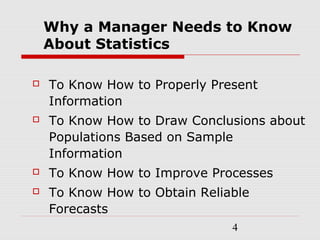
Why a Manager Needs to Know
About Statistics
 To Know How to Properly Present
Information
 To Know How to Draw Conclusions about
Populations Based on Sample
Information
 To Know How to Improve Processes
 To Know How to Obtain Reliable
Forecasts
5
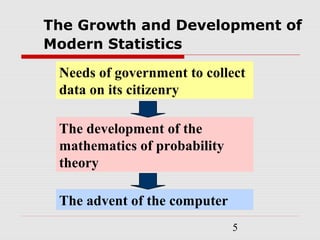
The Growth and Development of
Modern Statistics
Needs of government to collect
data on its citizenry
The development of the
mathematics of probability
theory
The advent of the computer
6
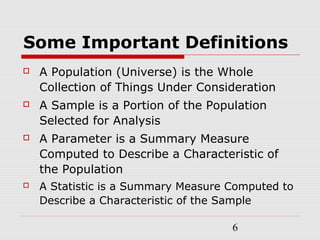
Some Important Definitions
 A Population (Universe) is the Whole
Collection of Things Under Consideration
 A Sample is a Portion of the Population
Selected for Analysis
 A Parameter is a Summary Measure
Computed to Describe a Characteristic of
the Population
 A Statistic is a Summary Measure Computed to
Describe a Characteristic of the Sample
7
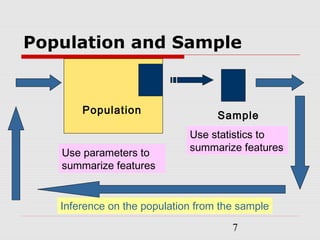
Population and Sample
Population
Sample
Use parameters to
summarize features
Use statistics to
summarize features
Inference on the population from the sample
8
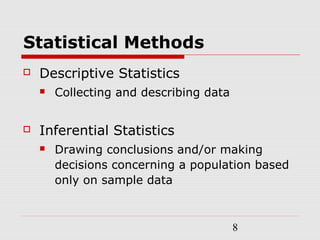
Statistical Methods
 Descriptive Statistics
 Collecting and describing data
 Inferential Statistics
 Drawing conclusions and/or making
decisions concerning a population based
only on sample data
9
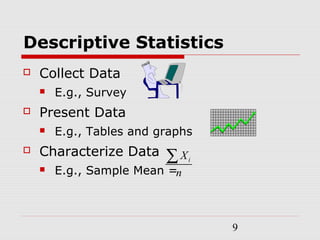
Descriptive Statistics
 Collect Data
 E.g., Survey
 Present Data
 E.g., Tables and graphs
 Characterize Data
 E.g., Sample Mean =
iX
n
∑
10
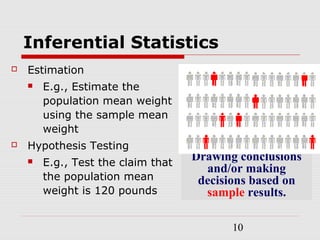
Inferential Statistics
 Estimation
 E.g., Estimate the
population mean weight
using the sample mean
weight
 Hypothesis Testing
 E.g., Test the claim that
the population mean
weight is 120 pounds
Drawing conclusions
and/or making
decisions based on
sample results.
11
Why We Need Data
 To Provide Input to Survey
 To Provide Input to Study
 To Measure Performance of Ongoing
Service or Production Process
 To Evaluate Conformance to Standards
 To Assist in Formulating Alternative
Courses of Action
 To Satisfy Curiosity
12
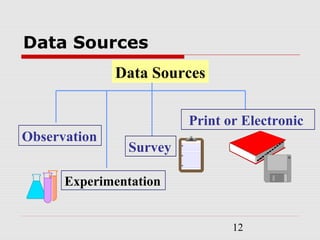
Data Sources
Observation
Experimentation
Survey
Print or Electronic
Data Sources
13
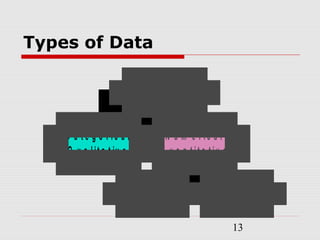
Types of Data
C a t e g o r i c a l
( Q u a l it a t iv e )
D i s c r e t e C o n t i n u o u s
N u m e r i c a l
( Q u a n t i t a t i v e )
D a t a
14
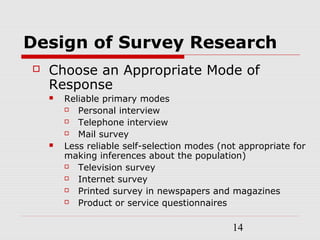
Design of Survey Research
 Choose an Appropriate Mode of
Response
 Reliable primary modes
 Personal interview
 Telephone interview
 Mail survey
 Less reliable self-selection modes (not appropriate for
making inferences about the population)
 Television survey
 Internet survey
 Printed survey in newspapers and magazines
 Product or service questionnaires
15
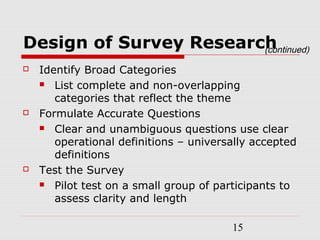
Design of Survey Research
 Identify Broad Categories
 List complete and non-overlapping
categories that reflect the theme
 Formulate Accurate Questions
 Clear and unambiguous questions use clear
operational definitions – universally accepted
definitions
 Test the Survey
 Pilot test on a small group of participants to
assess clarity and length
(continued)
16
Design of Survey Research
 Write a Cover Letter
 State the goal and purpose of the survey
 Explain the importance of a response
 Provide assurance of respondent
anonymity
 Offer incentive gift for respondent
participation
(continued)
17
Reasons for Drawing a Sample
 Less Time Consuming Than a Census
 Less Costly to Administer Than a
Census
 Less Cumbersome and More Practical
to Administer Than a Census of the
Targeted Population
18
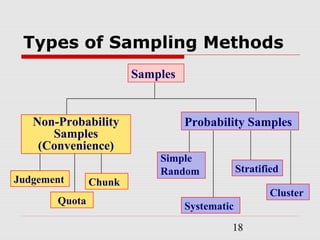
Types of Sampling Methods
Quota
Samples
Non-Probability
Samples
(Convenience)
Judgement Chunk
Probability Samples
Simple
Random
Systematic
Stratified
Cluster
19
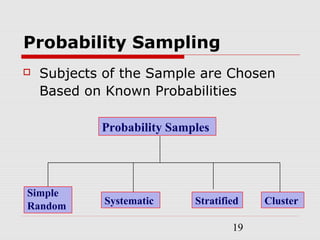
Probability Sampling
 Subjects of the Sample are Chosen
Based on Known Probabilities
Probability Samples
Simple
Random Systematic Stratified Cluster
20
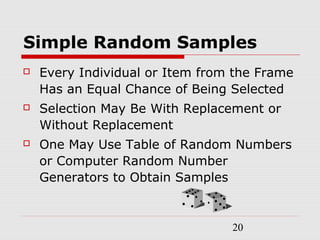
Simple Random Samples
 Every Individual or Item from the Frame
Has an Equal Chance of Being Selected
 Selection May Be With Replacement or
Without Replacement
 One May Use Table of Random Numbers
or Computer Random Number
Generators to Obtain Samples
21
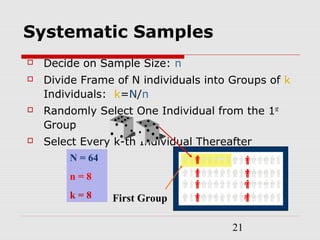
Systematic Samples
 Decide on Sample Size: n
 Divide Frame of N individuals into Groups of k
Individuals: k=N/n
 Randomly Select One Individual from the 1st
Group
 Select Every k-th Individual Thereafter
N = 64
n = 8
k = 8 First Group
22
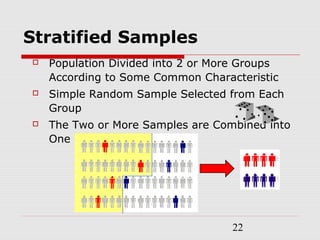
Stratified Samples
 Population Divided into 2 or More Groups
According to Some Common Characteristic
 Simple Random Sample Selected from Each
Group
 The Two or More Samples are Combined into
One
23
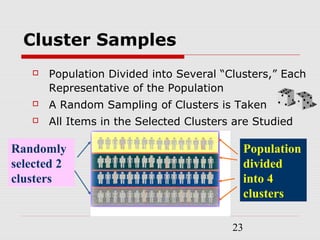
Cluster Samples
 Population Divided into Several “Clusters,” Each
Representative of the Population
 A Random Sampling of Clusters is Taken
 All Items in the Selected Clusters are Studied
Population
divided
into 4
clusters
Randomly
selected 2
clusters
24
Advantages and Disadvantages
 Simple Random Sample & Systematic Sample
 Simple to use
 May not be a good representation of the
population’s underlying characteristics
 Stratified Sample
 Ensures representation of individuals across
the entire population
 Cluster Sample
 More cost effective
 Less efficient (need larger sample to acquire
the same level of precision)
25
Evaluating Survey Worthiness
 What is the Purpose of the Survey?
 Is the Survey Based on a Probability
Sample?
 Coverage Error – Appropriate Frame
 Nonresponse Error – Follow up
 Measurement Error – Good Questions
Elicit Good Responses
 Sampling Error – Always Exists
26
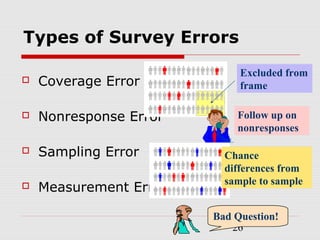
Types of Survey Errors
 Coverage Error
 Nonresponse Error
 Sampling Error
 Measurement Error
Excluded from
frame
Follow up on
nonresponses
Chance
differences from
sample to sample
Bad Question!
27
Chapter Summary
 Addressed Why a Manager Needs to
Know about Statistics
 Discussed the Growth and
Development of Modern Statistics
 Addressed the Notion of Descriptive
Versus Inferential Statistics
 Discussed the Importance of Data
28
Chapter Summary
 Defined and Described the Different
Types of Data and Sources
 Discussed the Design of Surveys
 Discussed Types of Sampling Methods
 Described Different Types of Survey
Errors
(continued)
Source: www.myphlip.pearsoncmg.com/cw/mpchapter.cfm

Business Basic Statistics

  • 1.
    1 Business Basic Statistics (9th Edition) Chapter1 Introduction and Data Collection
  • 2.
    2 Chapter Topics  Whya Manager Needs to Know About Statistics  The Growth and Development of Modern Statistics  Some Important Definitions  Descriptive Versus Inferential Statistics
  • 3.
    3 Chapter Topics  WhyData are Needed  Types of Data and Their Sources  Design of Survey Research  Types of Sampling Methods  Types of Survey Errors (continued)
  • 4.
    4 Why a ManagerNeeds to Know About Statistics  To Know How to Properly Present Information  To Know How to Draw Conclusions about Populations Based on Sample Information  To Know How to Improve Processes  To Know How to Obtain Reliable Forecasts
  • 5.
    5 The Growth andDevelopment of Modern Statistics Needs of government to collect data on its citizenry The development of the mathematics of probability theory The advent of the computer
  • 6.
    6 Some Important Definitions A Population (Universe) is the Whole Collection of Things Under Consideration  A Sample is a Portion of the Population Selected for Analysis  A Parameter is a Summary Measure Computed to Describe a Characteristic of the Population  A Statistic is a Summary Measure Computed to Describe a Characteristic of the Sample
  • 7.
    7 Population and Sample Population Sample Useparameters to summarize features Use statistics to summarize features Inference on the population from the sample
  • 8.
    8 Statistical Methods  DescriptiveStatistics  Collecting and describing data  Inferential Statistics  Drawing conclusions and/or making decisions concerning a population based only on sample data
  • 9.
    9 Descriptive Statistics  CollectData  E.g., Survey  Present Data  E.g., Tables and graphs  Characterize Data  E.g., Sample Mean = iX n ∑
  • 10.
    10 Inferential Statistics  Estimation E.g., Estimate the population mean weight using the sample mean weight  Hypothesis Testing  E.g., Test the claim that the population mean weight is 120 pounds Drawing conclusions and/or making decisions based on sample results.
  • 11.
    11 Why We NeedData  To Provide Input to Survey  To Provide Input to Study  To Measure Performance of Ongoing Service or Production Process  To Evaluate Conformance to Standards  To Assist in Formulating Alternative Courses of Action  To Satisfy Curiosity
  • 12.
  • 13.
    13 Types of Data Ca t e g o r i c a l ( Q u a l it a t iv e ) D i s c r e t e C o n t i n u o u s N u m e r i c a l ( Q u a n t i t a t i v e ) D a t a
  • 14.
    14 Design of SurveyResearch  Choose an Appropriate Mode of Response  Reliable primary modes  Personal interview  Telephone interview  Mail survey  Less reliable self-selection modes (not appropriate for making inferences about the population)  Television survey  Internet survey  Printed survey in newspapers and magazines  Product or service questionnaires
  • 15.
    15 Design of SurveyResearch  Identify Broad Categories  List complete and non-overlapping categories that reflect the theme  Formulate Accurate Questions  Clear and unambiguous questions use clear operational definitions – universally accepted definitions  Test the Survey  Pilot test on a small group of participants to assess clarity and length (continued)
  • 16.
    16 Design of SurveyResearch  Write a Cover Letter  State the goal and purpose of the survey  Explain the importance of a response  Provide assurance of respondent anonymity  Offer incentive gift for respondent participation (continued)
  • 17.
    17 Reasons for Drawinga Sample  Less Time Consuming Than a Census  Less Costly to Administer Than a Census  Less Cumbersome and More Practical to Administer Than a Census of the Targeted Population
  • 18.
    18 Types of SamplingMethods Quota Samples Non-Probability Samples (Convenience) Judgement Chunk Probability Samples Simple Random Systematic Stratified Cluster
  • 19.
    19 Probability Sampling  Subjectsof the Sample are Chosen Based on Known Probabilities Probability Samples Simple Random Systematic Stratified Cluster
  • 20.
    20 Simple Random Samples Every Individual or Item from the Frame Has an Equal Chance of Being Selected  Selection May Be With Replacement or Without Replacement  One May Use Table of Random Numbers or Computer Random Number Generators to Obtain Samples
  • 21.
    21 Systematic Samples  Decideon Sample Size: n  Divide Frame of N individuals into Groups of k Individuals: k=N/n  Randomly Select One Individual from the 1st Group  Select Every k-th Individual Thereafter N = 64 n = 8 k = 8 First Group
  • 22.
    22 Stratified Samples  PopulationDivided into 2 or More Groups According to Some Common Characteristic  Simple Random Sample Selected from Each Group  The Two or More Samples are Combined into One
  • 23.
    23 Cluster Samples  PopulationDivided into Several “Clusters,” Each Representative of the Population  A Random Sampling of Clusters is Taken  All Items in the Selected Clusters are Studied Population divided into 4 clusters Randomly selected 2 clusters
  • 24.
    24 Advantages and Disadvantages Simple Random Sample & Systematic Sample  Simple to use  May not be a good representation of the population’s underlying characteristics  Stratified Sample  Ensures representation of individuals across the entire population  Cluster Sample  More cost effective  Less efficient (need larger sample to acquire the same level of precision)
  • 25.
    25 Evaluating Survey Worthiness What is the Purpose of the Survey?  Is the Survey Based on a Probability Sample?  Coverage Error – Appropriate Frame  Nonresponse Error – Follow up  Measurement Error – Good Questions Elicit Good Responses  Sampling Error – Always Exists
  • 26.
    26 Types of SurveyErrors  Coverage Error  Nonresponse Error  Sampling Error  Measurement Error Excluded from frame Follow up on nonresponses Chance differences from sample to sample Bad Question!
  • 27.
    27 Chapter Summary  AddressedWhy a Manager Needs to Know about Statistics  Discussed the Growth and Development of Modern Statistics  Addressed the Notion of Descriptive Versus Inferential Statistics  Discussed the Importance of Data
  • 28.
    28 Chapter Summary  Definedand Described the Different Types of Data and Sources  Discussed the Design of Surveys  Discussed Types of Sampling Methods  Described Different Types of Survey Errors (continued) Source: www.myphlip.pearsoncmg.com/cw/mpchapter.cfm