BUSINESS
FORMATION 101
Co-Sponsored by SmartUp® & General Assembly®
Presented By Andrei D. Tsygankov, Esq.
Entrepreneur & Attorney-At-Law
About Me
• B.S. in Management from Georgia Tech
• J.D. from Georgia State University College of Law
• Current:
• Co-Founder and COO of SmartUp®
• Partner at Founders Legal™ (Bekiares Eliezer LLP)
• Former:
• Managing Director & In-House Counsel for a group of companies that focused on
Export Management & Distribution of goods internationally
How This Presentation May Help You
• Building Your Company: Business Formation from a Legal Perspective
• Why do you need a business entity?
• What important options should you consider?
• What do you need and when?
• Doing things yourself vs. seeking help from a professional
• Things to consider for Freelancers and Employees
What is a Business Entity?
An organization that is legally separate from its owners
Why do I need a Business Entity?
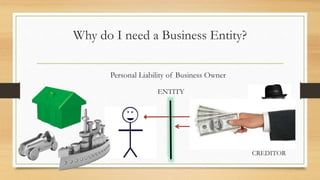
Personal Liability of Business Owner
CREDITOR
ENTITY
Why do I need a Business Entity?
1. Protects your personal assets (“Limited Liability”)
2. Entity lives on “forever”
1. Keeps things structured and organized
• Better governance and control
2. Easier to raise capital and sell or transfer the business
What Type of Business Entity Do I Need?
• Corporation
• Limited Liability Company (LLC)
Corporation & LLC: Similarities
• Both are formed and governed under State Law
• Both provide Limited Liability protection to their owners
• Both can do essentially the same things
• Do business
• Own property
• Raise money
Corporation & LLC: Differences
• Structure CAN be different
• Governance CAN be different
• Taxation CAN be different
Corporation
• Rigid Structure
• Roles for individuals are defined by law and practice
• 2 Choices for Taxation
• C Corporation (default)
• S Corporation (option, if applicable)
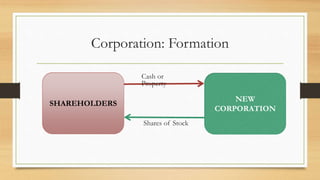
Corporation: Formation
INDIVIDUALS
NEW
CORPORATION
Cash or
Property
Shares of Stock
SHAREHOLDERS
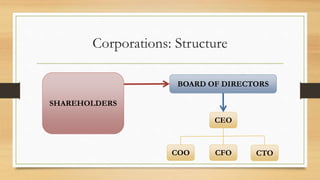
Corporations: Structure
BOARD OF DIRECTORS
SHAREHOLDERS
CEO
COO CFO CTO
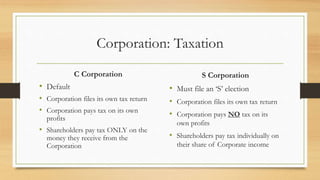
Corporation: Taxation
C Corporation
• Default
• Corporation files its own tax return
• Corporation pays tax on its own
profits
• Shareholders pay tax ONLY on the
money they receive from the
Corporation
S Corporation
• Must file an ‘S’ election
• Corporation files its own tax return
• Corporation pays NO tax on its
own profits
• Shareholders pay tax individually on
their share of Corporate income
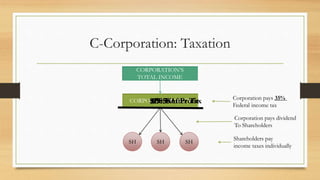
C-Corporation: Taxation
CORPORATE PROFITS
SH SH SH
CORPORATION’S
TOTAL INCOME
Corporation pays 35%
Federal income tax
Shareholders pay
income taxes individually
Corporation pays dividend
To Shareholders
$90 Net Profit$19.50$19.50$19.50$58.5 After Tax
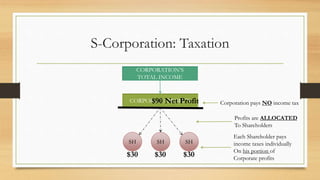
S-Corporation: Taxation
CORPORATE PROFITS
SH SH SH
CORPORATION’S
TOTAL INCOME
Corporation pays NO income tax
Each Shareholder pays
income taxes individually
On his portion of
Corporate profits
Profits are ALLOCATED
To Shareholders
$90 Net Profit
$30 $30 $30
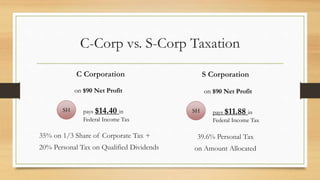
C-Corp vs. S-Corp Taxation
C Corporation
35% on 1/3 Share of Corporate Tax +
20% Personal Tax on Qualified Dividends
S Corporation
39.6% Personal Tax
on Amount Allocated
on $90 Net Profit
SH pays $14.40 in
Federal Income Tax
on $90 Net Profit
SH pays $11.88 in
Federal Income Tax
S-Corporation: Taxation
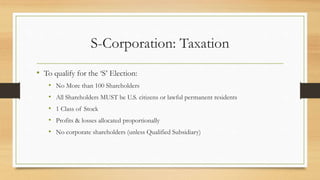
• To qualify for the ‘S’ Election:
• No More than 100 Shareholders
• All Shareholders MUST be U.S. citizens or lawful permanent residents
• 1 Class of Stock
• Profits & losses allocated proportionally
• No corporate shareholders (unless Qualified Subsidiary)
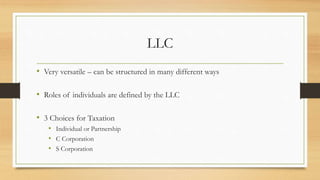
LLC
• Very versatile – can be structured in many different ways
• Roles of individuals are defined by the LLC
• 3 Choices for Taxation
• Individual or Partnership
• C Corporation
• S Corporation
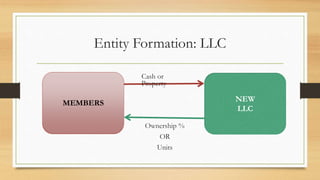
Entity Formation: LLC
INDIVIDUALS
NEW
LLC
Cash or
Property
Ownership %
OR
Units
MEMBERS
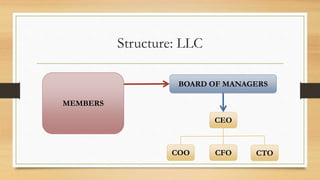
Structure: LLC
BOARD OF MANAGERS
MEMBERS
CEO
COO CFO CTO
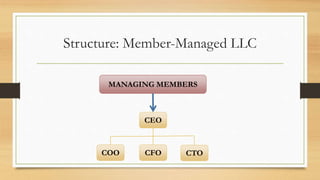
Structure: Member-Managed LLC
MANAGING MEMBERS
CEO
COO CFO CTO
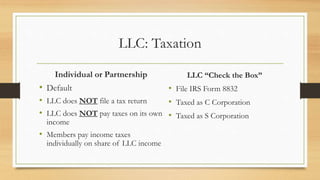
LLC: Taxation
Individual or Partnership
• Default
• LLC does NOT file a tax return
• LLC does NOT pay taxes on its own
income
• Members pay income taxes
individually on share of LLC income
LLC “Check the Box”
• File IRS Form 8832
• Taxed as C Corporation
• Taxed as S Corporation
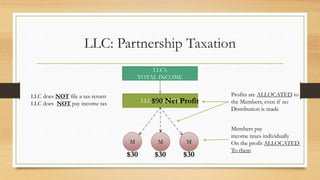
LLC: Partnership Taxation
LLC’s PROFITS
M M M
LLC’s
TOTAL INCOME
LLC does NOT file a tax return
LLC does NOT pay income tax
Members pay
income taxes individually
On the profit ALLOCATED
To them
Profits are ALLOCATED to
the Members, even if no
Distribution is made
$90 Net Profit
$30 $30 $30
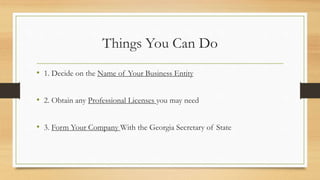
Things You Can Do
• 1. Decide on the Name of Your Business Entity
• 2. Obtain any Professional Licenses you may need
• 3. Form Your Company With the Georgia Secretary of State
Name Your Business Entity
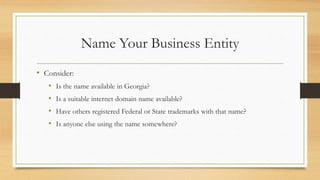
• Consider:
• Is the name available in Georgia?
• Is a suitable internet domain name available?
• Have others registered Federal or State trademarks with that name?
• Is anyone else using the name somewhere?
Name Your Business Entity
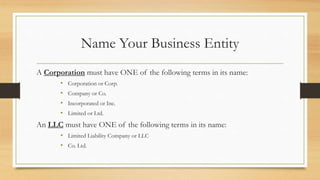
A Corporation must have ONE of the following terms in its name:
• Corporation or Corp.
• Company or Co.
• Incorporated or Inc.
• Limited or Ltd.
An LLC must have ONE of the following terms in its name:
• Limited Liability Company or LLC
• Co. Ltd.
Name Your Business Entity
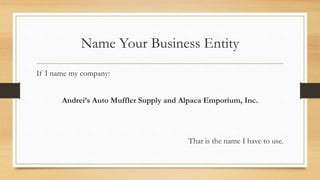
If I name my company:
Andrei’s Auto Muffler Supply and Alpaca Emporium, Inc.
That is the name I have to use.
Form Your Business Entity
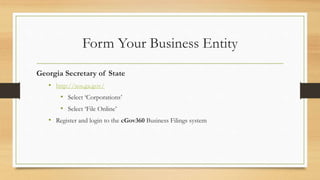
Georgia Secretary of State
• http://sos.ga.gov/
• Select ‘Corporations’
• Select ‘File Online’
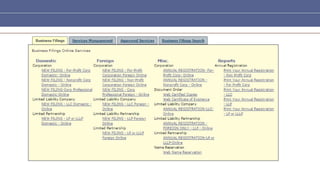
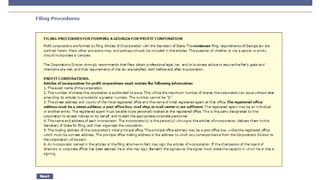
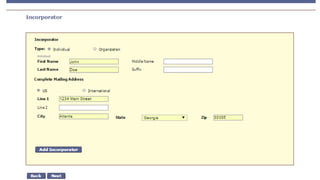
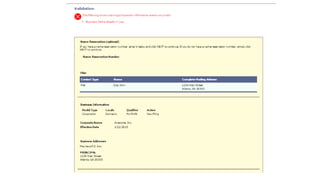
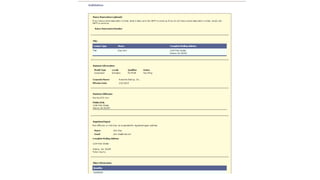
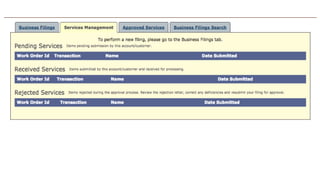
• Register and login to the cGov360 Business Filings system
Things You Can Do Continued
AFTER You Form Your Entity…
• 3. Obtain Your EIN (Tax ID) from the IRS
• www.irs.gov
• Apply for Employer ID Number
• 4. Give Notice of Formation in the County Newspaper (‘Legal Organ’)
• Give Notice in County where the Principal Office or the Registered Agent is located
• The Notice must be run for 2 consecutive weeks, and the cost is $40.00
Things You Can Do Continued
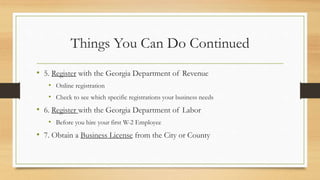
• 5. Register with the Georgia Department of Revenue
• Online registration
• Check to see which specific registrations your business needs
• 6. Register with the Georgia Department of Labor
• Before you hire your first W-2 Employee
• 7. Obtain a Business License from the City or County
Things You Can Do Continued
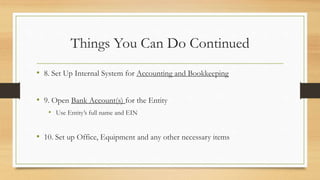
• 8. Set Up Internal System for Accounting and Bookkeeping
• 9. Open Bank Account(s) for the Entity
• Use Entity’s full name and EIN
• 10. Set up Office, Equipment and any other necessary items
Get Professional Assistance With…
Corporation
• Shareholder Agreement
• By-Laws
• Board Member Resolution Forms
• Shareholder Consent Forms
LLC
• Operating Agreement
• Manager Resolution Forms (if
applicable)
• Member Resolution & Consent
Forms
Get Professional Assistance With…
• Intellectual Property Assignment Agreements (for Founders)
• Vesting Agreements (for Founders and Very Early Employees)
• Restricted Stock or Unit Grant Agreements
• IRC Section 83(b) election
• Non-Disclosure Agreement
Get Professional Assistance With…
• Human Resources:
• Employment Agreements (with IP Assignment & Restrictive Covenants)
• Independent Contractor Agreements (with IP Assignment & Restrictive Covenants)
• For your Website or Application:
• Terms & Conditions
• Privacy Policy
• End User License Agreement (EULA)
Additional Considerations
• Secure your Intellectual Property (Consult with an IP Attorney)
• Patents
• Trademarks
• Plan for Taxes (Consult with a CPA)
• Consider if you need business insurance
For Freelancers
• Form a Single Member LLC
• Taxed as disregarded entity or S-Corporation
• Member-Managed Structure
• Obtain a quality Services Agreement that protects you
• Make sure your customer signs it
Considerations for Employees
• Employment Relationship
• Restrictive Covenants
• Intellectual Property
• Stock Options
Considerations for Employees
Employment Relationship
• At Will unless agreed to otherwise
• Employer can fire you at any time
• Employee can leave at any time
• Employer must abide by employment laws
• OSHA, Workers’ Compensation, Minimum Pay Requirements
Considerations for Employees
Intellectual Property
• Works for Hire
• Assignment to Employer
• Employer’s rights in works that Employee creates
• Within the Scope of Employment
• Using Employer Resources
• Using Employer Time
Considerations for Employees
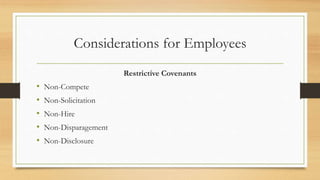
Restrictive Covenants
• Non-Compete
• Non-Solicitation
• Non-Hire
• Non-Disparagement
• Non-Disclosure
Considerations for Employees
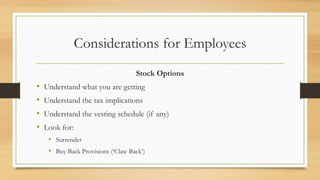
Stock Options
• Understand what you are getting
• Understand the tax implications
• Understand the vesting schedule (if any)
• Look for:
• Surrender
• Buy Back Provisions (‘Claw Back’)
My Contact Info
Andrei Tsygankov, Esq.
Andrei@smartuplegal.com
800-530-4983
@Smartup_
ATLANTA TECH VILLAGE
Suite 555
3423 Piedmont Road, NE
Atlanta, GA 30305
To schedule a consultation with me
please visit www.smartuplegal.com and
click consult!

Business Formation 101

  • 1.
    BUSINESS FORMATION 101 Co-Sponsored bySmartUp® & General Assembly® Presented By Andrei D. Tsygankov, Esq. Entrepreneur & Attorney-At-Law
  • 2.
    About Me • B.S.in Management from Georgia Tech • J.D. from Georgia State University College of Law • Current: • Co-Founder and COO of SmartUp® • Partner at Founders Legal™ (Bekiares Eliezer LLP) • Former: • Managing Director & In-House Counsel for a group of companies that focused on Export Management & Distribution of goods internationally
  • 3.
    How This PresentationMay Help You • Building Your Company: Business Formation from a Legal Perspective • Why do you need a business entity? • What important options should you consider? • What do you need and when? • Doing things yourself vs. seeking help from a professional • Things to consider for Freelancers and Employees
  • 4.
    What is aBusiness Entity? An organization that is legally separate from its owners
  • 5.
    Why do Ineed a Business Entity? Personal Liability of Business Owner CREDITOR ENTITY
  • 6.
    Why do Ineed a Business Entity? 1. Protects your personal assets (“Limited Liability”) 2. Entity lives on “forever” 1. Keeps things structured and organized • Better governance and control 2. Easier to raise capital and sell or transfer the business
  • 7.
    What Type ofBusiness Entity Do I Need? • Corporation • Limited Liability Company (LLC)
  • 8.
    Corporation & LLC:Similarities • Both are formed and governed under State Law • Both provide Limited Liability protection to their owners • Both can do essentially the same things • Do business • Own property • Raise money
  • 9.
    Corporation & LLC:Differences • Structure CAN be different • Governance CAN be different • Taxation CAN be different
  • 10.
    Corporation • Rigid Structure •Roles for individuals are defined by law and practice • 2 Choices for Taxation • C Corporation (default) • S Corporation (option, if applicable)
  • 11.
  • 12.
    Corporations: Structure BOARD OFDIRECTORS SHAREHOLDERS CEO COO CFO CTO
  • 13.
    Corporation: Taxation C Corporation •Default • Corporation files its own tax return • Corporation pays tax on its own profits • Shareholders pay tax ONLY on the money they receive from the Corporation S Corporation • Must file an ‘S’ election • Corporation files its own tax return • Corporation pays NO tax on its own profits • Shareholders pay tax individually on their share of Corporate income
  • 14.
    C-Corporation: Taxation CORPORATE PROFITS SHSH SH CORPORATION’S TOTAL INCOME Corporation pays 35% Federal income tax Shareholders pay income taxes individually Corporation pays dividend To Shareholders $90 Net Profit$19.50$19.50$19.50$58.5 After Tax
  • 15.
    S-Corporation: Taxation CORPORATE PROFITS SHSH SH CORPORATION’S TOTAL INCOME Corporation pays NO income tax Each Shareholder pays income taxes individually On his portion of Corporate profits Profits are ALLOCATED To Shareholders $90 Net Profit $30 $30 $30
  • 16.
    C-Corp vs. S-CorpTaxation C Corporation 35% on 1/3 Share of Corporate Tax + 20% Personal Tax on Qualified Dividends S Corporation 39.6% Personal Tax on Amount Allocated on $90 Net Profit SH pays $14.40 in Federal Income Tax on $90 Net Profit SH pays $11.88 in Federal Income Tax
  • 17.
    S-Corporation: Taxation • Toqualify for the ‘S’ Election: • No More than 100 Shareholders • All Shareholders MUST be U.S. citizens or lawful permanent residents • 1 Class of Stock • Profits & losses allocated proportionally • No corporate shareholders (unless Qualified Subsidiary)
  • 18.
    LLC • Very versatile– can be structured in many different ways • Roles of individuals are defined by the LLC • 3 Choices for Taxation • Individual or Partnership • C Corporation • S Corporation
  • 19.
    Entity Formation: LLC INDIVIDUALS NEW LLC Cashor Property Ownership % OR Units MEMBERS
  • 20.
    Structure: LLC BOARD OFMANAGERS MEMBERS CEO COO CFO CTO
  • 21.
  • 22.
    LLC: Taxation Individual orPartnership • Default • LLC does NOT file a tax return • LLC does NOT pay taxes on its own income • Members pay income taxes individually on share of LLC income LLC “Check the Box” • File IRS Form 8832 • Taxed as C Corporation • Taxed as S Corporation
  • 23.
    LLC: Partnership Taxation LLC’sPROFITS M M M LLC’s TOTAL INCOME LLC does NOT file a tax return LLC does NOT pay income tax Members pay income taxes individually On the profit ALLOCATED To them Profits are ALLOCATED to the Members, even if no Distribution is made $90 Net Profit $30 $30 $30
  • 24.
    Things You CanDo • 1. Decide on the Name of Your Business Entity • 2. Obtain any Professional Licenses you may need • 3. Form Your Company With the Georgia Secretary of State
  • 25.
    Name Your BusinessEntity • Consider: • Is the name available in Georgia? • Is a suitable internet domain name available? • Have others registered Federal or State trademarks with that name? • Is anyone else using the name somewhere?
  • 26.
    Name Your BusinessEntity A Corporation must have ONE of the following terms in its name: • Corporation or Corp. • Company or Co. • Incorporated or Inc. • Limited or Ltd. An LLC must have ONE of the following terms in its name: • Limited Liability Company or LLC • Co. Ltd.
  • 27.
    Name Your BusinessEntity If I name my company: Andrei’s Auto Muffler Supply and Alpaca Emporium, Inc. That is the name I have to use.
  • 28.
    Form Your BusinessEntity Georgia Secretary of State • http://sos.ga.gov/ • Select ‘Corporations’ • Select ‘File Online’ • Register and login to the cGov360 Business Filings system
  • 44.
    Things You CanDo Continued AFTER You Form Your Entity… • 3. Obtain Your EIN (Tax ID) from the IRS • www.irs.gov • Apply for Employer ID Number • 4. Give Notice of Formation in the County Newspaper (‘Legal Organ’) • Give Notice in County where the Principal Office or the Registered Agent is located • The Notice must be run for 2 consecutive weeks, and the cost is $40.00
  • 45.
    Things You CanDo Continued • 5. Register with the Georgia Department of Revenue • Online registration • Check to see which specific registrations your business needs • 6. Register with the Georgia Department of Labor • Before you hire your first W-2 Employee • 7. Obtain a Business License from the City or County
  • 46.
    Things You CanDo Continued • 8. Set Up Internal System for Accounting and Bookkeeping • 9. Open Bank Account(s) for the Entity • Use Entity’s full name and EIN • 10. Set up Office, Equipment and any other necessary items
  • 47.
    Get Professional AssistanceWith… Corporation • Shareholder Agreement • By-Laws • Board Member Resolution Forms • Shareholder Consent Forms LLC • Operating Agreement • Manager Resolution Forms (if applicable) • Member Resolution & Consent Forms
  • 48.
    Get Professional AssistanceWith… • Intellectual Property Assignment Agreements (for Founders) • Vesting Agreements (for Founders and Very Early Employees) • Restricted Stock or Unit Grant Agreements • IRC Section 83(b) election • Non-Disclosure Agreement
  • 49.
    Get Professional AssistanceWith… • Human Resources: • Employment Agreements (with IP Assignment & Restrictive Covenants) • Independent Contractor Agreements (with IP Assignment & Restrictive Covenants) • For your Website or Application: • Terms & Conditions • Privacy Policy • End User License Agreement (EULA)
  • 50.
    Additional Considerations • Secureyour Intellectual Property (Consult with an IP Attorney) • Patents • Trademarks • Plan for Taxes (Consult with a CPA) • Consider if you need business insurance
  • 51.
    For Freelancers • Forma Single Member LLC • Taxed as disregarded entity or S-Corporation • Member-Managed Structure • Obtain a quality Services Agreement that protects you • Make sure your customer signs it
  • 52.
    Considerations for Employees •Employment Relationship • Restrictive Covenants • Intellectual Property • Stock Options
  • 53.
    Considerations for Employees EmploymentRelationship • At Will unless agreed to otherwise • Employer can fire you at any time • Employee can leave at any time • Employer must abide by employment laws • OSHA, Workers’ Compensation, Minimum Pay Requirements
  • 54.
    Considerations for Employees IntellectualProperty • Works for Hire • Assignment to Employer • Employer’s rights in works that Employee creates • Within the Scope of Employment • Using Employer Resources • Using Employer Time
  • 55.
    Considerations for Employees RestrictiveCovenants • Non-Compete • Non-Solicitation • Non-Hire • Non-Disparagement • Non-Disclosure
  • 56.
    Considerations for Employees StockOptions • Understand what you are getting • Understand the tax implications • Understand the vesting schedule (if any) • Look for: • Surrender • Buy Back Provisions (‘Claw Back’)
  • 57.
    My Contact Info AndreiTsygankov, Esq. Andrei@smartuplegal.com 800-530-4983 @Smartup_ ATLANTA TECH VILLAGE Suite 555 3423 Piedmont Road, NE Atlanta, GA 30305 To schedule a consultation with me please visit www.smartuplegal.com and click consult!

Editor's Notes

  • #5 - When people say that they want to ‘form a business’, many times what they really mean is ‘form a business entity’ My definition of a business entity is simple: An organization that is distinctly separate from its owners. When I say separate, I mean separate: It conducts business that is separate from its owners; it keeps bank accounts and financial transactions separate from its owners; it owns property that is separate from its owners; often times it files taxes separate from that of its owners. It even has its own rights. This is an important distinction to understand – you might own the business entity, but it essentially a separate ‘fictitious person’ (not being political with this term).


  • #6 Can you do business as an individual? Yes. This is a business owner. Let’s call him Jim. Jim started a company that buys and sells things and also provides services. Jim has a house, a car and a really nice boat. If Jim does business individually, he will likely have credit with his suppliers (thus, he has trade creditors). If Jim’s business doesn’t do well, or let’s say Jim injures someone or damages something in the course of his business (all represented by the Creditor), they can come after Jim personally – and his house, his car, and his really nice boat. Now, if Jim actually formed a business entity, and he kept it separately (remember the last slide) many (if not most) of such creditors would only be able to look to the entity for payment (and not to Jim). So, there, he has a much better chance of keeping his nice boat. I also say most creditors, because some – like banks – want personal guarantees from owners. But, at least you get to decide who has the ‘personal guarantee’ and who doesn’t. Also, you will be responsible for personal negligence.
  • #7 The previous slide helped to illustrate that, if you set up and maintain your entity properly (we will get to what you need to do), it will help protect your personal assets. This is commonly referred to as “Limited Liability”, or having a “Corporate Veil”. Running a business through an entity will help set up MUCH better governance. This is especially important if you have more than one person (even if that other person is an employee with some authority to do something). You could set things up through agreements, but they would be complicated. The financials are also ‘cleaner’ because they are separate. You keep information on business income, costs, and expenses just for the entity. Investors – be they venture capitalists or just your Uncle Ned – will find it much more palpable to give money to something that officially ‘exists’, even if just on paper. It is much easier to sell them a piece of something when that something is defined (Assets, Liabilities, etc.)
  • #8 If you look online, websites just begin to rattle off every entity option that you have, along with pros and cons. Quite frankly, I am of the opinion that just about every business will be well served by either an entity structured as a Corporation or an Limited Liability Company (LLC). Sure, there is such a thing as a Limited Liability Partnership (used by some professional businesses), but honestly – if you don’t know why you want a partnership over one of these two, then I am willing to bet money that you don’t need it. We will go a little into the details of the structure and tax considerations/options of the Corporation and the LLC.
  • #9 Both entities are formed under State Law and are governed by state law. Every state has its own set of statutes that has something to say about how entities are formed in the state, how they can and cannot be run, and what the the rights are of everyone involved. If you form your company in Georgia, then it is governed by Georgia law. Here in Georgia, you form a Corporation or an LLC with the Georgia Secretary of State, and in a little bit, I will give you step by step instructions on how to do it. As we discussed in an earlier slide, they BOTH provide limited liability protection to the owners, as long as the owners set up and run the entity in accordance with the rules. Both entities can do the same exact things. Do business – whatever it may be; own property; raise capital. So, for our purposes here, they are both perfectly acceptable forms of business entities – regardless of what you do.
  • #10 1. Structure is how the entity is set up; who is involved; and what their relationship is 2. Governance is how the thing is run 3. Taxation is how it is taxed at the Federal and State level The main point here is this: For the business owner’s purposes, the Corporation and the LLC provide some of the same benefits. So, in that way, they are tools to run a business. The main difference between them is internal. For different situations a Corporation would just be a better tool than an LLC and vice versa.
  • #11 In a corporation, the structure is rigid and defined There are defined roles for all individuals involved 2 Options for taxation
  • #12 Let’s say that these individuals got together and formed a corporation with the Georgia Secretary of State. The individuals now contribute cash or property into the corporation. If it is a vehicle, the re-title the vehicle in the Corporation’s name. If it is land, they re-title the land in the Corporation’s name. If it is cash, they open a bank account owned by the Corporation, and they deposit the cash into it. The Corporation now owns it. In return, the corporation gives the individuals Shares of Stock (each represents a piece of the company). Usually, the stock the individuals receive in return is equal to the value of the stuff they contributed (so, it is a fair exchange) Once the individuals have the stock, they are now Shareholders of the Corporation.
  • #13 So, now the Corporation is owned by its Shareholders. They gave value for their stock. HOWEVER, individual Shareholders typically do NOT have the rights to RUN the Corporation, to make day-to-day decisions in the Corporation, to WORK in the Corporation, or receive a salary from the Corporation. This relationship can be changed by a Shareholder Agreement (a contract), but understand that this is the default. How does the Corporation get things done then? The Shareholders get together and elect a Board of Directors. The people elected to this Board are responsible for making sure the Corporation runs well (in a larger company these people can meet a few times per year; in a new company, they typically meet more often). Keep in mind, the Board typically has authority to make decisions AS A BOARD. Directors usually have no power individually. The Board of Directors makes the big business decisions. They can also delegate their authority and HIRE the Company Officers (CEO, COO, CFO, CTO, etc.) The C-Level officers then further hire employees as needed. The By-Laws of the Corporation would dictate


  • #15 Top Corporate Tax rate at the Federal level is 35% Top Qualified Dividend Tax rate at the Federal level is 20% Total tax to the shareholder on this corporate income can be 55%!!! This doesn’t include state income taxes, local taxes, property taxes, etc.
  • #16 We will assume that all of the shareholders are taxed at the highest Federal income tax rate of 39.6% today. 39.6% in taxes sure sounds better than 55%!! So, if the corporation made $90,000 in net profits in 2014; And each of these shareholders own 1/3 of the corporation; Each shareholder will be allocated $30,000 in income, on which he or she will pay taxes
  • #18 That sounds sweet. Why don’t all corporations do that? There are limits.
  • #19 Very versatile. That is why an LLC can work for a local sandwich shop, a real estate development project, and an auto manufacturer equally well. You can structure this basically to suit your own needs. The law provides some minimal guidance, but you can alter this internally by agreement.
  • #20 Let’s say that these individuals got together and formed a LLC with the Georgia Secretary of State. The individuals now contribute cash or property into the corporation. If it is a vehicle, the re-title the vehicle in the LLC’s name. If it is land, they re-title the land in the LLC’s name. If it is cash, they open a bank account owned by the LLC, and they deposit the cash into it. The LLC now owns it. In return, the LLC gives the individuals Units of Equity (each represents a piece of the company). Usually, the Units or percentage ownership the individuals receive in return is equal to the value of the stuff they contributed (so, it is a fair exchange) Once the individuals have the stock, they are now Members of the LLC.
  • #22 Member Managed – the owners manage the LLC directly, with no Board. You can have an arrangement where some of the Members are Managing Members and some are not – whatever suits your needs. This versatility is fantastic, but that versatility is also be a double edged weapon. What it means for the business owner is this: YOU can’t rely on the statutes and practice to sort out your structure, like you can with a corporation. YOU have to define things yourself. This is especially critical if you have more than one owner in this thing. You have to have a good Operating Agreement that defines all of the structure and governance of the LLC and the relationship among the Members. Investors.
  • #24 Complete and true flow through. In this partnership scenario, the LLC files no tax return and pays no taxes. All it does is provide each Member with information about the total money in the door, out the door from costs and expenses, and what each partner’s ultimate share of the profit is. Understand this: the Partners will pay taxes on LLC profits REGARDLESS of whether or not they actually received cash from the LLC. This is a prime issue to address in the LLC’s operating agreement. If the LLC elects to tax itself as a C Corporation or S Corporation, then it is the SAME as for the corporation, as I showed you earlier.
  • #27 The term must be visible, and it SHOULD BE USED! It needs to appear on your contracts, terms and conditions, business cards, letter heads, emails signatures, and any official communications. You CAN file a DBA and use a trade name