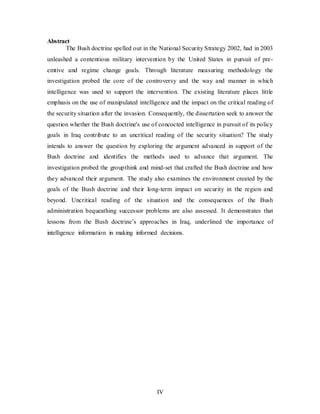
This dissertation examines whether the Bush doctrine's use of manipulated intelligence contributed to an uncritical reading of the security situation in Iraq. It explores how intelligence was used to support the Bush doctrine's policy goals of regime change and preemption rather than inform them. The central argument is that relying on intelligence to justify predetermined policies, rather than let intelligence guide the policy choice, undermined an accurate assessment of post-invasion Iraq and the costs involved. The study aims to establish the role of intelligence in pursuing the Bush doctrine and how its misuse impacted the outcome in Iraq and longer-term security. It analyzes primary sources and secondary literature to make the case that emotions and predetermined goals led to an over-reliance on dubious intelligence

![1
Introduction
The Bush doctrine, which was formulated after the terrorist attacks of September
11, 2001, unleashed a wave of controversy and caused tumult in the world order. The
Bush doctrine is a set of policy goals laid out in the country’s National Security Strategy
of 2002, Chapter V, to enforce regime change and pre-emptive attacks on hostile regimes,
among others.1 This doctrine was a justification or explanation of why it is imperative to
pursue such a direction. This was an ambitious plan with the potential to leave a lifelong
legacy. Leaders often aspire to leave a legacy that describes how they shaped the
strategic vision and values pursued by their country. While some set clear goals from the
beginning, others are usually transformed by challenging circumstances or by a defining
moment. Statesmen are quite often faced with the task of deciding what will best guide
their actions, moral principles or “interest defined in terms of power.”2 The key drivers of
the Bush doctrine attempted to police and shape the world order through a forceful
demonstration of power to attain moral objectives.
The interest of this study is to determine the essential role played by intelligence
information in pursuit of the Bush doctrine’s policy objectives. Examining the response
of the Bush administration to the 9/11 attacks and the declaration of its War on Terror, as
well as the rationale of what was explained in the U.S. National Security Strategy, NSS
2002, could help provide details for the key problem under analysis. According to Erin
Fitzgerald, the chief focus of the Bush administration in its global war on terror was to
view “intelligence agencies as tools to defeat terrorist opponents.”3 The Bush doctrine
was purposely crafted to guide its efforts in “securing the US homeland from terrorist
attacks as well as protecting the US allies and interests abroad,”4 perhaps with Iraq in
mind as a template for its implementation. This implementation of the regime change
1 US The White House, The National Security Strategy of the United States of America,
(17 September 2002) [online] State Department. Available at:
http://www.state.gov/documents/organization/63562.pdf [Accessed 30 Jan. 2016].
2 H. Morgenthau, H. Politics among nations, The Struggle for Power and Peace. 4th ed.
(New York: Alfred A. Knopf 1967) p.5.
3 E. Fitzgerald and J. Feffer, A New Approach to Intelligence? - IPS. [online] Institute for
Policy Studies, (25 June 2009) Available at: http://www.ips-
dc.org/a_new_approach_to_intelligence/ [Accessed 30 Jan. 2016].
4 US The White House, The National Security Strategy of the United States of America,
17 September 2002 [online] State Department. op cit.](https://image.slidesharecdn.com/07253869-9137-4cc8-9ec0-877b6b0df197-160706210348/85/Bush-doctrine-for-submission-1-5-320.jpg)
![2
concept is a laborious operation requiring a massive mobilization of intelligence
resources to provide accurate information and critical analysis, not only about leadership,
but also about the social fabric of society, especially any potential reaction to a foreign-
induced leadership change. Hence, intelligence information is significant in determining
success or failure for any operation of such a magnitude. The British Intelligence Corps’
motto rightly affirms Manui Dat Cognitio Vires, or “Knowledge Gives Strength to the
Arm.”5 This validates the significance of knowledge in operations. The reverse was the
case in the Bush doctrine’s application in Iraq. There was evidence of a gap between the
facts on the ground and intelligence information. Why this gap was not filled or the
mismatch reversed is the question of interest to this dissertation. Controversially,
intelligence was used to support the pursuit of policy goals, not to inform them. That is
the central argument of this dissertation.
This controversy is highlighted by the intelligence concocted to support the
pursuit of the Bush doctrine’s policy goals. Key judgements of National Intelligence
Estimate (NIE) 2002 appear to have influenced the Bush doctrine’s goals;6 however, they
were based on assumptions rather than corroborated intelligence information. Perhaps
this validates the point that when policymakers use intelligence to suit their policy
objectives instead of being guided by intelligence to pursue a policy goal, it usually ends
in an intelligence failure. The Bush doctrine offers a useful outline, due to the fact that it
invoked emotion to argue the justness of its cause and cherry-picked intelligence to
support its case. However, it turned out that some of the intelligence used was shaky. To
what extent did the use of biased intelligence information undermine a critical reading of
the situation in Iraq? This thesis aims to establish the role played by intelligence
information in pursuit of the Bush doctrine’s policy goals.
5 MoD UK, History of The Intelligence Corps. (2010). [online]
Army.mod.uk/intelligence. Available at:
https://www.army.mod.uk/documents/general/history_of_intelligence_corps.pdf
[Accessed 26 Jan. 2016].
6 Fas.org, NIE Key Judgments: Iraq's Continuing Programs for Weapons of Mass
Destruction, (October 2002) [online]. Available at: http://fas.org/irp/cia/product/iraq-
wmd.html [Accessed 24 Feb. 2016].](https://image.slidesharecdn.com/07253869-9137-4cc8-9ec0-877b6b0df197-160706210348/85/Bush-doctrine-for-submission-1-6-320.jpg)
![3
Central Argument
The key argument of this dissertation stresses that the use of intelligence by the
Bush administration in the pursuit of the Bush doctrine’s policy objectives neglected a
critical reading of the security situation. Emotional pressure to respond decisively and
quickly to the 9/11 terrorist attacks seems to have been a driving force, coupled with
being overly reliant on whatever intelligence information seemed to support, rather than
inform, the rational choice of action. Presumably, this helped to undermine any analysis
of the likely scenario emerging after the invasion, impeding the possible application of
appropriate measures or even avoiding the invasion altogether, if the long-term costs
were considered to be much higher than the benefits. Due to emotional appeal and the
impulse of defeating the terrorists and their rogue state sponsors, as stated by Fitzgerald
and Feffer, “intelligence was viewed as a tool to defeat opponents.”7 However, the
manner in which it was deployed became a pivotal factor. The sort of intelligence used in
pursuit of U.S. strategic goals is the main focus of this study. Certainly, any nation that
has been attacked has a right to respond. The problem is not the right of response, but the
approach, manner, and methods of response. Interestingly, the Bush doctrine
fundamentally challenged the notion of cooperation; it propagated unilateralism as an
alternative, “when cooperation is lacking in international affairs,”8 as affirmed in the
2002 National Security Strategy. The problem is compounded when suspicion is based on
fictional or concocted facts, throwing accepted norms into a political and legal dilemma.
The response to 9/11 was not only controversial; it also tried to do two
contradictory things simultaneously: forcefully impose an order and benignly cultivate it.
The key problem was the fictitious intelligence used in pursuit of doctrinal goals. As
things turned out, the process of implementing the Bush doctrine and its aftermath
demonstrated the danger of manipulating intelligence for political purposes or for
premeditated intentions divorced from reality. The expected difficulties were viewed
through a minimalist lens, while the threat was seen through a maximalist lens of
7 E. Fitzgerald, & J. Feffer, A New Approach to Intelligence? - IPS.[online] Institute for
Policy Studies, (25 June 2009) op cit.
8 US The White House, The National Security Strategy of the United States of America,
(17 September 2002) [online] State Department. Available at:
http://www.state.gov/documents/organization/63562.pdf [Accessed 30 Jan. 2016].](https://image.slidesharecdn.com/07253869-9137-4cc8-9ec0-877b6b0df197-160706210348/85/Bush-doctrine-for-submission-1-7-320.jpg)
![4
analysis. Perhaps this is further explained by the overconfident response provided by
then-Vice President Dick Chaney to a question by Tim Russert on NBC’s Meet the Press.
Russert asked Cheney, “Do you think the American people are prepared for a long,
costly, and bloody battle with significant American casualties?”9 Chaney’s response was,
“Well, I don’t think it’s likely to unfold that way, Tim, because I really do believe that we
will be greeted as liberators.”10 What sources of intelligence informed his views to form
such an opinion? This is a typical mirror-image prejudice with incalculable
consequences. This dissertation also will try to identify shortcomings in existing
literature.
ResearchQuestion
This dissertation seeks to answer the following research questions: Has the Bush
doctrine’s use of intelligence in pursuit of its policy goals in Iraq led to failure? To what
extent did fictitious intelligence contribute to fundamental flaws and failures of
intelligence in providing a critical reading of the situation, and how wide was the gap
between action and policy objectives? What sort of success did it achieve, a tactical
victory or a qualitative win? Can the Bush doctrine be used as a template to address
emerging future threats if guided by the right intelligence information?
ResearchAims
The aim of this dissertation is to identify the shortcomings of using intelligence to
suit political objectives rather than to guide a choice of action. It aims to establish how
the Bush doctrine sought to cultivate a world order in which threats to the U.S. homeland
or its allies are reduced or eradicated, but that this doctrine neglected the crucial aspect of
gathering intelligence information. This paper aims to link this neglect to the concoction
of intelligence in pursuit of the Bush doctrine’s goals, which then guided U.S. foreign
policy. It aims to corroborate the impact of regime change in Iraq through inaccurate
9 NBC News Meet the Press, Transcript for Sept. 14, 2003 (Videotape, March 16, 2003)
Guest: Dick Cheney, Vice President and Tim Russert, Moderator. [online] msnbc.com.
Available at: http://www.nbcnews.com/id/3080244/ns/meet_the_press/t/transcript-sept/
[Accessed 30 Jan. 2016].
10 Ibid,](https://image.slidesharecdn.com/07253869-9137-4cc8-9ec0-877b6b0df197-160706210348/85/Bush-doctrine-for-submission-1-8-320.jpg)
![5
intelligence information, and how that has impacted negatively on the current security
situation, and, in retrospect, on the domestic debate within the United States. Another aim
is to evaluate the raison d’être of the Bush doctrine, and to probe how intelligence
information was used to cement the doctrine’s objectives, which were merely grounded
in the end justifying the means, without critically examining the long-term impact on the
security environment. It aims to challenge the assumption that a rogue regime can be
replaced without triggering unnecessary instability, such as the case of Iraq. It aims to
demonstrate the importance of intelligence information in the planning process, when that
information is detached from emotion, and the consequences of failure when such
information is entangled in emotion. It aims to evaluate to what extent the Bush doctrine,
particularly its regime change aspect, has strengthened or weakened the world order; to
assess how debate on the Bush doctrine contributed to domestic discourse in the United
States and worldwide; and to ascertain whether it helped to constrain or enhance U.S.
foreign policy objectives in Iraq and elsewhere. As Gideon Rose observed in Foreign
Affairs, “It was deeply flawed in both conception and execution, because it tried to
muscle history forward, regardless of resistance.”11 In order to construct a compelling
argument, appropriate published primary sources and selected secondary sources have
been consulted extensively.
Dissertation structure
To make a structured argument, this dissertation is organized in five chapters. The
first chapter explores events that gave rise to the Bush doctrine. The second chapter
explores the argument advanced in support of the Bush doctrine and identifies the
methods used to advance that argument. The third chapter explores the use of intelligence
in the invasion of Iraq and its security implications. The fourth chapter examines the
environment created by the goals of the Bush doctrine and their long-term impact on
security in the region and beyond. The fifth chapter concludes by recapping lessons from
11 G. Rose, What Obama Gets Right, Keep Calm and Carry the Liberal Order On.
Foreign Affairs, (Vol. 94, Issue No. 5, September/October 2015) Available at:
https://www.foreignaffairs.com/articles/what-obama-gets-right [Accessed 31 Jan. 2016].](https://image.slidesharecdn.com/07253869-9137-4cc8-9ec0-877b6b0df197-160706210348/85/Bush-doctrine-for-submission-1-9-320.jpg)
![9
war against individual states, or group of states, if they recognize there is a good chance
they will lose.”24 This calls for caution against the illusion of victory, because it could be
a Pyrrhic victory on the ashes of long-term grand strategic interests. The Bush doctrine
succeeded in enforcing regime change in Iraq, but seemingly, it scored only a Pyrrhic
victory. This leads to the conclusion that the Bush doctrine attained or achieved the
opposite of its grand design.
Contradictorily, the Bush doctrine captures two varying schools of thought. First,
it plays with the realist theory advocated by Hans J. Morgenthau: “Realism assumes that
the world is composed of opposing interests and conflict among them is inevitable.”25
The Bush doctrine takes cognizance of the fact that “in an increasingly interconnected
world, regional crisis can strain our alliances, rekindle rivalries among the major powers,
and create horrifying affronts to human dignity.” 26 Consequently, the Bush doctrine
stresses the importance of power and military security by drawing attention to the U.S.
position of unparalleled military strength and great economic and political influence.
Conceivably, the Bush doctrine was seen by its creators as the best vaccine to prevent the
danger of terrorism from spreading worldwide. One assumption from this is that the Bush
doctrine, in an attempt to advance US national interests, used means that contradicted the
objectives of its grand strategy. What could the role of intelligence have been, then?
Lamont Colucci cautions that “intelligence should never be the driver in national security
policy, rather only the vehicle.” 27 The architects of the Bush doctrine were
neoconservative crusaders who were convinced that the mission of U.S. foreign policy is
to spread democracy around the world and regime change in Iraq. In Understanding the
Bush doctrine, Robert Jervis describes the doctrine as “the product of idiosyncratic and
structural factors, both a normal reaction to an abnormal situation and a policy that is
24 S. David, “American Foreign Policy towards the Middle East: A Necessary Change?”
In E. Inbar, Israel’s Strategic Agenda. (London: Routledge,2006), p1.
25 H. Morgenthau, Politics among nations, The Struggle for Power and Peace (4th ed.).
op cit.
26 US, The White House, The National Security Strategy of the United States of America,
(17 September 2002) op cit. p9
27 L. Colucci, Intelligence Is Not a Replacement for National Security Policy. [online] In
Public Safety, (19 August 2015) Available at:
http://inpublicsafety.com/2015/08/intelligence-is-not-a-replacement-for-national-
security-policy/ [Accessed 1 Feb. 2016].](https://image.slidesharecdn.com/07253869-9137-4cc8-9ec0-877b6b0df197-160706210348/85/Bush-doctrine-for-submission-1-13-320.jpg)
![10
likely to bring grief to the world and the United States.”28 This proves a point about the
danger of crossbreeding realism with impractical notions of spreading democracy around
the world, like the biblical version of weeds planted overnight among the wheat.
The Bush doctrine also demonstrated mirror images of Wilsonian idealistic views
of international relations. While liberal ideas made up “core aspects of Wilson’s vision
for world order and for America’s role within it,”29 the Bush vision articulated America’s
primacy in shaping the world order. The Wilsonian worldview contrasts with the
unilateral Bush approach to world affairs. This is perhaps a departure from the Wilsonian
view, which placed faith in international institutions. Instead of using intelligence to
critically evaluate how the situation would unfold, by paying particular attention to the
likely reaction of the population, intelligence gathering was biased in favour of
emphasizing weapons of mass destruction, Saddam Hussein, and Hussein’s inner circle.
The sectarian problem was not taken seriously despite the fact that it was only suppressed
under Saddam’s rule. According to Paul Pillar, “at its own initiative, the intelligence
community considered the principal challenges.” 30 This initiative was not given a
thorough consideration; if it had been, things could have turned out better, or perhaps, at
least, they would have been much better handled. Pillar further noted the efforts of the
intelligence community: “It forecast that in a deeply divided Iraqi society, with Sunnis
resentful over the loss of their dominant position and Shiites seeking power
commensurate with their majority status, there was a significant chance that the groups
would engage in violent conflict unless an occupying power prevented it.”31 Prejudice
among the Kurds, Sunnis and Shiites in Iraq is deeply engrained mentally and could not
have just disappeared with the removal of Saddam, but the Bush doctrine failed to take
note of this. How then could Vice President Dick Cheney believe that U.S. forces would
be welcomed as liberators in Iraq? Should he not have considered the potential sectarian
28 R. Jervis, Understanding the Bush Doctrine. Political Science Quarterly, (Vol.118,
Issue 3, Fall, 2003) p.366.
29 E. Manela, Wilson’s Radical Vision for Global Governance. [online] MIT Center for
International Studies. Audit Of Conventional Wisdom. (2008) Available at:
http://web.mit.edu/cis/pdf/Audit_04_08_Manela.pdf [Accessed 31 Jan. 2016].
30 P.R. Pillar, Intelligence, Policy, and the War in Iraq. Foreign Affairs, March/April
2006 op cit. p18.
31 Ibid,](https://image.slidesharecdn.com/07253869-9137-4cc8-9ec0-877b6b0df197-160706210348/85/Bush-doctrine-for-submission-1-14-320.jpg)
![12
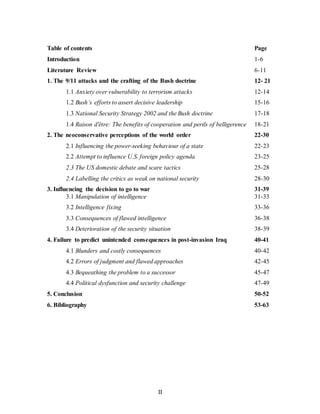
1. The 9/11 attacks and the crafting of the Bush doctrine
1.1 Anxiety over vulnerability to terrorism attacks
An appropriate answer to the question of this dissertation requires a critical
reading of the root causes of the Bush doctrine. The Bush doctrine is a set of policy goals
laid out in the country’s National Security Strategy of 2002, to enforce regime change
and pre-emptive attacks and “turn adversity into opportunity.”32 The crucial task is to
demonstrate the reason it was crafted and the purpose it was expected to advance. While
the Bush doctrine’s roots can be traced to Defence Planning Guidance (DPG), a
document authored by Paul Wolfowitz in 1992,33 it was the events of 9/11 that fertilized
its conception. Whether the mind-set that helped develop the Bush doctrine was
illuminated by historical events, or whether the doctrine was an attempt to wrestle with
history to settle unfinished business is debatable. Evidently, the events of the September
11, 2011, attacks against the United States by Al Qaeda terrorists, specifically against
symbols of U.S. commercial power in New York and military power in Arlington,
Virginia, ushered in a transformation of how power was projected in international
relations. George W. Bush, as president of the country under attack, faced a challenge in
choosing the best course of action. However, plans to attack the United States were
known by U.S. intelligence services. A declassified President’s Daily Brief (PDB) of
August 6, 2001, had a heading that clearly stated the intention of Al Qaeda: “Bin Ladin
(sic) Determined To Strike in US.”34 The PDB marked for the president only narrated
several attempts and intentions of Bin Laden to “follow the example of World Trade
Center bomber Ramzi Yousef and bring the fighting to America.”35 Despite the fact that
several successful and unsuccessful attempts were carried out, the content of the PDB
apparently attracted only negligence.
32 US The White House, The National Security Strategy of the United States of America,
(17 September 2002) [online] State Department. op.cit.p6
33 Burrough, B., Peretz, E., Rose, D. and Wise, D. The Path to War. [online] Vanity
Fair, (May 2004) Available at: http://www.vanityfair.com/news/2004/05/path-to-
war200405 [Accessed 21 Mar. 2016].
34 CIA, President's Daily Brief, "Bin Ladin Determined To Strike in US (6 August 2001)
declassified and approved for release on 10 April 2004[online] nsarchive.gwu.edu.
Available at: http://nsarchive.gwu.edu/NSAEBB/NSAEBB116/pdb8-6-2001.pdf
[Accessed 3 Feb. 2016].
35 Ibid,](https://image.slidesharecdn.com/07253869-9137-4cc8-9ec0-877b6b0df197-160706210348/85/Bush-doctrine-for-submission-1-16-320.jpg)
![13
Although the PDB claimed that it “could not corroborate some of the more
sensational threat reporting,” 36 it somehow noted,
“"nevertheless, FBI information since that time indicates patterns of suspicious activity in
this country consistent with preparations for hijackings or other types of attacks,
including recent surveillance of federal buildings in New York.”37 All of these were
warning signs that failed to attract the urgent attention of the president and his national
security team. After the 9/11 attacks, the Bush administration developed a defensive
attitude, trying to deflect criticism of its initial approach to terrorism. Condoleezza Rice,
who was then National Security Advisor, tried to down play the significance of the PDB
content by saying, “I don't think anybody could have predicted that these people would
take an airplane and slam it into the World Trade Center, take another one and slam it
into the Pentagon; that they would try to use an airplane as a missile.”38 Yet, two years
before the 9/11 attacks, a report titled The Sociology and Psychology of Terrorism: Who
Becomes a Terrorist and Why warned that “Suicide bomber(s) belonging to Al Qaeda's
Martyrdom Battalion could crash-land an aircraft packed with high explosives (C-4 and
semtex) into the Pentagon, the headquarters of the Central Intelligence Agency (CIA), or
the White House.”39 Of course, no one could accurately predict the nature of the threat,
but it is the duty of intelligence to analyse the information and put the pieces together to
allow policymakers to see a larger picture. If the FBI had observed patterns of suspicious
behaviour, they could have investigated and coordinated with other intelligence agencies.
Despite the warning signs, on the clear morning of Tuesday, September 11, 2001,
nineteen al-Qaeda inspired hijackers coordinated attacks using hijacked commercial
aircraft and hit selected symbols of American economic and military power, and they
probably would have hit a political landmark, such as the White House or the Capitol.
Like any other statesman in tribulation, George W. Bush faced his defining moment; he
36 Ibid,
37 Ibid,
38 CBSNews.com, '99 Report Warned Of Suicide Hijacking.(17 May 2002),[online]
Available at: http://www.cbsnews.com/news/99-report-warned-of-suicide-hijacking/
[Accessed 3 Feb. 2016].
39 R. Hudson, & M.L. Majeska, (ed) The Sociology and Psychology of Terrorism: Who
Becomes A Terrorist and Why? Washington, D.C. 20540–4840: Federal Research
Division Library of Congress, (The Library of Congress, September 1999), p7.](https://image.slidesharecdn.com/07253869-9137-4cc8-9ec0-877b6b0df197-160706210348/85/Bush-doctrine-for-submission-1-17-320.jpg)
![14
was transformed by the events. His explanation provides a prism for viewing his
approach. He clarified his change of position: “My vision shifted dramatically after
September 11, because I now realize the stakes, I realize the world has changed.”40 He
dealt with the situation according to his interpretation of the perils. Yet, George W. Bush
tried to advance what he thought was the greater cause of freedom. His perception of his
role as president was “to force decisions, and make sure it is in the minds of everyone
where we are headed.”41 Could this have had an impact on the intelligence services to
turn in the direction of the president’s preference? The evidence seems to suggest that
Bush wanted to direct events according to his desires, not necessarily by facts.
Initially, Bush was blamed for neglecting to focus on Al Qaeda; instead, “the
Bush White House became fixated on Iraq and Saddam Hussein at the expense of
focusing on al-Qaida's [sic] role in the terrorism.”42 Richard Clarke revealed that a day
after the 9/11 attacks, Bush told his aide “to go back over everything, everything, to see if
Saddam Hussein was linked in any way to the attacks.”43 This appears to suggest that
Bush was looking for facts to support his choice of action. Murray Waas of the National
Journal stated that the U.S. intelligence community told George W. Bush, through a PDB
of September 21,2001, that they had no evidence linking Saddam Hussein to the 9/11
attacks.44 The Bush administration wanted a justification for the choice of action it was
contemplating.
40 G. Bush, President Bush Meets with Prime Minister Blair. (31 January 2003) [online]
Georgewbush-whitehouse.archives.gov. Available at: http://georgewbush-
whitehouse.archives.gov/news/releases/2003/01/20030131-23.html [Accessed 5 Feb.
2016].
41 B. Woodward, Bush at war. (New York: Simon & Schuster 2002), p.416, p.144.
42 Seattlepi.com, Iraq link to 9/11 was sought early, Bush queried Clarke day after
attacks, Seattle Post-Intelligencer News Services, 28 March 2004[online] seattlepi.com.
Available at: http://www.seattlepi.com/national/article/Iraq-link-to-9-11-was-sought-
early-1140766.php [Accessed 3 Feb. 2016].
43 Ibid,
44 M. Waas, Key Bush Intelligence Briefing Kept From Hill Panel. National Journal, (22
November 2005) [online] nationaljournal.com. Available at:
http://www.nationaljournal.com/about/njweekly/stories/2005/1122nj 1.html#. [Accessed
3 Feb. 2016].](https://image.slidesharecdn.com/07253869-9137-4cc8-9ec0-877b6b0df197-160706210348/85/Bush-doctrine-for-submission-1-18-320.jpg)
![15
1.2 Bush’s efforts to assert decisive leadership
The evidence suggests that Bush wanted to control events with a display of
strength, not weakness. He saw himself being transformed from a learner into a decisive
leader and wanted to display that disposition at home and abroad. He probably wanted
history to remember him as a decisive leader, too, and this can be confirmed by the title
of a memoir, Decision Points, which he wrote after leaving office. A critical reading of
statements he made on the day of the attacks reveals a demonstration of evangelical
idealistic transformation. Addressing the nation on the evening of 9/11, Bush declared,
“We will make no distinction between the terrorists who committed these acts and those
who harbour them.”45 This vow morphed into a cornerstone of the Bush doctrine. It
appears that he started to view the world through a prism of good and evil: “America was
targeted for attack because we're the brightest beacon for freedom and opportunity in the
world.”46 For George W. Bush, America should “be a Nation that serves goals larger than
self.”47 However, in a State of the Union address to a Joint Session of Congress on
January 29, 2002, George W. Bush divided the world into good and evil and left no
middle ground. On one side, rogue states “and their terrorist allies, constitute an axis of
evil, arming to threaten the peace of the world,”48 and on other were America and its
allies, who were called upon by history “to action to fight freedom’s fight.”49 In the fight
for freedom there was no room for fence-sitting nations; thus, “every nation in every
region now has a decision to make: either you are with us or you are with the terrorists.”50
This type of attitude created a division among America’s traditional allies, particularly
when France and Germany refused to side with America’s quest to invade Iraq. And, it
was despite the commitment made in NSS 2002 to “respect the values, judgment, and
45 G. W. Bush, Decision points. (New York: Crown Publishers 2010), p138
46 Ibid,
47 G. W. Bush, President Delivers State of the Union Address. (29 January 2002) [online]
Georgewbush-whitehouse.archives.gov. Available at: http://georgewbush-
whitehouse.archives.gov/news/releases/2002/01/20020129-11.html [Accessed 4 Feb.
2016].
48 Ibid,
49 Ibid,
50 G.W. Bush, Address to a Joint Session of Congress and the American People. (20
September 2001) [online] Georgewbush-whitehouse.archives.gov. op cit.](https://image.slidesharecdn.com/07253869-9137-4cc8-9ec0-877b6b0df197-160706210348/85/Bush-doctrine-for-submission-1-19-320.jpg)
![16
interests of our friends and partners.”51 France and Germany were simply stressing the
importance of playing by international rules. With respect to this, Henry Kissinger
offered cautionary advice: “Order in this sense must be cultivated; it cannot be
imposed.”52 Consequently, the fundamental flaw in the Bush doctrine, particularly its
regime change aspect, was that it tried to impose order instead of cultivating it.
If the leading countries decide to flout the rules they aspire to advance, whenever
it suits them, how are they supposed to compel other countries to respect those rules? An
assumption can be made that a transformed George W. Bush was held firmly to a
particular belief informed by a tunnel view of the world, which perhaps helps to explain
why the intelligence that did not come through that tunnel view was neglected. This also
appears to validate a prediction by Alexis de Tocqueville that, “When an idea, whether
just or unreasonable, takes possession of the American mind, nothing is more difficult
than to get rid of it.”53 The leadership of George W. Bush and a quest for transformation
in global politics confirmed De Tocqueville’s statement. According to George W. Bush,
“as long as whole regions of the world simmer in resentment and tyranny—prone to
ideologies that feed hatred and excuse murder—violence will gather, and multiply in
destructive power, and cross the most defended borders, and raise a mortal threat.”54
Seemingly, the attitude of the Bush administration exhibited after the 9/11 attacks
fertilized the minds that crafted NSS 2002, which clarified the main tenets of the Bush
doctrine. It stands to reason, then, that the 9/11 attacks were the ground in which the
seeds of the Bush doctrine germinated.
51 US, The White House, The National Security Strategy of the United States of America,
(17 September 2002), op cit, p31.
52 H. Kissinger, World order, Reflecting on the Character of Nations and the Course of
History. (New York & London: Penguin Press 2014), p.8.
53 A.Tocqueville, Democracy in America. Trans. Gerald E. Bevan with an introduction by
Isaac Kramnick. (London: Penguin 2003), p.212.
54 G.W. Bush, President Sworn-In to Second Term, Inauguration, (20 January 2005)
[online] Georgewbush-whitehouse.archives.gov. Available at: http://georgewbush-
whitehouse.archives.gov/news/releases/2005/01/20050120-1.html [Accessed 5 Feb.
2016].](https://image.slidesharecdn.com/07253869-9137-4cc8-9ec0-877b6b0df197-160706210348/85/Bush-doctrine-for-submission-1-20-320.jpg)
![17
1.3 National Security Strategy 2002 and the Bush doctrine
Charles Krauthammer is credited as being the first to publicly use the phrase
“Bush doctrine,” in a June 4, 2001, article in The Weekly Standard titled “The Bush
Doctrine ABM, Kyoto, and the New American Unilateralism.” 55 Suffice it to say; the
U.S. National Security Strategy (NSS) issued on September 17, 2002, was the anchor of
the Bush doctrine. Like all other NSS documents, the Bush doctrine underlined key
security concerns for the administration, explained to Congress how it intended to
respond to the challenging circumstances, and calculated long-term security goals.
Having a clear explanation and guidelines puts the nation in a better position to lead in
most of the challenges identified. Condoleezza Rice suggested that the “National Security
Strategy offers a bold vision for protecting our nation that captures today’s new realities
and new opportunities.” 56 Jeremi Suri and James Goldgeier believed that the NSS
“creates space for leaders to articulate priorities, and match diverse capabilities to
overarching goals.”57 It is a channel through which the executive branch explains and
justifies to the U.S. Congress the direction and course of action to be taken to advance
vital national security interests.
Coherently, through the NSS, the administration organizes the mobilization of
adequate resources, while setting corresponding goals, and coordinates interagency
efforts, directing them towards a common foreign policy goal. Undoubtedly, the
framework of NSS 2002 had the same intention, but it marked a point of departure from
the past. In the words of John Lewis Gaddis, “The Bush strategy is an historic shift for
American foreign policy because it really is the first serious American grand strategy
since containment in the early days of the Cold War.”58 For Gaddis, the shock of Pearl
55 C. Krauthammer, The Bush Doctrine ABM, Kyoto, and the New American
Unilateralism. The Weekly Standard, (Vol.6, Issue No.36, 4 June 2001), p.5.
56 C. Rice, 2002 Wriston Lecture: A Balance of Power That Favors Freedom | Manhattan
Institute. (1 October 2002) [online] Manhattan Institute. Available at:
http://www.manhattan-institute.org/html/2002-wriston-lecture-balance-power-favors-
freedom-5566.html [Accessed 5 Feb. 2016].
57 J. Suri and J. Goldgeier,Why We Need a New National Security Strategy | Jeremi
Suri.18 January 2016 [online] Jeremisuri.net. Available at:
http://jeremisuri.net/archives/1394 [Accessed 4 Feb. 2016].
58 J. Gaddis, Interviews - John Lewis Gaddis | The War Behind Closed Doors |
FRONTLINE | PBS. [online] Pbs.org.16 January 2003. Available at:](https://image.slidesharecdn.com/07253869-9137-4cc8-9ec0-877b6b0df197-160706210348/85/Bush-doctrine-for-submission-1-21-320.jpg)
![18
Harbor forced the United States to devise the Truman doctrine, and the shock of 9/11
forced the US to devise the Bush doctrine. 59 However, NSS 2002 forcefully argued,
“deterrence is less likely to work against leaders of rogue states more willing to take
risks, gambling with the lives of their people, and the wealth of their nations.”60 This
highlights a significant departure from the doctrine that guided U.S. security policy
throughout the Cold War period. Justifiably, that Cold War had ended and the United
States needed a new set of policy guideline. The fundamental question was whether some
of the guidelines embedded in the Bush doctrine were appropriate or whether they
misguided national security. Like the mother of Achilles, who omitted to dip his heel in
water for adequate protection, the authors of the Bush doctrine implemented
predetermined motives eluding reality, which in the end proved to be the doctrine’s
greatest Achilles heel. An exploration of the precepts of the Bush doctrine will help shed
more light on its raison d’être.
1.4 Raison d'être: The benefits of cooperation and perils of belligerence
The rationale of the Bush doctrine comes from a belief in American
exceptionalism and determination to influence change in the world, especially in
countries ruled by tyrannies. Thus, it affirms, “The great strength of this nation must be
used to promote a balance of power that favours freedom.”61 The central objective of the
Bush doctrine “is to help make the world not just safer but better.”62 The conviction of
making the world better, is derived from the lessons of the 9/11 tragedy and the assurance
by George W. Bush that “as long as the United States of America is determined and
strong, this will not be an age of terror. This will be an age of liberty here and across the
world.” 63 However, a critical reading of the NSS 2002 reveals a consummate
http://www.pbs.org/wgbh/pages/frontline/shows/iraq/interviews/gaddis.html [Accessed 5
Feb. 2016].
59 Ibid,
60 US, The White House, The National Security Strategy of the United States of America,
(17 September 2002), op cit. p.15.
61 Ibid, p1.
62 Ibid,
63 G.W. Bush, Address to a Joint Session of Congress and the American People. (20
September 2001) op cit.](https://image.slidesharecdn.com/07253869-9137-4cc8-9ec0-877b6b0df197-160706210348/85/Bush-doctrine-for-submission-1-22-320.jpg)
![20
was “to make freedom and the development of democratic institutions key themes in our
bilateral relations.”69 This view is anchored in the belief that rogue states “brutalize their
own people and squander their national resources for the personal gain of the rulers.”70
Tyrants were seen as posing a clear and present danger to world peace and security by
breeding turmoil through discontent worldwide. The best remedy to stop the breeding of
global unrest is to remove the regimes that brutalize their own people. Iraq had been long
identified as a template to test the concept of regime change. George W. Bush’s choice of
words gave an early impression that war on Iraq was imminent. Addressing a joint
session of Congress on September 20, 2001, Bush made it clear that “our war on terror
begins with al-Qaida, but it does not end there.”71 This statement was made nine days
after the 9/11 attacks and appeared to be a coded warning, putting Afghanistan and Iraq
on notice.
While the Bush doctrine promised that it would be “establishing a new framework
for intelligence warning that provides seamless and integrated warning across the
spectrum of threats,”72 the evidence points to the contrary. Intelligence was selectively
used to support and justify a predetermined choice of action. As mentioned earlier,
despite being told that Al Qaeda was responsible for the 9/11 attacks, Bush still wanted
intelligence to provide evidence that linked Iraq to the attacks. Shaky intelligence has a
tendency to result in a house–of-cards effect. The Bush doctrine was compromised by
idealistic commitments that seemed to have been out of touch with reality, particularly
pre-emptive war and intervention to impose democratic regime. The United States has
always pursued carrot-and-stick diplomacy, but in most cases it has been balanced with
realistic goals of securing and promoting vital national interests. Each country has its own
beliefs, and if the Bush doctrine was undertaking to respect the opinions of others, how
could it succeed in imposing its own views without being accused of trying to exert
hegemonic power? This is reflective of what Morgenthau had alluded to, that “the goals
69 US, The White House, The National Security Strategy of the United States of America,
(17 September 2002) op cit. p 4
70 Ibid,14.
71 G.W. Bush, Address to a Joint Session of Congress and the American People. (20
September 2001) [online] Georgewbush-whitehouse.archives.gov. op.cit.
72 US, The White House, The National Security Strategy of the United States of America,
(17 September 2002) op cit. p.30.](https://image.slidesharecdn.com/07253869-9137-4cc8-9ec0-877b6b0df197-160706210348/85/Bush-doctrine-for-submission-1-24-320.jpg)
![22
2. The neoconservative perceptions of the world order
2.1 Influencing the power-seeking behaviour of a state
There is a view that the Bush doctrine was an improvement on a document written
in 1992 under the leadership of Paul Wolfowitz, then Undersecretary of Defence for
policy planning. The document contained proposals for a new post-Cold War strategy, or
Defence Planning Guidance. Not surprisingly, Paul Wolfowitz became the Deputy
Secretary of Defence during the first four years of the Bush administration, while his
boss, then Defence Secretary Dickey Cheney, became U.S. Vice President. Both are said
to have influenced the compilation of the 1992 document that was later discarded. These
were the last years of the presidency of George Herbert Walker Bush, father of George
W. Bush. William J Clinton, who succeeded George H.W. Bush as president, was blamed
by the neoconservatives for “seeking a new world harmony by constraining this
overwhelming American power within a web of international obligations -- rather than
maintaining, augmenting, and exploiting the American predominance.”74 Most of the
former senior officials from the George H.W. Bush administration found refuge in the
neoconservative platform, such as in the Project for the New American Century (PNAC).
Ideas expressed through the discarded 1992 DPG were reformulated in September
2000 to become “Rebuilding America’s Defences Strategy, Forces and Resources for a
New Century.” 75 There is traceable evidence that these views, which formed the
cornerstone of neo-conservative ideology, were well integrated into the Bush doctrine.
This invites a further question: What role did the neo-conservatives play in influencing
the Bush doctrine? The striking similarities between the PNAC and the Bush doctrine are
unambiguously clear. For Joseph Nye, the neoconservatives responsible for crafting the
Bush doctrine “do not want to be held back by institutional constraints and see our
legitimacy coming from our focus on democracy.”76 It is fair to assume that any group in
one country has the right to influence foreign policy in a way it deems appropriate;
74 C. Krauthammer, The Bush Doctrine ABM, Kyoto, and the New American
Unilateralism. The Weekly Standard, 4 June 2001, op cit. p1
75 PNAC, Rebuilding America's Defenses: Strategy, Forces and Resources For a New
Century, September 2000 [online] Cryptome.org. Available at:
http://cryptome.org/rad.htm [Accessed 8 Feb. 2016].
76 J. S. Nye, Soft Power: The Means to Success in World Politics. (New York: Public
Affairs, 2004) pp.175, p.141.](https://image.slidesharecdn.com/07253869-9137-4cc8-9ec0-877b6b0df197-160706210348/85/Bush-doctrine-for-submission-1-26-320.jpg)
![23
however, that influence must not expose to peril the nation’s long-term strategic interests.
Former senior officials of the George H. W. Bush administration also were motivated by
a sense of revenge for the electoral defeat of their former boss and were equally preparing
for a Republican to reclaim the White House from Clinton. Here the argument to make is
that the neoconservatives were the catalyst for the Bush doctrine. Assuming the Bush
doctrine was a Trojan horse, the neoconservatives were the soldiers hiding inside. Of
particular interest were the professed aspirations of the PNAC for American
exceptionalism and the means by which they sought to achieve that goal. Francis
Fukuyama, an ex-neoconservative noted that “the problem with neoconservatism’s
agenda lies not in its ends, which are as American as apple pie, but rather in the
overmilitarized means by which it has sought to accomplish them.”77 Now we are hearing
the same thing going into the 2016 U.S. primaries, from Donald Trump: “We’re going to
make the military bigger and better and stronger than ever before, and nobody — nobody
— nobody — is going to mess with us, folks. Nobody.”78 The PNAC has made several
attempts to influence US foreign policy.
2.2 Attempt to influence U.S. foreign policy agenda
In 1998, a number of PNAC members wrote a letter to Clinton, attempting to
influence him to use his State of the Union address “to chart a clear and determined
course to implementing a strategy for removing Saddam's regime from power.”79 The
letter was signed by Elliott Abrams; Richard L. Armitage; William J. Bennett; Jeffrey
Bergner; John Bolton; Paula Dobriansky; Francis Fukuyama; Robert Kagan; Zalmay
77 F. Fukuyama, After Neoconservatism, New York Times, 19 February 2006 [online]
Nytimes.com. Available at:
http://www.nytimes.com/2006/02/19/magazine/neo.html?pagewanted=all [Accessed 7
Feb. 2016].
78 J. Traub, Do Americans Really Want a Wall? 4 March 2016 [online] Foreign Policy.
Available at: http://foreignpolicy.com/2016/03/04/do-americans-really-want-a-wall-
trump-sanders-clinton-election-
isolationism/?utm_content=buffer34c2d&utm_medium=social&utm_source=facebook.co
m&utm_campaign=buffer [Accessed 6 Mar. 2016].
79 PNAC, Letter to President Clinton on Iraq, 26 January 1998 [online]
zfacts.com/metaPage. Available at: http://zfacts.com/metaPage/lib/98-Rumsfeld-Iraq.pdf
[Accessed 8 Feb. 2016].](https://image.slidesharecdn.com/07253869-9137-4cc8-9ec0-877b6b0df197-160706210348/85/Bush-doctrine-for-submission-1-27-320.jpg)
![25
inevitable.”85 In addition, he noted, “Bush wanted to remove Saddam, through military
action, justified by the conjunction of terrorism and WMD. But the intelligence and facts
were being fixed around the policy.”86 The neoconservative agenda, which was inserted
into the Bush doctrine, became the template for U.S. foreign policy; supposedly,
intelligence was expected follow the framework of the neoconservative view of how the
United States should operate in the world.
One of the neoconservatives, Charles Krauthammer, had argued, “at the dawn of
the 21st century, the task of the new administration is to develop a military and foreign
policy appropriate to our position of overwhelming dominance.” 87 Evidently, the
neoconservatives succeeded in inserting their views, which became the bedrock of the
Bush doctrine. There were equally noticeable sound bites on statements made by George
W. Bush during his presidency. Ostensibly, the Bush doctrine was nothing, but the
neoconservative plan to remove Saddam Hussein from power and 9/11 attacks presented
an opportunity to implement it. The Bush doctrine exhibited a paradox of legitimacy:
while it argued about the benevolence of its purpose, it tried to forcefully impose its
view. The issue regarding legitimacy is not acceptance through fear, but trust and
confidence. Although the Bush doctrine had managed to remove Saddam from power, the
democratization it sought is still a mirage. Thus, it won only a Pyrrhic victory, over the
ruins of legitimacy.
2.3 The US domestic debate and scare tactics
The 9/11 attacks have left deep scars in the United States, as well as a sense of
vulnerability to future coordinated terrorist attacks. A number of the silent majority of
Americans probably avoided the debate for fear of being considered terrorist apologists,
but as casualties began being felt among U.S. troops, some started to question the Bush
doctrine’s approach. Even in Congress, there was a handful that dared to question the
rationale of the Bush doctrine. The neoconservatives and other Bush administration
85 M. Rycroft, The Secret Downing Street Memo, 23 July 2002 [online] Available at:
http://nsarchive.gwu.edu/NSAEBB/NSAEBB328/II-Doc14.pdf [Accessed 23 Feb. 2016].
86 Ibid,
87 C. Krauthammer, C. The Bush Doctrine ABM, Kyoto, and the New American
Unilateralism. The Weekly Standard 4 June 2001, op cit.p2](https://image.slidesharecdn.com/07253869-9137-4cc8-9ec0-877b6b0df197-160706210348/85/Bush-doctrine-for-submission-1-29-320.jpg)
![26
supporters framed the argument in the context of security, and anyone against their side
of the argument was perceived as helping the enemy, those who wished to harm the
United States. The neoconservatives perceived their role, in the words of Andrew
Bacevich, as one that should “fuse American power to American principles, ensuring the
survival of those principles and subsequently their propagation to the benefit of all
humankind." 88 A number of realists rejected the premises of the Bush doctrine as
unrealistic. As noted by Mackubin T. Owens, “the most important critiques of the Bush
Doctrine also come from the political right: realists, including Henry Kissinger, Owen
Harries, Robert Ellsworth, Dimitri Simes, John Mearsheimer, and Stephen Walt; and
those whom Rosen calls ‘traditionalists,’ e.g. Patrick Buchanan, George Will, Andy
Bacevich, and James Kurth.”89 This is by no means to suggest that realists were less
concerned about the safety of the United States. However, they viewed the Bush doctrine
as counterproductive to U.S. national interests.
Obviously, Hans Morgenthau could have cautioned “realism refuses to identify
the moral aspirations of a particular nation with the moral laws that govern the
universe.”90 John Mearsheimer took it further, stating that,
realists do not believe that we live in a bandwagoning world. On the
contrary, realists tend to believe that we live in a balancing world, in
which, when one state puts its fist in another state’s face, the target usually
does not throw its hands in the air and surrender. Instead, it looks for ways
to defend itself; it balances against the threatening state.”91
As Mackubin T. Owens observed, “Realists stress the importance of power and military
security in international affairs and are most concerned about maintaining stability and a
88 A. Bacevich, The New American Militarism: How Americans are seduced by War.
(New York: Oxford University Press 2005), p71.
89 M. Owens, America’s Role in the World: Republican Empire and the Bush Doctrine |
Ashbrook. April 2006 [online] Ashbrook.org. Available at:
http://ashbrook.org/publications/oped-owens-06-americasrole/ [Accessed 21 Feb. 2016].
90 H. Morgenthau, Politics among nations, The Struggle for Power and Peace (4th ed.) op
cit. p.10.
91 J. Mearsheimer, Hans Morgenthau and the Iraq war: realism versus neo-conservatism,
18 May 2005 [online] OpenDemocracy. Available at:
https://www.opendemocracy.net/democracy-americanpower/morgenthau_2522.jsp
[Accessed 8 Feb. 2016].](https://image.slidesharecdn.com/07253869-9137-4cc8-9ec0-877b6b0df197-160706210348/85/Bush-doctrine-for-submission-1-30-320.jpg)
![27
peaceful balance of power.” 92 At an Air Force Academy graduation ceremony in
Colorado Springs, Bush dismissed the realists’ assumption: “The realists in this case have
lost contact with a fundamental reality. American has always been less secure when
freedom is in retreat and more secure when freedom is on the march.”93 The argument is
not whether freedom must retreat or be on a march; it is about the best approach for
ensuring freedom.
Journalist Eric Margolis was one of the critics of the Bush doctrine. He argued,
“The Bush administration is clearly obsessed with Iraq, but it has no clear plan on what to
do with this Mideast version of ex-Yugoslavia once America’s military might overthrows
Saddam Hussein's regime.”94 At its core, this argument points to a lack of prior planning
and claims an obsession with Iraq. In a cautionary prophecy, Margolis warned, “A war
that fails to achieve clear political objectives is merely an exercise in violence and
futility.”95 Clearly, the Bush administration wanted congressional authority before taking
the case to the UN. Therefore, “President George W. Bush asked Congress in mid-
September 2002 to pass a resolution granting the U.S. broad authority to use military
action against Iraq.”96 Obviously, before the vote, some members of Congress demanded
evidence to guide their choices on how to vote for the resolution authorizing the president
to go to war with Iraq. There were lawmakers who probably voted informed by political
calculations, including senators Hillary Clinton (D-NY), Barack Obama (D-IL), and John
McCain (R-AZ), all of whom later sought the presidential nomination of their respective
parties. Obama was able to beat Clinton for the Democratic Party nomination and
eventually defeated McCain to be elected U.S. President. Obama voted against the
92 M. Owens, America’s Role in the World: Republican Empire and the Bush Doctrine |
Ashbrook. April 2006 [online] Ashbrook.org. op.cit.
93 G.W. Bush, Commencement Address at the United States Air Force Academy in
Colorado Springs, Colorado,” June 2, 2004, CNN.com - Transcripts. [online] Available
at: http://transcripts.cnn.com/TRANSCRIPTS/0406/02/se.02.html [Accessed 21 Feb.
2016].
94 E. Margolis, Iraq Invasion: The Road to Folly. [online] The American Conservative 7
October 2002, Available at: http://www.theamericanconservative.com/articles/iraq-
invasion-the-road-to-folly/ [Accessed 21 Feb. 2016].
95 Ibid
96 G. Bruno and S. Otterman, National Intelligence Estimates. [online] Council on
Foreign Relations 14 May 2008. Available at: http://www.cfr.org/iraq/national-
intelligence-estimates/p7758#p5 [Accessed 22 Feb. 2016].](https://image.slidesharecdn.com/07253869-9137-4cc8-9ec0-877b6b0df197-160706210348/85/Bush-doctrine-for-submission-1-31-320.jpg)
![28
resolution while Clinton voted in favour, a decision that is still haunting her today, even
as part of the 2016 presidential race. Explaining why he was opposed to war, then-
Senator Obama, now U.S. president, stated, “What I am opposed to is the cynical attempt
by Richard Perle and Paul Wolfowitz and other armchair, weekend warriors in this
administration to shove their own ideological agendas down our throats, irrespective of
the costs in lives lost and in hardships borne.”97 In a prophetic prediction that today
depicts the current situation in Iraq, Obama said: “I know that even a successful war
against Iraq will require a U.S. occupation of undetermined length, at undetermined cost,
with undetermined consequences.”98 Those who opposed the Iraq war were considered
unpatriotic. This explains the attitudes of “either you are with us or with our enemy.”
2.4 Labelling the critics as weak on national security
The debate on the Bush doctrine has raised a plethora of questions about necessity
and validity. Democratic presidential candidate John Kerry, “in response to a question
about his vote against an $87 billion supplemental appropriation for military operations in
Iraq and Afghanistan,”99 gave a response that led to Bush’s campaign team branding him
as a flip-flopper. Responding to the question, Kerry said, “I actually did vote for the $87
billion before I voted against it.”100 The Republican Party wasted no time in turning the
theme of the 2004 campaign into a battle between strength and weakness in advancing
national security. They used typical political scarecrows to frighten the public about the
danger faced by the United States. During the 2004 presidential election, the Bush
campaign used an advertisement featuring wolves that asserted, “In an increasingly
dangerous world, even after the first terrorist attack on America, John Kerry and the
97 B. Obama, Transcript: Obama's Speech Against The Iraq War, 2 October 2002 [online]
NPR.org. Available at: http://www.npr.org/templates/story/story.php?storyId=99591469
[Accessed 23 Feb. 2016].
98 Ibid
99 CNN.com - Kerry discusses $87 billion comment - Sep 30, 2004. [online] Available at:
http://www.cnn.com/2004/ALLPOLITICS/09/30/kerry.comment/ [Accessed 21 Feb.
2016].
100 J. Kerry, In CNN Kerry discusses $87 billion comment, Sep 30, 2004 [online]
CNN.com. Available at:
http://www.cnn.com/2004/ALLPOLITICS/09/30/kerry.comment/ [Accessed 21 Feb.
2016]. [Accessed 21 Feb. 2016].](https://image.slidesharecdn.com/07253869-9137-4cc8-9ec0-877b6b0df197-160706210348/85/Bush-doctrine-for-submission-1-32-320.jpg)
![29
liberals in Congress voted to slash America’s intelligence operations by $6 billion.”101 It
continued to argue that those were “cuts so deep they would have weakened America’s
defenses. And weakness attracts those who are waiting to do America harm.”102 The
campaign advertisement reflected the views of Bush and his supporters, especially the
neoconservatives who perceived their role as the sole legitimate guardians of U.S.
national security. One of the scarecrows the Bush administration has used successfully is
Condoleezza Rice’s argument that “We don’t want the smoking gun to be a mushroom
cloud.”103 Wolf Blitzer asked Condoleezza Rice, “Is Iraq’s regime of President Saddam
Hussein right now a clear and present danger to the United States?”104 The response from
Rice was unmistakably clear: “It is a danger that is gathering momentum, and it simply
makes no sense to wait any longer to do something about the threat that is posed here.”105
It was a perfect scarecrow strategy, meant to disarm the war opponents ahead of any
argument.
Senator Edward M. Kennedy (D-Mass.) was one of those who argued, “the
administration has not made a convincing case that we face such an imminent threat to
our national security that a unilateral, pre-emptive American strike and an immediate war
are necessary.”106 A shadow of a doubt about the Bush approach to war, especially in
Iraq, gradually began to emerge. Towards the end of September 2002, “the debate on
whether to attack Iraq was heating up amid a flurry of activity in Congress and pointed
criticism of the White House from respected military men and top Democrats, including
101 H. Kurtz, In Ad Battle, GOP Unleashes Wolves, Democrats Use Ostrich, 23 October
2004 [online] www.washingtonpost.com. Available at:
http://www.washingtonpost.com/wp-dyn/articles/A55518-2004Oct22.html [Accessed 21
Feb. 2016]. [Accessed 21 Feb. 2016].
102 Ibid,
103 CNN.com - Transcripts. Interview With Condoleezza Rice; Pataki Talks About 9-11;
Graham, Shelby Discuss War on Terrorism Aired September 8, 2002 - 12:00 ET
[online] Available at: http://www.cnn.com/TRANSCRIPTS/0209/08/le.00.html
[Accessed 23 Feb. 2016].
104 Ibid,
105 Ibid,
106 R. Simon, and E. Schrader, Give Inspectors Time to Act, Kennedy Urges. [online] Los
Angeles Times 28 September 2002 Available at:
http://articles.latimes.com/2002/sep/28/nation/na-usiraq28 [Accessed 21 Feb. 2016].](https://image.slidesharecdn.com/07253869-9137-4cc8-9ec0-877b6b0df197-160706210348/85/Bush-doctrine-for-submission-1-33-320.jpg)
![30
former Vice President Al Gore.”107 The Bush administrative was mindful that “public
opinion polls in the fall of 2002 showed a majority of Americans would support a US
invasion of Iraq only if it posed a serious threat to the national security of the United
States,”108 and began to cultivate narratives that appeared to indicate the existence of a
threat to national security. Certainly this was not just a resolution authorizing the
President to send soldiers into battle. All congress members ought to know very well the
consequences of a war: some soldiers might return home in caskets. Behind every soldier
killed in action, there is always a grieving family to bear a lifelong burden of loss.
107 J. Donovan, Iraq: U.S. Debate Focuses On How, Not Whether, To Wage War. [online]
RadioFreeEurope/RadioLiberty, 25 September 2002, Available at:
http://www.rferl.org/content/article/1100891.html [Accessed 21 Feb. 2016].
108 S. Zunes and J. Feffer, Feinstein: Bad Choice for Intelligence - FPIF. [online] Foreign
Policy In Focus 23 December 2008 Available at:
http://fpif.org/feinstein_bad_choice_for_intelligence/ [Accessed 21 Feb. 2016].](https://image.slidesharecdn.com/07253869-9137-4cc8-9ec0-877b6b0df197-160706210348/85/Bush-doctrine-for-submission-1-34-320.jpg)
![31
3. Influencing the decision to go to war
3.1 Manipulation of intelligence
As highlighted by a number of scholars, intelligence information plays a pivotal
role in any operation. How then was intelligence used in pursuing the objectives of the
Bush doctrine? The answer to this question must validate the claim of a cognitive bias
approach to intelligence in the pursuit of the Bush doctrine’s objectives, particularly with
regard to the invasion of Iraq. Further questions in this section include: How did fictional
intelligence contributed to a fundamental flaw and ultimately to the failure of intelligence
in reading the situation critically? How wide was the gap between action and policy
objectives? The answer to these questions will be found when surveying several factors
that militated at that time. Observing the use of intelligence by the Bush doctrine through
the prism of intelligence failure synthesized by Richard Betts produces a clear picture.
Betts elucidated with practical clarification, stressing the theoretical approaches and
reasons why intelligence failures are inevitable. Betts observed that quite often when
“confronted by differing analyses, a leader mortgaged to his policy tends to resent or
dismiss the critical ones, even when they represent the majority view of the intelligence
community, and to cling to the data that support continued commitment.”109 The flaws
identified by Betts as causes of intelligence failure were obvious during the invasion of
Iraq. As it turned out, “much of the key intelligence that was used to justify the war was
based on fabrication, wishful thinking and lies — and as subsequent investigations
showed, it was dramatically wrong.”110 Overwhelming evidence seems to validate the
claim of a predetermined plan to remove Saddam Hussein from power and the 1998 letter
by a group of neo-conservatives confirms that plan.
It is also puzzling beyond imagination how accounts of Rafid Ahmed Alwan al-
Janabi, known as Curveball, came to be relied on as credible intelligence information.
Under the leadership of Ahmed Chalabi, the Iraqi National Congress fed whatever
information they concocted to the Americans. August Hanning, former director of
109 R. Betts, Analysis, War, and Decision: Why Intelligence Failures are Inevitable’,
World Politics, Vol. 31 No1, October 1978. p.64.
110 P. Taylor, Iraq war: the greatest intelligence failure in living memory. [online]
Telegraph.co.uk.18, March 2013. Available at:
http://www.telegraph.co.uk/news/worldnews/middleeast/iraq/9937516/Iraq-war-the-
greatest-intelligence-failure-in-living-memory.html [Accessed 8 Feb. 2016].](https://image.slidesharecdn.com/07253869-9137-4cc8-9ec0-877b6b0df197-160706210348/85/Bush-doctrine-for-submission-1-35-320.jpg)
![32
Germany’s foreign intelligence service, the Bundesnachrichtendienst (BND), “explained
that the administration of U.S. President George W. Bush was especially interested in
intelligence collected by the BND from an Iraqi defector codenamed ‘Curveball.’”111
Curveball fabricated intelligence information and claims that “Saddam Hussein had built
a fleet of biological weapons labs on wheels, in order to avoid detection from America
and other countries.”112 This information was then cherry-picked, not because of its
accuracy, but because it was an attractive justification for war that Saddam Hussein was
producing WMD and was busy concealing them. If the Germans who had questioned
Curveball expressed doubts about the accuracy of his information, why did the Bush
administration choose to rely on such dubious intelligence information? Richard Betts
cautioned again the politicization of intelligence and other cognitive biases that can
compromise intelligence information. What happened in pre-war Iraq was a desperate
attempt to politicize intelligence to justify a pre-determined goal. Sun Tzu offers useful
tips that still resonate well today: “When you know yourself and others, victory is not in
danger; when you know sky and earth, victory is inexhaustible.” 113 Utilization of
intelligence information is the best tool for attaining the victory to which Sun Tzu
alludes. The Bush administration used intelligence in a manner that supported its case for
removing Saddam Hussein.
The Bush administration spent 2002 building a case against Iraq both at home and
abroad. At home, it sought congressional approval to try to legitimize its planned action
of going to war in Iraq. In order to convince a hesitant world, the Bush administration
first had to demonstrate that it had solid support at home. Yet, “before the President's
campaign to convince Congress of the necessity of war with Iraq, the White House asked
the CIA to prepare a National Intelligence Estimate (NIE) on Iraq.”114 The request for
111 J. Fitsanakis, US misused our intel to justify Iraq War, says German ex-spy chief.
[online] intelNews.org. 29 August 2011. Available at:
http://intelnews.org/2011/08/29/01-805/ [Accessed 8 Feb. 2016].
112 Ibid,
113 Sun Tzu, The Art of War; Translated by Thomas Cleary; 1988, op cit. p.23.
114 J. Pfiffner, Did President Bush Mislead the Country in His Arguments for War with
Iraq? Presidential Studies Quarterly, (Vol. 34 No. 1, March 2004), p30](https://image.slidesharecdn.com/07253869-9137-4cc8-9ec0-877b6b0df197-160706210348/85/Bush-doctrine-for-submission-1-36-320.jpg)
![33
NIE was done on short notice and “was produced in just a few weeks because Congress
was nearing a vote on going to war with Iraq.”115 As David Kay noted,
it was a poor job, probably the worst of the modern NIE’s, partly
explained by the pressure, but more importantly explained by the lack of
information they had. And it was trying to drive towards a policy
conclusion where the information just simply didn’t support it.116
Vice President Dickey Cheney told the Veterans of Foreign Wars, “There is no doubt that
Saddam Hussein now has weapons of mass destruction. There is no doubt he is amassing
them to use against our friends, against our allies, and against us.”117 Intelligence was
therefore expected to confirm this assertion that Saddam Hussein was a threat to be
eliminated without any further delay.
3.2 Intelligence fixing
It should be taken into account that some U.S. lawmakers carried out their
responsibilities without necessarily endorsing the president’s increasing appetite for
waging war on Iraq. According to Senator Bob Graham (D-FL), at “a meeting of the
Senate Intelligence Committee on Sept. 5, 2002, CIA Director George Tenet was asked
what the NIE provided as the rationale for a preemptive war in Iraq?”118 Senator Graham
said he “was stunned when Tenet said that no NIE had been requested by the White
115 Pbs.org. Analysis - The October '02 National Intelligence Estimate | The Dark Side |
FRONTLINE | PBS. Retrieved 9 February 2016, from
http://www.pbs.org/wgbh/pages/frontline/darkside/themes/nie.html
116 Ibid,
117 D. Cheney, Vice President Speaks at Veterans of Foreign Wars 103rd National
Convention.26 August 2002 [online] Georgewbush-whitehouse.archives.gov. Available
at: http://georgewbush-whitehouse.archives.gov/news/releases/2002/08/20020826.html
[Accessed 9 Feb. 2016].
118 B. Graham, Bob Graham - What I Knew Before the Invasion. The Washington Post 20
November 2005 [online] Washingtonpost.com. Available at:
http://www.washingtonpost.com/wp-
dyn/content/article/2005/11/18/AR2005111802397.html [Accessed 22 Feb. 2016].](https://image.slidesharecdn.com/07253869-9137-4cc8-9ec0-877b6b0df197-160706210348/85/Bush-doctrine-for-submission-1-37-320.jpg)
![34
House and none had been prepared.”119 At that time, SSCI members noted, “the IC had
not produced on comprehensive, coordinated IC assessment of Iraq’s WMD programs
since the production of December 2000 Intelligence Community (IC) Assessment, Iraq:
Steadily Pursuing WMD Capabilities.”120 In the absence of an NIE assessment, what was
the source of intelligence initially used by the Bush administration to plead its case for
war in Iraq? Presumably, the main sources of intelligence were Ahmed Chalabi’s INC
and Curveball. David Kay substantiated this, saying the intelligence agencies “were
manipulated by Ahmed Chalabi and other dissidents whose central interest was ousting
Saddam.”121 Certainly there was a growing gap between the Bush administration’s
rhetoric and its supporting evidence. This prompted some members of Senate Select
Committee on Intelligence SSCI such as Dick Durbin (D-IL), Carl Levin (D-MI), and
Chair Senator Graham to write separately to CIA Director George Tenet, requesting an
estimate on Iraqi WMD.122 Senator Diane Feinstein (D-CA) also wrote, “President Bush
to request his assistance in ensuring that DCI prepare, on an immediate basis, an NIE
assessing the nature, magnitude and immediacy of the threat posed to the United States
by Iraq.”123 The NIE was produced in haste to meet the demands of doubting lawmakers
and an exasperated president eager to remove Saddam Hussein. One controversial key
judgement in the 2002 NIE was a claim that,
a foreign government service reported that as of early 2001, Niger planned
to send several tons of “pure uranium” (probably yellowcake) to Iraq. As
of early 2001, Niger and Iraq reportedly were still working out
119 Ibid
120 US Senate, Senate Select Committee on Intelligence, 108th Congress, Report on the
U.S. Intelligence Community's Prewar Assessments on Iraq, 7 July 2004. [online]
Available at: https://fas.org/irp/congress/2004_rpt/ssci_iraq.pdf [Accessed 28 Feb. 2016].
121 J. Borger, David Kay's final report. [online] The Guardian, 2 March 2004 Available
at: http://www.theguardian.com/world/2004/mar/03/usa.iraq [Accessed 23 Feb. 2016].
122 US Senate, Senate. Select Committee on Intelligence, 108th Congress, Report on the
U.S. Intelligence Community's Prewar Assessments on Iraq, 7 July 2004. op cit. pp. 298-
299.
123 Ibid, p.298.](https://image.slidesharecdn.com/07253869-9137-4cc8-9ec0-877b6b0df197-160706210348/85/Bush-doctrine-for-submission-1-38-320.jpg)
![35
arrangements for this deal, which could be for up to 500 tons of
yellowcake.124
At behest of the CIA, Ambassador Joe Wilson “travelled to Niger in February 2002 to
check out the allegation that Hussein had been shopping for uranium there.”125 According
to Wilson, “it did not take long to conclude that it was highly doubtful that any such
transaction had ever taken place.”126 Despite Wilson's conclusions “that no agreement
existed between Iraq and Niger,”127 during his January 2003 State of the Union address,
President Bush stated, “the British government has learned that Saddam Hussein recently
sought significant quantities of uranium from Africa.”128 There are indications that the
State Department, through a memo dated January 12, 2003, had “expressed concerns to
the CIA that the documents pertaining to the Iraq-Niger deal were forgeries.”129 In what
appeared to be revenge against Joe Wilson, “Conservative columnist Robert Novak,
quoting two unnamed administration sources, reported that Wilson’s wife, Valerie
Wilson (nee Plame), was a CIA operative working in the counterproliferation field.”130
Ostensibly, “Novak revealed her identity to suggest that Wilson had been sent to Niger
due to nepotism not his experience.” 131 When the issue was discussed by SSCI,
Democratic members refused to concur with the conclusion that, “the former ambassador
seems to have included information he learned from press accounts and from his beliefs
124 Fas.org, NIE Key Judgments: Iraq's Continuing Programs for Weapons of Mass
Destruction, October 2002 [online] op.cit.
125 D. Corn, Bashing Joe Wilson. [online] The Nation, 16 July 2004 Available at:
http://www.thenation.com/article/bashing-joe-wilson/ [Accessed 23 Feb. 2016].
126 J. Wilson, What I Didn't Find in Africa, The New York Times 6 July 2003 [online]
Nytimes.com. Available at: http://www.nytimes.com/2003/07/06/opinion/what-i-didn-t-
find-in-africa.html?pagewanted=all [Accessed 24 Feb. 2016].
127 Ibid
128 G.W. Bush, President Delivers "State of the Union". 28 January 2003 [online]
Georgewbush-whitehouse.archives.gov. Available at: http://georgewbush-
whitehouse.archives.gov/news/releases/2003/01/20030128-19.html [Accessed 24 Feb.
2016].
129 J. Leopold, Bush's '16 Words' Were False,19 April 2006 [online] Alternet. Available
at: http://www.alternet.org/story/35133/bush's_'16_words'_were_false [Accessed 24 Feb.
2016]. [Accessed 24 Feb. 2016].
130 D. Corn, Bashing Joe Wilson. [online] The Nation, 16 July 2004, op cit.
131 Ibid,](https://image.slidesharecdn.com/07253869-9137-4cc8-9ec0-877b6b0df197-160706210348/85/Bush-doctrine-for-submission-1-39-320.jpg)
![36
about how the Intelligence Community would have or should have handled the
information he provided.”132 This is a further demonstration of the extent to which the
Bush administration was determined to distort facts and to create other facts that would
fit within its narratives.
As it turned out, the intelligence information provided by Curveball was used by
U.S. Secretary of State Collin Powell to argue before the UN Security Council about the
threat posed by Saddam Hussein. However, David Kay, who was the head of the Iraqi
Survey Group, had to admit before the Senate Armed Services Committee that “we were
almost all wrong, and I certainly include myself here.”133 Responding to Kay, Democrat
Sen. Edward Kennedy concluded that “what has happened was more than a failure of
intelligence; it was the result of manipulation of the intelligence to justify a decision to go
to war.”134 The danger of manipulation of intelligence has been clearly demonstrated in
Iraq, which should serve as a reminder for future similar undertakings. The Bush doctrine
won a tactical victory by overthrowing Saddam Hussein, but it lost a long-term strategic
victory, because it did not use intelligence properly to inform its choice accurately.
3.3 Consequences of flawed intelligence
The impact of the flawed intelligence used by the Bush doctrine came to be felt
after the invasion of Iraq. This section of the dissertation seeks to investigate the
consequences of flawed intelligence and the security environment it created. Assuming
that the intelligence used had sounded the appropriate alarm and alerted policymakers—
especially those who were implementing the Bush doctrine—the situation might have
turned out differently. This calls to mind an allegory of wisdom in Nigeria, which says
that only a stupid fly that ignores warning sounds will follow the coffin inside the grave.
The evidence suggests that the Bush doctrine pursued its goals like a fly that ignored the
warning sounds, and ended up achieving the opposite. Mistakes, which were made,
132 US Senate, Senate. Select Committee on Intelligence, 108th Congress, Report on the
U.S. Intelligence Community's Prewar Assessments on Iraq, 7 July 2004. op cit. p
133 J. Diamond, USATODAY.com - Kay: 'We were almost all wrong', 28 January 2004
[online] Usatoday30.usatoday.com. Available at:
http://usatoday30.usatoday.com/news/washington/2004-01-28-kay-testifies_x.htm
[Accessed 9 Feb. 2016].
134 Ibid,](https://image.slidesharecdn.com/07253869-9137-4cc8-9ec0-877b6b0df197-160706210348/85/Bush-doctrine-for-submission-1-40-320.jpg)
![37
demonstrated a lack of proper planning informed by thorough intelligence assessment
and analysis. A probing of these mistakes will help illuminate the evidence to substantiate
this claim. The United States invaded Iraq under the false hope that they would be
greeted by the Iraqi people “as liberators,”135 to use the words of Dick Cheney. The other
fallacy was the neoconservative belief that the invasion would transform Iraq into a
Jeffersonian democracy and make it into an example for other countries in the Middle
East to emulate. This type of thinking validates the claim of the mirror imaging carried
out by senior members of the Bush administration in their frantic attempt to paint a good
picture of an unknown situation.
The decisive argument used to motivate the war against Iraq was that Saddam
Hussein had WMD and the prospect of danger if these weapons fell into the hands of
terrorists by design or by default. Colin Powell, then Secretary of State, felt that for the
invasion to take place, it had to receive some form of legitimacy from the international
community. Colin Powell had cautioned Bush before the Iraq war, “You are going to be
the proud owner of 25 million people.”136 He told Bush, “You will own all their hopes,
aspirations and problems. You’ll own it all.”137 Powell further cautioned, “It’s going to
suck the oxygen out of everything,” and “so you need to understand that this is not going
to be a walk in the woods.”138 Secretary of State Powell advised President Bush, “The
United States should only attack Iraq if it had a UN Security Council Resolution
authorizing such action.”139 It turned out that Powell was right and events that followed
the invasion proved the validity of his argument. It is worth noting that Powell was not
only Secretary of State, he is also a retired four-star general with combat experience,
former Chairman of the Joint Chief of Staffs of the U.S. military, and former National
Security Advisor to President Ronald Reagan. By marginalizing Powell, George W. Bush
denied himself well-balanced and experienced advice to the great peril of his own legacy.
Bush’s animosity toward Saddam Hussein seemed to be revenge-driven. While
135 NBC Interview with Dick Cheney Transcript for Sept. 14. 2003 Msnbc.com, op cit
136 B. Woodward, Plan of attack, (New York: Simon & Schuster 2004), p.91.
137 Ibid,
138 Ibid,
139 D. Gompert, H. Binnendijk and B. Lin, B. The Iraq War: Bush’s Biggest Blunder. 25
December 2014 [online] Newsweek.com. Available at: http://www.newsweek.com/iraq-
war-bushs-biggest-blunder-294411 [Accessed 10 Feb. 2016].](https://image.slidesharecdn.com/07253869-9137-4cc8-9ec0-877b6b0df197-160706210348/85/Bush-doctrine-for-submission-1-41-320.jpg)
![38
explaining the evils of Saddam, Bush mentioned one aspect that demonstrated that sense
of revenge: “After all, this is the guy who tried to kill my dad.”140 David Rennie alluded
to this as “an attempt to portray Saddam as a viscerally anti-US menace, whose
overthrow is a patriotic duty for Americans of all political persuasions, in which other
countries are only side-players.”141
3.4 Deterioration of the security situation
When U.S. troops entered Baghdad on April 9, 2003, they were not greeted as
liberators. Instead, massive looting took place, clearly demonstrating a lack of
preparation for a post-invasion situation. This mass looting was an indicator that no prior
intelligence assessment on the possible breakdown of law and order between the
overthrow of Saddam Hussein and the occupation had been given sufficient attention to
allow for contingency planning. A week before the U.S. troops captured Baghdad,
Condoleezza Rice convened a press conference to outline the goals of the Bush
administration in Iraq. Rice asserted, “Just as we've planned for a military victory, we
have been planning to win the peace.”142 It would be fair to acknowledge that there was
planning, but it was based on the false hope to which Rice alluded during the same press
conference: “We will help Iraqis build an Iraq that is whole, free and at peace with itself
and with its neighbours; an Iraq that is disarmed of all WMD; that no longer supports or
harbours terror; that respects the rights of the Iraqi people and the rule of law; and that is
140 G.W. Bush, In CNN.com - Bush calls Saddam 'the guy who tried to kill my dad' - Sep.
27, 2002. [online] Edition.cnn.com. Available at:
http://edition.cnn.com/2002/ALLPOLITICS/09/27/bush.war.talk/ [Accessed 1 Mar.
2016].
141 D. Rennie, That man tried to kill my dad, says Bush, 28 September 2002 [online]
Telegraph.co.uk. Available at:
http://www.telegraph.co.uk/news/worldnews/northamerica/usa/1408573/That-man-tried-
to-kill-my-dad-says-Bush.html [Accessed 1 Mar. 2016].
142 C. Rice, Dr. Condoleezza Rice Discusses Iraq Reconstruction, 4 April 2003[online]
Georgewbush-whitehouse.archives.gov. Available at: http://georgewbush-
whitehouse.archives.gov/news/releases/2003/04/20030404-12.html [Accessed 12 Feb.
2016].](https://image.slidesharecdn.com/07253869-9137-4cc8-9ec0-877b6b0df197-160706210348/85/Bush-doctrine-for-submission-1-42-320.jpg)
![39
on the path to democracy.”143 If the goals outlined by Rice were to be used as a yardstick
of the present situation, exactly the opposite was achieved.
From the very beginning, the attitude of the Bush administration toward the war
in Iraq was a head-in-the-sand approach, characterized by a denial of reality, a refusal to
see what was really happening. While the looting was taking place, Secretary of Defence
Donald Rumsfeld was denying reality at a press conference on April 11, 2003: “The
images you are seeing on television you are seeing over, and over, and over, and it’s the
same picture of some person walking out of some building with a vase, and you see it 20
times, and you think, my goodness, were there that many vases?”144 He asked again, “Is it
possible that there were that many vases in the whole country?” 145 Several self-
congratulatory statements made by senior officials reflected biased judgment. Biased
judgment and negligence in the consumption of intelligence information led to a situation
much worse than the Bush doctrine had originally anticipated. This is comparable to Iraqi
Information Minister Mohammed Saeed al-Sahhaf’s repeated assurances that there were
no American soldiers in Baghdad, even as the U.S. soldiers were entering the centre of
Baghdad. The assumption can be made that a number of the Bush administration’s
members were approaching the issue of Iraq with mirror-imaging expectations.
143 Ibid,
144 D. Rumsfeld, In Greg Mitchell, 6 years Ago: "Stuff Happens," Rumsfeld Said, Amid
Chaos in Iraq, 11 May 2009 [online] The Huffington Post. Available at:
http://www.huffingtonpost.com/greg-mitchell/6-years-ago-stuff-happens_b_185691.html
[Accessed 12 Feb. 2016].
145 Ibid,](https://image.slidesharecdn.com/07253869-9137-4cc8-9ec0-877b6b0df197-160706210348/85/Bush-doctrine-for-submission-1-43-320.jpg)
![40
4. Failure to predict unintended consequences in post-invasion Iraq
4.1 Blunders and costly consequences
John Tirman rightly observed that “All wars have unintended consequences. No
matter how cautious generals and political leaders are, war sets in motion waves of
change that can alter the currents of history.” 146 The Bush doctrine ought to have
recognized this reality. Clearly, there was colossal failure by the Bush administration in
forecasting the situation that was to emerge after the invasion and to plan accordingly. A
number of measures that could be considered counterproductive were taken by the Bush
administration after the invasion and the removal of Saddam Hussein. The measures
taken by the Bush administration appear to validate this notion of a lack of planning.
Initially, Jay Garner, a retired three-star U.S. army general, was appointed to head the
Office for Reconstruction and Humanitarian Assistance (ORHA). During his time as head
of ORHA, “Garner had used Saddam Hussein's Baathist loyalists in crucial positions.”147
According to James P. Pfiffner, “President Bush’s decision in late April 2003 to remove
Jay Garner and put Paul Bremer in complete charge of Iraq”148 presaged errors made by
Bremer. Bremer, who became U.S. Viceroy in Iraq and Head of Coalition Provisional
Authority (CPA) in Iraq, replaced Jay Garner. The name ORHA is more benevolent than
CPA, which sounds more like a colonial power. The CPA made serious errors of
judgment, the impact of which still haunt Iraq today. As Pfiffner noted, “the decision by
Bush to put Bremer fully in charge led to the first of the two blunders.”149 As if the
failure conspired against the success, these errors had a negative impact on the goal of the
invasion. Again, it boils down to the inappropriate intelligence information or lack of in
the planning process.
146 J. Tirman, Unintended Consequences — Global Issues. [online] Globalissues.org. 21
October 2001, Available at: http://www.globalissues.org/article/284/unintended-
consequences [Accessed 21 Feb. 2016].
147O. Sentinel, and S. Hudak, Retired Gen. Garner: We should never have gone to war
with Iraq, 22 July 2014 [online] OrlandoSentinel.com. Available at:
http://www.orlandosentinel.com/news/breaking-news/os-general-garner-speaks-iraq-
20140722-story.html [Accessed 14 Feb. 2016].
148 J. Pfiffner, US Blunders in Iraq: De-Baathification and Disbanding the Army.
Intelligence And National Security, (Vol. 25, Issue No.1 2010), p.77.
149 Ibid, p78.](https://image.slidesharecdn.com/07253869-9137-4cc8-9ec0-877b6b0df197-160706210348/85/Bush-doctrine-for-submission-1-44-320.jpg)
![41
The first act of US Viceroy Paul Bremer, then CPA Administrator, was to issue
Order Number One, for the de-Ba’athification of Iraqi society, and Order Number Two,
for the disbanding of the Iraqi army. What intelligence information informed Bremer’s
decision? Disbanding an entire army of angry and humiliated people, many of whom
disappeared with their weapons and ammunition, was a serious error of judgment. As
noted by Pfiffner,
the decisions fuelled the insurgency by: (1) alienating hundreds of
thousands of Iraqis who could not support themselves or their families; (2)
by undermining the normal infrastructure necessary for social and
economic activity; (3) by ensuring that there was not sufficient security to
carry on normal life; and (4) by creating insurgents who were angry at the
US, many of whom had weapons and were trained to use them.150
It transpired that the intelligence assessment was not followed. Richard Kerr, who headed
a team “to analyze the CIA’s intelligence performance before the war in Iraq concluded
that policy makers, though relying heavily on the inaccurate judgments about WMD,
largely ignored the accurate CIA predictions of the effect of war on post-Saddam Iraq.”151
He stressed, “Had the accurate CIA intelligence judgments about the effects of Saddam’s
fall been heeded by policy makers, they might have been more hesitant to de-
Baathification of the government and disband the Army.”152 The disbanded army and
other Baathists came to make a significant core of the Sunni insurgency that operated in
“the Sunni Arab population in an area bounded by the cities of Baghdad, Ramadi, and
Fallujah that has come to be known as the Sunni Triangle.”153
Judging by the events following the decision by Bremer to disband the army, the
security situation became the main casualty of Bremer’s error. Not only were the army
150 Ibid, p.76.
151 Ibid,
152 Ibid, p.78.
153 A. Hashim, Iraq's Chaos, Why the insurgency won't go away, 1 November 2004
[online] Bostonreview.net. Available at: https://www.bostonreview.net/hashim-iraqs-
chaos, [Accessed 21 Feb. 2016].](https://image.slidesharecdn.com/07253869-9137-4cc8-9ec0-877b6b0df197-160706210348/85/Bush-doctrine-for-submission-1-45-320.jpg)
![42
officers angry, but also those who had technical skills could not come out of hiding to
help restore essential services. Appropriate screening should have been carried out to
separate those who might have been useful in certain technical areas. The next task
should have been their orientation toward the new task of rebuilding their country for the
benefit of its inhabitants. Instead, the coalition uncritically behaved with the typical
mentality of an occupying power pulling all the strings. These actions contributed to the
fuelling of resentment and discontent toward the occupation forces. Iraq also became a
magnet, attracting foreign fighters who were motivated by a desire to kill coalition
soldiers. Once again, this highlighted a lack of critical thinking informed by a proper
analysis of intelligence regarding the potential response to the invasion by various groups
within Iraq, as well as others from outside the country likely to be attracted by the
prospect of fighting against infidels occupying Arab land.
4.2 Errors of judgement and flawed approaches
There were other methodological flaws that have become the main characteristics
of post-Saddam Iraq. These are all signs of inadequate pre-invasion planning, which was
fuelled only by the hope of getting things in Iraq to legitimize the invasion. Potential
problems apparently were overlooked. When U.S. Marines found some Iraqis trying to
pull down a huge statue of Saddam that stood in al-Firdos (Paradise) Square, one of the
Marines climbed up and “briefly covered the upright statue’s head with an American
flag”;154 perhaps sensing a symbolic error of judgment, he quickly “then replaced it with
an Iraqi flag.”155 Yet, by the time the soldier corrected his mistake, the message had been
irreversibly sent. The mistreatment of detainees at the Abu Ghraib detention facility was
another event that resulted in unintended consequences for the occupying authority in
many aspects. Intelligence could have played a crucial role in predicting the unintended
consequences of these actions in the interrogation of detainees. Consequently, the moral
integrity of the U.S. military, and the reputation and legitimacy of the U.S. intervention,
all came into serious question and invited more scrutiny, particularly from some of its
154 R. Nessman and D. Espo, Iraqis topple statue to celebrate end of Saddam's rule |
StAugustine.com. [online] 10 April 2003, Staugustine.com. Available at:
http://staugustine.com/stories/041003/new_1456617.shtml [Accessed 21 Feb. 2016].
155 Ibid,](https://image.slidesharecdn.com/07253869-9137-4cc8-9ec0-877b6b0df197-160706210348/85/Bush-doctrine-for-submission-1-46-320.jpg)
![43
allies. It later transpired that “Janis Karpinski, an Army reserve Brigadier General, who
was named commander of the 800th Military Police Brigade and put in charge of military
prisons in Iraq, had never run a prison system and had no training in handling
prisoners.”156 The report by Major General Antonio Taguba blamed Brig. Gen. Karpinski
for leadership failure. According to a report on abuse of detainees held at the Abu Ghraib
prison in Iraq, compiled by Maj. Gen. Taguba, “problems inherent in the 800th MP
Brigade were caused or exacerbated by poor leadership and the refusal of her command
to both establish and enforce basic standards and principles among its soldiers.”157
Karpinski was dismissive of allegations in the Taguba report, which she said made her
“the convenient scapegoat.”158 The fallout from the abuse of the Abu Ghraib detainees
had far-reaching implications for the reputation of the United States around the world.
These implications were twofold, political and legal, particularly in terms of the enhanced
interrogation techniques used to extract information from detainees under severe duress.
These events also highlighted a lack of preparedness on how detainees should be treated.
Other types of misjudgement were made in the search for insurgents, when U.S.
troops used heavy-handed approaches that alienated the Iraqi people instead of winning
their hearts and minds, particularly during midnight raids that U.S. troops called
“housecleaning.” Some raids on homes in the middle of the night were based on bad
intelligence. Specialist Garrett Reppenhagen, who served in Iraq with the 263rd
Armoured Battalion, First Infantry Division in Baquba, expressed regret at the
approaches used by U.S. troops in Iraq. He stated, “It was very hard to see the faces of
the Iraqi people when you took their family members away ... especially when you know
most of the time you have bad intelligence and you are raiding the house that usually the
156 S. Hersh, Torture at Abu Ghraib. [online] The New Yorker,10 May 2003 Available at:
http://www.newyorker.com/magazine/2004/05/10/torture-at-abu-ghraib [Accessed 15
Feb. 2016].
157 A. Taguba, ARTICLE 15-6 INVESTIGATION OF THE 800th MILITARY POLICE
BRIGADE. 4 June 2004 [online] www.dod.gov. Available at:
http://www.dod.gov/pubs/foi/Reading_Room/Detainee_Related/TAGUBA_REPORT_C
ERTIFICATIONS.pdf [Accessed 15 Feb. 2016].
158 M. Stannard, Many shared blame in Abu Ghraib / Ex-prison overseer accepts her role
but says others involved, 2 April 2005 [online] SFGate. Available at:
http://www.sfgate.com/news/article/Many-shared-blame-in-Abu-Ghraib-Ex-prison-
2688542.php [Accessed 17 Feb. 2016].](https://image.slidesharecdn.com/07253869-9137-4cc8-9ec0-877b6b0df197-160706210348/85/Bush-doctrine-for-submission-1-47-320.jpg)
![44
people inside are innocent.”159 That heavy-handed approach was again repeated during
assaults on Fallujah, Ramadi, Najaf and Husaybah. While the Fallujah assault in April
2004 was provoked by the killing of American Blackwater security company contractors,
“Operation Phantom Fury was proof of Washington’s calculation that Fallujah had to be
destroyed to be saved.”160 Ross Caputi, a former U.S. Marine who fought in the second
siege of Fallujah in November 2004, expressed remorse: “The US assault that left the city
in ruins, killed thousands of civilians, and displaced hundreds of thousands more; the
assault that poisoned a generation.”161 Certainly, this is Caputi’s personal opinion, but it
is perhaps indicative of the situation that he and other soldiers were forced to endure. If a
U.S. Marine could feel this way, what could be expected of the Iraqis, who were
constantly on the receiving end of the U.S. military’s brutal approaches? All of these
incidents reflected a high degree of neglect of intelligence in anticipating problems that
were brewing and developing a strategy that could have responded appropriately to the
rising wave of insurgency. Vice President Dick Cheney was expecting the U.S. troops to
be welcomed as liberators, but it turned out that their Commander-In-Chief, on his last
visit, had shoes thrown at him by an Iraqi journalist, Muntader al-Zaidi, who called him
“a dog who had delivered death and sorrow here from nearly six years of war.”162 The
shoe-throwing incident reflected deep-seated views held by the majority of the Iraqi
population, which were in turn fertilized by perceptions about several misjudgements,
159 A. Goodman, Transcript of interview with Spc. Garrett Reppenhagen who served in
Iraq with the 263rd Armored Battalion, First Infantry Division in Baquba, 12 July 2007,
Available at:
http://www.democracynow.org/2007/7/12/iraq_war_vets_describe_brutal_techniques
[Accessed 17 Feb. 2016].
160 R. Nessman and D. Espo, Iraqis topple statue to celebrate end of Saddam's rule |
StAugustine.com. op cit
161 R. Caputi, I am sorry for the role I played in Fallujah | Ross Caputi. [online] The
Guardian 22 December 2011. Available at:
http://www.theguardian.com/commentisfree/2011/dec/22/fallujah-us-marine-iraq
[Accessed 22 Feb. 2016].
162S. Myers and A. Rubin, Iraqi Journalist Hurls Shoes at Bush and Denounces him on
TV as a ‘Dog’. New York Times 14 December 2008 [online] Nytimes.com. Available at:
http://www.nytimes.com/2008/12/15/world/middleeast/15prexy.html [Accessed 21 Feb.
2016].](https://image.slidesharecdn.com/07253869-9137-4cc8-9ec0-877b6b0df197-160706210348/85/Bush-doctrine-for-submission-1-48-320.jpg)
![45
highlighted above. To sum it up, the Bush administration made preparations for war, but
not for the consequences of war.
4.3 Bequeathing the problem to a successor
As a Senator, Barack Obama had cautioned ardently that the “invasion of Iraq
without a clear rationale and without strong international support will only fan the flames
of the Middle East, and encourage the worst, rather than best, impulses of the Arab
world.”163 On assuming the presidency, Obama used different approaches to extinguish
some of the flames started by his predecessor. Significantly, the way a successor deals
with the problems left by his predecessor is likely to be revealing of his leadership
qualities. As U.S. president, Obama had to deal with the policies that he had criticized as
a legislator and campaigned to revise if and when he was elected president. As noted by
Dennis Ross, “in the two terms of George W. Bush, U.S. policy and national security
interests have been governed by war on terrorism... But ‘promoting freedom’ and ‘ending
tyranny’ have become the administration’s rhetorical guideposts.”164 However, as John
Daly states, “George W. Bush will forever be recognized as the man responsible for the
Iraq War, but the fate of Iraq can no longer be part of his legacy.”165 Obviously, it is not
an understatement to emphasize that Obama inherited the problems bequeathed by the
Bush administration, problems that he had earlier criticized as an attempt by the Bush
administration “to shove their own ideological agendas down our throats, irrespective of
the costs in lives lost and in hardships borne.”166 For Obama, the war in Iraq was a war of
choice and a deviation from the war of necessity against Al Qaeda. What, then, has the
Obama administration done differently as a point of departure from the Bush doctrine?
Considerable evidence suggests that Obama assumed the presidency at a time when the
reputation of the United States in the world, especially the Middle East, needed urgent
163 B. Obama, B. (2002). Transcript: Obama's Speech Against The Iraq War, 2 October
2002 [online] NPR.org. op.cit.
164 D. Ross, Statecraft : And How to Restore America's Standing in the World. (New
York: Farrar, Straus, and Giroux 2007), p.4.
165 J. Daly, Iraq is No Longer Bush's Legacy; It's Obama's. [online]
BernardGoldberg.com.14 June 2014 Available at: http://bernardgoldberg.com/iraq-
longer-bushs-legacy-obamas/ [Accessed 25 Feb. 2016].
166 Ibid,](https://image.slidesharecdn.com/07253869-9137-4cc8-9ec0-877b6b0df197-160706210348/85/Bush-doctrine-for-submission-1-49-320.jpg)
![46
repair. However, one policy objective, more than others, on which Obama has been
consistent is nuclear disarmament, which seems to have earned him the Nobel Peace
Prize in 2009.
A challenge that Obama inherited was chaos in Iraq, but being stymied by a
number of factors, he had to tread carefully between hope and reality. He was awarded a
Nobel Peace Prize, which the awarding committee thought, “to be pre-emptive and
encouraging for a leader who had ambitious global plans for scaling down a militaristic
American foreign policy.” 167 Hypothetically, the Nobel Peace Prize was more a
repudiation of the Bush policy than a reward for what Obama had practically contributed
to peace. When he took office, Iraq was in a complicated situation. Nevertheless, the
narrative of Bush supporters is that, “when Bush left office, he left behind an Iraqi state
that was functioning and stable, thanks largely to the President’s 2007 ‘surge’ of troops
that ended a Sunni insurgency threatening to tear the country apart.”168 Certainly the 2007
troop surge might have suppressed the Sunni insurgency, but what kind of seeds did that
surge plant in Iraq? Without the invasion of Iraq, this argument would not have been
necessary. As an analogy, if a porcelain container of water is not broken, the water will
not spill on the ground. Iraq was broken by the Bush doctrine. Even Tony Blair admitted,
“Of course you can’t say those of us who removed Saddam in 2003 bear no responsibility
for the situation in 2015.”169 Evidently, it is not a convincing argument to claim that,
because Obama pulled the troops out of Iraq, making the situation worse. The situation
has not improved since the day Iraq was invaded. How can one explain the statistics of
4,424 US soldiers dying in Iraq, and 31,951 wounded in action?170 The price tag for the
167 J. Salhani, The Truth About Obama’s Nobel Prize. [online] ThinkProgress, 18
September 2015 Available at: http://thinkprogress.org/world/2015/09/18/3703146/the-
truth-about-obamas-nobel-prize/ [Accessed 25 Feb. 2016].
168 R. Merry, Who Is More Responsible for the Rise of ISIS? Bush or Obama? [online]
The National Interest, 17 September 2014. Available at:
http://nationalinterest.org/feature/who-more-responsible-the-rise-isis-bush-or-obama-
11296 [Accessed 25 Feb. 2016].
169 J. Mullen, Tony Blair says he’s sorry for Iraq War ‘mistakes.’ [online] CNN, 26
October 2015. Available at: http://www.cnn.com/2015/10/25/europe/tony-blair-iraq-war/
[Accessed 25 Feb. 2016].
170 H. Fischer, A Guide to U.S. Military Casualty Statistics: Operation Freedom’s
Sentinel, Operation Inherent Resolve, Operation New Dawn, Operation Iraqi Freedom,](https://image.slidesharecdn.com/07253869-9137-4cc8-9ec0-877b6b0df197-160706210348/85/Bush-doctrine-for-submission-1-50-320.jpg)
![47
Iraq war is estimated at about “$1.7 trillion amount in war expenses,”171 excluding “$490
billion amount in war benefits owed to war veterans.”172 About “655,000: persons who
have died in Iraq since the invasion that would not have died if the invasion had not
occurred.”173 Are these immense human sacrifices and huge economic costs justifiable?
4.4 Political dysfunction and security challenge
Obama also inherited a political situation marked by a dysfunctional sectarian power
contest. Prime Minister Nouri al-Maliki, a Shia Muslim, was accused of practicing
political exclusion of Sunnis. Zachary Laub and Jonathan Masters made a similar
observation, that, “Maliki cemented his own power as U.S. forces pulled out in 2010 by
practicing what was largely denounced as a divisive politics that excluded Sunni political
rivals and gave Shias disproportionate benefits.”174 This contributed to the deepening of
sectarian divisions in Iraq, accentuating the significance of problems Obama had
inherited from the Bush administration. However, many Republicans blame Obama for
the withdrawal of troops from Iraq, which they claim has contributed to the rise of ISIS.
Republicans seem to suffer from a memory lapse, forgetting that, “Obama inherited a
timeline to exit Iraq from George W. Bush and followed it, but there was no agreement to
leave a large force behind.”175 Tony Karon underlined the point that “the decision to
leave Iraq by that date was not actually taken by President Obama — it was taken by
and Operation Enduring Freedom. [online] Congressional Research Service, 7 August
2015 Available at: https://www.fas.org/sgp/crs/natsec/RS22452.pdf [Accessed 28 Feb.
2016].
171 M. Kelley and G. Ingersoll, The Staggering Cost of the Last Decade’s US War In Iraq
— In Numbers. [online] Business Insider, 20 June 2014, Available at:
http://www.businessinsider.com/the-iraq-war-by-numbers-2014-6 [Accessed 28 Feb.
2016].
172 Ibid,
173 Ibid,
174 Z. Laub, and J. Masters, The Islamic State. [online] Council on Foreign Relations, 16
November 2016, Available at: http://www.cfr.org/iraq/islamic-state/p14811 [Accessed 25
Feb. 2016].
175 J. Gillin, Obama refused to sign plan in place to leave 10,000 troops in Iraq, Bush
says. [online] @politifact, 18 May 2015, Available at: http://www.politifact.com/truth-o-
meter/statements/2015/may/18/jeb-bush/obama-refused-sign-plan-place-leave-10000-
troops-i/ [Accessed 26 Feb. 2016].](https://image.slidesharecdn.com/07253869-9137-4cc8-9ec0-877b6b0df197-160706210348/85/Bush-doctrine-for-submission-1-51-320.jpg)
![48
President George W. Bush, and by the Iraqi government.”176 Another point of reminder is
that, “Obama ran on the campaign pledge of bringing a responsible end to the Iraq War,
and announced shortly after taking office that combat operations would end in 2010.”177
It should be mentioned that there was a further difference of opinion on the Status
of Force Agreement (SOFA). Karon further noted, “The U.S. troop presence in Iraq was
an overwhelmingly popular demand among Iraqis, and Prime Minister Nuri al-Maliki
appears to have been unwilling to take the political risk of extending it.”178 All of these
appear to highlight the challenges the Obama administration faced when it inherited a
problem left by the Bush administration. The deteriorating security situation is another
problem, which remains a challenge for the Obama administration, and with the election
scheduled in November 2016; he is likely to leave that problem to whoever is elected
president. The rise of ISIS to prominence in Iraq became a self-fulfilling prophecy of the
Bush doctrine. Lt. Gen. Michael Flynn, former Director of the Defence Intelligence
Agency said “the Bush administration’s reckless march into Iraq created the power
vacuum that allowed ISIS to take over in the region.”179 The ISIS has evolved from Al
Qaeda in Iraq, an organization that the Bush administration claimed was in Iraq before
the invasion. The Bush doctrine created a large security vacuum, which the ISIS is now
occupying, threatening the whole region. The impact of instability has unleashed a
refugee crisis that has reached European countries. Undoubtedly, the probability of ISIS
elements infiltrating the refugees is high. That is the consequence of the Bush doctrine,
which was meant to sow the seeds of democracy in Iraq and spread it to other countries in
176 T. Karon, Iraq’s Government, Not Obama, Called Time on the U.S. Troop Presence |
TIME.com. [online] TIME.com, 21 October 2011, Available at:
http://world.time.com/2011/10/21/iraq-not-obama-called-time-on-the-u-s-troop-presence/
[Accessed 25 Feb. 2016].
177 J. Gillin, Obama refused to sign plan in place to leave 10,000 troops in Iraq, Bush
says. [online] @politifact, 18 May 2015. op cit.
178 T. Karon, Iraq’s Government, Not Obama, Called Time on the U.S. Troop Presence |
TIME.com. [online] TIME.com, 21 October 2011. op cit.
179 A. Girard, Former Head of US Special Forces: Bush's War in Iraq Created ISIS.
[online] U.S. Uncut, 30 November 2015, Available at: http://usuncut.com/politics/flynn-
former-head-of-us-special-forces-bushs-invasion-of-iraq-created-isis/ [Accessed 28 Feb.
2016].](https://image.slidesharecdn.com/07253869-9137-4cc8-9ec0-877b6b0df197-160706210348/85/Bush-doctrine-for-submission-1-52-320.jpg)

![51
instead of the intelligence of a fox. And instead of using the intelligence of a fox, the
Bush doctrine was implemented in Iraq based on cherry-picked intelligence, which
probably had an impact on preparations and compromised the key strategic objective. A
careful examination of what occurred between the key objective and the logistical and
operational tactics used reveals that the mismatch is obvious. Evidently, it has been
demonstrated how inaccurate intelligence information can lead to a misinterpretation of
the situation. In advancing the objectives of the Bush doctrine, not only was the
intelligence information used to justify policy goals inaccurate, it was also embellished to
fit a political purpose. Claims that the Iraq war was a war of choice are validated by what
appear to have been predetermined efforts prior to the 9/11 attacks. At the very first
meeting of the NSC, on January 30, 2001, it was already postulated, “Iraq might be the
key to reshaping the entire region.”181 By challenging each nation to decide—“either you
are with us or with our enemies”182— the objective of the Bush doctrine was overarched
by the objective of cultivating a world order that would underpin the benefits of
cooperation and the perils of belligerence. Undoubtedly, imperial designs imposed by
force often end in failure; consequently, Iraq has become a point of reference as a
security quagmire because of the misguided policies of the Bush doctrine.
Clearly, the manipulation of intelligence information deprived policymakers of
the opportunity to learn well ahead about the situation they were getting into. Obviously,
the manipulation of intelligence information only served to deprive decision-makers of
the opportunity to know about the situation in Iraq well in advance. They made a decision
on the basis of corrupt intelligence information and the consequences are obvious, still
today. Secretary of State Colin Powell saw it coming and cautioned Bush that the
invasion was “going to suck the oxygen out of everything.” 183 However, it was the
mentality of Vice President Cheney that they would “be greeted as liberators”184 that won
the argument. The images that emerged depicted different scenes of looting and
181 L. Gardner, L. (2008). The long road to Baghdad: A History of U.S. Foreign Policy
from the 1970s to the Present, op.cit.
182 G.W. Bush, Address to a Joint Session of Congress and the American People. (20
September 2001) [online] Georgewbush-whitehouse.archives.gov. op cit.
183 B. Woodward, Plan of attack, op.cit.
184 NBC Interview with Dick Cheney Transcript for Sept. 14. 2003 Msnbc.com, op cit](https://image.slidesharecdn.com/07253869-9137-4cc8-9ec0-877b6b0df197-160706210348/85/Bush-doctrine-for-submission-1-55-320.jpg)
![52
lawlessness, the Abu Ghraib prison abuse, and other indications of U.S. soldiers using
heavy-handed methods to terrify Iraqi civilians. A lack of proper planning was
highlighted by blunders that were made, first by removing Lt. General Jay Garner,
Director of the Office for Reconstruction and Humanitarian Assistance, which was ready
to work with Iraqi technical experts, and then by replacing him with Paul Bremer as head
of the CPA. Bremer exacerbated blunders by disbanding the entire Iraq military without
any evaluation of the consequences for security. These blunders have become
synonymous with the Bush doctrine in Iraq. All of this could have been avoided if the
right intelligence information had been obtained and if an accurate assessment of the
likely emerging situation had been made. However, even with good intelligence, the
question of legitimacy and whether or not it was a just war could still be asked. Action in
this case is the best generator of testimony for the judgment of history.
It may be observed that the Bush doctrine bequeathed a plethora of problems to
the Obama administration. The lack of a critical reading of the situation in Iraq,
particularly the negligence regarding sectarian divisions, was costly. While the
intelligence community had earlier cautioned “with Sunnis resentful over the loss of their
dominant position and Shiites seeking power commensurate with their majority status,
there was a significant chance that the groups would engage in violent conflict.”185 This
warning was neglected for reasons pursued by the Bush doctrine. The rising tide of
insurgency, including the emerging ISIS, is partly the result of that sectarian divide,
which the Bush administration failed to anticipate and manage. Some of the blunders also
become magnets attracting insurgents at a ravenous rate. Lieutenant General Michael
Flynn rightly described the Iraqi fiasco: “The historic lesson is that it was a strategic
failure to go into Iraq. History will not be and should not be kind with that decision.”186
The new Iraq the Bush doctrine had hoped to midwife was either prematurely delivered
or delivered stillborn. The uncritical reading of the political situation was the most
decisive contributing factor. The lesson from the Bush doctrine approaches in Iraq
reinforces the importance of intelligence information in making informed decisions.
185 P.R. Pillar, Intelligence, Policy, and the War in Iraq. Foreign Affairs, op cit. p18.
186 A. Girard, Former Head of US Special Forces: Bush's War in Iraq Created ISIS.
[online] U.S. Uncut, 30 November 2015. op.cit.](https://image.slidesharecdn.com/07253869-9137-4cc8-9ec0-877b6b0df197-160706210348/85/Bush-doctrine-for-submission-1-56-320.jpg)

![54
Bibliography
Primary Sources
Bush, G.W., Address to a Joint Session of Congress and the American People. 20 September
2001 [online] Georgewbush-whitehouse.archives.gov. Available at:
http://georgewbush-whitehouse.archives.gov/news/releases/2001/09/20010920-8.html
[Accessed 28 Feb. 2016
Bush, G. W., "Commencement Address at the United States Air Force Academy in Colorado
Springs, Colorado," June 2, 2004,. [online] CNN.com - Transcripts. Available at:
http://transcripts.cnn.com/TRANSCRIPTS/0406/02/se.02.html [Accessed 21 Feb.
2016]. [Accessed 21 Feb. 2016].
Bush, G.W., President Sworn-In to Second Term, Inauguration, 20 January 2005 [online]
Georgewbush-whitehouse.archives.gov. Available at: http://georgewbush-
whitehouse.archives.gov/news/releases/2005/01/20050120-1.html [Accessed 5 Feb.
2016].
Bush, G.W., Decision points. New York: Crown Publishers, pp. 497
Bush, G. W., President Bush Meets with Prime Minister Blair. 31 January 2003 [online]
Georgewbush-whitehouse.archives.gov. Available at: http://georgewbush-
whitehouse.archives.gov/news/releases/2003/01/20030131-23.html [Accessed 5 Feb.
2016].
Bush, G. W., President Delivers "State of the Union, 28 January 2003 [online] Georgewbush-
whitehouse.archives.gov. Available at: http://georgewbush-
whitehouse.archives.gov/news/releases/2003/01/20030128-19.html [Accessed 24 Feb.
2016].
Bush, G. W., President Delivers State of the Union Address. 29 January 2002 [online]
Georgewbush-whitehouse.archives.gov. Available at: http://georgewbush-
whitehouse.archives.gov/news/releases/2002/01/20020129-11.html [Accessed 4
Feb. 2016].
Cheney, D., Vice President Speaks at Veterans of Foreign Wars 103rd National
Convention.26 August 2002 [online] Georgewbush-whitehouse.archives.gov.
Available at: http://georgewbush-](https://image.slidesharecdn.com/07253869-9137-4cc8-9ec0-877b6b0df197-160706210348/85/Bush-doctrine-for-submission-1-58-320.jpg)
![55
whitehouse.archives.gov/news/releases/2002/08/20020826.html [Accessed 9 Feb.
2016].
CIA, President’s Daily Brief, "Bin Ladin Determined To Strike in US. 6 August 2001 [online]
nsarchive.gwu.edu. Available at:
http://nsarchive.gwu.edu/NSAEBB/NSAEBB116/pdb8-6-2001.pdf [Accessed 3 Feb.
2016].
Fas.org, Key Judgments: Iraq's Continuing Programs for Weapons of Mass Destruction.
October 2002 [online] Available at: http://fas.org/irp/cia/product/iraq-wmd.html
[Accessed 24 Feb. 2016].
Fischer, H. A Guide to U.S. Military Casualty Statistics: Operation Freedom’s Sentinel,
Operation Inherent Resolve, Operation New Dawn, Operation Iraqi Freedom, and
Operation Enduring Freedom. [online] Congressional Research Service. 7 August
2015 Available at: https://www.fas.org/sgp/crs/natsec/RS22452.pdf [Accessed 28 Feb.
2016].
Hudson, R. & Majeska, M.L. (ed), The Sociology and Psychology of Terrorism: Who
Becomes A Terrorist and Why? Washington, D.C. 20540–4840: Federal Research
Division Library of Congress, (The Library of Congress, September 1999),
pp186.
MoD UK, (2010). History of The Intelligence Corps. [online] Army.mod.uk/intelligence.
Available at:
https://www.army.mod.uk/documents/general/history_of_intelligence_corps.pdf
[Accessed 26 Jan. 2016].
Rycroft, M., The Secret Downing Street Memo, 23 July 2002 [online]
http://nsarchive.gwu.edu/. Available at:
http://nsarchive.gwu.edu/NSAEBB/NSAEBB328/II-Doc14.pdf [Accessed 23 Feb.
2016]. [Accessed 23 Feb. 2016].
Taguba, A., Article 15-6 Investigation of the 800th Military Police Brigade. 4 June 2004
[online] www.dod.gov. Available at:
http://www.dod.gov/pubs/foi/Reading_Room/Detainee_Related/Taguba_Report_Certi
fications.pdf [Accessed 15 Feb. 2016].](https://image.slidesharecdn.com/07253869-9137-4cc8-9ec0-877b6b0df197-160706210348/85/Bush-doctrine-for-submission-1-59-320.jpg)
![56
US Senate, Senate Select Committee on Intelligence, 108th Congress., Report on the U.S.
Intelligence Community's Prewar Assessments on Iraq 7July 2004 [online] Available
at: https://fas.org/irp/congress/2004_rpt/ssci_iraq.pdf [Accessed 28 Feb. 2016].
US The White House, The National Security Strategy of the United States of America. 17
September 2002 [online] State Department. Available at:
http://www.state.gov/documents/organization/63562.pdf [Accessed 30 Jan. 2016].
US The White House, President Bush Meets with Prime Minister Blair. 31 January 2003
[online] Georgewbush-whitehouse.archives.gov. Available at: http://georgewbush-
whitehouse.archives.gov/news/releases/2003/01/20030131-23.html [Accessed 3 Feb.
2016].
Secondary Sources
Bacevich, A., The New American Militarism: How Americans are seduced by War. New
York: Oxford University Press, pp270
Betts, R., Analysis, War, and Decision: Why Intelligence Failures are Inevitable’, World
Politics, Vol. 31 No1, October 1978 pp61-89
Borger, J., David Kay's final report. [online] the Guardian, 2 March 2004 Available at:
http://www.theguardian.com/world/2004/mar/03/usa.iraq [Accessed 23 Feb. 2016].
Bruno, G. and Otterman, S., National Intelligence Estimates. [online] Council on Foreign
Relations 14 May 2008. Available at: http://www.cfr.org/iraq/national-
intelligence-estimates/p7758#p5 [Accessed 22 Feb. 2016].
Burrough, B., Peretz, E., Rose, D. and Wise, D., The Path to War. [online] Vanity Fair.
May 2004 Available at: http://www.vanityfair.com/news/2004/05/path-to-
war200405 [Accessed 21 Mar. 2016].
Bush, G.W., In CNN.com - Bush calls Saddam 'the guy who tried to kill my dad' - Sep. 27,
2002. [online] Edition.cnn.com. Available at:
http://edition.cnn.com/2002/ALLPOLITICS/09/27/bush.war.talk/ [Accessed 1 Mar.
2016].
Caputi, R., I am sorry for the role I played in Fallujah | Ross Caputi. [online] The
Guardian 22 December 2011. Available at:
http://www.theguardian.com/commentisfree/2011/dec/22/fallujah-us-marine-iraq
[Accessed 22 Feb. 2016].](https://image.slidesharecdn.com/07253869-9137-4cc8-9ec0-877b6b0df197-160706210348/85/Bush-doctrine-for-submission-1-60-320.jpg)
![57
CBSNews.com, 99 Report Warned Of Suicide Hijacking. 17 May 2002 [online] Available at:
http://www.cbsnews.com/news/99-report-warned-of-suicide-hijacking/ [Accessed 3
Feb. 2016].
CNN.com, Prior hints of September 11-type attack - May 18, 2002. [online] Edition.cnn.com.
Available at: http://edition.cnn.com/2002/US/05/17/bush.sept.11/ [Accessed 3 Feb.
2016].
CNN.com, Transcripts Interview With Condoleezza Rice; Pataki Talks About 9-11; Graham,
Shelby Discuss War on Terrorism Aired September 8, 2002 - 12:00 ET. [online]
Cnn.com. Available at: http://www.cnn.com/TRANSCRIPTS/0209/08/le.00.html
[Accessed 23 Feb. 2016].
CNN.com, Kerry discusses $87 billion comment, Sep 30, 2004 [online] www.cnn.com.
Available at: http://www.cnn.com/2004/ALLPOLITICS/09/30/kerry.comment/
[Accessed 21 Feb. 2016]. [Accessed 21 Feb. 2016].
Colucci, L., Intelligence Is Not a Replacement for National Security Policy.19 August 2015
[online] In Public Safety. Available at: http://inpublicsafety.com/2015/08/intelligence-
is-not-a-replacement-for-national-security-policy/ [Accessed 1 Feb. 2016].
Corn, D., Bashing Joe Wilson. [online] The Nation, 16 July 2004 Available at:
http://www.thenation.com/article/bashing-joe-wilson/ [Accessed 23 Feb. 2016].
Daly, J., Iraq is No Longer Bush's Legacy; It's Obama's. 14 June 2014 [online]
BernardGoldberg.com. Available at: http://bernardgoldberg.com/iraq-longer-bushs-
legacy-obamas/ [Accessed 25 Feb. 2016].
David, S., American Foreign Policy towards the Middle East: A Necessary Change?.Israel
Affairs, 12(4), pp.614-641
Diamond, J., USATODAY.com - Kay: 'We were almost all wrong', 28 January 2004 [online]
Usatoday30.usatoday.com. Available at:
http://usatoday30.usatoday.com/news/washington/2004-01-28-kay-testifies_x.htm
[Accessed 9 Feb. 2016].
Donovan, J., Iraq: U.S. Debate Focuses On How, Not Whether, To Wage War. 25 September
2002 [online] RadioFreeEurope/RadioLiberty. Available at:
http://www.rferl.org/content/article/1100891.html [Accessed 21 Feb. 2016].](https://image.slidesharecdn.com/07253869-9137-4cc8-9ec0-877b6b0df197-160706210348/85/Bush-doctrine-for-submission-1-61-320.jpg)
![58
Fitsanakis, J., US misused our intel to justify Iraq War, says German ex-spy chief. [online]
intelNews.org. 29 August 2011. Available at: http://intelnews.org/2011/08/29/01-805/
[Accessed 8 Feb. 2016].
Fitzgerald, E. and Feffer, J., A New Approach to Intelligence? - IPS. [online] Institute for
Policy Studies. 25 June 2009 Available at: http://www.ips-
dc.org/a_new_approach_to_intelligence/ [Accessed 30 Jan. 2016].
Fukuyama, F., America at the crossroads. (New Haven: Yale University Press 2006), pp 240
Fukuyama, F., After Neoconservatism, New York Times, 19 February 2006 [online]
Nytimes.com. Available at:
http://www.nytimes.com/2006/02/19/magazine/neo.html?pagewanted=all [Accessed 7
Feb. 2016].
Gaddis, J., Interviews - John Lewis Gaddis | The War Behind Closed Doors | FRONTLINE |
PBS. [online] Pbs.org.16 January 2003. Available at:
http://www.pbs.org/wgbh/pages/frontline/shows/iraq/interviews/gaddis.html
[Accessed 5 Feb. 2016].
Gardner, L., The long road to Baghdad: A History of U.S. Foreign Policy from the 1970s to
the Present. (New York, NY: New Press 2008), pp.320.
Gillin, J., Obama refused to sign plan in place to leave 10,000 troops in Iraq, Bush says. 18
May 2015 [online] @politifact. Available at: http://www.politifact.com/truth-o-
meter/statements/2015/may/18/jeb-bush/obama-refused-sign-plan-place-leave-10000-
troops-i/ [Accessed 26 Feb. 2016].
Girard, A., Former Head of US Special Forces: Bush's War in Iraq Created ISIS. [online] U.S.
Uncut. 30 November 2015 Available at: http://usuncut.com/politics/flynn-former-
head-of-us-special-forces-bushs-invasion-of-iraq-created-isis/ [Accessed 28 Feb.
2016].
Goodman, H., 4,486 American Soldiers Have Died in Iraq. President Obama Is Continuing a
Pointless and Deadly Quagmire, The Huffington Post. 17 September 2014 Available
at: http://www.huffingtonpost.com/h-a-goodman/4486-american-soldiers-
ha_b_5834592.html [Accessed 25 Feb. 2016].
Goodman, M., Failure of intelligence: The Decline and Fall of the CIA, (Lanham, Md.:
Rowman & Littlefield, 2008), pp400](https://image.slidesharecdn.com/07253869-9137-4cc8-9ec0-877b6b0df197-160706210348/85/Bush-doctrine-for-submission-1-62-320.jpg)
![59
Gookins, A., The Role of Intelligence in Policy Making. SAIS Review, 28(1) 2008, pp.65-73.
Graham, B., Bob Graham - What I Knew Before the Invasion. The Washington Post 20
November 2005 [online] Washingtonpost.com. Available at:
http://www.washingtonpost.com/wp-
dyn/content/article/2005/11/18/AR2005111802397.html [Accessed 22 Feb. 2016].
Hashim, A., Iraq's Chaos, Why the insurgency won't go away, 1 November 2004 [online]
Bostonreview.net. Available at: https://www.bostonreview.net/hashim-iraqs-chaos,
[Accessed 21 Feb. 2016].
Hersh, S., Torture at Abu Ghraib. [online] The New Yorker,10 May 2003 Available at:
http://www.newyorker.com/magazine/2004/05/10/torture-at-abu-ghraib [Accessed 15
Feb. 2016].
Jervis, R., Reports, politics, and intelligence failures: The case of Iraq. Journal of Strategic
Studies, (Vol. 29, No.1, 18 August 2006) pp.3-52.
Jervis, R., Understanding the Bush Doctrine. Political Science Quarterly, (Vol. 118, No.3,
Fall 2003), pp.365-388.
Karon, T., Iraq’s Government, Not Obama, Called Time on the U.S. Troop Presence |
TIME.com. [online] TIME.com. 21 October 2011 Available at:
http://world.time.com/2011/10/21/iraq-not-obama-called-time-on-the-u-s-troop-
presence/ [Accessed 26 Feb. 2016].
Kelley, M. and Ingersoll, G. (2014). The Staggering Cost Of The Last Decade's US War In
Iraq — In Numbers. [online] Business Insider. 20 June 2014 Available at:
http://www.businessinsider.com/the-iraq-war-by-numbers-2014-6 [Accessed 28 Feb.
2016].
Kerry, J., Kerry discusses $87 billion comment, 30 September 2004 [online] CNN.com.
Available at: http://www.cnn.com/2004/ALLPOLITICS/09/30/kerry.comment/
[Accessed 21 Feb. 2016]. [Accessed 21 Feb. 2016].
Kissinger, H., World order, Reflecting on the Character of Nations and the Course of History.
(New York & London: Penguin Press 2014), pp.420.
Krauthammer, C., The Bush Doctrine ABM, Kyoto, and the New American Unilateralism.
The Weekly Standard,4 June 2001, Vol.6, Issue No.36), pp.-1-6](https://image.slidesharecdn.com/07253869-9137-4cc8-9ec0-877b6b0df197-160706210348/85/Bush-doctrine-for-submission-1-63-320.jpg)
![60
Kurtz, H., In Ad Battle, GOP Unleashes Wolves, Democrats Use Ostrich, Washington Post 23
October 2004 [online] www.washingtonpost.com. Available at:
http://www.washingtonpost.com/wp-dyn/articles/A55518-2004Oct22.html [Accessed
21 Feb. 2016]. [Accessed 21 Feb. 2016].
Laub, Z. and Masters, J., The Islamic State. [online] Council on Foreign Relations. 23
February 2015 Available at: http://www.cfr.org/iraq/islamic-state/p14811 [Accessed
25 Feb. 2016].
Leopold, J., Bush's '16 Words' Were False, 19 April 2006 [online] Alternet. Available at:
http://www.alternet.org/story/35133/bush's_'16_words'_were_false [Accessed 24 Feb.
2016].
MacDonald, M. (2014). Overreach: Delusions of Regime Change in Iraq. (Cambridge, MA
Harvard University Press 2014) p336
Machiavelli, N., The Prince. (New York: The Modern Library 2007), pp.126.
Manela, E., Wilson’s Radical Vision for Global Governance, April 2008 [online] MIT Center
for International Studies. Available at:
http://web.mit.edu/cis/pdf/Audit_04_08_Manela.pdf [Accessed 31 Jan. 2016].
Margolis, E., Iraq Invasion: The Road to Folly. [online] The American Conservative 7
October 2002, Available at: http://www.theamericanconservative.com/articles/iraq-
invasion-the-road-to-folly/ [Accessed 21 Feb. 2016].
Mearsheimer, J., Hans Morgenthau and the Iraq war: realism versus neo-conservatism, 18
May 2005 [online] OpenDemocracy. Available at:
https://www.opendemocracy.net/democracy-
americanpower/morgenthau_2522.jsp [Accessed 8 Feb. 2016].
Merry, R., Who Is More Responsible for the Rise of ISIS? Bush or Obama? 17 September
2014 [online] The National Interest. Available at:
http://nationalinterest.org/feature/who-more-responsible-the-rise-isis-bush-or-obama-
11296 [Accessed 25 Feb. 2016].
Morgenthau, H. J., Politics among nations, The Struggle for Power and Peace. 4th ed. (New
York: Alfred A. Knopf 1967), pp.615.](https://image.slidesharecdn.com/07253869-9137-4cc8-9ec0-877b6b0df197-160706210348/85/Bush-doctrine-for-submission-1-64-320.jpg)
![61
Mullen, J., Tony Blair says he's sorry for Iraq War 'mistakes'. [online] CNN, 26 October 2015
Available at: http://www.cnn.com/2015/10/25/europe/tony-blair-iraq-war/ [Accessed
25 Feb. 2016].
Myers, S. and Rubin, A., Iraqi Journalist Hurls Shoes at Bush and Denounces him on TV as a
‘Dog’. New York Times 14 December 2008 [online] Nytimes.com. Available at:
http://www.nytimes.com/2008/12/15/world/middleeast/15prexy.html [Accessed 21
Feb. 2016].
NBC News Meet the Press, Transcript for Sept. 14 2003, Guest: Dick Cheney, Vice President
and Tim Russert, Moderator. [online] msnbc.com. Available at:
http://www.nbcnews.com/id/3080244/ns/meet_the_press/t/transcript-sept/ [Accessed
30 Jan. 2016].
Nessman, R. and Espo, D., Iraqis topple statue to celebrate end of Saddam's rule |
StAugustine.com. [online] 10 April 2003, Staugustine.com. Available at:
http://staugustine.com/stories/041003/new_1456617.shtml [Accessed 21 Feb. 2016].
Nye, J. S., Soft Power: The Means to Success in World Politics, (New York: Public Affairs
2004), pp.175.
Obama, B., Transcript: Obama's Speech Against The Iraq War, 2 October 2002 [online]
www.npr.org. Available at:
http://www.npr.org/templates/story/story.php?storyId=99591469 [Accessed 23 Feb.
2016]. [Accessed 23 Feb. 2016].
Owens, M., America’s Role in the World: Republican Empire and the Bush Doctrine. April
2006 [online] Ashbrook.org. Available at: http://ashbrook.org/publications/oped-
owens-06-americasrole/ [Accessed 21 Feb. 2016].
Pbs.org, Analysis - The October '02 National Intelligence Estimate | The Dark Side |
FRONTLINE | PBS. 20 June 2006 [online] Available at:
http://www.pbs.org/wgbh/pages/frontline/darkside/themes/nie.html [Accessed 9 Feb.
2016].
Pfiffner, J., Did President Bush Mislead the Country in His Arguments for War with Iraq?
Presidential Studies Quarterly, (Vol. 34 No. 1, March 2004),pp 25-46.
Pillar, P., Intelligence, Policy, and the War in Iraq. Foreign Affairs, (Vol. 85, No. 2
March/April 2006), pp. 15-27](https://image.slidesharecdn.com/07253869-9137-4cc8-9ec0-877b6b0df197-160706210348/85/Bush-doctrine-for-submission-1-65-320.jpg)
![62
PNAC, Letter to President Clinton on Iraq, 26 January 1998 [online] zfacts.com/metaPage.
Available at: http://zfacts.com/metaPage/lib/98-Rumsfeld-Iraq.pdf [Accessed 8 Feb.
2016].
PNAC, Rebuilding America's Defenses: Strategy, Forces and Resources For a New Century,
September 2000 [online] Cryptome.org. Available at: http://cryptome.org/rad.htm
[Accessed 8 Feb. 2016].
Record, J. (2003). The Bush Doctrine and War with Iraq. Parameters, (Vol.33, No.1 2003),
pp.4-21
Rennie, D., That man tried to kill my dad, says Bush, 28 September 2002 [online]
Telegraph.co.uk. Available at:
http://www.telegraph.co.uk/news/worldnews/northamerica/usa/1408573/That-man-
tried-to-kill-my-dad-says-Bush.html [Accessed 1 Mar. 2016].
Rice, C., Dr. Condoleezza Rice Discusses Iraq Reconstruction, 4 April 2003[online]
Georgewbush-whitehouse.archives.gov. Available at: http://georgewbush-
whitehouse.archives.gov/news/releases/2003/04/20030404-12.html [Accessed 12 Feb.
2016].
Rice, C., 2002 Wriston Lecture: A Balance of Power That Favors Freedom | Manhattan
Institute.1 October 2002 [online] Manhattan Institute. Available at:
http://www.manhattan-institute.org/html/2002-wriston-lecture-balance-power-favors-
freedom-5566.html [Accessed 5 Feb. 2016].
Rose, G., What Obama Gets Right, Keep Calm and Carry the Liberal Order On.Foreign
Affairs, [online] 94(5) September/October 2015 Available at:
https://www.foreignaffairs.com/articles/what-obama-gets-right [Accessed 31 Jan.
2016].
Ross, D., Statecraft: And How to Restore America's Standing in the World. (New York:
Farrar, Straus, and Giroux 2007), pp.384
Rumsfeld, D., In Greg Mitchell, 6 years Ago: "Stuff Happens," Rumsfeld Said, Amid Chaos
in Iraq, 11 May 2009 [online] The Huffington Post. Available at:
http://www.huffingtonpost.com/greg-mitchell/6-years-ago-stuff-
happens_b_185691.html [Accessed 12 Feb. 2016].](https://image.slidesharecdn.com/07253869-9137-4cc8-9ec0-877b6b0df197-160706210348/85/Bush-doctrine-for-submission-1-66-320.jpg)
![63
Salhani, J. (2015). The Truth About Obama’s Nobel Prize, 18 September 2015 [online]
ThinkProgress. Available at: http://thinkprogress.org/world/2015/09/18/3703146/the-
truth-about-obamas-nobel-prize/ [Accessed 25 Feb. 2016].
Seattlepi.com, Iraq link to 9/11 was sought early, Bush queried Clarke day after attacks,
Seattle Post-Intelligencer News Services, 28 March 2004[online] seattlepi.com.
Available at: http://www.seattlepi.com/national/article/Iraq-link-to-9-11-was-sought-
early-1140766.php [Accessed 3 Feb. 2016].
Sentinel, O. and Hudak, S., Retired Gen. Garner: We should never have gone to war with Iraq,
22 July 2014 [online] OrlandoSentinel.com. Available at:
http://www.orlandosentinel.com/news/breaking-news/os-general-garner-speaks-iraq-
20140722-story.html [Accessed 14 Feb. 2016].
Simon, R. and Schrader, E., Give Inspectors Time to Act, Kennedy Urges. [online] Los
Angeles Times 28 September 2002 Available at:
http://articles.latimes.com/2002/sep/28/nation/na-usiraq28 [Accessed 21 Feb.
2016].
Stannard, M., Many shared blame in Abu Ghraib / Ex-prison overseer accepts her role
but says others involved, 2 April 2005 [online] SFGate. Available at:
http://www.sfgate.com/news/article/Many-shared-blame-in-Abu-Ghraib-Ex-
prison-2688542.php [Accessed 17 Feb. 2016].
Sun Tzu, and Cleary, T. (1988). The art of war. (Boston, MA: Shambhala Publications, 1988),
pp172
Suri, J. and Goldgeier, J., Why We Need a New National Security Strategy | Jeremi Suri.18
January 2016 [online] Jeremisuri.net. Available at: http://jeremisuri.net/archives/1394
[Accessed 4 Feb. 2016].
Taylor, P., Iraq war: the greatest intelligence failure in living memory. [online]
Telegraph.co.uk.18 March 2013. Available at:
http://www.telegraph.co.uk/news/worldnews/middleeast/iraq/9937516/Iraq-war-the-
greatest-intelligence-failure-in-living-memory.html [Accessed 8 Feb. 2016].
Tirman, J., Unintended Consequences — Global Issues. [online] Globalissues.org. 21 October
2001, Available at: http://www.globalissues.org/article/284/unintended-consequences
[Accessed 21 Feb. 2016].](https://image.slidesharecdn.com/07253869-9137-4cc8-9ec0-877b6b0df197-160706210348/85/Bush-doctrine-for-submission-1-67-320.jpg)
![64
Tocqueville, A., Democracy in America. Trans. Gerald E. Bevan with an introduction by Isaac
Kramnick.. (London: Penguin 2003), p.992
Traub, J., Do Americans Really Want a Wall? [online] Foreign Policy, 4 March 2016
Available at: http://foreignpolicy.com/2016/03/04/do-americans-really-want-a-wall-
trump-sanders-clinton-election-
isolationism/?utm_content=buffer34c2d&utm_medium=social&utm_source=facebook
.com&utm_campaign=buffer [Accessed 6 Mar. 2016].
Waas, M., Key Bush Intelligence Briefing Kept From Hill Panel. National Journal, 22
November 2005 [online] nationaljournal.com. Available at:
http://www.nationaljournal.com/about/njweekly/stories/2005/1122nj 1.html#.
[Accessed 3 Feb. 2016].
Wilson, J., What I Didn't Find in Africa. [online] Nytimes.com. New York Times, 6 July 2003,
Available at: http://www.nytimes.com/2003/07/06/opinion/what-i-didn-t-find-in-
africa.html?pagewanted=all [Accessed 24 Feb. 2016].
Woodward, B. (2002). Bush at war. (New York: Simon & Schuster 2002), pp.416.
Zunes, S. and Feffer, J., Feinstein: Bad Choice for Intelligence - FPIF. [online] Foreign
Policy In Focus 23 December 2008 Available at:
http://fpif.org/feinstein_bad_choice_for_intelligence/ [Accessed 21 Feb. 2016].](https://image.slidesharecdn.com/07253869-9137-4cc8-9ec0-877b6b0df197-160706210348/85/Bush-doctrine-for-submission-1-68-320.jpg)


![[7] rincian pekan & jam efektif ski vii 1 & 2](https://cdn.slidesharecdn.com/ss_thumbnails/7rincianpekanjamefektifskivii12-161114005802-thumbnail.jpg?width=640&height=640&fit=bounds)


