Bus 4801 Unit 10 Final Project/4801 Unit 10 Final Course
Project.pdf
COURSE PROJECT
Course Project Overview
The study of ethics becomes a purely academic exercise unless
one can apply what is learned to
professional life. This project will help you make this type of
application.
To complete the project, you will:
Identify that an issue in a company has potential ethical
ramifications that you would like to see resolved
by a corporate policy.
Demonstrate why the issue is relevant and needs to be
addressed.
Examine the issue from all sides and from the perspective of all
stakeholders.
Evaluate different ethical decision-making models covered in
the course. You will be asked to choose one
model and apply it to the issue you identified.
Recommend a corporate policy that the company can implement
to addresses the chosen issue.
Ultimately, corporations are formed to make money. So, in your
course project, you will balance the
need to practice corporate social responsibility with the
corporation's prime directive of increasing
profits. Specifically, your project will weigh the impact of not
having a corporate policy for the issue you
have chosen against the cost of implementing one.
At the culmination of the project, you will recommend a policy
that addresses the ethical issue chosen
and that can be implemented by a company. The policy needs to
be specific and address all
stakeholders, as well as include provisions for monitoring the
effectiveness of the policy, for dealing with
employees who fail to comply, and for adapting the policy if it
needs changing in the future. In
recommending the policy, you will be expected to argue for
your policy with well-reasoned analysis and
specific examples. You are expected to synthesize much of the
work done for the assignments in Units 2
and 7 into a cohesive proposal, supporting the need for your
policy.
Project Objectives
To successfully complete this project, you will be expected to:
Assess the degree of social responsibility in a corporate
policy.1.
Develop a corporate policy for resolving ethical dilemmas.2.
Evaluate the parameters of ethical decision-making models as
they apply to the recommended policy.3.
Support recommendations with well-reasoned analysis and
specific examples.4.
Recommend a strategy for communicating the policy to the
organization in a manner that meets the needs
of the audience.
5.
Describe potential limitations of the policy and strategies for
monitoring and compliance.6.
Communicate your ideas in a style suitable to academic
readers.7.
Project Requirements
To achieve a successful project experience and outcome, you
are expected to meet the following requirements.
Written communication: Written communication is free of
errors that detract from the overall message.
APA formatting: References and citations are formatted
according to current APA style and formatting
guidelines.
Number of resources: Minimum of four resources.
Length of paper: 2,500 words, or 10 typed, double-spaced
pages. Note that the final paper includes the
project components completed in Units 2 and 7, as well as final
content completed in Unit 10.
Font and Font Size: Arial, 10-point.
Course Project – BUS4801 - Apr 11 2016 to Jun 17 2016 - ...
https://courserooma.capella.edu/webapps/blackboard/content/lis
tContent....
1 of 5 6/12/2016 10:38 AM
Please see the individual assignments for the requirements of
each.
Project Grading Criteria
project_grading.html
Project Components
Project Component Course Grade Weight Unit Due
Company Issue Identification 10% 2
Impact of Corporate Social Responsibility
Policy
10% 7
Addressing an Ethical Issue 20% 10
Total: 40%
[u02a1] Unit 2 Assignment 1
Company Issue Identification
This is the first component of your course
project.
Identify an Ethical Issue
In the Unit 1 assignment, you were asked to
discuss your personal ethical views. In this
assignment, you should consider what a
company-wide ethical dilemma looks like.
You will first need to identify a current or
potential ethical dilemma at a real company.
This could be a company where you are now employed, your
former employer, a friend's company, or
another company with which you are familiar. The issue should
also be something that needs to be
addressed with an organizational policy inside the company. In
other words, you believe that a policy
change would be better than other courses of action (such as
disciplinary action toward an individual
employee, or external action by the government or a nonprofit).
You do not have to create a policy at
this time, but be prepared to explain why implementing a policy
would be the right choice. Note: The
issue you select for this assignment will be used in the Unit 7
assignment and your final project in Unit
10.
For example, a company may choose to videotape the office and
read employee e-mails. The conflict
here may be that employees feel these practices are a violation
of privacy and feel they have a right to
a certain level of the privacy. However, stakeholders defend
these practices because their concerns are
whether the employees are getting their work done.
Assignment Instructions
Identify the ethical issue. Using best practices for academic
writing, write an essay that covers all of the
following:
Explain why you chose this particular issue and why you
believe it is important.
Resources
Company Issue Identification Scoring Guide.
APA Style and Format.
Capella Online Writing Center.
Smarthinking.
Course Project – BUS4801 - Apr 11 2016 to Jun 17 2016 - ...
https://courserooma.capella.edu/webapps/blackboard/content/lis
tContent....
2 of 5 6/12/2016 10:38 AM
Describe other stakeholders for this ethical issue, and what
concerns they are likely to have.
Explain why you believe that an organizational policy is the
right way to resolve the issue.
Describe how this particular issue might be related to larger
problems that affect your community, the
country, or the world. Is the issue currently in the media
spotlight? Are there any recent incidents or
reasons why this issue has come to the public's attention?
Support your choices with cited concepts from reliable
professional sources.
Review the Company Issue Identification Scoring Guide to learn
how to understand the grading criteria
for this assignment.
Submission Requirements
Your paper should meet the following requirements:
Written communication: Written communication is free of
errors that detract from the overall message.
APA formatting: References and citations are formatted
according to current APA style and formatting
guidelines.
Length of paper: 750–1,250 words, or 3–5 typed, double-spaced
pages.
Font and Font Size: Arial, 10 point.
Once complete, submit your paper in the assignment area.
[u07a1] Unit 7 Assignment 1
Impact of Corporate Social Responsibility Policy
This is the second component of your course
project. In this assignment, you will return to
the company-wide dilemma that you wrote
about in the Unit 2 assignment. Please note
that you will incorporate this paper into your
final project, due in Unit 10.
For this assignment, consider how a
company's social responsibility can affect the
workplace, stakeholders, clients, and other
outside parties.
In your paper, complete the following:
Explain in general terms how a company's social responsibility
policy can complement its obligation to
maximize profits for shareholders. Where might these goals
conflict?
Explain how you think the ethical issue itself might be affecting
employees, considering the specific
company dilemma you discussed in the Unit 2 assignment. How
about shareholders? Clients? Outside
parties?
State the approaches to ethical decision making (as discussed in
Chapter 2 of your text) you would
recommend for creating a policy to solve the issue. Explain.
Write an overview of a company policy that could be created,
based on this decision-making approach, to
address the ethical dilemma.
Explain the effects your policy might have on employees, if the
company actually used the policy you just
described. What would be the effects on shareholders? On
clients? On other outside parties? Please
consider both the potential positive and negative outcomes.
Review the Impact of Corporate Social Responsibility Policy
Scoring Guide to understand the grading
Resources
Impact of Corporate Social Responsibility Policy
Scoring Guide.
APA Style and Format.
Capella Online Writing Center.
Smarthinking.
Course Project – BUS4801 - Apr 11 2016 to Jun 17 2016 - ...
https://courserooma.capella.edu/webapps/blackboard/content/lis
tContent....
3 of 5 6/12/2016 10:38 AM
criteria for this assignment.
Submission Requirements
Your paper should meet the following requirements:
Written communication: Written communication is free of
errors that detract from the overall message.
APA formatting: References and citations are formatted
according to current APA style and formatting
guidelines.
Length of paper: 750–1,500 words, or 3–6 typed, double-spaced
pages.
Font and Font Size: Arial, 10 point.
Once complete, submit your paper in the assignment area.
[u10a1] Unit 10 Assignment 1
Addressing an Ethical Issue
For this final project, imagine that the CEO
has asked human resources department to
review the company's policies. You have been
personally asked to identify an issue you feel
needs addressing, to evaluate different
parameters for ethically deciding on how to
address the issue, and then to evaluate
various polices and propose a policy that the
company can implement to addresses the
chosen issue.
In your paper:
Describe an ethical dilemma and its importance and relevance.
Identify the various stakeholders and their positions.
Evaluate an ethical decision-making model, apply it to the
chosen issue, and analyze options for resolving
this ethical dilemma.
Recommend a corporate policy for resolving the issue and
support the recommendation with well-reasoned
analysis and specific examples, including the impact on various
stakeholders.
Analyze and recommend a strategy for communicating the
policy to the organization in a manner that
meets the needs of the audience.
Specify potential limitations of the policy and strategies for
monitoring and compliance.
As you can see, you have already accomplished many of these
points in the previous components of the
project (in Units 2 and 7). In this assignment, consolidate those
pieces and add additional information
to complete the evaluation and recommendation to the CEO.
Review the Addressing an Ethical Issue Scoring Guide to
understand the grading criteria for this
assignment.
Submission Requirements
Your paper should meet the following requirements:
Written communication: Written communication is free of
errors that detract from the overall message.
APA formatting: References and citations are formatted
according to current APA style and formatting
guidelines.
Number of resources: Minimum of four resources.
Resources
Addressing an Ethical Issue Scoring Guide.
APA Style and Format.
Capella Online Writing Center.
Smarthinking.
Course Project – BUS4801 - Apr 11 2016 to Jun 17 2016 - ...
https://courserooma.capella.edu/webapps/blackboard/content/lis
tContent....
4 of 5 6/12/2016 10:38 AM
Length of paper: About 2,500 words, or 10 typed, double-spaced
pages.
Font and Font Size: Arial, 10 point.
Once complete, submit your paper in the assignment area.
Course Project – BUS4801 - Apr 11 2016 to Jun 17 2016 - ...
https://courserooma.capella.edu/webapps/blackboard/content/lis
tContent....
5 of 5 6/12/2016 10:38 AM
Bus 4801 Unit 10 Final Project/A Personal Code of
Ethics_Transcript.pdf
L i c e n s e d u n d e r a C r e a t i v e C o m m o n s A t t r i
b u t i o n 3 . 0 L i c e n s e .
Transcript
http://media.capella.edu/CourseMedia/2015_BreezeConversions
/BUS48...
1 of 1 6/12/2016 10:32 AM
Bus 4801 Unit 10 Final Project/Addressing an Ethical Issue
Scoring Guide.pdf
Due Date: End of Unit 10.
Percentage of Course Grade: 20%.
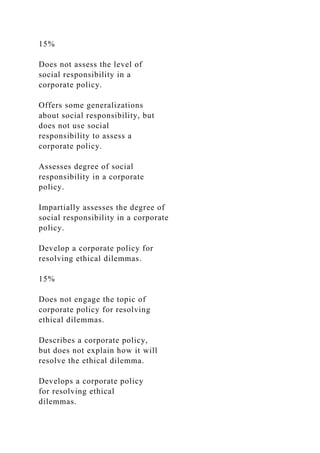
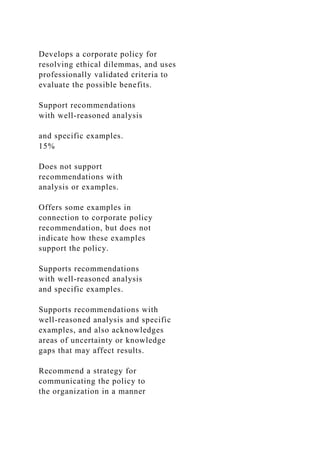
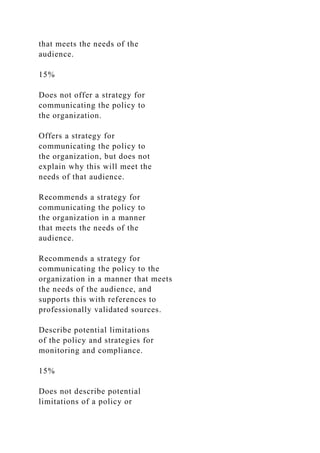
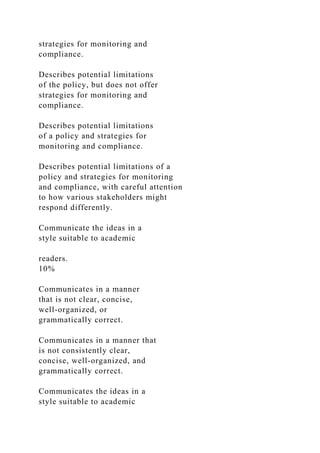
Addressing an Ethical Issue Scoring Guide Grading Rubric
Criteria Non-performance Basic Proficient Distinguished
Evaluate the parameters of
ethical decision-making
models as they apply to the
recommended policy.
15%
Does not engage the topic of
how parameters of ethical
decision-making models apply
to the recommended policy.
Offers some generalizations
about parameters of ethical
decision making, but does not
sufficiently apply them to the
recommended policy.
Evaluates parameters of
ethical decision-making
models as they apply to the
recommended policy.
Evaluates parameters of ethical
decision-making models as they apply
to the recommended policy, with
careful attention to multiple
stakeholders.
Assess degree of social
responsibility in a corporate
policy.
15%
Does not assess the level of
social responsibility in a
corporate policy.
Offers some generalizations
about social responsibility, but
does not use social
responsibility to assess a
corporate policy.
Assesses degree of social
responsibility in a corporate
policy.
Impartially assesses the degree of
social responsibility in a corporate
policy.
Develop a corporate policy for
resolving ethical dilemmas.
15%
Does not engage the topic of
corporate policy for resolving
ethical dilemmas.
Describes a corporate policy,
but does not explain how it will
resolve the ethical dilemma.
Develops a corporate policy
for resolving ethical
dilemmas.
Develops a corporate policy for
resolving ethical dilemmas, and uses
professionally validated criteria to
evaluate the possible benefits.
Support recommendations
with well-reasoned analysis
and specific examples.
15%
Does not support
recommendations with
analysis or examples.
Offers some examples in
connection to corporate policy
recommendation, but does not
indicate how these examples
support the policy.
Supports recommendations
with well-reasoned analysis
and specific examples.
Supports recommendations with
well-reasoned analysis and specific
examples, and also acknowledges
areas of uncertainty or knowledge
gaps that may affect results.
Recommend a strategy for
communicating the policy to
the organization in a manner
that meets the needs of the
audience.
15%
Does not offer a strategy for
communicating the policy to
the organization.
Offers a strategy for
communicating the policy to
the organization, but does not
explain why this will meet the
needs of that audience.
Recommends a strategy for
communicating the policy to
the organization in a manner
that meets the needs of the
audience.
Recommends a strategy for
communicating the policy to the
organization in a manner that meets
the needs of the audience, and
supports this with references to
professionally validated sources.
Describe potential limitations
of the policy and strategies for
monitoring and compliance.
15%
Does not describe potential
limitations of a policy or
strategies for monitoring and
compliance.
Describes potential limitations
of the policy, but does not offer
strategies for monitoring and
compliance.
Describes potential limitations
of a policy and strategies for
monitoring and compliance.
Describes potential limitations of a
policy and strategies for monitoring
and compliance, with careful attention
to how various stakeholders might
respond differently.
Communicate the ideas in a
style suitable to academic
readers.
10%
Communicates in a manner
that is not clear, concise,
well-organized, or
grammatically correct.
Communicates in a manner that
is not consistently clear,
concise, well-organized, and
grammatically correct.
Communicates the ideas in a
style suitable to academic
readers.
Communicates in an exemplary and
professional manner through clear,
concise, well-organized, and
grammatically correct writing, and
there are no style or formatting errors.
Print
Addressing an Ethical Issue Scoring Guide
https://courserooma.capella.edu/bbcswebdav/institution/BUS/B
US4801/...
1 of 1 6/12/2016 10:35 AM
Bus 4801 Unit 10 Final Project/BUSINESS_ETHICS.pdf
Journal of Public Administration, Finance and Law
Issue 6/2014
139
BUSINESS ETHICS
Nelu BURCEA
“Athenaeum” University of Bucharest, Romania
[email protected]
Ion CROITORU
“Athenaeum” University of Bucharest, Romania
[email protected]
Abstract: Through this study we seek to explore the concept of
business ethics, in those aspects that we consider to
be essential and concrete. We started from a few questions:
Could the two concepts be compatible? If not, why not?
If yes, could they be complementary? How real is the use of
ethics in the profits of a business? How can be business
ethics be exemplified and what principles are essential in doing
business? How does the business environment react
to the concept? These are some of the elements that will form
the basis of this scientific study. Lately, business ethics
has been becoming an increasingly popular topic. Set against
the global economic crisis, the companies’ credibility
could become a major concern. Business ethics also becomes a
challenge for training and informing employees and
employers, in order to make not only economical, but also
ethical decisions regarding their profits. In the study we
shall also address the ethical standards required in a business
world interested in fundamental values that can make
the difference in 21
st
century business. Also, according to a study conducted by the
authors, we shall address the two
most important ethical values that prove to be essential to a
business.
Keywords: Ethics, morality, fundamental human values,
business, management, religion, loyalty, integrity.
1. BUSINESS, MORALITY AND THE INFLUENCE OF
RELIGION. DEFINITIONS
AND DELIMITATIONS
According to the Encyclopedia of Philosophy and Humanities
(Enciclopedia de filosofie
si stiinte umane, 2004), the religious influence also contributes
to the development or limitation
of morality. Thus we have the “Buddhist morality”, defined as
the doctrine or the precepts on
good coming from the teachings of Buddha. Another approach
to morality is the “Confucian
morality”, representing “all ethical doctrines contained in
Confucius’ thought”. Another
perspective on morality is represented by the “Islamic
morality”, rooted in “the tradition derived
from the Qur’an and the tradition of Prophet Muhammad, which
formed the basis of the Islamic
civilization and was submitted to systematizations and critical
reflections in the medieval Arabic
philosophy.” The last discussed approach is the “Hebrew and
Christian morality”. It is “the
moral thinking related to the Hebrew and Christian religious
tradition, based on divine
revelation, and whose main object is salvation and the covenant
between God and His people,
and only then it contains moral prescriptions” (Craciun, 2005).
Through its influence, religion may limit or delineate morality.
In this way we can talk
about business ethical particularities in Christian countries and
specific behaviours in non-
Christian countries. Thus religion could at the most delineate
the moral profile of the individual
in a Christian or non-Christian country.
mailto:[email protected]
Journal of Public Administration, Finance and Law
Issue 6/2014
140
2. BUSINESS ETHICS. MORAL STANDARDS
On the other hand, ethics is the subject that examines the
personal moral standards of the
society (Velasquez, 2006). It answers the question on how these
standards can be applied in life
(Cheney, 2010). But what are these moral standards? According
to Manuel G. Velasquez, moral
standards are standards that deal with issues that have serious
consequences, consequences that
could be associated with feelings of shame and fear. Behind
these standards stands a good
reason, they are not based on authority, and they are not
reduced to a level of self-interest, nor
can they be accused of partiality (Cheney, 2010). This
definition is quite board and it creates
multiple options for making an accurate assessment of the idea
of standards. But involving the
feelings of “shame” and “fear” can bring into discussion
relativizing the terminology if one starts
from the multitude of applications. In other words, what causes
shame in an Eastern society
could be values in a European society and vice versa. Culture
(Dawson, 2010) is the engine that
creates particular values for each region. This, however, should
not lead to uniformity. I think,
however, that these possible confusions create the interest in
discovering different aspects of the
importance of diversity, which could otherwise remain
undiscovered. Far from diminishing the
importance of principles, this diversity provides value and
develops implementation strategies in
varied conditions.
In Ronald R. Sims conception on ethics (Sims, 2002), we should
clearly define the areas
of fundamental human values such as privacy violation, lying,
deception, sexual harassment,
unequal distribution of resources, threats, authoritarianism,
favouritism, conflict of interests, etc..
Defining all these areas brings to the attention of our study
values worth being discussed in an
economic and managerial context.
3. EVALUATION OF THE BUSINESS ETHICS STUDY
Before beginning an evaluation of the study, I would like to
mention several things about
it
1
. First, the study assessed the knowledge on the topic in general.
Then, the interest focused on
the way the Romanian manager reports to current ethics trends.
The study also sought to
determine whether a code of professional ethics exists, and to
stimulate the creation of such a
code that would regulate ethics in the company. Another goal of
the study was assessing the
manager’s opinion on the importance of ethics and morality in
two institutions, the university
and the church. The first one, given its involvement in this topic
through scientific research, and
the second one is designated by managers to be the promoter of
morality. One can notice
inconsistencies in understanding certain questions and topics. I
think this is due either to the
manager’s tendency of compressing the time for answers, either
to the relatively small space for
answers or to a lack of a deep understanding of the topic. It is a
fact that manager’s availability
for answers represents a current trend of focusing on ethics and
other social issues, other than
profit. Based on the answers given by the interviewed Romanian
managers, the illustrated
situation is quite positive. The answers seem quite objective,
and the issues in question seem
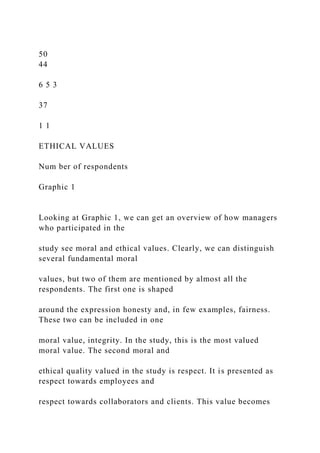
familiar. In Figure 1 we can observe Romanian managers’ trend
of ethical thinking.
1
The study was conducted by the author in 2010 on a sample of
45 Romanian managers
Journal of Public Administration, Finance and Law
Issue 6/2014
141
0
10
20
30
40
50
44
6 5 3
37
1 1
ETHICAL VALUES
Num ber of respondents
Graphic 1
Looking at Graphic 1, we can get an overview of how managers
who participated in the
study see moral and ethical values. Clearly, we can distinguish
several fundamental moral
values, but two of them are mentioned by almost all the
respondents. The first one is shaped
around the expression honesty and, in few examples, fairness.
These two can be included in one
moral value, integrity. In the study, this is the most valued
moral value. The second moral and
ethical quality valued in the study is respect. It is presented as
respect towards employees and
respect towards collaborators and clients. This value becomes
important through the concern for
others, in order to create a social balance.
4. TWO FUNDAMENTAL HUMAN VALUES, IMPORTANT IN
DEVELOPING
BUSINESS ETHICS
4. 1. Business loyalty
A topic that could be considered important in the broad concept
of business ethics is
employee’s loyalty to the company. In a study conducted by
Mathew A. Foust and presented in
his book Loyalty to Loyalty: Josiah Royce and the Genuine
Moral Life, he debates the issue of
employees’ loyalty towards the philosophy of the company
where he works and towards their
employer. Two dilemmas are brought into the picture. The first
one is related to the ethical
perspective of the duty that the employees should have towards
the one who pays them and the
values of the company. The question at issue is related to the
limits of this loyalty. Another
dilemma is related to a requirement from the employer that can
be considered extremist or
illegal. As an extreme example, the author gives the case of the
US in September 11, 2001. The
two dilemmas are brought into picture in order to delineate the
need or the lack of need for
loyalty. Beyond these discussions, loyalty remains an important
element in running a business
and particular matters should be resolved separately. Our
conclusion is that loyalty becomes
essential in the business process and the employee must be loyal
to the company, except for
extreme situations, which are illegal or can be considered
unethical. The respect should also be
Journal of Public Administration, Finance and Law
Issue 6/2014
142
mutual (Mattone, 2013), both from the employee and from the
employer. This way, employee’s
loyalty increases.
4. 2. Integrity
Another important element of business ethics is integrity.
According to the study
represented in Graphic 1, the interviewed managers considered
honesty to be an indispensable
value in business. In running a business, the primary phase of
evaluating it through classical
assessment methods like “good” or “bad” is long outdated. This
assessment method is simply a
“reactive” one, usable in a given situation. But there is a need
for a type of business
development that brings into picture the proactivity of the
manager or employee, becoming a
promoter of ethical values, not only a skilful character who
manages to figure things out without
being caught or without being accused of an illegal or immoral
crime.
Integrity is what reflects the individual’s concern for honour,
for moral values. In this
context, integrity becomes the opposite of hypocrisy. Hypocrisy
represents a false attitude in
interpersonal relations, the individual seeking to grab attention,
favours, etc. (Enachescu, 2005).
In the moral dimension of the individual, integrity represents
transparency, authenticity.
One could ask what motivates an individual in having integrity.
The danger of being
caught and punished for doing something wrong? The concern
for one’s image if the media
discovers the corruption case? What would his children or
grandchildren think about that
individual who lacks integrity? (Kennedy, 2005). Moral
integrity, as a fundamental value of
business ethics, is not about external motivation like fear of
punishment or tarnishing one’s
image in the society and family. Integrity is an intrinsic value, a
value that the individual does
not develop because of an outer primitive element, but because
of a culture of inner morality. It
is something like “I do this because I cannot do otherwise”,
because it's all about a personal set
of values, about education and accountability.
CONCLUSIONS
Business ethics, undeniably a current field, distinguishes itself
through its importance in
the beginning of the 21st century, after it started building its
academic way in the capitalist
countries. Ethics also materializes its importance for business
through the study conducted with
the participation of 45 managers. The most important ethical
issues highlighted by the answers to
the survey were: honesty, respect, fairness, transparency,
dignity, etc. The interest of the
Romanian managers in business ethics is reinforced by the
positive response regarding the
existence of an ethical code required for a proper management
of business relationships. The
profile of a businessman becomes positive, in the context on an
increasingly greater interest in
ethics and in accepting a goal that should have been considered
imperative and urgent from a
long time ago.
The two moral values discussed in this article are important in
the context of an important
business development endeavour and of creating a credible
economy. The two elements are also
important because the first one applies particularly to
employees, while the second one, integrity,
applies particularly to employers. The presentation and
development of the two values come to
balance the development of the managerial vision on business
ethics. I believe that the
Journal of Public Administration, Finance and Law
Issue 6/2014
143
implementation of ethics can have a much boarder dynamic if
the politicians would place greater
emphasis on promoting ethical values, from personal example to
major decisions taken in an
institutional setting.
In conclusion, business ethics remains on an upward trend in
Romania and in
international business due to the influence of external factors
such as competitive political and
business environments in other countries, but also due to
internal competition and consumers, to
the general public, who becomes increasingly informed in the
field of business ethics. The
ethical need is required in order to create an external ethical
image, and to have a functional and
credible business environment. The development of business
ethics as an intrinsic value remains
a perspective worth imitating and developing.
References
[1] Cheney, G., Lair, D.J., Ritz D., Kendall, B.E. (2010). Just a
Job? Communication, Ethics, and Professional Life.
New York: Oxford University Press. p. 54.
[2] Costa, J.D., (1998). The Ethical Imperative: Why Moral
Leadership Is Good Business, Reading, MA: Perseus
Publishing. p. 37.
[3] Crăciun, D., (2005). Etica în afaceri: o scurtă introducere.
Bucureşti: Editura ASE, pag. 27
[4]Dawson, C.S., (2010). Leading Culture Change: What Every
CEO Needs to Know, Stanford, CA: Stanford
Business Books. p. 3.
[5] Enăchescu, C., (2005). Tratat de psihologie morală.
București: Editura Thehnică. pag.67.
[6] Enciclopedia de filosofie și ştiinţe umane, (2004).
Bucureşti: Editura All Educational, pag. 710-714.
[7] Kennedy-Glans, D., Schulz, B., (2005). Corporate integrity:
a toolkit for managing beyond compliance. Ontario:
John Wiley&Sons Canada LTD.
[8] Mattone, J., (2013). Powerful Performance Management.
New York: American Management Association. p. 34.
[9] Sims, R.R., (2002). Teaching Business Ethics for Effective
Learning, p. 124.
[10] Velasquez, G.M., (2006). Business Ethics – Concepts and
Cases, New Jersey: Pearson Education Inc., p. 8.
Bus 4801 Unit 10 Final Project/Discussion Participation Scoring
Guide.pdf
Due Date: Weekly.
Percentage of Course Grade: 40%.
Discussion Participation Grading Rubric
Criteria Non-performance Basic Proficient Distinguished
Applies relevant course
concepts, theories, or materials
correctly.
Does not explain relevant course
concepts, theories, or materials.
Explains relevant course
concepts, theories, or materials.
Applies relevant course
concepts, theories, or materials
correctly.
Analyzes course concepts, theories, or
materials correctly, using examples or
supporting evidence.
Collaborates with fellow
learners, relating the
discussion to relevant course
concepts.
Does not collaborate with fellow
learners.
Collaborates with fellow learners
without relating discussion to the
relevant course concepts.
Collaborates with fellow
learners, relating the discussion
to relevant course concepts.
Collaborates with fellow learners,
relating the discussion to relevant
course concepts and extending the
dialogue.
Applies relevant professional,
personal, or other real-world
experiences.
Does not contribute professional,
personal, or other real-world
experiences.
Contributes professional,
personal, or other real-world
experiences, but lacks relevance.
Applies relevant professional,
personal, or other real-world
experiences.
Applies relevant professional, personal,
or other real-world experiences to
extend the dialogue.
Participation Guidelines
Actively participate in discussions. To do this you should create
a substantive post for each of the discussion
topics. Each post should demonstrate your achievement of the
participation criteria. In addition, you should also
respond to the posts of at least two of your fellow learners for
each discussion question-unless the discussion
instructions state otherwise. These responses to other learners
should also be substantive posts that contribute to
the conversation by asking questions, respectfully debating
positions, and presenting supporting information
relevant to the topic. Also, respond to any follow-up questions
the instructor directs to you in the discussion
area.
To allow other learners time to respond, you are encouraged to
post your initial responses in the discussion area
by midweek. Comment to other learners' posts are due by
Sunday at 11:59 p.m. (Central time zone).
Print
Discussion Participation Scoring Guide
https://courserooma.capella.edu/bbcswebdav/institution/BUS/B
US4801/...
1 of 1 6/12/2016 10:37 AM
Bus 4801 Unit 10 Final Project/ebook_login_access.docx
The below information will provide access to the ebook The
leadership challenge for course Bus 3012
BookShelf – Vital Source
Website https://www.vitalsource.com/
Website Signin https://bookshelf.vitalsource.com/#/user/signin
Login ID [email protected]
PW CPU_2016_
Bus 4801 Unit 10 Final Project/Ethical Outcomes and Business
Ethics Toward Improving.pdf
Ethical Outcomes and Business Ethics: Toward Improving
Business Ethics Education
Larry A. Floyd • Feng Xu • Ryan Atkins •
Cam Caldwell
Received: 25 May 2012 / Accepted: 5 April 2013 / Published
online: 7 May 2013
� Springer Science+Business Media Dordrecht 2013
Abstract Unethical conduct has reached crisis propor-
tions in business (Walker et al., Wall Str J East Edn,
258(37):A1–A10, 2011) and on today’s college campuses
(Burke et al., CPA J, 77(5):58–65, 2007). Despite the
evidence that suggests that more than half of business
students admit to dishonest practices (McCabe et al. 2006),
only about 5 % of business school deans surveyed believe
that dishonesty is a problem at their schools (Brown et al.,
Coll Stud J A, 44(2):299–308, 2010). In addition, the
AACSB which establishes standards for accredited busi-
ness schools has resisted the urging of deans and business
experts to require business schools to teach an ethics class,
and fewer than one-third of businesses schools now teach a
business ethics course at the graduate or undergraduate
levels (Swanson and Fisher, Advancing Business Ethics
Education, 2008). In this paper we briefly introduce the
status of business ethics education and report the results of
a survey of business students, deans of the top business
schools, and business ethics subject matter experts about
ten ethical outcomes. We then offer five specific
recommendations to encourage business ethics faculty and
decision makers to improve the teaching of business ethics.
Keywords Ethical outcome � Business ethics �
Improving business ethics educations �
Status of business ethics education
The reputation of business has been besmirched with a
continuous parade of financial scandals which have had
widespread economic repercussions (Friedman 2009),
created a worldwide recession (Reich 2011), and rocked
the world’s economic foundations (Lowenstein 2011). As a
result of a long parade of ethical misconduct, business is
now perceived by the public as both ‘‘a scourge’’ and as
‘‘ethically challenged’’ (Warnell 2011, p. 320). Cavanagh
(2009, p. 20) has noted that the leaders responsible for
these scandals ‘‘are graduates of our ‘‘best’’ business pro-
grams,’’ and has suggested that many of today’s most
highly regarded business schools have ‘‘failed to convey
ethics, social responsibility, and good moral habits to their
graduates.’’ In a society labeled ‘‘the cheating culture’’
(Callahan 2004), American business leaders have not only
lost the trust of their employees (Maritz 2010) but have
created a ‘‘global crisis of confidence’’ in society at large
(Walker et al. 2011, p. A1). An increasing number of
management scholars advocate that the accrediting bodies,
professional organizations, business schools, and faculties
who teach management courses need to rethink how
business ethics can be taught to influence future business
leaders but suggest that the prospects for meaningful
change with regard to business ethics education appear to
be unlikely (Swanson and Fisher 2008, 2011).
Although there are outstanding examples of universities
(Datar et al. 2010; Weber et al. 2008; Piper et al. 1993) and
L. A. Floyd (&)
Liberty University, Lynchburg, VA, USA
e-mail: [email protected]
F. Xu
Georgia South Western University, Americus, GA, USA
e-mail: [email protected]
R. Atkins
University of Georgia, Athens, GA, USA
e-mail: [email protected]
C. Caldwell
St. Thomas University, Miami Gardens, FL, USA
e-mail: [email protected]
123
J Bus Ethics (2013) 117:753–776
DOI 10.1007/s10551-013-1717-z
academic scholars (Sims and Sauser 2011; Giacalone and
Thompson 2006; Koehn 2005) that have worked hard to
increase the effectiveness of business ethics education, it is
nonetheless true that some business schools focus their
classroom teaching on emphasizing ‘‘the short-term share
price… while neglecting research, development, the repu-
tation of the firm and the future of the business and the
community’’ (Cavanagh 2009, p. 20). Though business
ethics scholars have lobbied heavily to upgrade the quality
of business ethics education for many years (Evans and
Robertson 2003; Hosmer 1985, 1988), others have sug-
gested that little has yet been done to change the typical
business school’s approach to teaching business ethics
(Evans and Weiss 2008). Felton and Sims (2005, p. 378)
noted that, business schools periodically ‘‘find themselves
on the defensive as to why they are not doing more’’ and
scramble ‘‘to develop a response’’ to improving business
ethics education. Indicators suggest that historically inef-
fective models will continue to be used to teach business
ethics, despite the apparent failure of business schools to
have a positive impact on the behavior of business leaders
(Swanson and Fisher 2008). The purpose of this paper is to
examine the role of today’s business school in teaching its
students about ethical values and social responsibility and
to identify how business students, deans of the top US
business schools, and subject matter experts in business
ethics view the importance of ethical priorities within both
the business school and the broader business context.
We begin this paper by summarizing the current status of
business ethics education, briefly describing the most com-
mon approach of business schools in teaching students about
social responsibility, moral conduct, and students’ obliga-
tions as future leaders. We also summarize the current
position of the Association to Advance Collegiate Schools of
Business (AACSB), the Academy of Management, and
many business schools with regard to their focus on business
ethics education. We identify the importance of ten ethically
related outcomes associated with both the business school
environment and society at large which we have incorpo-
rated into a survey of business students, business school
deans, and business ethics subject matter experts. After
summarizing the process used to gather data from these three
groups about these ethically related outcomes, we identify
how each of these groups rates the relative importance of
these ten outcomes. Integrating our findings from this survey
with the research of other scholars, we then offer five rec-
ommendations for the academic community of business
school administrators, the AACSB and the Academy of
Management, and business school faculty members as they
consider how they might improve the teaching of business
ethics to tomorrow’s business leaders. We conclude our
paper by identifying three contributions of this paper and
suggest opportunities for related business ethics research.
Status of Business Ethics Education
In their examination of the status of business ethics edu-
cation, Swanson and Fisher (2008, p. 1) have opined that it
is ‘‘the common practice in business schools of marginal-
izing ethics by scattering ethics topics superficially and
incoherently across the curriculum.’’ Noting that less than
one-third of all accredited business schools offer a stand-
along course in business ethics to graduate or undergrad-
uate students, Swanson and Fisher (2008) argue for an
extensive revitalization of the teaching of business students
about proper ethical conduct. Other scholars (Sims 2002;
McCabe et al. 2006; Trevino and Nelson 2010) and busi-
ness leaders (Krehmeyer 2007) agree that current thinking
about ethics education needs an immediate upgrade and
have suggested ways to make teaching business ethics
more effective.
AACSB International, the most highly regarded busi-
ness school academic rating body in the world, currently
does not require business schools to offer a stand-alone
business ethics class as part of their curriculum (Swanson
and Fisher 2008), and has resisted efforts on the part of
business ethics subject matter experts, faculty, and deans to
upgrade business ethics education. Swanson and Fisher
(2008, p. 5) reported that the AACSB had initially pro-
posed that business schools offer a required course in
business ethics but diluted its requirements and ‘‘adopted
more flexible, mission-driven standards’’ that ‘‘allowed
stand-alone coursework to be dismantled in favor of flex-
ibility in distributing ethics across the curriculum.’’ The
AACSB’s (2012: Standard 15) current language asks
business schools to incorporate ‘‘(e)thical understanding
and reasoning ability’’ into their curriculum to include
‘‘(e)thical and legal responsibilities in organizations and
society.’’ Although the AACSB (2012a, b: Ethics/Sus-
tainability Resource Center) endorses creating ‘‘codes of
conduct, values statements, honor codes, procedures for
handling allegations of misconduct, and other mecha-
nisms’’ to sustain a supportive culture for ethical behavior,
the AACSB (2012a, b: Ethics/Sustainability Resource
Center) standards specifically avoid ‘‘particular courses or
treatments.’’ Instead, the language of the AACSB (2012a,
b: Ethics/Sustainability Resource Center) states that
‘‘schools should assume great flexibility in fashioning
curricula to meet their missions and to fit with the specific
circumstances of particular programs,’’ and each school is
free to determine how to best integrate teaching business
ethics to ‘‘meet the needs of the mission of the school and
the learning goals for each degree program.’’
AACSB’s action to reduce the requirements for at least
one ethics course as a condition for accreditation was taken
despite ‘‘petitions from hundreds of professors and prac-
ticing managers as well as two associations—the
754 L. A. Floyd et al.
123
Washington, DC-based Ethics Resource Officers and the
Social Issues in Management Division’’ of the Academy of
Management (Swanson and Fisher 2008, p. 6). Several
scholars (Klein 1998; Swanson and Frederick 2005; Mitr-
off and Swanson 2004) suggest that this downgrading of
ethics education requirements was crafted by deans as a
politically expedient means to ‘‘wiggle out of recurring
curriculum battles at their own schools’’ (Swanson and
Fisher 2008, p. 6). As reported in a survey conducted by
Evans and Weiss (2008) business school deans have also
opined that more emphasis should be placed on business
ethics education and that increasing the awareness of stu-
dents about ethical awareness would raise the ethical level
of business practice. Evans and Weiss (2008, p. 51)
reported that ‘‘(m)ore than 80 % of the CEOs, deans, and
faculty (surveyed) agree that more emphasis should be
placed on ethics education, with 1 % or less disagreeing.’’
Similarly, in responding to survey statements about the
impact of expanding business ethics education ‘‘(b)etween
73 and 81 % of the respondents (of CEOs, deans, and
faculty) agree to some extent with the statement ‘‘A con-
certed effort by business schools to improve the ethical
awareness of students eventually will raise the ethical level
of actual business practice’’ (Evans and Weiss 2008, p. 51).
As Vidaver-Cohen (2004, p. 213) clearly noted, business
school deans ‘‘must take the lead’’ if business schools are
to create a healthy moral climate for teaching business
ethics.
At the heart of the business ethics debate, however, is
the question ‘‘What is the most effective way to teach
business students about ethical behavior and moral deci-
sion-making?’’ Many business ethics experts have
emphasized that effectively teaching business ethics
requires that business schools develop a fully integrated
approach that involves a carefully developed stand-alone
business ethics class (Swanson and Fisher 2008), coupled
with extensive integration of ethics cases (Piper et al.
1993), service learning (Weber et al. 2008; Vega 2007),
and developing skills associated with resolving ethical
dilemmas (Trevino and Nelson 2010). Critics of an ‘‘ethics
across the curriculum’’ approach suggest that ethical issues
are often complex and that business faculty are often
unprepared to teach the nuances of ethical choices in their
disciplines (Swanson and Fisher 2008). Of the deans who
were surveyed about the qualifications of business faculty
to teach business ethics 46 % indicated that at the under-
graduate level there is a shortage of faculty expertise, with
44 % of the deans indicating that faculty lacked adequate
expertise at the graduate level (Evans and Weiss 2008,
p. 47).
In addition, business school faculty have been described
as frequently being resistant to adding a required course in
business ethics to their curriculum (Windsor 2002;
Swanson and Fisher 2011), and some business schools have
actually reduced or eliminated required business ethics
courses. However, many business ethics scholars strongly
oppose the AACSB standard that business ethics can be
integrated effectively across a curriculum without the
existence of a foundation course in business ethics. As Ray
Hilgert, an Emeritus Professor of Management and Indus-
trial Relations at the prestigious Washington University
School of Business wryly observed about the effectiveness
of the AACSB standard allowing the teaching of business
ethics piecemeal across a business school’s curriculum, ‘‘If
you believe it’s integrated in all the courses, then I’m
willing to offer you the Brooklyn Bridge’’ (Nicklaus 2002,
p. C10). It is our position in this paper that the many
scholars who have supported Hilgert’s position in calling
for requiring a stand-alone business class are correct,
although it is not the purpose of this paper to focus on that
argument. We do, however, believe that the evidence
against the current practice of teaching business ethics
across-the-curriculum is compelling and support the pre-
mise that business schools and those who make decisions
about them have a moral obligation to improve the teach-
ing of business ethics.
The argument frequently framed in opposition to
requiring a course in business ethics is whether ethical
behavior can be taught (cf. Ryan and Bisson 2011; Piper
et al. 1993). Ethics, many scholars believe, incorporates an
intrinsic set of values that are unlikely to change and that
make up a person’s basic identity or sense of self (Swanson
and Dahler-Larsen 2008; Albert et al. 2000; Caldwell
2009). At the same time, critics of current business edu-
cation practices strongly advocate the importance of re-
framing the traditional rational/analytical models that focus
MBA and undergraduate business students on becoming
analysts rather than managers (Mintzberg 2004), and for
many years business scholars have advocated an increased
emphasis on teaching business practitioners and business
students the underlying values factors of decision making
(Carroll 1977).
Other organizations of management scholars have a
mixed commitment to advocating changes in the teaching
of business ethics. The Academy of Management, the
scholarly organization of university business faculty who
teach business ethics or to incorporate ethics across the
curriculum within their classrooms, has an ‘‘Ethics Edu-
cation Committee.’’ Although the mission for that com-
mittee includes increasing commitment to ethical conduct,
raising awareness about ethical issues, responding to
questions and concerns about ethical standards, and
embedding the practice of professional ethics within the
culture of the Academy (Schminke 2011), over the past
several years the committee has focused almost entirely on
clarifying rules for academic publications and has not
Ethical Outcomes and Business Ethics 755
123
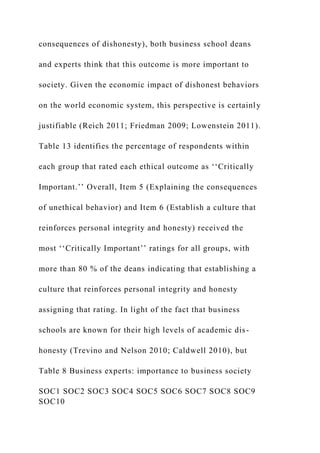
addressed its broader mission (Madsen 2011; Davis 2011;
Schminke 2009).
Swanson and Fisher (2008, 2011) have articulated the
concerns of many scholars about what ought to be done to
improve the ability of business schools to increase student
awareness of ethical issues and expand the focus of busi-
ness schools on positively influencing ethical conduct in
today’s complex world. The purpose of the survey asso-
ciated with this paper was to build upon the work of
business ethics scholars to obtain additional insights from
students, business school deans, and subject matter experts
about the importance of ethical outcomes within business
schools and in society. Both the business school context
and society at large were chosen as the topic of this survey
because many scholars have identified the importance of
both contexts (Datar et al. 2010; Trevino and Nelson 2010;
Karri et al. 2005), and scholarly organizations such as the
Academy of Management and the AACSB have recognized
that both contexts are vital for the effective teaching of
business ethics (Caldwell 2010; Swanson and Fisher 2011).
Description of Survey Outcomes
The purpose of this section of the paper is to provide a
scholarly basis for the ten ethical outcomes contained in the
survey. The outcomes included in this survey were devel-
oped after discussions with several highly regarded ethics
education scholars as well as a group of management
practitioners. The survey was then pretested with subject
matter experts and a group of university business students
to obtain feedback about the wording of outcomes and that
feedback was incorporated into the final list. The list of
outcomes was reviewed by those scholars, practitioners,
and students both before and after the survey was admin-
istered and the data was collected. Although the ten out-
comes contain some overlap in related content, all of the
scholars, practitioners, and students concurred that these
ethical outcomes were important factors at business
schools and in society at large. We acknowledge that these
ten ethical outcomes contain some redundancy across
factors, but note that this overlap was necessary to some
degree in order to identify the importance of each ethical
outcome category. The ten ethical outcomes are founda-
tions of decision making, clarifying rules for academic
publication, motivating others to understand values,
examining the pressures of the current business environ-
ment, identifying consequences of unethical behavior,
establishing a culture that reinforces integrity, creating
better monitoring systems, identifying the benefits of vir-
tuous conduct, fostering dialogue about ethics and values,
and increasing communication between academics and
practitioners. The survey asked respondents to identify the
importance of these ten ethically related outcomes both
within business schools and in society. The context of the
business school has a significant impact on the message
communicated to business students about the importance of
ethical conduct in their future careers (McCabe et al. 2002).
Creating a culture that reinforces the importance of ethical
conduct is widely acknowledged as important for preparing
business students to understand their ethical and moral
responsibilities as future business leaders (Trevino and
Nelson 2010; Swanson and Fisher 2011; Caldwell 2010), to
develop a moral imagination that enables students to be
aware of the consequences of moral dilemmas (Badaracco
1997), and to have the moral courage to make right choices
(Comer and Vega 2005). Each of the ten survey items is
reviewed below.
Foundations of Decision Making
Providing business students with information about theo-
ries and concepts of ethical decision making is widely
acknowledged to be a critical factor in teaching business
students to understand the moral and ethical duties that
businesses owe to stakeholders (Carroll and Buchholtz
2012). Although decision making is often thought to be a
product of ‘‘careful and deliberate cognition’’ (Martin and
Parmar 2012, p. 289), rational choice models are an
important, but incomplete part of ethical decision making.
Understanding key ethical concepts and their normative
and instrumental foundations is a key element of business
ethics education and enables students to recognize the
differing ethical perspectives and their impacts on decision
outcomes (Brady 1999; Hosmer 1995). Unfortunately,
Ghoshal (2003, p. 4) condemned the amoral ‘‘brutishness’’
of business ethics education—arguing that a failure to
provide a solid foundation for decision making led to such
moral disasters as the Enron debacle.
Dean Krehmeyer (2007, p. 4), Executive Director of
Business Roundtable, has criticized many business schools
for ‘‘not doing enough to build ethics into their curricula’’
and advocated that business schools provide this training
through ‘‘both a stand-alone course and the integration of
ethics into the other core disciplines.’’ The disadvantage of
attempting to teach business ethics across the curriculum
without a stand-alone ethics course is that there are a
multitude of ethical models that call for conflicting ethical
outcomes, and ethical decision making is dependent upon
understanding the principles and assumptions associated
with each of those models (Hosmer 1994, 1995, 2010;
Brady 1999).
Providing guidelines about ethical decision-making
theories, values, and concepts also has immense practical
value for practitioners and provides a touchstone for
guiding business decisions (Fulmer 2001). Collins and
756 L. A. Floyd et al.
123
Porras (2004, Chap. 3) emphasized that the core values of
businesses were critical factors that guided the most suc-
cessful businesses in their study of highly effective busi-
nesses. Covey (1992, 2003, 2004) has repeatedly
emphasized the fundamental importance of businesses
being value-based and principle-centered. McLean and
Elkind (2003) noted that it was this failure to put values
above profits that was at the core of Enron’s tragic demise.
Paine (2003) has emphasized that the ability to integrate
ethical organizational values with financial objectives was
a key priority to achieve superior results for the modern
organization.
Clarifying Rules for Academic Publications
The importance of meeting best practice for publishing
academic articles has an impact on the credibility of
scholars and academic institutions and the standards for
publishing business articles are set forth in the Academy of
Management’s Code of Ethics (Schminke 2009). Research
misconduct in academia is a ‘‘mounting concern within our
discipline’’ according to Bedeian et al. (2010, p. 716).
Bedeian et al. (2010, p. 716) reported that in a recent study
of 384 management scholars, nearly 80 % reported per-
sonal knowledge of the fabrication, falsification, or pla-
giarism of academic research and more than 90 % reported
cases of questionable research practices by their col-
leagues. Taylor and Stanton (2009, p. 94) have suggested
that the AACSB standards for becoming ‘‘academically
qualified’’ have resulted in ‘‘publishing for the sake of
publishing,’’ rather than for the more legitimate purpose of
creating and disseminating new knowledge.
Establishing standards for academic publication and
adhering to those standards is essential in ‘‘maintaining
public confidence and guarding the authority and auton-
omy’’ that academia enjoys in both the business world and
society (Bedeian et al. 2010, p. 723). Pfeffer and Sutton
(1999) have been strongly critical of the ‘‘knowing-doing’’
gap that exists between academia and the business world.
The need to bridge that gap by enhancing the credibility of
business research is important to both the business world
and academic institutions (Hughes et al. 2008). Lewis et al.
(2011) have documented that academic impropriety and the
incidence of plagiarism have severely impacted the integ-
rity of academic research and have become increasingly
common since 2000. Li (2010) found that one British
publisher found that 23 % of articles submitted to that
journal had been plagiarized. These findings suggest that
the ‘‘publish or perish’’ pressure that is placed on academic
scholars (Linton et al. 2011; Miller and Bedeian 2010) has
resulted in immoral behavior by some scholars that ulti-
mately will discredit academic institutions in the public eye
and among practitioners (Bedeian et al. 2010).
Motivating Others to Understand Values
Motivating others to understand their own value systems
was identified by Fink (2003) as an important element in
the academic learning process, and is widely acknowledged
to be critical to how one views ethical priorities (Badaracco
1997). Individual decision making is fundamentally tied to
one’s normative values and integrates rational and sub-
jective factors in arriving at decisions (Fishbein and Ajzen
1975; Goodchild 1986). In improving the effectiveness of
understanding values associated with business decision
making, Ravenscroft and Dillard (2008, pp. 183–186)
noted the importance of ‘‘moral imagining’’ which incor-
porates (1) prototypes or models, (2) the way in which
moral issues are framed, (3) the use of metaphors in
describing an ethical issue, and (4) the narrative or story
used to examine and construct an ethical context. Their
assessment clarified the importance of recognizing the
context of individual values and how one views the world
as key factors in determining moral duties (Ravenscroft
and Dillard 2008). Similarly, Swanson and Dahler-Larsen
(2008) identified the importance of understanding one’s
sense of self, one’s self-interests and biases, and one’s
relationships with others as key elements to achieving self-
awareness about decision making.
Although the articulation of organizational values is
acknowledged to be an important element in creating high
trust cultures and high performance work systems (Pfeffer
1998), the more common business focus is on economic
theories and rational decision models rather than on the
underlying values of business (Pfeffer 2005). Increasingly,
empirical evidence has identified the importance of high
involvement work practices and a focus on organizational
values as key elements to increasing business performance
(Huselid 1995; Cameron 2003; Ulrich et al. 2001; O’Neill
et al. 2011). Both academics and practitioners are recog-
nizing the importance of understanding the values of
individuals and the entire organization in making key
leadership decisions that affect organization success
(Caldwell et al. 2011).
Examining the Pressures of the Current Business
Environment
Examining the pressures of the current business environ-
ment that influence ethical decisions is important to busi-
ness schools in understanding the context of ethical
decision making (Carroll and Buchholtz 2012). Gioia
(1992) noted that the context of the business environment
and the ‘‘scripts’’ of an existing organizational culture have
a profound socialization effect on organization members.
He advocated the importance of focusing on those scripts
as part of the process of developing effective ethical
Ethical Outcomes and Business Ethics 757
123
models (Gioia 1992). Trevino and Nelson (2010) were
strong advocates of using schemas, scripts, and decision-
making models within a business school context. Caldwell
(2010) emphasized the importance of not only incorporat-
ing an understanding of socialization pressures to teach
business ethics but recommended focusing on the under-
lying normative values and assumptions that make up the
business school environment which ultimately determine
its ethical standards.
The pressures that affect today’s business environment
have grown increasingly complex in a world that has been
besieged with increased competitiveness, pressures to
achieve short-term results, expanded global competitive-
ness, and a worldwide economic downturn (Friedman
2009). Today’s rational business model, based largely on
the pursuit of short-term economic returns, has created
financial havoc for much of the business world as it has
pursued paper entrepreneurism rather than the creation of
real added value (Lowenstein 2011; Reich 2011). The
failures of business to demonstrate that its values are
honorable and its leaders are trustworthy over the past
decade have led to a decline in confidence in today’s
business leaders (George 2009; Maritz 2010), a steady
decrease in the quality of life, a dismal long-term economic
prognosis, and a growing cynicism about the future
(Friedman 2009).
Identifying Consequences of Unethical Behavior
Despite the fact that unethical behavior has become almost
universal in today’s business school environment (Decoo
2002), many business schools have failed to address the
growing problem of academic misconduct and a large
percentage of faculty consistently ignore blatant dishonest
behaviors (Burke et al. 2007). McCabe et al. (2006, p. 299)
reported that 47 % of business undergraduates and 56 % of
graduate students ‘‘admitted to engaging in some form of
cheating or questionable behavior.’’ However, the Center
for Academic Integrity reported that 44 % of 10,000 fac-
ulty surveyed have never reported academic cheating about
which they have been aware (Burke et al. 2007, p. 59).
Naimi (2007) noted that for a business ethics education
program to be effective, business schools must create a
program that is consistently applied and that effectively
addresses and enforces academic integrity (Weber 2006,
p. 27). The fact that many business faculty and adminis-
trators appear to ignore academic dishonesty sends the
message that a business school does not give academic
integrity high priority (Caldwell 2010).
Although the consequences of unethical conduct for
Arthur Andersen were terminal to the life of that highly
respected firm as a result of their complicity in the Enron
debacle, McLean and Elkind (2003) noted that the ethical
misconduct that had occurred at Enron that led to its
undoing was well known within the firm and frequently
encouraged by firm leaders. Despite the fact that the ram-
ifications for managerial dishonesty and ethical misconduct
are often highly publicized, the haunting recurrence of
these missteps suggest that the bigger crime is in getting
caught rather than in failing to honor an ethical duty
(Lowenstein 2011). Friedman (2009, Chap. 1) recounted
that the dominant philosophy of many of the guilty parties
leading up to the 2008 mortgage crisis was ‘‘I’ll be gone.
You’ll be gone.’’ The profits will have been made. The risk
will have been passed on. We will have escaped unharmed.
Meanwhile, however, thousands of investors throughout
the world have paid the price of the ethical misconduct of
those who perpetuated the frauds and machinations that
created the mortgage crisis and the economies of many
countries may never fully recover (Lowenstein 2011;
Friedman 2009).
Establishing a Culture that Reinforces Integrity
Establishing a culture within a business school that rein-
forces integrity and honesty has been successfully imple-
mented at a few noteworthy institutions (Procario-Foley
and Bean 2002; Datar et al. 2010). At Duquesne Univer-
sity, their emphasis on business ethics is founded on an
organizational culture closely integrated with the univer-
sity’s mission (Weber 2006). Consistent with Schein’s
(2010) description of the importance of leadership in cre-
ating a strong organizational culture, Weber (2006,
pp. 35–36) emphasized the importance of leadership at the
administrative, faculty, and student levels in creating a
commitment to an organizational culture that reinforced the
importance of the Duquesne ethics initiative. Several uni-
versities have established centers for ethics within their
business schools which reinforce the focus and commit-
ment of those business schools in creating an environment
that reinforces the teaching of ethical values (Warren and
Rosenthal 2006; Heller and Heller 2011).
Within the larger context of business in society, estab-
lishing a culture that reinforces integrity and honesty is
viewed as a fundamental obligation of every organization
(Trevino and Nelson 2010). Often, however, the creation of
an organizational structure that emphasizes ethical com-
pliance and ethics education has come after firms have
been cited for ethics violations and are mandated as a
condition for maintaining eligibility for government con-
tracts (Collins 2009). Hoffman et al. (2001) stressed that
creating an organizational culture that reinforced ethical
values must begin at the executive level of an organization.
Whitney (2010, p. 36) noted that the Chief Learning
Officer’s job in many corporations includes creating an
integrated and transparent organization culture that helps
758 L. A. Floyd et al.
123
employees at all levels to be aware of the ‘‘often compli-
cated and culturally charged’’ ethical and legal issues
facing the modern organization.
Creating Better Monitoring Systems
Creating better systems that monitor conduct and the
consequences of dishonesty appear to be an important
priority in the establishment of an academic environment
that promotes integrity within a business school (Caldwell
2010, pp. 6–8). Several model programs have been estab-
lished in which both faculty and students play a major role
in monitoring student behavior and in imposing conse-
quences (Crown and Spiller 1997; Weber et al. 2008).
Warren and Rosenthal (2006, pp. 691–694) advocated the
involvement of students in the education of peers and the
enforcement of ethical conduct as a necessary requirement
of an effective academic integrity program—citing
numerous examples of efforts being made by many of the
top business schools to improve ethics education and
enforcement. In light of the fact that academic dishonesty
in business schools has been described as a ‘‘plague’’
(Embleton and Helfer 2007; Junion-Metz 2000) and a
‘‘crisis’’ (Burke et al. 2007), the current system of moni-
toring student academic honest clearly does not appear to
be working at many universities.
In response to the Enron and the Arthur Andersen
disasters, Congress passed the Sarbanes–Oxley Act to
increase the accountability of businesses (McLean and
Elkind 2003). The unending sequence of highly question-
able ethical missteps of recent years confirms the reality
that nimble minds can develop new ways of creating ways
to sidestep the current rules of business behavior faster than
those who attempt to protect the public interest—or collude
with those ‘‘protectors’’ to circumvent rules that are
established (Reich 2011; Lowenstein 2011; Friedman
2009). Although there are a multitude of ethical enforce-
ment mechanisms and transaction costs that can be created
to attempt to prevent misconduct, creating better monitor-
ing systems tend to be after-the-fact efforts to redress moral
lapses and illegal behaviors (Colwell et al. 2011; Callahan
2004).
Identify the Benefits of Virtuous Conduct
Identifying the benefits of virtuous conduct in creating
wealth is a concept that applies to business schools through
enhancing the reputation of those schools that are viewed
as high performing models (Piper et al. 1993). As highly
ethical and noteworthy leaders in creating an ethical
environment for business students, schools that adopt
innovative and effective ways to teach business ethics and
focus on the importance of ethical behavior are
acknowledged for their commitment to creating conditions
that promote ethical behavior (Warren and Rosenthal 2006;
Weber et al. 2008; Trevino and Nelson 2010). The repu-
tations of those schools helps to add to their prestige (Datar
et al. 2010), and universities that cheat lose prestige and
public confidence (Rawe 2007). For business schools, their
reputation and credibility is the basis of their ability to
create value in the minds of the public and the business
community and substantially impacts an organization’s
identity (Elsbach and Kramer 1996).
In the business sector a growing body of empirical
evidence has demonstrated that businesses can ‘‘do well by
doing good’’ (Paine 2003; Tichy and McGill 2003; Cam-
eron et al. 2003; Cameron and Spreitzer 2012). Cameron
(2003) noted that businesses which he studied that modeled
principles of virtuousness actually increase employee
commitment and trust, reduce turnover, increase quality,
improve customer satisfaction, and increased profitability.
Pfeffer (1998) and Huselid (1995) similarly document
examples of firms who create high trust cultures by treating
employees as valued partners rather than as commodities.
Caldwell et al. (2011) suggested that organizations led by
highly ethical ‘‘transformative leaders’’ were also more
likely to create high trust and commitment and increase
organizational wealth (cf. Caldwell and Hansen 2010).
Positive organizational ethics emphasizes those values
which are ‘‘morally excellent or praiseworthy in business’’
and assist a business in creating long-term wealth, devel-
oping increased sensitivity about moral issues, and earning
the trust of organizational members (Stansbury and Son-
enshein 2012, p. 340).
Foster Dialogue About Ethics and Values
Fostering dialogue about ethics and ethical values and their
importance to the business school environment is vital to
increasing understanding about ethical dilemmas, potential
conflicts in values, and the importance of understanding the
long-term implications of business decisions (Badaracco
1997, 2002). Weick (2009) emphasized the importance of
‘‘organizational mindfulness’’ in bringing key ideas out
into the open that are associated with difficult organiza-
tional decisions, and Ray et al. (2011) have advocated the
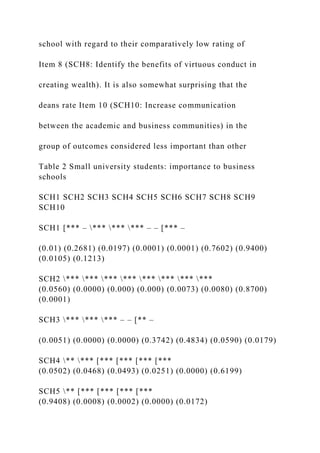
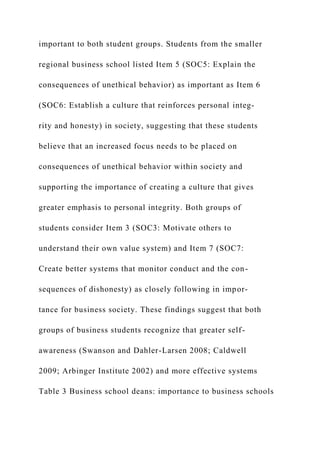
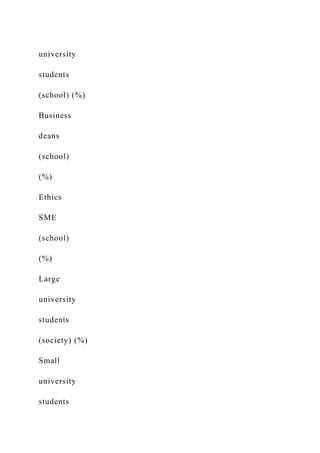
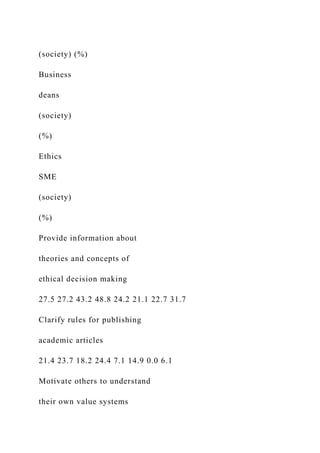
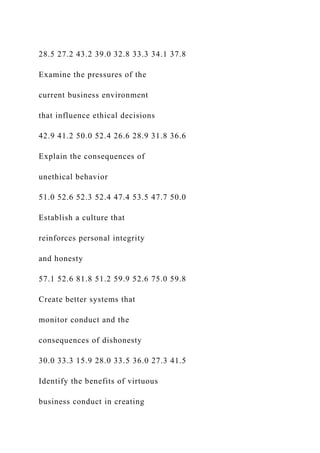
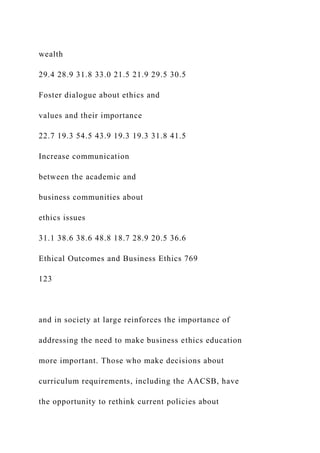
importance of the mindfulness concept within the business
school domain. Mindfulness incorporates the attentiveness
of individuals within an organization to its surroundings
and the capacity to effectively apply values on a timely
basis when unexpected circumstances arise (Levinthal and
Rerup 2006). This ability to address, discuss, and respond
on a timely basis to complex ethical problems is a critical
factor for business schools in the teaching of business
ethics and the resolving of ethical dilemmas (Carroll and
Buchholtz 2012; Badaracco 1997). Fink (2003) noted that
Ethical Outcomes and Business Ethics 759
123
this ability to examine one’s values and the factors that
make up one’s identity was a key element in the learning
process and was critical for significant learning to occur
within the university context. In the ethical decision-mak-
ing process, Hosmer (2010) emphasized the importance of
clarifying the ethical values and assumptions upon which
decision making was based.
Within the larger business context, Senge (2006,
Chap. 4) noted that encouraging open dialogue was a
critical step in the organizational learning process. This
opportunity to encourage free and open discussion of eth-
ical principles and values is essential to meaningful ethical
decision making (cf. Trevino and Nelson 2010; Carroll and
Buchholtz 2012). Covey (2004) described the self-assess-
ment process and the ability to reflect on personal and
organizational values as essential to a principle-centered
life and to ethical decision making in a world where
complexity and rapid change make choices difficult. The
ability to incorporate both normative and rational per-
spectives in decision making is a critical factor for prac-
titioners in their role as effective leaders (Badaracco 1997,
2002; Kolb et al. 2005). Collins and Porras (2004, Chap. 3)
emphasized that it was this ability to clarify and commit to
a driving set of core values that differentiated great com-
panies from those that were second-tier in performance.
Increasing Communication Between Academics
and Practitioners
The relevance of academic theory and the exchange of
information between academics and practitioners have
been frequently addressed as essential elements in mea-
suring the contributing value of business schools (Mintz-
berg 2004; Pfeffer and Fong 2002). Birnik and Billsberry
2008, p. 985) note that there is currently ‘‘great uncertainty
about what management students should be taught and
what they should learn.’’ A number of highly regarded
business scholars have been sharply critical of the focus of
business schools on a purely scientific and economically
based model which discounts values and relationships (cf.
Bennis and O’Toole 2005; Cameron 2006; Giacalone and
Thompson 2006). Rubin and Dierdorff (2011, p. 148) have
drawn the chilling conclusion that ‘‘recent research sug-
gests that courses designed to inculcate human capital
competencies are wholly underrepresented in MBA cur-
ricula.’’ Brinkmann et al. (2011) advocate expanding the
partnership between business schools and practitioners by
having guest speaker practitioners involved in the class-
room to offer their practical perception of ethical
dilemmas.
Although increasing the dialogue between practitioners
and scholars is perceived as a valued means for improving
the practical value of that which is taught in business
schools, many scholars and practitioners lack confidence in
the ability of academics to add value to the private sector
(Bailey et al. 1999; Ghoshal 2005; Mintzberg 2004;
Caldwell and Jeane 2007, p. 3). Rubin and Dierdorff (2009)
noted that practitioner managers consistently rated MBA
curriculum topics lower in importance than did MBA
faculty or administrators. Syed et al. (2010, p. 71) have
suggested that scholars need to be far more practical in
their research design, pay more attention to practitioner
context, and broaden their awareness of ethical implica-
tions of business to become more relevant in bridging the
research–practice gap. In their thoughtful examination of
the practical value of business education, three Harvard
scholars surveyed business school deans and business
executives and concluded that business school curricula are
slow to change, fail to address key behavioral issues, and
need to expand coverage of international business issues
(Datar et al. 2010).
Although a case could have been made to have included
other ethical outcomes in this survey, this section addresses
the importance of the ten outcomes which we have chosen
to include, documenting the importance of each of those
outcomes by citing the scholarly and practitioner literature.
Survey Methodology and Results
A survey instrument was developed using the ten ethically
related business ethics outcomes identified herein, asking
respondents to indicate via a Likert-type scale the relative
level of importance of each item from Not Important to
Critically Important. Respondents were asked to indicate
both the level of importance of each of the ten ethical
outcomes ‘‘to business schools’’ and ‘‘to society.’’ The
survey was administered to subject matter experts who
attended the Eighteenth Annual International Conference
Promoting Business Ethics held at St. Johns University in
2011 (82 responses), to the business school deans of the top
100 US business schools as identified by US News (Morse
and Flanigan 2011) (44 responses), and business students at
a highly rated top 100 business school (466 responses) and
at a small regional business school in the southern United
States (114 responses). A copy of the survey instrument is
included in the Appendix of this paper in Table 14.
In the following tables, we provide the survey results of
each respondent group’s comparisons of the level of
importance of the ten survey items within the business
school environment and within society. In light of the
potential differences existing in business ethics education
at the different business schools, we do not pool data from
our sample schools but provide those results separately. For
the survey data collected, categorical variables are mea-
sured using ordinal scales. Given the limited levels of
760 L. A. Floyd et al.
123
quantified measurement, there is no justification for ana-
lyzing the data using either normal or symmetric distribu-
tion. Implementation of normality tests returned small
p values for the data collected. Therefore, a classical two
samples (or paired sample) t test cannot be applied to
compare the importance rating of survey items. Instead,
according to Hollander and Wolfe (1999) and Anderson
et al. (2011), the Mann–Whitney–Wilcoxon (MWW)
nonparametric method is the appropriate statistical tool for
testing importance comparison for the ten ethical outcomes
in our study. For each respondent group, we applied the
nonparametric method to identify the outcomes which that
group considered to be the most important (1) within a
business school and (2) within society. In addition, we
examine each ethical outcome to identify whether it is
considered to be more important within a business context
or within society. In conducting this statistical analysis, we
used Minitab 16 statistical software. Tables for all of the
responses are included in Table 14 in Appendix.
Table 1 lists comparison results with p values of test
statistics on students’ ratings of the importance of the ten
ethical outcomes within business schools, based upon
survey responses from the 466 students attending the large
top-rated business school. These results suggest that the
business students considered Item 6 (SCH6: Establish a
culture that reinforces personal integrity and honesty) to be
the most important among the ten outcomes. This result is
consistent with the recommendations of several scholars
who have identified the importance of creating an ethical
culture to sustain an environment of academic integrity in
business schools (Trevino and Nelson 2010; Heller and
Heller 2011; Weber 2006). Item 5 (SCH5: Explain the
consequences of unethical behavior), and Item 4 (SCH4:
Examine the pressures of the current business environment
that influence ethical decisions) were considered to be the
second and the third most important in the rankings of
these business students and reflect students’ recognition of
the importance of understanding both the costs of unethical
behavior and the reasons for it occurring within a business
school context (cf. Caldwell 2010). As McCabe et al.
(2006) have noted, these three outcomes are important in
creating an integrated culture of academic integrity at a
university. Item 2 (SCH2: Clarify rules for publishing
academic articles) was rated by these students as the least
important item for business schools, which may reflect the
fact that business students are likely to obtain much of their
academic information from classroom lectures and text-
books, as opposed to academic publications (cf. Burke
et al. 2010), and may have minimal familiarity with stan-
dards for publishing academic articles.
Survey responses provided by the business school stu-
dents from the smaller regional business school reveal
similar results. According to the test statistics in Table 2,
both Item 5 (SCH5, Explaining the consequences of
unethical behavior) and Item 6 (SCH6: Establish a culture
that reinforces personal integrity and honesty) are
Table 1 Large university students: importance to business
schools
SCH1 SCH2 SCH3 SCH4 SCH5 SCH6 SCH7 SCH8 SCH9
SCH10
SCH1 [*** – *** *** *** – – [*** –
(0.000) (0.2233) (0.000) (0.000) (0.000) (0.9393) (0.5679)
(0.0012) (0.4347)
SCH2 *** *** *** *** *** *** *** ***
(0.000) (0.000) (0.000) (0.000) (0.000) (0.000) (0.0098) (0.000)
SCH3 *** *** *** – – [** –
(0.000) (0.000) (0.000) (0.2854) (0.5201) (0.0848) (0.7035)
SCH4 ** *** [*** [*** [*** [***
(0.0253) (0.000) (0.000) (0.000) (0.000) (0.000)
SCH5 ** [*** [*** [*** [***
(0.0174) (0.000) (0.000) (0.000) (0.000)
SCH6 [*** [*** [*** [***
(0.000) (0.000) (0.000) (0.000)
SCH7
– [*** –
(0.6572) (0.0025) (0.5138)
SCH8 [*** –
(0.0086) (0.8075)
SCH9 **
(0.0198)
–
p [ .1; * p  0.1; ** p  0.05; *** p  0.01. p value displayed
inside the parentheses. ‘‘[’’ indicates that corresponding row
item is rated
significantly more important than the column item. ‘‘’’
indicates the opposite
Ethical Outcomes and Business Ethics 761
123
perceived as the most important to business schools, with
Item 4 (SCH4: Examine the pressures of the current busi-
ness environment that influence ethical decisions) as the
third most important item. Item 2 (SCH2: Clarify rules for
publishing academic articles) was rated as the least
important ethical outcome for responding students at this
smaller school. The strong similarity of results from these
two student groups suggests that undergraduate students
share similar perspectives about the relative importance of
these ethical outcomes for the business school environ-
ment, regardless of their school size. Since the academic
requirements for grade average and ACT score from the
smaller regional school are significantly lower than the
larger school’s entry requirements, it appears that percep-
tions about ethical outcomes also do not vary significantly
based upon the incoming academic qualifications of busi-
ness students.
Ratings of the relative importance of the ten ethical
outcomes to business schools, from the 44 business school
deans are presented with statistics shown in Table 3. Based
upon these results, we note that business school deans also
rated Item 6 (SCH6: Establish a culture that reinforces
personal integrity and honesty) to be the most important
outcome for business schools, which is generally consistent
with the students’ rankings. For the deans, however, there
was no conclusive determination of the least important
item. Given p values of MWW test statistics, Item 2
(SCH2: Clarify rules for publishing academic articles),
Item 7 (SCH7: Create better systems that monitor conduct
and the consequences of dishonesty), Item 8 (SCH8:
Identify the benefits of virtuous conduct in creating wealth)
and Item 10 (SCH10: Increase communication between the
academic and business communities) were rated as less
important than other items, but were still rated somewhat
important. Given the fact that all of the business school
deans are from AACSB-accredited business schools and
are highly sensitive to the importance of academic integrity
in publishing in top journals, it is easy to understand why
these deans would rate Item 2 (SCH2: Clarify rules for
publishing academic articles) as more important than
business students rated this outcome. The comparatively
low rating given by deans to the importance of Item 7
(SCH7: Create better systems that monitor conduct and the
consequences of dishonesty) reflects the somewhat sur-
prising survey results of deans wherein ‘‘only about 5% of
deans believed dishonesty was a serious problem in their
school’’ (Brown et al. 2010, p. 299). Although a growing
body of research suggests that virtuous conduct creates
wealth, it is possible that business school deans either may
doubt the validity of that data as applied to the business
school with regard to their comparatively low rating of
Item 8 (SCH8: Identify the benefits of virtuous conduct in
creating wealth). It is also somewhat surprising that the
deans rate Item 10 (SCH10: Increase communication
between the academic and business communities) in the
group of outcomes considered less important than other
Table 2 Small university students: importance to business
schools
SCH1 SCH2 SCH3 SCH4 SCH5 SCH6 SCH7 SCH8 SCH9
SCH10
SCH1 [*** – *** *** *** – – [*** –
(0.01) (0.2681) (0.0197) (0.0001) (0.0001) (0.7602) (0.9400)
(0.0105) (0.1213)
SCH2 *** *** *** *** *** *** *** ***
(0.0560) (0.0000) (0.000) (0.000) (0.0073) (0.0080) (0.8700)
(0.0001)
SCH3 *** *** *** – – [** –
(0.0051) (0.0000) (0.0000) (0.3742) (0.4834) (0.0590) (0.0179)
SCH4 ** *** [*** [*** [*** [***
(0.0502) (0.0468) (0.0493) (0.0251) (0.0000) (0.6199)
SCH5 ** [*** [*** [*** [***
(0.9408) (0.0008) (0.0002) (0.0000) (0.0172)
SCH6 [*** [*** [*** [***
(0.0007) (0.0002) (0.0000) (0.0162)
SCH7
– [*** –
(0.8299) (0.0072) (0.2361)
SCH8 [*** –
(0.0088) (0.1452)
SCH9 **
(0.0001)
–
p [ .1; * p  0.1; ** p  0.05; *** p  0.01. p value displayed
inside the parentheses. ‘‘[’’ indicates that corresponding row
item is rated
significantly more important than the column item. ‘‘’’
indicates the opposite
762 L. A. Floyd et al.
123
factors, inasmuch as deans typically work extensively with
community and business leaders as external liaisons for
their universities (cf. Bailey et al. 2009; Thomas and Fra-
gueiro 2011).
As noted in Table 4, the 82 business ethics subject
matter experts agreed with students that Item 2 (SCH2:
Clarify rules for publishing academic articles) was the least
important of the ethical outcomes. We note with interest
that these 82 business ethics scholars rated all of these
ethical outcomes as generally important for the business
school environment. That fact suggests that these faculty
members and scholars may have a unique insight into the
interrelated nature of these ten ethical outcomes for busi-
ness schools, as compared to other faculty members, and
suggests that they place greater emphasis on the impor-
tance of an integrated system to create academic integrity
at business schools (cf. Datar et al. 2010; Weber et al.
2008; Caldwell 2010).
To compare perspectives about the importance of the ten
ethical outcomes in society, we conducted the same MWW
tests, with those results provided in Tables 5, 6, 7, 8 as
follows. Tables 5 and 6 indicate that both groups of busi-
ness school students rate Item 6 (SOC6: Establish a culture
that reinforces personal integrity and honesty) as the most
important ethical outcome for society. Consistent with
Callahan’s (2004) description of society as a ‘‘cheating
culture,’’ the decline in trust in today’s business leaders,
and the unending sequence of business events that have
reflected a culture of dishonesty, it seems clear that today’s
business students recognize the importance of creating a
business culture that reinforces integrity and honesty. Item
2 (SOC2: Clarify rules for publishing academic articles)
was not surprisingly indicated to be least important to
society, although it was nonetheless rated to be somewhat
important by these students. Although evidence-based
research and compliance with standards for research and
publication are of importance in creating academic credi-
bility (Schminke 2009), the nine other ethical outcomes
included in the survey are apparently perceived to be more
important to both student groups. Students from the smaller
regional business school listed Item 5 (SOC5: Explain the
consequences of unethical behavior) as important as Item 6
(SOC6: Establish a culture that reinforces personal integ-
rity and honesty) in society, suggesting that these students
believe that an increased focus needs to be placed on
consequences of unethical behavior within society and
supporting the importance of creating a culture that gives
greater emphasis to personal integrity. Both groups of
students consider Item 3 (SOC3: Motivate others to
understand their own value system) and Item 7 (SOC7:
Create better systems that monitor conduct and the con-
sequences of dishonesty) as closely following in impor-
tance for business society. These findings suggest that both
groups of business students recognize that greater self-
awareness (Swanson and Dahler-Larsen 2008; Caldwell
2009; Arbinger Institute 2002) and more effective systems
Table 3 Business school deans: importance to business schools
SCH1 SCH2 SCH3 SCH4 SCH5 SCH6 SCH7 SCH8 SCH9
SCH10
SCH1 [** – – – *** [*** [** – –
(0.0153) (0.8413) (0.3877) (0.4678) (0.0011) (0.0010) (0.0308)
(0.4040) (0.5044)
SCH2 ** *** *** *** – – *** –
(00323) (0.0008) (0.002) (0.0000) (0.2061) (0.9202) (0.0017)
(0.1751)
SCH3
– – *** [*** [* [** –
(0.3145) (0.3674) (0.0009) (0.0035) (0.0660) (0.3207) (0.6613)
SCH4
– ** [*** [*** – [*
(0.9269) (0.0078) (0.0000) (0.0035) (0.9634) (0.0665)
SCH5 *** [*** [*** – [*
(0.0098) (0.0001) (0.0067) (0.9070) (0.0882)
SCH6 [*** [*** [** [**
(0.0000) (0.0000) (0.0149) (0.0002)
SCH7
– *** **
(0.3126) (0.0001) (0.0107)
SCH8 *** –
(0.0065) (02529)
SCH9 [*
(0.0762)
–
p [ .1; * p  0.1; ** p  0.05; *** p  0.01. p value displayed
inside the parentheses. ‘‘[’’ indicates that corresponding row
item is rated
significantly more important than the column item. ‘‘’’
indicates the opposite
Ethical Outcomes and Business Ethics 763
123
for monitoring ethical conduct (Lowenstein 2011; Fried-
man 2009) are necessary if ethical business standards are to
be achieved in tomorrow’s business world.
Tables 7 and 8 suggest somewhat similar results from
the ratings provided by business school deans and business
ethics subject matter experts about the importance of the
Table 4 Business experts: importance to business schools
SCH1 SCH2 SCH3 SCH4 SCH5 SCH6 SCH7 SCH8 SCH9
SCH10
SCH1 [*** – – – – [*** [** – –
(0.0001) (0.4004) (0.5023) (0.4962) (0.7460) (0.0017) (0.0172)
(0.5331) (0.7398)
SCH2 *** *** *** *** – ** *** ***
(0.0006) (0.0000) (0.0000) (0.0000) (0.2120) (0.0231) (0.0004)
(0.0003)
SCH3 * * – [** [* – –
(0.0585) (0.0591) (0.2410) (0.0116) (0.0832) (0.8551) (0.6644)
SCH4
– – [*** [*** [* –
(0.9934) (0.7200) (0.0001) (0.0019) (0.0698) (0.3035)
SCH5
– [*** [*** [* –
(0.7126) (0.0001) (0.0020) (0.0697) (0.3035)
SCH6 [*** [*** – –
(0.0005) (0.0064) (0.3361) (0.5002)
SCH7
– *** ***
(0.3983) (0.0089) (0.0070)
SCH8 * **
(0.0627) (0.0453)
SCH9
–
(0.8115)
–
p [ .1; * p  0.1; ** p  0.05; *** p  0.01. p value displayed
inside the parentheses. ‘‘[’’ indicates that corresponding row
item is rated
significantly more important than the column item. ‘‘’’
indicates the opposite
Table 5 Large university students: importance to business
society
SOC1 SOC2 SOC3 SOC4 SOC5 SOC6 SOC7 SOC8 SOC9
SOC10
SOC1 [*** *** ** *** *** *** – – [***
(0.000) (0.000) (0.0171) (0.000) (0.000) (0.9393) (0.6990)
(0.3826) (0.0097)
SOC2 *** *** *** *** *** *** *** ***
(0.000) (0.000) (0.000) (0.000) (0.000) (0.000) (0.000) (0.000)
SOC3 [*** *** *** – [*** [*** [***
(0.004) (0.000) (0.000) (0.7738) (0.000) (0.000) (0.000)
SOC4 *** *** *** [*** [*** [***
(0.000) (0.000) (0.0098) (0.0059) (0.0011) (0.000)
SOC5 *** [*** [*** [*** [***
(0.0002) (0.000) (0.000) (0.000) (0.000)
SOC6 [*** [*** [*** [***
(0.000) (0.000) (0.000) (0.000)
SOC7 [*** [*** [***
(0.000) (0.000) (0.000)
SOC8
– [**
(0.6155) (0.0185)
SOC9 [*
(0.0574)
–
p [ .1; * p  0.1; ** p  0.05; *** p  0.01. p value displayed
inside the parentheses. ‘‘[’’ indicates that corresponding row
item is rated
significantly more important than the column item. ‘‘’’
indicates the opposite
764 L. A. Floyd et al.
123
ten ethical outcomes within society. Both groups rated Item
2 (SOC2: Clarify rules for publishing academic articles) as
the least important outcome to society. Although evidence-
based research is clearly important to society in establish-
ing the credibility of academic research (cf. Amos et al.
2011; Charlier et al. 2011), clarifying the rules for
Table 6 Small university students: importance to business
society
SOC1 SOC2 SOC3 SOC4 SOC5 SOC6 SOC7 SOC8 SOC9
SOC10
SOC1 [*** ** – *** *** *** – [** –
(0.000) (0.0104) (0.34112) (0.0000) (0.000) (0.0011) (0.8026)
(0.0491) (0.6969)
SOC2 *** *** *** *** *** *** *** ***
(0.0000) (0.0000) (0.0000) (0.0000) (0.0000) (0.0000) (0.0041)
(0.0000)
SOC3 [* ** *** – [** [*** [**
(0.0919) (0.0106) (0.0050) (0.4878) (0.0201) (0.0001) (0.0362)
SOC4 *** *** ** – [*** –
(0.0005) (0.0001) (0.0202) (0.4791) (0.0057) (0.5877)
SOC5
– [** [*** [*** [***
(0.8732) (0.0413) (0.0000) (0.0000) (0.0002)
SOC6 [** [*** [*** [***
(0.0237) (0.0000) (0.0000) (0.0000)
SOC7 [*** [*** [***
(0.0026) (0.0000) (0.0061)
SOC8 [** –
(0.0306) (0.8668)
SOC9 **
(0.0281)
–
p [ .1; * p  0.1; ** p  0.05; *** p  0.01. p value displayed
inside the parentheses. ‘‘[’’ indicates that corresponding row
item is rated
significantly more important than the column item. ‘‘’’
indicates the opposite
Table 7 Business school deans: importance to business society
SOC1 SOC2 SOC3 SOC4 SOC5 SOC6 SOC7 SOC8 SOC9
SOC10
SOC1 [*** ** ** *** *** * – [** –
(0.0000) (0.0481) (0.0109) (0.0017) (0.0000) (0.0965) (0.6319)
(0.0338) (0.8022)
SOC2 *** *** *** *** *** *** *** ***
(0.0000) (0.0000) (0.0000) (0.0000) (0.0000) (0.0000) (0.0000)
(0.0000)
SOC3
– – *** – – – [**
(0.5430) (0.1545) (0.0001) (0.6741) (0.2477) (0.847) (0.0242)
SOC4
– *** – [** – [***
(0.2976) (0.0002) (0.2771) (0.0383) (0.6571) (0.0039)
SOC5 *** [** [*** [*** [***
(0.0077) (0.0274) (0.0079) (0.0815) (0.0006)
SOC6 [*** [*** [*** [***
(0.0000) (0.0000) (0.0001) (0.0000)
SOC7
– – –
(0.4315) (0.5471) (0.1049)
SOC8
– –
(0.1907) (0.4602)
SOC9 [**
(0.0152)
–
p [ .1; * p  0.1; ** p  0.05; *** p  0.01. p value displayed
inside the parentheses. ‘‘[’’ indicates that corresponding row
item is rated
significantly more important than the column item. ‘‘’’
indicates the opposite
Ethical Outcomes and Business Ethics 765
123
publishing academic articles is not perceived by deans or
subject matter experts as being as important as the other
nine ethical outcomes. Deans and ethics experts also agreed
that Item 6 (SOC6: Establish a culture that reinforces
personal integrity and honesty) is the most important eth-
ical outcome for society—reinforcing the importance of
integrity in business articulated by a broad variety of
experts (Covey 2004; Hosmer 2010; Kouzes and Posner
2008a, b, 2011; Krehmeyer 2007).
For each group, we also conducted MWW tests to
determine whether a specific item is more important to
business schools than to business society. Test results are
provided in Tables 9, 10, 11, and 12. All four groups
agreed that Item 1 (Provide information about the theories
and concepts of ethical decision making), Item 2 (Clarify
rules for publishing academic articles), Item 4 (Examine
the pressures of the current business environment that
influence ethical decisions) and Item 10 (Increase com-
munication between the academic and business communi-
ties about ethical issues) are more important to business
schools than to the society. Although these topics were all
considered generally important to society, the focus of their
domain was perceived to be more business school-related
or should be emphasized more within a business school
context (cf. Swanson and Fisher 2008, 2011). In addition,
the students from both schools rated Item 8 (Identify the
benefits of virtuous business conduct in creating wealth) as
more important to business schools than to society,
apparently suggesting that business school students may
lack a clear understanding of how being ethical creates
wealth in society (cf. Caldwell and Hansen 2010; Cameron
and Spreitzer 2012). Both the larger schools business stu-
dents and the business school deans-rated Item 9 (Foster
dialogue about ethics and values and their importance) as
being more important to business schools than to society.
These responses suggest that the deans and the students
from the larger business school may both believe that the
business school setting is more appropriate or a more likely
setting for this discussion of ethics and values to occur. For
Item 7 (Create better systems that monitor conduct and the
consequences of dishonesty), both business school deans
and experts think that this outcome is more important to
society. Given the economic impact of dishonest behaviors
on the world economic system, this perspective is certainly
justifiable (Reich 2011; Friedman 2009; Lowenstein 2011).
Table 13 identifies the percentage of respondents within
each group that rated each ethical outcome as ‘‘Critically
Important.’’ Overall, Item 5 (Explaining the consequences
of unethical behavior) and Item 6 (Establish a culture that
reinforces personal integrity and honesty) received the
most ‘‘Critically Important’’ ratings for all groups, with
more than 80 % of the deans indicating that establishing a
culture that reinforces personal integrity and honesty
assigning that rating. In light of the fact that business
schools are known for their high levels of academic dis-
honesty (Trevino and Nelson 2010; Caldwell 2010), but
Table 8 Business experts: importance to business society
SOC1 SOC2 SOC3 SOC4 SOC5 SOC6 SOC7 SOC8 SOC9
SOC10
SOC1 [*** ** ** *** *** ** – ** *
(0.0000) (0.0221) (0.0376) (0.0006) (0.0000) (0.0112) (0.4138)
(0.0130) (0.0904)
SOC2 *** *** *** *** *** *** *** ***
(0.0000) (0.0000) (0.0000) (0.0000) (0.0000) (0.0000) (0.0000)
(0.0000)
SOC3
– – *** – [* – –
(0.7263) (0.1643) (0.0037) (0.7993) (0.0716) (0.9528) (0.4539)
SOC4 ** *** – – – [***
(0.0394) (0.0011) (0.5403) (0.2511) (0.6750) (0.6606)
SOC5
– – [*** [* [**
(0.2013) (0.2575) (0.0024) (0.0935) (0.0186)
SOC6 [*** [*** [*** [***
(0.0077) (0.0000) (0.0044) (0.0004)
SOC7 [** – –
(0.0417) (0.8447) (0.3090)
SOC8 * –
(0.0580) (0.5256)
SOC9
–
(0.3790)
-
p [ .1; * p  0.1; ** p  0.05; *** p  0.01. p value displayed
inside the parentheses. ‘‘[’’ indicates that corresponding row
item is rated
significantly more important than the column item. ‘‘’’
indicates the opposite
766 L. A. Floyd et al.
123
Table 9 Large university students: school versus society
SOC1 SOC2 SOC3 SOC4 SOC5 SOC6 SOC7 SOC8 SOC9
SOC10
SCH1 [***
(0.000)
SCH2 [***
(0.000)
SCH3 **
(0.0257)
SCH4 [***
(0.000)
SCH5
–
(0.2136)
SCH6
–
(0.6867)
SCH7
–
(0.5726)
SCH8 [***
(0.00001)
SCH9 [**
(0.0117)
SCH10 [***
(0.000)
–
p [ .1; * p  0.1; ** p  0.05; *** p  0.01. p value displayed
inside the parentheses. ‘‘[’’ indicates that corresponding row
item is rated
significantly more important than the column item. ‘‘’’
indicates the opposite
Table 10 Small university students: school versus society
SOC1 SOC2 SOC3 SOC4 SOC5 SOC6 SOC7 SOC8 SOC9
SOC10
SCH1 [**
(0.0389)
SCH2 [***
(0.0003)
SCH3
–
(0.2294)
SCH4 [***
(0.0037)
SCH5
–
(0.6880)
SCH6
–
(0.7223)
SCH7
–
(0.3256)
SCH8 [**
(0.0585)
SCH9
–
(0.2470)
SCH10 [***
(0.0038)
–
p [ .1; * p  0.1; ** p  0.05; *** p  0.01. p-value displayed
inside the parentheses. ‘‘[’’ indicates that corresponding row
item is rated
significantly more important than the column item. ‘‘’’
indicates the opposite
Ethical Outcomes and Business Ethics 767
123
Table 11 business school deans: school versus society
SOC1 SOC2 SOC3 SOC4 SOC5 SOC6 SOC7 SOC8 SOC9
SOC10
SCH1 [***
(0.0024)
SCH2 [***
(0.0000)
SCH3
–
(0.3553)
SCH4 [**
(0.0454)
SCH5
–
(0.6993)
SCH6
–
(0.8189)
SCH7 *
(0.0931)
SCH8
–
(0.0086)
SCH9 [**
(0.0289)
SCH10 [***
(0.0078)
–
p [ .1; * p  0.1; ** p  0.05; *** p  0.01. p-value displayed
inside the parentheses. ‘‘[’’ indicates that corresponding row
item is rated
significantly more important than the column item. ‘‘’’
indicates the opposite
Table 12 Business experts: school versus society
SOC1 SOC2 SOC3 SOC4 SOC5 SOC6 SOC7 SOC8 SOC9
SOC10
SCH1 [***
(0.0012)
SCH2 ***
(0.0000)
SCH3
–
(0.6618)
SCH4 [***
(0.0096)
SCH5
–
(0.6189)
SCH6
–
(0.2454)
SCH7 **
(0.0239)
SCH8
–
(0.5418)
SCH9
–
(0.5750)
SCH10 [*
(0.0611)
–
p [ .1; * p  0.1; ** p  0.05; *** p  0.01. p-value displayed
inside the parentheses. ‘‘[’’ indicates that corresponding row
item is rated
significantly more important than the column item. ‘‘’’
indicates the opposite
768 L. A. Floyd et al.
123
only 5 % of deans feel that academic dishonesty is a
problem on their campuses, (Brown et al. 2010, p. 299),
there appears to be a significant inconsistency between the
deans’ responses and the empirical evidence. Item 2
(Clarify rules for publishing academic articles) received the
fewest ‘‘Critically Important’’ ratings, but actually received
fewer such ratings than Item 9 (Foster dialogue about
ethics and values and their importance) within the business
school context. We note that business school students from
both schools rated Item 2 (Clarify rules for publishing
academic articles) as ‘‘Critically Important’’ more fre-
quently than either the deans or the ethics experts—both
within a business school environment and within society.
We note that none of the deans responding rated clarifying
rules for publishing academic articles as ‘‘Critically
Important’’ within society.
Although there are limitations to any data collection
effort from a survey of this type, the results of this survey
suggest that respondents agree that the ten ethical outcomes
identified in this survey are all important, that creating a
culture that reinforces integrity and honesty and identifying
the consequences of unethical behavior are most important,
and that clarifying the rules for publishing academic arti-
cles is least important.
Recommendations
In order to effectively address the important issues and
outcomes identified as important in teaching business eth-
ics at today’s business schools, we have sought to frame the
current status of the dialogue that has evolved in recent
years while adding important new insights from students,
business school deans, and business ethics subject matter
experts. Incorporating this information together, we offer
five recommendations.
(1) Decision makers about business curricula associated
with business ethics should revisit the implications of
the current practice of teaching business ethics to
insure that the priorities indicated in the survey results
are adequately addressed. The substantial agreement
from respondents about the importance of the appli-
cation of business ethics both on the college campus
Table 13 Summary recap: percent rating critically important
Item Large
university
students
(school) (%)
Small
university
students
(school) (%)
Business
deans
(school)
(%)
Ethics
SME
(school)
(%)
Large
university
students
(society) (%)
Small
university
students
(society) (%)
Business
deans
(society)
(%)
Ethics
SME
(society)
(%)
Provide information about
theories and concepts of
ethical decision making
27.5 27.2 43.2 48.8 24.2 21.1 22.7 31.7
Clarify rules for publishing
academic articles
21.4 23.7 18.2 24.4 7.1 14.9 0.0 6.1
Motivate others to understand
their own value systems
28.5 27.2 43.2 39.0 32.8 33.3 34.1 37.8
Examine the pressures of the
current business environment
that influence ethical decisions
42.9 41.2 50.0 52.4 26.6 28.9 31.8 36.6
Explain the consequences of
unethical behavior
51.0 52.6 52.3 52.4 47.4 53.5 47.7 50.0
Establish a culture that
reinforces personal integrity
and honesty
57.1 52.6 81.8 51.2 59.9 52.6 75.0 59.8
Create better systems that
monitor conduct and the
consequences of dishonesty
30.0 33.3 15.9 28.0 33.5 36.0 27.3 41.5
Identify the benefits of virtuous
business conduct in creating
wealth
29.4 28.9 31.8 33.0 21.5 21.9 29.5 30.5
Foster dialogue about ethics and
values and their importance
22.7 19.3 54.5 43.9 19.3 19.3 31.8 41.5
Increase communication
between the academic and
business communities about
ethics issues
31.1 38.6 38.6 48.8 18.7 28.9 20.5 36.6
Ethical Outcomes and Business Ethics 769
123
and in society at large reinforces the importance of
addressing the need to make business ethics education
more important. Those who make decisions about
curriculum requirements, including the AACSB, have
the opportunity to rethink current policies about
business ethics education. For example, a required
business ethics course, offered early in the academic
training of business students, could better prepare
business students to understand key business ethics
issues addressed in the remaining courses in their
business curriculum (Swanson and Fisher 2008;
Weber et al. 2008). This recommendation is not
new. Nearly 95 years ago, Hosmer (1988, p. 9)
recommended that the business school curriculum
begin with an ethics class that included ‘‘the first
principles and essential values of normative philos-
ophy, the processes of application, and the relation-
ships of those principles and values to economic
theory and the law.’’ The net impact of the current
AACSB policy to let business schools adopt a flexible
approach to teaching business ethics has resulted in
fewer than one-third of all business schools even
offering a business ethics course (Cavanagh 2009). In
light of the deteriorating condition of ethical business
behavior and the crisis conditions of plagiarism and
academic dishonesty at business schools (McCable
et al. 2006; Trevino and Nelson 2010), the AACSB
should carefully reconsider its responsibility in
establishing ethics education standards associated
with earning the AACSB accreditation endorsement.
(2) The Academy of Management should expand the
current scope of responsibilities of its Ethics Educa-
tion Committee. The feedback from this survey
suggests that the Academy of Management’s Ethics
Education Committee has the opportunity to expand
its scope from focusing entirely on publication-
related ethical standards to address broader ethical
issues deemed important by deans, ethics experts, and
students. Although clarifying rules for publishing
academic articles has value for Academy members
and is a necessary purpose for the Ethics Education
Committee, that ethical outcome is far from sufficient
to address the needs of Academy members, business
students, business schools, future employers, or
society at large. The evidence from the survey of
students, deans, and ethics subject matter experts
indicates that this ethical outcome is considered least
important overall by each of these parties—including
business school deans. Furthermore, as Schminke
(2011) has noted, the goals outlined by the Acad-
emy’s governing board for this important committee
extend far beyond simply addressing rules for pub-
lishing academic articles. The Academy’s governing
board should send a clear message to the Ethics
Education Committee that it should play a major role
in conducting additional research regarding improv-
ing the effectiveness of business ethics education
programs at colleges and universities, including
studying in-depth those ‘‘model programs’’ that are
most highly regarded (cf. Piper et al. 1993; Weber
et al. 2008; Caldwell 2010).
(3) Business school deans should examine how their
schools can create a more effective culture of academic
integrity on their business school campuses. Over-
whelmingly, responses from respondents to our survey
indicated that creating a culture of integrity was
considered to be a ‘‘Critically Important’’ outcome by
all of the survey groups. By adopting Codes of Ethics,
creating Centers for Ethics, increasing the involvement
of faculty and students in ethics monitoring and
enforcement, and other similar activities, business
school deans can play a major role in creating a culture
of academic integrity (Caldwell 2010; Weber et al.
2008; Swanson and Fisher 2011). Although Christen-
sen et al. (2007) note that some of the top fifty
international business schools have been successful in
creating such a culture, the weight of the evidence
suggests that most business schools fall far below the
standard required to build a meaningful culture of
honesty and integrity. For example, Brown et al. (2010,
p. 299) reported that in their survey of business school
deans ‘‘only about 5 % of deans believed dishonesty
was a serious problem in their school.’’ Apparently,
deans are either denying the clear message about the
problems of academic dishonesty that are admitted by
business school students (McCabe et al. 2006) and that
are going unreported according to the Center for
Academic Integrity (Burke et al. 2007) or believe that
their schools are all an exception to a common trend.
Swanson and Fisher (2008) have suggested that
business school deans are reluctant to push for ethics
courses due to resistance from faculty members.
According to the AACSB, the average tenure of a
business school dean is only 3 years (Thomas and
Fragueiro 2011, p. 54), and apparently deans have been
unwilling to confront the business ethics issue and the
need for expanded ethics education as a priority for
their business school curricula.
(4) Business schools should consider opportunities to
raise the focus of business students on applying the
principles and values taught in order to increase
students’ understanding of the application of those
principles and values. The results from this survey
suggest that the respondents perceive these outcomes
and the application of ethics principles to be impor-
tant both in business schools and in society.
770 L. A. Floyd et al.
123
Accordingly, the opportunity to focus on the teaching
of business ethics education as an application-ori-
ented learning experience appears to be warranted.
For example, involving students in service learning
projects is likely to help students to recognize the
importance of serving the communities in which they
will live and work as future business leaders (Man-
ville and Ober 2003; Seider et al. 2011). Teaching
future business leaders to more fully understand the
importance of good corporate citizenship (Carroll and
Buchholtz 2012; Pless et al. 2011; Godfrey et al.
2005) by actually adding value to society and
addressing community needs can also help to create
the culture of ethical commitment that business deans
and others recognize as so important for business
students (Weber et al. 2008; Swanson and Fisher
2008, 2011). As noted by Buddensick and Lo Re
(2010, p. 101) ‘‘participation in service learning
promotes inquiry of broader global and social issues’’
and ‘‘promotes an enhanced awareness of themselves
and their communities.’’ Hoivik (2004, pp. 239–240)
has noted that application-based approaches to teach-
ing business ethics have resulted in measurable
improvement in ethical awareness, moral reasoning,
and ethical judgment.
(5) Subject matter experts and faculty who teach and
conduct research in business ethics should expand
their research, particularly in applied research fields,
that address how important ethical outcomes can be
more effectively achieved on business school cam-
puses and in society. Examining the survey outcomes
suggests that the focus of those who teach in business
schools may be enhanced by understanding more
fully how the bridging of teaching and application can
change students’ perceptions and behaviors. Addi-
tional research in business ethics may provide
important insights to address the most effective ways
to impact student perceptions and behaviors. For
example, we note that the differences between
responses of large school and small school business
ethics students may suggest that differences in
respondent background or how ethics is taught may
impact the perceptions of students from the respective
schools. The overall results of responses suggest that
current methods of teaching business ethics need to
be studied more carefully to improve their effective-
ness (cf. Mitroff and Swanson 2004; Swanson and
Fisher 2011). We agree with those who suggest that
an evidence-based approach to business decision
making is the best means of changing the minds of
key decision makers (Pfeffer and Sutton 2006, 2007;
Pfeffer 1998), and encourage the expansion of applied
research about business ethics education.
Although we think that these recommendations are
soundly based in evidence and research, we agree with
other scholars (Swanson and Fisher 2008, 2011) that those
who actually make decisions about teaching business eth-
ics, researching business ethics education, and influencing
students in the classroom must ultimately be committed to
changing the behaviors of tomorrow’s future business
leaders. Without that commitment, change is unlikely—but
that change seems to be a clear need in today’s business
school environment and in society at large (Cavanagh
2009; Tichy and McGill 2003). Decision makers and fac-
ulty must have the moral courage (Sekerka et al. 2009;
Secretan 2009; Kouzes and Posner 2008a, b) to make tough
decisions in changing the status quo in business ethics
education (Swanson and Fisher 2008, 2011).
Contributions of Our Paper
This paper is heavily dependent upon the outstanding
research efforts of many business ethics scholars, practi-
tioners, and journalists who have identified the critical
importance of changing the culture in today’s business
environment—both in society at large and in today’s
business schools on campuses throughout the United States
(and throughout the world). Building upon that research,
we have summarized the status of decision makers’ per-
ceptions and actions associated with business ethics edu-
cation. We have added to past research by presenting
additional empirically based insights from business stu-
dents, the deans of the top US business schools, and subject
matter experts who research business ethics. Our paper
adds value to the academic and practitioner ethics literature
in three important ways.
(1) We contribute to the growing body of evidence that
suggests that business schools and their faculties
would more effectively change student behaviors by
recognizing the importance of the ethical outcomes
identified by our respondents as highly important.
Faculty and administrative decision makers may
profit by reconsidering current methods of teaching
business ethics and by creating an environment that
promotes thoughtful ethical analysis in a world where
ethical conduct in business and on campus have been
identified as a major problem (Carroll and Buchholtz
2012; Trevino and Nelson 2010; Callahan 2004). The
results of our survey confirm that students, deans, and
subject matter experts in ethics consider ethical
outcomes as important for both business schools
and society at large.
(2) We provide empirical evidence that affirms that
ethical issues are perceived by business students,
Ethical Outcomes and Business Ethics 771
123
deans, and business ethics subject matter experts as
complex contextual issues with broad ramifications.
In context with other research about the likelihood
that business faculty who teach ethics ‘‘across the
curriculum’’ are perceived as often lacking adequate
knowledge about ethics (Evans and Weiss 2008),
business school administrators and other academic
bodies, including the AACSB, may wish to conduct
extensive research about the most effective way to
teach these complex issues—especially in terms of
how different teaching modalities affect student
perceptions, values, and intentions.
(3) We encourage ethics decision makers to reexamine
how they can more effectively establish standards to
teach business ethics to address the critical problem
of preparing future business leaders to be more
effective at analyzing ethical issues. Swanson and
Frederick (2005) have suggested that those who are
responsible for making key decisions about the
teaching of business ethics are not fully appreciating
the logical consequences of their failure to make
appropriate changes in the status quo. We concur with
that opinion and urge decision makers to take prompt
action to address the ‘‘cheating culture’’ that typifies
today’s society (Callahan 2004). The research from
our study contributes to the extensive research that
affirms that teaching business ethics merits more
study and more empirical measurement (cf. Swanson
and Fisher 2011). Many outstanding universities have
made a concerted effort to improve the quality of
business ethics education, but much more research is
needed. (cf. Piper et al. 1993; Datar et al. 2010;
Weber et al. 2008).
Cavanagh (2009, p. 20) observed that ‘‘(M)ost business
schools would claim that that is not their purpose, nor do
they have the skills’’ to teach their students how to improve
their moral conduct. Other scholars, and the empirical
evidence that they present, suggest that such a change is
not only possible but required to create a healthier and
more productive economy (McCabe et al. 2006). Not-
withstanding, the failure of business schools to ‘‘reduce the
incongruity between doing what is right and doing what it
takes to get ahead’’ (Schwartz et al. 1991, p. 466) business
schools are now being blamed for failing to give adequate
attention to teaching business ethics and for those students
to be accused of being insensitive to issues of ethical
misconduct (Cabral-Cardoso 2004, p. 75).
We note with interest that the Institute for Global Ethics
UK Trust and the Institute of Business Ethics (2011) have
recently identified six key issues associated with the
teaching of business ethics. These subject matter experts
have noted that business ethics education could profit from
(1) Improved clarity about ethics nomenclature and
definitions.
(2) Increased interest and concern for ethics-related
teaching and research.
(3) The embedding of meaningful ethics-related sub-
stance of all business courses.
(4) The articulation of ethics-related criteria for business
schools by accrediting bodies and ranking institu-
tions, such as the Financial Times.
(5) Increased debate and dialogue by universities and
business schools about what it means to actually be an
ethical institution; and
(6) Identifying key stakeholders of business schools and a
mechanism for them to provide feedback about
ethics-related issues (Institute of Global Ethics UK
Trust 2011, p. 4).
Our research described herein provides empirical evidence
that closely parallels the important work done by these two
bodies and affirms the international significance of
addressing the need to improve the teaching of business
ethics.
Conclusion
According to the Washington Post Pulitzer Prize winner,
Kathleen Parker (2012), ‘‘students are not learning what
they need to compete for the jobs that do exist’’ and
numerous studies suggest that universities have not ade-
quately prepared students for careers. A 2009 survey of US
employers conducted for the Association of American
Colleges and Universities also found that 75 % of those
surveyed felt that colleges and universities needed to place
greater emphasis on teaching students skills associated
with the ability to connect choices and actions to ethical
decisions’’ (Hart Research Associates 2010, p. 2). As
Brinkmann and Peattie (2005, p. 151) have observed, the
ability of business schools to self-reflect and self-criticize
with regard to how they teach their students moral values is
more important in the post-Enron era than it has ever been.
In 2004, Ian Mitroff (2004), Distinguished Professor
Emeritus at the USC Marshall School of Business,
expressed his outrage at the state of business ethics edu-
cation. Mitroff (2004, p. 185) wrote that that the ‘‘man-
agement of truth’’ suggests that ‘‘one is willing to do
everything in one’s power to twist and distort numbers,
facts, and conclusions in order to support one’s predeter-
mined purposes.’’ Mitroff (2004, p. 188) closed his letter,
urging that key decision makers and faculty shed the false
notion that they had neither the power nor the responsi-
bility to change the status quo, with regard to business
ethics education and other critical issues facing academia.
772 L. A. Floyd et al.
123
With Mitroff (2004) and other noted scholars, we hope that
those who have the power to improve business ethics
education reflect on their obligations to business schools
and society in using that power.
Appendix
See Table 14.
References
AACSB. (2012). Business Accreditation Standards, Standard 15
Management of Curricula. http://www.aacsb.edu/accreditation/
business/standards/aol/standard15.asp.
AACSB. (2012). Ethics/Sustainability Resource Center,
Frequently
Asked Questions. http://www.aacsb.edu/resources/ethics-
sustainability/faq.asp.
Albert, S., Ashforth, B., & Dutton, J. (2000). Organizational
identity
and identification: Charting new waters and building new
bridges. Academy of Management Review, 25, 13–17.
Amos, B., Klimoski, R., & Marks, M. (2011). The challenges of
leadership development: Are business schools exhibiting evi-
dence based practice? In Academy of management annual
proceedings (pp. 1–6).
Anderson, D. R., Sweeney, D. J., & Williams, T. A. (2011).
Statistics
for business and economics (11th ed.). Mason, OH: South-
Western.
Arbinger Institute. (2002). Leadership and self deception:
Getting out
of the box. Berkeley, CA: Berrett-Koehler.
Badaracco, J. L., Jr. (1997). Defining moments: When managers
must
choose between right and right. Boston, MA: Harvard Business
School Press.
Badaracco, J. L., Jr. (2002). Leading quietly. Boston, MA:
Harvard
Business School Press.
Bailey, A. R., Chow, C. W., & Haddad, K. M. (2009).
Continuous
improvement in business education: Insights from the for-profit
sector and business school deans. Journal of Education for
Business, 74(3), 165–180.
Bedeian, A. G., Taylor, S. G., & Miller, A. N. (2010).
Management
science on the credibility bubble: Cardinal sins and various
misdemeanors. Academy of Management Learning & Education,
9(4), 715–725.
Bennis, W. G., & O’Toole, J. (2005). How business schools lost
their
way. Harvard Business Review, 83(5), 96–104.
Birnik, A., & Billsberry, J. (2008). Reorienting the business
school
agenda: The case for relevance, rigor, and righteousness.
Journal
of Business Ethics, 82(4), 985–999.
Brady, F. N. (1999). A systematic approach to teaching ethics in
business. Journal of Business Ethics, Part 2, 19(3), 309–318.
Brinkmann, J., & Peattie, K. (2005). Exploring business school
ethics.
Journal of Business Ethics Education, 2(2), 151–169.
Brinkmann, J., Sims, R. R., & Nelson, L. J. (2011). Business
ethics across
the curriculum? Journal of Business Ethics Education, 8, 83–
104.
Brown, B. S., Weible, R. J., & Olmosk, K. E. (2010). Business
school
deans on student academic dishonesty: A survey. College
Student Journal Part A, 44(2), 299–308.
Buddensick, J. C., & Lo Re, M. L. (2010). Measuring the effect
of
service learning on civic awareness. Business Research, 10(5),
101–107.
Burke, D. D., Johnson, R. A., & Kemp, D. J. (2010). The
twenty-first
century and legal studies in business: Preparing students to
perform in a globally competitive environment. Journal of Legal
Studies Education, 27(1), 1–33.
Burke, J. A., Polimeni, R. S., & Slavin, N. S. (2007). Academic
dishonesty: A crisis on campus. CPA Journal, 77(5), 58–65.
Cabral-Cardoso, C. (2004). Ethical misconduct in the business
school:
A case of plagiarism that turned bitter. Journal of Business
Ethics, Part 1, 49(1), 75–89.
Caldwell, C. (2009). Identity, self-awareness, and self-
deception:
Ethical implications for leaders and organizations. Journal of
Business Ethics, 90(3), 393–406.
Caldwell, C. (2010). A ten-step model for academic integrity: A
positive approach for business schools. Journal of Business
Ethics, 92(1), 1–13.
Table 14 Survey instrument
Item Description
SCH1 Importance to business schools: provide information
about
theories and concepts of ethical decision making
SOC1 Importance to business society: provide information
about
theories and concepts of ethical decision making
SCH2 Importance to business schools: clarify rules for
publishing
academic articles
SOC2 Importance to business society: clarify rules for
publishing
academic articles
SCH3 Importance to business schools: motivate others to
understand their own value systems
SOC3 Importance to business society: motivate others to
understand their own value systems
SCH4 Importance to business schools: examine the pressures of
the current business environment that influence ethical
decisions
SOC4 Importance to business society: examine the pressures of
the
current business environment that influence ethical
decisions
SCH5 Importance to business schools: explain the consequences
of unethical behavior
SOC5 Importance to business society: explain the consequences
of
unethical behavior
SCH6 Importance to business schools: establish a culture that
reinforces personal integrity and honesty
SOC6 Importance to business society: establish a culture that
reinforces personal integrity and honesty
SCH7 Importance to business schools: create better systems that
monitor conduct and the consequences of dishonesty
SOC7 Importance to business society: create better systems that
monitor conduct and the consequences of dishonesty
SCH8 Importance to business schools: identify the benefits of
virtuous business conduct in creating wealth
SOC8 Importance to business society: identify the benefits of
virtuous business conduct in creating wealth
SCH9 Importance to business schools: foster dialogue about
ethics
and values and their importance
SOC9 Importance to business society: foster dialogue about
ethics
and values and their importance
SCH10 Importance to business schools: increase communication
between the academic and business communities about
ethics issues
SOC10 Importance to business schools: increase communication
between the academic and business communities about
ethics issues
Ethical Outcomes and Business Ethics 773
123
http://www.aacsb.edu/accreditation/business/standards/aol/stand
ard15.asp
http://www.aacsb.edu/accreditation/business/standards/aol/stand
ard15.asp
http://www.aacsb.edu/resources/ethics-sustainability/faq.asp
Caldwell, C., & Hansen, M. (2010). Trustworthiness,
governance, and
wealth creation. Journal of Business Ethics, 97(2), 173–188.
Caldwell, C., & Jeane, L. (2007). Ethical leadership and
building
trust—Raising the bar for business. Journal of Academic Ethics,
5(1), 1–4.
Caldwell, C., Truong, D., Linh, P., & Tuan, A. (2011). Strategic
human resource management as ethical stewardship. Journal of
Business Ethics, 98(1), 171–182.
Callahan, D. (2004). The cheating culture: Why more Americans
are
doing wrong to get ahead. Orlando, FL: Mariner Books.
Cameron, K. S. (2003). Ethics, virtuousness, and constant
change. In
N. M. Tichy & A. R. McGill (Eds.), The ethical challenge: How
to lead with unyielding integrity (pp. 185–194). San Francisco,
CA: Jossey-Bass.
Cameron, K. S. (2006). Good or not bad: Standards and ethics
in
managing change. Academy of Management Learning & Edu-
cation, 5(3), 317–323.
Cameron, K. S., Dutton, J. E., & Quinn, R. E. (2003). Positive
organizational scholarship: Foundations of a new discipline.
San Francisco, CA: Berrett-Koehler.
Cameron, K. S., & Spreitzer, G. M. (2012). The oxford
handbook of
positive organizational scholarship. New York: Oxford Univer-
sity Press.
Carroll, A. B. (1977). Managing corporate social responsibility.
Glenview, IL: Scott Foresman & Company.
Carroll, A. B., & Buchholtz, A. K. (2012). Business and
society:
Ethics, sustainability, and stakeholder management (8th ed.).
Mason, OH: South-Western.
Cavanagh, G. F. (2009). What’s good for business? America,
20(4),
20–22.
Charlier, S. D., Brown, K. G., & Rynes, S. L. (2011). Teaching
evidence-based management in MBA programs: What evidence
is there? Academy of Management Learning & Education,
10(2),
222–236.
Christensen, L. J., Pierce, E., Hartman, L. P., Hoffman, W. M.,
&
Carter, J. (2007). Ethics, CSR, and sustainability education in
the
financial times top 50 global business schools: Baseline data
and
future research directions. Journal of Business Ethics, 73(4),
347–368.
Collins, D. (2009). Essentials of business ethics: Creating an
organization of integrity and superior performance. Hoboken,
NJ: Wiley.
Collins, J., & Porras, J. I. (2004). Built to last: Successful
habits of
visionary companies. New York: HarperCollins Publishing.
Colwell, S., Zyphur, M., & Schminke, M. (2011). When does
ethical
code enforcement matter in the inter-organizational context?
The
moderating role of switching costs. Journal of Business Ethics,
104(1), 47–58.
Comer, D. R., & Vega, G. (2005). An experiential exercise that
introduces the concept of personal ethical threshold to develop
moral courage. Journal of Business Ethics Education, 2(2),
171–197.
Covey, S. R. (1992). Principle-centered leadership. New York:
Simon & Schuster.
Covey, S. R. (2003). The seven habits of highly effective
people:
Powerful lessons in personal change. New York: Simon &
Schuster.
Covey, S. R. (2004). The 8th habit: From effectiveness to
greatness.
New York: Free Press.
Crown, D., & Spiller, M. (1997). Faculty responsibilities in
dealing
with collegiate cheating: A student development perspective.
Teaching Business Ethics, 1, 117–130.
Datar, S. M., Garvin, D. A., & Cullen, P. G. (2010). Rethinking
the
MBA: Business education at a crossroads. Boston, MA: Harvard
Business School Publishing.
Davis, J. H. (February 8, 2011). E-mail communication from
Jim
Davis, Co-chair of the Ethics Education Committee to Cam
Caldwell.
Decoo, W. (2002). Crisis on campus: Confronting academic
miscon-
duct. Hong Kong: The MIT Press.
Elsbach, K. D., & Kramer, R. M. (1996). Members’ responses to
organizational identity threats: Encountering and countering the
business week rankings. Administrative Science Quarterly,
41(3), 442–476.
Embleton, K., & Helfer, D. S. (2007). The plague of plagiarism
and
academic dishonesty. Searcher, 15(6), 23–26.
Evans, F. J., & Robertson, J. W. (2003). Teaching ethics in the
business school: Deans’ perceptions. In AACSB dean’s confer-
ence, Ft. Lauderdale, FL.
Evans, F. J., & Weiss, E. J. (2008). Views on the importance of
ethics
in business education: Survey results from AACSB Deans,
CEOs, and Faculty. In D. L. Swanson & D. G. Fisher (Eds.),
Advancing business ethics education (pp. 43–56). Charlotte,
NC:
Information Age Publishing.
Felton, E. L., & Sims, R. R. (2005). Teaching business ethics:
Targeted outputs. Journal of Business Ethics, 60(4), 377–391.
Fink, L. D. (2003). Creating significant learning experiences:
An
integrated approach to designing college courses. San Fran-
cisco, CA: Jossey-Bass.
Fishbein, M., & Ajzen, I. (1975). Belief, attitude, intention, and
behavior: An introduction to theory and research. Indianapolois,
IN: Addison-Wesley.
Friedman, T. L. (2009). Hot, flat, and crowded: Why we need a
green
revolution—And how it can renew America (Release 2.0). New
York: Picador.
Fulmer, R. M. (2001). Johnson & Johnson: Frameworks for
leader-
ship. Organizational Dynamics, 29(3), 211–220.
George, B. (2009, 11, 25). After the crisis: Restoring trust in
U.S.
leaders. Business Week Online, 11/25/2009, p. 16.
Ghoshal, S. (2003, July, 17). Business schools share the blame
for
enron. Financial Times (FT.com), pp. 1–4.
Ghoshal, S. (2005). Bad management theories are destroying
good
management practices. Academy of Management Learning &
Education, 4, 75–91.
Giacalone, R., & Thompson, K. (2006). Business ethics and
social
responsibility education: Shifting the worldview. Academy of
Management Learning and Education, 5(3), 266–277.
Gioia, D. A. (1992). Pinto fires and personal ethics: A script
analysis
of missed opportunities. Journal of Business Ethics, 11(5/6),
379–389.
Godfrey, P. C., Illes, L. M., & Berry, G. R. (2005). Creating
breadth
in business education through service-learning. Academy of
Management Learning & Education, 4(3), 309–323.
Goodchild, L. F. (1986). Toward a foundational normative
method in
business ethics. Journal of Business Ethics, 5(6), 485–498.
Hart Research Associates. (2010). Raising the bar-employers’
views
on college learning in the wake of the economic downturn.
Conducted for the Association of American Colleges and
Universities. http://www.aacu.org/leap/documents/2009_Emplo
yerSurvey.pdf.
Heller, N. A., & Heller, V. L. (2011). Business ethics
education: Are
business schools teaching to the AACSB ethics education task
force recommendations?’’. International Journal of Business &
Social Science, 2(20), 30–38.
Hoffman, W. M., Driscoll, D., & Painter-Morland, M. (2001).
Integrating ethics. In C. Moon & C. Bonny (Eds.), Business
ethics: Facing up to the issues (pp. 38–54). London: The
Economist Books.
Hoivik, H. v. W. (2004). Learning experiences from designing
and
teaching a mandatory MBA course on ethics and leadership.
774 L. A. Floyd et al.
123
http://www.aacu.org/leap/documents/2009_EmployerSurvey.pdf
Journal of Business Ethics Education, 1(2), 239–255. Supp.
2004 Special Issue.
Hollander, M., & Wolfe, D. A. (1999). Nonparametric statistical
methods (2nd ed.). New York: Wiley.
Hosmer, L. T. (1985). The other 338. Why a majority of our
schools
of business administration do not offer a course in business
ethics. Journal of Business Ethics, 4, 17–22.
Hosmer, L. T. (1988). Adding ethics to the business curriculum.
Business Horizons, 31(4), 9–15.
Hosmer, L. T. (1994). Strategic planning as if ethics mattered.
Strategic Management Journal, 15, 17–34.
Hosmer, L. T. (1995). Trust: The connecting link between
organi-
zational theory and philosophical ethics. Academy of Manage-
ment Review, 20(2), 379–403.
Hosmer, L. T. (2010). The ethics of management (7th ed.). New
York:
McGraw-Hill Irwin.
Hughes, T., O’Regan, N., & Wornham, D. (2008). The
credibility
issue: Closing the academic/practitioner gap. Strategic Choice,
17(7/8), 215–233.
Huselid, M. A. (1995). The impact of human resource
management
practices on turnover, productivity, and corporate financial
performance. Academy of Management Journal, 38(3), 635–672.
Institute for Global Ethics UK Trust in collaboration with the
Institute
of Business Ethics (2011). Promoting cultures of integrity: Six
ethical issues for business education. Report of a consultation
held at St. George’s House, Windsor Castle, June 7–8, 2011.
Junion-Metz, G. (2000). The E-plagiarism plague. School
Library
Journal, 56, 43–44.
Karri, R., Caldwell, C., Antonacopoulou, E. P., & Naegle, D.
(2005).
Building trust in schools of business—Opportunities for ethical
governance. Journal of Academic Ethics, 3(2–4), 159–182.
Klein, W. H. (1998). Recollections on implementing the ideas
of
Conceptual Foundations. In R. F. Duska (Ed.), Education,
leadership, and business ethics: Essays on the work of Clarence
Walton (pp. 91–109). Dordrecht: Kluwer Academic Publishers.
Koehn, D. (2005). Transforming our students: Teaching
business
ethics post-Enron. Business Ethics Quarterly, 15, 137–151.
Kolb, R., LeClair, D., Pelton, L., Swanson, D., & Windsor, D.
(2005).
Panel: The role of ethics in business curricula. Journal of
Business Ethics Education, 2(1), 5–12.
Kouzes, J. M., & Posner, B. Z. (2008a). Credibility: How
leaders gain
and lose it, why people demand it. San Francisco, CA: Jossey-
Bass.
Kouzes, J. M., & Posner, B. Z. (2008b). The leadership
challenge (4th
ed.). San Francisco, CA: Jossey-Bass.
Krehmeyer, D. (2007, October, 26). Teaching business ethics: A
critical need. Business Week Online, p. 4.
Levinthal, D., & Rerup, C. (2006). Crossing an apparent chasm:
Bridging mindful and less-mindful perspectives on organiza-
tional learning. Organization Science, 17, 502–513.
Lewis, B., Duchac, J., & Beets, D. S. (2011). An academic
publisher’s
response to plagiarism. Journal of Business Ethics, 102(3),
489–506.
Li, S. (2010, July, 9). Journal review process increasingly
includes
check for plagiarism. The Chronicle of Higher Education
Website.
Linton, J. D., Tierney, R., & Walsh, S. T. (2011). Publish or
perish: How
are research and reputation related? Serials Review, 37(4),
244–257.
Lowenstein, R. (2011). The end of wall street. New York: The
Penguin Press.
Madsen, S. R. (2011). Communications between Cam Caldwell
and
Susan Madsen, Co-Chair of the Academy of Management Ethics
Education Committee, regarding the role of the Ethics
Education
Committee in a series of phone calls and e-mails in January and
February, 2011.
Manville, B., & Ober, J. (2003). A company of citizens: What
the
world’s first democracy teaches leaders about creating great
organizations. Boston, MA: Harvard Business School Press.
Maritz Research. (2010, April, 14). Managing in an era of
distrust:
Maritz Poll reveals employees lack trust in their workplace.
Martin, K., & Parmar, B. (2012). Assumptions in decision
making
scholarship: Implications for business ethics research. Journal
of
Business Ethics, 105(3), 289–306.
McCabe, D. L., Butterfield, K. D., & Trevino, L. K. (2006).
Academic
dishonesty in graduate business programs: Prevalence, causes,
and proposed action. Academy of Management Learning &
Education, 5(3), 294–305.
McCabe, D. L., Trevino, L. K., & Butterfield, K. D. (2002).
Honor
codes and other contextual influences on academic integrity: A
replication and extension to modified honor code settings.
Research in Higher Education, 43(3), 357–378.
McLean, B., & Elkind, P. (2003). The smartest guys in the
room: The
amazing rise and scandalous fall of Enron. New York: Penguin.
Miller, A. N., & Bedeian, A. G. (2010). Publish or perish:
Academic
life as we live it (pp. 1–6). In Academy of management annual
meeting proceedings.
Mintzberg, H. (2004). Managers not MBAs: A hard look at the
soft
practice of managing and management development. San
Francisco, CA: Berrett-Koehler.
Mitroff, I. I. (2004). An open letter to the deans and faculties of
American business schools. Journal of Business Ethics, 54(2),
185–189.
Mitroff, I. I., & Swanson, D. L. (2004, June). An open letter to
the
deans and faculties of american business schools: A call for
action. Academy of Management Newsletter.
Morse, R., & Flanigan, S. (2011, March 14). Business schools
ranking
methodology. US News—Education. http://www.usnews.com/
education/best-graduate-schools/articles/2011/03/14/business-
school-rankings-methodology-2012.
Naimi, L. (2007). Strategies for teaching research ethics in
business,
management and organizational studies. Electronic Journal of
Business Research Methods, 5(1), 26–39.
Nicklaus, D. (2002). Is a bigger dose of ethics needed in
business
schools? St. Louis Post Dispatch, p. C10.
O’Neill, O. A., Feldman, D. C., Vandenberg, R. J., DeJoy, D.
M., &
Wilson, M. G. (2011). Organizational achievement values, high-
involvement work practices, and business unit performance.
Human Resource Management, 50(4), 541–558.
Paine, L. S. (2003). Value shift: Why companies must merge
social
and financial imperatives to achieve superior performance. New
York: McGraw-Hill.
Parker, K. (2012, January, 9). U.S. higher education failing to
focus
on basic skills. The News Tribune. http://www.thenewstribune.
com/2011/10/04/1850686/us-higher-education-failing-to.html.
Pfeffer, J. (1998). The human equation: Building profits by
putting
people first. Boston, MA: Harvard Business School Press.
Pfeffer, J. (2005). Why do bad management theories persist? A
comment on Ghoshal’’. Academy of Management Learning &
Education, 4(1), 96–100.
Pfeffer, J., & Fong, C. T. (2002). The end of business schools?
Less
success than meets the eye. Academy of Management Learning
& Education, 1(1), 78–95.
Pfeffer, J., & Sutton, R. (1999). Management half-truths and
nonsense: How to practice evidence-based management. Cali-
fornia Management Review, 48(3), 77–100.
Pfeffer, J., & Sutton, R. (2006). Evidence-based management.
Harvard Business Review, 84(7/8), 184–190.
Piper, T. R., Gentile, M. C., & Parks, S. D. (1993). Can ethics
be
taught? Perspectives, challenges, and approaches at the Har-
vard Business School. Boston, MA: Harvard Business School
Press.
Ethical Outcomes and Business Ethics 775
123
http://www.usnews.com/education/best-graduate-
schools/articles/2011/03/14/business-school-rankings-
methodology-2012
http://www.usnews.com/education/best-graduate-
schools/articles/2011/03/14/business-school-rankings-
methodology-2012
http://www.usnews.com/education/best-graduate-
schools/articles/2011/03/14/business-school-rankings-
methodology-2012
http://www.thenewstribune.com/2011/10/04/1850686/us-higher-
education-failing-to.html
http://www.thenewstribune.com/2011/10/04/1850686/us-higher-
education-failing-to.html
Pless, N. M., Maak, T., & Stahl, G. K. (2011). Developing
responsible
global leaders through international service-learning programs:
The ulysses experience. Academy of Management Learning &
Education, 10(2), 237–260.
Procario-Foley, E. G., & Bean, D. F. (2002). Institutions of
higher
education: Cornerstones in building ethical organizations.
Teaching Business Ethics, 6, 101–116.
Ravenscroft, S., & Dillard, J. (2008). Moral imagining: Toward
using
cognitive science in teaching business ethics. In D. L. Swanson
& D. G. Fisher (Eds.), Advancing business ethics education (pp.
167–189). Charlotte, NC: Information Age Publishing.
Rawe, J. (2007). A question of honor. Time, 169(22), 59–60.
Ray, J. L., Baker, L. T., & Plowman, D. A. (2011).
Organizational
mindfulness in business schools. Academy of Management
Learning & Education, 10(2), 188–203.
Reich, R. B. (2011). Aftershock: The next economy and
America’s
future. New York: Picador.
Rubin, R. S., & Dierdorff, E. C. (2009). How relevant is the
MBA?
Assessing the alignment of required MBA curricula and
required
managerial competencies. Academy of Management Learning &
Education, 8, 208–224.
Rubin, R. S., & Dierdorff, E. C. (2011). On the road to Abilene:
Time
to manage agreement about curricular relevance. Academy of
Management Learning & Education, 10(1), 148–161.
Ryan, T. G., & Bisson, J. (2011). Can ethics be taught?
International
Journal of Business & Social Science, 2(12), 44–52.
Schein, E. H. (2010). Organizational culture and leadership (4th
ed.).
San Francisco, CA: Jossey-Bass.
Schminke, M. (2009). Editor’s comments: The better angels of
our
nature—Ethics and integrity in the publishing process. Academy
of Management Review, 34(4), 586–591.
Schminke, M. (2011). E-mail communication from Marshall
Schm-
inke, former Chair of the Academy of Management Ethics
Education Committee, to Cam Caldwell on February 10, 2011,
summarizing the role of the committee.
Schwartz, R. H., Kassem, S., & Ludwig, D. (1991). The role of
business schools in managing the incongruence between doing
what is right and doing what it takes to get ahead. Journal of
Business Ethics, 10(6), 465–469.
Secretan, L. (2009). Moral courage. Leadership Excellence,
26(1),
18–20.
Seider, S., Gillmor, S., & Rabinowicz, S. (2011). The impact of
community service learning upon the worldviews of business
majors versus non-business majors at an American University.
Journal of Business Ethics, 98(3), 485–503.
Sekerka, L., Bagozzi, R., & Charnigo, R. (2009). Facing ethical
challenges in the workplace: Conceptualizing and measuring
professional moral courage. Journal of Business Ethics, 89(4),
565–579.
Senge, P. M. (2006). The fifth discipline: The art & practice of
the
learning organization. New York: Doubleday.
Sims, R. R. (2002). Teaching business ethics for effective
learning.
Westport, CT: Quorum Books.
Sims, R. R., & Sauser, W. I., Jr (Eds.). (2011). Experiences in
teaching business ethics. Charlotte, NC: Information Age
Publishing.
Stansbury, J. M., & Sonenshein, S. (2012). Positive business
ethics:
Grounding and elaborating a theory of good works. In K.
S. Cameron & G. M. Spreitzer (Eds.), The oxford handbook of
positive organizational scholarship (pp. 340–352). Oxford:
Oxford University Press.
Swanson, D. L., & Dahler-Larsen, P. (2008). Toward an ethical
sense
of self for business education. In D. L. Swanson & D. G. Fisher
(Eds.), Advancing business ethics education (pp. 191–220).
Charlotte, NC: Information Age Publishing.
Swanson, D. L., & Fisher, D. G. (2008). Business ethics
education: If
we don’t know where we’re going, any road will take us there.
In
D. L. Swanson & D. G. Fisher (Eds.), Advancing business ethics
education (pp. 1–23). Charlotte, NC: Information Age
Publishing.
Swanson, D. L., & Fisher. D. G. (2011). Assessing business
ethics
education: Starting the conversation in earnest. In D. L.
Swanson
& D. G. Fisher (Eds.), Toward assessing business ethics
education. Advancing business ethics education (pp. 1–21).
Charlotte, NC: Information Age Publishing.
Swanson, D. L., & Frederick, W. C. (2005). Denial and
leadership in
business ethics education. In R. A. Petersen & O. C. Ferrell
(Eds.), Business ethics: New challenges for business schools
and
corporate leaders (pp. 222–240). Armonk, NY: M. E. Sharpe.
Syed, J., Mingers, J., & Murray, P. A. (2010). Beyond rigour
and
relevance: A critical realist approach to business education.
Management Learning, 41(1), 71–85.
Taylor, R. L., & Stanton, A. D. (2009). Academic publishing
and
teaching effectiveness: An attitudinal study of AACSB accred-
ited business school faculty. Academy of Educational
Leadership
Journal, 13(2), 93–106.
Thomas, H., & Fragueiro, F. (2011). The dean’s many roles.
BizEd,
10(3), 54–59.
Tichy, N. M., & McGill, A. (Eds.). (2003). The ethical
challenge:
How to lead with unyielding integrity. San Francisco, CA:
Jossey-Bass.
Trevino, L. K., & Nelson, K. A. (2010). Managing business
ethics:
Straight talk about how to do it right (5th ed.). Hoboken, NJ:
Wiley.
Ulrich, D., Huselid, M. A., & Becker, B. E. (2001). The HR
scorecard: Linking people, strategy, and performance. Boston,
MA: Harvard Business School Press.
Vega, G. (2007). Teaching business ethics through service
learning
metaprojects. Journal of Management Education, 31(5), 647–
678.
Vidaver-Cohen, D. (2004). Fish starts to rot from head: The role
of
business school deans in curriculum planning for ethics. Journal
of Business Ethics Education, 1(2), 213–228.
Walker, M., Paletta, D., Blackstone, B., Gongloff, M., & Vieira,
P.
(2011). Global crisis of confidence. Wall Street Journal,
258(37),
A1–A10.
Warnell, J. M. (2011). Ask more of business education: Giving
voice
to values for emerging leaders. Journal of Business Ethics
Education, 8, 3210–3325.
Warren, B. W., & Rosenthal, D. (2006). Teaching business
ethics—Is
it a lost cause?’’. International Journal of Management, Part 2,
23(3), 679–698.
Weber, J. (2006). Implementing an organizational ethics
program in
an academic environment: The challenges and opportunities for
the Duquesne University Schools of Business. Journal of
Business Ethics, 65(1), 23–42.
Weber, J., Gerde, V. W., & Wasieleski, D. M. (2008). A
blueprint for
designing an ethics program in an academic setting. In D.
L. Swanson & D. G. Fisher (Eds.), Advancing business ethics
education (pp. 85–101). Charlotte, NC: Information Age
Publishing.
Weick, K. E. (2009). Making sense of the organization (Vol. 2).
West
Sussex: Wiley.
Whitney, K. (2010). Teaching right and wrong. Chief Learning
Officer, 9(6), 36–39.
Windsor, D. (2002). Moral activism and value harmonization in
an
integrating global economy. Research in Ethical Issues in
Organizations, 4, 85–105.
776 L. A. Floyd et al.
123
Reproduced with permission of the copyright owner. Further
reproduction prohibited without
permission.
c.10551_2013_Article_1717.pdfEthical Outcomes and Business
Ethics: Toward Improving Business Ethics
EducationAbstractStatus of Business Ethics
EducationDescription of Survey OutcomesFoundations of
Decision MakingClarifying Rules for Academic
PublicationsMotivating Others to Understand ValuesExamining
the Pressures of the Current Business EnvironmentIdentifying
Consequences of Unethical BehaviorEstablishing a Culture that
Reinforces IntegrityCreating Better Monitoring SystemsIdentify
the Benefits of Virtuous ConductFoster Dialogue About Ethics
and ValuesIncreasing Communication Between Academics and
PractitionersSurvey Methodology and
ResultsRecommendationsContributions of Our
PaperConclusionAppendixReferences
Bus 4801 Unit 10 Final Project/Unit 10 Personal Code of
Ethics.pdf
UNIT 10
Unit 10 Personal Code Of Ethics
INTRODUCTION
Click A Personal Code of Ethics to view the presentation.
In today's business world, we can see that a policy can be an
ideal vision of behavior. In this unit, you will draft your
corporate
policy to remedy an ethical issue that you find relevant. You
have
studied many ethical issues from many different perspectives
and
have evaluated the tools with which to make decisions
concerning
those issues. Now, it is time to act on that knowledge and
recommend a corporate policy that will make a meaningful
change concerning an issue you feel is important.
OBJECTIVES
To successfully complete this learning unit, you will be
expected to:
Recommend a corporate policy for resolving an ethical issue.1.
Assess how a recommended corporate policy is socially
responsible.2.
Support corporate policy recommendation for business ethics
policies and standards.3.
Recommend a strategy for communicating a policy to an
organization in a manner that meets the needs of the
audience.
4.
Describe potential limitations of a policy and strategies for
monitoring and compliance.5.
[u10s1] Unit 10 Study 1
Studies
Readings
Use the Capella library to read Floyd, Xu, Atkins, and
Caldwell's 2013 article, "Ethical Outcomes and
Business Ethics: Toward Improving Business Ethics Education,"
from Journal of Business Ethics, volume
117, issue 4, pages 753–776.
Use the Internet to read Burcea and Croitoru's 2014 article,
"Business Ethics," from Journal of Public
Administration, Finance and Law, volume 3, issue 6, pages
139–143.
[u10a1] Unit 10 Assignment 1
Addressing an Ethical Issue
For this final project, imagine that the CEO has asked human
resources department to review the
company's policies. You have been personally asked to identify
an issue you feel needs addressing, to
evaluate different parameters for ethically deciding on how to
address the issue, and then to evaluate
various polices and propose a policy that the company can
implement to addresses the chosen issue.
In your paper:
Describe an ethical dilemma and its importance and relevance.
Identify the various stakeholders and their positions.
A Personal Code of Ethics
Transcript
Unit 10 – BUS4801 - Apr 11 2016 to Jun 17 2016 - Section 03
https://courserooma.capella.edu/webapps/blackboard/content/lis
tContent....
1 of 3 6/12/2016 10:31 AM
Evaluate an ethical decision-making model,
apply it to the chosen issue, and analyze
options for resolving this ethical dilemma.
Recommend a corporate policy for
resolving the issue and support the
recommendation with well-reasoned
analysis and specific examples, including
the impact on various stakeholders.
Analyze and recommend a strategy for
communicating the policy to the
organization in a manner that meets the needs of the audience.
Specify potential limitations of the policy and strategies for
monitoring and compliance.
As you can see, you have already accomplished many of these
points in the previous components of the
project (in Units 2 and 7). In this assignment, consolidate those
pieces and add additional information
to complete the evaluation and recommendation to the CEO.
Review the Addressing an Ethical Issue Scoring Guide to
understand the grading criteria for this
assignment.
Submission Requirements
Your paper should meet the following requirements:
Written communication: Written communication is free of
errors that detract from the overall message.
APA formatting: References and citations are formatted
according to current APA style and formatting
guidelines.
Number of resources: Minimum of four resources.
Length of paper: About 2,500 words, or 10 typed, double-spaced
pages.
Font and Font Size: Arial, 10 point.
Once complete, submit your paper in the assignment area.
[u10d1] Unit 10 Discussion 1
Putting It All Together
Throughout this course, you discussed
business ethics as they apply to specific
situations. Taking a step back, assess the role
of ethics in business generally.
In your post, address the following:
What are the biggest impediments to
ethical behavior in business?
How do you think ethical behavior can be instilled while trying
to make profits for shareholders, based on
what you have learned in the course?
Response Guidelines
Feel free to comment on the post of your peers, but responses
are not required for this discussion.
[u10d2] Unit 10 Discussion 2
Resources
Addressing an Ethical Issue Scoring Guide.
APA Style and Format.
Capella Online Writing Center.
Smarthinking.
Resources
Discussion Participation Scoring Guide.
Unit 10 – BUS4801 - Apr 11 2016 to Jun 17 2016 - Section 03
https://courserooma.capella.edu/webapps/blackboard/content/lis
tContent....
2 of 3 6/12/2016 10:31 AM
Ethics and Enterprise Learning
It is now time to reflect on how the
information in this course may have
personally affected you and your view on
ethics.
Based on what you learned in this course,
complete the following:
Describe how your ethical decision making ability has
improved.
Explain what values, if any, you have adopted for your personal
code of ethics.
Describe what you feel is the most important thing you have
learned in this course.
Response Guidelines
Feel free to comment on the posts of your peers, but responses
are not required for this discussion.
Unit 10 Updates and Handouts
Periodically, information will be posted in this space for the
good of the class.
Ask Your Instructor
This thread was created to provide a convenient space for you to
ask questions—questions about
particular assignment and discussion activities, questions about
the course in general, questions about
expectations. If there is something that you feel you could use
help with, please post your question
here. Most likely, some of your classmates will have the same
concern, so your post may help several
learners. If you feel your question is private, please use the
Messages tool found under Notifications.
Resources
Discussion Participation Scoring Guide.
Unit 10 – BUS4801 - Apr 11 2016 to Jun 17 2016 - Section 03
https://courserooma.capella.edu/webapps/blackboard/content/lis
tContent....
3 of 3 6/12/2016 10:31 AM
3012 Unit 5 Final Project/3012 Unit 5 Final Project Hints.docx
Final Project Hints
Thank you in advance for taking the time to read this in great
detail. I assure you that it will be time well spent.
Past students have made the error of sending me a history report
on the individual they interviewed or researched for the class
project. That is not what the assignment calls for.
You selected Option B, do not simply submit a biography on
your subject. That is a sub-section of this assignment. You have
to conduct research to determine how he/she would have
answered the seven questions listed in the directions.
So how do you earn an “A”? That is easy……
Research (Option B) your leader. Conduct excellent research.
APA FORMAT MUST BE CORRECT
I have created the following outline to assist you:
Cover page
Table of Contents
Introduction -Explain why you chose your selected leader.
Provide a background, including the context of the leader's
environment and the culture of the organization and society.
Speak to the characteristics of your specific leader relevant to a
critical evaluation of leadership. (Two pages max.)
Definition of Leadership (Share your selected individual’s
definition of leadership.)
Model the Way (Speak to how your leader accomplishes this
and the remaining four principles below. Use examples. Also,
use headings so each section is crystal clear to me.)
Inspire a Shared Vision
Challenge the Process
Enable Others to Act
Encourage the Heart
Challenges and Opportunities (Speak to the challenges and
opportunities of your selected leader. This is a section of its
own. It is NOT your conclusion.)
Conclusion/Reflection (Don’t forget a conclusion and or
reflection.)
Reference page
I know you can do it!!!!! :)
3012 Unit 5 Final Project/Discussion Participation Scoring
Guide.pdf
Due Date: Weekly. Percentage of Course Grade: 30%.
Discussion Participation Grading Rubric
Criteria Non-performance Basic Proficient Distinguished
Applies relevant course
concepts, theories, or materials
correctly.
Does not explain relevant course
concepts, theories, or materials.
Explains relevant course
concepts, theories, or materials.
Applies relevant course
concepts, theories, or materials
correctly.
Analyzes course concepts, theories, or
materials correctly, using examples or
supporting evidence.
Collaborates with fellow
learners, relating the
discussion to relevant course
concepts.
Does not collaborate with fellow
learners.
Collaborates with fellow learners
without relating discussion to the
relevant course concepts.
Collaborates with fellow
learners, relating the discussion
to relevant course concepts.
Collaborates with fellow learners,
relating the discussion to relevant
course concepts and extending the
dialogue.
Applies relevant professional,
personal, or other real-world
experiences.
Does not contribute professional,
personal, or other real-world
experiences.
Contributes professional,
personal, or other real-world
experiences, but lacks relevance.
Applies relevant professional,
personal, or other real-world
experiences.
Applies relevant professional, personal,
or other real-world experiences to
extend the dialogue.
Participation Guidelines
Actively participate in discussions. To do this you should create
a substantive post for each of the discussion
topics. Each post should demonstrate your achievement of the
participation criteria. In addition, you should also
respond to the posts of at least two of your fellow learners for
each discussion question-unless the discussion
instructions state otherwise. These responses to other learners
should also be substantive posts that contribute to
the conversation by asking questions, respectfully debating
positions, and presenting supporting information
relevant to the topic. Also, respond to any follow-up questions
the instructor directs to you in the discussion
area.
To allow other learners time to respond, you are encouraged to
post your initial responses in the discussion area
by midweek. Comment to other learners' posts are due by
Sunday at 11:59 p.m. (Central time zone).
Print
Discussion Participation Scoring Guide
https://courserooma.capella.edu/bbcswebdav/institution/BUS/B
US3012/...
1 of 1 6/12/2016 11:19 AM
3012 Unit 5 Final Project/ebook_login_access.docx
The below information will provide access to the ebook The
leadership challenge for course Bus 3012
BookShelf – Vital Source
Website https://www.vitalsource.com/
Website Signin https://bookshelf.vitalsource.com/#/user/signin
Login ID [email protected]
PW CPU_2016_
3012 Unit 5 Final Project/Effective Leadership Practices Project
Scoring Guide.pdf
Due Date: End of Unit 5.
Percentage of Course Grade: 25%.
Effective Leadership Practices Project Scoring Guide Grading
Rubric
Criteria Non-performance Basic Proficient Distinguished
Explain the characteristics of a
specific leader relevant to a
critical evaluation of
leadership.
20%
Does not explain the characteristics
of a specific leader relevant to a
critical evaluation of leadership.
Discusses the characteristics
of a specific leader relevant to
a critical evaluation of
leadership.
Explains the characteristics of
a specific leader relevant to a
critical evaluation of
leadership.
Evaluates the characteristics of a
specific leader relevant to a critical
evaluation of leadership.
Describe the context (including
background, culture of the
organization and society) of a
specific leader's environment.
20%
Does not describe the context
(including background, culture of
the organization and society) of a
specific leader's environment.
Discusses the context
(including background,
culture of the organization and
society) of a specific leader's
environment.
Describes the context
(including background,
culture of the organization and
society) of a specific leader's
environment.
Evaluates the context (including
background, culture of the
organization and society) of a
specific leader's environment,
based on relevant literature.
Describe a specific leader's
definition of leadership.
20%
Does not describe a specific
leader's definition of leadership.
Discusses a specific leader's
definition of leadership.
Describes a specific leader's
definition of leadership.
Evaluates a specific leader's
definition of leadership, based on
relevant literature.
Describe how a specific leader
demonstrates the practices of
exemplary leadership.
20%
Does not describe how a specific
leader demonstrates the practices of
exemplary leadership.
Discusses how a specific
leader demonstrates the
practices of exemplary
leadership.
Describes how a specific
leader demonstrates the
practices of exemplary
leadership.
Evaluates how a specific leader
demonstrates the practices of
exemplary leadership, based on
relevant literature.
Describe the challenges and
opportunities faced by a
specific leader.
20%
Does not describe the challenges
and opportunities faced by a
specific leader.
Lists the challenges and/or
opportunities faced by a
specific leader.
Describes the challenges and
opportunities faced by a
specific leader.
Evaluates the challenges and
opportunities faced by a specific
leader, and how they impact the
leader's approach to leadership.
Print
Effective Leadership Practices Project Scoring
Guide
Effective Leadership Practices Project Scoring Guide
https://courserooma.capella.edu/bbcswebdav/institution/BUS/B
US3012/...
1 of 1 6/12/2016 11:19 AM
3012 Unit 5 Final Project/GREAT Discussion Guidelines and
Checklist.pdf
Introduction
This document provides guidance in creating substantive
discussion posts and providing feedback to learning
peers within the context of the coursework.
Substantive Discussion Posts
At the core of all Capella courses is a public discussion of
issues pertinent to the topics at hand. Typically, in
each unit, your instructor will post two or three questions in the
courseroom (which is where discussion takes
place). You are required to respond substantively to each. You
may ask, what is meant by substantively?
To understand what a substantive discussion is, remember the
components of a G.R.E.A.T. post:
Grammar rules apply. Make sure your posts are written
effectively.
Relevance is important. Your posts should pertain to the
readings, assignment or to the ongoing
discussion.
Engage your audience. Incorporate your interpretation of the
topic or issue.
Add value to the discussion. Generate questions, or provide
other learners with new information.
Timeliness is key. Provide your peers and instructors the
opportunity to respond.
The guideline is 250 words in length, but you should regard this
only as a guideline. If you have more to say
about a topic, you should do so. If you have said everything that
you can about a question and cannot meet the
guideline, it is better to post what you have than to add
irrelevant material just to get to 250 words. Your
instructor is going to evaluate you on what you wrote more than
on how much you wrote.
Responses to Other Learners
Capella learners bring a wealth of experiences to the course,
building and engaging our courseroom learning
community. As a member of the learning community, you are
expected to respond to the posts of your peers.
Your responses should address the substance of what was
written. Learning is a social experience; others are
depending on your insightfulness and contributions. A good
technique is to react and ask the author of the initial
post questions about what he or she wrote. This accomplishes
two useful things:
You will think more carefully about what was written if you
have to ask a question about it.
It stimulates discussion.
You should be supportive of and encouraging to your fellow
learners. If you read something that you like or that
you think was well written, say so. However, simple agreement
or disagreement should be accompanied by
substantive reasons, examples, or evidence. Asking questions is
an excellent way to encourage your peers to
share that experience.
Most learners find discussion posts and responses very helpful
in building their online community. Your fellow
learners comprise a valuable resource for you. Typically, they
are very experienced in their own fields and have
a great deal to share. Most are interested in forming a scholarly
network that can provide support and resources
with whom to share ideas. Being part of a community of
learning may be one of the most valuable aspects of
Print
GREAT Discussion Guidelines and Checklist
https://courserooma.capella.edu/bbcswebdav/institution/BUS/B
US3012/...
1 of 3 6/12/2016 11:20 AM
your time with Capella.
Guidelines for Effective Feedback
What Is Effective Feedback?
One of your responsibilities to yourself and your learning
community is to contribute to the process of giving
and receiving feedback. To help support a positive learning
experience at Capella, there are guidelines for
giving and receiving such feedback. Generally, exchanging
effective feedback is a part of your weekly
interactive learning discussions. Many courses at Capella also
use a formal peer review process for giving and
receiving feedback on course papers and projects.
Effective feedback:
Honors competence and reinforces behaviors.
Aligns expectations and course work priorities.
Fills gaps in knowledge.
Supports individuals to take corrective action.
Directs individuals toward meeting learning goals.
Giving Feedback
The following is a list of tips for giving effective feedback:
Plan your feedback. Making notes first may help you decide
what you want to say and how you want to
say it.
Focus on the work. Address the ideas shared, and avoid personal
comments.
Be specific. If something is not working, identify it and
describe why.
Suggest alternatives.
Acknowledge what works well. Offer praise.
Be courteous and truthful.
Ask questions for clarity.
Acknowledge valid points of view. Agree with what is true.
Explain yourself. Go beyond, “good point!” Elaborate your
comments with concisely written paragraphs.
Receiving Feedback
The following is a list of tips for receiving effective feedback:
Listen at all times, even in an online environment.
Be receptive to what others have to say.
Ponder what is said.
Challenge your work.
Prioritize the feedback you receive. Some learners use green,
yellow, and red to categorize their revisions
according to importance.
Remember that not everyone has to agree with your work. It is
okay for others to challenge it.
Checklist for Discussion Posts
GREAT Discussion Guidelines and Checklist
https://courserooma.capella.edu/bbcswebdav/institution/BUS/B
US3012/...
2 of 3 6/12/2016 11:20 AM
Ask yourself the following questions when participating in the
class dialogue, to improve the quality of the
courseroom discussion and to support team learning:
Does my contribution fit with the dialogue, or should I start a
separate discussion?1.
Are my ideas logically organized into an argument, and written
in clear and mechanically clean prose?2.
Am I expressing worthwhile ideas, or do they just take up
space?3.
Is the central thesis statement clear (whether direct or
implied)?4.
Can the reader easily determine what my main point is?5.
Does it provide sufficient, relevant, and interesting details?6.
Are there sufficient explanations or examples to support any
generalizations?7.
Does this contribution provide a series of points that add up to
an argument supporting the main point
(thesis)?
8.
Does the contribution proceed logically from point to point?9.
Are there any contradictions? Is the paragraph structure
logical?10.
Are there appropriate transitions words between ideas? Does it
flow?11.
Have I followed the courseroom etiquette?12.
Is my point of view clear?13.
Is the tone appropriate and respectful of others' ideas?14.
Do the hyperlinks work and follow the correct format?15.
Is the writing punctuated appropriately?16.
Is my contribution concise, precise, and free of grammatical
errors?17.
Are words spelled correctly?18.
If I referenced other authors, did I provide the appropriate
citation?19.
GREAT Discussion Guidelines and Checklist
https://courserooma.capella.edu/bbcswebdav/institution/BUS/B
US3012/...
3 of 3 6/12/2016 11:20 AM
3012 Unit 5 Final Project/Unit 5 Instructions.pdf
UNIT 5
Effective Leadership Practices
INTRODUCTION
In this course so far, you have learned four of Kouzes and
Posner's five practices of effective leadership:
Modeling the way.1.
Inspiring a shared vision.2.
Challenging the process.3.
Enabling others to act.4.
The fifth and final practice is encouraging the heart (Kouzes &
Posner, 2008).
Effective leaders realize that employees should be recognized
for a job well done. While some individuals
prefer public praise and others prefer personal recognition, most
employees want to be recognized in some
way.
In your readings for this unit, Kouzes and Posner state that
effective leaders begin their leadership
development by first learning to lead themselves. Effective
leadership begins from within and expands
outward to affect others. Kouzes and Posner describe how this
development cascades into effective
leadership (Kouzes & Posner, 2008).
You now have all of the tools needed to complete the course
project. When interviewing your selected leader
or researching your leader subject, remember to address the
practices, theories, styles, and characteristics
of effective leadership. Use them in your analysis of effective
leaders and in developing your own positive
leadership capabilities.
Reference
Kouzes, J., & Posner, B. (2012). The leadership challenge (5th
ed.). San Francisco, CA: Jossey-Bass.
OBJECTIVES
To successfully complete this learning unit, you will be
expected to:
Describe how the Kouzes and Posner philosophy would be
demonstrated through rewarding and recognizing
others.
1.
Articulate methods for celebrating and recognizing others that
reflect the principle of encouraging the heart.2.
Describe how exemplary leadership practices are reflected
through the leadership demonstrated by business or
community leaders.
3.
Evaluate the influence of environmental factors and
organizational culture on the leadership practices of
business or community leaders.
4.
Evaluate the extent to which strategies that integrate leadership
strengths and themes apply to specific
challenges and opportunities faced by business or community
leaders.
5.
Provide a course reflection on individual lessons for leadership
development.6.
[u05s1] Unit 5 Study 1
Studies
Readings
Use your The Leadership Challenge text to complete the
following reading:
Unit 5 – BUS3012 - May 16 2016 to Jun 17 2016 - Section 02
https://courserooma.capella.edu/webapps/blackboard/content/lis
tContent....
1 of 3 6/12/2016 10:38 AM
Chapter 12, "Leadership Is Everyone's Business," pages 329–
345.
[u05a1] Unit 5 Assignment 1
Effective Leadership Practices Project
Define effective leadership practices, based
on either your Option A interview or your
Option B research. Your final paper should
include the following:
Explain why you chose your selected
leader.
Evaluate the characteristics of a specific
leader relevant to a critical evaluation of
leadership.
Provide a background, including the context of the leader's
environment and the culture of the
organization and society.
Address each of the interview or research questions that follow.
Interview or Research Questions
In either your Option A interview or your Option B research,
address the following questions:
What is your chosen leader's definition of leadership?
How does your chosen leader demonstrate the five practices of
exemplary leadership?
How does your chosen leader model the way?1.
How does your chosen leader inspire a shared vision?2.
How does your chosen leader challenge the process?3.
How does your chosen leader enable others to act?4.
How does your chosen leader encourage the heart (Kouzes &
Posner, 2012)?5.
What challenges and opportunities does your chosen leader
face?
Complete and submit your final project as an attachment to this
assignment. You are also required to
submit your assignment to Turnitin (Unit 5 Effective Leadership
Practices Project).
Your paper should be 4–7 pages in length and include a
minimum of two sources other than your
textbook.
Format your paper according to current APA style and
formatting guidelines.
[u05d1] Unit 5 Discussion 1
Encouraging the Heart
In your readings for this unit from The
Leadership Challenge, you are introduced to
the last of the five practices of effective
leadership: encourage the heart. According to
Kouzes and Posner, leaders must recognize
contributions and celebrate values and
victories, in order to encourage the heart.
Resources
Effective Leadership Practices Project Scoring Guide.
APA Style and Formatting.
Turnitin.
Resources
Discussion Participation Scoring Guide.
GREAT Discussion Guidelines.
Unit 5 – BUS3012 - May 16 2016 to Jun 17 2016 - Section 02
https://courserooma.capella.edu/webapps/blackboard/content/lis
tContent....
2 of 3 6/12/2016 10:38 AM
The essentials of recognizing contributions include:
Expect the best.
Personalize recognition.
The essentials of celebrating the values and victories include:
Create a spirit of community.
Be personally involved.
For this discussion post, imagine that you have been asked by
your leader to create a rewards and
recognition program for your organization. Describe a program
that would reflect Kouzes and Posner's
approach to recognizing and celebrating others and their
contributions to the organization. Be specific
and as concrete as possible. Include guidelines and suggestions
where necessary.
Response Guidelines
Read your peers' posts and respond to at least two. Consider
your peers' ideas for rewards and
recognition programs. Compare and contrast their ideas to
yours. Describe ideas your peers suggested
that you would like to include in your program. Include
additional thoughts or reflections that further
the discussion. If possible, respond to peers who have not
already received feedback.
Reference
Kouzes, J., & Posner, B. (2012). The leadership challenge (5th
ed.). San Francisco, CA: Jossey-Bass.
[u05d2] Unit 5 Discussion 2
Course Reflection
Reflect upon your experience in this course
and identify three key concepts you have
learned that will help you in your current or
future leadership role.
Response Guidelines
Simply read your peers' posts. No responses
are required for this discussion.
Updates and Handouts
Periodically, information will be posted in this space for the
good of the class.
Ask Your Instructor
This thread was created to provide a convenient space for you to
ask questions—questions about
particular assignment and discussion activities, questions about
the course in general, questions about
expectations. If there is something that you feel you could use
help with, please post your question
here. Most likely, some of your classmates will have the same
concern, so your post may help several
learners. If you feel your question is private, please use the
Messages tool found under Notifications.
Resources
Discussion Participation Scoring Guide.
GREAT Discussion Guidelines.
Unit 5 – BUS3012 - May 16 2016 to Jun 17 2016 - Section 02
https://courserooma.capella.edu/webapps/blackboard/content/lis
tContent....
3 of 3 6/12/2016 10:38 AM
3012 Unit 5 Final Project/3012 Final Course Project.pdf
COURSE PROJECT
Effective Leadership Practices
The focus of this course project is to provide an opportunity for
you to closely examine effective
leadership practices. To complete this project, you will research
concepts in leadership and gather data
to support a definition of effective leadership, based on an in-
depth study of one real-world business
leader. You will use the five practices of exemplary leadership
from The Leadership Challenge textbook
as guidelines in your analysis. You will submit a final paper in
Unit 5 that incorporates your findings
throughout the course from the following project component
assignments:
Unit 1: Definition of Leadership.
Unit 2: Leadership Theories.
Unit 3: Leadership Styles and Characteristics.
Your definition of effective leadership must be based on the
example of a real-world business leader. You
must select the business leader you wish to study very early in
the course. You may study either a
business leader you know personally or a business leader from
the Option B Leader List. The business
leader you choose will determine which of the following two
project options you should pursue.
Option A: Interview a Personally-Known Business Leader
Identify an individual who is currently serving in a leadership
capacity at an organization you work for or
for which you have some knowledge. Arrange an interview with
your selected individual. Structure the
topic of your interview based on the five practices of exemplary
leadership outlined in your The
Leadership Challenge textbook, which are also listed below as
the Interview or Research Questions.
Conduct the interview, then write a summary describing how the
five practices are reflected through the
leadership demonstrated by the leader. Explain why you chose
your selected business leader. Provide
background and context for the environment and culture of the
organization for which your selected
leader provides leadership. Note: For your paper, change the
name and work affiliation of the leader
you interview in order to protect his or her privacy, but provide
the background and context as indicated
in this project description.
Option B: Research a Well-Known Business Leader
It may be difficult for you to gain access to interview an
available business leader within the timeframe
of this course. If so, with instructor approval, you can opt to
research a well-known business leader
from the Option B Leader List. Note: If you choose Option B,
you are required to choose someone from
this list.
Focus your research on addressing the five practices of
exemplary leadership outlined in your The
Leadership Challenge textbook, which are also listed below as
the Interview or Research Questions.
Write a summary describing how the five practices are reflected
through the leadership demonstrated
by the leader. Explain why you chose your selected leader.
Provide background and context for the
environment and culture of the organization or society in which
your selected leader provides
leadership.
Interview or Research Questions
In either your Option A interview or your Option B research,
address the following questions:
What is your chosen leader's definition of leadership?
How does your chosen leader demonstrate the five practices of
exemplary leadership?
How does your chosen leader model the way?1.
How does your chosen leader inspire a shared vision?2.
Course Project – BUS3012 - May 16 2016 to Jun 17 2016 - ...
https://courserooma.capella.edu/webapps/blackboard/content/lis
tContent....
1 of 5 6/12/2016 12:31 PM
How does your chosen leader challenge the process?3.
How does your chosen leader enable others to act?4.
How does your chosen leader encourage the heart (Kouzes &
Posner, 2012)?5.
What challenges and opportunities does your chosen leader
face?
Reference
Kouzes, J., & Posner, B. (2012). The leadership challenge (5th
ed.). San Francisco, CA: Jossey-Bass.
Project Objectives
To successfully complete this project, you will be expected to:
Evaluate the purpose and relevance of leadership.1.
Evaluate how leadership strengths apply in the workplace and
within the community.2.
Project Requirements
To achieve a successful project experience and outcome, you
are expected to meet the following requirements.
Written communication: Written communication is free of
errors that detract from the overall message.
APA formatting: Resources and citations are formatted
according to current APA style and formatting.
Length of paper: 4–7 typed, double-spaced pages.
Font and font size: Times New Roman, 12-point.
Project Grading Criteria
Effective Leadership Practices Project Scoring Guide Grading
Rubric
Criteria Non-performance Basic Proficient Distinguished
Explain the
characteristics of a
specific leader relevant
to a critical evaluation
of leadership.
20%
Does not explain the
characteristics of a
specific leader relevant to
a critical evaluation of
leadership.
Discusses the
characteristics of a
specific leader relevant to
a critical evaluation of
leadership.
Explains the
characteristics of a
specific leader relevant to
a critical evaluation of
leadership.
Evaluates the
characteristics of a
specific leader relevant to
a critical evaluation of
leadership.
Describe the context
(including background,
culture of the
organization and
society) of a specific
leader's environment.
20%
Does not describe the
context (including
background, culture of
the organization and
society) of a specific
leader's environment.
Discusses the context
(including background,
culture of the
organization and society)
of a specific leader's
environment.
Describes the context
(including background,
culture of the
organization and society)
of a specific leader's
environment.
Evaluates the context
(including background,
culture of the
organization and society)
of a specific leader's
environment, based on
relevant literature.
Describe a specific
leader's definition of
leadership.
20%
Does not describe a
specific leader's definition
of leadership.
Discusses a specific
leader's definition of
leadership.
Describes a specific
leader's definition of
leadership.
Evaluates a specific
leader's definition of
leadership, based on
relevant literature.
Describe how a specific
leader demonstrates
the practices of
exemplary leadership.
20%
Does not describe how a
specific leader
demonstrates the
practices of exemplary
leadership.
Discusses how a specific
leader demonstrates the
practices of exemplary
leadership.
Describes how a specific
leader demonstrates the
practices of exemplary
leadership.
Evaluates how a specific
leader demonstrates the
practices of exemplary
leadership, based on
relevant literature.
Describe the
challenges and
opportunities faced by
Does not describe the
challenges and
opportunities faced by a
Lists the challenges
and/or opportunities
faced by a specific leader.
Describes the challenges
and opportunities faced
by a specific leader.
Evaluates the challenges
and opportunities faced
by a specific leader, and
Course Project – BUS3012 - May 16 2016 to Jun 17 2016 - ...
https://courserooma.capella.edu/webapps/blackboard/content/lis
tContent....
2 of 5 6/12/2016 12:31 PM
Criteria Non-performance Basic Proficient Distinguished
a specific leader.
20%
specific leader. how they impact the
leader's approach to
leadership.
Project Components
Project Component Course Grade Weight Unit Due
Definition of Leadership 10% 1
Leadership Theories 10% 2
Leadership Styles and Characteristics 10% 3
Effective Leadership Practices Project 25% 5
Total: 55%
[u01a1] Unit 1 Assignment 1
Definition of Leadership
Based on the readings for this unit, your
independent research, and your
self-reflection, write a paper that addresses
the following prompts:
What is your definition of leadership?
How important is it to have a definition of
leadership? How does your definition
support your perspective on the concept of
leadership?
What is your approach to understanding
leadership? Does it start with a definition, or do you simply
follow your instincts?
What is your definition of management?
What do you see as the differences between leadership and
management?
Complete and submit your assignment as an attachment. You are
also required to submit your
assignment to Turnitin (Unit 1 Definition of Leadership).
Your paper should be 2–3 pages in length and include a
minimum of two sources other than your
textbook. Format your paper according to current APA style and
formatting guidelines.
[u02a1] Unit 2 Assignment 1
Leadership Theories
A leader must understand how leadership
theories can be used to influence and reward
individuals and teams, and develop
interpersonal skills that build trust.
Resources
Definition of Leadership Scoring Guide.
Capella Writing Center.
APA Style and Formatting.
Turnitin.
Resources
Leadership Theories Scoring Guide.
Course Project – BUS3012 - May 16 2016 to Jun 17 2016 - ...
https://courserooma.capella.edu/webapps/blackboard/content/lis
tContent....
3 of 5 6/12/2016 12:31 PM
In your paper, address the following:
Part One
In this unit's studies, you were directed to
select and research three leadership theories.
If you have not already done so, return to the
Independent Research section of this unit's studies and complete
the research. Summarize the three
leadership theories that you have selected. For each of the three
theories, identify the theorists, provide
a context, and provide an overall synopsis.
Part Two
Answer the following questions for each theory:
How can a leader use the theory to influence and reward
individuals and teams? Provide examples of how
a leader might use the theory as a strategy for leading in a work
environment or in a community.
How can a leader use the theory to develop interpersonal skills
for building trust? Provide examples of how
a leader might use the theory as a strategy for leading in a work
environment or in a community.
Complete and submit your assignment as an attachment. You are
also required to submit your
assignment to Turnitin (Unit 2 Leadership Theories).
Your paper should be 3–4 pages in length and include a
minimum of two sources other than your
textbook.
Format your paper according to current APA style and
formatting guidelines.
[u03a1] Unit 3 Assignment 1
Leadership Styles and Characteristics
For this assignment, analyze some of the
more common leadership styles and
characteristics of effective leaders, utilizing
the guidance below. Before starting, view the
Leadership Styles and Characteristics
illustration from your studies for this unit.
Select an organization (profit or non-profit)
and a leader within the organization whom
you admire. This should be an organization
where you might aspire to become a leader.
Note: You cannot use the individual OR organization you are
researching for your course project, due in
Unit 5.
Address the following prompts:
Describe this organization and the type of products or service it
provides. Add other background
information, such as size, years in business, location, and
reputation.
Analyze the leadership styles and characteristics of the leader
you selected.
Compare your own individual leadership styles and
characteristics to what you just described. Apply the
terms from the Leadership Styles and Characteristics illustration
in describing your leadership approach.
What type of leader do you see yourself to be?
Analyze how environmental and societal factors such as politics
and innovation might influence your
approach to leadership at this organization. How would these
(and other factors) affect the way you lead, if
Capella Writing Center.
APA Style and Formatting.
Turnitin.
Resources
Leadership Styles and Characteristics Scoring Guide.
Capella Writing Center.
APA Style and Formatting.
Turnitin.
Course Project – BUS3012 - May 16 2016 to Jun 17 2016 - ...
https://courserooma.capella.edu/webapps/blackboard/content/lis
tContent....
4 of 5 6/12/2016 12:31 PM
at all? Would there be differences in your leadership style if
you were in a different type of organization,
such as a technology company or a non-profit?
Analyze how economic conditions might influence your
approach to leadership. Would your leadership style
change during the time of a strong economy or a declining
economy? Would your style change if you were
leading an organization through different maturation phases
(including start-up, growth, and established)?
Complete and submit your assignment as an attachment. You are
also required to submit your
assignment to Turnitin (Unit 3 Leadership Styles and
Characteristics).
Your paper should be 3–4 pages in length and include a
minimum of two sources other than your
textbook.
Format your paper according to current APA style and
formatting guidelines.
[u05a1] Unit 5 Assignment 1
Effective Leadership Practices Project
Define effective leadership practices, based
on either your Option A interview or your
Option B research. Your final paper should
include the following:
Explain why you chose your selected
leader.
Evaluate the characteristics of a specific
leader relevant to a critical evaluation of
leadership.
Provide a background, including the context of the leader's
environment and the culture of the
organization and society.
Address each of the interview or research questions that follow.
Interview or Research Questions
In either your Option A interview or your Option B research,
address the following questions:
What is your chosen leader's definition of leadership?
How does your chosen leader demonstrate the five practices of
exemplary leadership?
How does your chosen leader model the way?1.
How does your chosen leader inspire a shared vision?2.
How does your chosen leader challenge the process?3.
How does your chosen leader enable others to act?4.
How does your chosen leader encourage the heart (Kouzes &
Posner, 2012)?5.
What challenges and opportunities does your chosen leader
face?
Complete and submit your final project as an attachment to this
assignment. You are also required to
submit your assignment to Turnitin (Unit 5 Effective Leadership
Practices Project).
Your paper should be 4–7 pages in length and include a
minimum of two sources other than your
textbook.
Format your paper according to current APA style and
formatting guidelines.
Resources
Effective Leadership Practices Project Scoring Guide.
APA Style and Formatting.
Turnitin.
Course Project – BUS3012 - May 16 2016 to Jun 17 2016 - ...
https://courserooma.capella.edu/webapps/blackboard/content/lis
tContent....
5 of 5 6/12/2016 12:31 PM

Bus 4801 Unit 10 Final Project4801 Unit 10 Final Course Project.docx

  • 1.
    Bus 4801 Unit10 Final Project/4801 Unit 10 Final Course Project.pdf COURSE PROJECT Course Project Overview The study of ethics becomes a purely academic exercise unless one can apply what is learned to professional life. This project will help you make this type of application. To complete the project, you will: Identify that an issue in a company has potential ethical ramifications that you would like to see resolved by a corporate policy. Demonstrate why the issue is relevant and needs to be addressed. Examine the issue from all sides and from the perspective of all stakeholders. Evaluate different ethical decision-making models covered in the course. You will be asked to choose one model and apply it to the issue you identified. Recommend a corporate policy that the company can implement to addresses the chosen issue. Ultimately, corporations are formed to make money. So, in your course project, you will balance the need to practice corporate social responsibility with the corporation's prime directive of increasing profits. Specifically, your project will weigh the impact of not having a corporate policy for the issue you have chosen against the cost of implementing one.
  • 2.
    At the culminationof the project, you will recommend a policy that addresses the ethical issue chosen and that can be implemented by a company. The policy needs to be specific and address all stakeholders, as well as include provisions for monitoring the effectiveness of the policy, for dealing with employees who fail to comply, and for adapting the policy if it needs changing in the future. In recommending the policy, you will be expected to argue for your policy with well-reasoned analysis and specific examples. You are expected to synthesize much of the work done for the assignments in Units 2 and 7 into a cohesive proposal, supporting the need for your policy. Project Objectives To successfully complete this project, you will be expected to: Assess the degree of social responsibility in a corporate policy.1. Develop a corporate policy for resolving ethical dilemmas.2. Evaluate the parameters of ethical decision-making models as they apply to the recommended policy.3. Support recommendations with well-reasoned analysis and specific examples.4. Recommend a strategy for communicating the policy to the organization in a manner that meets the needs of the audience. 5. Describe potential limitations of the policy and strategies for monitoring and compliance.6. Communicate your ideas in a style suitable to academic readers.7. Project Requirements
  • 3.
    To achieve asuccessful project experience and outcome, you are expected to meet the following requirements. Written communication: Written communication is free of errors that detract from the overall message. APA formatting: References and citations are formatted according to current APA style and formatting guidelines. Number of resources: Minimum of four resources. Length of paper: 2,500 words, or 10 typed, double-spaced pages. Note that the final paper includes the project components completed in Units 2 and 7, as well as final content completed in Unit 10. Font and Font Size: Arial, 10-point. Course Project – BUS4801 - Apr 11 2016 to Jun 17 2016 - ... https://courserooma.capella.edu/webapps/blackboard/content/lis tContent.... 1 of 5 6/12/2016 10:38 AM Please see the individual assignments for the requirements of each. Project Grading Criteria project_grading.html Project Components Project Component Course Grade Weight Unit Due Company Issue Identification 10% 2 Impact of Corporate Social Responsibility Policy 10% 7
  • 4.
    Addressing an EthicalIssue 20% 10 Total: 40% [u02a1] Unit 2 Assignment 1 Company Issue Identification This is the first component of your course project. Identify an Ethical Issue In the Unit 1 assignment, you were asked to discuss your personal ethical views. In this assignment, you should consider what a company-wide ethical dilemma looks like. You will first need to identify a current or potential ethical dilemma at a real company. This could be a company where you are now employed, your former employer, a friend's company, or another company with which you are familiar. The issue should also be something that needs to be addressed with an organizational policy inside the company. In other words, you believe that a policy change would be better than other courses of action (such as disciplinary action toward an individual employee, or external action by the government or a nonprofit). You do not have to create a policy at this time, but be prepared to explain why implementing a policy would be the right choice. Note: The issue you select for this assignment will be used in the Unit 7 assignment and your final project in Unit 10. For example, a company may choose to videotape the office and read employee e-mails. The conflict here may be that employees feel these practices are a violation of privacy and feel they have a right to a certain level of the privacy. However, stakeholders defend these practices because their concerns are
  • 5.
    whether the employeesare getting their work done. Assignment Instructions Identify the ethical issue. Using best practices for academic writing, write an essay that covers all of the following: Explain why you chose this particular issue and why you believe it is important. Resources Company Issue Identification Scoring Guide. APA Style and Format. Capella Online Writing Center. Smarthinking. Course Project – BUS4801 - Apr 11 2016 to Jun 17 2016 - ... https://courserooma.capella.edu/webapps/blackboard/content/lis tContent.... 2 of 5 6/12/2016 10:38 AM Describe other stakeholders for this ethical issue, and what concerns they are likely to have. Explain why you believe that an organizational policy is the right way to resolve the issue. Describe how this particular issue might be related to larger problems that affect your community, the country, or the world. Is the issue currently in the media spotlight? Are there any recent incidents or reasons why this issue has come to the public's attention? Support your choices with cited concepts from reliable professional sources. Review the Company Issue Identification Scoring Guide to learn
  • 6.
    how to understandthe grading criteria for this assignment. Submission Requirements Your paper should meet the following requirements: Written communication: Written communication is free of errors that detract from the overall message. APA formatting: References and citations are formatted according to current APA style and formatting guidelines. Length of paper: 750–1,250 words, or 3–5 typed, double-spaced pages. Font and Font Size: Arial, 10 point. Once complete, submit your paper in the assignment area. [u07a1] Unit 7 Assignment 1 Impact of Corporate Social Responsibility Policy This is the second component of your course project. In this assignment, you will return to the company-wide dilemma that you wrote about in the Unit 2 assignment. Please note that you will incorporate this paper into your final project, due in Unit 10. For this assignment, consider how a company's social responsibility can affect the workplace, stakeholders, clients, and other outside parties. In your paper, complete the following: Explain in general terms how a company's social responsibility policy can complement its obligation to maximize profits for shareholders. Where might these goals conflict? Explain how you think the ethical issue itself might be affecting employees, considering the specific
  • 7.
    company dilemma youdiscussed in the Unit 2 assignment. How about shareholders? Clients? Outside parties? State the approaches to ethical decision making (as discussed in Chapter 2 of your text) you would recommend for creating a policy to solve the issue. Explain. Write an overview of a company policy that could be created, based on this decision-making approach, to address the ethical dilemma. Explain the effects your policy might have on employees, if the company actually used the policy you just described. What would be the effects on shareholders? On clients? On other outside parties? Please consider both the potential positive and negative outcomes. Review the Impact of Corporate Social Responsibility Policy Scoring Guide to understand the grading Resources Impact of Corporate Social Responsibility Policy Scoring Guide. APA Style and Format. Capella Online Writing Center. Smarthinking. Course Project – BUS4801 - Apr 11 2016 to Jun 17 2016 - ... https://courserooma.capella.edu/webapps/blackboard/content/lis tContent.... 3 of 5 6/12/2016 10:38 AM criteria for this assignment. Submission Requirements Your paper should meet the following requirements:
  • 8.
    Written communication: Writtencommunication is free of errors that detract from the overall message. APA formatting: References and citations are formatted according to current APA style and formatting guidelines. Length of paper: 750–1,500 words, or 3–6 typed, double-spaced pages. Font and Font Size: Arial, 10 point. Once complete, submit your paper in the assignment area. [u10a1] Unit 10 Assignment 1 Addressing an Ethical Issue For this final project, imagine that the CEO has asked human resources department to review the company's policies. You have been personally asked to identify an issue you feel needs addressing, to evaluate different parameters for ethically deciding on how to address the issue, and then to evaluate various polices and propose a policy that the company can implement to addresses the chosen issue. In your paper: Describe an ethical dilemma and its importance and relevance. Identify the various stakeholders and their positions. Evaluate an ethical decision-making model, apply it to the chosen issue, and analyze options for resolving this ethical dilemma. Recommend a corporate policy for resolving the issue and support the recommendation with well-reasoned analysis and specific examples, including the impact on various stakeholders. Analyze and recommend a strategy for communicating the
  • 9.
    policy to theorganization in a manner that meets the needs of the audience. Specify potential limitations of the policy and strategies for monitoring and compliance. As you can see, you have already accomplished many of these points in the previous components of the project (in Units 2 and 7). In this assignment, consolidate those pieces and add additional information to complete the evaluation and recommendation to the CEO. Review the Addressing an Ethical Issue Scoring Guide to understand the grading criteria for this assignment. Submission Requirements Your paper should meet the following requirements: Written communication: Written communication is free of errors that detract from the overall message. APA formatting: References and citations are formatted according to current APA style and formatting guidelines. Number of resources: Minimum of four resources. Resources Addressing an Ethical Issue Scoring Guide. APA Style and Format. Capella Online Writing Center. Smarthinking. Course Project – BUS4801 - Apr 11 2016 to Jun 17 2016 - ... https://courserooma.capella.edu/webapps/blackboard/content/lis tContent.... 4 of 5 6/12/2016 10:38 AM
  • 10.
    Length of paper:About 2,500 words, or 10 typed, double-spaced pages. Font and Font Size: Arial, 10 point. Once complete, submit your paper in the assignment area. Course Project – BUS4801 - Apr 11 2016 to Jun 17 2016 - ... https://courserooma.capella.edu/webapps/blackboard/content/lis tContent.... 5 of 5 6/12/2016 10:38 AM Bus 4801 Unit 10 Final Project/A Personal Code of Ethics_Transcript.pdf L i c e n s e d u n d e r a C r e a t i v e C o m m o n s A t t r i b u t i o n 3 . 0 L i c e n s e . Transcript http://media.capella.edu/CourseMedia/2015_BreezeConversions /BUS48... 1 of 1 6/12/2016 10:32 AM Bus 4801 Unit 10 Final Project/Addressing an Ethical Issue Scoring Guide.pdf Due Date: End of Unit 10. Percentage of Course Grade: 20%. Addressing an Ethical Issue Scoring Guide Grading Rubric
  • 11.
    Criteria Non-performance BasicProficient Distinguished Evaluate the parameters of ethical decision-making models as they apply to the recommended policy. 15% Does not engage the topic of how parameters of ethical decision-making models apply to the recommended policy. Offers some generalizations about parameters of ethical decision making, but does not sufficiently apply them to the recommended policy. Evaluates parameters of ethical decision-making models as they apply to the recommended policy. Evaluates parameters of ethical decision-making models as they apply to the recommended policy, with careful attention to multiple stakeholders. Assess degree of social responsibility in a corporate policy.
  • 12.
    15% Does not assessthe level of social responsibility in a corporate policy. Offers some generalizations about social responsibility, but does not use social responsibility to assess a corporate policy. Assesses degree of social responsibility in a corporate policy. Impartially assesses the degree of social responsibility in a corporate policy. Develop a corporate policy for resolving ethical dilemmas. 15% Does not engage the topic of corporate policy for resolving ethical dilemmas. Describes a corporate policy, but does not explain how it will resolve the ethical dilemma. Develops a corporate policy for resolving ethical dilemmas.
  • 13.
    Develops a corporatepolicy for resolving ethical dilemmas, and uses professionally validated criteria to evaluate the possible benefits. Support recommendations with well-reasoned analysis and specific examples. 15% Does not support recommendations with analysis or examples. Offers some examples in connection to corporate policy recommendation, but does not indicate how these examples support the policy. Supports recommendations with well-reasoned analysis and specific examples. Supports recommendations with well-reasoned analysis and specific examples, and also acknowledges areas of uncertainty or knowledge gaps that may affect results. Recommend a strategy for communicating the policy to the organization in a manner
  • 14.
    that meets theneeds of the audience. 15% Does not offer a strategy for communicating the policy to the organization. Offers a strategy for communicating the policy to the organization, but does not explain why this will meet the needs of that audience. Recommends a strategy for communicating the policy to the organization in a manner that meets the needs of the audience. Recommends a strategy for communicating the policy to the organization in a manner that meets the needs of the audience, and supports this with references to professionally validated sources. Describe potential limitations of the policy and strategies for monitoring and compliance. 15% Does not describe potential limitations of a policy or
  • 15.
    strategies for monitoringand compliance. Describes potential limitations of the policy, but does not offer strategies for monitoring and compliance. Describes potential limitations of a policy and strategies for monitoring and compliance. Describes potential limitations of a policy and strategies for monitoring and compliance, with careful attention to how various stakeholders might respond differently. Communicate the ideas in a style suitable to academic readers. 10% Communicates in a manner that is not clear, concise, well-organized, or grammatically correct. Communicates in a manner that is not consistently clear, concise, well-organized, and grammatically correct. Communicates the ideas in a style suitable to academic
  • 16.
    readers. Communicates in anexemplary and professional manner through clear, concise, well-organized, and grammatically correct writing, and there are no style or formatting errors. Print Addressing an Ethical Issue Scoring Guide Addressing an Ethical Issue Scoring Guide https://courserooma.capella.edu/bbcswebdav/institution/BUS/B US4801/... 1 of 1 6/12/2016 10:35 AM Bus 4801 Unit 10 Final Project/BUSINESS_ETHICS.pdf Journal of Public Administration, Finance and Law Issue 6/2014 139 BUSINESS ETHICS Nelu BURCEA “Athenaeum” University of Bucharest, Romania
  • 17.
    [email protected] Ion CROITORU “Athenaeum”University of Bucharest, Romania [email protected] Abstract: Through this study we seek to explore the concept of business ethics, in those aspects that we consider to be essential and concrete. We started from a few questions: Could the two concepts be compatible? If not, why not? If yes, could they be complementary? How real is the use of ethics in the profits of a business? How can be business ethics be exemplified and what principles are essential in doing business? How does the business environment react to the concept? These are some of the elements that will form the basis of this scientific study. Lately, business ethics has been becoming an increasingly popular topic. Set against the global economic crisis, the companies’ credibility could become a major concern. Business ethics also becomes a challenge for training and informing employees and employers, in order to make not only economical, but also ethical decisions regarding their profits. In the study we shall also address the ethical standards required in a business world interested in fundamental values that can make
  • 18.
    the difference in21 st century business. Also, according to a study conducted by the authors, we shall address the two most important ethical values that prove to be essential to a business. Keywords: Ethics, morality, fundamental human values, business, management, religion, loyalty, integrity. 1. BUSINESS, MORALITY AND THE INFLUENCE OF RELIGION. DEFINITIONS AND DELIMITATIONS According to the Encyclopedia of Philosophy and Humanities (Enciclopedia de filosofie si stiinte umane, 2004), the religious influence also contributes to the development or limitation of morality. Thus we have the “Buddhist morality”, defined as the doctrine or the precepts on good coming from the teachings of Buddha. Another approach to morality is the “Confucian morality”, representing “all ethical doctrines contained in Confucius’ thought”. Another perspective on morality is represented by the “Islamic
  • 19.
    morality”, rooted in“the tradition derived from the Qur’an and the tradition of Prophet Muhammad, which formed the basis of the Islamic civilization and was submitted to systematizations and critical reflections in the medieval Arabic philosophy.” The last discussed approach is the “Hebrew and Christian morality”. It is “the moral thinking related to the Hebrew and Christian religious tradition, based on divine revelation, and whose main object is salvation and the covenant between God and His people, and only then it contains moral prescriptions” (Craciun, 2005). Through its influence, religion may limit or delineate morality. In this way we can talk about business ethical particularities in Christian countries and specific behaviours in non- Christian countries. Thus religion could at the most delineate the moral profile of the individual in a Christian or non-Christian country. mailto:[email protected] mailto:[email protected] Journal of Public Administration, Finance and Law
  • 20.
    Issue 6/2014 140 2. BUSINESSETHICS. MORAL STANDARDS On the other hand, ethics is the subject that examines the personal moral standards of the society (Velasquez, 2006). It answers the question on how these standards can be applied in life (Cheney, 2010). But what are these moral standards? According to Manuel G. Velasquez, moral standards are standards that deal with issues that have serious consequences, consequences that could be associated with feelings of shame and fear. Behind these standards stands a good reason, they are not based on authority, and they are not reduced to a level of self-interest, nor can they be accused of partiality (Cheney, 2010). This definition is quite board and it creates multiple options for making an accurate assessment of the idea of standards. But involving the feelings of “shame” and “fear” can bring into discussion relativizing the terminology if one starts from the multitude of applications. In other words, what causes
  • 21.
    shame in anEastern society could be values in a European society and vice versa. Culture (Dawson, 2010) is the engine that creates particular values for each region. This, however, should not lead to uniformity. I think, however, that these possible confusions create the interest in discovering different aspects of the importance of diversity, which could otherwise remain undiscovered. Far from diminishing the importance of principles, this diversity provides value and develops implementation strategies in varied conditions. In Ronald R. Sims conception on ethics (Sims, 2002), we should clearly define the areas of fundamental human values such as privacy violation, lying, deception, sexual harassment, unequal distribution of resources, threats, authoritarianism, favouritism, conflict of interests, etc.. Defining all these areas brings to the attention of our study values worth being discussed in an economic and managerial context. 3. EVALUATION OF THE BUSINESS ETHICS STUDY
  • 22.
    Before beginning anevaluation of the study, I would like to mention several things about it 1 . First, the study assessed the knowledge on the topic in general. Then, the interest focused on the way the Romanian manager reports to current ethics trends. The study also sought to determine whether a code of professional ethics exists, and to stimulate the creation of such a code that would regulate ethics in the company. Another goal of the study was assessing the manager’s opinion on the importance of ethics and morality in two institutions, the university and the church. The first one, given its involvement in this topic through scientific research, and the second one is designated by managers to be the promoter of morality. One can notice inconsistencies in understanding certain questions and topics. I think this is due either to the manager’s tendency of compressing the time for answers, either to the relatively small space for answers or to a lack of a deep understanding of the topic. It is a fact that manager’s availability
  • 23.
    for answers representsa current trend of focusing on ethics and other social issues, other than profit. Based on the answers given by the interviewed Romanian managers, the illustrated situation is quite positive. The answers seem quite objective, and the issues in question seem familiar. In Figure 1 we can observe Romanian managers’ trend of ethical thinking. 1 The study was conducted by the author in 2010 on a sample of 45 Romanian managers Journal of Public Administration, Finance and Law Issue 6/2014 141 0 10 20 30 40
  • 24.
    50 44 6 5 3 37 11 ETHICAL VALUES Num ber of respondents Graphic 1 Looking at Graphic 1, we can get an overview of how managers who participated in the study see moral and ethical values. Clearly, we can distinguish several fundamental moral values, but two of them are mentioned by almost all the respondents. The first one is shaped around the expression honesty and, in few examples, fairness. These two can be included in one moral value, integrity. In the study, this is the most valued moral value. The second moral and ethical quality valued in the study is respect. It is presented as respect towards employees and respect towards collaborators and clients. This value becomes
  • 25.
    important through theconcern for others, in order to create a social balance. 4. TWO FUNDAMENTAL HUMAN VALUES, IMPORTANT IN DEVELOPING BUSINESS ETHICS 4. 1. Business loyalty A topic that could be considered important in the broad concept of business ethics is employee’s loyalty to the company. In a study conducted by Mathew A. Foust and presented in his book Loyalty to Loyalty: Josiah Royce and the Genuine Moral Life, he debates the issue of employees’ loyalty towards the philosophy of the company where he works and towards their employer. Two dilemmas are brought into the picture. The first one is related to the ethical perspective of the duty that the employees should have towards the one who pays them and the values of the company. The question at issue is related to the limits of this loyalty. Another dilemma is related to a requirement from the employer that can
  • 26.
    be considered extremistor illegal. As an extreme example, the author gives the case of the US in September 11, 2001. The two dilemmas are brought into picture in order to delineate the need or the lack of need for loyalty. Beyond these discussions, loyalty remains an important element in running a business and particular matters should be resolved separately. Our conclusion is that loyalty becomes essential in the business process and the employee must be loyal to the company, except for extreme situations, which are illegal or can be considered unethical. The respect should also be Journal of Public Administration, Finance and Law Issue 6/2014 142 mutual (Mattone, 2013), both from the employee and from the employer. This way, employee’s loyalty increases. 4. 2. Integrity
  • 27.
    Another important elementof business ethics is integrity. According to the study represented in Graphic 1, the interviewed managers considered honesty to be an indispensable value in business. In running a business, the primary phase of evaluating it through classical assessment methods like “good” or “bad” is long outdated. This assessment method is simply a “reactive” one, usable in a given situation. But there is a need for a type of business development that brings into picture the proactivity of the manager or employee, becoming a promoter of ethical values, not only a skilful character who manages to figure things out without being caught or without being accused of an illegal or immoral crime. Integrity is what reflects the individual’s concern for honour, for moral values. In this context, integrity becomes the opposite of hypocrisy. Hypocrisy represents a false attitude in interpersonal relations, the individual seeking to grab attention, favours, etc. (Enachescu, 2005). In the moral dimension of the individual, integrity represents
  • 28.
    transparency, authenticity. One couldask what motivates an individual in having integrity. The danger of being caught and punished for doing something wrong? The concern for one’s image if the media discovers the corruption case? What would his children or grandchildren think about that individual who lacks integrity? (Kennedy, 2005). Moral integrity, as a fundamental value of business ethics, is not about external motivation like fear of punishment or tarnishing one’s image in the society and family. Integrity is an intrinsic value, a value that the individual does not develop because of an outer primitive element, but because of a culture of inner morality. It is something like “I do this because I cannot do otherwise”, because it's all about a personal set of values, about education and accountability. CONCLUSIONS Business ethics, undeniably a current field, distinguishes itself through its importance in the beginning of the 21st century, after it started building its
  • 29.
    academic way inthe capitalist countries. Ethics also materializes its importance for business through the study conducted with the participation of 45 managers. The most important ethical issues highlighted by the answers to the survey were: honesty, respect, fairness, transparency, dignity, etc. The interest of the Romanian managers in business ethics is reinforced by the positive response regarding the existence of an ethical code required for a proper management of business relationships. The profile of a businessman becomes positive, in the context on an increasingly greater interest in ethics and in accepting a goal that should have been considered imperative and urgent from a long time ago. The two moral values discussed in this article are important in the context of an important business development endeavour and of creating a credible economy. The two elements are also important because the first one applies particularly to employees, while the second one, integrity, applies particularly to employers. The presentation and development of the two values come to
  • 30.
    balance the developmentof the managerial vision on business ethics. I believe that the Journal of Public Administration, Finance and Law Issue 6/2014 143 implementation of ethics can have a much boarder dynamic if the politicians would place greater emphasis on promoting ethical values, from personal example to major decisions taken in an institutional setting. In conclusion, business ethics remains on an upward trend in Romania and in international business due to the influence of external factors such as competitive political and business environments in other countries, but also due to internal competition and consumers, to the general public, who becomes increasingly informed in the field of business ethics. The ethical need is required in order to create an external ethical image, and to have a functional and
  • 31.
    credible business environment.The development of business ethics as an intrinsic value remains a perspective worth imitating and developing. References [1] Cheney, G., Lair, D.J., Ritz D., Kendall, B.E. (2010). Just a Job? Communication, Ethics, and Professional Life. New York: Oxford University Press. p. 54. [2] Costa, J.D., (1998). The Ethical Imperative: Why Moral Leadership Is Good Business, Reading, MA: Perseus Publishing. p. 37. [3] Crăciun, D., (2005). Etica în afaceri: o scurtă introducere. Bucureşti: Editura ASE, pag. 27 [4]Dawson, C.S., (2010). Leading Culture Change: What Every CEO Needs to Know, Stanford, CA: Stanford Business Books. p. 3. [5] Enăchescu, C., (2005). Tratat de psihologie morală. București: Editura Thehnică. pag.67. [6] Enciclopedia de filosofie și ştiinţe umane, (2004). Bucureşti: Editura All Educational, pag. 710-714. [7] Kennedy-Glans, D., Schulz, B., (2005). Corporate integrity: a toolkit for managing beyond compliance. Ontario:
  • 32.
    John Wiley&Sons CanadaLTD. [8] Mattone, J., (2013). Powerful Performance Management. New York: American Management Association. p. 34. [9] Sims, R.R., (2002). Teaching Business Ethics for Effective Learning, p. 124. [10] Velasquez, G.M., (2006). Business Ethics – Concepts and Cases, New Jersey: Pearson Education Inc., p. 8. Bus 4801 Unit 10 Final Project/Discussion Participation Scoring Guide.pdf Due Date: Weekly. Percentage of Course Grade: 40%. Discussion Participation Grading Rubric Criteria Non-performance Basic Proficient Distinguished Applies relevant course concepts, theories, or materials correctly. Does not explain relevant course concepts, theories, or materials.
  • 33.
    Explains relevant course concepts,theories, or materials. Applies relevant course concepts, theories, or materials correctly. Analyzes course concepts, theories, or materials correctly, using examples or supporting evidence. Collaborates with fellow learners, relating the discussion to relevant course concepts. Does not collaborate with fellow learners. Collaborates with fellow learners without relating discussion to the relevant course concepts. Collaborates with fellow learners, relating the discussion to relevant course concepts. Collaborates with fellow learners, relating the discussion to relevant course concepts and extending the dialogue. Applies relevant professional, personal, or other real-world
  • 34.
    experiences. Does not contributeprofessional, personal, or other real-world experiences. Contributes professional, personal, or other real-world experiences, but lacks relevance. Applies relevant professional, personal, or other real-world experiences. Applies relevant professional, personal, or other real-world experiences to extend the dialogue. Participation Guidelines Actively participate in discussions. To do this you should create a substantive post for each of the discussion topics. Each post should demonstrate your achievement of the participation criteria. In addition, you should also respond to the posts of at least two of your fellow learners for each discussion question-unless the discussion instructions state otherwise. These responses to other learners should also be substantive posts that contribute to the conversation by asking questions, respectfully debating positions, and presenting supporting information relevant to the topic. Also, respond to any follow-up questions the instructor directs to you in the discussion area. To allow other learners time to respond, you are encouraged to post your initial responses in the discussion area
  • 35.
    by midweek. Commentto other learners' posts are due by Sunday at 11:59 p.m. (Central time zone). Print Discussion Participation Scoring Guide Discussion Participation Scoring Guide https://courserooma.capella.edu/bbcswebdav/institution/BUS/B US4801/... 1 of 1 6/12/2016 10:37 AM Bus 4801 Unit 10 Final Project/ebook_login_access.docx The below information will provide access to the ebook The leadership challenge for course Bus 3012 BookShelf – Vital Source Website https://www.vitalsource.com/ Website Signin https://bookshelf.vitalsource.com/#/user/signin Login ID [email protected] PW CPU_2016_ Bus 4801 Unit 10 Final Project/Ethical Outcomes and Business Ethics Toward Improving.pdf Ethical Outcomes and Business Ethics: Toward Improving Business Ethics Education Larry A. Floyd • Feng Xu • Ryan Atkins • Cam Caldwell
  • 36.
    Received: 25 May2012 / Accepted: 5 April 2013 / Published online: 7 May 2013 � Springer Science+Business Media Dordrecht 2013 Abstract Unethical conduct has reached crisis propor- tions in business (Walker et al., Wall Str J East Edn, 258(37):A1–A10, 2011) and on today’s college campuses (Burke et al., CPA J, 77(5):58–65, 2007). Despite the evidence that suggests that more than half of business students admit to dishonest practices (McCabe et al. 2006), only about 5 % of business school deans surveyed believe that dishonesty is a problem at their schools (Brown et al., Coll Stud J A, 44(2):299–308, 2010). In addition, the AACSB which establishes standards for accredited busi- ness schools has resisted the urging of deans and business experts to require business schools to teach an ethics class, and fewer than one-third of businesses schools now teach a business ethics course at the graduate or undergraduate levels (Swanson and Fisher, Advancing Business Ethics Education, 2008). In this paper we briefly introduce the
  • 37.
    status of businessethics education and report the results of a survey of business students, deans of the top business schools, and business ethics subject matter experts about ten ethical outcomes. We then offer five specific recommendations to encourage business ethics faculty and decision makers to improve the teaching of business ethics. Keywords Ethical outcome � Business ethics � Improving business ethics educations � Status of business ethics education The reputation of business has been besmirched with a continuous parade of financial scandals which have had widespread economic repercussions (Friedman 2009), created a worldwide recession (Reich 2011), and rocked the world’s economic foundations (Lowenstein 2011). As a result of a long parade of ethical misconduct, business is now perceived by the public as both ‘‘a scourge’’ and as ‘‘ethically challenged’’ (Warnell 2011, p. 320). Cavanagh (2009, p. 20) has noted that the leaders responsible for these scandals ‘‘are graduates of our ‘‘best’’ business pro-
  • 38.
    grams,’’ and hassuggested that many of today’s most highly regarded business schools have ‘‘failed to convey ethics, social responsibility, and good moral habits to their graduates.’’ In a society labeled ‘‘the cheating culture’’ (Callahan 2004), American business leaders have not only lost the trust of their employees (Maritz 2010) but have created a ‘‘global crisis of confidence’’ in society at large (Walker et al. 2011, p. A1). An increasing number of management scholars advocate that the accrediting bodies, professional organizations, business schools, and faculties who teach management courses need to rethink how business ethics can be taught to influence future business leaders but suggest that the prospects for meaningful change with regard to business ethics education appear to be unlikely (Swanson and Fisher 2008, 2011). Although there are outstanding examples of universities (Datar et al. 2010; Weber et al. 2008; Piper et al. 1993) and L. A. Floyd (&)
  • 39.
    Liberty University, Lynchburg,VA, USA e-mail: [email protected] F. Xu Georgia South Western University, Americus, GA, USA e-mail: [email protected] R. Atkins University of Georgia, Athens, GA, USA e-mail: [email protected] C. Caldwell St. Thomas University, Miami Gardens, FL, USA e-mail: [email protected] 123 J Bus Ethics (2013) 117:753–776 DOI 10.1007/s10551-013-1717-z academic scholars (Sims and Sauser 2011; Giacalone and Thompson 2006; Koehn 2005) that have worked hard to increase the effectiveness of business ethics education, it is nonetheless true that some business schools focus their classroom teaching on emphasizing ‘‘the short-term share
  • 40.
    price… while neglectingresearch, development, the repu- tation of the firm and the future of the business and the community’’ (Cavanagh 2009, p. 20). Though business ethics scholars have lobbied heavily to upgrade the quality of business ethics education for many years (Evans and Robertson 2003; Hosmer 1985, 1988), others have sug- gested that little has yet been done to change the typical business school’s approach to teaching business ethics (Evans and Weiss 2008). Felton and Sims (2005, p. 378) noted that, business schools periodically ‘‘find themselves on the defensive as to why they are not doing more’’ and scramble ‘‘to develop a response’’ to improving business ethics education. Indicators suggest that historically inef- fective models will continue to be used to teach business ethics, despite the apparent failure of business schools to have a positive impact on the behavior of business leaders (Swanson and Fisher 2008). The purpose of this paper is to examine the role of today’s business school in teaching its students about ethical values and social responsibility and
  • 41.
    to identify howbusiness students, deans of the top US business schools, and subject matter experts in business ethics view the importance of ethical priorities within both the business school and the broader business context. We begin this paper by summarizing the current status of business ethics education, briefly describing the most com- mon approach of business schools in teaching students about social responsibility, moral conduct, and students’ obliga- tions as future leaders. We also summarize the current position of the Association to Advance Collegiate Schools of Business (AACSB), the Academy of Management, and many business schools with regard to their focus on business ethics education. We identify the importance of ten ethically related outcomes associated with both the business school environment and society at large which we have incorpo- rated into a survey of business students, business school deans, and business ethics subject matter experts. After summarizing the process used to gather data from these three
  • 42.
    groups about theseethically related outcomes, we identify how each of these groups rates the relative importance of these ten outcomes. Integrating our findings from this survey with the research of other scholars, we then offer five rec- ommendations for the academic community of business school administrators, the AACSB and the Academy of Management, and business school faculty members as they consider how they might improve the teaching of business ethics to tomorrow’s business leaders. We conclude our paper by identifying three contributions of this paper and suggest opportunities for related business ethics research. Status of Business Ethics Education In their examination of the status of business ethics edu- cation, Swanson and Fisher (2008, p. 1) have opined that it is ‘‘the common practice in business schools of marginal- izing ethics by scattering ethics topics superficially and incoherently across the curriculum.’’ Noting that less than one-third of all accredited business schools offer a stand-
  • 43.
    along course inbusiness ethics to graduate or undergrad- uate students, Swanson and Fisher (2008) argue for an extensive revitalization of the teaching of business students about proper ethical conduct. Other scholars (Sims 2002; McCabe et al. 2006; Trevino and Nelson 2010) and busi- ness leaders (Krehmeyer 2007) agree that current thinking about ethics education needs an immediate upgrade and have suggested ways to make teaching business ethics more effective. AACSB International, the most highly regarded busi- ness school academic rating body in the world, currently does not require business schools to offer a stand-alone business ethics class as part of their curriculum (Swanson and Fisher 2008), and has resisted efforts on the part of business ethics subject matter experts, faculty, and deans to upgrade business ethics education. Swanson and Fisher (2008, p. 5) reported that the AACSB had initially pro- posed that business schools offer a required course in
  • 44.
    business ethics butdiluted its requirements and ‘‘adopted more flexible, mission-driven standards’’ that ‘‘allowed stand-alone coursework to be dismantled in favor of flex- ibility in distributing ethics across the curriculum.’’ The AACSB’s (2012: Standard 15) current language asks business schools to incorporate ‘‘(e)thical understanding and reasoning ability’’ into their curriculum to include ‘‘(e)thical and legal responsibilities in organizations and society.’’ Although the AACSB (2012a, b: Ethics/Sus- tainability Resource Center) endorses creating ‘‘codes of conduct, values statements, honor codes, procedures for handling allegations of misconduct, and other mecha- nisms’’ to sustain a supportive culture for ethical behavior, the AACSB (2012a, b: Ethics/Sustainability Resource Center) standards specifically avoid ‘‘particular courses or treatments.’’ Instead, the language of the AACSB (2012a, b: Ethics/Sustainability Resource Center) states that ‘‘schools should assume great flexibility in fashioning
  • 45.
    curricula to meettheir missions and to fit with the specific circumstances of particular programs,’’ and each school is free to determine how to best integrate teaching business ethics to ‘‘meet the needs of the mission of the school and the learning goals for each degree program.’’ AACSB’s action to reduce the requirements for at least one ethics course as a condition for accreditation was taken despite ‘‘petitions from hundreds of professors and prac- ticing managers as well as two associations—the 754 L. A. Floyd et al. 123 Washington, DC-based Ethics Resource Officers and the Social Issues in Management Division’’ of the Academy of Management (Swanson and Fisher 2008, p. 6). Several scholars (Klein 1998; Swanson and Frederick 2005; Mitr- off and Swanson 2004) suggest that this downgrading of ethics education requirements was crafted by deans as a
  • 46.
    politically expedient meansto ‘‘wiggle out of recurring curriculum battles at their own schools’’ (Swanson and Fisher 2008, p. 6). As reported in a survey conducted by Evans and Weiss (2008) business school deans have also opined that more emphasis should be placed on business ethics education and that increasing the awareness of stu- dents about ethical awareness would raise the ethical level of business practice. Evans and Weiss (2008, p. 51) reported that ‘‘(m)ore than 80 % of the CEOs, deans, and faculty (surveyed) agree that more emphasis should be placed on ethics education, with 1 % or less disagreeing.’’ Similarly, in responding to survey statements about the impact of expanding business ethics education ‘‘(b)etween 73 and 81 % of the respondents (of CEOs, deans, and faculty) agree to some extent with the statement ‘‘A con- certed effort by business schools to improve the ethical awareness of students eventually will raise the ethical level of actual business practice’’ (Evans and Weiss 2008, p. 51).
  • 47.
    As Vidaver-Cohen (2004,p. 213) clearly noted, business school deans ‘‘must take the lead’’ if business schools are to create a healthy moral climate for teaching business ethics. At the heart of the business ethics debate, however, is the question ‘‘What is the most effective way to teach business students about ethical behavior and moral deci- sion-making?’’ Many business ethics experts have emphasized that effectively teaching business ethics requires that business schools develop a fully integrated approach that involves a carefully developed stand-alone business ethics class (Swanson and Fisher 2008), coupled with extensive integration of ethics cases (Piper et al. 1993), service learning (Weber et al. 2008; Vega 2007), and developing skills associated with resolving ethical dilemmas (Trevino and Nelson 2010). Critics of an ‘‘ethics across the curriculum’’ approach suggest that ethical issues are often complex and that business faculty are often
  • 48.
    unprepared to teachthe nuances of ethical choices in their disciplines (Swanson and Fisher 2008). Of the deans who were surveyed about the qualifications of business faculty to teach business ethics 46 % indicated that at the under- graduate level there is a shortage of faculty expertise, with 44 % of the deans indicating that faculty lacked adequate expertise at the graduate level (Evans and Weiss 2008, p. 47). In addition, business school faculty have been described as frequently being resistant to adding a required course in business ethics to their curriculum (Windsor 2002; Swanson and Fisher 2011), and some business schools have actually reduced or eliminated required business ethics courses. However, many business ethics scholars strongly oppose the AACSB standard that business ethics can be integrated effectively across a curriculum without the existence of a foundation course in business ethics. As Ray Hilgert, an Emeritus Professor of Management and Indus-
  • 49.
    trial Relations atthe prestigious Washington University School of Business wryly observed about the effectiveness of the AACSB standard allowing the teaching of business ethics piecemeal across a business school’s curriculum, ‘‘If you believe it’s integrated in all the courses, then I’m willing to offer you the Brooklyn Bridge’’ (Nicklaus 2002, p. C10). It is our position in this paper that the many scholars who have supported Hilgert’s position in calling for requiring a stand-alone business class are correct, although it is not the purpose of this paper to focus on that argument. We do, however, believe that the evidence against the current practice of teaching business ethics across-the-curriculum is compelling and support the pre- mise that business schools and those who make decisions about them have a moral obligation to improve the teach- ing of business ethics. The argument frequently framed in opposition to requiring a course in business ethics is whether ethical
  • 50.
    behavior can betaught (cf. Ryan and Bisson 2011; Piper et al. 1993). Ethics, many scholars believe, incorporates an intrinsic set of values that are unlikely to change and that make up a person’s basic identity or sense of self (Swanson and Dahler-Larsen 2008; Albert et al. 2000; Caldwell 2009). At the same time, critics of current business edu- cation practices strongly advocate the importance of re- framing the traditional rational/analytical models that focus MBA and undergraduate business students on becoming analysts rather than managers (Mintzberg 2004), and for many years business scholars have advocated an increased emphasis on teaching business practitioners and business students the underlying values factors of decision making (Carroll 1977). Other organizations of management scholars have a mixed commitment to advocating changes in the teaching of business ethics. The Academy of Management, the scholarly organization of university business faculty who
  • 51.
    teach business ethicsor to incorporate ethics across the curriculum within their classrooms, has an ‘‘Ethics Edu- cation Committee.’’ Although the mission for that com- mittee includes increasing commitment to ethical conduct, raising awareness about ethical issues, responding to questions and concerns about ethical standards, and embedding the practice of professional ethics within the culture of the Academy (Schminke 2011), over the past several years the committee has focused almost entirely on clarifying rules for academic publications and has not Ethical Outcomes and Business Ethics 755 123 addressed its broader mission (Madsen 2011; Davis 2011; Schminke 2009). Swanson and Fisher (2008, 2011) have articulated the concerns of many scholars about what ought to be done to improve the ability of business schools to increase student
  • 52.
    awareness of ethicalissues and expand the focus of busi- ness schools on positively influencing ethical conduct in today’s complex world. The purpose of the survey asso- ciated with this paper was to build upon the work of business ethics scholars to obtain additional insights from students, business school deans, and subject matter experts about the importance of ethical outcomes within business schools and in society. Both the business school context and society at large were chosen as the topic of this survey because many scholars have identified the importance of both contexts (Datar et al. 2010; Trevino and Nelson 2010; Karri et al. 2005), and scholarly organizations such as the Academy of Management and the AACSB have recognized that both contexts are vital for the effective teaching of business ethics (Caldwell 2010; Swanson and Fisher 2011). Description of Survey Outcomes The purpose of this section of the paper is to provide a scholarly basis for the ten ethical outcomes contained in the
  • 53.
    survey. The outcomesincluded in this survey were devel- oped after discussions with several highly regarded ethics education scholars as well as a group of management practitioners. The survey was then pretested with subject matter experts and a group of university business students to obtain feedback about the wording of outcomes and that feedback was incorporated into the final list. The list of outcomes was reviewed by those scholars, practitioners, and students both before and after the survey was admin- istered and the data was collected. Although the ten out- comes contain some overlap in related content, all of the scholars, practitioners, and students concurred that these ethical outcomes were important factors at business schools and in society at large. We acknowledge that these ten ethical outcomes contain some redundancy across factors, but note that this overlap was necessary to some degree in order to identify the importance of each ethical outcome category. The ten ethical outcomes are founda-
  • 54.
    tions of decisionmaking, clarifying rules for academic publication, motivating others to understand values, examining the pressures of the current business environ- ment, identifying consequences of unethical behavior, establishing a culture that reinforces integrity, creating better monitoring systems, identifying the benefits of vir- tuous conduct, fostering dialogue about ethics and values, and increasing communication between academics and practitioners. The survey asked respondents to identify the importance of these ten ethically related outcomes both within business schools and in society. The context of the business school has a significant impact on the message communicated to business students about the importance of ethical conduct in their future careers (McCabe et al. 2002). Creating a culture that reinforces the importance of ethical conduct is widely acknowledged as important for preparing business students to understand their ethical and moral responsibilities as future business leaders (Trevino and
  • 55.
    Nelson 2010; Swansonand Fisher 2011; Caldwell 2010), to develop a moral imagination that enables students to be aware of the consequences of moral dilemmas (Badaracco 1997), and to have the moral courage to make right choices (Comer and Vega 2005). Each of the ten survey items is reviewed below. Foundations of Decision Making Providing business students with information about theo- ries and concepts of ethical decision making is widely acknowledged to be a critical factor in teaching business students to understand the moral and ethical duties that businesses owe to stakeholders (Carroll and Buchholtz 2012). Although decision making is often thought to be a product of ‘‘careful and deliberate cognition’’ (Martin and Parmar 2012, p. 289), rational choice models are an important, but incomplete part of ethical decision making. Understanding key ethical concepts and their normative and instrumental foundations is a key element of business
  • 56.
    ethics education andenables students to recognize the differing ethical perspectives and their impacts on decision outcomes (Brady 1999; Hosmer 1995). Unfortunately, Ghoshal (2003, p. 4) condemned the amoral ‘‘brutishness’’ of business ethics education—arguing that a failure to provide a solid foundation for decision making led to such moral disasters as the Enron debacle. Dean Krehmeyer (2007, p. 4), Executive Director of Business Roundtable, has criticized many business schools for ‘‘not doing enough to build ethics into their curricula’’ and advocated that business schools provide this training through ‘‘both a stand-alone course and the integration of ethics into the other core disciplines.’’ The disadvantage of attempting to teach business ethics across the curriculum without a stand-alone ethics course is that there are a multitude of ethical models that call for conflicting ethical outcomes, and ethical decision making is dependent upon understanding the principles and assumptions associated
  • 57.
    with each ofthose models (Hosmer 1994, 1995, 2010; Brady 1999). Providing guidelines about ethical decision-making theories, values, and concepts also has immense practical value for practitioners and provides a touchstone for guiding business decisions (Fulmer 2001). Collins and 756 L. A. Floyd et al. 123 Porras (2004, Chap. 3) emphasized that the core values of businesses were critical factors that guided the most suc- cessful businesses in their study of highly effective busi- nesses. Covey (1992, 2003, 2004) has repeatedly emphasized the fundamental importance of businesses being value-based and principle-centered. McLean and Elkind (2003) noted that it was this failure to put values above profits that was at the core of Enron’s tragic demise. Paine (2003) has emphasized that the ability to integrate
  • 58.
    ethical organizational valueswith financial objectives was a key priority to achieve superior results for the modern organization. Clarifying Rules for Academic Publications The importance of meeting best practice for publishing academic articles has an impact on the credibility of scholars and academic institutions and the standards for publishing business articles are set forth in the Academy of Management’s Code of Ethics (Schminke 2009). Research misconduct in academia is a ‘‘mounting concern within our discipline’’ according to Bedeian et al. (2010, p. 716). Bedeian et al. (2010, p. 716) reported that in a recent study of 384 management scholars, nearly 80 % reported per- sonal knowledge of the fabrication, falsification, or pla- giarism of academic research and more than 90 % reported cases of questionable research practices by their col- leagues. Taylor and Stanton (2009, p. 94) have suggested that the AACSB standards for becoming ‘‘academically
  • 59.
    qualified’’ have resultedin ‘‘publishing for the sake of publishing,’’ rather than for the more legitimate purpose of creating and disseminating new knowledge. Establishing standards for academic publication and adhering to those standards is essential in ‘‘maintaining public confidence and guarding the authority and auton- omy’’ that academia enjoys in both the business world and society (Bedeian et al. 2010, p. 723). Pfeffer and Sutton (1999) have been strongly critical of the ‘‘knowing-doing’’ gap that exists between academia and the business world. The need to bridge that gap by enhancing the credibility of business research is important to both the business world and academic institutions (Hughes et al. 2008). Lewis et al. (2011) have documented that academic impropriety and the incidence of plagiarism have severely impacted the integ- rity of academic research and have become increasingly common since 2000. Li (2010) found that one British publisher found that 23 % of articles submitted to that
  • 60.
    journal had beenplagiarized. These findings suggest that the ‘‘publish or perish’’ pressure that is placed on academic scholars (Linton et al. 2011; Miller and Bedeian 2010) has resulted in immoral behavior by some scholars that ulti- mately will discredit academic institutions in the public eye and among practitioners (Bedeian et al. 2010). Motivating Others to Understand Values Motivating others to understand their own value systems was identified by Fink (2003) as an important element in the academic learning process, and is widely acknowledged to be critical to how one views ethical priorities (Badaracco 1997). Individual decision making is fundamentally tied to one’s normative values and integrates rational and sub- jective factors in arriving at decisions (Fishbein and Ajzen 1975; Goodchild 1986). In improving the effectiveness of understanding values associated with business decision making, Ravenscroft and Dillard (2008, pp. 183–186) noted the importance of ‘‘moral imagining’’ which incor-
  • 61.
    porates (1) prototypesor models, (2) the way in which moral issues are framed, (3) the use of metaphors in describing an ethical issue, and (4) the narrative or story used to examine and construct an ethical context. Their assessment clarified the importance of recognizing the context of individual values and how one views the world as key factors in determining moral duties (Ravenscroft and Dillard 2008). Similarly, Swanson and Dahler-Larsen (2008) identified the importance of understanding one’s sense of self, one’s self-interests and biases, and one’s relationships with others as key elements to achieving self- awareness about decision making. Although the articulation of organizational values is acknowledged to be an important element in creating high trust cultures and high performance work systems (Pfeffer 1998), the more common business focus is on economic theories and rational decision models rather than on the underlying values of business (Pfeffer 2005). Increasingly,
  • 62.
    empirical evidence hasidentified the importance of high involvement work practices and a focus on organizational values as key elements to increasing business performance (Huselid 1995; Cameron 2003; Ulrich et al. 2001; O’Neill et al. 2011). Both academics and practitioners are recog- nizing the importance of understanding the values of individuals and the entire organization in making key leadership decisions that affect organization success (Caldwell et al. 2011). Examining the Pressures of the Current Business Environment Examining the pressures of the current business environ- ment that influence ethical decisions is important to busi- ness schools in understanding the context of ethical decision making (Carroll and Buchholtz 2012). Gioia (1992) noted that the context of the business environment and the ‘‘scripts’’ of an existing organizational culture have a profound socialization effect on organization members.
  • 63.
    He advocated theimportance of focusing on those scripts as part of the process of developing effective ethical Ethical Outcomes and Business Ethics 757 123 models (Gioia 1992). Trevino and Nelson (2010) were strong advocates of using schemas, scripts, and decision- making models within a business school context. Caldwell (2010) emphasized the importance of not only incorporat- ing an understanding of socialization pressures to teach business ethics but recommended focusing on the under- lying normative values and assumptions that make up the business school environment which ultimately determine its ethical standards. The pressures that affect today’s business environment have grown increasingly complex in a world that has been besieged with increased competitiveness, pressures to achieve short-term results, expanded global competitive-
  • 64.
    ness, and aworldwide economic downturn (Friedman 2009). Today’s rational business model, based largely on the pursuit of short-term economic returns, has created financial havoc for much of the business world as it has pursued paper entrepreneurism rather than the creation of real added value (Lowenstein 2011; Reich 2011). The failures of business to demonstrate that its values are honorable and its leaders are trustworthy over the past decade have led to a decline in confidence in today’s business leaders (George 2009; Maritz 2010), a steady decrease in the quality of life, a dismal long-term economic prognosis, and a growing cynicism about the future (Friedman 2009). Identifying Consequences of Unethical Behavior Despite the fact that unethical behavior has become almost universal in today’s business school environment (Decoo 2002), many business schools have failed to address the growing problem of academic misconduct and a large
  • 65.
    percentage of facultyconsistently ignore blatant dishonest behaviors (Burke et al. 2007). McCabe et al. (2006, p. 299) reported that 47 % of business undergraduates and 56 % of graduate students ‘‘admitted to engaging in some form of cheating or questionable behavior.’’ However, the Center for Academic Integrity reported that 44 % of 10,000 fac- ulty surveyed have never reported academic cheating about which they have been aware (Burke et al. 2007, p. 59). Naimi (2007) noted that for a business ethics education program to be effective, business schools must create a program that is consistently applied and that effectively addresses and enforces academic integrity (Weber 2006, p. 27). The fact that many business faculty and adminis- trators appear to ignore academic dishonesty sends the message that a business school does not give academic integrity high priority (Caldwell 2010). Although the consequences of unethical conduct for Arthur Andersen were terminal to the life of that highly
  • 66.
    respected firm asa result of their complicity in the Enron debacle, McLean and Elkind (2003) noted that the ethical misconduct that had occurred at Enron that led to its undoing was well known within the firm and frequently encouraged by firm leaders. Despite the fact that the ram- ifications for managerial dishonesty and ethical misconduct are often highly publicized, the haunting recurrence of these missteps suggest that the bigger crime is in getting caught rather than in failing to honor an ethical duty (Lowenstein 2011). Friedman (2009, Chap. 1) recounted that the dominant philosophy of many of the guilty parties leading up to the 2008 mortgage crisis was ‘‘I’ll be gone. You’ll be gone.’’ The profits will have been made. The risk will have been passed on. We will have escaped unharmed. Meanwhile, however, thousands of investors throughout the world have paid the price of the ethical misconduct of those who perpetuated the frauds and machinations that created the mortgage crisis and the economies of many
  • 67.
    countries may neverfully recover (Lowenstein 2011; Friedman 2009). Establishing a Culture that Reinforces Integrity Establishing a culture within a business school that rein- forces integrity and honesty has been successfully imple- mented at a few noteworthy institutions (Procario-Foley and Bean 2002; Datar et al. 2010). At Duquesne Univer- sity, their emphasis on business ethics is founded on an organizational culture closely integrated with the univer- sity’s mission (Weber 2006). Consistent with Schein’s (2010) description of the importance of leadership in cre- ating a strong organizational culture, Weber (2006, pp. 35–36) emphasized the importance of leadership at the administrative, faculty, and student levels in creating a commitment to an organizational culture that reinforced the importance of the Duquesne ethics initiative. Several uni- versities have established centers for ethics within their business schools which reinforce the focus and commit-
  • 68.
    ment of thosebusiness schools in creating an environment that reinforces the teaching of ethical values (Warren and Rosenthal 2006; Heller and Heller 2011). Within the larger context of business in society, estab- lishing a culture that reinforces integrity and honesty is viewed as a fundamental obligation of every organization (Trevino and Nelson 2010). Often, however, the creation of an organizational structure that emphasizes ethical com- pliance and ethics education has come after firms have been cited for ethics violations and are mandated as a condition for maintaining eligibility for government con- tracts (Collins 2009). Hoffman et al. (2001) stressed that creating an organizational culture that reinforced ethical values must begin at the executive level of an organization. Whitney (2010, p. 36) noted that the Chief Learning Officer’s job in many corporations includes creating an integrated and transparent organization culture that helps 758 L. A. Floyd et al.
  • 69.
    123 employees at alllevels to be aware of the ‘‘often compli- cated and culturally charged’’ ethical and legal issues facing the modern organization. Creating Better Monitoring Systems Creating better systems that monitor conduct and the consequences of dishonesty appear to be an important priority in the establishment of an academic environment that promotes integrity within a business school (Caldwell 2010, pp. 6–8). Several model programs have been estab- lished in which both faculty and students play a major role in monitoring student behavior and in imposing conse- quences (Crown and Spiller 1997; Weber et al. 2008). Warren and Rosenthal (2006, pp. 691–694) advocated the involvement of students in the education of peers and the enforcement of ethical conduct as a necessary requirement of an effective academic integrity program—citing
  • 70.
    numerous examples ofefforts being made by many of the top business schools to improve ethics education and enforcement. In light of the fact that academic dishonesty in business schools has been described as a ‘‘plague’’ (Embleton and Helfer 2007; Junion-Metz 2000) and a ‘‘crisis’’ (Burke et al. 2007), the current system of moni- toring student academic honest clearly does not appear to be working at many universities. In response to the Enron and the Arthur Andersen disasters, Congress passed the Sarbanes–Oxley Act to increase the accountability of businesses (McLean and Elkind 2003). The unending sequence of highly question- able ethical missteps of recent years confirms the reality that nimble minds can develop new ways of creating ways to sidestep the current rules of business behavior faster than those who attempt to protect the public interest—or collude with those ‘‘protectors’’ to circumvent rules that are established (Reich 2011; Lowenstein 2011; Friedman
  • 71.
    2009). Although thereare a multitude of ethical enforce- ment mechanisms and transaction costs that can be created to attempt to prevent misconduct, creating better monitor- ing systems tend to be after-the-fact efforts to redress moral lapses and illegal behaviors (Colwell et al. 2011; Callahan 2004). Identify the Benefits of Virtuous Conduct Identifying the benefits of virtuous conduct in creating wealth is a concept that applies to business schools through enhancing the reputation of those schools that are viewed as high performing models (Piper et al. 1993). As highly ethical and noteworthy leaders in creating an ethical environment for business students, schools that adopt innovative and effective ways to teach business ethics and focus on the importance of ethical behavior are acknowledged for their commitment to creating conditions that promote ethical behavior (Warren and Rosenthal 2006; Weber et al. 2008; Trevino and Nelson 2010). The repu-
  • 72.
    tations of thoseschools helps to add to their prestige (Datar et al. 2010), and universities that cheat lose prestige and public confidence (Rawe 2007). For business schools, their reputation and credibility is the basis of their ability to create value in the minds of the public and the business community and substantially impacts an organization’s identity (Elsbach and Kramer 1996). In the business sector a growing body of empirical evidence has demonstrated that businesses can ‘‘do well by doing good’’ (Paine 2003; Tichy and McGill 2003; Cam- eron et al. 2003; Cameron and Spreitzer 2012). Cameron (2003) noted that businesses which he studied that modeled principles of virtuousness actually increase employee commitment and trust, reduce turnover, increase quality, improve customer satisfaction, and increased profitability. Pfeffer (1998) and Huselid (1995) similarly document examples of firms who create high trust cultures by treating employees as valued partners rather than as commodities.
  • 73.
    Caldwell et al.(2011) suggested that organizations led by highly ethical ‘‘transformative leaders’’ were also more likely to create high trust and commitment and increase organizational wealth (cf. Caldwell and Hansen 2010). Positive organizational ethics emphasizes those values which are ‘‘morally excellent or praiseworthy in business’’ and assist a business in creating long-term wealth, devel- oping increased sensitivity about moral issues, and earning the trust of organizational members (Stansbury and Son- enshein 2012, p. 340). Foster Dialogue About Ethics and Values Fostering dialogue about ethics and ethical values and their importance to the business school environment is vital to increasing understanding about ethical dilemmas, potential conflicts in values, and the importance of understanding the long-term implications of business decisions (Badaracco 1997, 2002). Weick (2009) emphasized the importance of ‘‘organizational mindfulness’’ in bringing key ideas out
  • 74.
    into the openthat are associated with difficult organiza- tional decisions, and Ray et al. (2011) have advocated the importance of the mindfulness concept within the business school domain. Mindfulness incorporates the attentiveness of individuals within an organization to its surroundings and the capacity to effectively apply values on a timely basis when unexpected circumstances arise (Levinthal and Rerup 2006). This ability to address, discuss, and respond on a timely basis to complex ethical problems is a critical factor for business schools in the teaching of business ethics and the resolving of ethical dilemmas (Carroll and Buchholtz 2012; Badaracco 1997). Fink (2003) noted that Ethical Outcomes and Business Ethics 759 123 this ability to examine one’s values and the factors that make up one’s identity was a key element in the learning process and was critical for significant learning to occur
  • 75.
    within the universitycontext. In the ethical decision-mak- ing process, Hosmer (2010) emphasized the importance of clarifying the ethical values and assumptions upon which decision making was based. Within the larger business context, Senge (2006, Chap. 4) noted that encouraging open dialogue was a critical step in the organizational learning process. This opportunity to encourage free and open discussion of eth- ical principles and values is essential to meaningful ethical decision making (cf. Trevino and Nelson 2010; Carroll and Buchholtz 2012). Covey (2004) described the self-assess- ment process and the ability to reflect on personal and organizational values as essential to a principle-centered life and to ethical decision making in a world where complexity and rapid change make choices difficult. The ability to incorporate both normative and rational per- spectives in decision making is a critical factor for prac- titioners in their role as effective leaders (Badaracco 1997,
  • 76.
    2002; Kolb etal. 2005). Collins and Porras (2004, Chap. 3) emphasized that it was this ability to clarify and commit to a driving set of core values that differentiated great com- panies from those that were second-tier in performance. Increasing Communication Between Academics and Practitioners The relevance of academic theory and the exchange of information between academics and practitioners have been frequently addressed as essential elements in mea- suring the contributing value of business schools (Mintz- berg 2004; Pfeffer and Fong 2002). Birnik and Billsberry 2008, p. 985) note that there is currently ‘‘great uncertainty about what management students should be taught and what they should learn.’’ A number of highly regarded business scholars have been sharply critical of the focus of business schools on a purely scientific and economically based model which discounts values and relationships (cf. Bennis and O’Toole 2005; Cameron 2006; Giacalone and
  • 77.
    Thompson 2006). Rubinand Dierdorff (2011, p. 148) have drawn the chilling conclusion that ‘‘recent research sug- gests that courses designed to inculcate human capital competencies are wholly underrepresented in MBA cur- ricula.’’ Brinkmann et al. (2011) advocate expanding the partnership between business schools and practitioners by having guest speaker practitioners involved in the class- room to offer their practical perception of ethical dilemmas. Although increasing the dialogue between practitioners and scholars is perceived as a valued means for improving the practical value of that which is taught in business schools, many scholars and practitioners lack confidence in the ability of academics to add value to the private sector (Bailey et al. 1999; Ghoshal 2005; Mintzberg 2004; Caldwell and Jeane 2007, p. 3). Rubin and Dierdorff (2009) noted that practitioner managers consistently rated MBA curriculum topics lower in importance than did MBA
  • 78.
    faculty or administrators.Syed et al. (2010, p. 71) have suggested that scholars need to be far more practical in their research design, pay more attention to practitioner context, and broaden their awareness of ethical implica- tions of business to become more relevant in bridging the research–practice gap. In their thoughtful examination of the practical value of business education, three Harvard scholars surveyed business school deans and business executives and concluded that business school curricula are slow to change, fail to address key behavioral issues, and need to expand coverage of international business issues (Datar et al. 2010). Although a case could have been made to have included other ethical outcomes in this survey, this section addresses the importance of the ten outcomes which we have chosen to include, documenting the importance of each of those outcomes by citing the scholarly and practitioner literature. Survey Methodology and Results
  • 79.
    A survey instrumentwas developed using the ten ethically related business ethics outcomes identified herein, asking respondents to indicate via a Likert-type scale the relative level of importance of each item from Not Important to Critically Important. Respondents were asked to indicate both the level of importance of each of the ten ethical outcomes ‘‘to business schools’’ and ‘‘to society.’’ The survey was administered to subject matter experts who attended the Eighteenth Annual International Conference Promoting Business Ethics held at St. Johns University in 2011 (82 responses), to the business school deans of the top 100 US business schools as identified by US News (Morse and Flanigan 2011) (44 responses), and business students at a highly rated top 100 business school (466 responses) and at a small regional business school in the southern United States (114 responses). A copy of the survey instrument is included in the Appendix of this paper in Table 14. In the following tables, we provide the survey results of
  • 80.
    each respondent group’scomparisons of the level of importance of the ten survey items within the business school environment and within society. In light of the potential differences existing in business ethics education at the different business schools, we do not pool data from our sample schools but provide those results separately. For the survey data collected, categorical variables are mea- sured using ordinal scales. Given the limited levels of 760 L. A. Floyd et al. 123 quantified measurement, there is no justification for ana- lyzing the data using either normal or symmetric distribu- tion. Implementation of normality tests returned small p values for the data collected. Therefore, a classical two samples (or paired sample) t test cannot be applied to compare the importance rating of survey items. Instead, according to Hollander and Wolfe (1999) and Anderson
  • 81.
    et al. (2011),the Mann–Whitney–Wilcoxon (MWW) nonparametric method is the appropriate statistical tool for testing importance comparison for the ten ethical outcomes in our study. For each respondent group, we applied the nonparametric method to identify the outcomes which that group considered to be the most important (1) within a business school and (2) within society. In addition, we examine each ethical outcome to identify whether it is considered to be more important within a business context or within society. In conducting this statistical analysis, we used Minitab 16 statistical software. Tables for all of the responses are included in Table 14 in Appendix. Table 1 lists comparison results with p values of test statistics on students’ ratings of the importance of the ten ethical outcomes within business schools, based upon survey responses from the 466 students attending the large top-rated business school. These results suggest that the business students considered Item 6 (SCH6: Establish a
  • 82.
    culture that reinforcespersonal integrity and honesty) to be the most important among the ten outcomes. This result is consistent with the recommendations of several scholars who have identified the importance of creating an ethical culture to sustain an environment of academic integrity in business schools (Trevino and Nelson 2010; Heller and Heller 2011; Weber 2006). Item 5 (SCH5: Explain the consequences of unethical behavior), and Item 4 (SCH4: Examine the pressures of the current business environment that influence ethical decisions) were considered to be the second and the third most important in the rankings of these business students and reflect students’ recognition of the importance of understanding both the costs of unethical behavior and the reasons for it occurring within a business school context (cf. Caldwell 2010). As McCabe et al. (2006) have noted, these three outcomes are important in creating an integrated culture of academic integrity at a university. Item 2 (SCH2: Clarify rules for publishing
  • 83.
    academic articles) wasrated by these students as the least important item for business schools, which may reflect the fact that business students are likely to obtain much of their academic information from classroom lectures and text- books, as opposed to academic publications (cf. Burke et al. 2010), and may have minimal familiarity with stan- dards for publishing academic articles. Survey responses provided by the business school stu- dents from the smaller regional business school reveal similar results. According to the test statistics in Table 2, both Item 5 (SCH5, Explaining the consequences of unethical behavior) and Item 6 (SCH6: Establish a culture that reinforces personal integrity and honesty) are Table 1 Large university students: importance to business schools SCH1 SCH2 SCH3 SCH4 SCH5 SCH6 SCH7 SCH8 SCH9 SCH10 SCH1 [*** – *** *** *** – – [*** – (0.000) (0.2233) (0.000) (0.000) (0.000) (0.9393) (0.5679)
  • 84.
    (0.0012) (0.4347) SCH2 ****** *** *** *** *** *** *** (0.000) (0.000) (0.000) (0.000) (0.000) (0.000) (0.0098) (0.000) SCH3 *** *** *** – – [** – (0.000) (0.000) (0.000) (0.2854) (0.5201) (0.0848) (0.7035) SCH4 ** *** [*** [*** [*** [*** (0.0253) (0.000) (0.000) (0.000) (0.000) (0.000) SCH5 ** [*** [*** [*** [*** (0.0174) (0.000) (0.000) (0.000) (0.000) SCH6 [*** [*** [*** [*** (0.000) (0.000) (0.000) (0.000) SCH7 – [*** – (0.6572) (0.0025) (0.5138) SCH8 [*** – (0.0086) (0.8075) SCH9 ** (0.0198) – p [ .1; * p 0.1; ** p 0.05; *** p 0.01. p value displayed inside the parentheses. ‘‘[’’ indicates that corresponding row item is rated significantly more important than the column item. ‘‘’’
  • 85.
    indicates the opposite EthicalOutcomes and Business Ethics 761 123 perceived as the most important to business schools, with Item 4 (SCH4: Examine the pressures of the current busi- ness environment that influence ethical decisions) as the third most important item. Item 2 (SCH2: Clarify rules for publishing academic articles) was rated as the least important ethical outcome for responding students at this smaller school. The strong similarity of results from these two student groups suggests that undergraduate students share similar perspectives about the relative importance of these ethical outcomes for the business school environ- ment, regardless of their school size. Since the academic requirements for grade average and ACT score from the smaller regional school are significantly lower than the larger school’s entry requirements, it appears that percep-
  • 86.
    tions about ethicaloutcomes also do not vary significantly based upon the incoming academic qualifications of busi- ness students. Ratings of the relative importance of the ten ethical outcomes to business schools, from the 44 business school deans are presented with statistics shown in Table 3. Based upon these results, we note that business school deans also rated Item 6 (SCH6: Establish a culture that reinforces personal integrity and honesty) to be the most important outcome for business schools, which is generally consistent with the students’ rankings. For the deans, however, there was no conclusive determination of the least important item. Given p values of MWW test statistics, Item 2 (SCH2: Clarify rules for publishing academic articles), Item 7 (SCH7: Create better systems that monitor conduct and the consequences of dishonesty), Item 8 (SCH8: Identify the benefits of virtuous conduct in creating wealth) and Item 10 (SCH10: Increase communication between the
  • 87.
    academic and businesscommunities) were rated as less important than other items, but were still rated somewhat important. Given the fact that all of the business school deans are from AACSB-accredited business schools and are highly sensitive to the importance of academic integrity in publishing in top journals, it is easy to understand why these deans would rate Item 2 (SCH2: Clarify rules for publishing academic articles) as more important than business students rated this outcome. The comparatively low rating given by deans to the importance of Item 7 (SCH7: Create better systems that monitor conduct and the consequences of dishonesty) reflects the somewhat sur- prising survey results of deans wherein ‘‘only about 5% of deans believed dishonesty was a serious problem in their school’’ (Brown et al. 2010, p. 299). Although a growing body of research suggests that virtuous conduct creates wealth, it is possible that business school deans either may doubt the validity of that data as applied to the business
  • 88.
    school with regardto their comparatively low rating of Item 8 (SCH8: Identify the benefits of virtuous conduct in creating wealth). It is also somewhat surprising that the deans rate Item 10 (SCH10: Increase communication between the academic and business communities) in the group of outcomes considered less important than other Table 2 Small university students: importance to business schools SCH1 SCH2 SCH3 SCH4 SCH5 SCH6 SCH7 SCH8 SCH9 SCH10 SCH1 [*** – *** *** *** – – [*** – (0.01) (0.2681) (0.0197) (0.0001) (0.0001) (0.7602) (0.9400) (0.0105) (0.1213) SCH2 *** *** *** *** *** *** *** *** (0.0560) (0.0000) (0.000) (0.000) (0.0073) (0.0080) (0.8700) (0.0001) SCH3 *** *** *** – – [** – (0.0051) (0.0000) (0.0000) (0.3742) (0.4834) (0.0590) (0.0179) SCH4 ** *** [*** [*** [*** [*** (0.0502) (0.0468) (0.0493) (0.0251) (0.0000) (0.6199) SCH5 ** [*** [*** [*** [*** (0.9408) (0.0008) (0.0002) (0.0000) (0.0172)
  • 89.
    SCH6 [*** [***[*** [*** (0.0007) (0.0002) (0.0000) (0.0162) SCH7 – [*** – (0.8299) (0.0072) (0.2361) SCH8 [*** – (0.0088) (0.1452) SCH9 ** (0.0001) – p [ .1; * p 0.1; ** p 0.05; *** p 0.01. p value displayed inside the parentheses. ‘‘[’’ indicates that corresponding row item is rated significantly more important than the column item. ‘‘’’ indicates the opposite 762 L. A. Floyd et al. 123 factors, inasmuch as deans typically work extensively with community and business leaders as external liaisons for their universities (cf. Bailey et al. 2009; Thomas and Fra-
  • 90.
    gueiro 2011). As notedin Table 4, the 82 business ethics subject matter experts agreed with students that Item 2 (SCH2: Clarify rules for publishing academic articles) was the least important of the ethical outcomes. We note with interest that these 82 business ethics scholars rated all of these ethical outcomes as generally important for the business school environment. That fact suggests that these faculty members and scholars may have a unique insight into the interrelated nature of these ten ethical outcomes for busi- ness schools, as compared to other faculty members, and suggests that they place greater emphasis on the impor- tance of an integrated system to create academic integrity at business schools (cf. Datar et al. 2010; Weber et al. 2008; Caldwell 2010). To compare perspectives about the importance of the ten ethical outcomes in society, we conducted the same MWW tests, with those results provided in Tables 5, 6, 7, 8 as
  • 91.
    follows. Tables 5and 6 indicate that both groups of busi- ness school students rate Item 6 (SOC6: Establish a culture that reinforces personal integrity and honesty) as the most important ethical outcome for society. Consistent with Callahan’s (2004) description of society as a ‘‘cheating culture,’’ the decline in trust in today’s business leaders, and the unending sequence of business events that have reflected a culture of dishonesty, it seems clear that today’s business students recognize the importance of creating a business culture that reinforces integrity and honesty. Item 2 (SOC2: Clarify rules for publishing academic articles) was not surprisingly indicated to be least important to society, although it was nonetheless rated to be somewhat important by these students. Although evidence-based research and compliance with standards for research and publication are of importance in creating academic credi- bility (Schminke 2009), the nine other ethical outcomes included in the survey are apparently perceived to be more
  • 92.
    important to bothstudent groups. Students from the smaller regional business school listed Item 5 (SOC5: Explain the consequences of unethical behavior) as important as Item 6 (SOC6: Establish a culture that reinforces personal integ- rity and honesty) in society, suggesting that these students believe that an increased focus needs to be placed on consequences of unethical behavior within society and supporting the importance of creating a culture that gives greater emphasis to personal integrity. Both groups of students consider Item 3 (SOC3: Motivate others to understand their own value system) and Item 7 (SOC7: Create better systems that monitor conduct and the con- sequences of dishonesty) as closely following in impor- tance for business society. These findings suggest that both groups of business students recognize that greater self- awareness (Swanson and Dahler-Larsen 2008; Caldwell 2009; Arbinger Institute 2002) and more effective systems Table 3 Business school deans: importance to business schools
  • 93.
    SCH1 SCH2 SCH3SCH4 SCH5 SCH6 SCH7 SCH8 SCH9 SCH10 SCH1 [** – – – *** [*** [** – – (0.0153) (0.8413) (0.3877) (0.4678) (0.0011) (0.0010) (0.0308) (0.4040) (0.5044) SCH2 ** *** *** *** – – *** – (00323) (0.0008) (0.002) (0.0000) (0.2061) (0.9202) (0.0017) (0.1751) SCH3 – – *** [*** [* [** – (0.3145) (0.3674) (0.0009) (0.0035) (0.0660) (0.3207) (0.6613) SCH4 – ** [*** [*** – [* (0.9269) (0.0078) (0.0000) (0.0035) (0.9634) (0.0665) SCH5 *** [*** [*** – [* (0.0098) (0.0001) (0.0067) (0.9070) (0.0882) SCH6 [*** [*** [** [** (0.0000) (0.0000) (0.0149) (0.0002) SCH7 – *** ** (0.3126) (0.0001) (0.0107) SCH8 *** – (0.0065) (02529)
  • 94.
    SCH9 [* (0.0762) – p [.1; * p 0.1; ** p 0.05; *** p 0.01. p value displayed inside the parentheses. ‘‘[’’ indicates that corresponding row item is rated significantly more important than the column item. ‘‘’’ indicates the opposite Ethical Outcomes and Business Ethics 763 123 for monitoring ethical conduct (Lowenstein 2011; Fried- man 2009) are necessary if ethical business standards are to be achieved in tomorrow’s business world. Tables 7 and 8 suggest somewhat similar results from the ratings provided by business school deans and business ethics subject matter experts about the importance of the Table 4 Business experts: importance to business schools SCH1 SCH2 SCH3 SCH4 SCH5 SCH6 SCH7 SCH8 SCH9 SCH10 SCH1 [*** – – – – [*** [** – –
  • 95.
    (0.0001) (0.4004) (0.5023)(0.4962) (0.7460) (0.0017) (0.0172) (0.5331) (0.7398) SCH2 *** *** *** *** – ** *** *** (0.0006) (0.0000) (0.0000) (0.0000) (0.2120) (0.0231) (0.0004) (0.0003) SCH3 * * – [** [* – – (0.0585) (0.0591) (0.2410) (0.0116) (0.0832) (0.8551) (0.6644) SCH4 – – [*** [*** [* – (0.9934) (0.7200) (0.0001) (0.0019) (0.0698) (0.3035) SCH5 – [*** [*** [* – (0.7126) (0.0001) (0.0020) (0.0697) (0.3035) SCH6 [*** [*** – – (0.0005) (0.0064) (0.3361) (0.5002) SCH7 – *** *** (0.3983) (0.0089) (0.0070) SCH8 * ** (0.0627) (0.0453) SCH9 – (0.8115)
  • 96.
    – p [ .1;* p 0.1; ** p 0.05; *** p 0.01. p value displayed inside the parentheses. ‘‘[’’ indicates that corresponding row item is rated significantly more important than the column item. ‘‘’’ indicates the opposite Table 5 Large university students: importance to business society SOC1 SOC2 SOC3 SOC4 SOC5 SOC6 SOC7 SOC8 SOC9 SOC10 SOC1 [*** *** ** *** *** *** – – [*** (0.000) (0.000) (0.0171) (0.000) (0.000) (0.9393) (0.6990) (0.3826) (0.0097) SOC2 *** *** *** *** *** *** *** *** (0.000) (0.000) (0.000) (0.000) (0.000) (0.000) (0.000) (0.000) SOC3 [*** *** *** – [*** [*** [*** (0.004) (0.000) (0.000) (0.7738) (0.000) (0.000) (0.000) SOC4 *** *** *** [*** [*** [*** (0.000) (0.000) (0.0098) (0.0059) (0.0011) (0.000) SOC5 *** [*** [*** [*** [*** (0.0002) (0.000) (0.000) (0.000) (0.000) SOC6 [*** [*** [*** [*** (0.000) (0.000) (0.000) (0.000) SOC7 [*** [*** [*** (0.000) (0.000) (0.000)
  • 97.
    SOC8 – [** (0.6155) (0.0185) SOC9[* (0.0574) – p [ .1; * p 0.1; ** p 0.05; *** p 0.01. p value displayed inside the parentheses. ‘‘[’’ indicates that corresponding row item is rated significantly more important than the column item. ‘‘’’ indicates the opposite 764 L. A. Floyd et al. 123 ten ethical outcomes within society. Both groups rated Item 2 (SOC2: Clarify rules for publishing academic articles) as the least important outcome to society. Although evidence- based research is clearly important to society in establish- ing the credibility of academic research (cf. Amos et al. 2011; Charlier et al. 2011), clarifying the rules for Table 6 Small university students: importance to business society
  • 98.
    SOC1 SOC2 SOC3SOC4 SOC5 SOC6 SOC7 SOC8 SOC9 SOC10 SOC1 [*** ** – *** *** *** – [** – (0.000) (0.0104) (0.34112) (0.0000) (0.000) (0.0011) (0.8026) (0.0491) (0.6969) SOC2 *** *** *** *** *** *** *** *** (0.0000) (0.0000) (0.0000) (0.0000) (0.0000) (0.0000) (0.0041) (0.0000) SOC3 [* ** *** – [** [*** [** (0.0919) (0.0106) (0.0050) (0.4878) (0.0201) (0.0001) (0.0362) SOC4 *** *** ** – [*** – (0.0005) (0.0001) (0.0202) (0.4791) (0.0057) (0.5877) SOC5 – [** [*** [*** [*** (0.8732) (0.0413) (0.0000) (0.0000) (0.0002) SOC6 [** [*** [*** [*** (0.0237) (0.0000) (0.0000) (0.0000) SOC7 [*** [*** [*** (0.0026) (0.0000) (0.0061) SOC8 [** – (0.0306) (0.8668) SOC9 ** (0.0281)
  • 99.
    – p [ .1;* p 0.1; ** p 0.05; *** p 0.01. p value displayed inside the parentheses. ‘‘[’’ indicates that corresponding row item is rated significantly more important than the column item. ‘‘’’ indicates the opposite Table 7 Business school deans: importance to business society SOC1 SOC2 SOC3 SOC4 SOC5 SOC6 SOC7 SOC8 SOC9 SOC10 SOC1 [*** ** ** *** *** * – [** – (0.0000) (0.0481) (0.0109) (0.0017) (0.0000) (0.0965) (0.6319) (0.0338) (0.8022) SOC2 *** *** *** *** *** *** *** *** (0.0000) (0.0000) (0.0000) (0.0000) (0.0000) (0.0000) (0.0000) (0.0000) SOC3 – – *** – – – [** (0.5430) (0.1545) (0.0001) (0.6741) (0.2477) (0.847) (0.0242) SOC4 – *** – [** – [*** (0.2976) (0.0002) (0.2771) (0.0383) (0.6571) (0.0039) SOC5 *** [** [*** [*** [*** (0.0077) (0.0274) (0.0079) (0.0815) (0.0006) SOC6 [*** [*** [*** [*** (0.0000) (0.0000) (0.0001) (0.0000)
  • 100.
    SOC7 – – – (0.4315)(0.5471) (0.1049) SOC8 – – (0.1907) (0.4602) SOC9 [** (0.0152) – p [ .1; * p 0.1; ** p 0.05; *** p 0.01. p value displayed inside the parentheses. ‘‘[’’ indicates that corresponding row item is rated significantly more important than the column item. ‘‘’’ indicates the opposite Ethical Outcomes and Business Ethics 765 123 publishing academic articles is not perceived by deans or subject matter experts as being as important as the other nine ethical outcomes. Deans and ethics experts also agreed that Item 6 (SOC6: Establish a culture that reinforces
  • 101.
    personal integrity andhonesty) is the most important eth- ical outcome for society—reinforcing the importance of integrity in business articulated by a broad variety of experts (Covey 2004; Hosmer 2010; Kouzes and Posner 2008a, b, 2011; Krehmeyer 2007). For each group, we also conducted MWW tests to determine whether a specific item is more important to business schools than to business society. Test results are provided in Tables 9, 10, 11, and 12. All four groups agreed that Item 1 (Provide information about the theories and concepts of ethical decision making), Item 2 (Clarify rules for publishing academic articles), Item 4 (Examine the pressures of the current business environment that influence ethical decisions) and Item 10 (Increase com- munication between the academic and business communi- ties about ethical issues) are more important to business schools than to the society. Although these topics were all considered generally important to society, the focus of their
  • 102.
    domain was perceivedto be more business school-related or should be emphasized more within a business school context (cf. Swanson and Fisher 2008, 2011). In addition, the students from both schools rated Item 8 (Identify the benefits of virtuous business conduct in creating wealth) as more important to business schools than to society, apparently suggesting that business school students may lack a clear understanding of how being ethical creates wealth in society (cf. Caldwell and Hansen 2010; Cameron and Spreitzer 2012). Both the larger schools business stu- dents and the business school deans-rated Item 9 (Foster dialogue about ethics and values and their importance) as being more important to business schools than to society. These responses suggest that the deans and the students from the larger business school may both believe that the business school setting is more appropriate or a more likely setting for this discussion of ethics and values to occur. For Item 7 (Create better systems that monitor conduct and the
  • 103.
    consequences of dishonesty),both business school deans and experts think that this outcome is more important to society. Given the economic impact of dishonest behaviors on the world economic system, this perspective is certainly justifiable (Reich 2011; Friedman 2009; Lowenstein 2011). Table 13 identifies the percentage of respondents within each group that rated each ethical outcome as ‘‘Critically Important.’’ Overall, Item 5 (Explaining the consequences of unethical behavior) and Item 6 (Establish a culture that reinforces personal integrity and honesty) received the most ‘‘Critically Important’’ ratings for all groups, with more than 80 % of the deans indicating that establishing a culture that reinforces personal integrity and honesty assigning that rating. In light of the fact that business schools are known for their high levels of academic dis- honesty (Trevino and Nelson 2010; Caldwell 2010), but Table 8 Business experts: importance to business society SOC1 SOC2 SOC3 SOC4 SOC5 SOC6 SOC7 SOC8 SOC9 SOC10
  • 104.
    SOC1 [*** **** *** *** ** – ** * (0.0000) (0.0221) (0.0376) (0.0006) (0.0000) (0.0112) (0.4138) (0.0130) (0.0904) SOC2 *** *** *** *** *** *** *** *** (0.0000) (0.0000) (0.0000) (0.0000) (0.0000) (0.0000) (0.0000) (0.0000) SOC3 – – *** – [* – – (0.7263) (0.1643) (0.0037) (0.7993) (0.0716) (0.9528) (0.4539) SOC4 ** *** – – – [*** (0.0394) (0.0011) (0.5403) (0.2511) (0.6750) (0.6606) SOC5 – – [*** [* [** (0.2013) (0.2575) (0.0024) (0.0935) (0.0186) SOC6 [*** [*** [*** [*** (0.0077) (0.0000) (0.0044) (0.0004) SOC7 [** – – (0.0417) (0.8447) (0.3090) SOC8 * – (0.0580) (0.5256) SOC9 – (0.3790)
  • 105.
    - p [ .1;* p 0.1; ** p 0.05; *** p 0.01. p value displayed inside the parentheses. ‘‘[’’ indicates that corresponding row item is rated significantly more important than the column item. ‘‘’’ indicates the opposite 766 L. A. Floyd et al. 123 Table 9 Large university students: school versus society SOC1 SOC2 SOC3 SOC4 SOC5 SOC6 SOC7 SOC8 SOC9 SOC10 SCH1 [*** (0.000) SCH2 [*** (0.000) SCH3 ** (0.0257) SCH4 [*** (0.000) SCH5 – (0.2136)
  • 106.
    SCH6 – (0.6867) SCH7 – (0.5726) SCH8 [*** (0.00001) SCH9 [** (0.0117) SCH10[*** (0.000) – p [ .1; * p 0.1; ** p 0.05; *** p 0.01. p value displayed inside the parentheses. ‘‘[’’ indicates that corresponding row item is rated significantly more important than the column item. ‘‘’’ indicates the opposite Table 10 Small university students: school versus society SOC1 SOC2 SOC3 SOC4 SOC5 SOC6 SOC7 SOC8 SOC9 SOC10 SCH1 [** (0.0389)
  • 107.
  • 108.
    – p [ .1;* p 0.1; ** p 0.05; *** p 0.01. p-value displayed inside the parentheses. ‘‘[’’ indicates that corresponding row item is rated significantly more important than the column item. ‘‘’’ indicates the opposite Ethical Outcomes and Business Ethics 767 123 Table 11 business school deans: school versus society SOC1 SOC2 SOC3 SOC4 SOC5 SOC6 SOC7 SOC8 SOC9 SOC10 SCH1 [*** (0.0024) SCH2 [*** (0.0000) SCH3 – (0.3553) SCH4 [** (0.0454) SCH5 –
  • 109.
    (0.6993) SCH6 – (0.8189) SCH7 * (0.0931) SCH8 – (0.0086) SCH9 [** (0.0289) SCH10[*** (0.0078) – p [ .1; * p 0.1; ** p 0.05; *** p 0.01. p-value displayed inside the parentheses. ‘‘[’’ indicates that corresponding row item is rated significantly more important than the column item. ‘‘’’ indicates the opposite Table 12 Business experts: school versus society SOC1 SOC2 SOC3 SOC4 SOC5 SOC6 SOC7 SOC8 SOC9 SOC10 SCH1 [***
  • 110.
  • 111.
    SCH10 [* (0.0611) – p [.1; * p 0.1; ** p 0.05; *** p 0.01. p-value displayed inside the parentheses. ‘‘[’’ indicates that corresponding row item is rated significantly more important than the column item. ‘‘’’ indicates the opposite 768 L. A. Floyd et al. 123 only 5 % of deans feel that academic dishonesty is a problem on their campuses, (Brown et al. 2010, p. 299), there appears to be a significant inconsistency between the deans’ responses and the empirical evidence. Item 2 (Clarify rules for publishing academic articles) received the fewest ‘‘Critically Important’’ ratings, but actually received fewer such ratings than Item 9 (Foster dialogue about ethics and values and their importance) within the business school context. We note that business school students from both schools rated Item 2 (Clarify rules for publishing
  • 112.
    academic articles) as‘‘Critically Important’’ more fre- quently than either the deans or the ethics experts—both within a business school environment and within society. We note that none of the deans responding rated clarifying rules for publishing academic articles as ‘‘Critically Important’’ within society. Although there are limitations to any data collection effort from a survey of this type, the results of this survey suggest that respondents agree that the ten ethical outcomes identified in this survey are all important, that creating a culture that reinforces integrity and honesty and identifying the consequences of unethical behavior are most important, and that clarifying the rules for publishing academic arti- cles is least important. Recommendations In order to effectively address the important issues and outcomes identified as important in teaching business eth- ics at today’s business schools, we have sought to frame the
  • 113.
    current status ofthe dialogue that has evolved in recent years while adding important new insights from students, business school deans, and business ethics subject matter experts. Incorporating this information together, we offer five recommendations. (1) Decision makers about business curricula associated with business ethics should revisit the implications of the current practice of teaching business ethics to insure that the priorities indicated in the survey results are adequately addressed. The substantial agreement from respondents about the importance of the appli- cation of business ethics both on the college campus Table 13 Summary recap: percent rating critically important Item Large university students (school) (%) Small
  • 114.
  • 115.
    (society) (%) Business deans (society) (%) Ethics SME (society) (%) Provide informationabout theories and concepts of ethical decision making 27.5 27.2 43.2 48.8 24.2 21.1 22.7 31.7 Clarify rules for publishing academic articles 21.4 23.7 18.2 24.4 7.1 14.9 0.0 6.1 Motivate others to understand their own value systems
  • 116.
    28.5 27.2 43.239.0 32.8 33.3 34.1 37.8 Examine the pressures of the current business environment that influence ethical decisions 42.9 41.2 50.0 52.4 26.6 28.9 31.8 36.6 Explain the consequences of unethical behavior 51.0 52.6 52.3 52.4 47.4 53.5 47.7 50.0 Establish a culture that reinforces personal integrity and honesty 57.1 52.6 81.8 51.2 59.9 52.6 75.0 59.8 Create better systems that monitor conduct and the consequences of dishonesty 30.0 33.3 15.9 28.0 33.5 36.0 27.3 41.5 Identify the benefits of virtuous business conduct in creating
  • 117.
    wealth 29.4 28.9 31.833.0 21.5 21.9 29.5 30.5 Foster dialogue about ethics and values and their importance 22.7 19.3 54.5 43.9 19.3 19.3 31.8 41.5 Increase communication between the academic and business communities about ethics issues 31.1 38.6 38.6 48.8 18.7 28.9 20.5 36.6 Ethical Outcomes and Business Ethics 769 123 and in society at large reinforces the importance of addressing the need to make business ethics education more important. Those who make decisions about curriculum requirements, including the AACSB, have the opportunity to rethink current policies about
  • 118.
    business ethics education.For example, a required business ethics course, offered early in the academic training of business students, could better prepare business students to understand key business ethics issues addressed in the remaining courses in their business curriculum (Swanson and Fisher 2008; Weber et al. 2008). This recommendation is not new. Nearly 95 years ago, Hosmer (1988, p. 9) recommended that the business school curriculum begin with an ethics class that included ‘‘the first principles and essential values of normative philos- ophy, the processes of application, and the relation- ships of those principles and values to economic theory and the law.’’ The net impact of the current AACSB policy to let business schools adopt a flexible approach to teaching business ethics has resulted in fewer than one-third of all business schools even offering a business ethics course (Cavanagh 2009). In
  • 119.
    light of thedeteriorating condition of ethical business behavior and the crisis conditions of plagiarism and academic dishonesty at business schools (McCable et al. 2006; Trevino and Nelson 2010), the AACSB should carefully reconsider its responsibility in establishing ethics education standards associated with earning the AACSB accreditation endorsement. (2) The Academy of Management should expand the current scope of responsibilities of its Ethics Educa- tion Committee. The feedback from this survey suggests that the Academy of Management’s Ethics Education Committee has the opportunity to expand its scope from focusing entirely on publication- related ethical standards to address broader ethical issues deemed important by deans, ethics experts, and students. Although clarifying rules for publishing academic articles has value for Academy members and is a necessary purpose for the Ethics Education
  • 120.
    Committee, that ethicaloutcome is far from sufficient to address the needs of Academy members, business students, business schools, future employers, or society at large. The evidence from the survey of students, deans, and ethics subject matter experts indicates that this ethical outcome is considered least important overall by each of these parties—including business school deans. Furthermore, as Schminke (2011) has noted, the goals outlined by the Acad- emy’s governing board for this important committee extend far beyond simply addressing rules for pub- lishing academic articles. The Academy’s governing board should send a clear message to the Ethics Education Committee that it should play a major role in conducting additional research regarding improv- ing the effectiveness of business ethics education programs at colleges and universities, including studying in-depth those ‘‘model programs’’ that are
  • 121.
    most highly regarded(cf. Piper et al. 1993; Weber et al. 2008; Caldwell 2010). (3) Business school deans should examine how their schools can create a more effective culture of academic integrity on their business school campuses. Over- whelmingly, responses from respondents to our survey indicated that creating a culture of integrity was considered to be a ‘‘Critically Important’’ outcome by all of the survey groups. By adopting Codes of Ethics, creating Centers for Ethics, increasing the involvement of faculty and students in ethics monitoring and enforcement, and other similar activities, business school deans can play a major role in creating a culture of academic integrity (Caldwell 2010; Weber et al. 2008; Swanson and Fisher 2011). Although Christen- sen et al. (2007) note that some of the top fifty international business schools have been successful in creating such a culture, the weight of the evidence
  • 122.
    suggests that mostbusiness schools fall far below the standard required to build a meaningful culture of honesty and integrity. For example, Brown et al. (2010, p. 299) reported that in their survey of business school deans ‘‘only about 5 % of deans believed dishonesty was a serious problem in their school.’’ Apparently, deans are either denying the clear message about the problems of academic dishonesty that are admitted by business school students (McCabe et al. 2006) and that are going unreported according to the Center for Academic Integrity (Burke et al. 2007) or believe that their schools are all an exception to a common trend. Swanson and Fisher (2008) have suggested that business school deans are reluctant to push for ethics courses due to resistance from faculty members. According to the AACSB, the average tenure of a business school dean is only 3 years (Thomas and Fragueiro 2011, p. 54), and apparently deans have been
  • 123.
    unwilling to confrontthe business ethics issue and the need for expanded ethics education as a priority for their business school curricula. (4) Business schools should consider opportunities to raise the focus of business students on applying the principles and values taught in order to increase students’ understanding of the application of those principles and values. The results from this survey suggest that the respondents perceive these outcomes and the application of ethics principles to be impor- tant both in business schools and in society. 770 L. A. Floyd et al. 123 Accordingly, the opportunity to focus on the teaching of business ethics education as an application-ori- ented learning experience appears to be warranted. For example, involving students in service learning
  • 124.
    projects is likelyto help students to recognize the importance of serving the communities in which they will live and work as future business leaders (Man- ville and Ober 2003; Seider et al. 2011). Teaching future business leaders to more fully understand the importance of good corporate citizenship (Carroll and Buchholtz 2012; Pless et al. 2011; Godfrey et al. 2005) by actually adding value to society and addressing community needs can also help to create the culture of ethical commitment that business deans and others recognize as so important for business students (Weber et al. 2008; Swanson and Fisher 2008, 2011). As noted by Buddensick and Lo Re (2010, p. 101) ‘‘participation in service learning promotes inquiry of broader global and social issues’’ and ‘‘promotes an enhanced awareness of themselves and their communities.’’ Hoivik (2004, pp. 239–240) has noted that application-based approaches to teach-
  • 125.
    ing business ethicshave resulted in measurable improvement in ethical awareness, moral reasoning, and ethical judgment. (5) Subject matter experts and faculty who teach and conduct research in business ethics should expand their research, particularly in applied research fields, that address how important ethical outcomes can be more effectively achieved on business school cam- puses and in society. Examining the survey outcomes suggests that the focus of those who teach in business schools may be enhanced by understanding more fully how the bridging of teaching and application can change students’ perceptions and behaviors. Addi- tional research in business ethics may provide important insights to address the most effective ways to impact student perceptions and behaviors. For example, we note that the differences between responses of large school and small school business
  • 126.
    ethics students maysuggest that differences in respondent background or how ethics is taught may impact the perceptions of students from the respective schools. The overall results of responses suggest that current methods of teaching business ethics need to be studied more carefully to improve their effective- ness (cf. Mitroff and Swanson 2004; Swanson and Fisher 2011). We agree with those who suggest that an evidence-based approach to business decision making is the best means of changing the minds of key decision makers (Pfeffer and Sutton 2006, 2007; Pfeffer 1998), and encourage the expansion of applied research about business ethics education. Although we think that these recommendations are soundly based in evidence and research, we agree with other scholars (Swanson and Fisher 2008, 2011) that those who actually make decisions about teaching business eth- ics, researching business ethics education, and influencing
  • 127.
    students in theclassroom must ultimately be committed to changing the behaviors of tomorrow’s future business leaders. Without that commitment, change is unlikely—but that change seems to be a clear need in today’s business school environment and in society at large (Cavanagh 2009; Tichy and McGill 2003). Decision makers and fac- ulty must have the moral courage (Sekerka et al. 2009; Secretan 2009; Kouzes and Posner 2008a, b) to make tough decisions in changing the status quo in business ethics education (Swanson and Fisher 2008, 2011). Contributions of Our Paper This paper is heavily dependent upon the outstanding research efforts of many business ethics scholars, practi- tioners, and journalists who have identified the critical importance of changing the culture in today’s business environment—both in society at large and in today’s business schools on campuses throughout the United States (and throughout the world). Building upon that research,
  • 128.
    we have summarizedthe status of decision makers’ per- ceptions and actions associated with business ethics edu- cation. We have added to past research by presenting additional empirically based insights from business stu- dents, the deans of the top US business schools, and subject matter experts who research business ethics. Our paper adds value to the academic and practitioner ethics literature in three important ways. (1) We contribute to the growing body of evidence that suggests that business schools and their faculties would more effectively change student behaviors by recognizing the importance of the ethical outcomes identified by our respondents as highly important. Faculty and administrative decision makers may profit by reconsidering current methods of teaching business ethics and by creating an environment that promotes thoughtful ethical analysis in a world where ethical conduct in business and on campus have been
  • 129.
    identified as amajor problem (Carroll and Buchholtz 2012; Trevino and Nelson 2010; Callahan 2004). The results of our survey confirm that students, deans, and subject matter experts in ethics consider ethical outcomes as important for both business schools and society at large. (2) We provide empirical evidence that affirms that ethical issues are perceived by business students, Ethical Outcomes and Business Ethics 771 123 deans, and business ethics subject matter experts as complex contextual issues with broad ramifications. In context with other research about the likelihood that business faculty who teach ethics ‘‘across the curriculum’’ are perceived as often lacking adequate knowledge about ethics (Evans and Weiss 2008), business school administrators and other academic
  • 130.
    bodies, including theAACSB, may wish to conduct extensive research about the most effective way to teach these complex issues—especially in terms of how different teaching modalities affect student perceptions, values, and intentions. (3) We encourage ethics decision makers to reexamine how they can more effectively establish standards to teach business ethics to address the critical problem of preparing future business leaders to be more effective at analyzing ethical issues. Swanson and Frederick (2005) have suggested that those who are responsible for making key decisions about the teaching of business ethics are not fully appreciating the logical consequences of their failure to make appropriate changes in the status quo. We concur with that opinion and urge decision makers to take prompt action to address the ‘‘cheating culture’’ that typifies today’s society (Callahan 2004). The research from
  • 131.
    our study contributesto the extensive research that affirms that teaching business ethics merits more study and more empirical measurement (cf. Swanson and Fisher 2011). Many outstanding universities have made a concerted effort to improve the quality of business ethics education, but much more research is needed. (cf. Piper et al. 1993; Datar et al. 2010; Weber et al. 2008). Cavanagh (2009, p. 20) observed that ‘‘(M)ost business schools would claim that that is not their purpose, nor do they have the skills’’ to teach their students how to improve their moral conduct. Other scholars, and the empirical evidence that they present, suggest that such a change is not only possible but required to create a healthier and more productive economy (McCabe et al. 2006). Not- withstanding, the failure of business schools to ‘‘reduce the incongruity between doing what is right and doing what it takes to get ahead’’ (Schwartz et al. 1991, p. 466) business
  • 132.
    schools are nowbeing blamed for failing to give adequate attention to teaching business ethics and for those students to be accused of being insensitive to issues of ethical misconduct (Cabral-Cardoso 2004, p. 75). We note with interest that the Institute for Global Ethics UK Trust and the Institute of Business Ethics (2011) have recently identified six key issues associated with the teaching of business ethics. These subject matter experts have noted that business ethics education could profit from (1) Improved clarity about ethics nomenclature and definitions. (2) Increased interest and concern for ethics-related teaching and research. (3) The embedding of meaningful ethics-related sub- stance of all business courses. (4) The articulation of ethics-related criteria for business schools by accrediting bodies and ranking institu- tions, such as the Financial Times.
  • 133.
    (5) Increased debateand dialogue by universities and business schools about what it means to actually be an ethical institution; and (6) Identifying key stakeholders of business schools and a mechanism for them to provide feedback about ethics-related issues (Institute of Global Ethics UK Trust 2011, p. 4). Our research described herein provides empirical evidence that closely parallels the important work done by these two bodies and affirms the international significance of addressing the need to improve the teaching of business ethics. Conclusion According to the Washington Post Pulitzer Prize winner, Kathleen Parker (2012), ‘‘students are not learning what they need to compete for the jobs that do exist’’ and numerous studies suggest that universities have not ade- quately prepared students for careers. A 2009 survey of US
  • 134.
    employers conducted forthe Association of American Colleges and Universities also found that 75 % of those surveyed felt that colleges and universities needed to place greater emphasis on teaching students skills associated with the ability to connect choices and actions to ethical decisions’’ (Hart Research Associates 2010, p. 2). As Brinkmann and Peattie (2005, p. 151) have observed, the ability of business schools to self-reflect and self-criticize with regard to how they teach their students moral values is more important in the post-Enron era than it has ever been. In 2004, Ian Mitroff (2004), Distinguished Professor Emeritus at the USC Marshall School of Business, expressed his outrage at the state of business ethics edu- cation. Mitroff (2004, p. 185) wrote that that the ‘‘man- agement of truth’’ suggests that ‘‘one is willing to do everything in one’s power to twist and distort numbers, facts, and conclusions in order to support one’s predeter- mined purposes.’’ Mitroff (2004, p. 188) closed his letter,
  • 135.
    urging that keydecision makers and faculty shed the false notion that they had neither the power nor the responsi- bility to change the status quo, with regard to business ethics education and other critical issues facing academia. 772 L. A. Floyd et al. 123 With Mitroff (2004) and other noted scholars, we hope that those who have the power to improve business ethics education reflect on their obligations to business schools and society in using that power. Appendix See Table 14. References AACSB. (2012). Business Accreditation Standards, Standard 15 Management of Curricula. http://www.aacsb.edu/accreditation/ business/standards/aol/standard15.asp. AACSB. (2012). Ethics/Sustainability Resource Center,
  • 136.
    Frequently Asked Questions. http://www.aacsb.edu/resources/ethics- sustainability/faq.asp. Albert,S., Ashforth, B., & Dutton, J. (2000). Organizational identity and identification: Charting new waters and building new bridges. Academy of Management Review, 25, 13–17. Amos, B., Klimoski, R., & Marks, M. (2011). The challenges of leadership development: Are business schools exhibiting evi- dence based practice? In Academy of management annual proceedings (pp. 1–6). Anderson, D. R., Sweeney, D. J., & Williams, T. A. (2011). Statistics for business and economics (11th ed.). Mason, OH: South- Western. Arbinger Institute. (2002). Leadership and self deception: Getting out of the box. Berkeley, CA: Berrett-Koehler. Badaracco, J. L., Jr. (1997). Defining moments: When managers must
  • 137.
    choose between rightand right. Boston, MA: Harvard Business School Press. Badaracco, J. L., Jr. (2002). Leading quietly. Boston, MA: Harvard Business School Press. Bailey, A. R., Chow, C. W., & Haddad, K. M. (2009). Continuous improvement in business education: Insights from the for-profit sector and business school deans. Journal of Education for Business, 74(3), 165–180. Bedeian, A. G., Taylor, S. G., & Miller, A. N. (2010). Management science on the credibility bubble: Cardinal sins and various misdemeanors. Academy of Management Learning & Education, 9(4), 715–725. Bennis, W. G., & O’Toole, J. (2005). How business schools lost their way. Harvard Business Review, 83(5), 96–104. Birnik, A., & Billsberry, J. (2008). Reorienting the business school agenda: The case for relevance, rigor, and righteousness.
  • 138.
    Journal of Business Ethics,82(4), 985–999. Brady, F. N. (1999). A systematic approach to teaching ethics in business. Journal of Business Ethics, Part 2, 19(3), 309–318. Brinkmann, J., & Peattie, K. (2005). Exploring business school ethics. Journal of Business Ethics Education, 2(2), 151–169. Brinkmann, J., Sims, R. R., & Nelson, L. J. (2011). Business ethics across the curriculum? Journal of Business Ethics Education, 8, 83– 104. Brown, B. S., Weible, R. J., & Olmosk, K. E. (2010). Business school deans on student academic dishonesty: A survey. College Student Journal Part A, 44(2), 299–308. Buddensick, J. C., & Lo Re, M. L. (2010). Measuring the effect of service learning on civic awareness. Business Research, 10(5), 101–107. Burke, D. D., Johnson, R. A., & Kemp, D. J. (2010). The twenty-first
  • 139.
    century and legalstudies in business: Preparing students to perform in a globally competitive environment. Journal of Legal Studies Education, 27(1), 1–33. Burke, J. A., Polimeni, R. S., & Slavin, N. S. (2007). Academic dishonesty: A crisis on campus. CPA Journal, 77(5), 58–65. Cabral-Cardoso, C. (2004). Ethical misconduct in the business school: A case of plagiarism that turned bitter. Journal of Business Ethics, Part 1, 49(1), 75–89. Caldwell, C. (2009). Identity, self-awareness, and self- deception: Ethical implications for leaders and organizations. Journal of Business Ethics, 90(3), 393–406. Caldwell, C. (2010). A ten-step model for academic integrity: A positive approach for business schools. Journal of Business Ethics, 92(1), 1–13. Table 14 Survey instrument Item Description SCH1 Importance to business schools: provide information about
  • 140.
    theories and conceptsof ethical decision making SOC1 Importance to business society: provide information about theories and concepts of ethical decision making SCH2 Importance to business schools: clarify rules for publishing academic articles SOC2 Importance to business society: clarify rules for publishing academic articles SCH3 Importance to business schools: motivate others to understand their own value systems SOC3 Importance to business society: motivate others to understand their own value systems SCH4 Importance to business schools: examine the pressures of the current business environment that influence ethical decisions SOC4 Importance to business society: examine the pressures of the current business environment that influence ethical
  • 141.
    decisions SCH5 Importance tobusiness schools: explain the consequences of unethical behavior SOC5 Importance to business society: explain the consequences of unethical behavior SCH6 Importance to business schools: establish a culture that reinforces personal integrity and honesty SOC6 Importance to business society: establish a culture that reinforces personal integrity and honesty SCH7 Importance to business schools: create better systems that monitor conduct and the consequences of dishonesty SOC7 Importance to business society: create better systems that monitor conduct and the consequences of dishonesty SCH8 Importance to business schools: identify the benefits of virtuous business conduct in creating wealth SOC8 Importance to business society: identify the benefits of virtuous business conduct in creating wealth
  • 142.
    SCH9 Importance tobusiness schools: foster dialogue about ethics and values and their importance SOC9 Importance to business society: foster dialogue about ethics and values and their importance SCH10 Importance to business schools: increase communication between the academic and business communities about ethics issues SOC10 Importance to business schools: increase communication between the academic and business communities about ethics issues Ethical Outcomes and Business Ethics 773 123 http://www.aacsb.edu/accreditation/business/standards/aol/stand ard15.asp http://www.aacsb.edu/accreditation/business/standards/aol/stand ard15.asp http://www.aacsb.edu/resources/ethics-sustainability/faq.asp http://www.aacsb.edu/resources/ethics-sustainability/faq.asp Caldwell, C., & Hansen, M. (2010). Trustworthiness, governance, and
  • 143.
    wealth creation. Journalof Business Ethics, 97(2), 173–188. Caldwell, C., & Jeane, L. (2007). Ethical leadership and building trust—Raising the bar for business. Journal of Academic Ethics, 5(1), 1–4. Caldwell, C., Truong, D., Linh, P., & Tuan, A. (2011). Strategic human resource management as ethical stewardship. Journal of Business Ethics, 98(1), 171–182. Callahan, D. (2004). The cheating culture: Why more Americans are doing wrong to get ahead. Orlando, FL: Mariner Books. Cameron, K. S. (2003). Ethics, virtuousness, and constant change. In N. M. Tichy & A. R. McGill (Eds.), The ethical challenge: How to lead with unyielding integrity (pp. 185–194). San Francisco, CA: Jossey-Bass. Cameron, K. S. (2006). Good or not bad: Standards and ethics in managing change. Academy of Management Learning & Edu- cation, 5(3), 317–323.
  • 144.
    Cameron, K. S.,Dutton, J. E., & Quinn, R. E. (2003). Positive organizational scholarship: Foundations of a new discipline. San Francisco, CA: Berrett-Koehler. Cameron, K. S., & Spreitzer, G. M. (2012). The oxford handbook of positive organizational scholarship. New York: Oxford Univer- sity Press. Carroll, A. B. (1977). Managing corporate social responsibility. Glenview, IL: Scott Foresman & Company. Carroll, A. B., & Buchholtz, A. K. (2012). Business and society: Ethics, sustainability, and stakeholder management (8th ed.). Mason, OH: South-Western. Cavanagh, G. F. (2009). What’s good for business? America, 20(4), 20–22. Charlier, S. D., Brown, K. G., & Rynes, S. L. (2011). Teaching evidence-based management in MBA programs: What evidence is there? Academy of Management Learning & Education, 10(2),
  • 145.
    222–236. Christensen, L. J.,Pierce, E., Hartman, L. P., Hoffman, W. M., & Carter, J. (2007). Ethics, CSR, and sustainability education in the financial times top 50 global business schools: Baseline data and future research directions. Journal of Business Ethics, 73(4), 347–368. Collins, D. (2009). Essentials of business ethics: Creating an organization of integrity and superior performance. Hoboken, NJ: Wiley. Collins, J., & Porras, J. I. (2004). Built to last: Successful habits of visionary companies. New York: HarperCollins Publishing. Colwell, S., Zyphur, M., & Schminke, M. (2011). When does ethical code enforcement matter in the inter-organizational context? The moderating role of switching costs. Journal of Business Ethics, 104(1), 47–58.
  • 146.
    Comer, D. R.,& Vega, G. (2005). An experiential exercise that introduces the concept of personal ethical threshold to develop moral courage. Journal of Business Ethics Education, 2(2), 171–197. Covey, S. R. (1992). Principle-centered leadership. New York: Simon & Schuster. Covey, S. R. (2003). The seven habits of highly effective people: Powerful lessons in personal change. New York: Simon & Schuster. Covey, S. R. (2004). The 8th habit: From effectiveness to greatness. New York: Free Press. Crown, D., & Spiller, M. (1997). Faculty responsibilities in dealing with collegiate cheating: A student development perspective. Teaching Business Ethics, 1, 117–130. Datar, S. M., Garvin, D. A., & Cullen, P. G. (2010). Rethinking the MBA: Business education at a crossroads. Boston, MA: Harvard
  • 147.
    Business School Publishing. Davis,J. H. (February 8, 2011). E-mail communication from Jim Davis, Co-chair of the Ethics Education Committee to Cam Caldwell. Decoo, W. (2002). Crisis on campus: Confronting academic miscon- duct. Hong Kong: The MIT Press. Elsbach, K. D., & Kramer, R. M. (1996). Members’ responses to organizational identity threats: Encountering and countering the business week rankings. Administrative Science Quarterly, 41(3), 442–476. Embleton, K., & Helfer, D. S. (2007). The plague of plagiarism and academic dishonesty. Searcher, 15(6), 23–26. Evans, F. J., & Robertson, J. W. (2003). Teaching ethics in the business school: Deans’ perceptions. In AACSB dean’s confer- ence, Ft. Lauderdale, FL. Evans, F. J., & Weiss, E. J. (2008). Views on the importance of ethics
  • 148.
    in business education:Survey results from AACSB Deans, CEOs, and Faculty. In D. L. Swanson & D. G. Fisher (Eds.), Advancing business ethics education (pp. 43–56). Charlotte, NC: Information Age Publishing. Felton, E. L., & Sims, R. R. (2005). Teaching business ethics: Targeted outputs. Journal of Business Ethics, 60(4), 377–391. Fink, L. D. (2003). Creating significant learning experiences: An integrated approach to designing college courses. San Fran- cisco, CA: Jossey-Bass. Fishbein, M., & Ajzen, I. (1975). Belief, attitude, intention, and behavior: An introduction to theory and research. Indianapolois, IN: Addison-Wesley. Friedman, T. L. (2009). Hot, flat, and crowded: Why we need a green revolution—And how it can renew America (Release 2.0). New York: Picador. Fulmer, R. M. (2001). Johnson & Johnson: Frameworks for leader-
  • 149.
    ship. Organizational Dynamics,29(3), 211–220. George, B. (2009, 11, 25). After the crisis: Restoring trust in U.S. leaders. Business Week Online, 11/25/2009, p. 16. Ghoshal, S. (2003, July, 17). Business schools share the blame for enron. Financial Times (FT.com), pp. 1–4. Ghoshal, S. (2005). Bad management theories are destroying good management practices. Academy of Management Learning & Education, 4, 75–91. Giacalone, R., & Thompson, K. (2006). Business ethics and social responsibility education: Shifting the worldview. Academy of Management Learning and Education, 5(3), 266–277. Gioia, D. A. (1992). Pinto fires and personal ethics: A script analysis of missed opportunities. Journal of Business Ethics, 11(5/6), 379–389. Godfrey, P. C., Illes, L. M., & Berry, G. R. (2005). Creating breadth
  • 150.
    in business educationthrough service-learning. Academy of Management Learning & Education, 4(3), 309–323. Goodchild, L. F. (1986). Toward a foundational normative method in business ethics. Journal of Business Ethics, 5(6), 485–498. Hart Research Associates. (2010). Raising the bar-employers’ views on college learning in the wake of the economic downturn. Conducted for the Association of American Colleges and Universities. http://www.aacu.org/leap/documents/2009_Emplo yerSurvey.pdf. Heller, N. A., & Heller, V. L. (2011). Business ethics education: Are business schools teaching to the AACSB ethics education task force recommendations?’’. International Journal of Business & Social Science, 2(20), 30–38. Hoffman, W. M., Driscoll, D., & Painter-Morland, M. (2001). Integrating ethics. In C. Moon & C. Bonny (Eds.), Business ethics: Facing up to the issues (pp. 38–54). London: The Economist Books.
  • 151.
    Hoivik, H. v.W. (2004). Learning experiences from designing and teaching a mandatory MBA course on ethics and leadership. 774 L. A. Floyd et al. 123 http://www.aacu.org/leap/documents/2009_EmployerSurvey.pdf http://www.aacu.org/leap/documents/2009_EmployerSurvey.pdf Journal of Business Ethics Education, 1(2), 239–255. Supp. 2004 Special Issue. Hollander, M., & Wolfe, D. A. (1999). Nonparametric statistical methods (2nd ed.). New York: Wiley. Hosmer, L. T. (1985). The other 338. Why a majority of our schools of business administration do not offer a course in business ethics. Journal of Business Ethics, 4, 17–22. Hosmer, L. T. (1988). Adding ethics to the business curriculum. Business Horizons, 31(4), 9–15. Hosmer, L. T. (1994). Strategic planning as if ethics mattered. Strategic Management Journal, 15, 17–34.
  • 152.
    Hosmer, L. T.(1995). Trust: The connecting link between organi- zational theory and philosophical ethics. Academy of Manage- ment Review, 20(2), 379–403. Hosmer, L. T. (2010). The ethics of management (7th ed.). New York: McGraw-Hill Irwin. Hughes, T., O’Regan, N., & Wornham, D. (2008). The credibility issue: Closing the academic/practitioner gap. Strategic Choice, 17(7/8), 215–233. Huselid, M. A. (1995). The impact of human resource management practices on turnover, productivity, and corporate financial performance. Academy of Management Journal, 38(3), 635–672. Institute for Global Ethics UK Trust in collaboration with the Institute of Business Ethics (2011). Promoting cultures of integrity: Six ethical issues for business education. Report of a consultation held at St. George’s House, Windsor Castle, June 7–8, 2011.
  • 153.
    Junion-Metz, G. (2000).The E-plagiarism plague. School Library Journal, 56, 43–44. Karri, R., Caldwell, C., Antonacopoulou, E. P., & Naegle, D. (2005). Building trust in schools of business—Opportunities for ethical governance. Journal of Academic Ethics, 3(2–4), 159–182. Klein, W. H. (1998). Recollections on implementing the ideas of Conceptual Foundations. In R. F. Duska (Ed.), Education, leadership, and business ethics: Essays on the work of Clarence Walton (pp. 91–109). Dordrecht: Kluwer Academic Publishers. Koehn, D. (2005). Transforming our students: Teaching business ethics post-Enron. Business Ethics Quarterly, 15, 137–151. Kolb, R., LeClair, D., Pelton, L., Swanson, D., & Windsor, D. (2005). Panel: The role of ethics in business curricula. Journal of Business Ethics Education, 2(1), 5–12. Kouzes, J. M., & Posner, B. Z. (2008a). Credibility: How leaders gain
  • 154.
    and lose it,why people demand it. San Francisco, CA: Jossey- Bass. Kouzes, J. M., & Posner, B. Z. (2008b). The leadership challenge (4th ed.). San Francisco, CA: Jossey-Bass. Krehmeyer, D. (2007, October, 26). Teaching business ethics: A critical need. Business Week Online, p. 4. Levinthal, D., & Rerup, C. (2006). Crossing an apparent chasm: Bridging mindful and less-mindful perspectives on organiza- tional learning. Organization Science, 17, 502–513. Lewis, B., Duchac, J., & Beets, D. S. (2011). An academic publisher’s response to plagiarism. Journal of Business Ethics, 102(3), 489–506. Li, S. (2010, July, 9). Journal review process increasingly includes check for plagiarism. The Chronicle of Higher Education Website. Linton, J. D., Tierney, R., & Walsh, S. T. (2011). Publish or perish: How
  • 155.
    are research andreputation related? Serials Review, 37(4), 244–257. Lowenstein, R. (2011). The end of wall street. New York: The Penguin Press. Madsen, S. R. (2011). Communications between Cam Caldwell and Susan Madsen, Co-Chair of the Academy of Management Ethics Education Committee, regarding the role of the Ethics Education Committee in a series of phone calls and e-mails in January and February, 2011. Manville, B., & Ober, J. (2003). A company of citizens: What the world’s first democracy teaches leaders about creating great organizations. Boston, MA: Harvard Business School Press. Maritz Research. (2010, April, 14). Managing in an era of distrust: Maritz Poll reveals employees lack trust in their workplace. Martin, K., & Parmar, B. (2012). Assumptions in decision making scholarship: Implications for business ethics research. Journal
  • 156.
    of Business Ethics, 105(3),289–306. McCabe, D. L., Butterfield, K. D., & Trevino, L. K. (2006). Academic dishonesty in graduate business programs: Prevalence, causes, and proposed action. Academy of Management Learning & Education, 5(3), 294–305. McCabe, D. L., Trevino, L. K., & Butterfield, K. D. (2002). Honor codes and other contextual influences on academic integrity: A replication and extension to modified honor code settings. Research in Higher Education, 43(3), 357–378. McLean, B., & Elkind, P. (2003). The smartest guys in the room: The amazing rise and scandalous fall of Enron. New York: Penguin. Miller, A. N., & Bedeian, A. G. (2010). Publish or perish: Academic life as we live it (pp. 1–6). In Academy of management annual meeting proceedings. Mintzberg, H. (2004). Managers not MBAs: A hard look at the soft
  • 157.
    practice of managingand management development. San Francisco, CA: Berrett-Koehler. Mitroff, I. I. (2004). An open letter to the deans and faculties of American business schools. Journal of Business Ethics, 54(2), 185–189. Mitroff, I. I., & Swanson, D. L. (2004, June). An open letter to the deans and faculties of american business schools: A call for action. Academy of Management Newsletter. Morse, R., & Flanigan, S. (2011, March 14). Business schools ranking methodology. US News—Education. http://www.usnews.com/ education/best-graduate-schools/articles/2011/03/14/business- school-rankings-methodology-2012. Naimi, L. (2007). Strategies for teaching research ethics in business, management and organizational studies. Electronic Journal of Business Research Methods, 5(1), 26–39. Nicklaus, D. (2002). Is a bigger dose of ethics needed in business
  • 158.
    schools? St. LouisPost Dispatch, p. C10. O’Neill, O. A., Feldman, D. C., Vandenberg, R. J., DeJoy, D. M., & Wilson, M. G. (2011). Organizational achievement values, high- involvement work practices, and business unit performance. Human Resource Management, 50(4), 541–558. Paine, L. S. (2003). Value shift: Why companies must merge social and financial imperatives to achieve superior performance. New York: McGraw-Hill. Parker, K. (2012, January, 9). U.S. higher education failing to focus on basic skills. The News Tribune. http://www.thenewstribune. com/2011/10/04/1850686/us-higher-education-failing-to.html. Pfeffer, J. (1998). The human equation: Building profits by putting people first. Boston, MA: Harvard Business School Press. Pfeffer, J. (2005). Why do bad management theories persist? A comment on Ghoshal’’. Academy of Management Learning & Education, 4(1), 96–100.
  • 159.
    Pfeffer, J., &Fong, C. T. (2002). The end of business schools? Less success than meets the eye. Academy of Management Learning & Education, 1(1), 78–95. Pfeffer, J., & Sutton, R. (1999). Management half-truths and nonsense: How to practice evidence-based management. Cali- fornia Management Review, 48(3), 77–100. Pfeffer, J., & Sutton, R. (2006). Evidence-based management. Harvard Business Review, 84(7/8), 184–190. Piper, T. R., Gentile, M. C., & Parks, S. D. (1993). Can ethics be taught? Perspectives, challenges, and approaches at the Har- vard Business School. Boston, MA: Harvard Business School Press. Ethical Outcomes and Business Ethics 775 123 http://www.usnews.com/education/best-graduate- schools/articles/2011/03/14/business-school-rankings- methodology-2012 http://www.usnews.com/education/best-graduate- schools/articles/2011/03/14/business-school-rankings-
  • 160.
    methodology-2012 http://www.usnews.com/education/best-graduate- schools/articles/2011/03/14/business-school-rankings- methodology-2012 http://www.thenewstribune.com/2011/10/04/1850686/us-higher- education-failing-to.html http://www.thenewstribune.com/2011/10/04/1850686/us-higher- education-failing-to.html Pless, N. M.,Maak, T., & Stahl, G. K. (2011). Developing responsible global leaders through international service-learning programs: The ulysses experience. Academy of Management Learning & Education, 10(2), 237–260. Procario-Foley, E. G., & Bean, D. F. (2002). Institutions of higher education: Cornerstones in building ethical organizations. Teaching Business Ethics, 6, 101–116. Ravenscroft, S., & Dillard, J. (2008). Moral imagining: Toward using cognitive science in teaching business ethics. In D. L. Swanson & D. G. Fisher (Eds.), Advancing business ethics education (pp. 167–189). Charlotte, NC: Information Age Publishing. Rawe, J. (2007). A question of honor. Time, 169(22), 59–60.
  • 161.
    Ray, J. L.,Baker, L. T., & Plowman, D. A. (2011). Organizational mindfulness in business schools. Academy of Management Learning & Education, 10(2), 188–203. Reich, R. B. (2011). Aftershock: The next economy and America’s future. New York: Picador. Rubin, R. S., & Dierdorff, E. C. (2009). How relevant is the MBA? Assessing the alignment of required MBA curricula and required managerial competencies. Academy of Management Learning & Education, 8, 208–224. Rubin, R. S., & Dierdorff, E. C. (2011). On the road to Abilene: Time to manage agreement about curricular relevance. Academy of Management Learning & Education, 10(1), 148–161. Ryan, T. G., & Bisson, J. (2011). Can ethics be taught? International Journal of Business & Social Science, 2(12), 44–52. Schein, E. H. (2010). Organizational culture and leadership (4th
  • 162.
    ed.). San Francisco, CA:Jossey-Bass. Schminke, M. (2009). Editor’s comments: The better angels of our nature—Ethics and integrity in the publishing process. Academy of Management Review, 34(4), 586–591. Schminke, M. (2011). E-mail communication from Marshall Schm- inke, former Chair of the Academy of Management Ethics Education Committee, to Cam Caldwell on February 10, 2011, summarizing the role of the committee. Schwartz, R. H., Kassem, S., & Ludwig, D. (1991). The role of business schools in managing the incongruence between doing what is right and doing what it takes to get ahead. Journal of Business Ethics, 10(6), 465–469. Secretan, L. (2009). Moral courage. Leadership Excellence, 26(1), 18–20. Seider, S., Gillmor, S., & Rabinowicz, S. (2011). The impact of community service learning upon the worldviews of business
  • 163.
    majors versus non-businessmajors at an American University. Journal of Business Ethics, 98(3), 485–503. Sekerka, L., Bagozzi, R., & Charnigo, R. (2009). Facing ethical challenges in the workplace: Conceptualizing and measuring professional moral courage. Journal of Business Ethics, 89(4), 565–579. Senge, P. M. (2006). The fifth discipline: The art & practice of the learning organization. New York: Doubleday. Sims, R. R. (2002). Teaching business ethics for effective learning. Westport, CT: Quorum Books. Sims, R. R., & Sauser, W. I., Jr (Eds.). (2011). Experiences in teaching business ethics. Charlotte, NC: Information Age Publishing. Stansbury, J. M., & Sonenshein, S. (2012). Positive business ethics: Grounding and elaborating a theory of good works. In K. S. Cameron & G. M. Spreitzer (Eds.), The oxford handbook of
  • 164.
    positive organizational scholarship(pp. 340–352). Oxford: Oxford University Press. Swanson, D. L., & Dahler-Larsen, P. (2008). Toward an ethical sense of self for business education. In D. L. Swanson & D. G. Fisher (Eds.), Advancing business ethics education (pp. 191–220). Charlotte, NC: Information Age Publishing. Swanson, D. L., & Fisher, D. G. (2008). Business ethics education: If we don’t know where we’re going, any road will take us there. In D. L. Swanson & D. G. Fisher (Eds.), Advancing business ethics education (pp. 1–23). Charlotte, NC: Information Age Publishing. Swanson, D. L., & Fisher. D. G. (2011). Assessing business ethics education: Starting the conversation in earnest. In D. L. Swanson & D. G. Fisher (Eds.), Toward assessing business ethics education. Advancing business ethics education (pp. 1–21). Charlotte, NC: Information Age Publishing.
  • 165.
    Swanson, D. L.,& Frederick, W. C. (2005). Denial and leadership in business ethics education. In R. A. Petersen & O. C. Ferrell (Eds.), Business ethics: New challenges for business schools and corporate leaders (pp. 222–240). Armonk, NY: M. E. Sharpe. Syed, J., Mingers, J., & Murray, P. A. (2010). Beyond rigour and relevance: A critical realist approach to business education. Management Learning, 41(1), 71–85. Taylor, R. L., & Stanton, A. D. (2009). Academic publishing and teaching effectiveness: An attitudinal study of AACSB accred- ited business school faculty. Academy of Educational Leadership Journal, 13(2), 93–106. Thomas, H., & Fragueiro, F. (2011). The dean’s many roles. BizEd, 10(3), 54–59. Tichy, N. M., & McGill, A. (Eds.). (2003). The ethical challenge:
  • 166.
    How to leadwith unyielding integrity. San Francisco, CA: Jossey-Bass. Trevino, L. K., & Nelson, K. A. (2010). Managing business ethics: Straight talk about how to do it right (5th ed.). Hoboken, NJ: Wiley. Ulrich, D., Huselid, M. A., & Becker, B. E. (2001). The HR scorecard: Linking people, strategy, and performance. Boston, MA: Harvard Business School Press. Vega, G. (2007). Teaching business ethics through service learning metaprojects. Journal of Management Education, 31(5), 647– 678. Vidaver-Cohen, D. (2004). Fish starts to rot from head: The role of business school deans in curriculum planning for ethics. Journal of Business Ethics Education, 1(2), 213–228. Walker, M., Paletta, D., Blackstone, B., Gongloff, M., & Vieira, P. (2011). Global crisis of confidence. Wall Street Journal, 258(37),
  • 167.
    A1–A10. Warnell, J. M.(2011). Ask more of business education: Giving voice to values for emerging leaders. Journal of Business Ethics Education, 8, 3210–3325. Warren, B. W., & Rosenthal, D. (2006). Teaching business ethics—Is it a lost cause?’’. International Journal of Management, Part 2, 23(3), 679–698. Weber, J. (2006). Implementing an organizational ethics program in an academic environment: The challenges and opportunities for the Duquesne University Schools of Business. Journal of Business Ethics, 65(1), 23–42. Weber, J., Gerde, V. W., & Wasieleski, D. M. (2008). A blueprint for designing an ethics program in an academic setting. In D. L. Swanson & D. G. Fisher (Eds.), Advancing business ethics education (pp. 85–101). Charlotte, NC: Information Age Publishing.
  • 168.
    Weick, K. E.(2009). Making sense of the organization (Vol. 2). West Sussex: Wiley. Whitney, K. (2010). Teaching right and wrong. Chief Learning Officer, 9(6), 36–39. Windsor, D. (2002). Moral activism and value harmonization in an integrating global economy. Research in Ethical Issues in Organizations, 4, 85–105. 776 L. A. Floyd et al. 123 Reproduced with permission of the copyright owner. Further reproduction prohibited without permission. c.10551_2013_Article_1717.pdfEthical Outcomes and Business Ethics: Toward Improving Business Ethics EducationAbstractStatus of Business Ethics EducationDescription of Survey OutcomesFoundations of Decision MakingClarifying Rules for Academic PublicationsMotivating Others to Understand ValuesExamining the Pressures of the Current Business EnvironmentIdentifying Consequences of Unethical BehaviorEstablishing a Culture that Reinforces IntegrityCreating Better Monitoring SystemsIdentify the Benefits of Virtuous ConductFoster Dialogue About Ethics and ValuesIncreasing Communication Between Academics and
  • 169.
    PractitionersSurvey Methodology and ResultsRecommendationsContributionsof Our PaperConclusionAppendixReferences Bus 4801 Unit 10 Final Project/Unit 10 Personal Code of Ethics.pdf UNIT 10 Unit 10 Personal Code Of Ethics INTRODUCTION Click A Personal Code of Ethics to view the presentation. In today's business world, we can see that a policy can be an ideal vision of behavior. In this unit, you will draft your corporate policy to remedy an ethical issue that you find relevant. You have studied many ethical issues from many different perspectives and have evaluated the tools with which to make decisions concerning those issues. Now, it is time to act on that knowledge and recommend a corporate policy that will make a meaningful change concerning an issue you feel is important. OBJECTIVES To successfully complete this learning unit, you will be expected to: Recommend a corporate policy for resolving an ethical issue.1. Assess how a recommended corporate policy is socially responsible.2. Support corporate policy recommendation for business ethics policies and standards.3. Recommend a strategy for communicating a policy to an organization in a manner that meets the needs of the
  • 170.
    audience. 4. Describe potential limitationsof a policy and strategies for monitoring and compliance.5. [u10s1] Unit 10 Study 1 Studies Readings Use the Capella library to read Floyd, Xu, Atkins, and Caldwell's 2013 article, "Ethical Outcomes and Business Ethics: Toward Improving Business Ethics Education," from Journal of Business Ethics, volume 117, issue 4, pages 753–776. Use the Internet to read Burcea and Croitoru's 2014 article, "Business Ethics," from Journal of Public Administration, Finance and Law, volume 3, issue 6, pages 139–143. [u10a1] Unit 10 Assignment 1 Addressing an Ethical Issue For this final project, imagine that the CEO has asked human resources department to review the company's policies. You have been personally asked to identify an issue you feel needs addressing, to evaluate different parameters for ethically deciding on how to address the issue, and then to evaluate various polices and propose a policy that the company can implement to addresses the chosen issue. In your paper: Describe an ethical dilemma and its importance and relevance. Identify the various stakeholders and their positions. A Personal Code of Ethics
  • 171.
    Transcript Unit 10 –BUS4801 - Apr 11 2016 to Jun 17 2016 - Section 03 https://courserooma.capella.edu/webapps/blackboard/content/lis tContent.... 1 of 3 6/12/2016 10:31 AM Evaluate an ethical decision-making model, apply it to the chosen issue, and analyze options for resolving this ethical dilemma. Recommend a corporate policy for resolving the issue and support the recommendation with well-reasoned analysis and specific examples, including the impact on various stakeholders. Analyze and recommend a strategy for communicating the policy to the organization in a manner that meets the needs of the audience. Specify potential limitations of the policy and strategies for monitoring and compliance. As you can see, you have already accomplished many of these points in the previous components of the project (in Units 2 and 7). In this assignment, consolidate those pieces and add additional information to complete the evaluation and recommendation to the CEO. Review the Addressing an Ethical Issue Scoring Guide to understand the grading criteria for this assignment. Submission Requirements Your paper should meet the following requirements: Written communication: Written communication is free of
  • 172.
    errors that detractfrom the overall message. APA formatting: References and citations are formatted according to current APA style and formatting guidelines. Number of resources: Minimum of four resources. Length of paper: About 2,500 words, or 10 typed, double-spaced pages. Font and Font Size: Arial, 10 point. Once complete, submit your paper in the assignment area. [u10d1] Unit 10 Discussion 1 Putting It All Together Throughout this course, you discussed business ethics as they apply to specific situations. Taking a step back, assess the role of ethics in business generally. In your post, address the following: What are the biggest impediments to ethical behavior in business? How do you think ethical behavior can be instilled while trying to make profits for shareholders, based on what you have learned in the course? Response Guidelines Feel free to comment on the post of your peers, but responses are not required for this discussion. [u10d2] Unit 10 Discussion 2 Resources Addressing an Ethical Issue Scoring Guide. APA Style and Format. Capella Online Writing Center. Smarthinking.
  • 173.
    Resources Discussion Participation ScoringGuide. Unit 10 – BUS4801 - Apr 11 2016 to Jun 17 2016 - Section 03 https://courserooma.capella.edu/webapps/blackboard/content/lis tContent.... 2 of 3 6/12/2016 10:31 AM Ethics and Enterprise Learning It is now time to reflect on how the information in this course may have personally affected you and your view on ethics. Based on what you learned in this course, complete the following: Describe how your ethical decision making ability has improved. Explain what values, if any, you have adopted for your personal code of ethics. Describe what you feel is the most important thing you have learned in this course. Response Guidelines Feel free to comment on the posts of your peers, but responses are not required for this discussion. Unit 10 Updates and Handouts Periodically, information will be posted in this space for the good of the class. Ask Your Instructor
  • 174.
    This thread wascreated to provide a convenient space for you to ask questions—questions about particular assignment and discussion activities, questions about the course in general, questions about expectations. If there is something that you feel you could use help with, please post your question here. Most likely, some of your classmates will have the same concern, so your post may help several learners. If you feel your question is private, please use the Messages tool found under Notifications. Resources Discussion Participation Scoring Guide. Unit 10 – BUS4801 - Apr 11 2016 to Jun 17 2016 - Section 03 https://courserooma.capella.edu/webapps/blackboard/content/lis tContent.... 3 of 3 6/12/2016 10:31 AM 3012 Unit 5 Final Project/3012 Unit 5 Final Project Hints.docx Final Project Hints Thank you in advance for taking the time to read this in great detail. I assure you that it will be time well spent. Past students have made the error of sending me a history report on the individual they interviewed or researched for the class project. That is not what the assignment calls for. You selected Option B, do not simply submit a biography on your subject. That is a sub-section of this assignment. You have to conduct research to determine how he/she would have answered the seven questions listed in the directions. So how do you earn an “A”? That is easy…… Research (Option B) your leader. Conduct excellent research. APA FORMAT MUST BE CORRECT
  • 175.
    I have createdthe following outline to assist you: Cover page Table of Contents Introduction -Explain why you chose your selected leader. Provide a background, including the context of the leader's environment and the culture of the organization and society. Speak to the characteristics of your specific leader relevant to a critical evaluation of leadership. (Two pages max.) Definition of Leadership (Share your selected individual’s definition of leadership.) Model the Way (Speak to how your leader accomplishes this and the remaining four principles below. Use examples. Also, use headings so each section is crystal clear to me.) Inspire a Shared Vision Challenge the Process Enable Others to Act Encourage the Heart Challenges and Opportunities (Speak to the challenges and opportunities of your selected leader. This is a section of its own. It is NOT your conclusion.) Conclusion/Reflection (Don’t forget a conclusion and or reflection.) Reference page I know you can do it!!!!! :) 3012 Unit 5 Final Project/Discussion Participation Scoring Guide.pdf Due Date: Weekly. Percentage of Course Grade: 30%. Discussion Participation Grading Rubric Criteria Non-performance Basic Proficient Distinguished Applies relevant course concepts, theories, or materials correctly.
  • 176.
    Does not explainrelevant course concepts, theories, or materials. Explains relevant course concepts, theories, or materials. Applies relevant course concepts, theories, or materials correctly. Analyzes course concepts, theories, or materials correctly, using examples or supporting evidence. Collaborates with fellow learners, relating the discussion to relevant course concepts. Does not collaborate with fellow learners. Collaborates with fellow learners without relating discussion to the relevant course concepts. Collaborates with fellow learners, relating the discussion to relevant course concepts. Collaborates with fellow learners, relating the discussion to relevant course concepts and extending the dialogue.
  • 177.
    Applies relevant professional, personal,or other real-world experiences. Does not contribute professional, personal, or other real-world experiences. Contributes professional, personal, or other real-world experiences, but lacks relevance. Applies relevant professional, personal, or other real-world experiences. Applies relevant professional, personal, or other real-world experiences to extend the dialogue. Participation Guidelines Actively participate in discussions. To do this you should create a substantive post for each of the discussion topics. Each post should demonstrate your achievement of the participation criteria. In addition, you should also respond to the posts of at least two of your fellow learners for each discussion question-unless the discussion instructions state otherwise. These responses to other learners should also be substantive posts that contribute to the conversation by asking questions, respectfully debating positions, and presenting supporting information relevant to the topic. Also, respond to any follow-up questions the instructor directs to you in the discussion area. To allow other learners time to respond, you are encouraged to
  • 178.
    post your initialresponses in the discussion area by midweek. Comment to other learners' posts are due by Sunday at 11:59 p.m. (Central time zone). Print Discussion Participation Scoring Guide Discussion Participation Scoring Guide https://courserooma.capella.edu/bbcswebdav/institution/BUS/B US3012/... 1 of 1 6/12/2016 11:19 AM 3012 Unit 5 Final Project/ebook_login_access.docx The below information will provide access to the ebook The leadership challenge for course Bus 3012 BookShelf – Vital Source Website https://www.vitalsource.com/ Website Signin https://bookshelf.vitalsource.com/#/user/signin Login ID [email protected] PW CPU_2016_ 3012 Unit 5 Final Project/Effective Leadership Practices Project Scoring Guide.pdf Due Date: End of Unit 5. Percentage of Course Grade: 25%. Effective Leadership Practices Project Scoring Guide Grading Rubric Criteria Non-performance Basic Proficient Distinguished
  • 179.
    Explain the characteristicsof a specific leader relevant to a critical evaluation of leadership. 20% Does not explain the characteristics of a specific leader relevant to a critical evaluation of leadership. Discusses the characteristics of a specific leader relevant to a critical evaluation of leadership. Explains the characteristics of a specific leader relevant to a critical evaluation of leadership. Evaluates the characteristics of a specific leader relevant to a critical evaluation of leadership. Describe the context (including background, culture of the organization and society) of a specific leader's environment. 20% Does not describe the context
  • 180.
    (including background, cultureof the organization and society) of a specific leader's environment. Discusses the context (including background, culture of the organization and society) of a specific leader's environment. Describes the context (including background, culture of the organization and society) of a specific leader's environment. Evaluates the context (including background, culture of the organization and society) of a specific leader's environment, based on relevant literature. Describe a specific leader's definition of leadership. 20% Does not describe a specific leader's definition of leadership. Discusses a specific leader's definition of leadership. Describes a specific leader's definition of leadership.
  • 181.
    Evaluates a specificleader's definition of leadership, based on relevant literature. Describe how a specific leader demonstrates the practices of exemplary leadership. 20% Does not describe how a specific leader demonstrates the practices of exemplary leadership. Discusses how a specific leader demonstrates the practices of exemplary leadership. Describes how a specific leader demonstrates the practices of exemplary leadership. Evaluates how a specific leader demonstrates the practices of exemplary leadership, based on relevant literature. Describe the challenges and opportunities faced by a specific leader. 20% Does not describe the challenges
  • 182.
    and opportunities facedby a specific leader. Lists the challenges and/or opportunities faced by a specific leader. Describes the challenges and opportunities faced by a specific leader. Evaluates the challenges and opportunities faced by a specific leader, and how they impact the leader's approach to leadership. Print Effective Leadership Practices Project Scoring Guide Effective Leadership Practices Project Scoring Guide https://courserooma.capella.edu/bbcswebdav/institution/BUS/B US3012/... 1 of 1 6/12/2016 11:19 AM 3012 Unit 5 Final Project/GREAT Discussion Guidelines and Checklist.pdf Introduction This document provides guidance in creating substantive discussion posts and providing feedback to learning peers within the context of the coursework. Substantive Discussion Posts
  • 183.
    At the coreof all Capella courses is a public discussion of issues pertinent to the topics at hand. Typically, in each unit, your instructor will post two or three questions in the courseroom (which is where discussion takes place). You are required to respond substantively to each. You may ask, what is meant by substantively? To understand what a substantive discussion is, remember the components of a G.R.E.A.T. post: Grammar rules apply. Make sure your posts are written effectively. Relevance is important. Your posts should pertain to the readings, assignment or to the ongoing discussion. Engage your audience. Incorporate your interpretation of the topic or issue. Add value to the discussion. Generate questions, or provide other learners with new information. Timeliness is key. Provide your peers and instructors the opportunity to respond. The guideline is 250 words in length, but you should regard this only as a guideline. If you have more to say about a topic, you should do so. If you have said everything that you can about a question and cannot meet the guideline, it is better to post what you have than to add irrelevant material just to get to 250 words. Your instructor is going to evaluate you on what you wrote more than on how much you wrote. Responses to Other Learners Capella learners bring a wealth of experiences to the course, building and engaging our courseroom learning community. As a member of the learning community, you are expected to respond to the posts of your peers. Your responses should address the substance of what was written. Learning is a social experience; others are
  • 184.
    depending on yourinsightfulness and contributions. A good technique is to react and ask the author of the initial post questions about what he or she wrote. This accomplishes two useful things: You will think more carefully about what was written if you have to ask a question about it. It stimulates discussion. You should be supportive of and encouraging to your fellow learners. If you read something that you like or that you think was well written, say so. However, simple agreement or disagreement should be accompanied by substantive reasons, examples, or evidence. Asking questions is an excellent way to encourage your peers to share that experience. Most learners find discussion posts and responses very helpful in building their online community. Your fellow learners comprise a valuable resource for you. Typically, they are very experienced in their own fields and have a great deal to share. Most are interested in forming a scholarly network that can provide support and resources with whom to share ideas. Being part of a community of learning may be one of the most valuable aspects of Print GREAT Discussion Guidelines and Checklist GREAT Discussion Guidelines and Checklist https://courserooma.capella.edu/bbcswebdav/institution/BUS/B US3012/... 1 of 3 6/12/2016 11:20 AM
  • 185.
    your time withCapella. Guidelines for Effective Feedback What Is Effective Feedback? One of your responsibilities to yourself and your learning community is to contribute to the process of giving and receiving feedback. To help support a positive learning experience at Capella, there are guidelines for giving and receiving such feedback. Generally, exchanging effective feedback is a part of your weekly interactive learning discussions. Many courses at Capella also use a formal peer review process for giving and receiving feedback on course papers and projects. Effective feedback: Honors competence and reinforces behaviors. Aligns expectations and course work priorities. Fills gaps in knowledge. Supports individuals to take corrective action. Directs individuals toward meeting learning goals. Giving Feedback The following is a list of tips for giving effective feedback: Plan your feedback. Making notes first may help you decide what you want to say and how you want to say it. Focus on the work. Address the ideas shared, and avoid personal comments. Be specific. If something is not working, identify it and describe why. Suggest alternatives. Acknowledge what works well. Offer praise. Be courteous and truthful. Ask questions for clarity. Acknowledge valid points of view. Agree with what is true.
  • 186.
    Explain yourself. Gobeyond, “good point!” Elaborate your comments with concisely written paragraphs. Receiving Feedback The following is a list of tips for receiving effective feedback: Listen at all times, even in an online environment. Be receptive to what others have to say. Ponder what is said. Challenge your work. Prioritize the feedback you receive. Some learners use green, yellow, and red to categorize their revisions according to importance. Remember that not everyone has to agree with your work. It is okay for others to challenge it. Checklist for Discussion Posts GREAT Discussion Guidelines and Checklist https://courserooma.capella.edu/bbcswebdav/institution/BUS/B US3012/... 2 of 3 6/12/2016 11:20 AM Ask yourself the following questions when participating in the class dialogue, to improve the quality of the courseroom discussion and to support team learning: Does my contribution fit with the dialogue, or should I start a separate discussion?1. Are my ideas logically organized into an argument, and written in clear and mechanically clean prose?2. Am I expressing worthwhile ideas, or do they just take up space?3.
  • 187.
    Is the centralthesis statement clear (whether direct or implied)?4. Can the reader easily determine what my main point is?5. Does it provide sufficient, relevant, and interesting details?6. Are there sufficient explanations or examples to support any generalizations?7. Does this contribution provide a series of points that add up to an argument supporting the main point (thesis)? 8. Does the contribution proceed logically from point to point?9. Are there any contradictions? Is the paragraph structure logical?10. Are there appropriate transitions words between ideas? Does it flow?11. Have I followed the courseroom etiquette?12. Is my point of view clear?13. Is the tone appropriate and respectful of others' ideas?14. Do the hyperlinks work and follow the correct format?15. Is the writing punctuated appropriately?16. Is my contribution concise, precise, and free of grammatical errors?17. Are words spelled correctly?18. If I referenced other authors, did I provide the appropriate citation?19. GREAT Discussion Guidelines and Checklist https://courserooma.capella.edu/bbcswebdav/institution/BUS/B US3012/... 3 of 3 6/12/2016 11:20 AM 3012 Unit 5 Final Project/Unit 5 Instructions.pdf
  • 188.
    UNIT 5 Effective LeadershipPractices INTRODUCTION In this course so far, you have learned four of Kouzes and Posner's five practices of effective leadership: Modeling the way.1. Inspiring a shared vision.2. Challenging the process.3. Enabling others to act.4. The fifth and final practice is encouraging the heart (Kouzes & Posner, 2008). Effective leaders realize that employees should be recognized for a job well done. While some individuals prefer public praise and others prefer personal recognition, most employees want to be recognized in some way. In your readings for this unit, Kouzes and Posner state that effective leaders begin their leadership development by first learning to lead themselves. Effective leadership begins from within and expands outward to affect others. Kouzes and Posner describe how this development cascades into effective leadership (Kouzes & Posner, 2008). You now have all of the tools needed to complete the course project. When interviewing your selected leader or researching your leader subject, remember to address the practices, theories, styles, and characteristics of effective leadership. Use them in your analysis of effective leaders and in developing your own positive leadership capabilities. Reference Kouzes, J., & Posner, B. (2012). The leadership challenge (5th ed.). San Francisco, CA: Jossey-Bass.
  • 189.
    OBJECTIVES To successfully completethis learning unit, you will be expected to: Describe how the Kouzes and Posner philosophy would be demonstrated through rewarding and recognizing others. 1. Articulate methods for celebrating and recognizing others that reflect the principle of encouraging the heart.2. Describe how exemplary leadership practices are reflected through the leadership demonstrated by business or community leaders. 3. Evaluate the influence of environmental factors and organizational culture on the leadership practices of business or community leaders. 4. Evaluate the extent to which strategies that integrate leadership strengths and themes apply to specific challenges and opportunities faced by business or community leaders. 5. Provide a course reflection on individual lessons for leadership development.6. [u05s1] Unit 5 Study 1
  • 190.
    Studies Readings Use your TheLeadership Challenge text to complete the following reading: Unit 5 – BUS3012 - May 16 2016 to Jun 17 2016 - Section 02 https://courserooma.capella.edu/webapps/blackboard/content/lis tContent.... 1 of 3 6/12/2016 10:38 AM Chapter 12, "Leadership Is Everyone's Business," pages 329– 345. [u05a1] Unit 5 Assignment 1 Effective Leadership Practices Project Define effective leadership practices, based on either your Option A interview or your Option B research. Your final paper should include the following: Explain why you chose your selected leader. Evaluate the characteristics of a specific leader relevant to a critical evaluation of leadership. Provide a background, including the context of the leader's environment and the culture of the organization and society. Address each of the interview or research questions that follow. Interview or Research Questions In either your Option A interview or your Option B research, address the following questions:
  • 191.
    What is yourchosen leader's definition of leadership? How does your chosen leader demonstrate the five practices of exemplary leadership? How does your chosen leader model the way?1. How does your chosen leader inspire a shared vision?2. How does your chosen leader challenge the process?3. How does your chosen leader enable others to act?4. How does your chosen leader encourage the heart (Kouzes & Posner, 2012)?5. What challenges and opportunities does your chosen leader face? Complete and submit your final project as an attachment to this assignment. You are also required to submit your assignment to Turnitin (Unit 5 Effective Leadership Practices Project). Your paper should be 4–7 pages in length and include a minimum of two sources other than your textbook. Format your paper according to current APA style and formatting guidelines. [u05d1] Unit 5 Discussion 1 Encouraging the Heart In your readings for this unit from The Leadership Challenge, you are introduced to the last of the five practices of effective leadership: encourage the heart. According to Kouzes and Posner, leaders must recognize contributions and celebrate values and victories, in order to encourage the heart. Resources Effective Leadership Practices Project Scoring Guide.
  • 192.
    APA Style andFormatting. Turnitin. Resources Discussion Participation Scoring Guide. GREAT Discussion Guidelines. Unit 5 – BUS3012 - May 16 2016 to Jun 17 2016 - Section 02 https://courserooma.capella.edu/webapps/blackboard/content/lis tContent.... 2 of 3 6/12/2016 10:38 AM The essentials of recognizing contributions include: Expect the best. Personalize recognition. The essentials of celebrating the values and victories include: Create a spirit of community. Be personally involved. For this discussion post, imagine that you have been asked by your leader to create a rewards and recognition program for your organization. Describe a program that would reflect Kouzes and Posner's approach to recognizing and celebrating others and their contributions to the organization. Be specific and as concrete as possible. Include guidelines and suggestions where necessary. Response Guidelines Read your peers' posts and respond to at least two. Consider your peers' ideas for rewards and recognition programs. Compare and contrast their ideas to yours. Describe ideas your peers suggested
  • 193.
    that you wouldlike to include in your program. Include additional thoughts or reflections that further the discussion. If possible, respond to peers who have not already received feedback. Reference Kouzes, J., & Posner, B. (2012). The leadership challenge (5th ed.). San Francisco, CA: Jossey-Bass. [u05d2] Unit 5 Discussion 2 Course Reflection Reflect upon your experience in this course and identify three key concepts you have learned that will help you in your current or future leadership role. Response Guidelines Simply read your peers' posts. No responses are required for this discussion. Updates and Handouts Periodically, information will be posted in this space for the good of the class. Ask Your Instructor This thread was created to provide a convenient space for you to ask questions—questions about particular assignment and discussion activities, questions about the course in general, questions about expectations. If there is something that you feel you could use help with, please post your question here. Most likely, some of your classmates will have the same concern, so your post may help several learners. If you feel your question is private, please use the Messages tool found under Notifications. Resources Discussion Participation Scoring Guide.
  • 194.
    GREAT Discussion Guidelines. Unit5 – BUS3012 - May 16 2016 to Jun 17 2016 - Section 02 https://courserooma.capella.edu/webapps/blackboard/content/lis tContent.... 3 of 3 6/12/2016 10:38 AM 3012 Unit 5 Final Project/3012 Final Course Project.pdf COURSE PROJECT Effective Leadership Practices The focus of this course project is to provide an opportunity for you to closely examine effective leadership practices. To complete this project, you will research concepts in leadership and gather data to support a definition of effective leadership, based on an in- depth study of one real-world business leader. You will use the five practices of exemplary leadership from The Leadership Challenge textbook as guidelines in your analysis. You will submit a final paper in Unit 5 that incorporates your findings throughout the course from the following project component assignments: Unit 1: Definition of Leadership. Unit 2: Leadership Theories. Unit 3: Leadership Styles and Characteristics. Your definition of effective leadership must be based on the example of a real-world business leader. You must select the business leader you wish to study very early in the course. You may study either a
  • 195.
    business leader youknow personally or a business leader from the Option B Leader List. The business leader you choose will determine which of the following two project options you should pursue. Option A: Interview a Personally-Known Business Leader Identify an individual who is currently serving in a leadership capacity at an organization you work for or for which you have some knowledge. Arrange an interview with your selected individual. Structure the topic of your interview based on the five practices of exemplary leadership outlined in your The Leadership Challenge textbook, which are also listed below as the Interview or Research Questions. Conduct the interview, then write a summary describing how the five practices are reflected through the leadership demonstrated by the leader. Explain why you chose your selected business leader. Provide background and context for the environment and culture of the organization for which your selected leader provides leadership. Note: For your paper, change the name and work affiliation of the leader you interview in order to protect his or her privacy, but provide the background and context as indicated in this project description. Option B: Research a Well-Known Business Leader It may be difficult for you to gain access to interview an available business leader within the timeframe of this course. If so, with instructor approval, you can opt to research a well-known business leader from the Option B Leader List. Note: If you choose Option B, you are required to choose someone from this list. Focus your research on addressing the five practices of exemplary leadership outlined in your The Leadership Challenge textbook, which are also listed below as the Interview or Research Questions.
  • 196.
    Write a summarydescribing how the five practices are reflected through the leadership demonstrated by the leader. Explain why you chose your selected leader. Provide background and context for the environment and culture of the organization or society in which your selected leader provides leadership. Interview or Research Questions In either your Option A interview or your Option B research, address the following questions: What is your chosen leader's definition of leadership? How does your chosen leader demonstrate the five practices of exemplary leadership? How does your chosen leader model the way?1. How does your chosen leader inspire a shared vision?2. Course Project – BUS3012 - May 16 2016 to Jun 17 2016 - ... https://courserooma.capella.edu/webapps/blackboard/content/lis tContent.... 1 of 5 6/12/2016 12:31 PM How does your chosen leader challenge the process?3. How does your chosen leader enable others to act?4. How does your chosen leader encourage the heart (Kouzes & Posner, 2012)?5. What challenges and opportunities does your chosen leader face? Reference Kouzes, J., & Posner, B. (2012). The leadership challenge (5th ed.). San Francisco, CA: Jossey-Bass.
  • 197.
    Project Objectives To successfullycomplete this project, you will be expected to: Evaluate the purpose and relevance of leadership.1. Evaluate how leadership strengths apply in the workplace and within the community.2. Project Requirements To achieve a successful project experience and outcome, you are expected to meet the following requirements. Written communication: Written communication is free of errors that detract from the overall message. APA formatting: Resources and citations are formatted according to current APA style and formatting. Length of paper: 4–7 typed, double-spaced pages. Font and font size: Times New Roman, 12-point. Project Grading Criteria Effective Leadership Practices Project Scoring Guide Grading Rubric Criteria Non-performance Basic Proficient Distinguished Explain the characteristics of a specific leader relevant to a critical evaluation of leadership. 20% Does not explain the characteristics of a specific leader relevant to a critical evaluation of
  • 198.
    leadership. Discusses the characteristics ofa specific leader relevant to a critical evaluation of leadership. Explains the characteristics of a specific leader relevant to a critical evaluation of leadership. Evaluates the characteristics of a specific leader relevant to a critical evaluation of leadership. Describe the context (including background, culture of the organization and society) of a specific leader's environment. 20% Does not describe the context (including background, culture of the organization and society) of a specific
  • 199.
    leader's environment. Discusses thecontext (including background, culture of the organization and society) of a specific leader's environment. Describes the context (including background, culture of the organization and society) of a specific leader's environment. Evaluates the context (including background, culture of the organization and society) of a specific leader's environment, based on relevant literature. Describe a specific leader's definition of leadership. 20% Does not describe a specific leader's definition of leadership. Discusses a specific leader's definition of
  • 200.
    leadership. Describes a specific leader'sdefinition of leadership. Evaluates a specific leader's definition of leadership, based on relevant literature. Describe how a specific leader demonstrates the practices of exemplary leadership. 20% Does not describe how a specific leader demonstrates the practices of exemplary leadership. Discusses how a specific leader demonstrates the practices of exemplary leadership. Describes how a specific leader demonstrates the practices of exemplary leadership. Evaluates how a specific
  • 201.
    leader demonstrates the practicesof exemplary leadership, based on relevant literature. Describe the challenges and opportunities faced by Does not describe the challenges and opportunities faced by a Lists the challenges and/or opportunities faced by a specific leader. Describes the challenges and opportunities faced by a specific leader. Evaluates the challenges and opportunities faced by a specific leader, and Course Project – BUS3012 - May 16 2016 to Jun 17 2016 - ... https://courserooma.capella.edu/webapps/blackboard/content/lis tContent.... 2 of 5 6/12/2016 12:31 PM Criteria Non-performance Basic Proficient Distinguished a specific leader.
  • 202.
    20% specific leader. howthey impact the leader's approach to leadership. Project Components Project Component Course Grade Weight Unit Due Definition of Leadership 10% 1 Leadership Theories 10% 2 Leadership Styles and Characteristics 10% 3 Effective Leadership Practices Project 25% 5 Total: 55% [u01a1] Unit 1 Assignment 1 Definition of Leadership Based on the readings for this unit, your independent research, and your self-reflection, write a paper that addresses the following prompts: What is your definition of leadership? How important is it to have a definition of leadership? How does your definition support your perspective on the concept of leadership? What is your approach to understanding leadership? Does it start with a definition, or do you simply follow your instincts? What is your definition of management? What do you see as the differences between leadership and management? Complete and submit your assignment as an attachment. You are
  • 203.
    also required tosubmit your assignment to Turnitin (Unit 1 Definition of Leadership). Your paper should be 2–3 pages in length and include a minimum of two sources other than your textbook. Format your paper according to current APA style and formatting guidelines. [u02a1] Unit 2 Assignment 1 Leadership Theories A leader must understand how leadership theories can be used to influence and reward individuals and teams, and develop interpersonal skills that build trust. Resources Definition of Leadership Scoring Guide. Capella Writing Center. APA Style and Formatting. Turnitin. Resources Leadership Theories Scoring Guide. Course Project – BUS3012 - May 16 2016 to Jun 17 2016 - ... https://courserooma.capella.edu/webapps/blackboard/content/lis tContent.... 3 of 5 6/12/2016 12:31 PM In your paper, address the following: Part One In this unit's studies, you were directed to select and research three leadership theories. If you have not already done so, return to the
  • 204.
    Independent Research sectionof this unit's studies and complete the research. Summarize the three leadership theories that you have selected. For each of the three theories, identify the theorists, provide a context, and provide an overall synopsis. Part Two Answer the following questions for each theory: How can a leader use the theory to influence and reward individuals and teams? Provide examples of how a leader might use the theory as a strategy for leading in a work environment or in a community. How can a leader use the theory to develop interpersonal skills for building trust? Provide examples of how a leader might use the theory as a strategy for leading in a work environment or in a community. Complete and submit your assignment as an attachment. You are also required to submit your assignment to Turnitin (Unit 2 Leadership Theories). Your paper should be 3–4 pages in length and include a minimum of two sources other than your textbook. Format your paper according to current APA style and formatting guidelines. [u03a1] Unit 3 Assignment 1 Leadership Styles and Characteristics For this assignment, analyze some of the more common leadership styles and characteristics of effective leaders, utilizing the guidance below. Before starting, view the Leadership Styles and Characteristics illustration from your studies for this unit. Select an organization (profit or non-profit) and a leader within the organization whom
  • 205.
    you admire. Thisshould be an organization where you might aspire to become a leader. Note: You cannot use the individual OR organization you are researching for your course project, due in Unit 5. Address the following prompts: Describe this organization and the type of products or service it provides. Add other background information, such as size, years in business, location, and reputation. Analyze the leadership styles and characteristics of the leader you selected. Compare your own individual leadership styles and characteristics to what you just described. Apply the terms from the Leadership Styles and Characteristics illustration in describing your leadership approach. What type of leader do you see yourself to be? Analyze how environmental and societal factors such as politics and innovation might influence your approach to leadership at this organization. How would these (and other factors) affect the way you lead, if Capella Writing Center. APA Style and Formatting. Turnitin. Resources Leadership Styles and Characteristics Scoring Guide. Capella Writing Center. APA Style and Formatting. Turnitin. Course Project – BUS3012 - May 16 2016 to Jun 17 2016 - ... https://courserooma.capella.edu/webapps/blackboard/content/lis tContent....
  • 206.
    4 of 56/12/2016 12:31 PM at all? Would there be differences in your leadership style if you were in a different type of organization, such as a technology company or a non-profit? Analyze how economic conditions might influence your approach to leadership. Would your leadership style change during the time of a strong economy or a declining economy? Would your style change if you were leading an organization through different maturation phases (including start-up, growth, and established)? Complete and submit your assignment as an attachment. You are also required to submit your assignment to Turnitin (Unit 3 Leadership Styles and Characteristics). Your paper should be 3–4 pages in length and include a minimum of two sources other than your textbook. Format your paper according to current APA style and formatting guidelines. [u05a1] Unit 5 Assignment 1 Effective Leadership Practices Project Define effective leadership practices, based on either your Option A interview or your Option B research. Your final paper should include the following: Explain why you chose your selected leader. Evaluate the characteristics of a specific leader relevant to a critical evaluation of
  • 207.
    leadership. Provide a background,including the context of the leader's environment and the culture of the organization and society. Address each of the interview or research questions that follow. Interview or Research Questions In either your Option A interview or your Option B research, address the following questions: What is your chosen leader's definition of leadership? How does your chosen leader demonstrate the five practices of exemplary leadership? How does your chosen leader model the way?1. How does your chosen leader inspire a shared vision?2. How does your chosen leader challenge the process?3. How does your chosen leader enable others to act?4. How does your chosen leader encourage the heart (Kouzes & Posner, 2012)?5. What challenges and opportunities does your chosen leader face? Complete and submit your final project as an attachment to this assignment. You are also required to submit your assignment to Turnitin (Unit 5 Effective Leadership Practices Project). Your paper should be 4–7 pages in length and include a minimum of two sources other than your textbook. Format your paper according to current APA style and formatting guidelines. Resources Effective Leadership Practices Project Scoring Guide. APA Style and Formatting.
  • 208.
    Turnitin. Course Project –BUS3012 - May 16 2016 to Jun 17 2016 - ... https://courserooma.capella.edu/webapps/blackboard/content/lis tContent.... 5 of 5 6/12/2016 12:31 PM