Business & Branding Model
By Sigma Group/ Farzad Moghaddam
Tehran University
Burberry Case Study / Aims
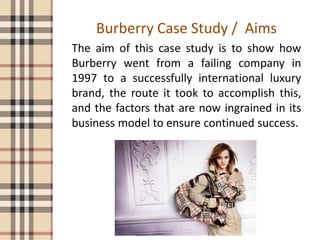
The aim of this case study is to show how
Burberry went from a failing company in
1997 to a successfully international luxury
brand, the route it took to accomplish this,
and the factors that are now ingrained in its
business model to ensure continued success.
Methodology
Burberry's past and present business
strategies also Branding Model are
broken down to show how the company
has reinvented and re-established itself
as an international luxury brand after a
serious drop in profits.
History of Burberry
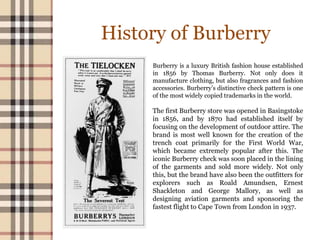
Burberry is a luxury British fashion house established
in 1856 by Thomas Burberry. Not only does it
manufacture clothing, but also fragrances and fashion
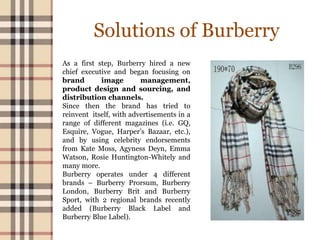
accessories. Burberry’s distinctive check pattern is one
of the most widely copied trademarks in the world.
The first Burberry store was opened in Basingstoke
in 1856, and by 1870 had established itself by
focusing on the development of outdoor attire. The
brand is most well known for the creation of the
trench coat primarily for the First World War,
which became extremely popular after this. The
iconic Burberry check was soon placed in the lining
of the garments and sold more widely. Not only
this, but the brand have also been the outfitters for
explorers such as Roald Amundsen, Ernest
Shackleton and George Mallory, as well as
designing aviation garments and sponsoring the
fastest flight to Cape Town from London in 1937.
History of Burberry
Burberry was an independent company
until 1955 when it was taken over by Great
Universal Stores (GUS). In the 70s the
brand was strongly associated with
football firms, hooliganism and later the
‘chav’ stereotype. Fake garments with the
distinctive check printed on the outside
were sold to the masses, giving the
impression that Burberry was no longer
exclusive and took away its high
desirability.
but by the end of 1998's financial year, the
company had seen their annual profits
drop from £62 million to £25 million.
A reconstruction of the company's
business model was desperately
needed for the future.
History
of
Burberry
Burberry Analysis
Burberry identified the key strategic challenges that faced their business:
• A heavy reliance upon a small base of core products;
• A company-owned retail network based within non-
strategic locations;
• An inconsistent wholesale distribution strategy with
Burberry products being sold in a wide range of retail
environments of varying quality;
• Parallel trading of Burberry products by legitimate
wholesale customers to other non approved distributors;
• A poorly controlled licensing strategy which resulted in
inconsistencies in prices, design and quality control across
markets;
• Under-investment in corporate infrastructures, specifically
in relation to marketing, merchandising, product
development and other support functions.
Solutions of Burberry
As a first step, Burberry hired a new
chief executive and began focusing on
brand image management,
product design and sourcing, and
distribution channels.
Since then the brand has tried to
reinvent itself, with advertisements in a
range of different magazines (i.e. GQ,
Esquire, Vogue, Harper’s Bazaar, etc.),
and by using celebrity endorsements
from Kate Moss, Agyness Deyn, Emma
Watson, Rosie Huntington-Whitely and
many more.
Burberry operates under 4 different
brands – Burberry Prorsum, Burberry
London, Burberry Brit and Burberry
Sport, with 2 regional brands recently
added (Burberry Black Label and
Burberry Blue Label).
New Business Model
It is important at this stage to note that
the various initiatives detailed above
markedly improved Burberry’s
financial performance. From 2000,
(when most of the initiatives were
concluded) to 2003, turnover
increased by 263 per cent and profits
rose by 630 per cent.
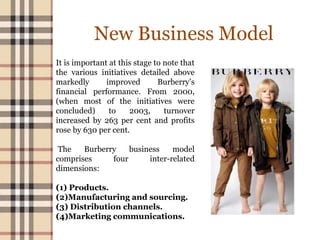
The Burberry business model
comprises four inter-related
dimensions:
(1) Products.
(2)Manufacturing and sourcing.
(3) Distribution channels.
(4)Marketing communications.
Burberry IMBC (Integrated Marketing
and Branding Communications)
Burberry clearly identify the importance of active
marketing communications in the development
of an image and lifestyle that is capable of
“generating interest among retail
customers, wholesale buyers and the
media”. In order to generate and sustain a
coherent brand identity, all Burberry marketing
activities are managed from London. Any local
form of marketing communication and activity
are determined by the direction provided by the
London marketing team.
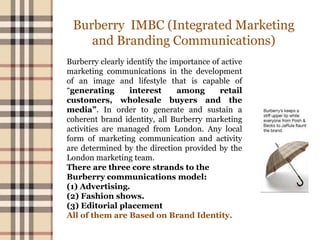
There are three core strands to the
Burberry communications model:
(1) Advertising.
(2) Fashion shows.
(3) Editorial placement
All of them are Based on Brand Identity.
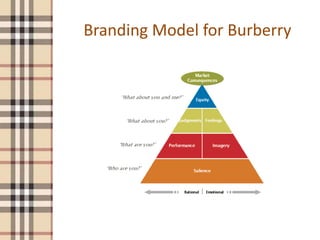
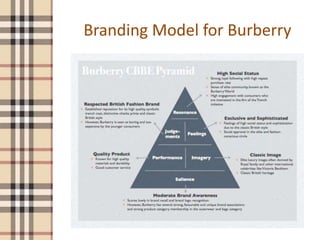
Branding Model for Burberry
Brand Values
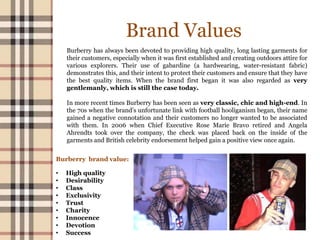
Burberry has always been devoted to providing high quality, long lasting garments for
their customers, especially when it was first established and creating outdoors attire for
various explorers. Their use of gabardine (a hardwearing, water-resistant fabric)
demonstrates this, and their intent to protect their customers and ensure that they have
the best quality items. When the brand first began it was also regarded as very
gentlemanly, which is still the case today.
In more recent times Burberry has been seen as very classic, chic and high-end. In
the 70s when the brand’s unfortunate link with football hooliganism began, their name
gained a negative connotation and their customers no longer wanted to be associated
with them. In 2006 when Chief Executive Rose Marie Bravo retired and Angela
Ahrendts took over the company, the check was placed back on the inside of the
garments and British celebrity endorsement helped gain a positive view once again.
Burberry brand value:
• High quality
• Desirability
• Class
• Exclusivity
• Trust
• Charity
• Innocence
• Devotion
• Success
Brand Values
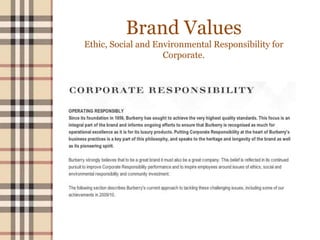
Ethic, Social and Environmental Responsibility for
Corporate.
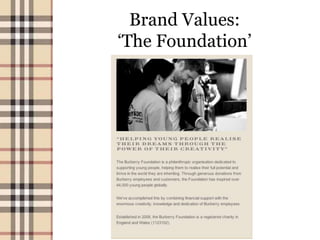
Brand Values:
‘The Foundation’
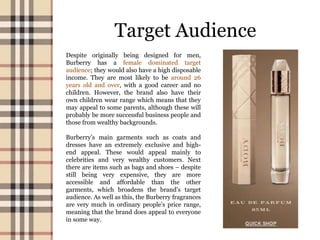
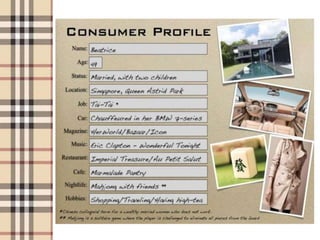
Target Audience
Despite originally being designed for men,
Burberry has a female dominated target
audience; they would also have a high disposable
income. They are most likely to be around 26
years old and over, with a good career and no
children. However, the brand also have their
own children wear range which means that they
may appeal to some parents, although these will
probably be more successful business people and
those from wealthy backgrounds.
Burberry’s main garments such as coats and
dresses have an extremely exclusive and high-
end appeal. These would appeal mainly to
celebrities and very wealthy customers. Next
there are items such as bags and shoes – despite
still being very expensive, they are more
accessible and affordable than the other
garments, which broadens the brand’s target
audience. As well as this, the Burberry fragrances
are very much in ordinary people’s price range,
meaning that the brand does appeal to everyone
in some way.
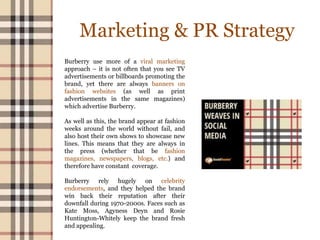
Marketing & PR Strategy
Burberry use more of a viral marketing
approach – it is not often that you see TV
advertisements or billboards promoting the
brand, yet there are always banners on
fashion websites (as well as print
advertisements in the same magazines)
which advertise Burberry.
As well as this, the brand appear at fashion
weeks around the world without fail, and
also host their own shows to showcase new
lines. This means that they are always in
the press (whether that be fashion
magazines, newspapers, blogs, etc.) and
therefore have constant coverage.
Burberry rely hugely on celebrity
endorsements, and they helped the brand
win back their reputation after their
downfall during 1970-2000s. Faces such as
Kate Moss, Agyness Deyn and Rosie
Huntington-Whitely keep the brand fresh
and appealing.
Successes/Failures
Burberry’s management has made smart decisions in investing in revamping its
brand as well as expanding it. The company recently purchased its licensed stores
in China to operate directly and further expand in the fastest growing luxury
market in the world. As well as this, the idea to feature all its lines under one store
concept instead of separating the different lines has helped its success.
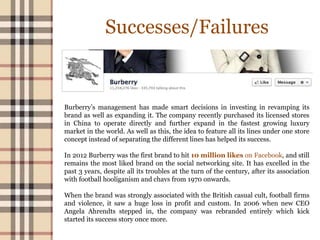
In 2012 Burberry was the first brand to hit 10 million likes on Facebook, and still
remains the most liked brand on the social networking site. It has excelled in the
past 3 years, despite all its troubles at the turn of the century, after its association
with football hooliganism and chavs from 1970 onwards.
When the brand was strongly associated with the British casual cult, football firms
and violence, it saw a huge loss in profit and custom. In 2006 when new CEO
Angela Ahrendts stepped in, the company was rebranded entirely which kick
started its success story once more.
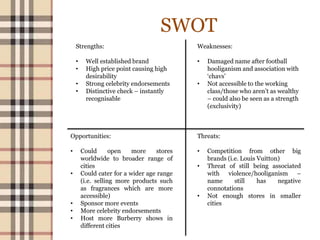
SWOT
Strengths:
• Well established brand
• High price point causing high
desirability
• Strong celebrity endorsements
• Distinctive check – instantly
recognisable
Weaknesses:
• Damaged name after football
hooliganism and association with
‘chavs’
• Not accessible to the working
class/those who aren’t as wealthy
– could also be seen as a strength
(exclusivity)
Opportunities:
• Could open more stores
worldwide to broader range of
cities
• Could cater for a wider age range
(i.e. selling more products such
as fragrances which are more
accessible)
• Sponsor more events
• More celebrity endorsements
• Host more Burberry shows in
different cities
Threats:
• Competition from other big
brands (i.e. Louis Vuitton)
• Threat of still being associated
with violence/hooliganism –
name still has negative
connotations
• Not enough stores in smaller
cities
Conclusion
Burberry's business model stands as both a generic example of
how to create a luxury brand, but also a unique one as well.
Their model identifies five key success factors:
1. The importance of clearly defined brand positioning
with attractive values and lifestyle associations.
2. Maximum market coverage through co-ordinated
distribution where retail and wholesale chains
complement each other.
3. Extension into adjacent product areas through strong
licensing agreements and/or internal capability.
4. Flexible management of important foreign markets.
5. Exceptional media relations management to create
and maintain the brand's reputation.
Thanks
to
Sophia Meritt
Dr. Ata Homayoun

Burberry business&branding model

  • 1.
    Business & BrandingModel By Sigma Group/ Farzad Moghaddam Tehran University
  • 2.
    Burberry Case Study/ Aims The aim of this case study is to show how Burberry went from a failing company in 1997 to a successfully international luxury brand, the route it took to accomplish this, and the factors that are now ingrained in its business model to ensure continued success.
  • 3.
    Methodology Burberry's past andpresent business strategies also Branding Model are broken down to show how the company has reinvented and re-established itself as an international luxury brand after a serious drop in profits.
  • 4.
    History of Burberry Burberryis a luxury British fashion house established in 1856 by Thomas Burberry. Not only does it manufacture clothing, but also fragrances and fashion accessories. Burberry’s distinctive check pattern is one of the most widely copied trademarks in the world. The first Burberry store was opened in Basingstoke in 1856, and by 1870 had established itself by focusing on the development of outdoor attire. The brand is most well known for the creation of the trench coat primarily for the First World War, which became extremely popular after this. The iconic Burberry check was soon placed in the lining of the garments and sold more widely. Not only this, but the brand have also been the outfitters for explorers such as Roald Amundsen, Ernest Shackleton and George Mallory, as well as designing aviation garments and sponsoring the fastest flight to Cape Town from London in 1937.
  • 5.
    History of Burberry Burberrywas an independent company until 1955 when it was taken over by Great Universal Stores (GUS). In the 70s the brand was strongly associated with football firms, hooliganism and later the ‘chav’ stereotype. Fake garments with the distinctive check printed on the outside were sold to the masses, giving the impression that Burberry was no longer exclusive and took away its high desirability. but by the end of 1998's financial year, the company had seen their annual profits drop from £62 million to £25 million. A reconstruction of the company's business model was desperately needed for the future.
  • 6.
  • 7.
    Burberry Analysis Burberry identifiedthe key strategic challenges that faced their business: • A heavy reliance upon a small base of core products; • A company-owned retail network based within non- strategic locations; • An inconsistent wholesale distribution strategy with Burberry products being sold in a wide range of retail environments of varying quality; • Parallel trading of Burberry products by legitimate wholesale customers to other non approved distributors; • A poorly controlled licensing strategy which resulted in inconsistencies in prices, design and quality control across markets; • Under-investment in corporate infrastructures, specifically in relation to marketing, merchandising, product development and other support functions.
  • 8.
    Solutions of Burberry Asa first step, Burberry hired a new chief executive and began focusing on brand image management, product design and sourcing, and distribution channels. Since then the brand has tried to reinvent itself, with advertisements in a range of different magazines (i.e. GQ, Esquire, Vogue, Harper’s Bazaar, etc.), and by using celebrity endorsements from Kate Moss, Agyness Deyn, Emma Watson, Rosie Huntington-Whitely and many more. Burberry operates under 4 different brands – Burberry Prorsum, Burberry London, Burberry Brit and Burberry Sport, with 2 regional brands recently added (Burberry Black Label and Burberry Blue Label).
  • 9.
    New Business Model Itis important at this stage to note that the various initiatives detailed above markedly improved Burberry’s financial performance. From 2000, (when most of the initiatives were concluded) to 2003, turnover increased by 263 per cent and profits rose by 630 per cent. The Burberry business model comprises four inter-related dimensions: (1) Products. (2)Manufacturing and sourcing. (3) Distribution channels. (4)Marketing communications.
  • 10.
    Burberry IMBC (IntegratedMarketing and Branding Communications) Burberry clearly identify the importance of active marketing communications in the development of an image and lifestyle that is capable of “generating interest among retail customers, wholesale buyers and the media”. In order to generate and sustain a coherent brand identity, all Burberry marketing activities are managed from London. Any local form of marketing communication and activity are determined by the direction provided by the London marketing team. There are three core strands to the Burberry communications model: (1) Advertising. (2) Fashion shows. (3) Editorial placement All of them are Based on Brand Identity.
  • 11.
  • 12.
  • 13.
    Brand Values Burberry hasalways been devoted to providing high quality, long lasting garments for their customers, especially when it was first established and creating outdoors attire for various explorers. Their use of gabardine (a hardwearing, water-resistant fabric) demonstrates this, and their intent to protect their customers and ensure that they have the best quality items. When the brand first began it was also regarded as very gentlemanly, which is still the case today. In more recent times Burberry has been seen as very classic, chic and high-end. In the 70s when the brand’s unfortunate link with football hooliganism began, their name gained a negative connotation and their customers no longer wanted to be associated with them. In 2006 when Chief Executive Rose Marie Bravo retired and Angela Ahrendts took over the company, the check was placed back on the inside of the garments and British celebrity endorsement helped gain a positive view once again. Burberry brand value: • High quality • Desirability • Class • Exclusivity • Trust • Charity • Innocence • Devotion • Success
  • 14.
    Brand Values Ethic, Socialand Environmental Responsibility for Corporate.
  • 15.
  • 16.
    Target Audience Despite originallybeing designed for men, Burberry has a female dominated target audience; they would also have a high disposable income. They are most likely to be around 26 years old and over, with a good career and no children. However, the brand also have their own children wear range which means that they may appeal to some parents, although these will probably be more successful business people and those from wealthy backgrounds. Burberry’s main garments such as coats and dresses have an extremely exclusive and high- end appeal. These would appeal mainly to celebrities and very wealthy customers. Next there are items such as bags and shoes – despite still being very expensive, they are more accessible and affordable than the other garments, which broadens the brand’s target audience. As well as this, the Burberry fragrances are very much in ordinary people’s price range, meaning that the brand does appeal to everyone in some way.
  • 18.
    Marketing & PRStrategy Burberry use more of a viral marketing approach – it is not often that you see TV advertisements or billboards promoting the brand, yet there are always banners on fashion websites (as well as print advertisements in the same magazines) which advertise Burberry. As well as this, the brand appear at fashion weeks around the world without fail, and also host their own shows to showcase new lines. This means that they are always in the press (whether that be fashion magazines, newspapers, blogs, etc.) and therefore have constant coverage. Burberry rely hugely on celebrity endorsements, and they helped the brand win back their reputation after their downfall during 1970-2000s. Faces such as Kate Moss, Agyness Deyn and Rosie Huntington-Whitely keep the brand fresh and appealing.
  • 19.
    Successes/Failures Burberry’s management hasmade smart decisions in investing in revamping its brand as well as expanding it. The company recently purchased its licensed stores in China to operate directly and further expand in the fastest growing luxury market in the world. As well as this, the idea to feature all its lines under one store concept instead of separating the different lines has helped its success. In 2012 Burberry was the first brand to hit 10 million likes on Facebook, and still remains the most liked brand on the social networking site. It has excelled in the past 3 years, despite all its troubles at the turn of the century, after its association with football hooliganism and chavs from 1970 onwards. When the brand was strongly associated with the British casual cult, football firms and violence, it saw a huge loss in profit and custom. In 2006 when new CEO Angela Ahrendts stepped in, the company was rebranded entirely which kick started its success story once more.
  • 20.
    SWOT Strengths: • Well establishedbrand • High price point causing high desirability • Strong celebrity endorsements • Distinctive check – instantly recognisable Weaknesses: • Damaged name after football hooliganism and association with ‘chavs’ • Not accessible to the working class/those who aren’t as wealthy – could also be seen as a strength (exclusivity) Opportunities: • Could open more stores worldwide to broader range of cities • Could cater for a wider age range (i.e. selling more products such as fragrances which are more accessible) • Sponsor more events • More celebrity endorsements • Host more Burberry shows in different cities Threats: • Competition from other big brands (i.e. Louis Vuitton) • Threat of still being associated with violence/hooliganism – name still has negative connotations • Not enough stores in smaller cities
  • 21.
    Conclusion Burberry's business modelstands as both a generic example of how to create a luxury brand, but also a unique one as well. Their model identifies five key success factors: 1. The importance of clearly defined brand positioning with attractive values and lifestyle associations. 2. Maximum market coverage through co-ordinated distribution where retail and wholesale chains complement each other. 3. Extension into adjacent product areas through strong licensing agreements and/or internal capability. 4. Flexible management of important foreign markets. 5. Exceptional media relations management to create and maintain the brand's reputation.
  • 22.