Matter and its properties.
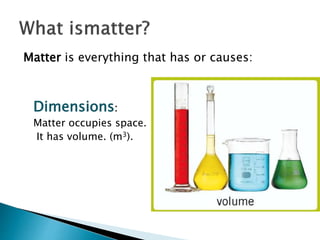
Matter is everything that has or causes:
Dimensions:
Matter occupies space.
It has volume. (m3).
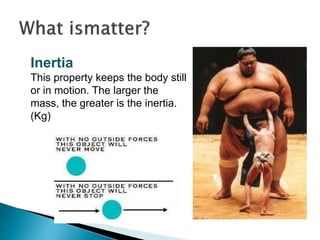
Inertia
This property keeps the body still
or in motion. The larger the
mass, the greater is the inertia.
(Kg)
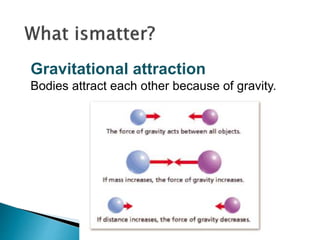
Gravitational attraction
Bodies attract each other because of gravity.
Mass is the amount of matter in an object.
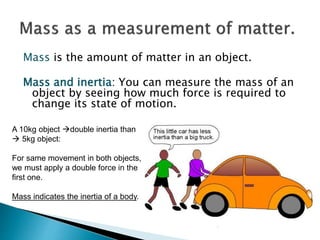
Mass and inertia: You can measure the mass of an
object by seeing how much force is required to
change its state of motion.
A 10kg object double inertia than
 5kg object:
For same movement in both objects,
we must apply a double force in the
first one.
Mass indicates the inertia of a body.
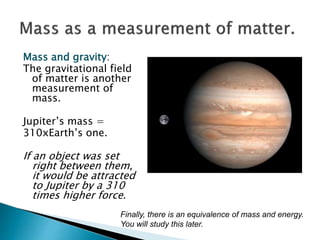
Mass and gravity:
The gravitational field
of matter is another
measurement of
mass.
Jupiter’s mass =
310xEarth’s one.
If an object was set
right between them,
it would be attracted
to Jupiter by a 310
times higher force.
Finally, there is an equivalence of mass and energy.
You will study this later.
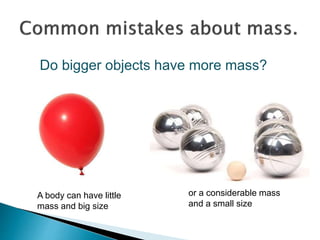
A body can have little
mass and big size
or a considerable mass
and a small size
Do bigger objects have more mass?
This is due to a body’s matter can be more or less
compacted, thus occupy more or less space.
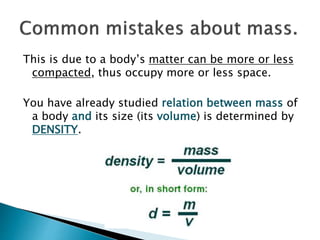
You have already studied relation between mass of
a body and its size (its volume) is determined by
DENSITY.
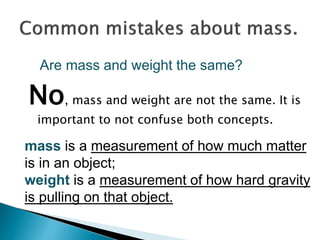
No, mass and weight are not the same. It is
important to not confuse both concepts.
Are mass and weight the same?
mass is a measurement of how much matter
is in an object;
weight is a measurement of how hard gravity
is pulling on that object.
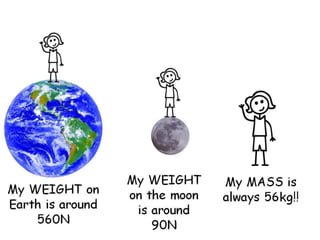
Your mass is the same wherever you are (on Earth,
on the moon, floating in space) because
the amount of stuff you're made of doesn't
change!!!!
What you call weight, is in fact your MASS!!!
Measured in kg in the IS.
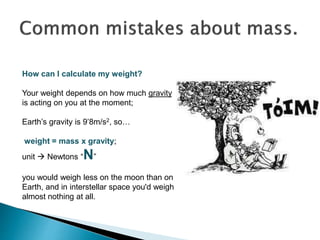
How can I calculate my weight?
Your weight depends on how much gravity
is acting on you at the moment;
Earth’s gravity is 9’8m/s2, so…
weight = mass x gravity;
unit  Newtons “N”
you would weigh less on the moon than on
Earth, and in interstellar space you'd weigh
almost nothing at all.
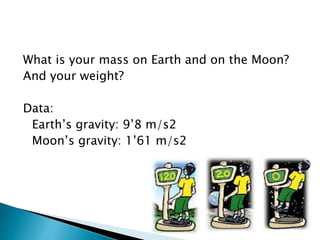
What is your mass on Earth and on the Moon?
And your weight?
Data:
Earth’s gravity: 9’8 m/s2
Moon’s gravity: 1’61 m/s2
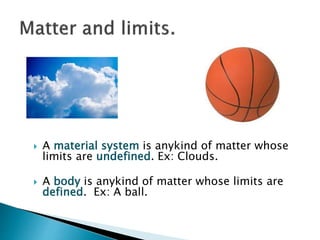
 A material system is anykind of matter whose
limits are undefined. Ex: Clouds.
 A body is anykind of matter whose limits are
defined. Ex: A ball.
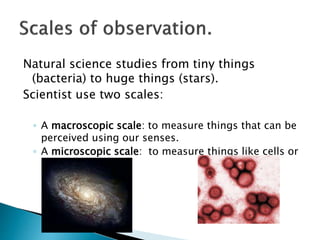
Natural science studies from tiny things
(bacteria) to huge things (stars).
Scientist use two scales:
◦ A macroscopic scale: to measure things that can be
perceived using our senses.
◦ A microscopic scale: to measure things like cells or
atoms.
 It’s a way of writing numbers to avoid writing
too many zeros.
 It consists of writing using powers of ten.
 Ex:
100.000.000.000.000.000.000.000.000=
1026
0’000000000000001= 10-15
1. What is matter? What are the characteristics of
matter?
2.What is the difference between a material
system and a body?
3. Give an example of inertia in everyday life.
4. Calculate the weight of my dog on the Earth
and on the Moon, knowing it is 20kg. What is
its mass?
6. In your notebook fill in the blanks using the
words of this unit.
Matter is everything that has……., ……… and is
the cause of ………. attraction.
7. Classify the following as bodies or material
systems:
a)A ball b) A galaxy c) The water in a river
d) The air in the atmosphere

Matter and its properties

  • 1.
    Matter and itsproperties.
  • 2.
    Matter is everythingthat has or causes: Dimensions: Matter occupies space. It has volume. (m3).
  • 3.
    Inertia This property keepsthe body still or in motion. The larger the mass, the greater is the inertia. (Kg)
  • 4.
    Gravitational attraction Bodies attracteach other because of gravity.
  • 5.
    Mass is theamount of matter in an object. Mass and inertia: You can measure the mass of an object by seeing how much force is required to change its state of motion. A 10kg object double inertia than  5kg object: For same movement in both objects, we must apply a double force in the first one. Mass indicates the inertia of a body.
  • 6.
    Mass and gravity: Thegravitational field of matter is another measurement of mass. Jupiter’s mass = 310xEarth’s one. If an object was set right between them, it would be attracted to Jupiter by a 310 times higher force. Finally, there is an equivalence of mass and energy. You will study this later.
  • 7.
    A body canhave little mass and big size or a considerable mass and a small size Do bigger objects have more mass?
  • 8.
    This is dueto a body’s matter can be more or less compacted, thus occupy more or less space. You have already studied relation between mass of a body and its size (its volume) is determined by DENSITY.
  • 9.
    No, mass andweight are not the same. It is important to not confuse both concepts. Are mass and weight the same? mass is a measurement of how much matter is in an object; weight is a measurement of how hard gravity is pulling on that object.
  • 10.
    Your mass isthe same wherever you are (on Earth, on the moon, floating in space) because the amount of stuff you're made of doesn't change!!!! What you call weight, is in fact your MASS!!! Measured in kg in the IS.
  • 11.
    How can Icalculate my weight? Your weight depends on how much gravity is acting on you at the moment; Earth’s gravity is 9’8m/s2, so… weight = mass x gravity; unit  Newtons “N” you would weigh less on the moon than on Earth, and in interstellar space you'd weigh almost nothing at all.
  • 13.
    What is yourmass on Earth and on the Moon? And your weight? Data: Earth’s gravity: 9’8 m/s2 Moon’s gravity: 1’61 m/s2
  • 14.
     A materialsystem is anykind of matter whose limits are undefined. Ex: Clouds.  A body is anykind of matter whose limits are defined. Ex: A ball.
  • 15.
    Natural science studiesfrom tiny things (bacteria) to huge things (stars). Scientist use two scales: ◦ A macroscopic scale: to measure things that can be perceived using our senses. ◦ A microscopic scale: to measure things like cells or atoms.
  • 16.
     It’s away of writing numbers to avoid writing too many zeros.  It consists of writing using powers of ten.  Ex: 100.000.000.000.000.000.000.000.000= 1026 0’000000000000001= 10-15
  • 17.
    1. What ismatter? What are the characteristics of matter? 2.What is the difference between a material system and a body? 3. Give an example of inertia in everyday life. 4. Calculate the weight of my dog on the Earth and on the Moon, knowing it is 20kg. What is its mass?
  • 18.
    6. In yournotebook fill in the blanks using the words of this unit. Matter is everything that has……., ……… and is the cause of ………. attraction. 7. Classify the following as bodies or material systems: a)A ball b) A galaxy c) The water in a river d) The air in the atmosphere