Sexual Harassment, Abuse and Bullying-
What You Need to Know
Copyright© 2006 by Lorna Stremcha
Presented by: Lorna Stremcha
Written by: Lorna Stremcha
Edited by: Lorna Stremcha
Originally Presented to:
The Montana’s Conference on RACE 2006
by Lorna Stremcha
Sponsoring Organizations
 Eagles Watch Inc.
 Montana Board of Crime Control
 Office of Public Instruction
 Indian Law Resource Center
 Office of the Coordinator of Indian Affairs
 AARP
 Montana Arts Council
 Department of Transportation
 KMTX Radio
 Department of Justice
 Talent Search, Office of the Commissioner of Higher Education
 Commissioner of Higher Education
 Department of Commerce
 Department of Public Health and Human Services
 Department of Corrections
Adaptation by:
Lorna Stremcha
Lesson # 1
I’m one of the
lucky ones, I
can tell my story
and I will tell it
often.
Welcome to:
Bullying and What You Need
to Know
Available on
Amazon
Most targets are caught by surprise.
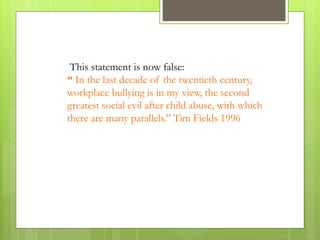
This statement is now false:
“ In the last decade of the twentieth century,
workplace bullying is in my view, the second
greatest social evil after child abuse, with which
there are many parallels.” Tim Fields 1996
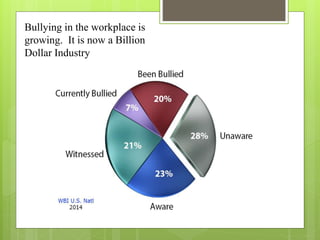
Bullying in the workplace is
growing. It is now a Billion
Dollar Industry
Workplace Bullying Defined
 Workplace Bullying is the repeated mistreatment of one
employee targeted by one or more employees with a
malicious mix of humiliation, intimidation and sabotage of
performance.
Workplace Bullying
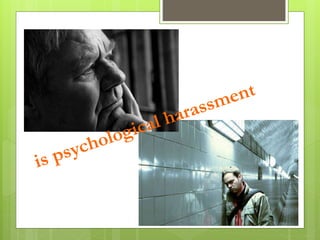
is psychological harassment.
is psychological violence.
is.
Workplace Bullying is a Different Kind of Discrimination
causes physical damage
creates loss of social support
creates economic reduction or loss
causes psychological injury
Workplace Bullying
 is 2-3 times more prevalent than illegal
discrimination
 is sub-lethal, non-physical workplace
violence.
 approximately 1 in 6 workers directly
experience it
 is a more general type of harassment, that
crosses gender, race and age boundaries.
How does it differ from sexual harassment?
 Bullying incidents tend to be trivial and cannot stand alone to merit
disciplinary action or grievance action.
 Bullying differs from sexual harassment in that it is not identified after one
single incident. It is an accumulation of small incidents which slowly grow
over a long period of time. Whereas; sexual harassment can be the result of a
single incident.
Bullying occurs:
 (Usually, but not always) when one person or many
persons in positions of power, authority, trust,
responsibility, management, administration, etc…
feels threatened by another person or subordinate that
displays qualities of ability, popularity, knowledge,
skill, strength, drive, determination, tenacity and
success, which the bully him/herself believes he/she
can never possess.
How to recognize a bully:
They often have personalities which are described
as a Dr. Jekyll and Mr. Hyde.
They are mean and vicious in private, but innocent
and charming in public or in front of witnesses.
They are convincing and compulsive liars that can
lie on the spot.
Bullies display
 often display high levels of
aggression
 often lack interpersonal skills
 often display immaturity
 often display insufficient skill
levels to fulfill their positions of
authority, management, etc…
 often are unable to accept
responsibility for physical and
mental well-being of those in
his/her charge
 Bullies generally control subordinates/others
by using physical and psychological
strategies.
 Bullies seek to increase their own confidence
by lower his/her subordinates/others
confidence.
 Bullies demean, destroy and breakdown
subordinates and others so they can feel
good about his or her self.
 Bullies repeat his or her process regularly.
The process becomes additive and
compulsive.
 Bullies are insecure and lack confidence, thus
causing the bully to use power and
intimidation over subordinates or others.
To be continue

Bullying Lesson One

  • 1.
    Sexual Harassment, Abuseand Bullying- What You Need to Know Copyright© 2006 by Lorna Stremcha Presented by: Lorna Stremcha Written by: Lorna Stremcha Edited by: Lorna Stremcha
  • 2.
    Originally Presented to: TheMontana’s Conference on RACE 2006 by Lorna Stremcha Sponsoring Organizations  Eagles Watch Inc.  Montana Board of Crime Control  Office of Public Instruction  Indian Law Resource Center  Office of the Coordinator of Indian Affairs  AARP  Montana Arts Council  Department of Transportation  KMTX Radio  Department of Justice  Talent Search, Office of the Commissioner of Higher Education  Commissioner of Higher Education  Department of Commerce  Department of Public Health and Human Services  Department of Corrections
  • 3.
  • 4.
    I’m one ofthe lucky ones, I can tell my story and I will tell it often.
  • 5.
    Welcome to: Bullying andWhat You Need to Know Available on Amazon
  • 6.
    Most targets arecaught by surprise.
  • 7.
    This statement isnow false: “ In the last decade of the twentieth century, workplace bullying is in my view, the second greatest social evil after child abuse, with which there are many parallels.” Tim Fields 1996
  • 8.
    Bullying in theworkplace is growing. It is now a Billion Dollar Industry
  • 9.
    Workplace Bullying Defined Workplace Bullying is the repeated mistreatment of one employee targeted by one or more employees with a malicious mix of humiliation, intimidation and sabotage of performance.
  • 10.
    Workplace Bullying is psychologicalharassment. is psychological violence.
  • 11.
  • 13.
    Workplace Bullying isa Different Kind of Discrimination causes physical damage creates loss of social support creates economic reduction or loss causes psychological injury
  • 14.
    Workplace Bullying  is2-3 times more prevalent than illegal discrimination  is sub-lethal, non-physical workplace violence.  approximately 1 in 6 workers directly experience it  is a more general type of harassment, that crosses gender, race and age boundaries.
  • 15.
    How does itdiffer from sexual harassment?  Bullying incidents tend to be trivial and cannot stand alone to merit disciplinary action or grievance action.  Bullying differs from sexual harassment in that it is not identified after one single incident. It is an accumulation of small incidents which slowly grow over a long period of time. Whereas; sexual harassment can be the result of a single incident.
  • 16.
    Bullying occurs:  (Usually,but not always) when one person or many persons in positions of power, authority, trust, responsibility, management, administration, etc… feels threatened by another person or subordinate that displays qualities of ability, popularity, knowledge, skill, strength, drive, determination, tenacity and success, which the bully him/herself believes he/she can never possess.
  • 17.
    How to recognizea bully: They often have personalities which are described as a Dr. Jekyll and Mr. Hyde. They are mean and vicious in private, but innocent and charming in public or in front of witnesses. They are convincing and compulsive liars that can lie on the spot.
  • 18.
    Bullies display  oftendisplay high levels of aggression  often lack interpersonal skills  often display immaturity  often display insufficient skill levels to fulfill their positions of authority, management, etc…  often are unable to accept responsibility for physical and mental well-being of those in his/her charge
  • 19.
     Bullies generallycontrol subordinates/others by using physical and psychological strategies.  Bullies seek to increase their own confidence by lower his/her subordinates/others confidence.  Bullies demean, destroy and breakdown subordinates and others so they can feel good about his or her self.  Bullies repeat his or her process regularly. The process becomes additive and compulsive.  Bullies are insecure and lack confidence, thus causing the bully to use power and intimidation over subordinates or others.
  • 20.