The Bulgarian Route between Asia,
Europe and the US East Coast as an
investment opportunity
Bulgaria- a unique streamlined route between
continents
The Variety of Terminal
and Modality Options in
Bulgaria to transship and
expedite to Northern
Europe and the US -
The Bulgaria Stretch – a variety
of secure options on NATO turf
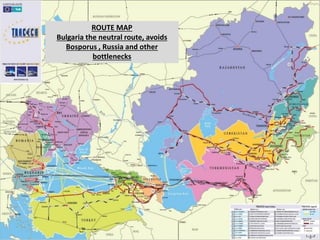
ROUTE MAP
Bulgaria the neutral route, avoids
Bosporus , Russia and other
bottlenecks
The Danube River – Europe’s largest inland artery
Bulgaria – a 300 mile access to a 1800 miles waterway, 10 European countries
Investment opportunities
• Streamlined service West
China-Central Asia - EU - US
East coast
• Providing solutions on the
busy Turkey / Kurdistan to EU
route
• Railcar fleet due for
replacement all across
Europe and Turkey
• Available 100mln. USD EU
grants for modal shift –
Marco Polo
• Infrastructure and related
technologies
• Inland waterways
unutilized
• IT implementation
• Shipping containers traffic
not diversified among
alternative ports and
transport modalities
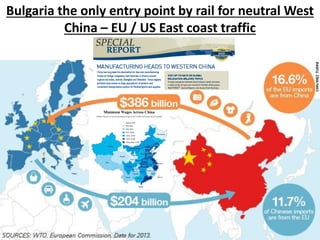
Bulgaria the only entry point by rail for neutral West
China – EU / US East coast traffic
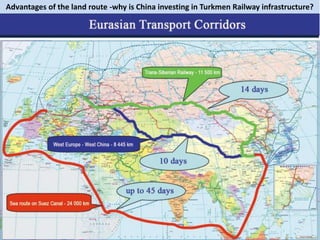
Advantages of the land route -why is China investing in Turkmen Railway infrastructure?
Modal split disparities b/n Central Asia and the
EU meet and get solved in Bulgaria Fig. 4. Modal split trends
of freight transport
demand in EECCA (%)
0%
10%
20%
30%
40%
50%
60%
70%
80%
90%
100%
1991 1995 2000 2005
inland water rail road, inland
Main challenge
and opportunity
in C.Asia to
Europe
transportation –
streamlining rail
to road
transshipment
Bulgaria is the only
European country that
handles both standard gauge
and broad gauge rail rolling
stock on its entire territory
and transports the rail cars
directly on board special
RAIL FERRY VESSELS,
connecting Europe and
Central Asia in a streamlined
service without
transshipment
BULGARIA–TRANSIT FLOWS FROM ASIA
Varna Ferry, Burgas RoRo
terminals - hubs for
regular RoRo and Rail
Ferry services Asia-
Europe-Africa
• RoRo + Rail Ferry from
the Ukraine to Europe
through Bulgaria
• Regular RoRo service
from Georgia to Europe
– through Bulgaria
• Rail Ferry from Georgia
/ Azerbaijan to the EU
• THE ONE OF ONLY TWO
• EU-RUSSIA DIRECT
• BORDER CROSSINGS
The Bulgarian Rail Ferry Varna-Batumi
across the Black Sea (Bulgaria-Georgia)
Transporting Broad Gauge Rail Cars from the Caspian
into Europe
The only gauge compatibility between
C.Asia and Europe is in Bulgaria
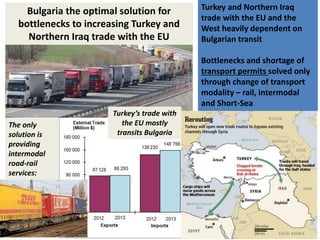
Turkey and Northern Iraq
trade with the EU and the
West heavily dependent on
Bulgarian transit
Bottlenecks and shortage of
transport permits solved only
through change of transport
modality – rail, intermodal
and Short-Sea
Bulgaria the optimal solution for
bottlenecks to increasing Turkey and
Northern Iraq trade with the EU
Turkey’s trade with
the EU mostly
transits Bulgaria
The only
solution is
providing
intermodal
road-rail
services:
Bulgarian Railway
Infrastructure
• 6,238 km of rail track;
• 4,316 km of these are main lines
• of which 67 per cent electrified
•Second Danube bridge at Vidin –
Kalafat - a missing connection
along Corridor IV (€226 million);
•The ‘Plovdiv – Svilengrad
(Turkish border) electrification
and reconstruction - €340 million
•Corridor VIII - ‘Carnobat –
Syndel doubling and
electrification - €21.12 million.
•Sofia-Plovdiv modernization -
€353 million
•Sofia – Pernik – Radomir
modernization - €103 million
•Plovdiv – Bourgas line sections
renewal - €66.5 million
•Sofia – Dragoman (Serbian
border) modernization - €85
million
•Mezdra – Gorna Oriahovitsa
modernization - €167 million
Potential niches on the Bulgarian inland waterways market
• Grouping break bulk general cargoes – 100 to 300 ton –
the TIVA Com best practice (wine + cans + rubber granulate
• Containerization of continental intra – Europe and US-
bound traffic, 45’ containers on barges
• Integration with inland hubs for consolidation of
inland freight / consolidation of barge quantities
• Door-to-door booking interface – a need for an
operator (forwarders sell the inland waterways only when they have no other option)
• Operating a streamlined one-stop-shop rail service to
the Ports alongside the navigation activity
• Using smaller (300-700) ton vessels – the Dutch
neokemp spits model
• LNG and products transports on inland routes
Hindrances and challenges with the
old style railroading
Cross-docking Cross-docking
Cross-docking
First physical
manipulation
of freight
Second physical
manipulation of
freight
Rail siding Shunting Marshalling Station
platform
Conventional rail forwarders and railways do this part only,
no door-to-door solutions
A MAJOR CHALLENGE INDEVELOPING A MODAL SHIFT –
INTERMODAL EQUIPMENT
THE RAILCARS / WAGONS 60ft vs. 90ft.
VS.
90’ intermodal railcar platforms in demand and 2
RGS – 60’-er
Bulgarian market potentials - maritime
• High maritime rates, long transit times, three
transshipments, no regular scheduled feeder
• There is a cartel monopoly of three shipping
lines carriers controlling 90% of the market
• They control the inland carriage
• Sofia-based forwarders interested in Koper
Thessaloniki and Constanta to avoid the
cartels elsewhere
AN OUTCRY ON THE MARKET FOR INTERMODAL REGULAR
CONNECTIONS TO ALTERNATIVE PORTS, CONSTANTA, THESSALONIKI,
KOPER
Thank you for attending!
INVESTMENT FORUM 2014
“Bulgaria: Grow Your Business”
Ivo Konstantinov
Commercial Councilor
Embassy of the Republic of
Bulgaria
1621 22nd Street, NW,
Washington D.C. 20008
trade@bulgaria-embassy.org
Tel. +1 202 387 5770
Tel.+1 202 332 6609
Fax: +1 202 234 7973

Bulgaria_Investment_Logistics_Hub

  • 1.
    The Bulgarian Routebetween Asia, Europe and the US East Coast as an investment opportunity Bulgaria- a unique streamlined route between continents
  • 2.
    The Variety ofTerminal and Modality Options in Bulgaria to transship and expedite to Northern Europe and the US - The Bulgaria Stretch – a variety of secure options on NATO turf
  • 3.
    ROUTE MAP Bulgaria theneutral route, avoids Bosporus , Russia and other bottlenecks
  • 4.
    The Danube River– Europe’s largest inland artery Bulgaria – a 300 mile access to a 1800 miles waterway, 10 European countries
  • 5.
    Investment opportunities • Streamlinedservice West China-Central Asia - EU - US East coast • Providing solutions on the busy Turkey / Kurdistan to EU route • Railcar fleet due for replacement all across Europe and Turkey • Available 100mln. USD EU grants for modal shift – Marco Polo • Infrastructure and related technologies • Inland waterways unutilized • IT implementation • Shipping containers traffic not diversified among alternative ports and transport modalities
  • 6.
    Bulgaria the onlyentry point by rail for neutral West China – EU / US East coast traffic
  • 7.
    Advantages of theland route -why is China investing in Turkmen Railway infrastructure?
  • 8.
    Modal split disparitiesb/n Central Asia and the EU meet and get solved in Bulgaria Fig. 4. Modal split trends of freight transport demand in EECCA (%) 0% 10% 20% 30% 40% 50% 60% 70% 80% 90% 100% 1991 1995 2000 2005 inland water rail road, inland Main challenge and opportunity in C.Asia to Europe transportation – streamlining rail to road transshipment
  • 9.
    Bulgaria is theonly European country that handles both standard gauge and broad gauge rail rolling stock on its entire territory and transports the rail cars directly on board special RAIL FERRY VESSELS, connecting Europe and Central Asia in a streamlined service without transshipment
  • 10.
    BULGARIA–TRANSIT FLOWS FROMASIA Varna Ferry, Burgas RoRo terminals - hubs for regular RoRo and Rail Ferry services Asia- Europe-Africa • RoRo + Rail Ferry from the Ukraine to Europe through Bulgaria • Regular RoRo service from Georgia to Europe – through Bulgaria • Rail Ferry from Georgia / Azerbaijan to the EU • THE ONE OF ONLY TWO • EU-RUSSIA DIRECT • BORDER CROSSINGS
  • 11.
    The Bulgarian RailFerry Varna-Batumi across the Black Sea (Bulgaria-Georgia) Transporting Broad Gauge Rail Cars from the Caspian into Europe
  • 12.
    The only gaugecompatibility between C.Asia and Europe is in Bulgaria
  • 13.
    Turkey and NorthernIraq trade with the EU and the West heavily dependent on Bulgarian transit Bottlenecks and shortage of transport permits solved only through change of transport modality – rail, intermodal and Short-Sea Bulgaria the optimal solution for bottlenecks to increasing Turkey and Northern Iraq trade with the EU Turkey’s trade with the EU mostly transits Bulgaria The only solution is providing intermodal road-rail services:
  • 14.
    Bulgarian Railway Infrastructure • 6,238km of rail track; • 4,316 km of these are main lines • of which 67 per cent electrified •Second Danube bridge at Vidin – Kalafat - a missing connection along Corridor IV (€226 million); •The ‘Plovdiv – Svilengrad (Turkish border) electrification and reconstruction - €340 million •Corridor VIII - ‘Carnobat – Syndel doubling and electrification - €21.12 million. •Sofia-Plovdiv modernization - €353 million •Sofia – Pernik – Radomir modernization - €103 million •Plovdiv – Bourgas line sections renewal - €66.5 million •Sofia – Dragoman (Serbian border) modernization - €85 million •Mezdra – Gorna Oriahovitsa modernization - €167 million
  • 15.
    Potential niches onthe Bulgarian inland waterways market • Grouping break bulk general cargoes – 100 to 300 ton – the TIVA Com best practice (wine + cans + rubber granulate • Containerization of continental intra – Europe and US- bound traffic, 45’ containers on barges • Integration with inland hubs for consolidation of inland freight / consolidation of barge quantities • Door-to-door booking interface – a need for an operator (forwarders sell the inland waterways only when they have no other option) • Operating a streamlined one-stop-shop rail service to the Ports alongside the navigation activity • Using smaller (300-700) ton vessels – the Dutch neokemp spits model • LNG and products transports on inland routes
  • 16.
    Hindrances and challengeswith the old style railroading Cross-docking Cross-docking Cross-docking First physical manipulation of freight Second physical manipulation of freight Rail siding Shunting Marshalling Station platform Conventional rail forwarders and railways do this part only, no door-to-door solutions
  • 17.
    A MAJOR CHALLENGEINDEVELOPING A MODAL SHIFT – INTERMODAL EQUIPMENT THE RAILCARS / WAGONS 60ft vs. 90ft. VS. 90’ intermodal railcar platforms in demand and 2 RGS – 60’-er
  • 18.
  • 19.
    Bulgarian market potentials- maritime • High maritime rates, long transit times, three transshipments, no regular scheduled feeder • There is a cartel monopoly of three shipping lines carriers controlling 90% of the market • They control the inland carriage • Sofia-based forwarders interested in Koper Thessaloniki and Constanta to avoid the cartels elsewhere AN OUTCRY ON THE MARKET FOR INTERMODAL REGULAR CONNECTIONS TO ALTERNATIVE PORTS, CONSTANTA, THESSALONIKI, KOPER
  • 20.
    Thank you forattending! INVESTMENT FORUM 2014 “Bulgaria: Grow Your Business” Ivo Konstantinov Commercial Councilor Embassy of the Republic of Bulgaria 1621 22nd Street, NW, Washington D.C. 20008 trade@bulgaria-embassy.org Tel. +1 202 387 5770 Tel.+1 202 332 6609 Fax: +1 202 234 7973