Building Microservices with gRPC and
NATS
Shiju Varghese
Consulting Solutions Architect
April 28, 2017
About Me
• Consulting Solutions Architect and Trainer
• Focused on Golang, Microservices and Cloud-Native
distributed systems architectures
• Published Author: “Web Development with Go” and “Go
Recipes”
• Honoured with Microsoft MVP award seven times
• Blog: https://medium.com/@shijuvar
Agenda
• Inter-Process communications in Microservices
architecture
• Building high performance APIs with gRPC and Protocol
Buffers
• Building Microservices with event-driven architectures
using NATS
MICROSERVICES
ARCHITECTURE
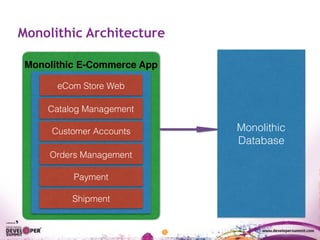
Monolithic Architecture
Catalog Management
Customer Accounts
Orders Management
Payment
Monolithic
Database
Monolithic E-Commerce App
eCom Store Web
Shipment
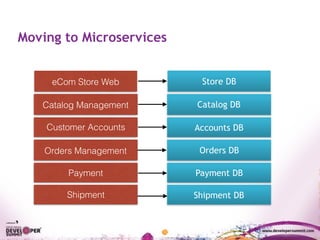
Moving to Microservices
Catalog Management
Customer Accounts
Orders Management
Payment
eCom Store Web
Shipment
Catalog DB
Accounts DB
Orders DB
Payment DB
Store DB
Shipment DB
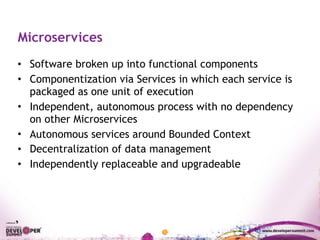
Microservices
• Software broken up into functional components
• Componentization via Services in which each service is
packaged as one unit of execution
• Independent, autonomous process with no dependency
on other Microservices
• Autonomous services around Bounded Context
• Decentralization of data management
• Independently replaceable and upgradeable
Challenges
• A business transaction may span into multiple services
• Decentralization of data management
• Communications between Microservices without having
any performance bottleneck
Inter-Process Communications between
Microservices
• Communications over high performance APIs
• Event-Driven architecture using messaging systems
Design Considerations for Building APIs
• Scaling APIs into millions (even billions) of APIs calls
• Wire format; Serialisation and deserialisation of
messages
• Building streaming APIs
• RESTful Vs RPC?
• Text encoding Vs binary encoding?
Why not REST
• Uses HTTP/1.x; Separate TCP Connection per request
• Text on the wire; Not performance efficient
• Harder API evolution
• Not Domain-Specific
• Not strongly-typed
• Lack of streaming capabilities
GRPC AND PROTOCOL
BUFFERS
What is gRPC
• High performance, open-source universal RPC
framework
• A Cloud Native Computing Foundation(CNCF) project
• Open source version of Google’s internal framework
Stubby
• Uses Protocol Buffers as the IDL
• HTTP/2 for transport
• Bi-Directional streaming
• RPC is efficient, domain-specific and strongly-typed
• Works across languages and platforms
Protocol Buffers
• Google's language-neutral, platform-neutral, extensible
mechanism for serialising structured data
• IDL - Describe once and generate interfaces for multiple
languages
• Structure of the Request and Response
• Binary format for network transmission
• Supports multiple languages
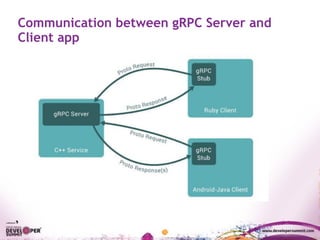
Communication between gRPC Server and
Client app
Types of RPC Methods
• Simple RPC
• Server-side streaming RPC
• Client-side streaming RPC
• Bi-directional streaming RPC
gRPC Workflow
ProtoBuf
Definitions
protoc
Compiler
Go
Ruby
Java gRPC Server
gRPC Client
Define1 Compile2
Implement3Generate Code
protoc --go_out=plugins=grpc
DEMO
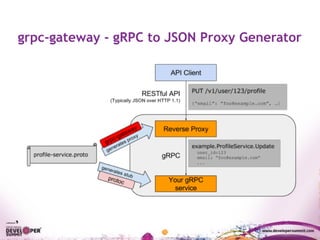
grpc-gateway - gRPC to JSON Proxy Generator
BUILDING MICROSERVICES
WITH EVENT-DRIVEN
ARCHITECTURE USING NATS
Inter-Process Communication Using an Event-
Driven Architecture
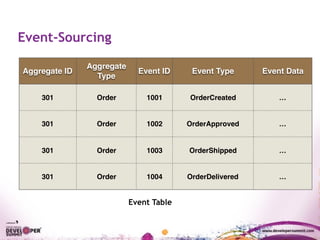
Event-Sourcing
Aggregate ID
Aggregate
Type
Event ID Event Type Event Data
301 Order 1001 OrderCreated …
301 Order 1002 OrderApproved …
301 Order 1003 OrderShipped …
301 Order 1004 OrderDelivered …
Event Table
• Open source, lightweight, high-performance cloud
native messaging system
• Highly performant, extremely light-weight; Capable of
sending 11-12 million messages per second
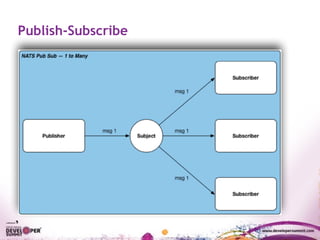
• Publish-Subscribe messaging system
• Available in two interoperable modules:
• NATS Server
• NATS Streaming Server (with persistent messaging)
Introducing NATS - Shiju Varghese's Blog
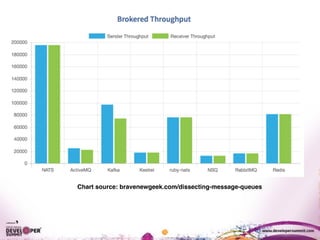
Chart source: bravenewgeek.com/dissecting-message-queues
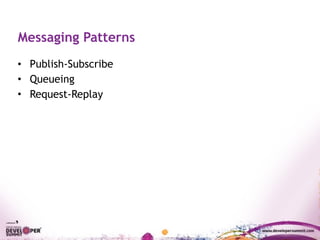
Messaging Patterns
• Publish-Subscribe
• Queueing
• Request-Replay
Components of Messaging Architecture
• Message: Messages are the unit of data exchange. A
payload, which is used for exchanging the data between
applications.
• Subject: Subject specifies the destination of messages.
• Producer: Producers send messages to the NATS server.
• Consumer: Consumers receive messages from the NATS
server.
• Messaging Server: NATS Server distributes the messages
from producers to consumers.
Publish-Subscribe
DEMO
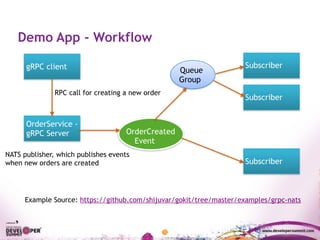
Demo App - Workflow
OrderService -
gRPC Server
gRPC client
Subscriber
OrderCreated
Event
Subscriber
Subscriber
Queue
Group
NATS publisher, which publishes events
when new orders are created
RPC call for creating a new order
Example Source: https://github.com/shijuvar/gokit/tree/master/examples/grpc-nats
Thank you
Blog: medium.com/@shijuvar
LinkedIn: linkedin.com/in/shijuvar
Email: gophermonk@gmail.com

Building Microservices with gRPC and NATS

  • 1.
    Building Microservices withgRPC and NATS Shiju Varghese Consulting Solutions Architect April 28, 2017
  • 2.
    About Me • ConsultingSolutions Architect and Trainer • Focused on Golang, Microservices and Cloud-Native distributed systems architectures • Published Author: “Web Development with Go” and “Go Recipes” • Honoured with Microsoft MVP award seven times • Blog: https://medium.com/@shijuvar
  • 3.
    Agenda • Inter-Process communicationsin Microservices architecture • Building high performance APIs with gRPC and Protocol Buffers • Building Microservices with event-driven architectures using NATS
  • 4.
  • 5.
    Monolithic Architecture Catalog Management CustomerAccounts Orders Management Payment Monolithic Database Monolithic E-Commerce App eCom Store Web Shipment
  • 6.
    Moving to Microservices CatalogManagement Customer Accounts Orders Management Payment eCom Store Web Shipment Catalog DB Accounts DB Orders DB Payment DB Store DB Shipment DB
  • 7.
    Microservices • Software brokenup into functional components • Componentization via Services in which each service is packaged as one unit of execution • Independent, autonomous process with no dependency on other Microservices • Autonomous services around Bounded Context • Decentralization of data management • Independently replaceable and upgradeable
  • 8.
    Challenges • A businesstransaction may span into multiple services • Decentralization of data management • Communications between Microservices without having any performance bottleneck
  • 9.
    Inter-Process Communications between Microservices •Communications over high performance APIs • Event-Driven architecture using messaging systems
  • 10.
    Design Considerations forBuilding APIs • Scaling APIs into millions (even billions) of APIs calls • Wire format; Serialisation and deserialisation of messages • Building streaming APIs • RESTful Vs RPC? • Text encoding Vs binary encoding?
  • 11.
    Why not REST •Uses HTTP/1.x; Separate TCP Connection per request • Text on the wire; Not performance efficient • Harder API evolution • Not Domain-Specific • Not strongly-typed • Lack of streaming capabilities
  • 12.
  • 13.
    What is gRPC •High performance, open-source universal RPC framework • A Cloud Native Computing Foundation(CNCF) project • Open source version of Google’s internal framework Stubby • Uses Protocol Buffers as the IDL • HTTP/2 for transport • Bi-Directional streaming • RPC is efficient, domain-specific and strongly-typed • Works across languages and platforms
  • 14.
    Protocol Buffers • Google'slanguage-neutral, platform-neutral, extensible mechanism for serialising structured data • IDL - Describe once and generate interfaces for multiple languages • Structure of the Request and Response • Binary format for network transmission • Supports multiple languages
  • 15.
    Communication between gRPCServer and Client app
  • 16.
    Types of RPCMethods • Simple RPC • Server-side streaming RPC • Client-side streaming RPC • Bi-directional streaming RPC
  • 17.
    gRPC Workflow ProtoBuf Definitions protoc Compiler Go Ruby Java gRPCServer gRPC Client Define1 Compile2 Implement3Generate Code protoc --go_out=plugins=grpc
  • 18.
  • 19.
    grpc-gateway - gRPCto JSON Proxy Generator
  • 20.
  • 21.
    Inter-Process Communication Usingan Event- Driven Architecture
  • 22.
    Event-Sourcing Aggregate ID Aggregate Type Event IDEvent Type Event Data 301 Order 1001 OrderCreated … 301 Order 1002 OrderApproved … 301 Order 1003 OrderShipped … 301 Order 1004 OrderDelivered … Event Table
  • 23.
    • Open source,lightweight, high-performance cloud native messaging system • Highly performant, extremely light-weight; Capable of sending 11-12 million messages per second • Publish-Subscribe messaging system • Available in two interoperable modules: • NATS Server • NATS Streaming Server (with persistent messaging) Introducing NATS - Shiju Varghese's Blog
  • 24.
  • 25.
  • 26.
    Components of MessagingArchitecture • Message: Messages are the unit of data exchange. A payload, which is used for exchanging the data between applications. • Subject: Subject specifies the destination of messages. • Producer: Producers send messages to the NATS server. • Consumer: Consumers receive messages from the NATS server. • Messaging Server: NATS Server distributes the messages from producers to consumers.
  • 27.
  • 28.
  • 29.
    Demo App -Workflow OrderService - gRPC Server gRPC client Subscriber OrderCreated Event Subscriber Subscriber Queue Group NATS publisher, which publishes events when new orders are created RPC call for creating a new order Example Source: https://github.com/shijuvar/gokit/tree/master/examples/grpc-nats
  • 30.
    Thank you Blog: medium.com/@shijuvar LinkedIn:linkedin.com/in/shijuvar Email: gophermonk@gmail.com