gRPC in Go
@AlmogBaku
Who are you?
@AlmogBaku on github
1. A serial entrepreneur
2. Developer for 12 years
3. GitHub addicted (kubernetes maintainer, etc.)
4. Consultant/freelancer
5. Blog about entrepreneurship and
development:
www.AlmogBaku.com
What are we GOing to talk about?
1. What is Protocol Buffer?
2. What is gRPC?
3. How does it work (high-level)
4. How to use it w/ Go?
5. Tips and tricks
Disclaimer
You wanna know more? Google it!
Google tip: use the keyword “golang”
Who heard about Go?
Who heard about Protocol Buffer?
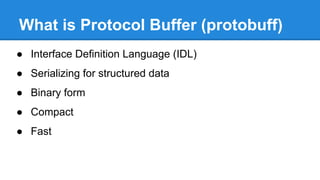
What is Protocol Buffer (protobuff)
● Interface Definition Language (IDL)
● Serializing for structured data
● Binary form
● Compact
● Fast
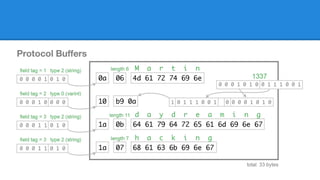
{
"userName": "Martin",
"favouriteNumber": 1337,
"interests": ["daydreaming", "hacking"]
}
total: 82 bytes
message Person {
string user_name = 1;
int64 favourite_number = 2;
repeated string interests = 3;
}
Protocol Buffer definition:JSON:
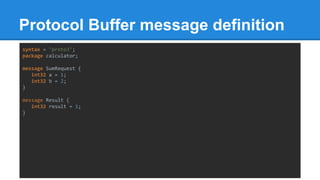
Protocol Buffer message definition
syntax = "proto3";
package calculator;
message SumRequest {
int32 a = 1;
int32 b = 2;
}
message Result {
int32 result = 1;
}
Who heard about gRPC?
What is GRPC
● = gRPC Remote Procedure Calls
● Universal RPC framework
● Fast transportation over http2
● Messages encoded using Protocol Buffer
● Libraries in ~10 languages(native C, Go, Java)
● Layered & pluggable - bring your own monitoring, auth,
load-balancing etc.
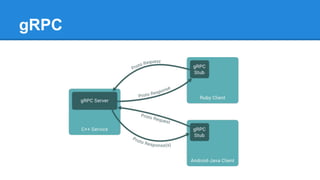
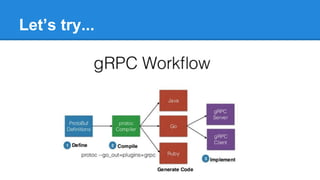
gRPC
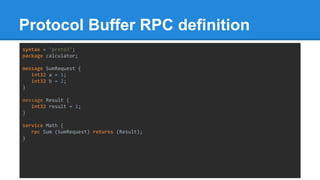
Protocol Buffer RPC definition
syntax = "proto3";
package calculator;
message SumRequest {
int32 a = 1;
int32 b = 2;
}
message Result {
int32 result = 1;
}
service Math {
rpc Sum (SumRequest) returns (Result);
}
Let’s try...
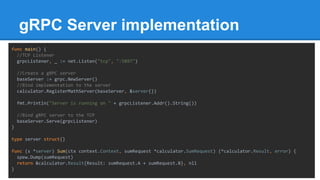
gRPC Server implementation
func main() {
//TCP Listener
grpcListener, _ := net.Listen("tcp", ":5897")
//Create a gRPC server
baseServer := grpc.NewServer()
//Bind implementation to the server
calculator.RegisterMathServer(baseServer, &server{})
fmt.Println("Server is running on " + grpcListener.Addr().String())
//Bind gRPC server to the TCP
baseServer.Serve(grpcListener)
}
type server struct{}
func (s *server) Sum(ctx context.Context, sumRequest *calculator.SumRequest) (*calculator.Result, error) {
spew.Dump(sumRequest)
return &calculator.Result{Result: sumRequest.A + sumRequest.B}, nil
}
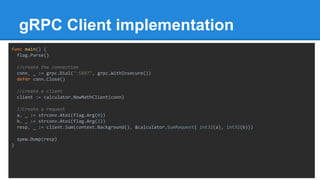
gRPC Client implementation
func main() {
flag.Parse()
//create the connection
conn, _ := grpc.Dial(":5897", grpc.WithInsecure())
defer conn.Close()
//create a client
client := calculator.NewMathClient(conn)
//Create a request
a, _ := strconv.Atoi(flag.Arg(0))
b, _ := strconv.Atoi(flag.Arg(1))
resp, _ := client.Sum(context.Background(), &calculator.SumRequest{ int32(a), int32(b)})
spew.Dump(resp)
}
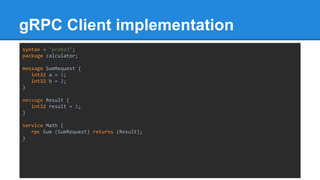
gRPC Client implementation
syntax = "proto3";
package calculator;
message SumRequest {
int32 a = 1;
int32 b = 2;
}
message Result {
int32 result = 1;
}
service Math {
rpc Sum (SumRequest) returns (Result);
}
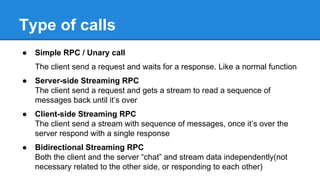
Type of calls
● Simple RPC / Unary call
The client send a request and waits for a response. Like a normal function
● Server-side Streaming RPC
The client send a request and gets a stream to read a sequence of
messages back until it’s over
● Client-side Streaming RPC
The client send a stream with sequence of messages, once it’s over the
server respond with a single response
● Bidirectional Streaming RPC
Both the client and the server “chat” and stream data independently(not
necessary related to the other side, or responding to each other)
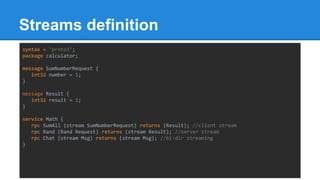
Streams definition
syntax = "proto3";
package calculator;
message SumNumberRequest {
int32 number = 1;
}
message Result {
int32 result = 1;
}
service Math {
rpc SumAll (stream SumNumberRequest) returns (Result); //client stream
rpc Rand (Rand Request) returns (stream Result); //server stream
rpc Chat (stream Msg) returns (stream Msg); //bi-dir streaming
}
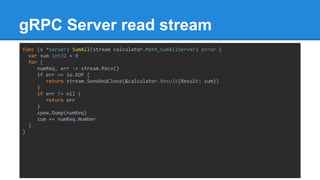
gRPC Server read stream
func (s *server) SumAll(stream calculator.Math_SumAllServer) error {
var sum int32 = 0
for {
numReq, err := stream.Recv()
if err == io.EOF {
return stream.SendAndClose(&calculator.Result{Result: sum})
}
if err != nil {
return err
}
spew.Dump(numReq)
sum += numReq.Number
}
}
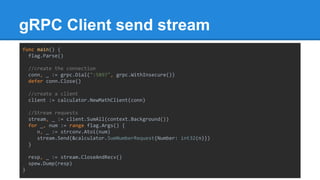
gRPC Client send stream
func main() {
flag.Parse()
//create the connection
conn, _ := grpc.Dial(":5897", grpc.WithInsecure())
defer conn.Close()
//create a client
client := calculator.NewMathClient(conn)
//Stream requests
stream, _ := client.SumAll(context.Background())
for _, num := range flag.Args() {
n, _ := strconv.Atoi(num)
stream.Send(&calculator.SumNumberRequest{Number: int32(n)})
}
resp, _ := stream.CloseAndRecv()
spew.Dump(resp)
}
Tips and Tricks
Real life is a bit more complicated...
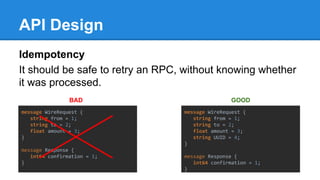
API Design
Idempotency
It should be safe to retry an RPC, without knowing whether
it was processed.
message WireRequest {
string from = 1;
string to = 2;
float amount = 3;
}
message Response {
int64 confirmation = 1;
}
message WireRequest {
string from = 1;
string to = 2;
float amount = 3;
string UUID = 4;
}
message Response {
int64 confirmation = 1;
}
BAD GOOD
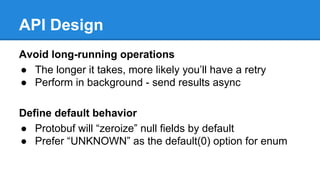
API Design
Avoid long-running operations
● The longer it takes, more likely you’ll have a retry
● Perform in background - send results async
Define default behavior
● Protobuf will “zeroize” null fields by default
● Prefer “UNKNOWN” as the default(0) option for enum
API Design
Avoid batch operations as unary
● Use stream or multiple calls instead
● Error handling become complex
Errors
Don’t panic!
● May crash the server…
● Return errors to the callers
Propagate
● Blindly return errors from libraries can be
difficult to debug
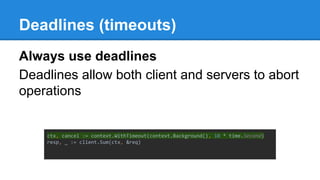
Deadlines (timeouts)
Always use deadlines
Deadlines allow both client and servers to abort
operations
ctx, cancel := context.WithTimeout(context.Background(), 10 * time.Second)
resp, _ := client.Sum(ctx, &req)
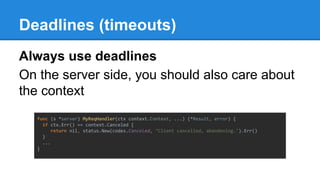
Deadlines (timeouts)
Always use deadlines
On the server side, you should also care about
the context
func (s *server) MyReqHandler(ctx context.Context, ...) (*Result, error) {
if ctx.Err() == context.Canceled {
return nil, status.New(codes.Canceled, "Client cancelled, abandoning.").Err()
}
...
}
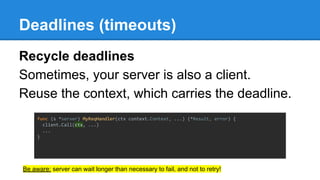
Deadlines (timeouts)
Recycle deadlines
Sometimes, your server is also a client.
Reuse the context, which carries the deadline.
func (s *server) MyReqHandler(ctx context.Context, ...) (*Result, error) {
client.Call(ctx, ...)
...
}
Be aware: server can wait longer than necessary to fail, and not to retry!
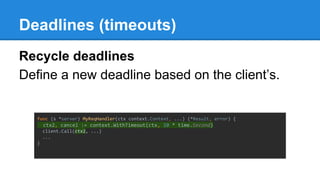
Deadlines (timeouts)
Recycle deadlines
Define a new deadline based on the client’s.
func (s *server) MyReqHandler(ctx context.Context, ...) (*Result, error) {
ctx2, cancel := context.WithTimeout(ctx, 10 * time.Second)
client.Call(ctx2, ...)
...
}
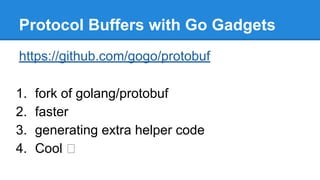
Protocol Buffers with Go Gadgets
https://github.com/gogo/protobuf
1. fork of golang/protobuf
2. faster
3. generating extra helper code
4. Cool
Protocol Buffers with Go Gadgets
message Decision {
Rule rule = 1;
uint64 remain = 2; //kb
Action do = 3;
google.protobuf.Duration TTL = 5 [(gogoproto.stdduration) = true, (gogoproto.nullable) = false];
}
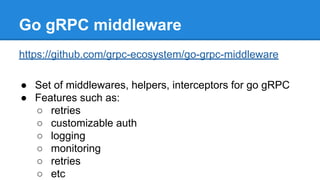
Go gRPC middleware
https://github.com/grpc-ecosystem/go-grpc-middleware
● Set of middlewares, helpers, interceptors for go gRPC
● Features such as:
○ retries
○ customizable auth
○ logging
○ monitoring
○ retries
○ etc
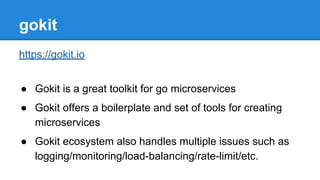
gokit
https://gokit.io
● Gokit is a great toolkit for go microservices
● Gokit offers a boilerplate and set of tools for creating
microservices
● Gokit ecosystem also handles multiple issues such as
logging/monitoring/load-balancing/rate-limit/etc.
Thanks.
@AlmogBaku

gRPC in Go

  • 1.
  • 2.
    Who are you? @AlmogBakuon github 1. A serial entrepreneur 2. Developer for 12 years 3. GitHub addicted (kubernetes maintainer, etc.) 4. Consultant/freelancer 5. Blog about entrepreneurship and development: www.AlmogBaku.com
  • 3.
    What are weGOing to talk about? 1. What is Protocol Buffer? 2. What is gRPC? 3. How does it work (high-level) 4. How to use it w/ Go? 5. Tips and tricks
  • 4.
    Disclaimer You wanna knowmore? Google it! Google tip: use the keyword “golang”
  • 5.
  • 6.
    Who heard aboutProtocol Buffer?
  • 7.
    What is ProtocolBuffer (protobuff) ● Interface Definition Language (IDL) ● Serializing for structured data ● Binary form ● Compact ● Fast
  • 8.
    { "userName": "Martin", "favouriteNumber": 1337, "interests":["daydreaming", "hacking"] } total: 82 bytes message Person { string user_name = 1; int64 favourite_number = 2; repeated string interests = 3; } Protocol Buffer definition:JSON:
  • 10.
    Protocol Buffer messagedefinition syntax = "proto3"; package calculator; message SumRequest { int32 a = 1; int32 b = 2; } message Result { int32 result = 1; }
  • 11.
  • 12.
    What is GRPC ●= gRPC Remote Procedure Calls ● Universal RPC framework ● Fast transportation over http2 ● Messages encoded using Protocol Buffer ● Libraries in ~10 languages(native C, Go, Java) ● Layered & pluggable - bring your own monitoring, auth, load-balancing etc.
  • 13.
  • 14.
    Protocol Buffer RPCdefinition syntax = "proto3"; package calculator; message SumRequest { int32 a = 1; int32 b = 2; } message Result { int32 result = 1; } service Math { rpc Sum (SumRequest) returns (Result); }
  • 15.
  • 16.
    gRPC Server implementation funcmain() { //TCP Listener grpcListener, _ := net.Listen("tcp", ":5897") //Create a gRPC server baseServer := grpc.NewServer() //Bind implementation to the server calculator.RegisterMathServer(baseServer, &server{}) fmt.Println("Server is running on " + grpcListener.Addr().String()) //Bind gRPC server to the TCP baseServer.Serve(grpcListener) } type server struct{} func (s *server) Sum(ctx context.Context, sumRequest *calculator.SumRequest) (*calculator.Result, error) { spew.Dump(sumRequest) return &calculator.Result{Result: sumRequest.A + sumRequest.B}, nil }
  • 17.
    gRPC Client implementation funcmain() { flag.Parse() //create the connection conn, _ := grpc.Dial(":5897", grpc.WithInsecure()) defer conn.Close() //create a client client := calculator.NewMathClient(conn) //Create a request a, _ := strconv.Atoi(flag.Arg(0)) b, _ := strconv.Atoi(flag.Arg(1)) resp, _ := client.Sum(context.Background(), &calculator.SumRequest{ int32(a), int32(b)}) spew.Dump(resp) }
  • 18.
    gRPC Client implementation syntax= "proto3"; package calculator; message SumRequest { int32 a = 1; int32 b = 2; } message Result { int32 result = 1; } service Math { rpc Sum (SumRequest) returns (Result); }
  • 19.
    Type of calls ●Simple RPC / Unary call The client send a request and waits for a response. Like a normal function ● Server-side Streaming RPC The client send a request and gets a stream to read a sequence of messages back until it’s over ● Client-side Streaming RPC The client send a stream with sequence of messages, once it’s over the server respond with a single response ● Bidirectional Streaming RPC Both the client and the server “chat” and stream data independently(not necessary related to the other side, or responding to each other)
  • 20.
    Streams definition syntax ="proto3"; package calculator; message SumNumberRequest { int32 number = 1; } message Result { int32 result = 1; } service Math { rpc SumAll (stream SumNumberRequest) returns (Result); //client stream rpc Rand (Rand Request) returns (stream Result); //server stream rpc Chat (stream Msg) returns (stream Msg); //bi-dir streaming }
  • 21.
    gRPC Server readstream func (s *server) SumAll(stream calculator.Math_SumAllServer) error { var sum int32 = 0 for { numReq, err := stream.Recv() if err == io.EOF { return stream.SendAndClose(&calculator.Result{Result: sum}) } if err != nil { return err } spew.Dump(numReq) sum += numReq.Number } }
  • 22.
    gRPC Client sendstream func main() { flag.Parse() //create the connection conn, _ := grpc.Dial(":5897", grpc.WithInsecure()) defer conn.Close() //create a client client := calculator.NewMathClient(conn) //Stream requests stream, _ := client.SumAll(context.Background()) for _, num := range flag.Args() { n, _ := strconv.Atoi(num) stream.Send(&calculator.SumNumberRequest{Number: int32(n)}) } resp, _ := stream.CloseAndRecv() spew.Dump(resp) }
  • 23.
    Tips and Tricks Reallife is a bit more complicated...
  • 24.
    API Design Idempotency It shouldbe safe to retry an RPC, without knowing whether it was processed. message WireRequest { string from = 1; string to = 2; float amount = 3; } message Response { int64 confirmation = 1; } message WireRequest { string from = 1; string to = 2; float amount = 3; string UUID = 4; } message Response { int64 confirmation = 1; } BAD GOOD
  • 25.
    API Design Avoid long-runningoperations ● The longer it takes, more likely you’ll have a retry ● Perform in background - send results async Define default behavior ● Protobuf will “zeroize” null fields by default ● Prefer “UNKNOWN” as the default(0) option for enum
  • 26.
    API Design Avoid batchoperations as unary ● Use stream or multiple calls instead ● Error handling become complex
  • 27.
    Errors Don’t panic! ● Maycrash the server… ● Return errors to the callers Propagate ● Blindly return errors from libraries can be difficult to debug
  • 28.
    Deadlines (timeouts) Always usedeadlines Deadlines allow both client and servers to abort operations ctx, cancel := context.WithTimeout(context.Background(), 10 * time.Second) resp, _ := client.Sum(ctx, &req)
  • 29.
    Deadlines (timeouts) Always usedeadlines On the server side, you should also care about the context func (s *server) MyReqHandler(ctx context.Context, ...) (*Result, error) { if ctx.Err() == context.Canceled { return nil, status.New(codes.Canceled, "Client cancelled, abandoning.").Err() } ... }
  • 30.
    Deadlines (timeouts) Recycle deadlines Sometimes,your server is also a client. Reuse the context, which carries the deadline. func (s *server) MyReqHandler(ctx context.Context, ...) (*Result, error) { client.Call(ctx, ...) ... } Be aware: server can wait longer than necessary to fail, and not to retry!
  • 31.
    Deadlines (timeouts) Recycle deadlines Definea new deadline based on the client’s. func (s *server) MyReqHandler(ctx context.Context, ...) (*Result, error) { ctx2, cancel := context.WithTimeout(ctx, 10 * time.Second) client.Call(ctx2, ...) ... }
  • 32.
    Protocol Buffers withGo Gadgets https://github.com/gogo/protobuf 1. fork of golang/protobuf 2. faster 3. generating extra helper code 4. Cool
  • 33.
    Protocol Buffers withGo Gadgets message Decision { Rule rule = 1; uint64 remain = 2; //kb Action do = 3; google.protobuf.Duration TTL = 5 [(gogoproto.stdduration) = true, (gogoproto.nullable) = false]; }
  • 34.
    Go gRPC middleware https://github.com/grpc-ecosystem/go-grpc-middleware ●Set of middlewares, helpers, interceptors for go gRPC ● Features such as: ○ retries ○ customizable auth ○ logging ○ monitoring ○ retries ○ etc
  • 35.
    gokit https://gokit.io ● Gokit isa great toolkit for go microservices ● Gokit offers a boilerplate and set of tools for creating microservices ● Gokit ecosystem also handles multiple issues such as logging/monitoring/load-balancing/rate-limit/etc.
  • 36.