API Management for Microservices
Architecture using WSO2 API
Microgateway
Vidura Gamini Abhaya
Senior Director — Solutions Architecture
WSO2
Microservices
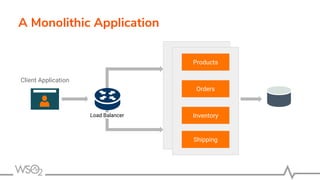
A Monolithic Application
Products
Orders
Inventory
Shipping
Client Application
Load Balancer
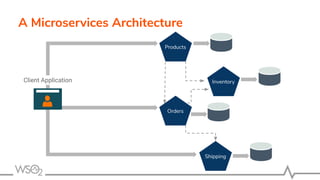
A Microservices Architecture
Products
Orders
Inventory
Shipping
Client Application
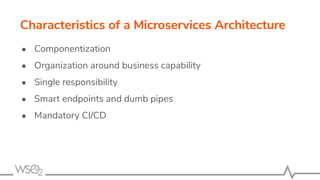
● Componentization
● Organization around business capability
● Single responsibility
● Smart endpoints and dumb pipes
● Mandatory CI/CD
Characteristics of a Microservices Architecture
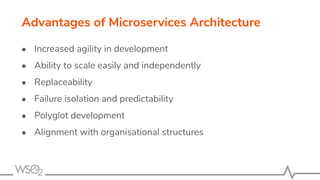
● Increased agility in development
● Ability to scale easily and independently
● Replaceability
● Failure isolation and predictability
● Polyglot development
● Alignment with organisational structures
Advantages of Microservices Architecture
● Inter-service communication
● Service governance
● Management complexity
● Heavily dependent on deployment methodology
Liabilities of Microservices Architecture
The Role of API Management in
Microservices Architecture
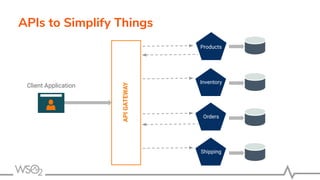
APIs to Simplify Things
APIGATEWAY
Products
Inventory
Orders
Shipping
Client Application
• Uniformity in exposing heterogeneous services
• Discovery of endpoints
• Organizing security perimeters/boundaries
• Policy definition and enforcement
• Business value reporting
API Management Brings Order to MS Chaos
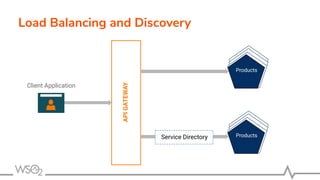
Load Balancing and Discovery
APIGATEWAY
Products
Client Application
Products
Service Directory
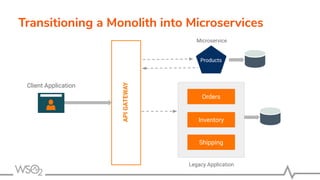
Transitioning a Monolith into Microservices
APIGATEWAY
Products
Client Application
Orders
Inventory
Shipping
Microservice
Legacy Application
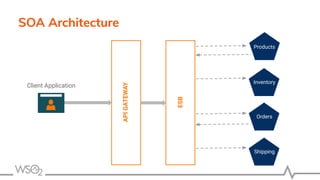
SOA Architecture
APIGATEWAY
Products
Inventory
Orders
Shipping
Client Application
ESB
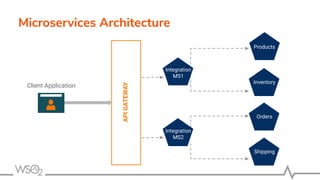
Microservices Architecture
APIGATEWAY
Products
Inventory
Orders
Shipping
Client Application
Integration
MS1
Integration
MS2
Decentralized API Management
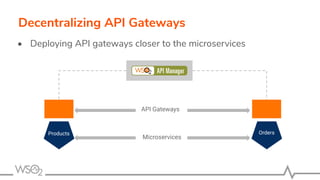
• Deploying API gateways closer to the microservices
Decentralizing API Gateways
API Gateways
Microservices
Products Orders
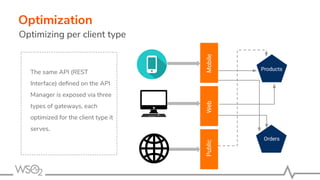
Optimizing per client type
Optimization
MobileWebPublic
The same API (REST
Interface) defined on the API
Manager is exposed via three
types of gateways, each
optimized for the client type it
serves.
Products
Orders
WSO2 API Microgateway
● Designed to scale
○ Self-validating tokens
○ Localized rate limiting
○ Offline analytics
○ Immutable
● Native support for Docker/K8S
● Private Jet Gateway for microservices
● First-class support for lifecycle management across
environments
Introducing WSO2 API Microgateway
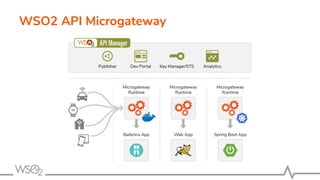
WSO2 API Microgateway
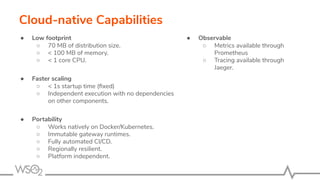
Cloud-native Capabilities
● Low footprint
○ 70 MB of distribution size.
○ < 100 MB of memory.
○ < 1 core CPU.
● Faster scaling
○ < 1s startup time (fixed)
○ Independent execution with no dependencies
on other components.
● Portability
○ Works natively on Docker/Kubernetes.
○ Immutable gateway runtimes.
○ Fully automated CI/CD.
○ Regionally resilient.
○ Platform independent.
● Observable
○ Metrics available through
Prometheus
○ Tracing available through
Jaeger.
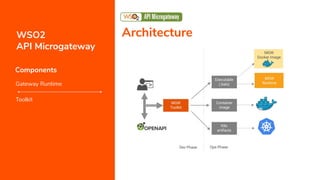
WSO2
API Microgateway
Architecture
Components
Gateway Runtime
Toolkit
AGILE
INTEGRATION SIMPLE
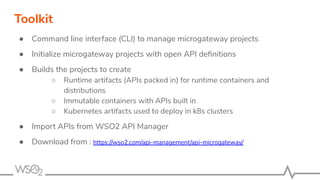
● Command line interface (CLI) to manage microgateway projects
● Initialize microgateway projects with open API definitions
● Builds the projects to create
○ Runtime artifacts (APIs packed in) for runtime containers and
distributions
○ Immutable containers with APIs built in
○ Kubernetes artifacts used to deploy in k8s clusters
● Import APIs from WSO2 API Manager
● Download from : https://wso2.com/api-management/api-microgateway/
Toolkit
● Serves the requests applying
○ Security, Rate limiting, Transformations, Analytics, and more
● Available as archived distributions as well as docker images [1]
● Can be built by burning APIs into container images to spawn immutable
containers
● Runs on top of artifacts generated by the toolkit
[1]- https://hub.docker.com/r/wso2/wso2micro-gw
Runtime
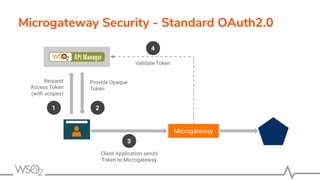
Microgateway Security - Standard OAuth2.0
Microgateway
Request
Access Token
(with scopes)
Provide Opaque
Token
Client Application sends
Token to Microgateway
Validate Token
1 2
3
4
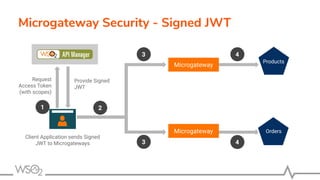
Microgateway Security - Signed JWT
Products
Orders
Client Application sends Signed
JWT to Microgateways
Microgateway
Microgateway
Request
Access Token
(with scopes)
Provide Signed
JWT
1 2
3
3
4
4
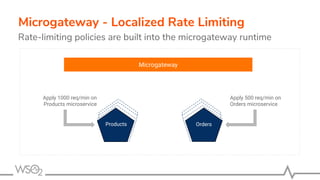
Rate-limiting policies are built into the microgateway runtime
Microgateway - Localized Rate Limiting
Microgateway
OrdersProducts
Apply 1000 req/min on
Products microservice
Apply 500 req/min on
Orders microservice
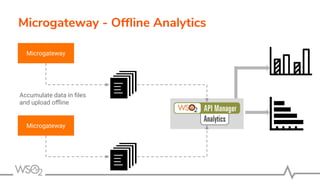
Microgateway - Offline Analytics
Microgateway
Microgateway
Accumulate data in files
and upload offline
Typical Use cases
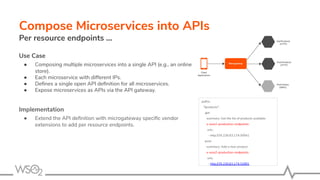
Compose Microservices into APIs
Per resource endpoints ...
Use Case
● Composing multiple microservices into a single API (e.g., an online
store).
● Each microservice with different IPs.
● Defines a single open API definition for all microservices.
● Expose microservices as APIs via the API gateway.
Implementation
● Extend the API definition with microgateway specific vendor
extensions to add per resource endpoints.
paths:
"/products":
get:
summary: Get the list of products available
x-wso2-production-endpoints:
urls:
- http://35.226.63.174:30941
post:
summary: Add a new product
x-wso2-production-endpoints:
urls:
- http://35.226.63.174:31891
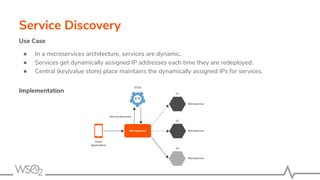
Service Discovery
Use Case
● In a microservices architecture, services are dynamic.
● Services get dynamically assigned IP addresses each time they are redeployed.
● Central (key/value store) place maintains the dynamically assigned IPs for services.
Implementation
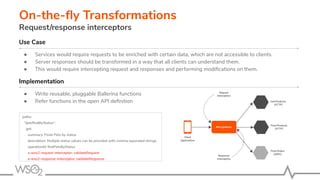
On-the-fly Transformations
Request/response interceptors
Use Case
● Services would require requests to be enriched with certain data, which are not accessible to clients.
● Server responses should be transformed in a way that all clients can understand them.
● This would require intercepting request and responses and performing modifications on them.
Implementation
● Write reusable, pluggable Ballerina functions
● Refer functions in the open API definition
paths:
"/pet/findByStatus":
get:
summary: Finds Pets by status
description: Multiple status values can be provided with comma separated strings
operationId: findPetsByStatus
x-wso2-request-interceptor: validateRequest
x-wso2-response-interceptor: validateResponse
API Gateway for East-West and North-South Traffic
Use Case
• In a microservice architecture, service-to-service communication and client-facing services may
require different security schemas
• Microservices might enforce different security mechanisms to restrict access control
Implementation
● Supports a variety range of security mechanisms
○ Self-contained jwt tokens
○ OAuth2
○ Basic Authentication
○ Mutual SSL (introduced with v3.0)
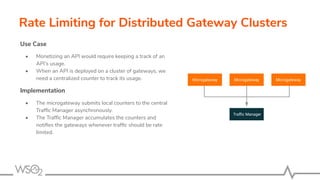
Rate Limiting for Distributed Gateway Clusters
Use Case
• Monetizing an API would require keeping a track of an
API’s usage.
• When an API is deployed on a cluster of gateways, we
need a centralized counter to track its usage.
Implementation
• The microgateway submits local counters to the central
Traffic Manager asynchronously.
• The Traffic Manager accumulates the counters and
notifies the gateways whenever traffic should be rate
limited.
Microgateway Microgateway
Traffic Manager
Microgateway
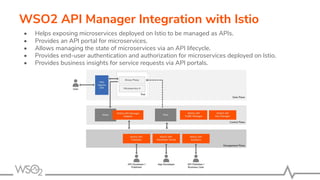
WSO2 API Manager Integration with Istio
• Helps exposing microservices deployed on Istio to be managed as APIs.
• Provides an API portal for microservices.
• Allows managing the state of microservices via an API lifecycle.
• Provides end-user authentication and authorization for microservices deployed on Istio.
• Provides business insights for service requests via API portals.
Development Workflow
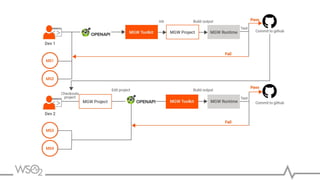
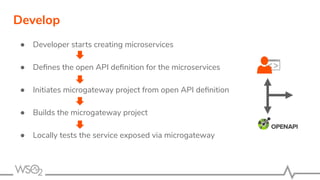
● Developer starts creating microservices
● Defines the open API definition for the microservices
● Initiates microgateway project from open API definition
● Builds the microgateway project
● Locally tests the service exposed via microgateway
Develop
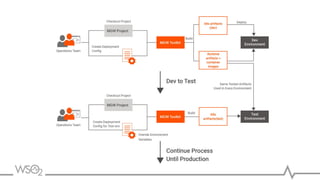
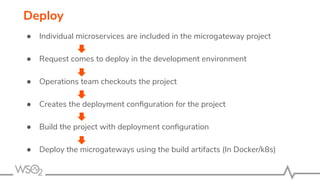
Operational Workflow
● Individual microservices are included in the microgateway project
● Request comes to deploy in the development environment
● Operations team checkouts the project
● Creates the deployment configuration for the project
● Build the project with deployment configuration
● Deploy the microgateways using the build artifacts (In Docker/k8s)
Deploy
Deployment Patterns
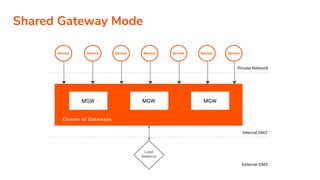
Shared Gateway Mode
MGW MGW MGW
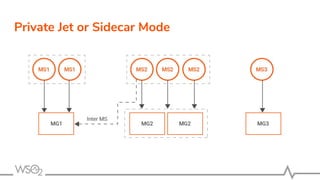
Private Jet or Sidecar Mode
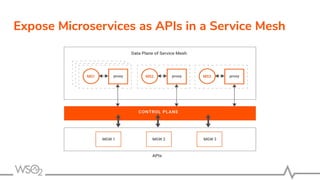
Expose Microservices as APIs in a Service Mesh
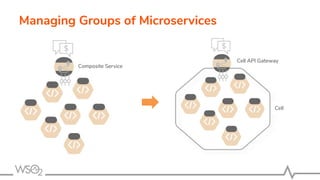
Composite Microservices
Composite Service
Cell API Gateway
Cell
Managing Groups of Microservices
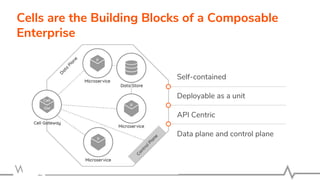
Self-contained
Deployable as a unit
API Centric
Data plane and control plane
Cells are the Building Blocks of a Composable
Enterprise
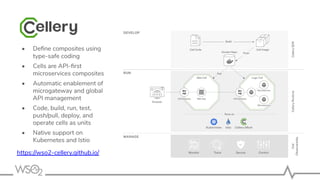
https://wso2-cellery.github.io/
• Define composites using
type-safe coding
• Cells are API-first
microservices composites
• Automatic enablement of
microgateway and global
API management
• Code, build, run, test,
push/pull, deploy, and
operate cells as units
• Native support on
Kubernetes and Istio
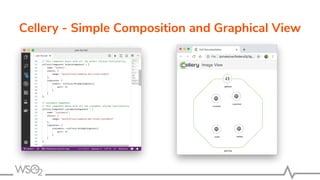
Cellery - Simple Composition and Graphical View
API Microgateway 3.0 is released -
https://wso2.com/blogs/thesource/2019/07/wso2-api-microgateway-3-0-is-released/
Cellery
https://wso2-cellery.github.io/
More Information
THANK YOU
wso2.com

[Workshop] API Management in Microservices Architecture

  • 1.
    API Management forMicroservices Architecture using WSO2 API Microgateway Vidura Gamini Abhaya Senior Director — Solutions Architecture WSO2
  • 2.
  • 3.
  • 4.
  • 5.
    ● Componentization ● Organizationaround business capability ● Single responsibility ● Smart endpoints and dumb pipes ● Mandatory CI/CD Characteristics of a Microservices Architecture
  • 6.
    ● Increased agilityin development ● Ability to scale easily and independently ● Replaceability ● Failure isolation and predictability ● Polyglot development ● Alignment with organisational structures Advantages of Microservices Architecture
  • 7.
    ● Inter-service communication ●Service governance ● Management complexity ● Heavily dependent on deployment methodology Liabilities of Microservices Architecture
  • 8.
    The Role ofAPI Management in Microservices Architecture
  • 9.
    APIs to SimplifyThings APIGATEWAY Products Inventory Orders Shipping Client Application
  • 10.
    • Uniformity inexposing heterogeneous services • Discovery of endpoints • Organizing security perimeters/boundaries • Policy definition and enforcement • Business value reporting API Management Brings Order to MS Chaos
  • 11.
    Load Balancing andDiscovery APIGATEWAY Products Client Application Products Service Directory
  • 12.
    Transitioning a Monolithinto Microservices APIGATEWAY Products Client Application Orders Inventory Shipping Microservice Legacy Application
  • 13.
  • 14.
  • 15.
  • 16.
    • Deploying APIgateways closer to the microservices Decentralizing API Gateways API Gateways Microservices Products Orders
  • 17.
    Optimizing per clienttype Optimization MobileWebPublic The same API (REST Interface) defined on the API Manager is exposed via three types of gateways, each optimized for the client type it serves. Products Orders
  • 18.
  • 19.
    ● Designed toscale ○ Self-validating tokens ○ Localized rate limiting ○ Offline analytics ○ Immutable ● Native support for Docker/K8S ● Private Jet Gateway for microservices ● First-class support for lifecycle management across environments Introducing WSO2 API Microgateway
  • 20.
  • 21.
    Cloud-native Capabilities ● Lowfootprint ○ 70 MB of distribution size. ○ < 100 MB of memory. ○ < 1 core CPU. ● Faster scaling ○ < 1s startup time (fixed) ○ Independent execution with no dependencies on other components. ● Portability ○ Works natively on Docker/Kubernetes. ○ Immutable gateway runtimes. ○ Fully automated CI/CD. ○ Regionally resilient. ○ Platform independent. ● Observable ○ Metrics available through Prometheus ○ Tracing available through Jaeger.
  • 22.
  • 23.
  • 24.
    ● Command lineinterface (CLI) to manage microgateway projects ● Initialize microgateway projects with open API definitions ● Builds the projects to create ○ Runtime artifacts (APIs packed in) for runtime containers and distributions ○ Immutable containers with APIs built in ○ Kubernetes artifacts used to deploy in k8s clusters ● Import APIs from WSO2 API Manager ● Download from : https://wso2.com/api-management/api-microgateway/ Toolkit
  • 25.
    ● Serves therequests applying ○ Security, Rate limiting, Transformations, Analytics, and more ● Available as archived distributions as well as docker images [1] ● Can be built by burning APIs into container images to spawn immutable containers ● Runs on top of artifacts generated by the toolkit [1]- https://hub.docker.com/r/wso2/wso2micro-gw Runtime
  • 26.
    Microgateway Security -Standard OAuth2.0 Microgateway Request Access Token (with scopes) Provide Opaque Token Client Application sends Token to Microgateway Validate Token 1 2 3 4
  • 27.
    Microgateway Security -Signed JWT Products Orders Client Application sends Signed JWT to Microgateways Microgateway Microgateway Request Access Token (with scopes) Provide Signed JWT 1 2 3 3 4 4
  • 28.
    Rate-limiting policies arebuilt into the microgateway runtime Microgateway - Localized Rate Limiting Microgateway OrdersProducts Apply 1000 req/min on Products microservice Apply 500 req/min on Orders microservice
  • 29.
    Microgateway - OfflineAnalytics Microgateway Microgateway Accumulate data in files and upload offline
  • 30.
  • 31.
    Compose Microservices intoAPIs Per resource endpoints ... Use Case ● Composing multiple microservices into a single API (e.g., an online store). ● Each microservice with different IPs. ● Defines a single open API definition for all microservices. ● Expose microservices as APIs via the API gateway. Implementation ● Extend the API definition with microgateway specific vendor extensions to add per resource endpoints. paths: "/products": get: summary: Get the list of products available x-wso2-production-endpoints: urls: - http://35.226.63.174:30941 post: summary: Add a new product x-wso2-production-endpoints: urls: - http://35.226.63.174:31891
  • 32.
    Service Discovery Use Case ●In a microservices architecture, services are dynamic. ● Services get dynamically assigned IP addresses each time they are redeployed. ● Central (key/value store) place maintains the dynamically assigned IPs for services. Implementation
  • 33.
    On-the-fly Transformations Request/response interceptors UseCase ● Services would require requests to be enriched with certain data, which are not accessible to clients. ● Server responses should be transformed in a way that all clients can understand them. ● This would require intercepting request and responses and performing modifications on them. Implementation ● Write reusable, pluggable Ballerina functions ● Refer functions in the open API definition paths: "/pet/findByStatus": get: summary: Finds Pets by status description: Multiple status values can be provided with comma separated strings operationId: findPetsByStatus x-wso2-request-interceptor: validateRequest x-wso2-response-interceptor: validateResponse
  • 34.
    API Gateway forEast-West and North-South Traffic Use Case • In a microservice architecture, service-to-service communication and client-facing services may require different security schemas • Microservices might enforce different security mechanisms to restrict access control Implementation ● Supports a variety range of security mechanisms ○ Self-contained jwt tokens ○ OAuth2 ○ Basic Authentication ○ Mutual SSL (introduced with v3.0)
  • 35.
    Rate Limiting forDistributed Gateway Clusters Use Case • Monetizing an API would require keeping a track of an API’s usage. • When an API is deployed on a cluster of gateways, we need a centralized counter to track its usage. Implementation • The microgateway submits local counters to the central Traffic Manager asynchronously. • The Traffic Manager accumulates the counters and notifies the gateways whenever traffic should be rate limited. Microgateway Microgateway Traffic Manager Microgateway
  • 36.
    WSO2 API ManagerIntegration with Istio • Helps exposing microservices deployed on Istio to be managed as APIs. • Provides an API portal for microservices. • Allows managing the state of microservices via an API lifecycle. • Provides end-user authentication and authorization for microservices deployed on Istio. • Provides business insights for service requests via API portals.
  • 37.
  • 39.
    ● Developer startscreating microservices ● Defines the open API definition for the microservices ● Initiates microgateway project from open API definition ● Builds the microgateway project ● Locally tests the service exposed via microgateway Develop
  • 40.
  • 42.
    ● Individual microservicesare included in the microgateway project ● Request comes to deploy in the development environment ● Operations team checkouts the project ● Creates the deployment configuration for the project ● Build the project with deployment configuration ● Deploy the microgateways using the build artifacts (In Docker/k8s) Deploy
  • 43.
  • 44.
  • 45.
    Private Jet orSidecar Mode
  • 46.
    Expose Microservices asAPIs in a Service Mesh
  • 47.
  • 48.
    Composite Service Cell APIGateway Cell Managing Groups of Microservices
  • 50.
    Self-contained Deployable as aunit API Centric Data plane and control plane Cells are the Building Blocks of a Composable Enterprise
  • 51.
    https://wso2-cellery.github.io/ • Define compositesusing type-safe coding • Cells are API-first microservices composites • Automatic enablement of microgateway and global API management • Code, build, run, test, push/pull, deploy, and operate cells as units • Native support on Kubernetes and Istio
  • 52.
    Cellery - SimpleComposition and Graphical View
  • 53.
    API Microgateway 3.0is released - https://wso2.com/blogs/thesource/2019/07/wso2-api-microgateway-3-0-is-released/ Cellery https://wso2-cellery.github.io/ More Information
  • 54.