Building local, thinking global
European Open Science Cloud
.
Sarah Jones
Digital Curation Centre
sarah.jones@glasgow.ac.uk
Twitter: @sjDCC
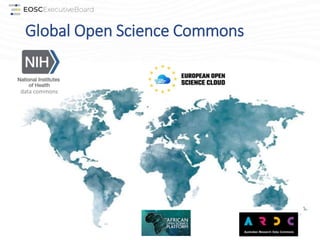
Global Open Science Commons
data commons
18/06/2019
Research Data Alliance BoFs
Several sessions run to coordinate work:
• Towards a Global Open Science Commons,
March 2018, Berlin
• Delivering a Global Open Science Commons,
November 2018, Gaborone
• Coordinating Global Open Science Commons
initiatives, March 2019, Philadelphia
18/06/2019 G7 Open Science Working Group, Paris, 19 June 2019 3
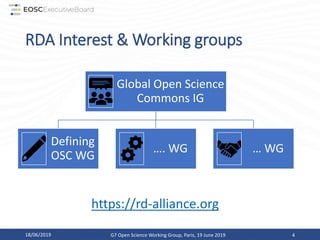
RDA Interest & Working groups
Global Open Science
Commons IG
Defining
OSC WG
…. WG … WG
18/06/2019 G7 Open Science Working Group, Paris, 19 June 2019 4
https://rd-alliance.org
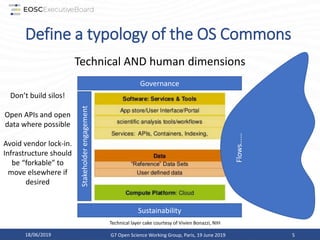
Define a typology of the OS Commons
18/06/2019 G7 Open Science Working Group, Paris, 19 June 2019 5
Technical AND human dimensions
Governance
Sustainability
Stakeholderengagement
Technical layer cake courtesy of Vivien Bonazzi, NIH
Flows…….
Don’t build silos!
Open APIs and open
data where possible
Avoid vendor lock-in.
Infrastructure should
be “forkable” to
move elsewhere if
desired
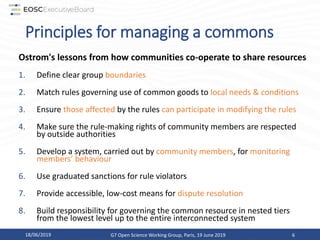
Principles for managing a commons
Ostrom's lessons from how communities co-operate to share resources
1. Define clear group boundaries
2. Match rules governing use of common goods to local needs & conditions
3. Ensure those affected by the rules can participate in modifying the rules
4. Make sure the rule-making rights of community members are respected
by outside authorities
5. Develop a system, carried out by community members, for monitoring
members’ behaviour
6. Use graduated sanctions for rule violators
7. Provide accessible, low-cost means for dispute resolution
8. Build responsibility for governing the common resource in nested tiers
from the lowest level up to the entire interconnected system
18/06/2019 G7 Open Science Working Group, Paris, 19 June 2019 6
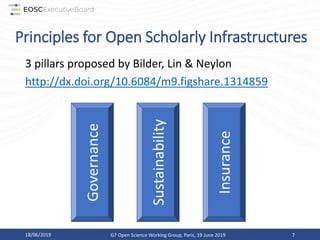
Principles for Open Scholarly Infrastructures
3 pillars proposed by Bilder, Lin & Neylon
http://dx.doi.org/10.6084/m9.figshare.1314859
18/06/2019 G7 Open Science Working Group, Paris, 19 June 2019 7
Governance
Sustainability
Insurance
Where EOSC is strong?
• Governance
• Community ownership?
• Stakeholder engagement?
18/06/2019 G7 Open Science Working Group, Paris, 19 June 2019 8
What is EOSC?
18/06/2019 G7 Open Science Working Group, Paris, 19 June 2019 9
An open festival for science
• Virtual space where science producers and science
consumers come together
• Inclusive to people of all backgrounds and cultures
• An open-ended range of content and services
• Quality mark « Data made in Europe »
18/06/2019 G7 Open Science Working Group, Paris, 19 June 2019 10
A platform for European research
Grow in stages…
• Underlying infrastructure needs to be developed,
owned and operated publicly
• Extend to engage with private initiatives
• All must adhere to Rules and uphold common values
• Be a living, breathing system that adapts to changes
18/06/2019 G7 Open Science Working Group, Paris, 19 June 2019 11
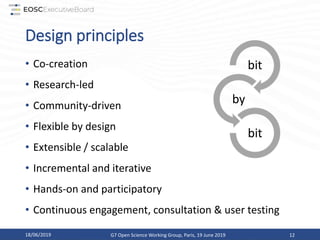
Design principles
• Co-creation
• Research-led
• Community-driven
• Flexible by design
• Extensible / scalable
• Incremental and iterative
• Hands-on and participatory
• Continuous engagement, consultation & user testing
18/06/2019 G7 Open Science Working Group, Paris, 19 June 2019 12
bit
by
bit
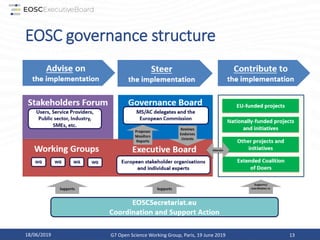
EOSC Governance 2019-2020
EOSC governance structure
18/06/2019 G7 Open Science Working Group, Paris, 19 June 2019 13
Governance Board
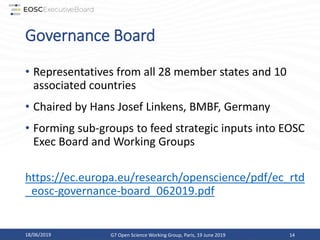
• Representatives from all 28 member states and 10
associated countries
• Chaired by Hans Josef Linkens, BMBF, Germany
• Forming sub-groups to feed strategic inputs into EOSC
Exec Board and Working Groups
https://ec.europa.eu/research/openscience/pdf/ec_rtd
_eosc-governance-board_062019.pdf
18/06/2019 G7 Open Science Working Group, Paris, 19 June 2019 14
Executive Board
18/06/2019 G7 Open Science Working Group, Paris, 19 June 2019 15
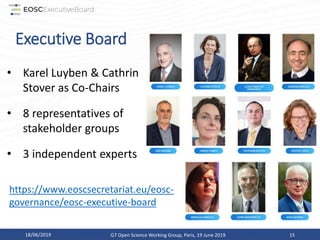
• Karel Luyben & Cathrin
Stover as Co-Chairs
• 8 representatives of
stakeholder groups
• 3 independent experts
https://www.eoscsecretariat.eu/eosc-
governance/eosc-executive-board
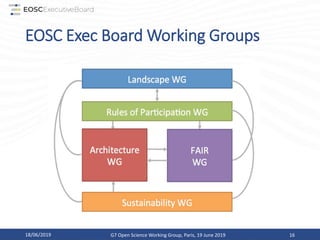
EOSC Exec Board Working Groups
18/06/2019 G7 Open Science Working Group, Paris, 19 June 2019 16
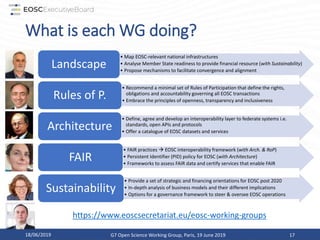
What is each WG doing?
• Map EOSC-relevant national infrastructures
• Analyse Member State readiness to provide financial resource (with Sustainability)
• Propose mechanisms to facilitate convergence and alignment
Landscape
• Recommend a minimal set of Rules of Participation that define the rights,
obligations and accountability governing all EOSC transactions
• Embrace the principles of openness, transparency and inclusiveness
Rules of P.
• Define, agree and develop an interoperability layer to federate systems i.e.
standards, open APIs and protocols
• Offer a catalogue of EOSC datasets and services
Architecture
• FAIR practices  EOSC interoperability framework (with Arch. & RoP)
• Persistent Identifier (PID) policy for EOSC (with Architecture)
• Frameworks to assess FAIR data and certify services that enable FAIR
FAIR
• Provide a set of strategic and financing orientations for EOSC post 2020
• In-depth analysis of business models and their different implications
• Options for a governance framework to steer & oversee EOSC operations
Sustainability
18/06/2019 G7 Open Science Working Group, Paris, 19 June 2019 17
https://www.eoscsecretariat.eu/eosc-working-groups
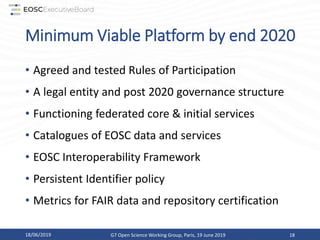
Minimum Viable Platform by end 2020
• Agreed and tested Rules of Participation
• A legal entity and post 2020 governance structure
• Functioning federated core & initial services
• Catalogues of EOSC data and services
• EOSC Interoperability Framework
• Persistent Identifier policy
• Metrics for FAIR data and repository certification
18/06/2019 G7 Open Science Working Group, Paris, 19 June 2019 18
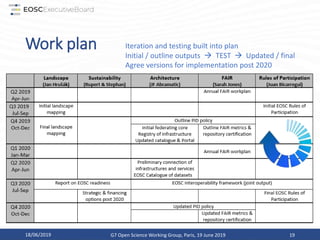
Work plan
18/06/2019 G7 Open Science Working Group, Paris, 19 June 2019 19
Iteration and testing built into plan
Initial / outline outputs  TEST  Updated / final
Agree versions for implementation post 2020
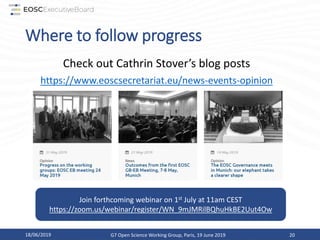
Where to follow progress
Check out Cathrin Stover’s blog posts
https://www.eoscsecretariat.eu/news-events-opinion
18/06/2019 G7 Open Science Working Group, Paris, 19 June 2019 20
Join forthcoming webinar on 1st July at 11am CEST
https://zoom.us/webinar/register/WN_9mJMRilBQhuHkBE2Uut4Ow
Thanks for listening!
Questions?
sarah.jones@glasgow.ac.uk
Twitter: @sjDCC

Building local, thinking global - EOSC

  • 1.
    Building local, thinkingglobal European Open Science Cloud . Sarah Jones Digital Curation Centre sarah.jones@glasgow.ac.uk Twitter: @sjDCC
  • 2.
    Global Open ScienceCommons data commons 18/06/2019
  • 3.
    Research Data AllianceBoFs Several sessions run to coordinate work: • Towards a Global Open Science Commons, March 2018, Berlin • Delivering a Global Open Science Commons, November 2018, Gaborone • Coordinating Global Open Science Commons initiatives, March 2019, Philadelphia 18/06/2019 G7 Open Science Working Group, Paris, 19 June 2019 3
  • 4.
    RDA Interest &Working groups Global Open Science Commons IG Defining OSC WG …. WG … WG 18/06/2019 G7 Open Science Working Group, Paris, 19 June 2019 4 https://rd-alliance.org
  • 5.
    Define a typologyof the OS Commons 18/06/2019 G7 Open Science Working Group, Paris, 19 June 2019 5 Technical AND human dimensions Governance Sustainability Stakeholderengagement Technical layer cake courtesy of Vivien Bonazzi, NIH Flows……. Don’t build silos! Open APIs and open data where possible Avoid vendor lock-in. Infrastructure should be “forkable” to move elsewhere if desired
  • 6.
    Principles for managinga commons Ostrom's lessons from how communities co-operate to share resources 1. Define clear group boundaries 2. Match rules governing use of common goods to local needs & conditions 3. Ensure those affected by the rules can participate in modifying the rules 4. Make sure the rule-making rights of community members are respected by outside authorities 5. Develop a system, carried out by community members, for monitoring members’ behaviour 6. Use graduated sanctions for rule violators 7. Provide accessible, low-cost means for dispute resolution 8. Build responsibility for governing the common resource in nested tiers from the lowest level up to the entire interconnected system 18/06/2019 G7 Open Science Working Group, Paris, 19 June 2019 6
  • 7.
    Principles for OpenScholarly Infrastructures 3 pillars proposed by Bilder, Lin & Neylon http://dx.doi.org/10.6084/m9.figshare.1314859 18/06/2019 G7 Open Science Working Group, Paris, 19 June 2019 7 Governance Sustainability Insurance
  • 8.
    Where EOSC isstrong? • Governance • Community ownership? • Stakeholder engagement? 18/06/2019 G7 Open Science Working Group, Paris, 19 June 2019 8
  • 9.
    What is EOSC? 18/06/2019G7 Open Science Working Group, Paris, 19 June 2019 9
  • 10.
    An open festivalfor science • Virtual space where science producers and science consumers come together • Inclusive to people of all backgrounds and cultures • An open-ended range of content and services • Quality mark « Data made in Europe » 18/06/2019 G7 Open Science Working Group, Paris, 19 June 2019 10 A platform for European research
  • 11.
    Grow in stages… •Underlying infrastructure needs to be developed, owned and operated publicly • Extend to engage with private initiatives • All must adhere to Rules and uphold common values • Be a living, breathing system that adapts to changes 18/06/2019 G7 Open Science Working Group, Paris, 19 June 2019 11
  • 12.
    Design principles • Co-creation •Research-led • Community-driven • Flexible by design • Extensible / scalable • Incremental and iterative • Hands-on and participatory • Continuous engagement, consultation & user testing 18/06/2019 G7 Open Science Working Group, Paris, 19 June 2019 12 bit by bit
  • 13.
    EOSC Governance 2019-2020 EOSCgovernance structure 18/06/2019 G7 Open Science Working Group, Paris, 19 June 2019 13
  • 14.
    Governance Board • Representativesfrom all 28 member states and 10 associated countries • Chaired by Hans Josef Linkens, BMBF, Germany • Forming sub-groups to feed strategic inputs into EOSC Exec Board and Working Groups https://ec.europa.eu/research/openscience/pdf/ec_rtd _eosc-governance-board_062019.pdf 18/06/2019 G7 Open Science Working Group, Paris, 19 June 2019 14
  • 15.
    Executive Board 18/06/2019 G7Open Science Working Group, Paris, 19 June 2019 15 • Karel Luyben & Cathrin Stover as Co-Chairs • 8 representatives of stakeholder groups • 3 independent experts https://www.eoscsecretariat.eu/eosc- governance/eosc-executive-board
  • 16.
    EOSC Exec BoardWorking Groups 18/06/2019 G7 Open Science Working Group, Paris, 19 June 2019 16
  • 17.
    What is eachWG doing? • Map EOSC-relevant national infrastructures • Analyse Member State readiness to provide financial resource (with Sustainability) • Propose mechanisms to facilitate convergence and alignment Landscape • Recommend a minimal set of Rules of Participation that define the rights, obligations and accountability governing all EOSC transactions • Embrace the principles of openness, transparency and inclusiveness Rules of P. • Define, agree and develop an interoperability layer to federate systems i.e. standards, open APIs and protocols • Offer a catalogue of EOSC datasets and services Architecture • FAIR practices  EOSC interoperability framework (with Arch. & RoP) • Persistent Identifier (PID) policy for EOSC (with Architecture) • Frameworks to assess FAIR data and certify services that enable FAIR FAIR • Provide a set of strategic and financing orientations for EOSC post 2020 • In-depth analysis of business models and their different implications • Options for a governance framework to steer & oversee EOSC operations Sustainability 18/06/2019 G7 Open Science Working Group, Paris, 19 June 2019 17 https://www.eoscsecretariat.eu/eosc-working-groups
  • 18.
    Minimum Viable Platformby end 2020 • Agreed and tested Rules of Participation • A legal entity and post 2020 governance structure • Functioning federated core & initial services • Catalogues of EOSC data and services • EOSC Interoperability Framework • Persistent Identifier policy • Metrics for FAIR data and repository certification 18/06/2019 G7 Open Science Working Group, Paris, 19 June 2019 18
  • 19.
    Work plan 18/06/2019 G7Open Science Working Group, Paris, 19 June 2019 19 Iteration and testing built into plan Initial / outline outputs  TEST  Updated / final Agree versions for implementation post 2020
  • 20.
    Where to followprogress Check out Cathrin Stover’s blog posts https://www.eoscsecretariat.eu/news-events-opinion 18/06/2019 G7 Open Science Working Group, Paris, 19 June 2019 20 Join forthcoming webinar on 1st July at 11am CEST https://zoom.us/webinar/register/WN_9mJMRilBQhuHkBE2Uut4Ow
  • 21.

Editor's Notes

  • #10 The parable of the Elephant
  • #11 When asked what kind of party the EOSC would be, one group suggested an open festival as EOSC is a …
  • #13 How do we build the EOSC? We tried to encapsulate some of the ethos we all spoke about at the teambuilding in Munich
  • #15 Federal Ministry of Education and Research (BMBF)