ARTS ADVOCACY
TRAINING: BUILDING
FROM WITHIN
John R. Corlett,
Vice President,
Government Relations
and Community
Affairs
The MetroHealth
System
ARTS ADVOCACY:
BUILDING FROM WITHIN
1. Setting Advocacy Goals and
Priorities
2. Building Internal Advocacy
Structures
3. Developing Strategies/Tactics
4. Evaluating Progress
5. Rules for 501(c)(3) Organizations
WHY BE INVOLVED IN
ADVOCACY
Achieving large-scale and lasting results
for individuals or communities –
typically cannot be accomplished with
private resources alone. Often, it
requires public investments and
government directives. While an
organization might identify and
implement effective interventions, larger
and more sustainable funding sources
are needed to scale up those
interventions and broaden their impacts.
Securing such commitments requires
SETTING ADVOCACY GOALS
AND PRIORITIES
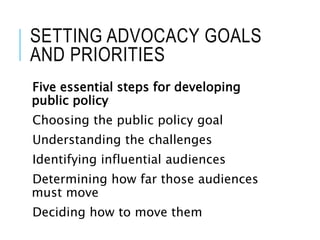
Five essential steps for developing
public policy
Choosing the public policy goal
Understanding the challenges
Identifying influential audiences
Determining how far those audiences
must move
Deciding how to move them
SETTING ADVOCACY GOALS
AND PRIORITES
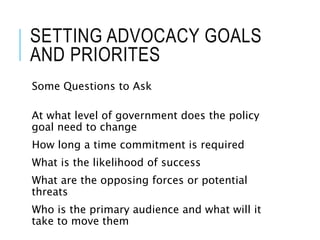
Some Questions to Ask
At what level of government does the policy
goal need to change
How long a time commitment is required
What is the likelihood of success
What are the opposing forces or potential
threats
Who is the primary audience and what will it
take to move them
BUILDING INTERNAL
ADVOCACY STRUCTURES
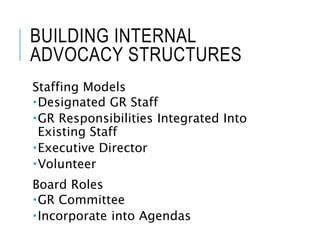
Staffing Models
Designated GR Staff
GR Responsibilities Integrated Into
Existing Staff
Executive Director
Volunteer
Board Roles
GR Committee
Incorporate into Agendas
DEVELOPING
STRATEGIES/TACTICS
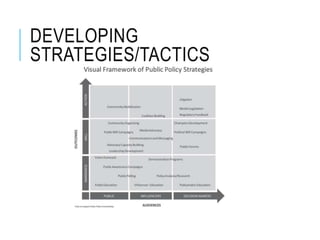
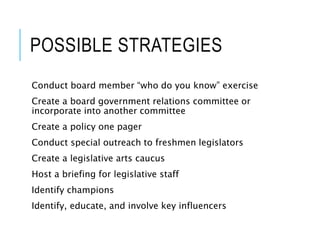
POSSIBLE STRATEGIES
Conduct board member “who do you know” exercise
Create a board government relations committee or
incorporate into another committee
Create a policy one pager
Conduct special outreach to freshmen legislators
Create a legislative arts caucus
Host a briefing for legislative staff
Identify champions
Identify, educate, and involve key influencers
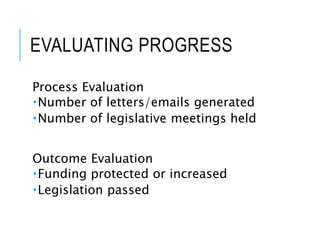
EVALUATING PROGRESS
Process Evaluation
Number of letters/emails generated
Number of legislative meetings held
Outcome Evaluation
Funding protected or increased
Legislation passed
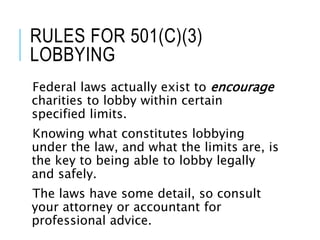
RULES FOR 501(C)(3)
LOBBYING
Federal laws actually exist to encourage
charities to lobby within certain
specified limits.
Knowing what constitutes lobbying
under the law, and what the limits are, is
the key to being able to lobby legally
and safely.
The laws have some detail, so consult
your attorney or accountant for
professional advice.
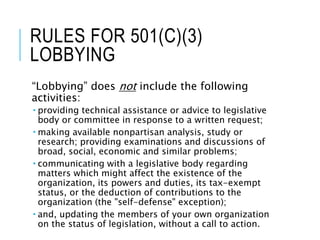
RULES FOR 501(C)(3)
LOBBYING
“Lobbying” does not include the following
activities:
 providing technical assistance or advice to legislative
body or committee in response to a written request;
 making available nonpartisan analysis, study or
research; providing examinations and discussions of
broad, social, economic and similar problems;
 communicating with a legislative body regarding
matters which might affect the existence of the
organization, its powers and duties, its tax-exempt
status, or the deduction of contributions to the
organization (the "self-defense" exception);
 and, updating the members of your own organization
on the status of legislation, without a call to action.
PROHIBITED ACTIVITIES
Charities are expressly prohibited from
intervening in a political campaign of any
candidate for public office, and from
engaging in partisan activity of any kind.
Charities may not use government
funds, such as government grants or
contracts, to lobby, including the use of
federal funds to lobby for federal grants
or contracts.
QUESTIONS?

Building From Within

  • 1.
    ARTS ADVOCACY TRAINING: BUILDING FROMWITHIN John R. Corlett, Vice President, Government Relations and Community Affairs The MetroHealth System
  • 2.
    ARTS ADVOCACY: BUILDING FROMWITHIN 1. Setting Advocacy Goals and Priorities 2. Building Internal Advocacy Structures 3. Developing Strategies/Tactics 4. Evaluating Progress 5. Rules for 501(c)(3) Organizations
  • 3.
    WHY BE INVOLVEDIN ADVOCACY Achieving large-scale and lasting results for individuals or communities – typically cannot be accomplished with private resources alone. Often, it requires public investments and government directives. While an organization might identify and implement effective interventions, larger and more sustainable funding sources are needed to scale up those interventions and broaden their impacts. Securing such commitments requires
  • 4.
    SETTING ADVOCACY GOALS ANDPRIORITIES Five essential steps for developing public policy Choosing the public policy goal Understanding the challenges Identifying influential audiences Determining how far those audiences must move Deciding how to move them
  • 5.
    SETTING ADVOCACY GOALS ANDPRIORITES Some Questions to Ask At what level of government does the policy goal need to change How long a time commitment is required What is the likelihood of success What are the opposing forces or potential threats Who is the primary audience and what will it take to move them
  • 6.
    BUILDING INTERNAL ADVOCACY STRUCTURES StaffingModels Designated GR Staff GR Responsibilities Integrated Into Existing Staff Executive Director Volunteer Board Roles GR Committee Incorporate into Agendas
  • 7.
  • 8.
    POSSIBLE STRATEGIES Conduct boardmember “who do you know” exercise Create a board government relations committee or incorporate into another committee Create a policy one pager Conduct special outreach to freshmen legislators Create a legislative arts caucus Host a briefing for legislative staff Identify champions Identify, educate, and involve key influencers
  • 9.
    EVALUATING PROGRESS Process Evaluation Numberof letters/emails generated Number of legislative meetings held Outcome Evaluation Funding protected or increased Legislation passed
  • 10.
    RULES FOR 501(C)(3) LOBBYING Federallaws actually exist to encourage charities to lobby within certain specified limits. Knowing what constitutes lobbying under the law, and what the limits are, is the key to being able to lobby legally and safely. The laws have some detail, so consult your attorney or accountant for professional advice.
  • 11.
    RULES FOR 501(C)(3) LOBBYING “Lobbying”does not include the following activities:  providing technical assistance or advice to legislative body or committee in response to a written request;  making available nonpartisan analysis, study or research; providing examinations and discussions of broad, social, economic and similar problems;  communicating with a legislative body regarding matters which might affect the existence of the organization, its powers and duties, its tax-exempt status, or the deduction of contributions to the organization (the "self-defense" exception);  and, updating the members of your own organization on the status of legislation, without a call to action.
  • 12.
    PROHIBITED ACTIVITIES Charities areexpressly prohibited from intervening in a political campaign of any candidate for public office, and from engaging in partisan activity of any kind. Charities may not use government funds, such as government grants or contracts, to lobby, including the use of federal funds to lobby for federal grants or contracts.
  • 13.