Laura Van Doore

@lauravandoore

Building compelling
business cases for 

Design Systems
Design Systems 

are here to stay
@lauravandoore
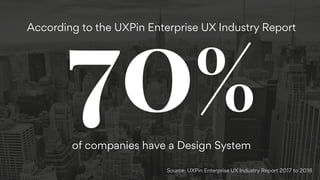
70%
According to the UXPin Enterprise UX Industry Report
of companies have a Design System
Source: UXPin Enterprise UX Industry Report 2017 to 2018
How accurate is this for the
audience here today?
We’re convinced
@lauravandoore
But this guy isn’t
@lauravandoore
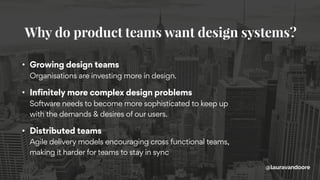
• Growing design teams

Organisations are investing more in design.
• Infinitely more complex design problems

Software needs to become more sophisticated to keep up
with the demands & desires of our users.
• Distributed teams

Agile delivery models encouraging cross functional teams,
making it harder for teams to stay in sync
Why do product teams want design systems?
@lauravandoore
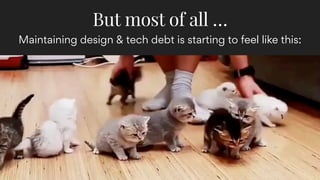
Maintaining design & tech debt is starting to feel like this:
But most of all …
This all makes perfect sense, the
benefits speak for themselves. 
This is a no-brainer.
— ME, 4 YEARS AGO
“
This was going to be me:
EXPECTATION
REALITY
vs
So how can we design our business case to
best communicate the clear and tangible
benefits of having a design system?
UXing your business case
@lauravandoore
THE IMPORTANCE OF
@lauravandoore
Know your enemy
Audience
Know your audience
@lauravandoore
• Emphasise benefits that appeal to your audience, not to you

Resist the urge to only focus on the team benefits, and focus on measurable
business benefits instead.
• Write in the parlance of your audience

Avoid jargon and use the language of business to craft your business case.
Don’t go to war alone
@lauravandoore
Don’t go to war alone
@lauravandoore
• Get internal buy-in before external

There’s no point in trying to convince upper management that you need a
design system if you haven’t successfully convinced your team yet.
• Form a united, cogent case together

Get designers, developers, BAs, product managers together and get every
teams perspective. You’ll find more and more benefits this way.
@lauravandoore
Timing is everything
@lauravandoore
• Recognise your position in the funding cycle

Is the business investing to scale up? Or is upper management doubling
down on cost reductions? Try to avoid asking for a large investment when
the business is scaling down.
• Present the cure when the pain hurts the worst

If a design system has been a hard sell, focus on waiting for an opportunity
where the benefits can really shine.
Getting the timing wrong can make
the rest of your case fall over
@lauravandoore
@lauravandoore
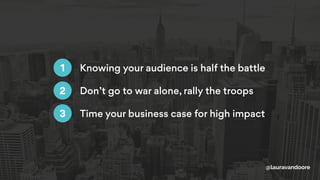
Knowing your audience is half the battle1
Don’t go to war alone, rally the troops
Time your business case for high impact
2
3
Translating team benefits to
tangible business outcomes.
@lauravandoore
THE CHALLENGE
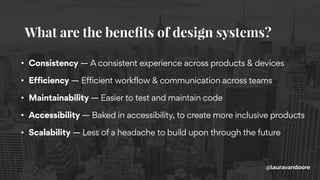
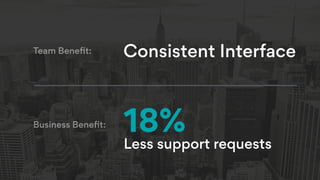
• Consistency — A consistent experience across products & devices
• Efficiency — Efficient workflow & communication across teams
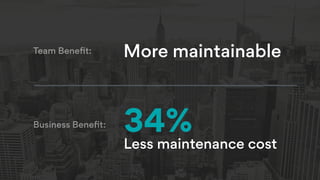
• Maintainability — Easier to test and maintain code
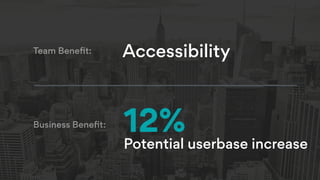
• Accessibility — Baked in accessibility, to create more inclusive products
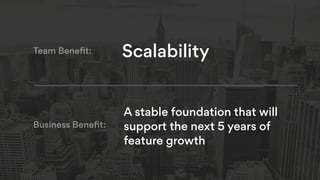
• Scalability — Less of a headache to build upon through the future
What are the benefits of design systems?
@lauravandoore
What does it look like if we re-interpret or
translate these benefits into a format
that provide business outcomes?
Efficient workflowTeam Benefit:
Business Benefit: 28%
Faster to market
34%
Less maintenance cost
More maintainableTeam Benefit:
Business Benefit:
18%
Less support requests
Consistent InterfaceTeam Benefit:
Business Benefit:
12%
Potential userbase increase
AccessibilityTeam Benefit:
Business Benefit:
A stable foundation that will
support the next 5 years of
feature growth
ScalabilityTeam Benefit:
Business Benefit:
A great business case
@lauravandoore
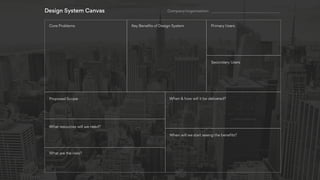
THEANATOMYOF
@lauravandoore
Buckle up
What are we solving?
Problem Statement
1
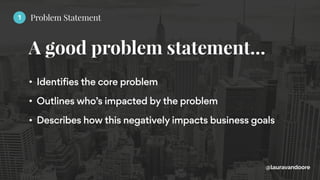
A good problem statement…
@lauravandoore
• Identifies the core problem
• Outlines who’s impacted by the problem
• Describes how this negatively impacts business goals
1 Problem Statement
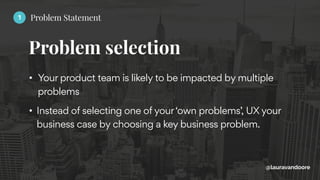
Problem selection
@lauravandoore
• Your product team is likely to be impacted by multiple
problems
• Instead of selecting one of your‘own problems’, UX your
business case by choosing a key business problem.
1 Problem Statement
What are we gaining from the proposed initiative?
Benefits & ROI
2
A design system increases ROI largely
because it reduces cost rather than
directly increasing revenue
— BRAD FROST
“
2 Benefits & ROI
Benefits & ROI
@lauravandoore
• Financials come first

Upper management will usually look for financial benefits first, and then
focus on peripheral benefits, like employee satisfaction.
• Emphasise business outcomes, over team benefits

Remember to frame your business case around tangible business
outcomes, rather than ambiguous benefits.
2 Benefits & ROI
Cost & Resources
3
Presenting Cost
@lauravandoore
• Demonstrate that you clearly understand the cost

It’s much easier to persuade the naysayers if you can calculate & clearly
articulate the project costs.
• Present multiple cost scenarios

Give your case a better chance by presenting different cost/resourcing
options to balance the project funding & risk.
3 Costs & Resources
Risks
4
Risks of going ahead
@lauravandoore
• Be realistic, rather than utopian

Try to be open and honest about the potential risks. Otherwise your business
case will seem too biased and lose credibility.
• Outline the risks of failure

What’s the worst case scenario?
4 Risks
Risks of falling behind
@lauravandoore
• There is risk in doing nothing
• Bigger product team = Increased need for design system

As a product team grows larger, there’s more need for standardised ways of
working. The more people you have, the less efficient workflows will be.
4 Risks
Make sure the reward
outweighs the risk.
@lauravandoore
4 Risks
Implementation Plan
5
Delivery
@lauravandoore
• Present a solid roadmap

Show a clear, deliverable scope, as well as your plans to grow & extend the
design system over time.
• Pinpoint where you’ll see a return

Clearly indicate in your delivery plan when and how you’ll start to reap the
benefits of the design system (hint: the sooner the better)
5 Implementation Plan
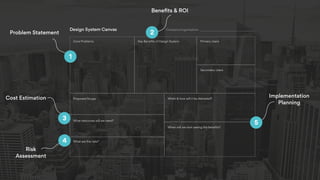
@lauravandoore
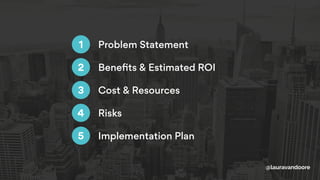
Problem Statement1
Benefits & Estimated ROI
Cost & Resources
Risks
2
3
4
Implementation Plan5
3 ROLLOUTSTRATEGIES
To manage cost & risk
@lauravandoore
Chip Away
#1
@lauravandoore
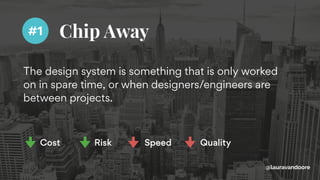
Chip Away
The design system is something that is only worked
on in spare time, or when designers/engineers are
between projects.
@lauravandoore
#1
Cost Risk Speed Quality
Hibernation
#2
@lauravandoore
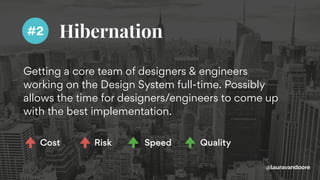
Hibernation
Getting a core team of designers & engineers
working on the Design System full-time. Possibly
allows the time for designers/engineers to come up
with the best implementation.
@lauravandoore
#2
Cost Risk Speed Quality
Piggyback
#3
@lauravandoore
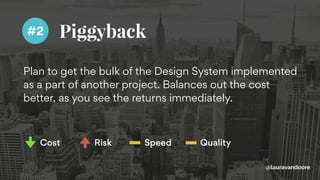
Piggyback
Plan to get the bulk of the Design System implemented
as a part of another project. Balances out the cost
better, as you see the returns immediately.
@lauravandoore
#2
Cost Risk Speed Quality
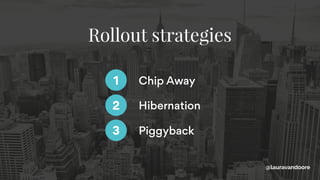
Chip Away1
Hibernation
Piggyback
2
3
@lauravandoore
Rollout strategies
Problem Statement
Cost Estimation
Benefits & ROI
Implementation
Planning
Risk 

Assessment
5
4
3
1
2
Thanks
Laura Van Doore
@lauravandoore

Building compelling business cases for Design Systems

  • 1.
    Laura Van Doore
 @lauravandoore
 Buildingcompelling business cases for 
 Design Systems
  • 2.
    Design Systems 
 arehere to stay @lauravandoore
  • 3.
    70% According to theUXPin Enterprise UX Industry Report of companies have a Design System Source: UXPin Enterprise UX Industry Report 2017 to 2018
  • 4.
    How accurate isthis for the audience here today?
  • 5.
  • 6.
    But this guyisn’t @lauravandoore
  • 7.
    • Growing designteams
 Organisations are investing more in design. • Infinitely more complex design problems
 Software needs to become more sophisticated to keep up with the demands & desires of our users. • Distributed teams
 Agile delivery models encouraging cross functional teams, making it harder for teams to stay in sync Why do product teams want design systems? @lauravandoore
  • 8.
    Maintaining design &tech debt is starting to feel like this: But most of all …
  • 9.
    This all makesperfect sense, the benefits speak for themselves. 
 This is a no-brainer. — ME, 4 YEARS AGO “
  • 10.
    This was goingto be me:
  • 11.
  • 12.
    So how canwe design our business case to best communicate the clear and tangible benefits of having a design system?
  • 13.
    UXing your businesscase @lauravandoore THE IMPORTANCE OF
  • 14.
  • 15.
    Know your audience @lauravandoore •Emphasise benefits that appeal to your audience, not to you
 Resist the urge to only focus on the team benefits, and focus on measurable business benefits instead. • Write in the parlance of your audience
 Avoid jargon and use the language of business to craft your business case.
  • 16.
    Don’t go towar alone @lauravandoore
  • 17.
    Don’t go towar alone @lauravandoore • Get internal buy-in before external
 There’s no point in trying to convince upper management that you need a design system if you haven’t successfully convinced your team yet. • Form a united, cogent case together
 Get designers, developers, BAs, product managers together and get every teams perspective. You’ll find more and more benefits this way.
  • 18.
  • 19.
    Timing is everything @lauravandoore •Recognise your position in the funding cycle
 Is the business investing to scale up? Or is upper management doubling down on cost reductions? Try to avoid asking for a large investment when the business is scaling down. • Present the cure when the pain hurts the worst
 If a design system has been a hard sell, focus on waiting for an opportunity where the benefits can really shine.
  • 20.
    Getting the timingwrong can make the rest of your case fall over @lauravandoore
  • 21.
    @lauravandoore Knowing your audienceis half the battle1 Don’t go to war alone, rally the troops Time your business case for high impact 2 3
  • 22.
    Translating team benefitsto tangible business outcomes. @lauravandoore THE CHALLENGE
  • 23.
    • Consistency —A consistent experience across products & devices • Efficiency — Efficient workflow & communication across teams • Maintainability — Easier to test and maintain code • Accessibility — Baked in accessibility, to create more inclusive products • Scalability — Less of a headache to build upon through the future What are the benefits of design systems? @lauravandoore
  • 24.
    What does itlook like if we re-interpret or translate these benefits into a format that provide business outcomes?
  • 25.
  • 26.
  • 27.
    34% Less maintenance cost MoremaintainableTeam Benefit: Business Benefit:
  • 28.
    18% Less support requests ConsistentInterfaceTeam Benefit: Business Benefit:
  • 29.
  • 30.
    A stable foundationthat will support the next 5 years of feature growth ScalabilityTeam Benefit: Business Benefit:
  • 31.
    A great businesscase @lauravandoore THEANATOMYOF
  • 32.
  • 33.
    What are wesolving? Problem Statement 1
  • 34.
    A good problemstatement… @lauravandoore • Identifies the core problem • Outlines who’s impacted by the problem • Describes how this negatively impacts business goals 1 Problem Statement
  • 35.
    Problem selection @lauravandoore • Yourproduct team is likely to be impacted by multiple problems • Instead of selecting one of your‘own problems’, UX your business case by choosing a key business problem. 1 Problem Statement
  • 36.
    What are wegaining from the proposed initiative? Benefits & ROI 2
  • 37.
    A design systemincreases ROI largely because it reduces cost rather than directly increasing revenue — BRAD FROST “ 2 Benefits & ROI
  • 38.
    Benefits & ROI @lauravandoore •Financials come first
 Upper management will usually look for financial benefits first, and then focus on peripheral benefits, like employee satisfaction. • Emphasise business outcomes, over team benefits
 Remember to frame your business case around tangible business outcomes, rather than ambiguous benefits. 2 Benefits & ROI
  • 39.
  • 40.
    Presenting Cost @lauravandoore • Demonstratethat you clearly understand the cost
 It’s much easier to persuade the naysayers if you can calculate & clearly articulate the project costs. • Present multiple cost scenarios
 Give your case a better chance by presenting different cost/resourcing options to balance the project funding & risk. 3 Costs & Resources
  • 41.
  • 42.
    Risks of goingahead @lauravandoore • Be realistic, rather than utopian
 Try to be open and honest about the potential risks. Otherwise your business case will seem too biased and lose credibility. • Outline the risks of failure
 What’s the worst case scenario? 4 Risks
  • 43.
    Risks of fallingbehind @lauravandoore • There is risk in doing nothing • Bigger product team = Increased need for design system
 As a product team grows larger, there’s more need for standardised ways of working. The more people you have, the less efficient workflows will be. 4 Risks
  • 44.
    Make sure thereward outweighs the risk. @lauravandoore 4 Risks
  • 45.
  • 46.
    Delivery @lauravandoore • Present asolid roadmap
 Show a clear, deliverable scope, as well as your plans to grow & extend the design system over time. • Pinpoint where you’ll see a return
 Clearly indicate in your delivery plan when and how you’ll start to reap the benefits of the design system (hint: the sooner the better) 5 Implementation Plan
  • 47.
    @lauravandoore Problem Statement1 Benefits &Estimated ROI Cost & Resources Risks 2 3 4 Implementation Plan5
  • 48.
    3 ROLLOUTSTRATEGIES To managecost & risk @lauravandoore
  • 49.
  • 50.
    Chip Away The designsystem is something that is only worked on in spare time, or when designers/engineers are between projects. @lauravandoore #1 Cost Risk Speed Quality
  • 51.
  • 52.
    Hibernation Getting a coreteam of designers & engineers working on the Design System full-time. Possibly allows the time for designers/engineers to come up with the best implementation. @lauravandoore #2 Cost Risk Speed Quality
  • 53.
  • 54.
    Piggyback Plan to getthe bulk of the Design System implemented as a part of another project. Balances out the cost better, as you see the returns immediately. @lauravandoore #2 Cost Risk Speed Quality
  • 55.
  • 57.
    Problem Statement Cost Estimation Benefits& ROI Implementation Planning Risk 
 Assessment 5 4 3 1 2
  • 58.